

The advice most finance leads still hear is to pick the payroll vendor with the lowest monthly price. That advice fails a medical practice that pays remote staff, because the advertised base almost never equals the bill.
Payroll service fees are usually a mix of a fixed charge and a per-employee or per-run charge, plus extras that appear when you pay a bonus, file in a second state, or fix a deposit. A plan that looks cheap on the proposal can cost more across a year than a higher fixed fee that already includes tax filing, year-end forms, and off-cycle runs.
If you're comparing a virtual medical receptionist, a patient coordinator, or medical billing support in another country, the number that matters is the annual all-in cost for the same headcount, pay frequency, and jurisdictions. I would not sign on the base line. Put at least two quotes into one scenario, then test whether the higher-fee plan is cheaper once staff time and penalty exposure sit on the same page.
Payroll service fees rarely arrive as one number, and they are almost never a percentage of wages. Most providers combine a fixed monthly charge with a per-employee or per-payroll-run fee. That mix, not the headline, decides which plan is cheaper at your headcount.
A 2026 pricing comparison reported typical basic payroll outsourcing at about $150 to $200 per employee per year, or roughly $2 to $15 per paycheck, depending on frequency and scope. The same comparison put small-business full-service plans, including tax filing and compliance support, at $20 to more than $100 per month. Setup commonly ran $50 to $1,000, year-end wage statements $5 to $15 per form, off-cycle runs $25 to $50 each, and multistate filings $10 to $50 per state per month. These are reported ranges, not promises, and they move with provider, pay frequency, and what the contract includes.
| Fee model | How it is billed | Reported range | Best fit |
|---|---|---|---|
| Small-business full-service plan | Monthly | $20 to more than $100 per month | Small teams that want tax filing included |
| Per-employee fee | Per worker per year | $150 to $200 per employee per year (basic outsourcing) | Stable headcount |
| Per-paycheck equivalent | Per pay run | About $2 to $15 per paycheck | Comparing pay frequencies |
| Self-service with per-employee fee | Monthly plus per employee | $40 to $80 per month plus $4 to $12 per employee | Teams with in-house HR and finance capacity |
| Full-service outsourcing | Monthly plus per employee | $80 to $150 per month plus $8 to $25 per employee | Teams without spare administrative staff |
A flat monthly plan suits a small practice with simple pay and few jurisdictions. A per-employee fee stays predictable when headcount barely moves, and it gets expensive when you hire in a burst. The per-paycheck row is the translator: biweekly pay creates about twice as many runs as monthly pay, so the same per-check price doubles the processing line.
Self-service leaves calculation and filing work with your bookkeeper or office manager. Full service costs more on the invoice because tax filing and support sit inside the fee. A practice with a capable in-house bookkeeper and one state can stay on the cheaper row. A practice paying people in two states, or mixing W-2 staff with contractors, usually outgrows it.
Collect two or three quotes. Force each into the same headcount and the same pay frequency, annualize every line, and compare those totals. Ignore the base line until that math is done.
Unbundle every invoice into six lines before you compare vendors: platform or base fee, per-employee or per-run charges, tax-filing and year-end form fees, payment or wire fees, implementation and integration charges, and off-cycle, correction, amendment, and support fees. The U.S. Treasury states that EFTPS is free, while a payroll service or other third party may charge for related services. The government payment and the vendor's administration are different bills.
One pricing guide estimates that small-business owners can underestimate actual monthly costs by 15% to 30% when they compare only advertised rates. That gap is where medical practices get surprised: a second state for a remote biller, a commission run, a garnishment, or a data export when you leave.
| Add-on | Reported range | When it applies |
|---|---|---|
| Implementation or setup | $50 to $1,000 | Once, during onboarding |
| Year-end wage statements | $5 to $15 per form | Each employee, each year |
| Off-cycle payroll run | $25 to $50 per run | Bonuses, commissions, corrections, final pay |
| Multistate filing | $10 to $50 per state per month | Staff working in additional states |
| Payment or wire fees | No published standard range; confirm in writing. EFTPS itself is free | Cross-border or manual payments |
| Correction or amendment | No published standard range; confirm in writing | Filings or payments that must be redone |
Wire fees and correction fees stay blank until the provider writes them down. A blank cell is not a zero.
Practical rule: Divide the annual total by active workers, then by 12. That cost per active worker per month is the only figure worth comparing across providers.
Say twelve administrative staff are paid biweekly. That is 312 paychecks a year. At about $2 to $15 each, processing alone is $624 to $4,680. Paid monthly, 144 paychecks land at $288 to $2,160. Two off-cycle bonus runs at $25 to $50 add $50 to $100. Twelve year-end statements at $5 to $15 add $60 to $180. These figures are illustrative, not quotes.
The IRS requires employers to deposit 100% of required federal tax liabilities by the due date, so a plan that assumes you can short a deposit and catch up later is a bad cash-flow bet. Benefits sit outside most payroll quotes. Health insurance through our partner SafetyWing is an additional $106 per month per person, and it belongs in the fully loaded comparison, not in the payroll line.
For cross-border teams, the wire itself is often the small number. Compliance labor grows with jurisdictions, currencies, worker classification, and benefits. Price that labor, or you'll understate the cheaper-looking plan.
Quoted all-in rates show what a bundled price can look like when payroll, taxes, and account management sit inside one monthly figure. These are LatHire's own quoted amounts. Where a savings percentage appears, the comparison baseline isn't defined, so ask what wage, benefit load, and recruiting cost sits behind it before you treat the percent as a saving.
| Role | Quoted monthly cost | Savings stated by provider |
|---|---|---|
| Setter, full-time | $1,050 all-in, no placement fee | Not stated |
| Customer support representative | $1,900 | Up to 65% |
| Marketing assistant | $2,100 | Up to 60% |
| Bookkeeper | $2,000 | Up to 55% |
| Accountant | $2,500 | Up to 65% |
| Human resources manager | $2,800 | Up to 60% |
| Financial analyst | $2,800 | Up to 70% |
| Monthly staffing average | $1,899 per hire, all fees included | Not stated |
A full-time setter at $1,050 includes payroll, taxes, compliance, and account management, with no placement fee. The bookkeeper quote is $2,000 a month. The accountant quote is $2,500. The staffing average is $1,899 per hire, fees included. Seniority, weekly hours, currency, and contract length change the number. A low rate that excludes benefits or local registrations isn't all-in, even if the label says it is.
Most of these titles don't match a clinic. A setter, a marketing assistant, and a financial analyst are sales or finance seats. Don't force them onto a front-desk workflow. Ask for a written quote on the role you will hire: virtual medical receptionist, patient coordinator, appointment scheduler, insurance verification specialist, medical billing support, prior-authorization support, or medical administrative assistant. If a role has no quote, mark the cell unknown. These are administrative seats. They don't diagnose, treat, or perform licensed clinical work.
Compare each quoted monthly figure with your own fully loaded cost for the same seat: wage or contractor pay, employer taxes, benefits, recruiting hours, and the management time your office manager spends correcting timesheets. The wage alone is the wrong denominator. Collect other providers' quotes the same way, same hours, same country, same inclusions, or the table will flatter whoever bundled more.
Full service costs more per month and per employee than self-service, so the premium has to be earned back. Published estimates put self-service around $40 to $80 per month plus $4 to $12 per employee, and full-service outsourcing around $80 to $150 per month plus $8 to $25 per employee, according to a small-business payroll cost guide. Headline math stops there. It rarely prices the hours your office manager spends on corrections, or what a late deposit does to the practice.
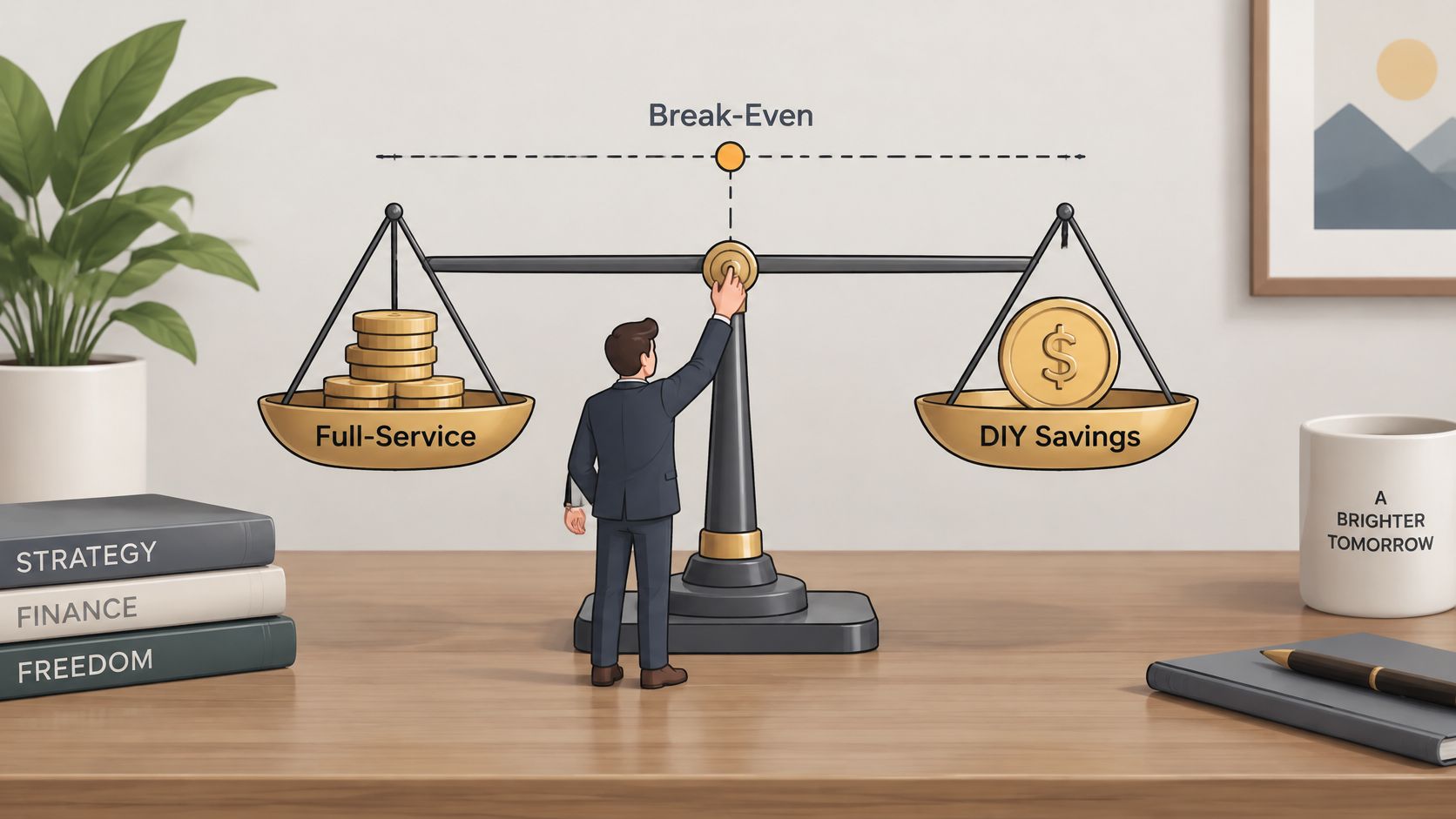
Use penalty exposure as the benchmark, not a second fee table. For U.S. employers, federal employment-tax deposits made 6 to 15 days late incur a 5% penalty, and deposits 16 or more days late generally incur 10%, per IRS Publication 15. On a $100,000 required deposit, that 10% penalty is $10,000 before interest, amended filings, or internal labor. A payroll fee is defensible when its controls cut expected penalty and correction cost by more than the premium over doing it yourself.
A provider calculates and remits employer payroll taxes. It doesn't erase them. Social Security, Medicare, unemployment, and workers' compensation stay in both columns of your comparison. So does the cost of a missed classification when a contractor should have been an employee.
A 15-person practice with remote billing and scheduling staff in two countries is a different problem from a four-person office in one state. If the operations manager already spends two days a month fixing pay, currency, or timekeeping, the full-service premium often pays back faster than the quote suggests. Currency conversion, local tax rules, and payment timing don't show up in a domestic per-employee fee. The broader cost of hiring remote talent from Latin America includes those items, not just the wage.
A single-country team of four, with a capable bookkeeper and straightforward hourly pay, usually keeps self-service cheaper. Buying full service there mostly purchases capacity you already have.
Count countries, currencies, contractor payments, and how often you run bonuses. Then compare the annual premium with a sober estimate of correction time. Confirm the tax obligations with a qualified advisor before you treat either column as final. This isn't a promise that outsourcing saves money. It's a test of whether this premium does.
Cutting the tax-filing line to save a per-form fee usually moves the cost onto your staff and into penalty exposure. The levers that work are narrower.
Bundle before you bargain. Ask whether tax filing, year-end forms, and ordinary support are inside the fixed fee. A higher base can be the cheaper year when those items are otherwise billed one by one. If the bundle excludes amendments, you're still exposed on the expensive events.
Batch the exceptions. Off-cycle runs are where per-run pricing hurts. Hold commissions, stipend corrections, and small bonus amounts for the regular cycle when labor law and cash flow allow a final paycheck or a legally timed bonus to go out on time. Don't delay those to save $25.
Match frequency to cash, then re-price. Weekly pay feels fair and multiplies per-check fees. Monthly pay lowers the processing count and can strain hourly staff. Pick the rhythm the practice can fund, then price monthly and biweekly inside the same vendor model so you're not comparing unlike calendars.
Negotiate the contract, not just the rate. Deposit requirements, billing rhythm, the minimum term, and whether you can export historical payroll data without a fee decide the cost of leaving. A cheap year one with a locked export is an expensive year three.
Deloitte's 2024 Global Payroll Management survey found that 26% of respondents charged payroll costs back to the business, including extra charges for exception processing. North America was highest, at 28%. An internal recharge doesn't lower the vendor bill. It stops a multi-site group from treating payroll as a free overhead bucket. Exception processing matters more when you have contractors, cross-border workers, or odd schedules.
Nearly three in ten surveyed North American organizations passed payroll-related costs back to business units. Visibility is the point, not a new invoice to your clinicians.
We bill international contracts, payments, taxes, and labor compliance across Latin America on one monthly invoice, and clients pay nothing until they hire. Confirm that in the contract, not in a sales email. A written payroll compliance checklist is a useful way to test whether a "included" line names deposits, registrations, and year-end forms.
A payroll vendor isn't automatically a HIPAA business associate. Under the HIPAA Privacy Rule, a business associate performs functions for a covered entity that involve using or disclosing individually identifiable health information. Billing, accounting, and administrative services are listed examples, which is why the question comes up. The trigger is the data, not the word "payroll."
A vendor that receives only employee names, wages, bank details, tax forms, and time records may not be a business associate if it doesn't use or disclose protected health information. The analysis changes when time records are tied to identifiable patients, when scheduling exports carry encounter detail, or when an integration can reach appointment or billing data. HHS defines protected health information broadly, including information related to a person's health care or payment for that care, in electronic, paper, or oral form.
Where a vendor does handle PHI, HIPAA requires a written business associate agreement. That requirement is separate from good security habits. Reasonable practices, not substitutes for the agreement, include a security questionnaire, role-based access, encryption in transit and at rest, and a defined breach-notice timeline. HHS doesn't recognize an official HIPAA certification. Treat any "HIPAA certified" badge as marketing, not proof.
Map every field the vendor can see and mark which fields, if any, are PHI. Restrict integrations to the minimum. A low processing fee doesn't offset an unclear privacy incident. Requirements vary by how your practice is organized and what the tools exchange, so confirm the analysis with qualified counsel or a compliance professional. Global payroll practices for cross-border teams should sit next to that map, because a worker in another country doesn't shrink the covered entity's duties over data that stays PHI.
Ask these as yes-or-no decision questions, and point each answer at the add-on table rather than accepting "included" as a description.
Build the all-in annual estimate for at least two quotes on the same headcount, frequency, and jurisdictions. Choose only after those totals exist. We state no hidden fees, no deposit before hiring, and monthly rolling billing per person at the quoted price. Verify those sentences in the contract.
If a deposit error has already produced a balance due, a separate guide to business tax debt relief is a more relevant next read than another software demo. Obligations differ by country and by state. Confirm them with qualified counsel or a payroll advisor before you treat a quote as compliant.
Request a quote for your actual roster, pay frequency, and states, then check every line against the questions above. We'll price the administrative roles you name, with payroll and compliance on the same monthly figure, so you can compare that total with a second provider on equal terms.