

Your new remote scheduler starts Monday. She's bilingual, experienced in U.S. healthcare, and based in Colombia. She'll answer patient calls, confirm appointments, and work inside your practice management system during your office hours. Then your office manager asks a simple question. How do we pay her, and are we sure she's a contractor?
That's where many medical practices discover that a staffing decision is also a payroll decision. The answer affects worker classification, tax forms, statutory benefits, payment timing, privacy controls, and what happens if the relationship ends. It can also affect obligations in the worker's country, not just in the United States.
Global payroll best practices for medical practices start before the first payment. Build a country-by-country operating model, document why you chose it, calculate the fully loaded cost, control access to payroll and patient systems, and review the arrangement when the role changes. Don't treat payroll as a monthly transfer with a contract attached.
The nine practices below give practice managers a workable framework for hiring Latin American medical virtual assistants, patient coordinators, billing support staff, and other remote healthcare professionals. You'll see where a contractor model may fit, where an employer of record is safer, and which records you need if a regulator, bank, or auditor asks questions later.
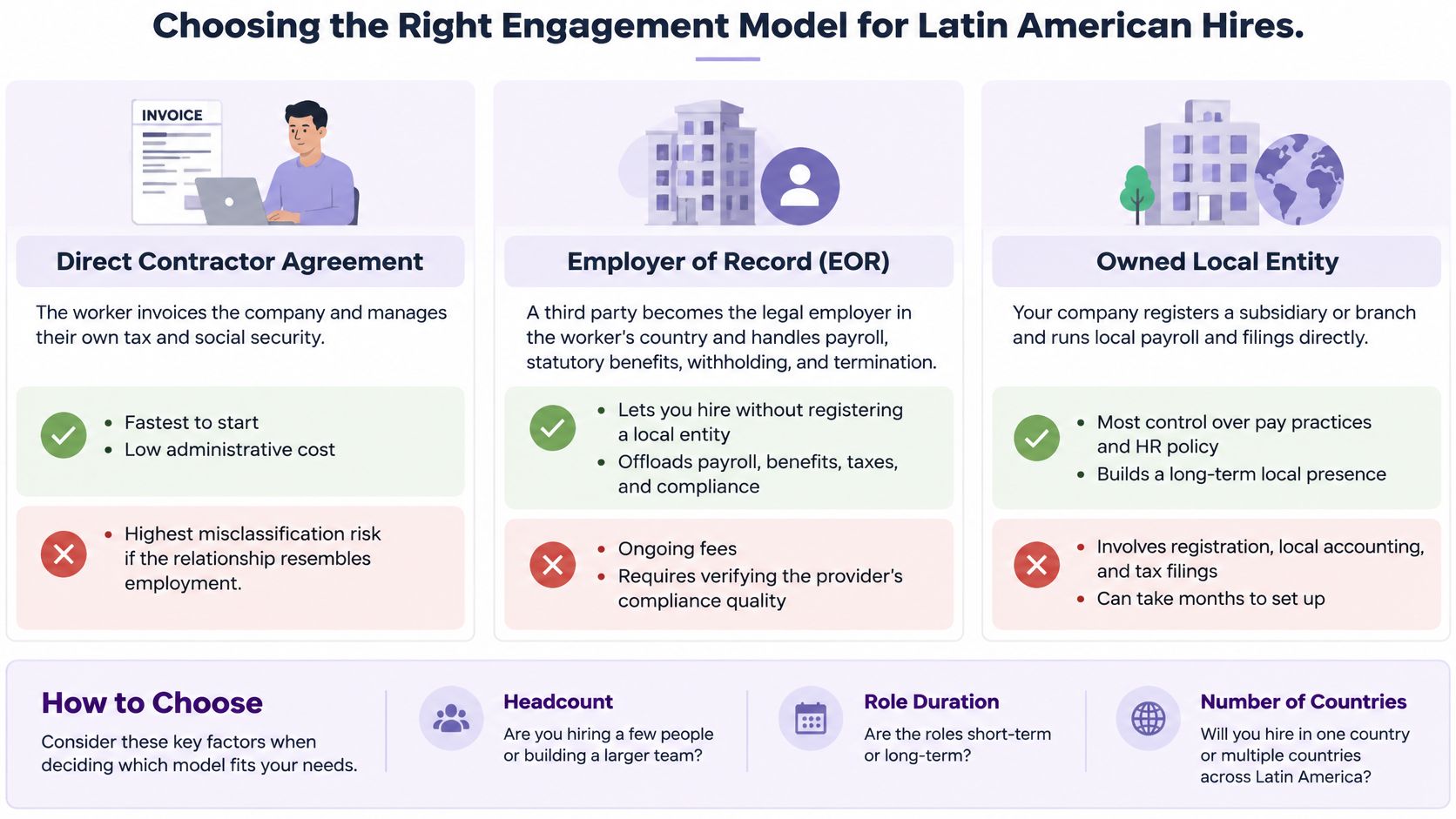
Decide how each person will be legally engaged before you recruit. Most practices choose among three models. A direct independent contractor agreement is simplest to start, an employer of record, or EOR, becomes the legal employer in the worker's country, and an owned local entity gives you direct control with the heaviest setup and filing burden.
Each model shifts risk differently. Contractors leave classification and statutory exposure largely with your practice. An EOR moves much of the local employment administration to the provider, but you still direct the work and need to verify what the provider handles. An entity rarely makes sense for a small practice with one or two remote staff, though it may suit a larger healthcare organization building a permanent team in one country.
Consider headcount, expected duration, supervision, and how central the work is to daily operations. A short project to clean up a billing backlog is different from a permanent virtual receptionist who covers phones every weekday. Choose per country and per role, because Mexico, Brazil, Argentina, and Colombia don't operate under identical rules.
For example, a U.S. dermatology group hires a Mexico based medical billing specialist for recurring claim follow up. The work is part time but scheduled, supervised, and ongoing. Instead of defaulting to a contractor agreement, the group evaluates an EOR and asks counsel to review the choice.
A contract label doesn't decide classification. What matters is the substance of the relationship, including supervision, set hours, exclusivity, use of your systems, and whether the work is part of your core operations. Location outside the United States doesn't settle the question either.
The U.S. Department of Labor rule that took effect March 11, 2024 under the Fair Labor Standards Act economic reality framework looks at six factors together. They cover opportunity for profit or loss, investments, permanence, control, whether the work is integral to the business, and specialized skill with business initiative. No single factor automatically decides the result.
A Colombian virtual assistant may start with occasional appointment reminders. Three months later, she's required to be available Monday through Friday, takes daily assignments in your scheduling system, attends staff meetings, and handles patient communications. That pattern looks much more like employment, and your file should say you noticed.
The Congressional Research Service summary reinforces that point. Its overview of the six economic dependence factors makes moving into continuing core work, such as billing or prior authorization coordination, a practical trigger to reassess status.
Practical rule: If you control the schedule, the method, and the ongoing workload, don't rely on a contractor invoice to prove contractor status.
Use a written checklist at onboarding and renewal, and track it against a clear worker classification review process. Keep the reasoning in a role specific file. Comparative frameworks such as contractor vs employee Australia can help managers see the control issues, but local counsel should decide the Latin American position.
A medical virtual assistant's monthly pay is only part of the employment cost. Build a country-level calendar that captures recurring, annual, and accrued obligations, so payment dates and cash needs do not catch your practice by surprise.
The details differ across Latin America. Mexico requires an aguinaldo annual bonus and, where applicable, profit sharing. Brazil has a 13th salary and FGTS severance fund contributions. Argentina pays the SAC in June and December. Colombia has prima de servicios and cesantías, with related interest and deposit rules. Social security contributions and filing dates add further deadlines.

For a practice with an account coordinator in Mexico and a designer in Argentina, accruing aguinaldo and SAC monthly helps prevent a cash shortfall in June or December. It also gives managers a more accurate basis for comparing the cost of an employee with a contractor rate.
Online filing does not remove the need to track each obligation. The OECD reports that 98% of tax administrations surveyed allow taxpayers to register online. Set up each country's schedule to include:
Review each calendar yearly with local payroll providers or counsel. Confirm due dates and rates, since countries differ in their level of digital maturity and filing processes.
Before paying a remote medical virtual assistant, patient coordinator, or billing specialist, confirm the worker's tax status and collect the required records. U.S. practices generally request a current Form W-8BEN from a foreign individual or Form W-8BEN-E from a foreign business entity. These forms document foreign status and support a treaty position, but they do not determine withholding on their own.
The correct withholding and reporting treatment depends on where services are performed, the worker's residence, and your status as payer. Have a tax professional confirm it before payment. Collect the local identifier used for payroll or invoicing, such as Mexico's RFC, Brazil's CPF or CNPJ, or the equivalent in Argentina or Colombia.
A Brazil-based transcription specialist, for example, should provide a CPF and signed W-8BEN before the first payment. Record the required invoice format too, so each monthly payment can be matched to a valid invoice. This gives the practice a usable record instead of a year-end search through email and bank confirmations.
ADP's 2025 survey found average payroll accuracy of about 85%, with data inaccuracies cited by 37% of respondents. Automation cannot correct a missing identifier or an expired form. Validate the worker, work location, identifiers, and effective dates before entering data into an automated workflow. Otherwise, the system can repeat errors across payroll runs.
Keep the process practical:
Payroll is a treasury problem, not just a transfer. The currency you choose affects the worker's real income and your budget variance. Funding dates, bank holidays, local salary deadlines, and invoice cycles all determine whether pay arrives when promised.
Currency movement is not theoretical. A 2026 survey reported by Thomson Reuters found that 97% of surveyed finance executives experienced changes in cross-border payroll costs because of FX movements during the prior year. Forecast liabilities in both local and reporting currency, and define who absorbs variance before it becomes an argument.

A startup pays a Colombian developer in U.S. dollars on the fifth business day each month. When a bank change request arrives by email, finance calls a number already on file instead of trusting the message. Medical practices should use the same discipline for remote billing staff and schedulers.
Use segregation of duties between preparing and approving payments. Reconcile the payroll register to the bank file and the general ledger posting. If you use a platform, review how coordinated global payroll services handle currency, funding, and local payment execution rather than assuming every country works the same way.
The cheapest provider isn't always the lowest cost option. Poor FX visibility and manual reconciliation can cost more than the fee you saved.
A remote billing specialist may need claim details to follow up on denials, while payroll staff need bank and tax records to pay that specialist. Keep those workflows separate. National identifiers, bank details, salary history, and tax records require careful handling, and patient information brings separate privacy obligations.
Payroll data generally isn't protected health information by itself. Patient information accessed through practice systems is different. Your HIPAA obligations concern how you grant, limit, and remove that access. No official HIPAA certification exists for an individual or service, so assess the safeguards in use rather than relying on marketing labels.

Brazil's LGPD, Colombia's Law 1581 of 2012, and Mexico's federal personal data law each set rules for private-sector data processing. Apply controls that work across locations: collect only what each task requires, restrict access by role, encrypt data in transit and at rest, set retention periods, and remove access promptly when someone leaves.
For example, a physician group can give its Mexico-based billing team the claim fields needed for follow-up without exposing clinical notes. Keep payroll files outside patient systems, and end a departing worker's access on their last day.
Use a simple test: can this worker do the job without seeing this record? If yes, remove the access.
Access standard: Give remote staff only the patient and payroll access their duties require, and keep a record of each review.
A generic U.S. template rarely survives contact with another country's employment rules. Your contract should state the engagement model, scope, compensation and currency, payment dates, hours or deliverables, confidentiality, intellectual property, termination terms, and governing law. If a term can't be waived locally, writing the opposite in English won't fix it.
Spanish language or bilingual documents often improve understanding for Latin American workers. They also reduce disputes about what was promised. Still, local counsel should confirm which language version controls and whether your governing law clause is enforceable for that worker and role.
Termination is where weak paperwork becomes expensive. Notice, final pay, accrued statutory items, and severance can differ sharply by country. A U.S. at will statement may not describe the actual local framework, especially after you've structured the role as employment.
A design agency hiring a Colombia based UX designer uses a Spanish language agreement reviewed locally. It defines deliverables, includes an intellectual property assignment, and states that termination follows the applicable local rules. A medical practice needs the same care for workflow documentation, patient communication scripts, and training materials a remote coordinator creates.
Policies on devices, acceptable use, and security training should be consistent, but adapt the enforcement language to the engagement model. A contractor policy and an employee handbook aren't interchangeable.
Time records do two jobs. They determine pay, and they show whether the relationship still matches its classification. If a supposed contractor must attend fixed hours every day, your time system may be documenting the problem.
Employees in Mexico, Brazil, Argentina, and Colombia accrue vacation and other leave under local rules. Illness, maternity, paternity, and family leave standards also vary. A U.S. benefits plan may not satisfy mandatory local health coverage or social security enrollment, so start with the statutory baseline in the worker's country.
A telehealth company employs a Brazil based patient scheduling coordinator. HR loads local vacation accrual rules into the timekeeping system and publishes a team leave calendar. The scheduling manager can plan phone coverage without ad hoc approvals or last minute gaps.
That visibility matters in patient facing roles. A virtual medical receptionist, appointment scheduler, or insurance verification specialist can't disappear during a local holiday your U.S. team didn't know about. Build local holidays, accruals, and approval rules into the system before the first working day.
Discretionary items such as equipment stipends or learning budgets are easier to manage when documented separately from mandatory benefits. Keep them consistent enough to feel fair, but don't let a global policy override a local statutory entitlement.
A payroll program that was correct at onboarding can drift. People change roles, compensation, bank accounts, and countries. Laws change too. Your review cycle should catch those changes before an authority, patient, or worker does.
Design payroll for data exchange, not just payslips. The OECD's 2024 survey material reports that approximately 80% of tax administrations receive data directly from taxpayer business systems. That direction favors a controlled employee master record, country specific rules, electronic submission, and an auditable calculation trail.
APIs are now the practical starting point for integration. Payroll.org reported that APIs were used by 44% of organizations in its 2025 Global Payroll Week survey to connect payroll with HR, finance, and time systems. Standardize worker data and earning codes first, then automate validation and exception workflows.
Measurement is still weak in many organizations. A related 2025 survey of payroll professionals found that 38% did not track payroll performance at all. Track accuracy, on time payment, adjustment volume, error resolution time, compliance incidents, and vendor service levels by country and worker type.
A practice with staff in two countries reviews everything each December. It confirms year end statutory payments, checks tax forms, and finds a former contractor who still has portal access. Access is removed the same day, and the closure is documented.
Use a structured payroll compliance checklist to assign owners and due dates. Before selecting a provider, request a sample payroll run, a written responsibility map, and data exit terms so you can retrieve complete records if you change vendors.
| Practice | Main Focus | Implementation Effort | Key Actions | Expected Outcome | Ideal Use Case |
|---|---|---|---|---|---|
| Choose an engagement model | Contractor, Employer of Record (EOR), or owned entity | Low for contractors; moderate for EOR; high for an owned entity | Assess each country and role by headcount, duration, and level of control | Better fit between hiring needs, administrative costs, and local obligations | Selecting a hiring model for new or expanding country operations |
| Classify workers correctly | Employee versus independent contractor status | Moderate; requires documented, recurring reviews | Evaluate actual working conditions and reassess when duties or supervision change | Lower risk of misclassification, back pay, and penalties | Onboarding or changing the scope of cross-border roles |
| Build a statutory payroll calendar | Country-specific payments, contributions, and deadlines | Moderate to high; requires local research and regular updates | Track statutory items, due dates, accruals, and responsible owners by country | More accurate labor-cost budgets and fewer missed deadlines | Employing staff in multiple countries with different payroll rules |
| Collect tax forms and identifiers | Tax documentation, local IDs, withholding, and invoicing | Moderate; may require tax and local-provider support | Collect applicable W-8 forms and local tax identifiers before payment | Fewer payment delays, reporting errors, and withholding issues | Paying a new foreign worker or entity |
| Manage currency, timing, and payment controls | Exchange exposure, pay schedules, and fraud prevention | Moderate; depends on payment systems and approval workflows | Set currency and pay-date policies; verify bank changes; use payment approvals | More predictable payments and reduced fraud or misdirection risk | Processing recurring international payroll or contractor payments |
| Protect personal data and payroll records | Privacy, security, access, and retention | Moderate to high; requires technical and legal controls | Limit access, encrypt records, set retention periods, and manage cross-border transfers | Reduced data exposure and clearer privacy compliance | Handling sensitive worker data or giving remote staff access to patient information |
| Draft contracts and local-language documents | Engagement terms, IP, termination, and policies | Moderate to high; local legal review is often needed | Use country- and model-specific contracts; clarify pay, duties, and termination | Fewer misunderstandings and better alignment with local requirements | Hiring workers in a new country or using a new engagement model |
| Administer time, leave, and benefits | Local leave rules, statutory benefits, and tracking | Moderate; country-specific system configuration is needed | Configure local accruals and leave rules; track contractor deliverables separately | More consistent administration and fewer unexpected liabilities | Managing employees across countries or monitoring contractor scope |
| Create a compliance calendar and audit trail | Ongoing reviews, records, provider oversight, and corrective action | Moderate to high; requires assigned owners and regular review | Track deadlines and approvals; review providers; document and resolve gaps | Earlier issue detection and stronger audit readiness | Maintaining or scaling a multi-country payroll program |
Effective global payroll best practices aren't a single vendor decision. They're an operating system that connects your engagement model, classification file, statutory calendar, tax records, payment controls, privacy safeguards, contracts, leave administration, and audit trail. Each piece supports the others. A well drafted contract doesn't help much if your time records contradict it, and polished payroll software doesn't help if the worker's tax identifier, work location, or compensation change was never validated.
Start with a country by country matrix before the first payment. For each role, write down the country, engagement model, classification reasoning, fully loaded cost, statutory items, pay currency, funding date, system access, and named compliance owner. That one page forces the hard questions early, when they're still inexpensive to answer. It also gives a new practice manager or finance lead a clear record of why decisions were made.
Then build a human in the loop review cycle. Automate calculations, integrations, reconciliations, and reminders where the source data is reliable. Require human review for a new country, a status change, an unusual bonus, a retroactive adjustment, a bank change, or a cross border move. Those exceptions carry the risk. Routine payroll should be quiet and predictable, but exceptions should never pass through without a second set of eyes.
Be honest about the trade offs. A contractor model is faster to launch but offers less protection when you need fixed coverage for patient calls, scheduling, insurance verification, billing follow up, or prior authorization support. An EOR costs more in visible fees but can reduce local administration and statutory risk. An owned entity gives control that most medical practices don't need until headcount in one country justifies permanent local infrastructure. Choose based on the actual role and duration, not on the lowest monthly quote.
Recheck the arrangement whenever duties, hours, supervision, compensation, location, or legal status change. Confirm country specific requirements with qualified counsel, tax advisors, or compliance professionals, because this guide can't determine the right model for a specific worker. The goal isn't perfect paperwork for its own sake. It's paying people accurately and on time, protecting patient and payroll information, and being able to show your work months later.
If you're building a remote healthcare team, start with the matrix for your first country and first role this week. LatHire can help you source pre vetted Latin American professionals, including bilingual virtual medical receptionists, patient coordinators, appointment schedulers, insurance verification specialists, medical billing support, and prior authorization support aligned with U.S. working hours, with support for international payroll, benefits, and legal compliance. Bring a clear role description, decide interview steps in advance, and verify the engagement model before onboarding so your first hire strengthens operations instead of creating cleanup work.