

Friday afternoon, a clinic posts a remote scheduler opening and labels it healthcare support. By Monday the stack is people who have roomed patients. Almost none have run a phone queue that has to cover both coasts.
The ad asked for healthcare experience and a team player. It never named pay, the time zone, or the clinical tasks this hire will not do. Applicants fill the blanks. You spend the week sorting guesses.
Field data from a 2025 study suggests that masculine-coded wording in ads can reduce the share of women who apply. Wording is only one lever. Inclusive or skills-based lines convert the right people only when pay, hours, scope, and the actual selection steps match those words. If the posting promises flexibility and the screen still requires on-site coverage, the softer language just draws people you will reject.
That gap costs a practice twice. Candidates use the posting to decide whether to apply. Later, a careful description can stand as evidence of essential functions if a dispute turns on what the job required. I would not treat a polished paragraph as a fix for a role nobody has defined. A manager can revise a description that already matches the work. A job descriptions writer earns the fee when the role is new, the worker may see patient information, or prior ads have already pulled the wrong people.
Say a practice manager has rewritten a virtual medical receptionist ad three times. Applicants still arrive expecting clinical work, or they can only cover hours that never overlap the front desk. The title sounded familiar. The week they would work did not.
A job descriptions writer is the person, or an assisted draft a human finishes, who turns those manager notes into a posting a candidate can use to accept or decline. For U.S. medical practices, that means naming the administrative work of a remote receptionist, patient coordinator, scheduler, insurance-verification specialist, prior-authorization assistant, or billing-support role, and stating the clinical duties that are out of scope. The writer does not invent the job. You still own the facts.
Hire that help when the role is new, when the worker may see patient information, when pay or schedule transparency is unsettled, or when two prior postings drew the wrong people. If an accurate description already exists, edit it in-house. Do not buy smoother adjectives to hide a role nobody has defined.
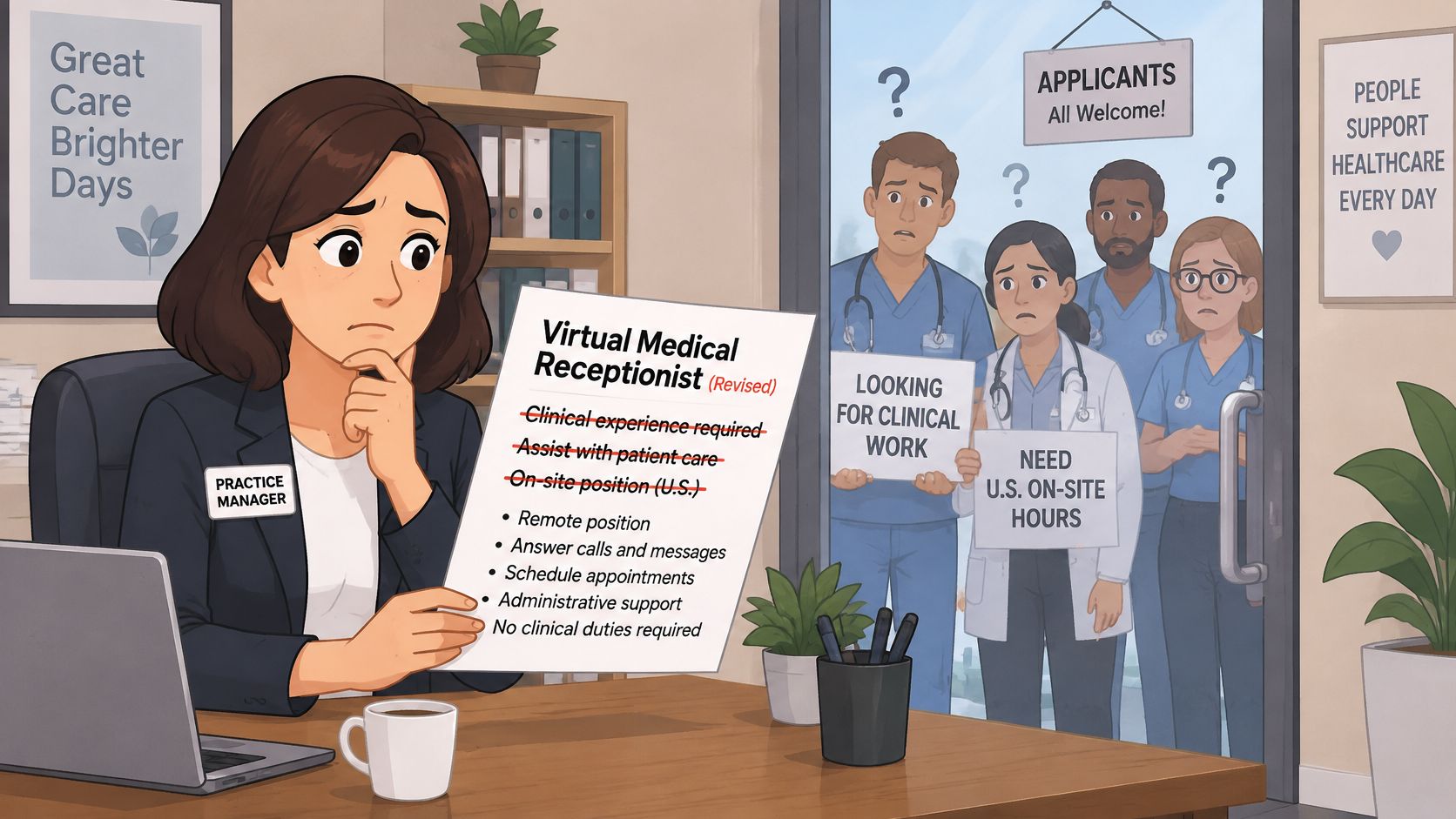
A posting that cannot tell a candidate what the week looks like will keep filling the inbox with the wrong week.
The next decision is which writing option fits, because a freelance project, a recruiter bundle, and an edited AI draft fail in different places. Pick that row before you ask anyone for a sample.
| Option | Best when | Cost signal | Practice still owns |
|---|---|---|---|
| Practice manager | Familiar role and an accurate existing description | Staff time only | Duties, pay, and final approval |
| Freelance job descriptions writer | New, specialized, or repeatedly mismatched role | Project fee; professional writing benchmark is $43.46 an hour median | Facts, legal review, and approval |
| Recruiter or staffing bundle | Search and posting are bought together | Often inside a placement fee, not a separate writing invoice | Whether the ad matches real work |
| AI draft plus human edit | Need a fast structure for a known workflow | Software fee plus editor time | Every duty, exclusion, pay figure, and compliance line |
Read the row before you request samples. The cost signal is not a quote. It is the bill you should expect to see, or not see, once the search is underway.
The Bureau of Labor Statistics figures describe salaried writers in the technical-writing occupation, not freelance fees for a single posting: about 46,400 jobs in 2025, median pay of $90,390 or $43.46 an hour, a bachelor's degree as the typical entry education, and a projection of 46,700 jobs by 2035 with about 3,200 openings a year. A one-off medical posting is usually a project fee. You are buying a structured document, a question list, and a revision, not a staff writer on payroll.
A recruiter-written ad can look free while the writing sits inside a placement fee. That is fine when you want the search and the posting together, and a poor trade when the ad describes a job your coordinators do not do. You still have to read it against the week. An AI subscription is inexpensive only when an editor who knows the workflow verifies every duty, pay figure, and scope line. Software that drafts faster does not know your payer portals, your overlap hours, or the pay band your partners approved.
Practical rule: Use in-house effort for a familiar role, pay for a specialist when compliance or mismatch risk is high, and never outsource the facts.
You approve duties, pay, employment model, and the final text. A writer can organize them. A writer cannot swear they are true.
A front-desk manager pastes last quarter's scheduler notes into a chat tool and gets a cleaner posting in a few minutes. The title is tighter and the skills sound open. The hours, the exclusions, and the pay band are still the old ones, so the better wording will attract the wrong people.
Run the work in three stages: discovery, drafting, and editing. Discovery means interviewing the provider or practice manager, an incumbent if one exists, and the person who will supervise the remote worker. List the systems, such as the EHR, the phone platform, and the payer portals. Separate daily tasks from rare ones, and write down what the role must not do. A small practice hiring one scheduler can do this in a single working session. A multi-site group hiring billing support and prior-authorization staff should not skip it, because each site's templates and payers differ.
Drafting then locks the title, employee or contractor model, location limits, overlap hours, duties, exclusions, must-have evidence, pay and benefits, and the selection steps. Inclusive or skills-based lines only convert the right candidates when those facts match the words. If the band is for a coordinator who verifies eligibility, the draft should not read like a revenue-cycle manager, and a posting that says you hire on demonstrated skill cannot hide an unstated credential in the selection steps.
Editing strips inflated adjectives and checks that every requirement can be tested against something you will score.
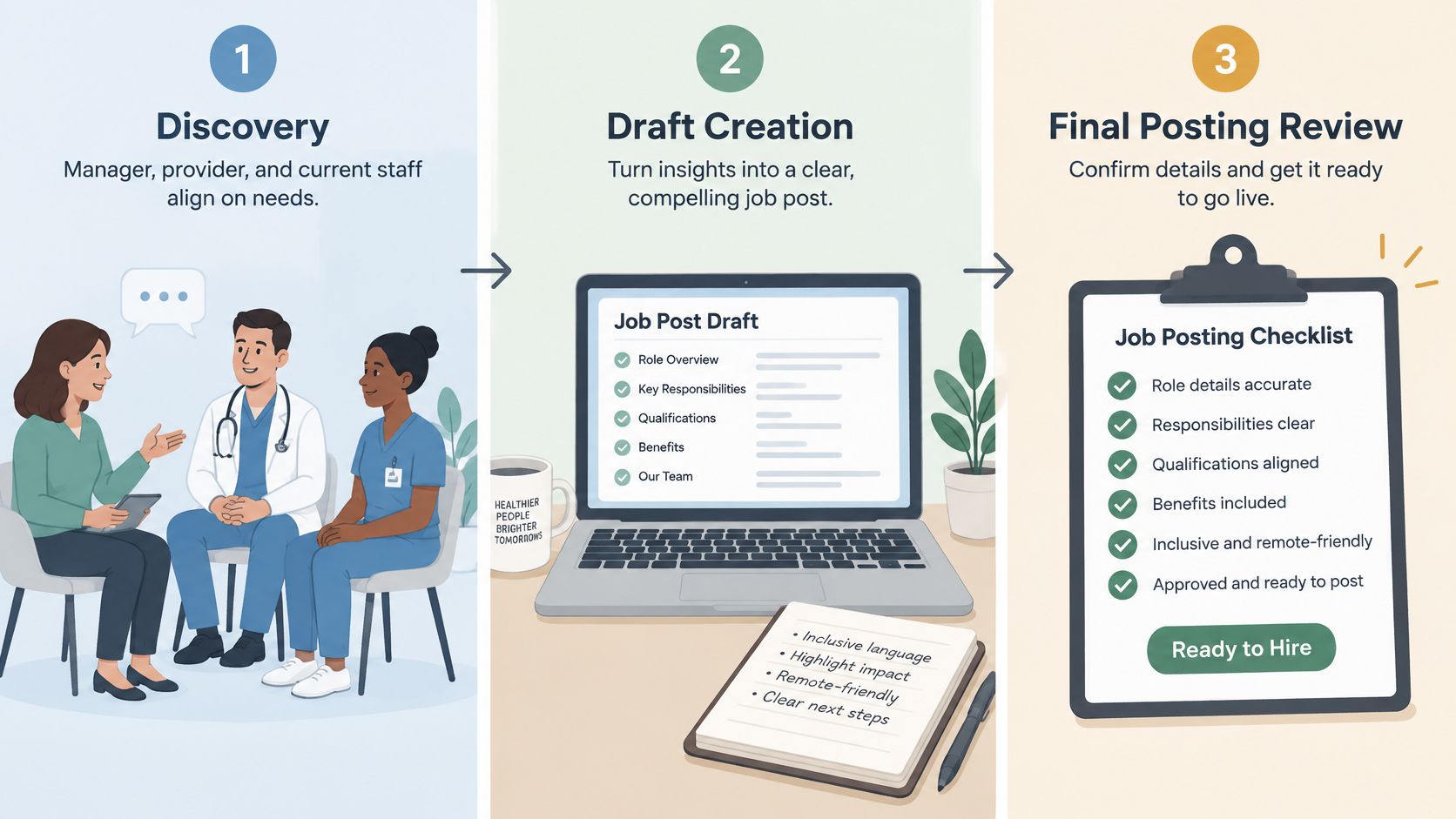
AI is useful for turning a messy brief into headings, offering plainer phrasing, and producing a first skills list you can cut. It fails when it invents software, implies clinical authority, copies vague prestige language, or states a pay range the practice has not approved. The tool works like a fast scribe. The person who approves the text, a human writer or a heavy editor, decides which facts belong on the page.
If you import your job description into LatHire, the AI hiring process uses those requirements to suggest candidates, so settle the duties, exclusions, and pay before you start the search.
The handoff is a draft plus a question list, not a signed compliance opinion. Unanswered questions about contractor status, wage notices, or privacy duties go to qualified counsel, not into confident sentences.
A candidate reads the posting before ever speaking to your recruiter, so the words have to carry the offer. Six items belong in the text: a pay range with currency and whether it is hourly or annual, employee or contractor status and who runs payroll, the U.S. clinic hours that must be covered against the candidate's time zone, any location limits, the selection stages, and a realistic response time. Pay is where most practices still stall. Job-market reporting found that 53.3% of jobs included pay information in September 2025, which leaves a large share of postings silent on the number applicants look for first.
Writing those specifics costs you applications from people who were never a fit, and that is the point. Volume from mismatched candidates burns screening hours on both sides. For a distributed role, say whether the range is in U.S. dollars, whether it reflects seniority or geography, and whether benefits apply to employees only. A contractor paid through their own entity is not the same offer as a W-2 seat with your benefits plan, even when the daily tasks look alike.
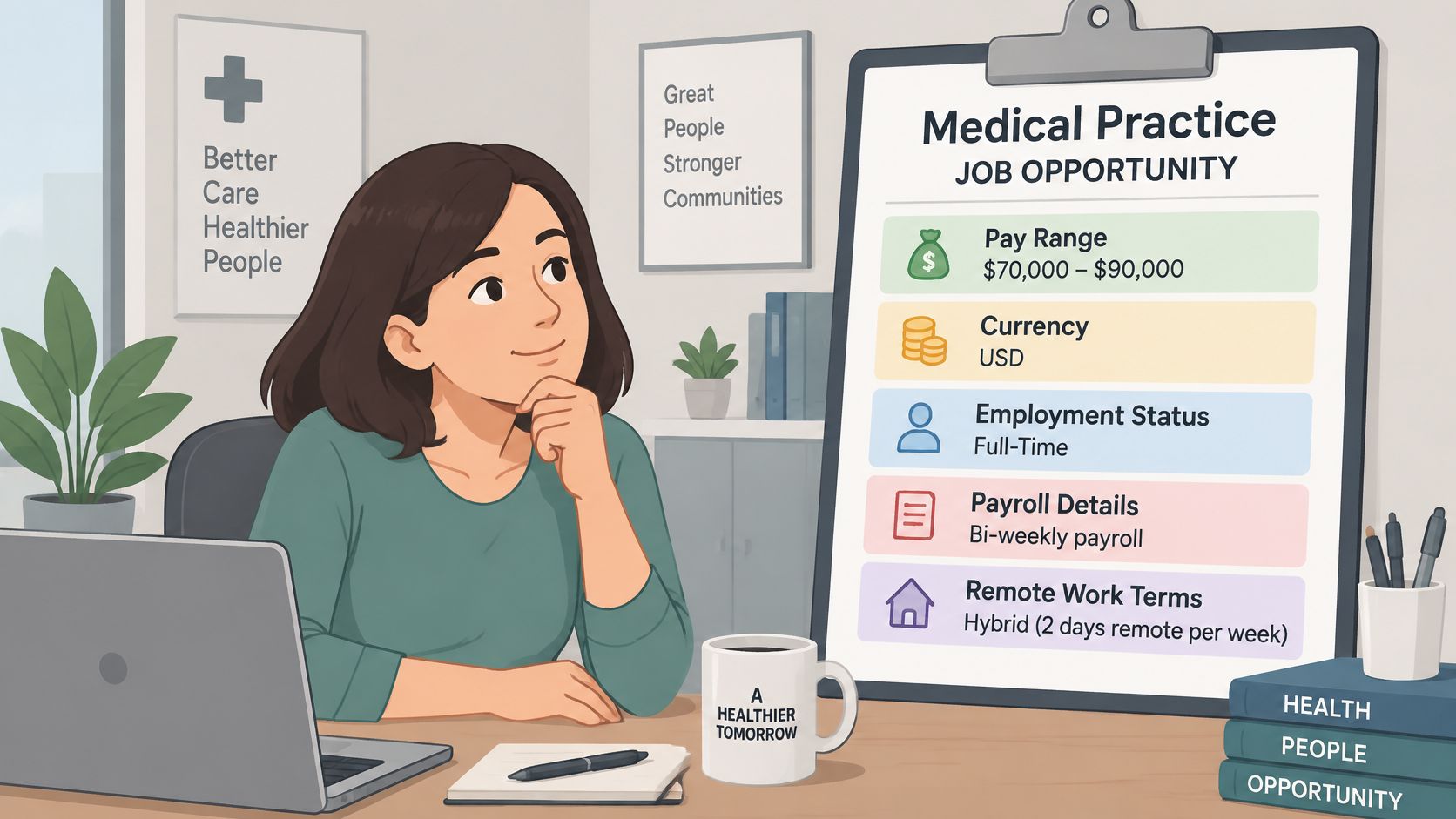
The disclosure and the hiring steps have to agree. A posting that names four interview stages when the practice runs two turns your carefully neutral, skills-based wording into decoration, and the candidates who planned around it leave first.
| Element | State in posting | Why it matters |
|---|---|---|
| Pay | Range or credible band with currency and basis | Filters out candidates whose floor sits above the band |
| Employment model | Employee or contractor status and payroll responsibility | Changes pay, benefits, and compliance duties |
| Hours and overlap | U.S. clinic hours covered and candidate time zone | Prevents schedule mismatches after hiring |
| Duties and exclusions | Administrative tasks included and clinical tasks excluded | Sets scope and supports an accurate essential-functions record |
| PHI access | Systems, data types, training, and escalation path | Shows whether a business associate agreement is needed |
| Selection and timeline | Stages and a realistic response time | Sets expectations before candidates apply |
If you are hiring across borders and the overlap hours are real, you can connect your opening with LATAM candidates only after those lines are explicit. A time-zone match that is not written down is not a match.
Separate desk work from care. The Bureau of Labor Statistics description of medical assistants lists administrative tasks such as scheduling appointments, maintaining medical records, answering telephones, handling insurance forms, coding information, billing-related communication, and managing supplies. Clinical duties in that occupation can include recording vital signs, preparing patients for examinations, collecting specimens, and administering medications when a physician directs the work and state law allows it. A remote administrative posting should name the workflows you will assign, such as scheduling, referral coordination, insurance verification, prior-authorization follow-up, inbox routing, or records requests. It should say the worker does not diagnose, treat, or independently make medical decisions.
A primary care scheduler and an orthopedics prior-authorization assistant both sit at a desk, but the second needs payer and procedure vocabulary. Neither posting should promise clinical judgment. Specialty language belongs in the tasks. Licensure language does not, unless the role and the jurisdiction require a license, which these administrative seats do not.
The EEOC's Title I technical assistance manual treats a written description prepared before advertising or interviewing as evidence of essential functions under the Americans with Disabilities Act, and it considers the work people perform as more persuasive than a task nobody does. Essential functions for a remote healthcare-staff role might include coverage during defined U.S. business hours, documenting patient communications in the EHR, handling a stated message volume, or completing insurance-verification steps accurately. A preferred headset, occasional overtime, or a nonessential software tool is a marginal preference. Do not label it job-critical.
If a remote worker or outside service will create, receive, maintain, or transmit protected health information for a covered provider, evaluate business-associate status. HHS guidance on business associates identifies practice management, billing, claims administration, data processing, and related healthcare operations as activities that can create that status. Before access, a covered entity generally must obtain satisfactory written assurances through a business associate agreement. Name the systems, the types of protected health information, required training, confidentiality expectations, how incidents are escalated, and whether the person is in your workforce or supplied by an outside organization. "HIPAA compliant" is not an operational requirement. HHS does not recognize an official HIPAA certification, so "HIPAA certified" is not a credential you can demand as if it were a license.
HHS guidance on business associates and mobile access says covered entities and business associates may use mobile devices to access electronic protected health information in cloud environments only when appropriate physical, administrative, and technical safeguards protect confidentiality, integrity, and availability, and when required business associate agreements are in place. Put checkable conditions in the posting: access only through the practice's approved EHR account, multifactor authentication, encrypted organization-managed devices, no personal email or unapproved local storage of patient records, a private work area, and immediate reporting of suspected incidents. The safeguards and the agreement are the HIPAA-side conditions. The device and workspace lines are how you make those safeguards visible to a remote candidate. They are not a slogan.
Wage notices, contractor tests, and privacy duties vary by state and by how the worker is engaged. Confirm them with qualified counsel or a compliance professional before you publish. Our notes on legal and compliance requirements are a starting map for cross-border hiring, not a substitute for that review.
Change the line, then keep the competency. A weak scheduler ad says "rockstar who owns the phones." A usable line says "return patient calls the same business day, schedule into defined provider templates, and document each message in the EHR." The first attracts people who like the adjective. The second tells a coordinator whether the desk matches their skills, and it gives you something to test.
A weak billing-support line says "bachelor's degree and five years in healthcare." A usable line says the person has worked denial follow-up, can explain a remittance in writing, and will complete a sample denial scenario. Years and a diploma can stay if they are essential and you accept a stated equivalent. They should not stand in for the work sample you will score.
A 2025 study of 37,920 participants found that replacing stereotypically masculine wording with semantically equivalent gender-neutral language increased application rates among women and among men whose identities were less aligned with masculinity. In the field data, women represented 40.0% of applicants when masculine wording was relatively low, versus 34.1% when it was relatively high. Keep the competency. Replace the costume. "Analyze ambiguous eligibility denials and make a timely next step" is assessable. "Dominate the work queue" is not.
Apply a three-line test to every sentence.
Is the behavior observable, is it essential to this job, and can the practice assess it before hire?
If a sentence fails one of the three, cut it or rewrite it as a task, an output, or a work sample. "Excellent communication" fails. "Write a two-paragraph message a patient can act on, in the languages this desk uses" can pass if you collect a sample. For patient-facing seats, tie that sample to your English language requirements and to any second language the front desk needs, rather than to a prestige label like "native speaker."
Neutral wording does not fix a screen that still demands an unneeded degree. A 2025 survey of 1,084 U.S. and U.K. employers found that 85% claimed to use skills-based hiring, but only 53% said they had eliminated degree requirements from some postings. The share of U.S. postings requiring a bachelor's degree rose from 16.6% in November 2023 to 19.3% in November 2025. Deleting "bachelor's degree" from the ad while the interview guide still sorts on it is a wording exercise, not a hiring change.
Translate each must-have into evidence. Define the outcome, mark what you will train versus what must already be present, name acceptable equivalent experience, and connect the line to a structured assessment. For a remote insurance-verification specialist, that might be a redacted eligibility screenshot they talk through, not a diploma. For prior-authorization support in a surgical practice, it might be a sample of how they read a payer checklist. Specialty clinics may need that payer or procedure vocabulary. No posting should promise diagnosis or treatment.
Reject a writer who removes the degree sentence and leaves the selection steps unchanged. The posting and the screen are one process. If you will not score a work sample, do not advertise a skills test you will not run.
| Criterion | Pass | Send back |
|---|---|---|
| Source of duties | Based on manager and incumbent interviews | Copied from a generic template |
| Must-have evidence | Each requirement maps to a test or work sample | Degree or years with no equivalent accepted |
| Inclusion | Observable, job-related behavior | Gendered, age-coded, or prestige adjectives |
| Transparency | Pay, hours, time zone, and stages stated | Duties only |
| Medical scope | Administrative tasks and exclusions named | Clinical care or a certification claim implied |
| Sample quality | Shows questions and a before-and-after | Polished language with invented tools or duties |
Score at least two samples on your own role, not on a generic clinic. Give each writer or tool the same one-page brief, with one deliberate gap, such as an unstated pay band or an unnamed EHR. The stronger sample asks about the gap. The weaker sample invents Epic, a salary, or a clinical duty so the page looks finished.
Read the before-and-after on one weak line from your current ad. You want the replacement to name an output, not a personality. Ask for the list of questions they could not answer from your brief. A short list of gaps is a better sign than a polished page. Ask for an explicit note that legal conclusions need counsel. A draft that declares your contractor model "compliant in every state" is a draft to send back.
I would pay for a second draft only after the scorecard passes on scope, pay, and evidence. A second polish of a wrong job is a second wrong job.
A job descriptions writer is worth paying when the practice cannot yet state the work, the boundaries, and the screening evidence in plain language. If you can already do that, edit the posting yourself and spend the fee on the search. The words only convert the right candidates when the pay, the hours, the scope, and the selection steps are the same facts you will use after someone applies.
Choose the writing option from the table before you request samples. Brief the writer with real workflows, systems, and exclusions. Score the draft against observable evidence and medical scope. Publish pay, hours, employment model, and clinical exclusions before you invite applications. A fast AI structure is acceptable only after someone who knows the desk has checked every duty and every number.
Write a one-page brief that lists systems, daily tasks, tasks the role must not do, overlap hours, and the approved pay range. Leave blanks where you are unsure. Blanks are safer than invented precision.
Ask the writer or the tool for questions before any prose. Answer the ones you can. Send wage, contractor, and privacy questions to counsel rather than letting the draft guess.
Align the interview or work sample to every must-have line. If the posting requires same-day documentation in the EHR, the screen should include a short writing sample. If it requires a degree you will not waive, say so, and do not call the process skills-based.
Do not treat the finished ad as a clinical job, a certification, or a legal opinion. Remote reception, scheduling, verification, prior-authorization support, and billing support stay administrative unless a license and your state rules say otherwise. That limit protects patients and keeps the applicant pool honest.
When the description already matches the work and you want pre-vetted remote professionals, the writing step can feed the search instead of sitting in a folder. In our first hiring step, you set up a hiring profile by importing that description or using our in-house AI to build one, and clients who import a description receive candidate suggestions based on those requirements. Bring a posting you would be willing to be screened against yourself.
If your one-page brief is ready, review LatHire's healthcare and administrative role options and import the description you would hire against. We will use that profile to suggest candidates from the requirements you approved. Keep clinical duties off the posting, and confirm wage and privacy duties with your own counsel before you hire.