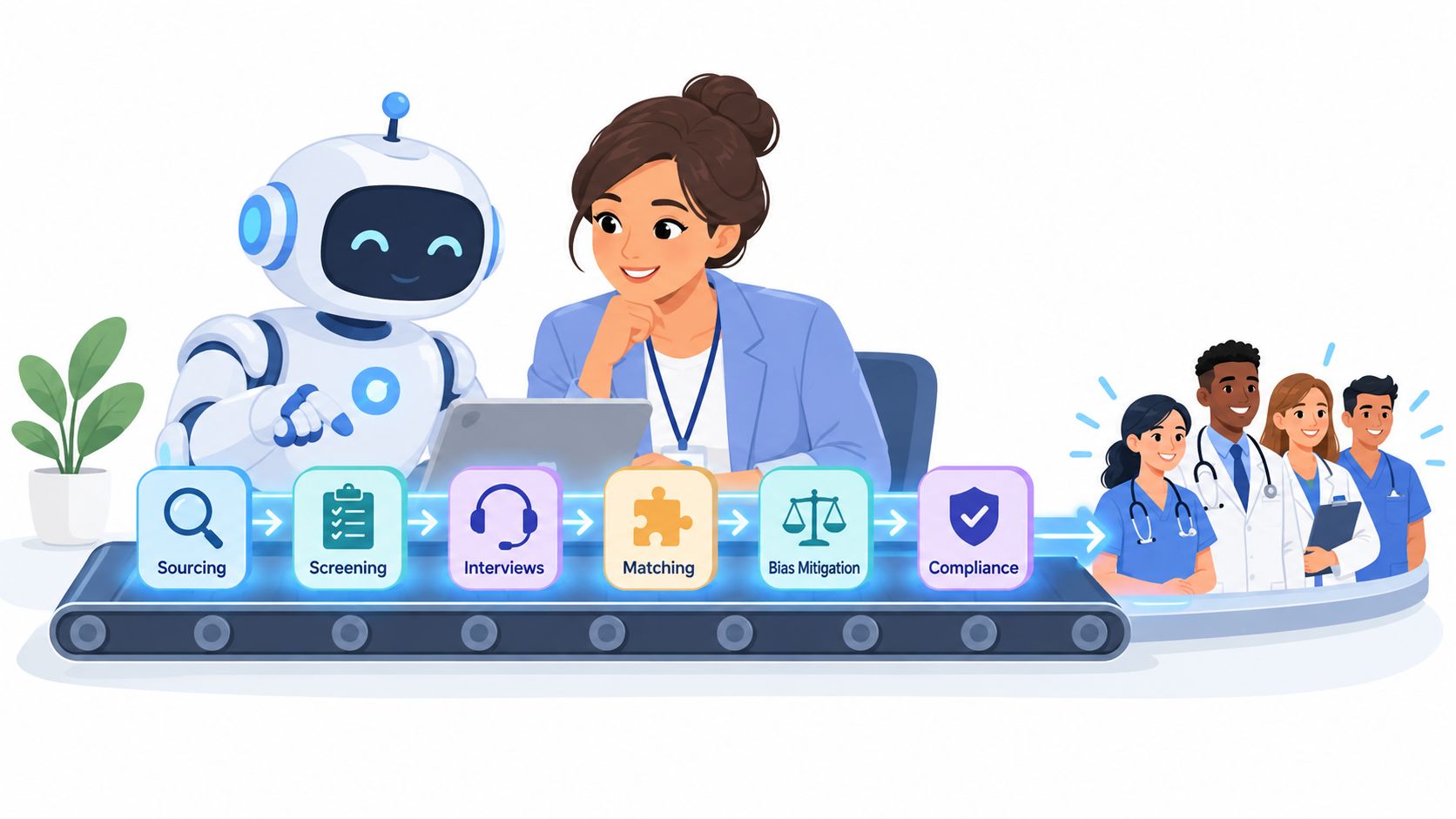
A practice manager starts Monday short two medical assistants, a remote prior-authorization specialist, and a part-time biller. By 9 a.m., the inbox holds 80 applications, but the manager still has to identify active credentials, confirm remote-work readiness, protect applicant information, and judge whether someone can communicate appropriately with patients. More applications don't solve that workload. A disciplined AI hiring process can.
For a medical practice, AI hiring isn't a hands-off decision engine. It's a layered workflow in which machine learning, natural language processing, and automation handle repeatable work, while people retain responsibility for clinical fit, licensure, patient-facing judgment, and employment decisions. The workflow must also account for HIPAA-aware data handling, credential verification, state-specific rules, accessibility, and the limits of automated scoring.
The practical model has seven stages: sourcing, screening, assessments, interview coordination, candidate matching, bias and compliance review, and post-hire measurement. The sections below show where automation helps, where it creates risk, and how to introduce it without allowing speed to outrun patient safety.
A remote nurse may appear qualified on paper, yet still lack an active license in the patient's state. A scheduler may handle volume well but struggle with patient-facing communication. An AI hiring process helps a practice surface those issues earlier, while keeping clinical judgment, credential decisions, and employment decisions with accountable staff.
The most useful applications are narrow and operational. AI can organize applicants, extract structured details from resumes, ask consistent preliminary questions, schedule interviews, and flag missing information. It should not decide whether a medical assistant can work outside the role's permitted scope, whether a nurse's license supports the assignment, or whether a candidate can exercise appropriate judgment with patients. Any system handling applicant information also needs access controls, retention rules, and vendor terms that fit the practice's HIPAA obligations.
Adoption is no longer limited to pilots. A 2026 SHRM-based report says 39% of HR teams use AI for talent functions, 46% expect to use it by year-end, and recruiting is the top HR use case at 27% of companies, according to coverage of the SHRM-based recruiting report. A separate 2026 benchmark says 69% of companies use AI in hiring in some capacity, while only 18% use it broadly across the process. Practices should read that gap as an implementation warning: buying a tool is easier than defining safe handoffs, review standards, and escalation rules.
A medical practice can apply AI across seven connected activities:
Practical rule: Automate clerical work, not accountability. If a decision affects patient access, clinical safety, licensure, or employment rights, assign a named human reviewer.
The business case is usually time. One benchmark places the average U.S. process at about 42 days from job opening to accepted offer, while 2026 reporting describes reductions of roughly 33% to 50% for some advanced AI recruiting implementations, with broader claims reaching 70% in certain workflows. These figures come from reported AI time-to-hire benchmarks, not a promise for every practice. A small dermatology office hiring one scheduler will have different results from a multi-location group recruiting continuously.
A workable workflow begins with a clean requisition. The manager defines the role, shift, location, reporting line, required credentials, EHR experience, language expectations, and tasks that remain outside the position's authority. That information becomes the evaluation rubric. If the job description is vague, the model will just automate vague judgment.
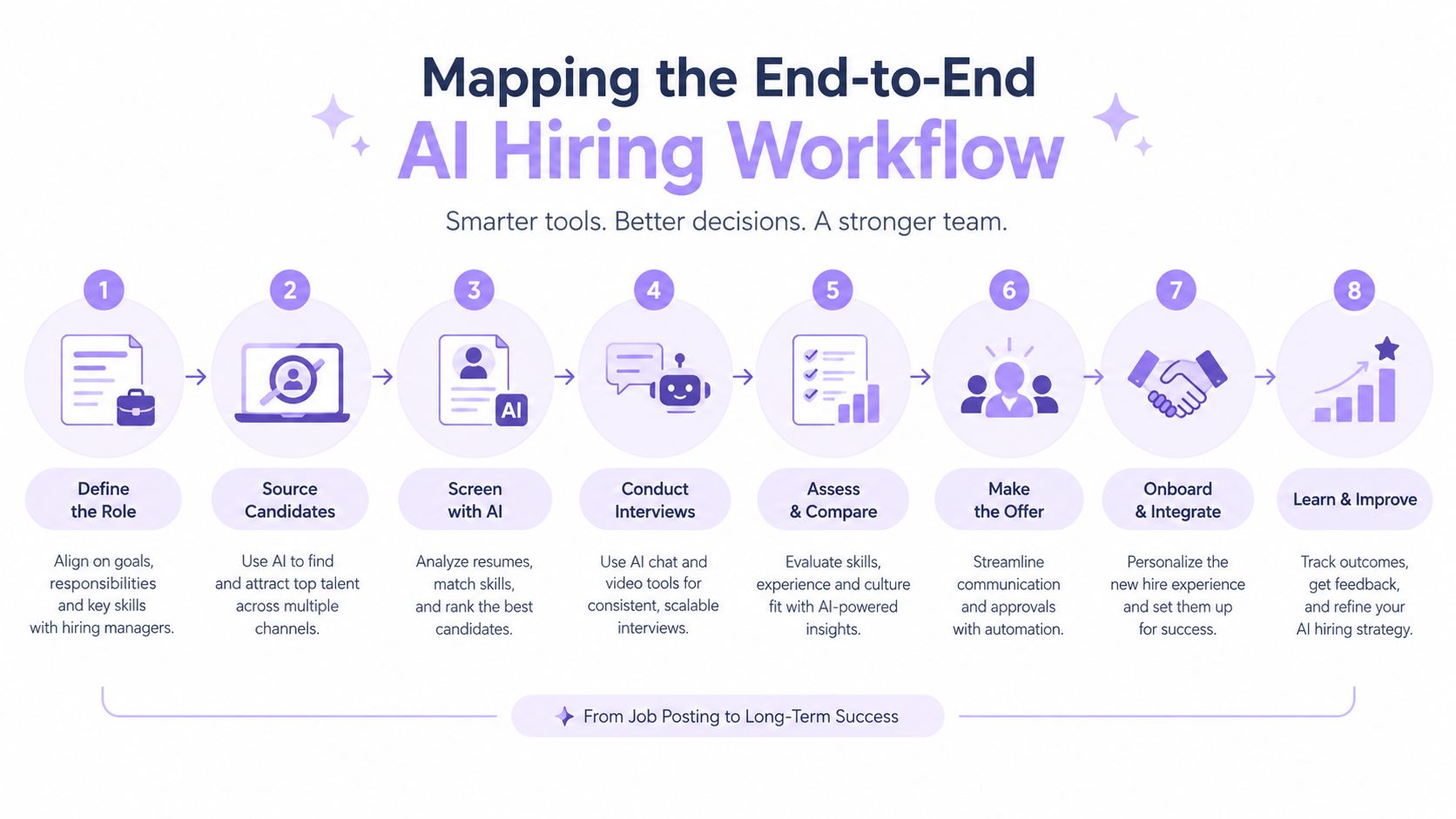
Candidate data enters through applications, resumes, questionnaires, references, and credential records. An AI system may source across job boards or internal talent pools, parse employment dates and certifications, rank candidates against the role criteria, and send automated questions about shift availability, remote-work arrangements, certification status, or willingness to work on-site. Assessment results can then trigger scheduling, while an ATS or HRIS preserves the decision trail.
The handoffs need explicit ownership:
| Stage | Automation can support | Human checkpoint |
|---|---|---|
| Requisition intake | Structure requirements and identify missing fields | Manager approves essential duties and exclusions |
| Candidate intake | Parse resumes and standardize fields | Recruiter checks extraction accuracy |
| Initial screen | Ask consistent job-related questions | Reviewer handles exceptions and ambiguous answers |
| Assessment | Score defined skills or simulations | Manager evaluates context and accommodations |
| Interview | Schedule, remind, and organize notes | Interviewers assess behavior, judgment, and rapport |
| Verification | Gather references and credential documents | Authorized staff verify status and discrepancies |
| Offer and onboarding | Trigger forms and tasks | Practice approves compensation and start conditions |
The final clinical-fit decision, salary approval, and assessment of patient-facing rapport should remain with people. AI can surface evidence, but it can't carry the professional responsibility for those conclusions.
Candidate records aren't automatically Protected Health Information just because the employer is a medical practice. However, applications can contain sensitive personal information, and a hiring workflow may intersect with patient information if staff reuse clinical systems, upload patient examples, or test candidates with real records. Keep recruiting data separate from production patient data, minimize collection, control access, and confirm where the vendor stores and processes information.
For remote healthcare staff, security also includes the working environment. The workflow should record whether the candidate can use a private workspace, approved devices, secure connectivity, and appropriate procedures without treating a home-office answer as a substitute for a formal compliance review. Before implementation, have counsel or a qualified privacy professional assess the vendor relationship, contracts, retention settings, and applicable state requirements.
AI sourcing works best when the practice defines evidence before reviewing applicants. For a medical assistant, that might include recent clinical duties, EHR familiarity, certification status, patient population, and schedule. For a remote biller or prior-authorization coordinator, it may include payer workflow experience, documentation accuracy, and familiarity with the systems your team uses. For a receptionist, bilingual communication, appointment volume, and escalation habits may matter more than clinical terminology.
Resume parsing can extract employment dates, facility types, patient populations, certifications, and stated language ability. It can also flag gaps or missing documents for review. A practice might configure an automated question about an expired certification, identify a stated employment gap longer than 90 days, or prioritize recent clinical volume. Those rules must be treated as review signals, not proof that a candidate is unsuitable. A career break, for example, may reflect caregiving, relocation, education, or incomplete resume information.
Screening criteria should match the work:
Use this cut recruitment hype guide to pressure-test vendor claims, especially when a product promises to infer personality, loyalty, or “culture fit” from weak proxies.
Keep the model from making unsupported inferences about age, disability, ethnicity, accent, family status, health, or personality. Don't allow an AI score to override a required credential review, and don't treat keyword absence as evidence that a candidate lacks a skill. Store the original application alongside the parsed output so a reviewer can correct extraction errors.
A practical review checklist includes:
AI-assisted assessments and human-led interviews solve different problems. A structured assessment can produce consistent results for EHR data entry, appointment scheduling, HIPAA knowledge checks, or authorization simulations. A human conversation is better suited to evaluating how someone explains a difficult situation, handles an upset patient, recognizes a boundary, or responds when the workflow doesn't match the script.
AI-led interviews can be asynchronous video sessions, chatbot screens, or recorded answers to standardized questions. They may help applicants in different time zones and reduce scheduling work, but convenience doesn't make the evaluation fair or useful. By September 2026, 63% of active job seekers had already been interviewed by AI, according to CNBC's reporting on AI interviews. The same coverage reports that 68% of surveyed technology professionals distrusted fully AI-driven hiring, while 92% believed AI screening could miss qualified applicants who don't optimize for keywords.
Use automation to present the same job-related prompt and collect structured information. Keep a trained interviewer responsible for:
Tell candidates when AI is involved, what it evaluates, whether a human reviews the output, how recordings are retained, and how to request an accommodation. Don't make candidates guess whether facial movements, voice patterns, writing style, or response speed affect their result. A transparent process can still be rigorous.
Candidate trust deserves operational attention. Gartner reports that only 26% of applicants trust AI to evaluate them fairly, 32% worry AI could cause their application to fail, and 25% say AI use reduces their trust in employers, as described in Gartner's applicant trust findings. In healthcare, where staff represent the practice to patients, a cold or opaque process can undermine the relationship before the first shift begins.
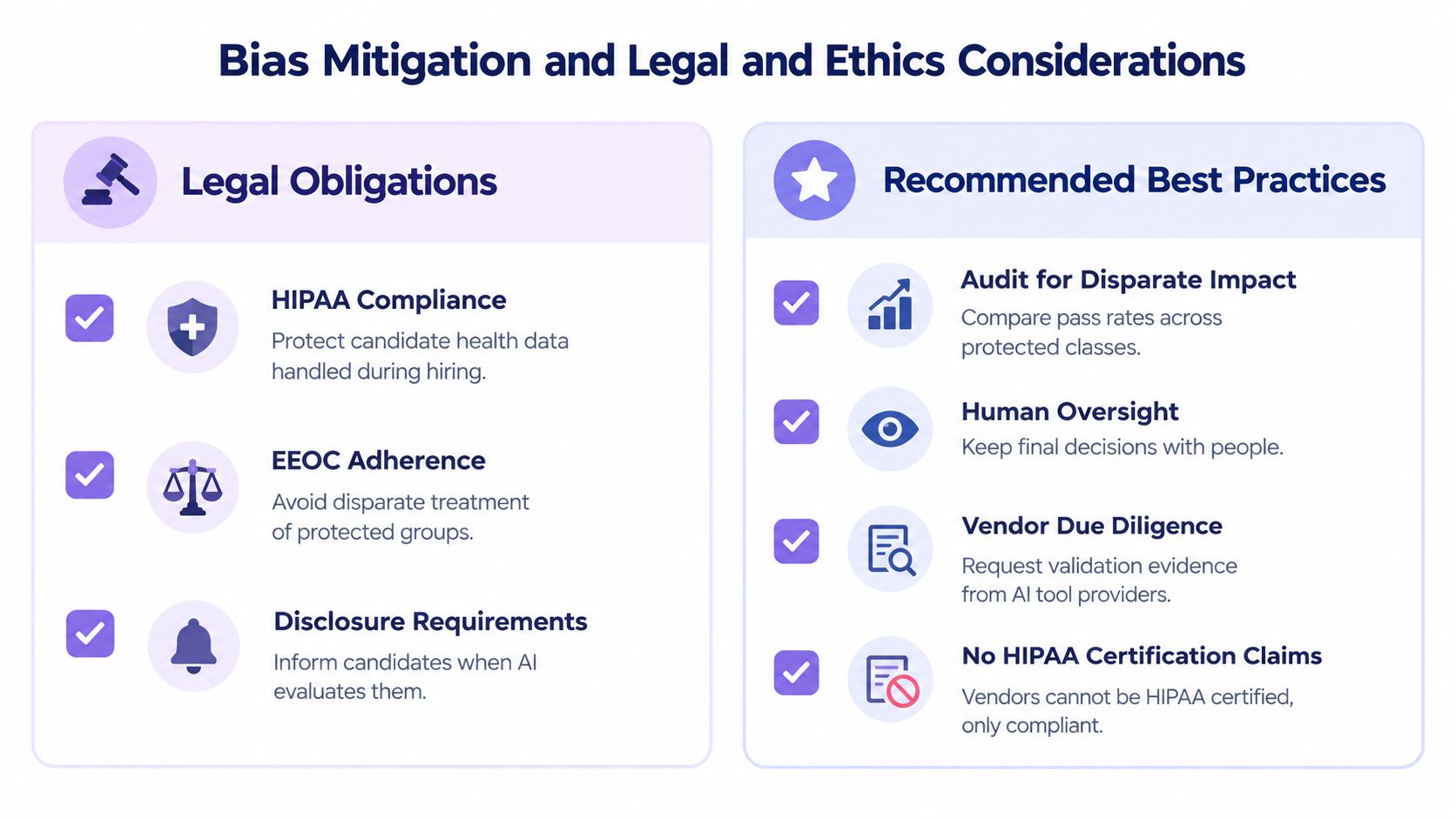
A remote medical assistant may handle scheduling data, messages, or insurance details before the first interview ends. That makes AI hiring a compliance decision as well as an efficiency project. HIPAA, employment discrimination rules, disability requirements, state AI laws, and privacy obligations address different risks. HIPAA applies to protected health information and covered workflows, while employment law addresses fair treatment and discriminatory effects. A vendor's security statement does not settle either issue, and no official HHS-recognized “HIPAA certification” replaces a practice's own compliance analysis.
List every point where an algorithm influences an employment decision. For each step, identify the data used, the features scored, the groups potentially affected, the available human override, and the records retained. Review video tools, chatbots, tests, and screening systems for barriers affecting applicants with disabilities. The EEOC's technical assistance on AI and disability discrimination can support that review.
A bias audit should compare selection outcomes across relevant protected groups where lawful and practical. Investigate material differences, record the explanation, and document the corrective action. Reported reviews of AI bias audits found that 85% of AI systems met accepted fairness thresholds, with average outcomes reported as up to 45% fairer for racial minorities and 39% fairer for women than the human-led processes they replaced. Those findings do not establish that a particular healthcare tool is safe. They show why a practice should test its own funnel instead of assuming that either human reviewers or AI are automatically fair.
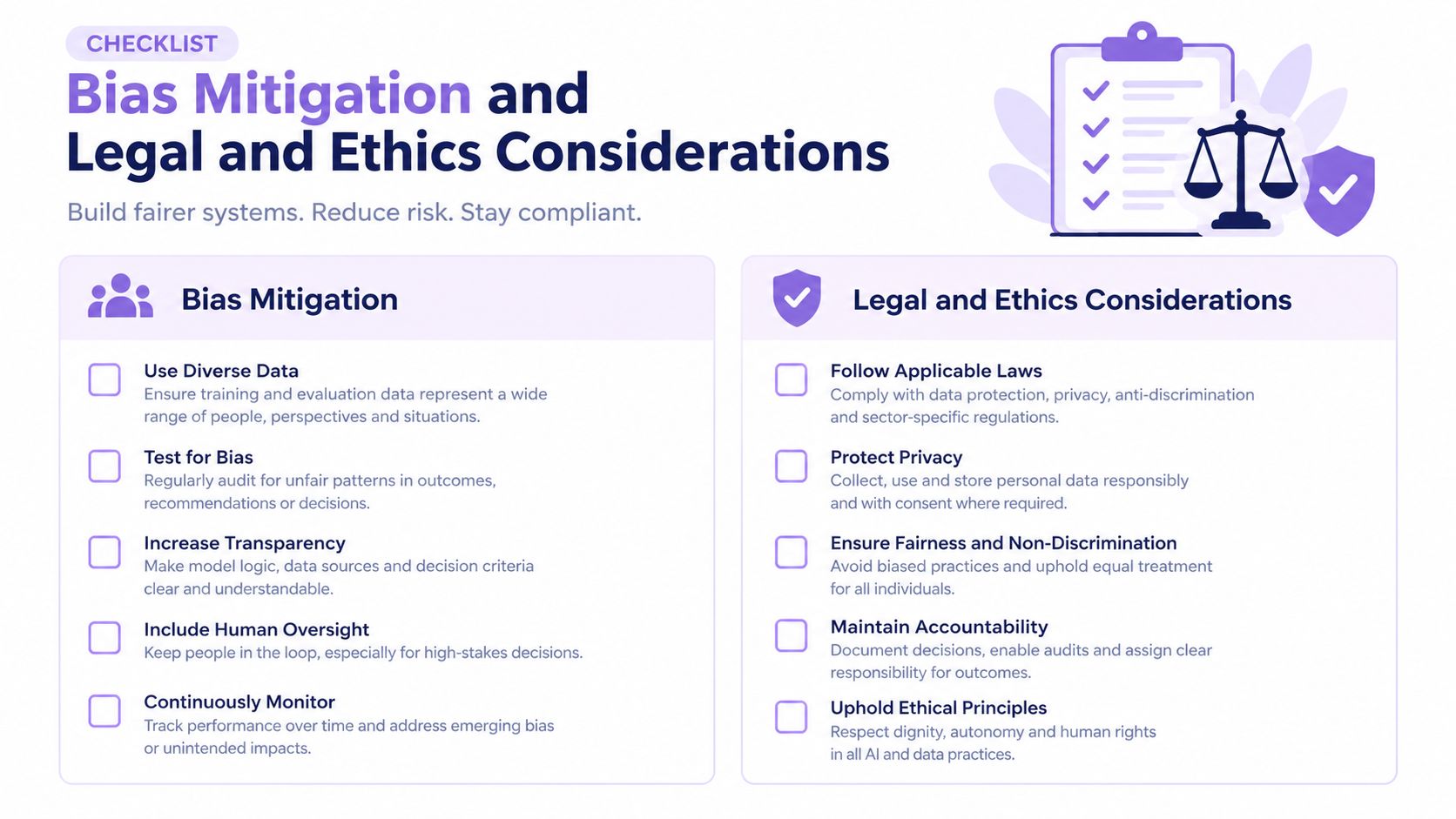
Ask the vendor to identify its data sources, scoring inputs, retention controls, subprocessors, model-change process, accessibility approach, audit evidence, and human-review options. Confirm whether a Business Associate Agreement fits the data and service involved. Ask how the vendor supports the practice's compliance duties, including access controls, deletion requests, incident response, and review of model changes. “HIPAA certified” is not a sufficient answer.
State requirements can change quickly. Illinois has enacted employment-related AI provisions that make notice and discriminatory-effect questions especially relevant, while other jurisdictions may take different approaches. Have qualified employment and privacy counsel review candidate notices, accommodation procedures, retention schedules, and background-reporting implications before deployment. For clinical roles, review state licensure requirements separately, especially when remote staff support patients located in another state.
Start with a defined staffing problem, not a product demonstration. A remote scheduler, billing assistant, or prior-authorization coordinator can work well for a pilot because the workflow is repetitive and success criteria are visible. Map the current process from requisition to start date. Record duplicate data entry, handoffs, and points requiring professional judgment.
Use this sequence:
For remote healthcare staffing, verify licensure for the state where the patient is located, not only the state where the candidate lives. Telehealth compacts and state rules can affect eligibility. Before advancing an applicant, ask structured questions about the candidate's home workspace, privacy, device security, and HIPAA procedures. The same practical checks appear in this guidance on faster remote healthcare hiring.
A practice may use a service such as Medical Virtual Assistants to access pre-vetted LATAM healthcare talent, including bilingual professionals and candidates aligned with U.S. working hours. Treat that service as a staffing source, not a substitute for internal controls. Define the person's responsibilities, verify applicable credentials, limit access to systems and patient information, and specify which administrative tasks they may perform.
Generic job descriptions create weak screening criteria. If a tool ranks candidates before managers define human review, it may reward matching keywords instead of competence. A practice can also create unnecessary privacy exposure by storing interview recordings with a vendor before deciding who may access them, how long they are retained, and how deletion requests are handled.
Set the implementation cadence around staff capacity, vendor review, policy approval, and pilot feedback. Do not expand because the first screens appear efficient. Expand after reviewers can explain recommendations, candidates understand the process, and the practice can document that its controls operate as intended.
A dashboard should answer four separate questions. Is the practice moving candidates efficiently? Are new hires capable and reliable? Do candidates understand and complete the process? Can the practice demonstrate that its controls operate as designed?
Don't compare every small weekly movement. Hiring volume fluctuates, especially in a small practice. Review results on a 30, 60, and 90-day cadence, using the ATS, HRIS, credentialing records, supervisor evaluations, candidate surveys, and audit logs together.
| Metric | Family | Data Source | Baseline Range | Alert Threshold |
|---|---|---|---|---|
| Time-to-fill | Speed | ATS and HRIS | Establish during pilot | Escalate when the AI path is slower than the prior documented process |
| Time-to-first-interview | Speed | ATS | Establish by role | Review when scheduling delays persist across comparable openings |
| Screening-to-offer rate | Speed and quality | ATS | Establish by role | Investigate abrupt changes after a model or rubric update |
| 90-day retention | Quality | HRIS | Establish by role | Review when new-hire departures cluster around one source or workflow |
| Licensure pass rate | Quality and compliance | Credentialing system | Expect role-specific verification | Escalate any preventable failure before start |
| Supervisor-rated competency | Quality | Structured 30, 60, and 90-day reviews | Establish with managers | Review when scores conflict with screening recommendations |
| Assessment completion rate | Candidate experience | Assessment platform | Establish during pilot | Investigate candidate drop-off after a new step is added |
| Offer-acceptance ratio | Candidate experience | ATS and HRIS | Establish by role | Review alongside candidate comments and process changes |
| Adverse-impact ratios | Compliance | ATS and HR analytics | Establish with counsel | Escalate material differences for qualified review |
| Audit-log completeness | Compliance | ATS, vendor logs, policy records | Target complete decision records | Treat missing records as a control failure |
| Consent capture rate | Compliance | ATS and assessment platform | Target complete capture | Pause the affected workflow when required consent is missing |
One metric rarely explains a hiring problem. A faster funnel with declining 90-day retention may be selecting for availability rather than capability. Strong acceptance with poor candidate feedback may indicate that applicants want the job but dislike the process. Review the evidence by role, location, shift, and applicant group where legally appropriate.
An AI hiring process earns its place in a medical practice when it protects licensure, HIPAA obligations, accessibility, and patient-facing accountability. Use AI for repetitive work and structured evaluation. Keep people responsible for clinical fit, unclear records, accommodations, compensation, rapport, and the final decision.
A practice manager can start with three actions:
Remote staffing still requires role-specific controls. Medical Virtual Assistants can be one option for sourcing pre-vetted LATAM healthcare professionals. Confirm state requirements, define permitted access to patient information, and document supervision, escalation, and language expectations.
For a remote scheduler, biller, prior-authorization coordinator, or medical administrative assistant, assess workflow knowledge, availability, language ability, and privacy controls before discussing candidates. The practice should retain the final hiring decision and verify that the person can work safely within its patient-facing processes.