

A practice manager hires a bilingual virtual receptionist in Colombia to answer calls, schedule appointments, and follow up on referrals. The arrangement looks straightforward until the assistant needs access to patient records, works the practice's fixed hours, uses its systems, and receives detailed instructions about how every task must be completed. At that point, the legal and compliance requirements for LATAM staff extend far beyond signing a contractor agreement and sending an international wire.
For a U.S. medical practice, the practical framework has four connected parts: worker classification, international payroll, healthcare privacy, and written contracts. You also need to account for local employment rules, state-specific obligations, cross-border clinical licensing where applicable, and the controls that protect patient information. This guide explains how to evaluate those risks, when an employer of record can reduce administrative exposure, and how to build an onboarding workflow that practice owners and managers can maintain.
The appeal is understandable. A remote medical receptionist or administrative assistant in Latin America may offer strong communication skills, overlapping U.S. working hours, and experience supporting patient-facing workflows. A practice can extend phone coverage, reduce pressure on an in-office team, and keep referral or authorization work moving without adding another person to the physical office.
The risk appears when the practice treats the arrangement as ordinary outsourcing. A remote worker may be physically outside the United States, but the practice still controls access to its electronic health record, call platform, scheduling rules, escalation process, and patient communications. Those facts can create obligations under U.S. privacy law, tax and employment rules, and the worker's home-country labor framework.
Practical rule: The location of the worker is only one part of the analysis. The work performed, the degree of control, the data accessed, and the legal structure all matter.
The compliance exposure usually develops across several connected decisions:
The pressure is not theoretical. One independent 2026 benchmark reports that cumulative GDPR fines exceeded €7.1 billion from 2018 through mid-2025, with €1.15 billion issued in 2025 alone. The same benchmark reports an average of 443 daily GDPR breach notifications in Europe in 2025, although a U.S. practice must still determine whether GDPR applies to its own activities rather than assuming every international arrangement is covered (employer compliance statistics).
Global mobility can support a deliberate staffing strategy, but it needs operational discipline. Resources such as global mobility come leva strategica can help managers think beyond recruitment and consider how legal structure, payroll, workforce planning, and data governance fit together. For a medical practice, the right objective isn't just to hire abroad. It's to create a repeatable system in which every remote role has a documented classification, defined access, and accountable employment structure.
Calling someone a contractor doesn't make them one. The Internal Revenue Service applies common-law principles based largely on the practice's right to control what the worker does and how the worker performs it. The IRS guidance on independent contractors and employees specifically states that working remotely doesn't change the analysis. A practice can still have an employment relationship when it controls the details of performance from a distance.
That distinction matters for medical virtual assistants because many roles are integrated into the practice. A scheduler may work assigned hours, follow a written call script, use the practice's software, attend team meetings, and obtain approval before changing an appointment. A billing support specialist may follow payer-specific procedures established by the practice and handle tasks that are central to revenue operations. Those facts can point toward employee status even if the person invoices monthly.
Look at the relationship in practice. The most useful review examines behavioral control, financial structure, and integration into the business.
Behavioral control includes who sets the schedule, trains the worker, determines the process, reviews performance, and decides which tools must be used. A worker who independently determines the method, sequence, and timing of work has a different profile from someone required to follow a practice-designed workflow during fixed hours.
Financial control includes whether the worker can advertise services to other clients, make a profit or loss through business decisions, provide their own equipment, and bear meaningful operating expenses. Exclusivity, guaranteed regular payments, and reliance on one practice can increase classification risk, although no single factor decides the outcome.
Integration asks whether the work is a key part of the practice's ordinary operations. A virtual receptionist who answers patient calls and schedules visits is more integrated into daily operations than a specialist hired for a discrete, project-based technology task.
The Department of Labor's misclassification guidance warns that misclassification can deprive workers of minimum wage, overtime pay, and other protections. For a medical practice, exposure may also involve payroll corrections, tax issues, back pay, and disputes over the worker's rights.
Role design should happen before recruitment. A virtual receptionist can collect demographic information, route calls, confirm appointments, and communicate approved instructions. A patient coordinator can organize referrals and track outstanding documents. An insurance verification specialist can gather benefit information and record payer responses. None of those descriptions should imply authority to diagnose, interpret symptoms, recommend treatment, or make independent clinical decisions.
Clinical work raises a separate question. The HHS telehealth licensing guidance explains that cross-state practice may depend on a full state license, temporary practice rules, reciprocity, compact membership, or telehealth registration. A remote worker located in LATAM doesn't automatically gain authority to provide care to a patient in a U.S. state.
Before onboarding, document:
A contractor classification review resource may help organize the questions, but it shouldn't replace advice from qualified employment counsel when the relationship is substantial, exclusive, or operationally integrated. If the facts point toward employment, restructure the engagement rather than relying on a more forceful contract label.
International payroll isn't a payment method. It's a system for calculating local tax withholding, statutory contributions, currency requirements, wages, leave, benefits, notice, and termination obligations. A practice that sends a monthly payment to a worker without addressing those items may be paying the invoice while leaving the legal relationship unresolved.
The rules differ across Latin American countries, and they can also differ depending on whether the person is an employee, an independent professional, or engaged through an employer of record. The global payroll guidance from ADP describes the problem as a multi-country process involving local income tax withholding, social security or equivalent contributions, local currency requirements where applicable, and country-specific wage, overtime, notice, and benefits rules.
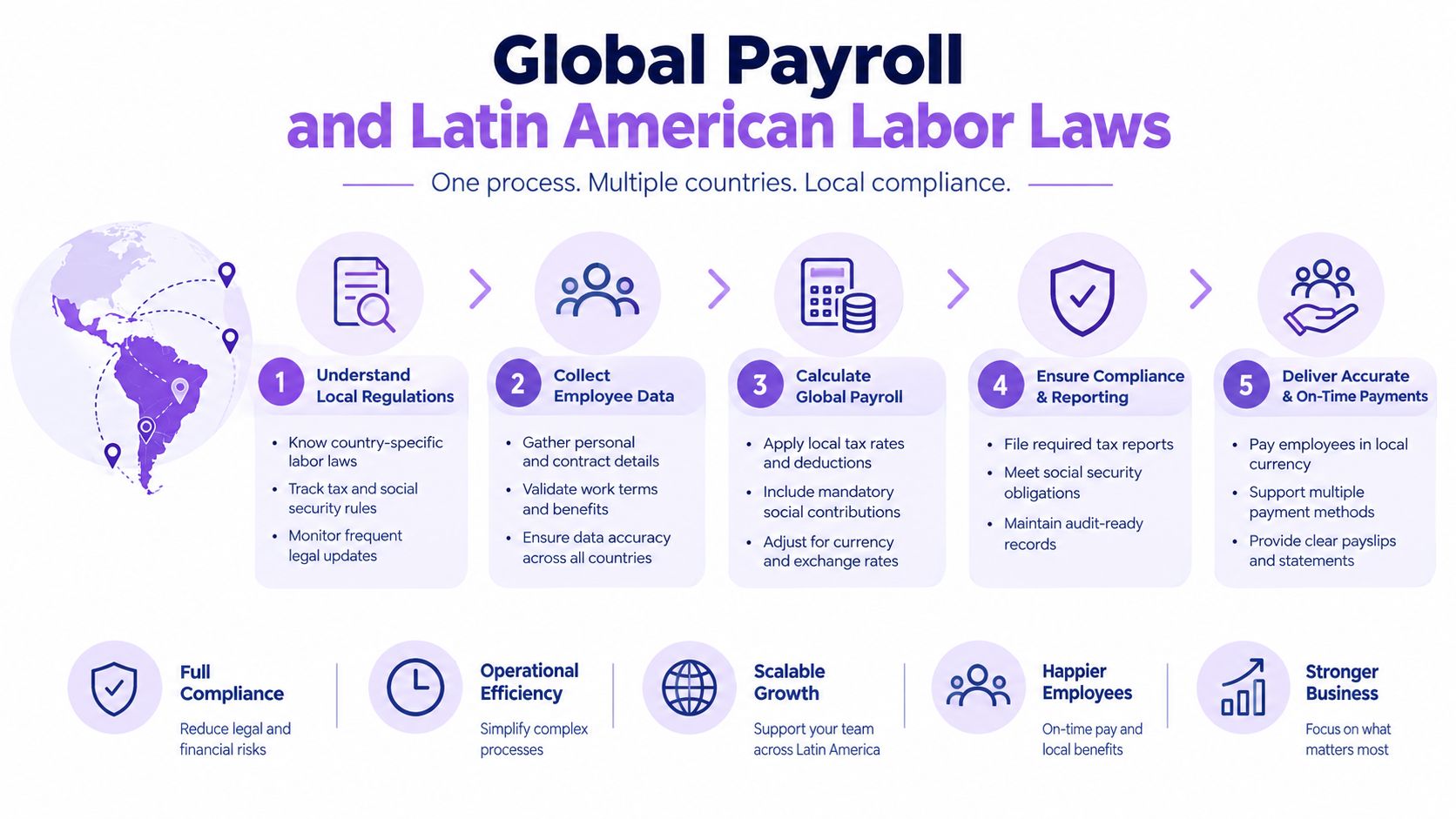
A practice pursuing a direct hire may need to establish a local employment structure, register with relevant authorities, calculate payroll, remit contributions, maintain required records, and administer leave and termination correctly. The practice may also need local advice on mandatory contract language, working time, severance, holidays, probation, benefits, and restrictions on termination.
The operational burden doesn't end after the first payment. A change in the worker's schedule, duties, compensation, location, or reporting relationship can affect the analysis. Termination is particularly sensitive because local law may require notice, documented grounds, consultation, or statutory payments that aren't obvious from a U.S.-style agreement.
A single error can spread across several systems. An incorrect classification can produce the wrong contract. The wrong contract can result in incorrect payroll treatment. That can affect statutory contributions, leave records, benefits, and the final payment when the relationship ends. This is why practices should avoid treating payroll as an accounting task isolated from hiring and compliance.
An employer of record generally employs the worker locally while the U.S. practice directs the day-to-day work. The EOR typically manages local employment contracts, payroll calculations, statutory remittances, required benefits, and employment administration under the applicable country framework. The practice still needs to control the role responsibly, protect patient information, and verify that the EOR's scope matches its needs.
An EOR doesn't eliminate risk. You still need to review the service agreement, understand who handles employee records, confirm how privacy obligations flow through the arrangement, and establish an escalation process for payroll, leave, performance, and termination questions. The practice also pays for administrative support and may have less flexibility than it would under an informal contractor arrangement.
Use a country-specific payroll or employment review before the worker starts. A payroll compliance checklist for international hiring can help managers collect the information required for that review.
Assign ownership for each recurring responsibility. The practice manager may approve hours and compensation changes. The payroll provider or EOR may calculate withholding and contributions. The compliance lead may review access and documentation. Local counsel may advise on a new country, a termination, or a material change in duties.
Keep a country file containing the signed agreement, classification analysis, payment records, leave documentation, tax and contribution confirmations, and termination procedure. Don't assume that a vendor invoice proves compliance. It proves that money moved, not that the underlying employment obligations were satisfied.
For a U.S. medical practice, the worker's access to patient information is often the most immediate operational concern. A receptionist may see names, phone numbers, appointment details, insurance information, and messages. A referral coordinator may access clinical documentation needed to route a referral. A billing assistant may handle claims data and explanations of benefits. The role can be administrative while still involving protected health information.
The Health Insurance Portability and Accountability Act doesn't create an official “HIPAA certified” designation for individuals or vendors. Training can be useful, but a certificate alone doesn't establish that the practice has selected an appropriate vendor, limited access, or implemented the required safeguards.
The HHS guidance on business associates states that HIPAA requires a written business associate contract or other arrangement when a covered entity engages a business associate to perform healthcare activities or services involving protected health information. The agreement must define permitted and required uses and disclosures of PHI, and it must require the business associate not to use or disclose PHI beyond what the agreement or law allows.
The practice should determine the relationship before granting access. If a staffing company, EOR, or other service provider handles PHI on the practice's behalf, assess whether that organization is acting as a business associate and whether a BAA is required. If the remote individual is employed directly by the practice, the practice still needs appropriate workforce policies, training, access controls, and documented supervision.
A BAA should align with the actual workflow. It should address permitted uses, safeguards, reporting of incidents, subcontractors where relevant, access to records, return or destruction of PHI, and termination consequences. A generic confidentiality clause isn't a substitute for analyzing the HIPAA relationship.
Contract language won't protect a practice if the workflow gives a worker excessive access. Start with the minimum information needed for the assigned task.
Use individual accounts, multifactor authentication, role-based permissions, secure device settings, and documented incident escalation. These are recommended security practices that support a defensible program. They aren't a replacement for identifying which HIPAA rules apply to the practice and its vendors.
A manager reviewing a vendor agreement can use an AI contract review service to flag missing provisions or inconsistent language, but the output should be reviewed by qualified counsel. Automated review can help with organization. It can't decide whether a particular workflow makes a provider, staffing company, or remote worker a business associate.
Privacy test: If the assistant can see patient information, ask exactly why that access is necessary, what system grants it, who reviews it, and what happens when the engagement ends.
The EOR versus direct-hire decision is a structural choice, not merely a vendor comparison. Direct hiring can provide more control over the relationship and may fit a practice with a sustained presence in a particular country, internal human resources capability, and access to local legal and payroll support. An EOR can reduce the need for the practice to build that infrastructure, but it adds service fees, third-party dependencies, and a need to supervise the provider carefully.
A contractor arrangement may appear simpler, but it carries the greatest danger when the worker performs an ongoing, closely managed role. A practice shouldn't choose the contractor label because it is cheaper or faster if the actual relationship resembles employment. The business model must follow the facts of the role.
| Feature | Employer of Record (EOR) | Direct Hire / Contractor |
|---|---|---|
| Local employment structure | The EOR generally employs the worker under local law | The practice must establish or manage the appropriate legal structure |
| Payroll administration | The EOR typically calculates payroll and handles statutory remittances | The practice or its payroll provider handles country-specific requirements |
| Local benefits and leave | The EOR administers applicable obligations | The practice must identify and administer them correctly |
| Day-to-day direction | The practice directs operational work and performance | The practice directs the work, subject to the legal relationship |
| Control and flexibility | A third party manages employment administration | The practice has more direct control, but also more responsibility |
| Setup and maintenance | Faster to operationalize in countries supported by the EOR | More involved, especially when the practice lacks local infrastructure |
| Main trade-off | Service cost, vendor oversight, and contract dependency | Legal, payroll, registration, and administrative burden |
| Best fit | Practices testing a country or hiring without a local entity | Practices with durable country presence and local compliance resources |
An EOR often fits a small or midsize practice hiring its first worker in a country. It can be useful when the practice doesn't want to form a local entity, doesn't have local payroll expertise, or expects to hire across multiple countries. The provider may handle employment records, payslips, statutory benefits, and required remittances under the local framework.
That convenience comes with due diligence. Ask who is the legal employer, who signs the employment agreement, how termination decisions are implemented, where worker records are stored, and how the EOR handles patient information. Confirm that a BAA or equivalent arrangement is in place when the provider's services involve PHI.
A platform such as LatHire's employer of record model may combine talent sourcing with international payroll and compliance administration. Treat that as one possible operating model, not a substitute for reviewing the specific service agreement and the role's privacy requirements.
Direct hire may be appropriate when a practice has a local entity, trusted counsel, established payroll infrastructure, and a long-term staffing plan in one jurisdiction. It can provide more direct ownership of employment policies and a closer connection between the practice and the worker.
It isn't automatically lower risk. The practice must maintain accurate records, monitor local changes, handle leave and benefits, and apply a legally sound termination process. Before choosing direct hire, calculate the internal time required to manage those functions and identify the person accountable for each one.
The legal and compliance requirements for LATAM staff should be handled as one workflow. Worker classification affects the contract. The contract affects payroll and local labor obligations. The role determines privacy access, and privacy access determines whether a business associate arrangement, additional safeguards, or a narrower workflow is needed.
A practice manager can use the following checklist before approving a remote hire:
Payment controls deserve their own review. Confirm the recipient, approval process, currency, records, and provider responsibilities before the first transfer, particularly when the practice uses multiple corridors or vendors. A practical compliance checklist for money transfer corridors can help finance and operations teams identify transfer-related questions without confusing payment execution with employment compliance.
A 2026 compliance survey found that 80% of organizations update compliance policies yearly, compared with 63% in 2020, while another benchmark found that only 32% take a proactive approach to employment law compliance despite 61% reporting that they are very or completely confident they are fully compliant (HCM compliance benchmarks). The lesson for medical practices is straightforward: confidence isn't a control. A documented review process is.
If you're evaluating bilingual LATAM receptionists, patient coordinators, schedulers, billing support, or administrative assistants, start with the role and access map before comparing candidates. Medical Virtual Assistants can help practices source pre-vetted LATAM healthcare talent, but the practice remains responsible for choosing an appropriate structure, limiting PHI access, and confirming obligations with qualified legal and compliance professionals.
If your practice is preparing to hire remote healthcare staff, review one current role against this checklist before opening recruitment. Document the classification, payroll model, privacy access, and offboarding plan, then consult qualified counsel or a compliant hiring partner to resolve gaps before the worker receives patient or practice-system access.