

A global payroll manager becomes essential when paying people abroad stops being a calculation task and becomes a control problem. A 2024 payroll-complexity report cited by Bloomberg Tax found that approximately 53% of global businesses had incurred payroll penalties during the previous five years, and the reported share rose from about 24% among organizations operating in only one country to 67% among organizations operating in multiple countries. That gap is the clearest case for the role. For U.S. medical practices, the lesson is narrower but related. You may never need this hire full time, yet you still need the discipline behind it whenever remote staff, medical virtual assistants, payroll vendors, or cloud tools touch pay data, work location records, or patient information.
A global payroll manager owns pay accuracy, statutory compliance, and payroll reporting in every country where the company employs or pays people. They set common standards, coordinate local execution, and prove each cycle was complete before money moves. A domestic payroll owner usually works inside one tax regime, one currency, and one main calendar. The global role works across several of each at the same time, often through providers they don't directly manage day to day.
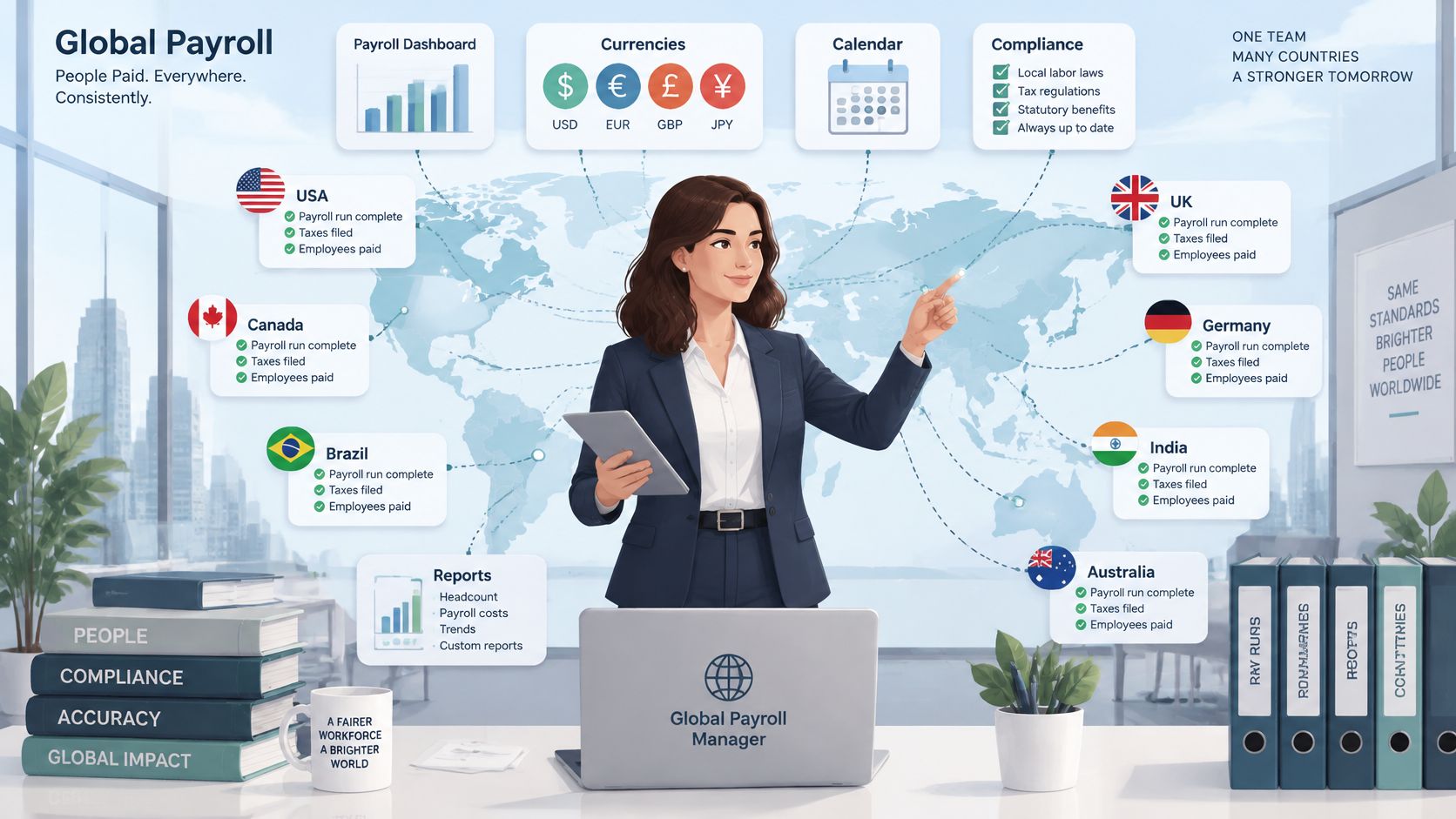
The scale is real, not theoretical. The 2025 Global Payroll Week survey found that more than 36% of 585 respondents reported managing payroll in at least six countries, while 7% managed payroll in 51 or more countries. At that footprint, nobody can rely on memory for withholding rules, social insurance, payslip requirements, benefits deductions, or filing dates. The manager builds repeatable controls that local teams can run without waiting for headquarters to interpret every exception.
Say a 90-person company has staff in the United States, Canada, Mexico, and Germany. It now runs four pay calendars, several currencies, separate employing entities, and different withholding and reporting rules. Each local provider may calculate correctly, but no single local team sees late HR changes, funding cutoffs, general ledger coding, and cross-country headcount together. Errors usually start at those joins. The global payroll manager owns the joins.
Practical rule: Hire for control when providers multiply faster than anyone can review their inputs, outputs, and deadlines.
You don't always need the title. A single foreign hire, or a contractor-only arrangement, can often be handled by a domestic payroll owner working with a competent local provider. That breaks down when you add recurring pay cycles in several countries, monthly employee changes, or finance reporting that must tie by entity and country. Before you write the job description, inventory every country, entity, pay frequency, worker type, payment method, and provider. If you can't list them cleanly on one page, that's your first project, not a recruiting brief.
The governing rule is simple. The global payroll manager owns controls and evidence even where HR owns employee data, finance owns funding, and local specialists own calculations. Outsourcing a calculation doesn't outsource your need to know whether inputs were complete, approvals happened, and the register reconciles.
Say an employee in Spain changes role and pay rate on the 20th. HR records it in the HRIS, but the change file never reaches the local provider, so payroll runs on the old rate and the error surfaces next cycle as a correction, a payslip query, and a journal adjustment. HR didn't set out to cause a payroll error. The intake control failed because nobody confirmed that approved changes, effective dates, and provider receipt matched before the cutoff. That's exactly the kind of handoff the global manager should own.
| Area | Typical tasks | Usual owner | Common failure point |
|---|---|---|---|
| Employee data and changes | Hires, pay-rate changes, status changes, terminations | HR with global payroll review | Changes entered late or not sent to local providers |
| Pay calculation | Gross-to-net, overtime, allowances, leave accruals | Country payroll specialists under the global manager | Local rule updates not applied |
| Tax and social contributions | Withholding, employer and employee contributions, filings | Local providers or in-house country leads | Missed deadlines and incorrect registrations |
| Payment execution | Funding, currency conversion, bank file release | Finance treasury with payroll | Dual approval skipped under time pressure |
| Reconciliation | Payroll register to general ledger and funding files | Global payroll manager with finance | Variances carried forward without explanation |
| Reporting | Cost by entity and country, headcount, variance analysis | Global payroll manager | Reports built from unreconciled data |
| Exception management | Missing inputs, late changes, reversals, corrections | Global payroll manager | Exceptions resolved in email with no log |
Put that ownership into a short RACI-style agreement. Name who's responsible, accountable, consulted, and informed for change intake, cutoff exceptions, bank-detail changes, filing confirmations, funding release, and post-pay corrections. Have HR, finance, and each provider sign it, then review it quarterly and after any country launch or provider change. Ownership that lives only in a job description rarely survives the first audit, resignation, or urgent off-cycle payment.
Smaller companies often combine this role with HR operations or finance. That can work, but only if controls are written down and another person can run the cycle during leave. I'd rather see a part-time owner with a clean exception log, cutoff checklist, and reconciliation pack than a senior hire who keeps the process in their head. The test isn't whether tasks got done this month. It's whether someone else can prove how they got done.
Two skills fail most often in this hire. Candidates know payroll rules for one country but can't design controls that work across countries, or they manage providers politely without forcing clear inputs, confirmations, and escalation dates. Strong candidates talk about data lineage, exceptions, and evidence without prompting. They can explain how a change moves from HRIS to payroll to the general ledger, and where they'd stop the cycle if something doesn't tie.
Communication matters as much as technical knowledge. The role spends much of its time getting timely information from local teams, finance partners, and providers in other time zones. A candidate who writes vague reminders will struggle. You need someone who can state the missing item, the deadline, the consequence of missing it, and the fallback decision in plain language.
| Competency | Strong performance looks like | Interview test |
|---|---|---|
| Multi-jurisdiction rule monitoring | Names a current source for rule changes and a process for applying them | Ask how they learned of their last local rule change and how they tracked its effect |
| Control design | Describes approvals, reconciliations and evidence kept for each cycle | Ask which control would have caught a wrong bank detail change |
| Systems and data integration | Traces an employee change from HRIS to payroll to general ledger | Give a census with conflicting dates and ask what they check first |
| Vendor and provider management | Sets service levels, escalation paths and review cadence | Ask how they would replace a local provider mid-year |
| Stakeholder communication | Gets timely inputs from local teams and explains variances to finance | Role-play a deadline reminder to a provider who has not responded |
Give the candidate a sample census with three employees whose dates, currencies, or entity codes conflict. Ask what they check first, who they contact, and how they'd prevent the same error next month. A strong answer starts by freezing the affected records, checking source documents and effective dates, and adding a validation or exception report. A weak answer jumps straight to recalculating pay.
Use a second scenario for judgment under time pressure. Ask how they'd respond to a missed local filing deadline discovered two days before the due date. Listen for immediate escalation, confirmation of the actual statutory date, a documented recovery plan, and a calendar fix afterward. Red flags include reliance on memory for rules, no change log, and an inability to name a control they've personally run.
Balance matters too. A candidate with deep knowledge of one region may still be the right hire if local advisers cover the rest of your footprint. Language skills also matter where you employ staff in Spanish-speaking or Portuguese-speaking countries, especially when payslip queries or provider escalations happen in the local language. Hire for the footprint you have and the next country you're likely to add, not for an imaginary global map.
Multi-country payroll penalties rarely come from one dramatic mistake. They usually come from ordinary misses repeated across calendars, a registration nobody renewed, a contribution paid after the local cutoff, or a filing confirmed by email but never evidenced. The manager's job is to make those misses visible before they're expensive. A working payroll compliance checklist helps only if every line has a named owner, a due date, and proof of completion.
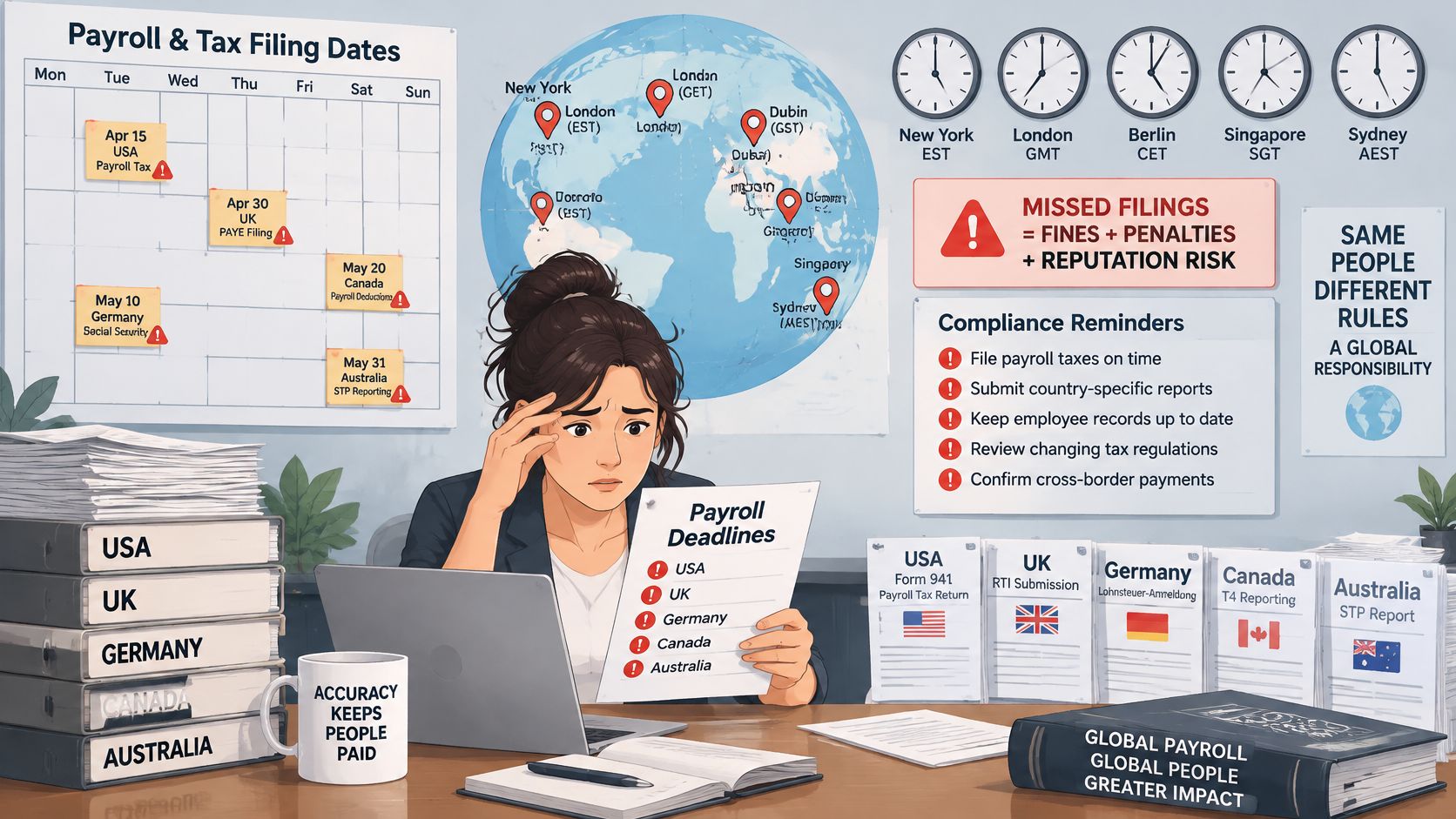
Build one master calendar by country and entity. Include pay dates, input cutoffs, provider delivery dates, tax and social contribution deadlines, payslip duties, year-end forms, and funding lead times. Reconcile each payroll period against that register, and use an escalation rule for anything late, for example same-day notice to finance and legal once a statutory date is at risk. Keep filing confirmations with the payroll pack, not in a provider inbox. If you can't retrieve evidence during an audit, the control didn't operate in any useful sense.
Treat employee work location as a primary payroll input, not an HR note. Article 15 of the OECD Model Tax Convention establishes that employment income is generally taxable in the employee's residence state unless employment is exercised in another state, and when work is performed in that other state, the host state may also tax the remuneration. That principle is why business travel, remote-work days, and relocation dates belong in payroll governance. Physical presence can change withholding, reporting, social insurance, and employer registration duties.
Maintain a country-by-country workday ledger. Reconcile approved leave, business travel, remote-work days, payroll periods, residence documentation, employing-entity records, and which entity bears the compensation cost. Add pre-hire jurisdiction review, alerts for cross-border travel thresholds you set with advisers, and monthly exception reports for anyone working outside their payroll country. That ledger gives payroll a defensible starting point instead of reconstructing travel after year end.
A tax treaty may allocate taxing rights, but it doesn't automatically remove local registration, withholding, labor law, or social contribution obligations.
Keep treaty analysis separate from domestic law review. The OECD Model is a reference for bilateral treaties, not a substitute for the actual treaty and local rules in each work location. Requirements vary by jurisdiction, so confirm obligations with qualified tax and legal advisers before you hire, relocate, or approve extended remote work abroad. I would not let a manager approve a new work country until payroll, tax, immigration, and permanent establishment questions have named owners.
Close each cycle with reporting finance can use without rebuilding it. Provide cost by entity and country, headcount by location, employer taxes and contributions, one-off payments, corrections, and variance explanations against the prior period and forecast. Tie those reports to the reconciled register and general ledger. If headcount in payroll doesn't match HR, or funding doesn't match net pay plus statutory payments, explain the difference in the pack. Unexplained variances are where errors hide and employee trust erodes.
Group the stack into six parts and test the joins between them. Your HRIS is the source for hires, pay changes, and terminations, and the usual failure is a change entered in HR that never reaches payroll. The payroll engine or local provider platform calculates and files, so verify rule updates and filing confirmations country by country rather than trusting a global status screen.
Time and attendance supplies hours and leave balances, and corrections after the payroll lock are the weak point. Expense and currency tools handle reimbursements and foreign exchange, so record which rate source you use, when conversion happens, and who approves exceptions. Finance systems receive journals, funding, and bank files, and the payroll register must tie to the general ledger every cycle. A reporting data store consolidates cost and headcount, but it needs one owner for field definitions, such as what counts as a termination in each country.
When you review global payroll software, ask vendors to state in writing which countries, filings, payments, and payslip duties they cover and which remain yours. Verify current filing support by country, API or file-based integration, data residency terms, audit trail depth, support response levels, and data exit terms. Treat any certification claim as a starting point and ask for documentation of the controls themselves, including access reviews, change management, and incident notification.
A single platform reduces handoffs and gives you one reporting view. It may still cover some countries less thoroughly than a specialist local provider, particularly where local filings, benefits, or language support are unusual. I would choose fewer handoffs only after a pilot country proves inputs, calculations, payments, and journals all reconcile. A clean demo doesn't prove a clean payroll.
Start with segregation of duties. No single person should be able to create a worker, change bank details, approve payroll, and release funds without independent review. That one rule prevents many fraud paths and also catches honest errors, such as a transposed account number or a pay change applied to the wrong employee record.
Payroll data is high-sensitivity financial and identity information. A mature control set described in Ramco's payroll data security guidance includes role-based access, multi-factor authentication for privileged and remote access, encryption in transit and at rest, and tamper-evident logs for data exports and configuration changes. Processors should see only their assigned populations. HR partners shouldn't have bank file release rights, and finance approvers shouldn't be able to edit employee master data.
For a practical view of permission design beyond broad administrator roles, Doczen's guide to granular access control is a useful reference when you're breaking access down by population, task, and approval step. Granularity matters because payroll access isn't one decision. Viewing a payslip, exporting a census, changing a tax table, and releasing funds carry different risks and should carry different permissions.
Say a payroll specialist moves to another team on Monday. Her access to the Mexico entity should be removed that same week, her provider portal account disabled, and her removal evidenced in the next quarterly recertification. Do the same for terminations, country transfers, and provider staff changes. Access that lingers after a role change is a common audit finding because nobody feels urgency once the person has left the team.
Strict approval can delay an urgent correction for an underpaid employee. That's a real trade-off, so define the emergency path before you need it rather than waiving controls under pressure. For vendors, require security due diligence, incident-notification deadlines, data retention and deletion terms, controlled APIs, and periodic disaster-recovery testing. Keep evidence of approvals, calculations, exports, and statutory submissions with each cycle pack. Security that isn't evidenced won't help you in an audit or an incident review.
Pay for this role depends on scope more than title. The price drivers are number of countries, entities, employees, pay frequencies, local rule complexity, provider count, and whether the manager leads a team or only sets standards. A manager coordinating two providers from a hub isn't the same job as a manager governing payroll across several regions, even if both job ads use the same title.
| Scope tier | Countries and headcount | Typical responsibilities | Benchmark source |
|---|---|---|---|
| Single extra country | One or two countries, small headcount | Local filings coordinated with a provider, basic reconciliation | Current local payroll salary survey |
| Regional footprint | Three to six countries, growing headcount | Standards, reconciliation, provider management and first exception control | Current salary survey for the hub location with regional adjustment |
| Multi-region footprint | Seven to fifteen countries, multiple entities | Team leadership, controls design, reporting to finance | Senior finance and HR salary surveys for the hub location |
| Global footprint | More than fifteen countries | Governance across providers, systems strategy, audit readiness | Executive compensation surveys and specialist payroll benchmarks |
Use the tiers as planning thresholds, not market standards. Start with a current, dated salary survey for the market where the role sits, then adjust for the scope tier, seniority required, languages, systems knowledge, and team leadership. A role based in one country but accountable for several may need a different benchmark from a role based inside the countries it covers. Set the range from scope first, then check the top of the range against the cost of a serious error in a high-risk country.
Don't publish or budget from unnamed pay figures or older surveys. Name the survey and its date beside every figure you use. If you map the job to official labor statistics, state the closest occupation code you used and why it's only an approximation, because no single code captures this exact role.
Experience is easier to judge from specific work than years alone. A candidate who has launched payroll in a second country, replaced a provider mid-year, or rebuilt an exception process usually shows more relevant depth than someone with a longer history in one country. Ask what broke, what control they added, and how they measured whether corrections fell. Years tell you exposure. Those answers tell you capability.
Many small U.S. medical practices never need a dedicated global payroll manager. If you engage a few medical virtual assistants abroad, your priority is usually a clear payment path plus a privacy check before anyone receives system access. Start with one question for each role. Will this person create, receive, maintain, or transmit protected health information for your practice?
HHS explains in its business associate guidance that functions such as claims processing, data analysis, utilization review, and billing can make a person or entity a business associate when they handle PHI for a covered entity. That means insurance verification, medical billing support, prior-authorization support, referral handling, and EHR-based patient coordination will often require a written business associate agreement before access. Appointment scheduling may involve less PHI depending on the workflow, but don't decide that from the job title alone. Map the actual screens, messages, and records the role will touch.
A BAA isn't just a confidentiality promise. The HHS sample business associate agreement provisions must establish permitted uses and disclosures, bar uses outside the agreement or law, require appropriate safeguards including Security Rule protections for electronic PHI, and require reporting of unauthorized uses or disclosures. Translate that into role-based EHR permissions, approved communication tools, no local downloads or printing of patient files, secure device rules, incident-reporting deadlines, and documented offboarding. Payroll and HR records should identify the worker, contracting entity, work location, access level, start date, and termination date so access ends when the engagement ends.
Cloud tools need the same discipline as people. HHS states in its cloud and mobile device answers that using a cloud service provider to maintain electronic PHI without a BAA violates the HIPAA Rules. Review EHR access, cloud drives, messaging platforms, call recording, virtual desktops, and personal devices before onboarding. Apply global payroll best practices to the employment side through a structured global payroll best practices review, but keep HIPAA decisions with your compliance lead and qualified counsel.
Keep role boundaries clear. Virtual medical receptionists, patient coordinators, schedulers, and administrative assistants shouldn't diagnose patients, provide clinical care, or independently make medical decisions unless the role and jurisdiction expressly permit licensed work. Requirements vary, and there's no official HHS HIPAA certification for a person or service. Judge vendors by their safeguards, BAAs, training, and access controls, not by a certification badge.
Start with the team your footprint needs. In three to five countries, one hub often works if it includes a global payroll manager, a finance partner for funding and general ledger tie-out, an HRIS owner for employee data, and outside advisers for filings and rule interpretation. Local filings can be outsourced while the hub owns cutoffs, reconciliation, and exceptions. Once you pass roughly ten countries as a planning example, local leads who escalate to the hub usually become necessary because provider queries and statutory changes arrive faster than one person can triage them well.
| Model | How it works | Fits best when | Main trade-off |
|---|---|---|---|
| Central hub | One global payroll manager sets standards; local specialists execute in each country | Many countries with recurring payroll cycles | Requires strong local coordination and senior staffing |
| Hub with outsourced providers | Hub owns controls and reconciliation; third-party payroll bureaus calculate and file locally | Moderate footprint with a few established countries | Dependence on vendor handoffs and data quality |
| Employer of record | Provider is the legal employer locally; the company directs day-to-day work | Small headcount in a country where setting up an entity is not justified | Less direct control over local terms and higher cost per person |
| Fully outsourced global provider | Provider runs payroll across countries under contract | Lean internal team with limited payroll expertise | Root-cause analysis of errors becomes harder |
Control and visibility shrink as you outsource more of the cycle. Setup speed and cost per head may improve, but you still need someone internally who can challenge a register, explain a variance, and stop a payment file. Medical practices will recognise the same pattern in revenue cycle decisions, where billing performance metrics and compliance determine whether outsourcing is performing or moving problems out of sight. Payroll deserves the same measurement discipline.
A few employees in one or two countries often fit a domestic payroll owner with a local provider. Three to six countries with monthly changes usually justify a dedicated hire or a clearly assigned hub owner. Many countries with few staff each often point toward an employer of record or outsourced provider. A hire brings control and institutional knowledge but costs recruiting time and senior salary. Outsourcing shortens setup but demands vendor governance. Many companies combine both, with the internal manager setting standards and owning reconciliation while providers file locally. Confirm who owns each task before you sign anything.
A global payroll manager adds value when country-level data, recurring exceptions, and handoffs need clear ownership. Accuracy depends on controls, reconciliation, work-location discipline, and evidence, not calculations alone. Choose an internal hire, an outsourced provider, or a hybrid model based on the countries and pay cycles involved, and how much time exceptions require. For a U.S. medical practice, determine whether each remote role handles PHI. That decision shapes BAAs, access permissions, approved tools, and offboarding. The same governance principle applies to medical billing outsourcing: clear task ownership and performance checks help keep service arrangements accountable, as the guide to why medical billing outsourcing goes wrong reflects.
Start with a country inventory, then document responsibilities across HR, finance, and providers. Check pay benchmarks against dated sources, and consult qualified counsel about PHI coverage. If you are defining remote administrative roles, LatHire connects U.S. companies with pre-vetted Latin American professionals, including administrative talent. Define the role scope, systems access, and payroll handoffs before matching candidates; the platform can match companies with qualified candidates in as fast as 24 hours. A defined workflow makes ownership and exceptions easier to track across countries.