
The most popular advice about recruitment and technology is to automate more of the hiring process. For a medical practice, that's the wrong starting point. Automating an unclear role, an inconsistent screening rule, or a poorly managed interview process moves candidates through a weak system faster.
The useful approach is to define the work, identify the hiring delay, and apply technology to that specific problem. An applicant tracking system can organize decisions. Scheduling software can reduce coordination. A realistic work sample can distinguish someone who understands insurance verification from someone who merely lists it on a résumé. None of those tools removes your responsibility for judging candidates fairly or protecting patient information after hiring.
For owners and practice managers evaluating remote healthcare staff, the decision also extends beyond recruiting. You need to know which tasks can leave the office, who handles exceptions, how a remote employee gets access to systems, and whether providers spend less time correcting administrative work.
A sound process also gives candidates notice when AI is involved, a workable human alternative, and a route to challenge an incorrect assessment. Those aren't decorative policies. They belong in the workflow alongside interview invitations and decision records.
Choose tools by the work they improve, not by the sophistication of their demonstrations. The practical test is whether your team can hire a capable person with less coordination, defensible decisions, and manageable operating costs.
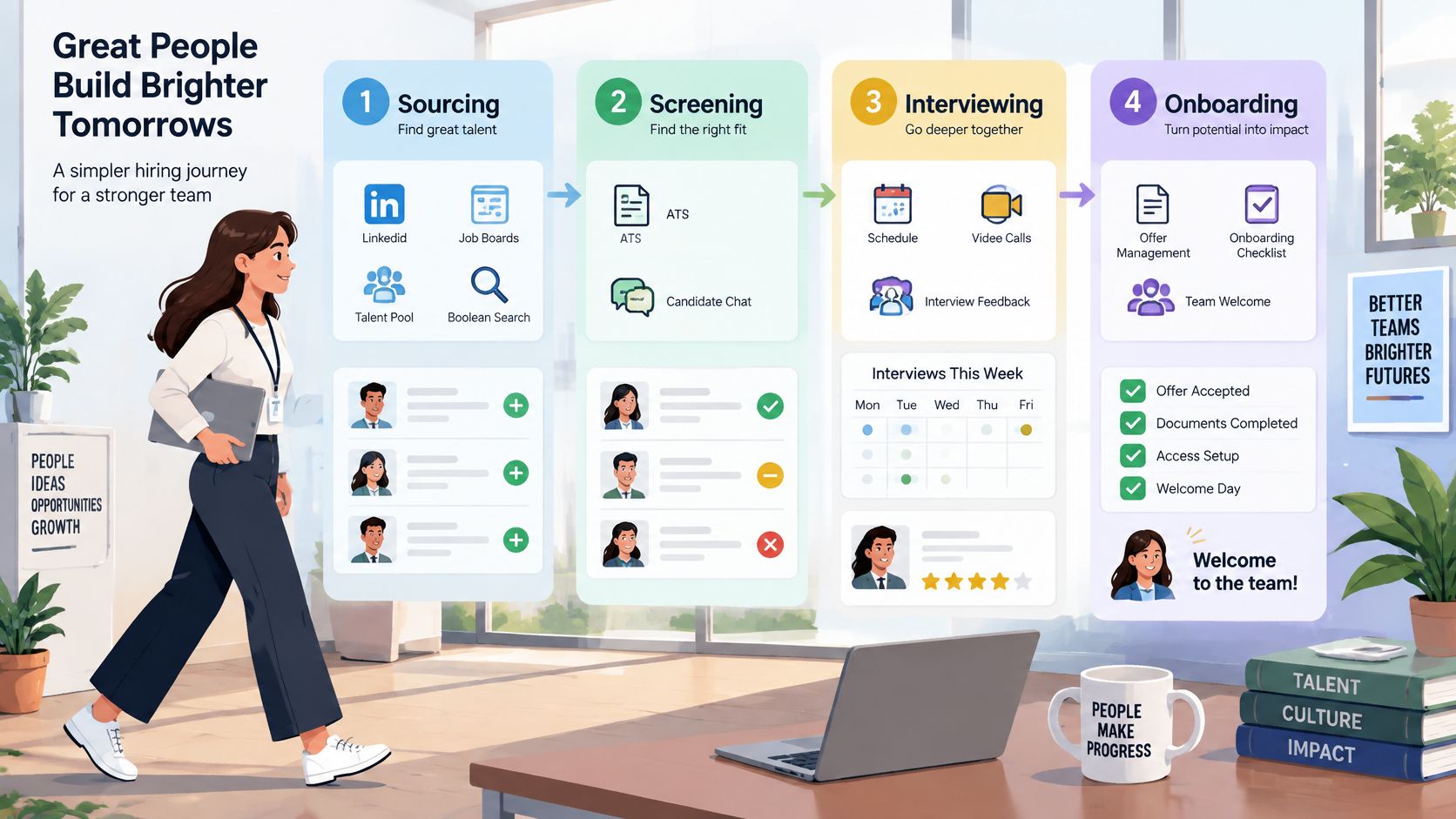
Recruitment technology isn't one product. It's a collection of tools supporting candidate discovery, applications, evaluation, interviews, and onboarding. In Gem's 2025 recruiting trends report, 96% of recruiting teams reported using AI in some capacity, with 47% describing themselves as AI-enabled across multiple workflows.
Adoption alone doesn't establish suitability for a medical practice. A platform designed for continuous corporate recruiting may create more administration than it removes when you're filling an occasional receptionist vacancy.
| Stage | Typical technology | What it changes | Main limitation |
|---|---|---|---|
| Sourcing | Job boards, talent pools, search tools | Reaches candidates beyond your own inbox | Adds volume, not necessarily fit |
| Application and tracking | Applicant tracking system (ATS) | Keeps candidates, stages and notes in one record | Poor data entry undermines reports |
| Screening | Résumé parsing, knockout questions, AI screening | Filters and ranks large applicant pools | Can miss non-standard experience or encode bias |
| Assessment | Skills tests, work samples, coding tasks | Checks job-relevant ability directly | Needs validated, role-specific tasks to be useful |
| Interviewing | Video interview and scheduling tools | Cuts coordination time across time zones | Adds candidate friction when poorly designed |
| Offer and onboarding | E-signature, HR information systems, onboarding workflows | Moves approved hires into payroll and internal systems | Compliance review is still required |
An applicant tracking system, or ATS, should hold the candidate record, current stage, assessment evidence, and decision history. It won't produce trustworthy reporting if managers leave candidates in outdated stages or record rejection reasons only in private emails. Standardize stage names and required fields before investing in elaborate dashboards.
Sourcing tools address a different problem: access. They can help a practice find remote patient coordinators outside its local market, but broader reach also creates more applications to review. Use job descriptions that state working hours, patient-facing responsibilities, required language capability, and escalation boundaries clearly.
Scheduling tools are useful when a practice manager, provider, and overseas candidate keep exchanging availability. Configure calendar permissions, time-zone displays, rescheduling rules, and a contact for technical problems. Don't require candidates to create unnecessary accounts just to book a conversation.
Resources on recruitment automation software can help you distinguish workflow automation from candidate evaluation. That distinction matters because sending a reminder carries different consequences from rejecting an applicant.
Buying rule: A product demonstration proves that a feature exists. It doesn't prove that your team needs it.
Map your current stages and examine where candidates wait longest. If qualified applicants sit in a provider's inbox, another sourcing subscription won't solve the bottleneck. Fix ownership or interview availability before paying to increase applicant volume.
Start with a procedure your team can run manually. Once responsibilities and decisions are clear, add tools to the steps that consume unnecessary effort. Otherwise, you'll spend implementation time configuring software around habits that should have been removed.
For a remote insurance verification specialist, the workflow should connect the job description, assessment, interview, and onboarding expectations. If each stage measures something different, the final decision becomes a collection of impressions rather than an evaluation of the role.
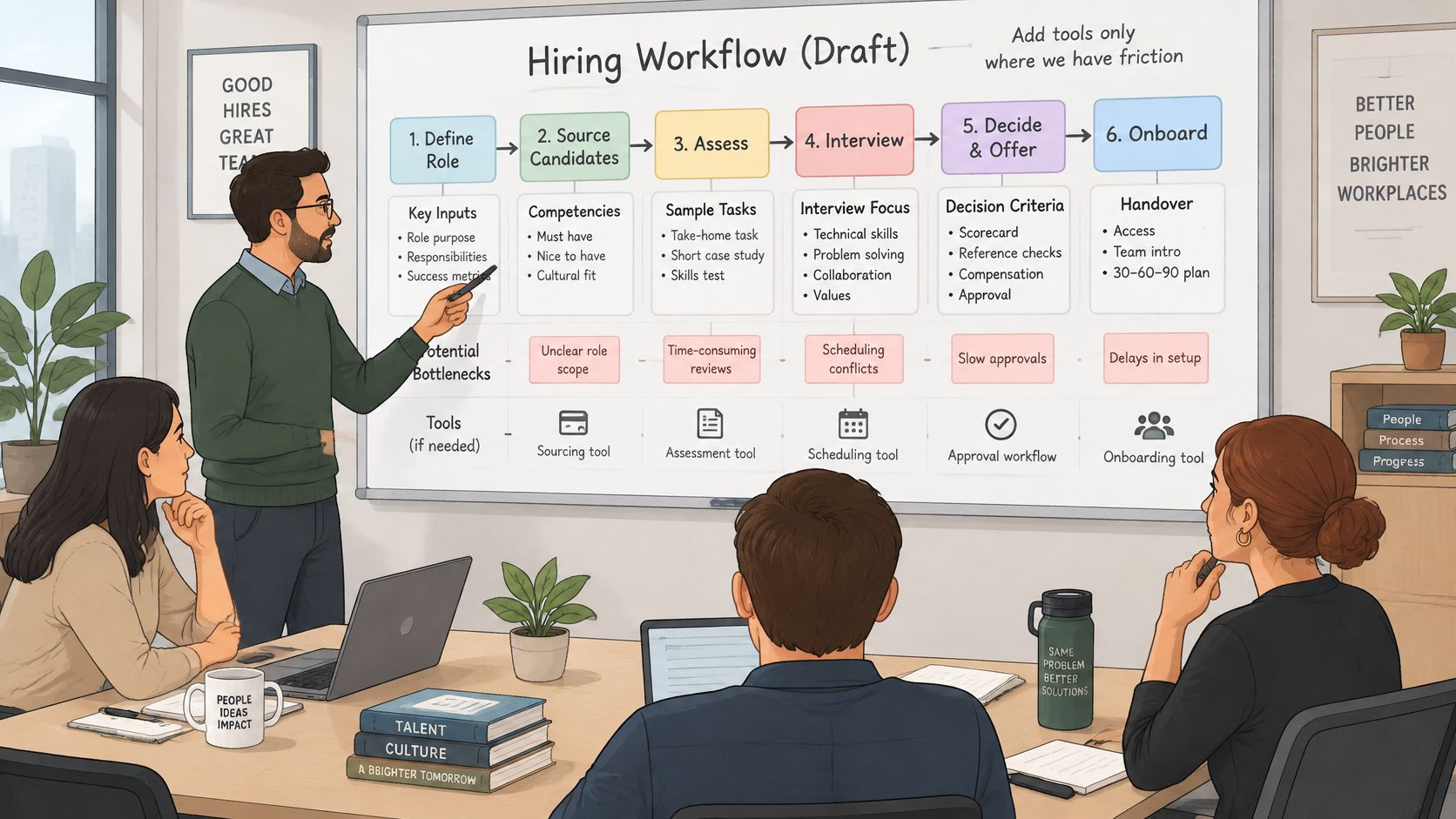
Write observable competencies. Describe what successful performance looks like, then pair each competency with a sample task. For insurance verification, that could mean documenting eligibility accurately, identifying missing information, explaining next steps, and escalating uncertainty rather than guessing.
Choose a single system of record and assign someone to maintain it. Separate spreadsheets and inbox notes invite duplicate outreach and conflicting decisions; a shared tracker can be sufficient for a small practice if permissions and ownership are clear.
Give each stage an owner and a response deadline. Set a practical service target for screening decisions and interview feedback, then configure reminders around it. The common mistake is assigning responsibility to “the team,” which leaves nobody accountable when a candidate stalls.
Automate scheduling and routine status messages before judgment-heavy steps. Test messages as a candidate would receive them, including time zones, reply addresses, and rescheduling instructions; a polished template is useless if replies go to an unmonitored mailbox.
Put a job-relevant assessment before the final interview. Use fictional information and a written scoring rubric so managers evaluate the same evidence. Don't turn the exercise into unpaid production work or ask applicants to enter live patient systems.
Require a person to review a proposed rejection following an automated score. Record the job-related reason and the evidence considered, rather than copying the software's recommendation into the decision field.
Define hiring and performance measures together. Track time-to-hire, stage conversion, candidate withdrawal, and post-hire performance against the actual role. A fast hire who requires constant correction isn't an operational success.
Define the start and end of each measure before comparing results. Time-to-hire becomes misleading when one manager starts counting at application and another starts at requisition approval. Candidate drop-off should distinguish people who withdrew from people your team just stopped contacting.
Quality of hire needs equally concrete criteria. For a patient coordinator, use message-routing accuracy, completeness of documentation, adherence to escalation rules, and the amount of supervision required. Don't use provider satisfaction alone, since a friendly employee can still leave work incomplete.
Implementation requires staff time for configuration, templates, testing, and training. A small practice hiring infrequently may get more value from a disciplined shared tracker than a separate ATS subscription. Any hiring manager should be able to explain why a candidate advanced without asking the software to reconstruct the decision.
AI-assisted screening can produce stronger evidence than résumé review alone. In field experiments on AI-assisted structured interviews, candidates shortlisted using AI interview evidence passed a subsequent blind human interview at rates 17.5–20 percentage points higher than candidates shortlisted from résumés alone; approximately 21% of participants also listed a required technical skill that the system assessed as “Not Familiar.”
Those findings concern technical recruitment, not medical administrative hiring. They support testing demonstrated ability rather than accepting résumé claims, but they don't establish that an AI score is correct for a billing specialist. A disagreement between a résumé and an assessment could reflect overstated experience, an inadequate question, or a mistaken assessment.
In practice, AI screening can parse résumés, compare answers with a role profile, summarize interview recordings, and recommend candidates for review. These functions are most useful when the role is clearly defined and the practice has enough applications to justify the additional setup and checking.
Consider a remote billing-specialist applicant who describes payer-portal work as claims operations. A keyword filter looking for specific portal terminology might rank that candidate poorly despite relevant experience. A structured task asking the applicant to explain how they would investigate a stalled claim gives your reviewer better evidence.
The reverse problem matters too. A candidate can repeat the expected terminology without knowing when to escalate a denial or how to document the next action. Fluency with the interview format isn't the same as competence with the work.
Let the system organize evidence. Don't let a ranking substitute for an explanation.
Use a written review policy rather than relying on individual managers to decide when an AI recommendation deserves scrutiny.
For broader workforce-planning context, the Capstone Workforce AI resource hub offers an additional resource to consult. Use external reading to sharpen vendor questions, not as a substitute for validating a tool against your own role.
AI is less useful when you can't articulate what a good answer looks like. Leadership judgment, unusual career paths, and complex patient-facing situations need contextual discussion rather than a compressed score. Automated employment tools can also raise location-specific obligations, so have qualified counsel confirm the requirements that apply before deployment.
Choose an assessment by the work you need to observe, not by the software available. Titles and degrees provide background, but they don't show whether a candidate can resolve a scheduling conflict or document an insurance discrepancy. The World Economic Forum's Future of Jobs Report 2025 projects that 39% of workers' existing skill sets will be transformed or become outdated by 2030, reinforcing the need to evaluate current capability.
| Method | Best for | What it measures | Main risk |
|---|---|---|---|
| Structured interview | Most roles, including senior ones | Judgment, communication and role knowledge | Unstructured versions reward confidence over ability |
| Work sample | Billing, scheduling, writing and coding tasks | Demonstrated output on a real task | Time-consuming to score without a rubric |
| Timed skills test | High-volume roles with clear right answers | Knowledge and working speed | Can measure test-taking more than job skill |
| Portfolio or code review | Technical and design roles | Quality of past work | Hard to confirm authorship without a live task |
| Reference check | Final-stage verification | Consistency of past performance | Reference quality varies widely |
| Credential verification | Licensed or certified roles | That a license or certification is valid and current | Confirms the credential, not competence |
A scheduling coordinator could complete a fictional calendar exercise containing conflicting provider availability, visit-type restrictions, and patient preferences. Score rule application, accuracy, patient communication, and appropriate escalation. Then ask the candidate to explain a difficult choice in a structured interview.
For a developer supporting practice integrations, use a short, fixed-duration take-home exercise with stated pass criteria. Follow it with a live explanation of design decisions and error handling. A guide to technical skill assessment can help frame that evaluation, but a medical receptionist shouldn't face a technical test unrelated to the job.
Unstructured interviews allow managers to drift toward confidence, familiarity, or conversational ease. Portfolios have a different weakness: the finished output may not reveal the candidate's contribution. Ask candidates to explain their work and complete a small related task without disclosing confidential material from previous employers.
Define the skills before creating questions:
Score criteria independently before discussing candidates as a panel. Keep take-home tasks short and explain the expected effort upfront. If speed isn't central to the job, don't make a tight timer the main determinant of success.
Candidates should know when AI is involved, what it does, and how to reach a person. In a 2026 UK survey described by The Tennessean, 47% of jobseekers reported being interviewed by AI, 82% weren't told beforehand, 24% discovered it after the interview began, and 30% abandoned a process after learning it involved an AI-led interview; preferred safeguards included upfront disclosure (40%), a human-interview option (45%), and independent bias audits (28%).
That survey describes UK jobseekers, not the prevalence of AI interviewing among U.S. medical practices. Its operational lesson is straightforward: don't surprise applicants with an automated interviewer after they've prepared for a conversation with a person.
Research involving 39 HR professionals and AI developers, published in The International Journal of Human Resource Management, identified similar-to-me and stereotype bias associated with historical hiring data, the translation of human judgments into model features, and reinforcing feedback loops.
For cross-border hiring, examine whether language, education, geography, or communication style is functioning as an unjustified proxy. A patient-facing role may require clear spoken English or Spanish, but that doesn't justify scoring resemblance to a preferred accent. Assess whether patients can understand the candidate and whether the candidate communicates accurately.
Apply this checklist during your next hiring cycle:
An appeal address is useless if nobody owns the inbox. Assign a reviewer, record the issue, inspect the underlying evidence, and communicate the outcome. When a transcript failure caused the problem, let the candidate repeat the affected activity rather than defend an unreliable score.
For legal context, Nick Norris, P.A.’s information on discrimination is a starting point for understanding issues to discuss with counsel, not a determination that a particular hiring workflow is compliant.
These controls consume staff time. A small practice can begin with clear notice, a human alternative, and an assigned review contact while developing more formal monitoring. Requirements vary by location, so confirm your obligations with qualified counsel rather than assuming the vendor's default settings are sufficient.
Delegate repeatable administrative work, not clinical accountability. Before recruiting a medical virtual assistant, specify what the person can complete, what they can prepare for review, and what they must immediately route elsewhere.
| Task | Remote administrative assistant | Must stay with licensed staff |
|---|---|---|
| Appointment scheduling and reminders | Yes, using approved scripts | Any clinical triage decision |
| Insurance verification | Yes, following a written checklist | Clinical implications of coverage exceptions; administrative coverage questions go to the designated payer or billing lead |
| Prior-authorization submission and status tracking | Yes, using a shared authorization tracker | Medical necessity statements and clinical appeals |
| Referral coordination | Yes, sending records under the practice's privacy policy | Choosing the specialist or the urgency level |
| Patient messages mentioning symptoms | Routing to licensed staff only | Any clinical response |
| Billing claim follow-up | Yes, with access limited to the data needed | Clinical documentation supporting coding and disputes; qualified coding or billing staff handle administrative determinations |
Not every difficult administrative question requires a license. Coverage interpretation, coding, and disputed claims may require a qualified billing specialist rather than a clinician; clinical judgments still belong with appropriately licensed staff.
Physicians reported an average 57.8-hour workweek in 2024, including 7.3 hours of administrative work, according to the American Medical Association's physician workload analysis. That supports examining administrative queues, not assuming every physician task can be delegated.
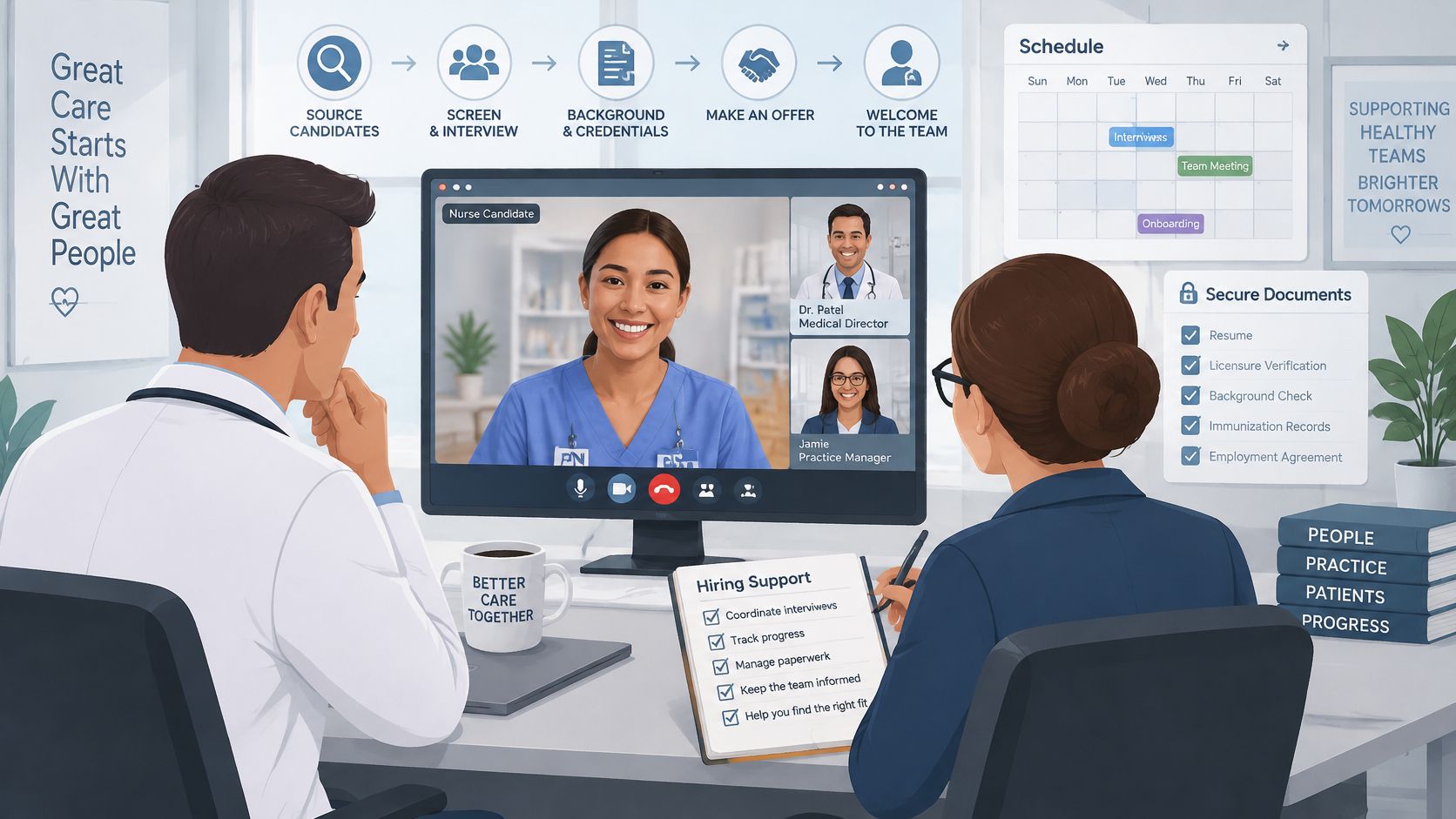
Virtual medical receptionists handle calls and messages; appointment schedulers manage approved booking rules; patient coordinators organize follow-through. Insurance verification specialists, prior-authorization support staff, medical billing support, and medical administrative assistants require different assessment tasks and escalation paths.
Prior authorization deserves particular scrutiny: 95% of physicians in an AMA survey said it somewhat or significantly increased burnout, according to the AMA's prior-authorization findings. Use a controlled tracker containing the patient identifier, payer, submission date, status, next action, owner, escalation deadline, and resolution date.
Specialty changes the work mix. An imaging-heavy or surgical practice may need authorization and referral coordination, while a predominantly self-pay practice may need payment follow-up. Observe your own queue before deciding which role to recruit.
For remote staff handling protected health information, build role-based access, approved secure devices, privacy training, and incident reporting into onboarding. Use individual accounts and an access-removal checklist rather than shared provider credentials. These are operating recommendations, not a complete statement of HIPAA requirements.
Have your compliance professional determine the applicable HIPAA arrangements, including whether a vendor requires a business associate agreement. HHS doesn't recognize an official HIPAA certification, so request documented policies and controls rather than accepting a certification claim. An AI-supported hiring process doesn't replace healthcare-specific access review.
Pilot measure: Count the work providers no longer need to redo, not just the tasks an assistant marks complete.
The AMA's comparison data showed burnout symptoms at 43.2% in 2024, compared with 48.2% in 2023 and 53% in 2022. Those figures don't prove remote staffing reduces burnout. Compare after-hours EHR work, referral turnaround, authorization cycle time, and correction effort before and after a bounded pilot.
Pilot a tool at the stage with the clearest delay instead of replacing the entire hiring process. Define a trial window that suits your recruiting volume, and preserve baseline records from recent comparable vacancies. If you rarely hire, you may need to judge usability and administrative effort before you have enough completed hires to assess outcomes.
A scheduling pilot should be judged on coordination effort and completed interviews. An assessment pilot should be judged on useful evidence, scoring effort, candidate withdrawal, and subsequent job performance. Don't keep a tool merely because the team has spent time configuring it.
Use a compact vendor review:
Calculate costs around the staff effort you can realistically remove. If managers must spend more time checking summaries than they previously spent reading applications, the apparent automation saving isn't a saving.
Buying software leaves your team responsible for configuration and daily administration. A service model can reduce that setup burden, but your practice still needs an accountable hiring manager and clear performance expectations.
At LatHire, companies can browse and hire talent directly, or tell us what they need and receive a curated shortlist within 24 hours. We take care of HR, international payroll, and legal compliance while the company manages the hired talent directly. That division of responsibility doesn't transfer your practice's clinical supervision, patient privacy decisions, or role-specific access approvals.
Bring the pilot results to the people who will manage the hire. Keep the tool only if its contribution is clear enough to explain without a vendor presentation.
Recruitment and technology work together when you connect each tool to a defined hiring problem. Start with the work your medical practice needs done, assess candidates against that work, and preserve a clear explanation for every hiring decision. Faster processing isn't useful if it advances unsuitable candidates or obscures why capable applicants were rejected.
For remote healthcare staffing, keep administrative delegation separate from clinical judgment and evaluate results through queue performance, accuracy, and provider rework. Build candidate notice, a human alternative, and reconsideration into the process from the outset.
Use your next open role to create a workflow map, a role-specific work sample, and a pilot scorecard. If you need help sourcing remote talent, tell LatHire the responsibilities, working hours, and escalation boundaries so we can help you build a relevant shortlist.