

Cultural intelligence, or CQ if you want to sound fancy, is the skill of not falling flat on your face when you’re dropped into a culturally diverse setting. It’s not about memorizing a textbook of do's and don'ts for every country on earth. It's about your core ability to adapt your approach and actually get things done when different cultural norms collide—whether that’s on a Zoom call with your new hire from Brazil or when launching your product in Japan.
So you did the smart thing. You hired the best people you could find, no matter their zip code. But now, you're noticing the little fractures that threaten to become full-blown cracks.
Deadlines get torpedoed by national holidays you’d never heard of. A direct "no" is considered deeply disrespectful in one person’s culture, while another team member's vague "yes"—which really meant "maybe"—just derailed your entire project timeline. Your star engineer in Bogotá seems to agree to everything on the call but then delivers something completely different.
Sound familiar? This isn't a talent problem. It's not a work ethic issue. It's a culture gap, plain and simple.
Trying to run a global team without addressing these gaps is like trying to build a modern company on a dial-up connection. It’s slow, it's painful, and it’s destined to fail. Soon enough, you're stuck with:
This is exactly where Cultural Intelligence (CQ) stops being a fuzzy HR concept and becomes a mission-critical business tool. Think of it as the operating system that allows all your diverse talent to actually sync up and collaborate. Our guide on how to manage remote teams across different cultures is a great place to start digging in.
Let’s be blunt: Treating cultural intelligence as a 'nice-to-have' is one of the fastest and most expensive ways to fail in a global market. It’s not about being politically correct; it’s about being effective.
We're going to cut through the academic jargon and show you exactly why CQ is the difference between a high-performing global team and a very expensive, very frustrating social experiment.
Let's be honest, "Cultural Intelligence" sounds like a term straight out of a corporate leadership seminar, right? The kind of thing you’d find on a motivational poster next to a wilting office fern.
But this isn’t about memorizing every global holiday or learning to bow perfectly. Stick with me, because this concept is far more practical—and powerful—than it sounds.
Simply put, Cultural Intelligence (CQ) is your ability to relate and work effectively across different cultures. It's the secret sauce that prevents a brilliant product launch from becoming a viral meme for all the wrong reasons. It’s what keeps a diverse, talented team from constantly—and accidentally—stepping on each other's toes.
Let's get one thing straight: CQ isn't just about "being respectful." That's the bare minimum, the table stakes for playing in a global economy.
Cultural Intelligence is an active, measurable skill, much like IQ (your cognitive ability) or EQ (your emotional intelligence). The researchers who coined the term didn't mess around; they defined it as a person's capability to function effectively in culturally diverse situations. This isn't fluffy theory; it’s a concrete skillset.
This diagram helps break down the core components into a simple, practical framework. No PhD required.
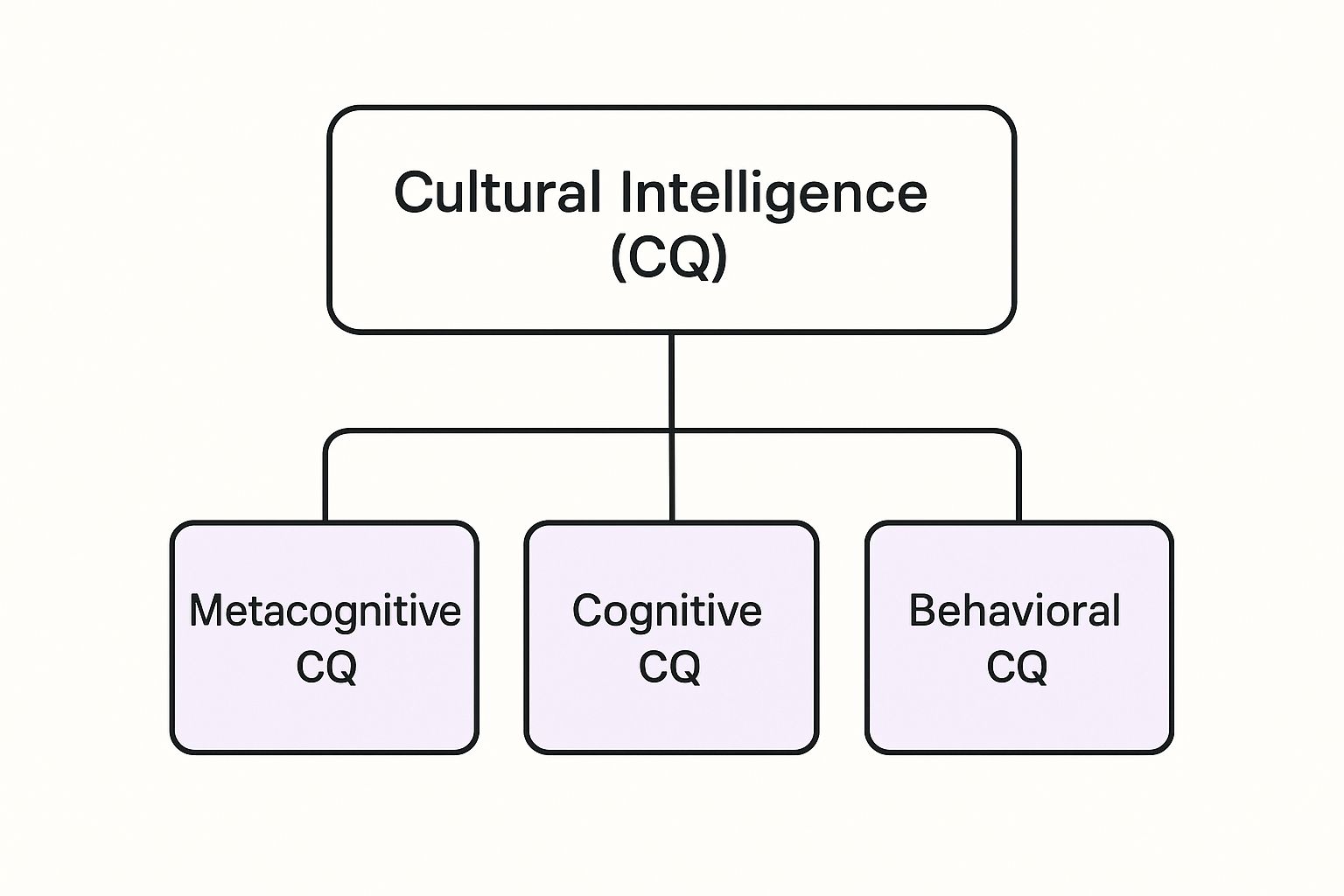
As you can see, it's not a single trait. It's a combination of how we think, what we know, and what we do.
At its heart, CQ gives your team the tools for not just surviving but thriving in diverse global environments, especially when it comes to mastering cross-cultural communication challenges. Forget the dry, academic definitions. Think of this as your field guide.
CQ isn't some mystical quality. Researchers have broken it down into four distinct, practical components that you can actually develop and measure in your team.
Here's what they actually mean in the real world.
| CQ Component | What It Actually Means | How It Looks in Practice |
|---|---|---|
| CQ Drive (Motivational) | Your why. This is the genuine interest and confidence you have when interacting with people from other cultures. It's giving a damn. | A team member who eagerly volunteers for a project with an international partner, seeing it as an exciting learning opportunity, not a burden. |
| CQ Knowledge (Cognitive) | Your what. This is your understanding of the general frameworks of culture—like communication styles, values, or leadership norms. | Knowing that in some cultures, direct, blunt feedback is seen as helpful honesty, while in others, it's considered deeply disrespectful. |
| CQ Strategy (Metacognitive) | Your how. This is your ability to plan for, reflect on, and adapt during cross-cultural interactions. It's your internal game plan. | Pausing before sending a Slack message to a colleague in another country to think, "Will my sarcastic humor translate here, or should I just be boring and clear?" |
| CQ Action (Behavioral) | Your do. This is your ability to actually modify your behavior—your words, tone, and body language—to fit the situation. | Slowing down your speaking pace and avoiding slang in a meeting with non-native English speakers to ensure everyone can actually follow along. |
These four components work together, creating a powerful skillset that goes far beyond simple "cultural awareness."
CQ isn’t just about avoiding embarrassment. It's about turning cultural differences from a recurring liability into your company’s single biggest competitive advantage.
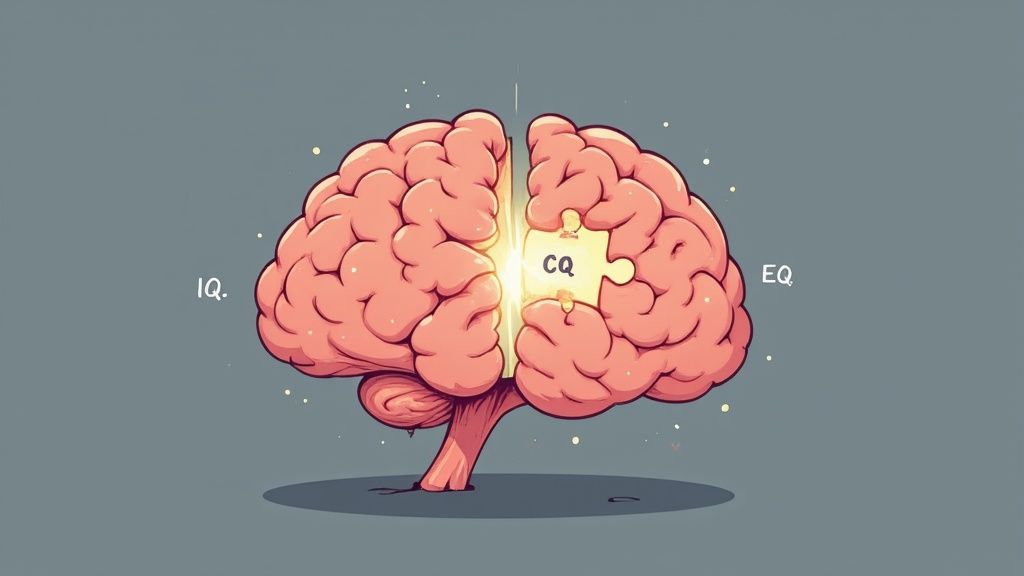
You did everything by the book. You hired for raw intelligence (IQ) to get the sharpest minds and screened for emotional intelligence (EQ) to build a collaborative team. So why does it feel like your all-star global crew is constantly talking past each other?
It’s because your brilliant developer in Berlin and your top marketer in São Paulo can have all the smarts and charisma in the world and still misread each other completely. Hope you enjoy mediating Slack disputes—because that’s now your full-time job.
Here’s the hard truth: building a global team adds a layer of complexity that raw intellect and emotional awareness alone can’t solve. Cultural Intelligence (CQ) is the missing third dimension.
IQ gets you in the door. EQ helps you read the room—but only if it’s a room you already understand. The cues, norms, and unwritten social rules that EQ depends on get completely scrambled when you cross borders.
Think about it. A high-EQ manager from a consensus-driven culture might hear a direct, assertive comment from a colleague and register it as aggressive. Meanwhile, that colleague, coming from a more direct culture, sees their feedback as honest and efficient. Both are smart, both mean well, but their cultural programming has set them on a collision course.
This isn't just a hypothetical. I've seen high-IQ, high-EQ teams implode because they had no shared framework for figuring out why their signals were getting crossed. They had the engine and the steering wheel but no GPS for the global landscape.
The assumption that good intentions and a high IQ are enough to bridge cultural gaps is the single most expensive mistake founders make when building a global team. It’s a recipe for burnout, mistrust, and missed opportunities.
CQ is the bridge. It’s the ability to recognize that your own emotional and logical defaults don't apply everywhere. It’s about hitting pause, analyzing the cultural context, and then adapting your approach before you react.
Don't mistake CQ for just another personality trait or a nice-to-have like being "open-minded." This is a distinct and measurable competency. Research confirms that CQ is a construct separate from general intelligence or personality traits, cementing its role as a specialized skill you have to build. (Toot, toot! Glad the academics back me up on this one.)
Without this third dimension, you’re just guessing. Is your engineer from Japan quiet because they're disengaged, or because in their culture, interrupting a senior leader is a sign of deep disrespect? Your EQ might tell you they seem withdrawn, but your CQ tells you to create a different, safer way for them to share their brilliant ideas. For more on this, check out our guide on the role of soft skills in remote hiring from LATAM.
IQ and EQ will help you build a great local team. For a global team to actually thrive, CQ is non-negotiable.
Ever brushed off cultural friction as just a few awkward moments on a Zoom call? It’s an easy mistake to make. But we aren't talking about minor social blunders. We're talking about the real, tangible damage that piles up when your team’s cultural intelligence is low.
This isn't about hurt feelings; it's about a direct hit to your bottom line. Think botched negotiations, product launches that turn into PR nightmares, and your best global talent quietly polishing their résumés because they're tired of being misunderstood.
Low CQ isn't just uncomfortable. It’s expensive.
Let me walk you through a scenario I've seen play out more than once. A US-based project manager fires off what he thinks is a clear, direct email to a partner in Japan. He outlines a serious project delay and demands an immediate action plan. From his perspective, it's just efficient communication.
But to the Japanese team, it’s a public rebuke that causes a massive loss of face. The result? The partnership grinds to a halt. Trust evaporates. What should have been a collaborative fix becomes a silent, relationship-ending standoff.
That one email, born from a total lack of cultural intelligence, cost the company a $50,000 contract and months of wasted work. The cost isn't always that obvious, but trust me, it’s always there, bleeding your P&L through a thousand tiny paper cuts.
Low cultural intelligence creates an invisible tax on every single cross-cultural interaction. Every misread email, every botched negotiation, every frustrated team member—it all adds up, slowing you down and costing you money.
These aren't just isolated incidents; they're symptoms of a bigger, systemic problem. Without CQ, your company is operating with a critical blind spot, and the consequences are brutal:
This isn’t about fear-mongering. It’s a pragmatic look at the risk you’re taking by ignoring CQ. Beyond these direct costs, recognizing the profound impact of culture itself is vital; you can learn more about turning a strong company culture as a competitive advantage. Ultimately, ignoring cultural intelligence isn’t just bad for morale—it's a terrible business strategy.

Alright, enough theory. The idea of cultural intelligence is pointless if you can't actually put it to work. You don't need some five-year corporate plan or a cheesy sensitivity training that makes everyone roll their eyes. You just need a practical, founder-tested playbook you can start using next week.
Let’s be real. You’re not going to fix every cross-cultural communication gap overnight. But you can start building the right muscles. The goal isn't perfection; it’s progress.
These are the low-cost, high-impact strategies I’ve seen work in the trenches.
Your onboarding process is your first—and best—chance to set the cultural tone. Most places just throw a new hire into the deep end and hope they can swim. Don't do that.
Instead, build a simple "How We Work" guide that’s less about HR policies and more about your team’s real-life communication norms.
You can't learn to swim by reading a book about it, and the same goes for CQ. You have to build it through structured, hands-on experience. Don’t just hope for collaboration; engineer it.
The best way to build cultural muscle is to actually use it. Throwing people from different backgrounds onto a high-stakes project without any guardrails is a recipe for disaster. But giving them a structured way to collaborate is a recipe for growth.
When kicking off a new cross-functional project, intentionally create small, diverse teams. Make it a rule that for the first 15 minutes of the kickoff call, no one is allowed to talk about work. Instead, use a prompt like, "What’s one thing about your city that most people don’t know?" This forces a personal connection before the project pressure kicks in. It sounds small, but it works.
Global meetings are where cultural friction becomes most visible. The person who thinks out loud clashes with the person who needs to reflect before speaking. The only way to fix this is to be a ruthless facilitator. Our guide on cross-cultural communication in the workplace has deeper dives on this.
Ultimately, building team CQ isn't a one-and-done initiative. It's a continuous process. Studies show that customized programs are the most effective, as companies like Coca-Cola have found by linking higher CQ to better business outcomes. You can discover more insights about these findings on globaledge.msu.edu.
Alright, let's cut to the chase. You've heard the pitch, but you still have questions. Every smart leader does. Here are the straight-up answers to the questions about cultural intelligence that are probably rattling around in your head. No fluff, no jargon.
Absolutely not. In fact, relying on your "common sense" is one of the fastest ways to get into trouble on a global team.
Think about it: your common sense is a product of your culture. What feels like efficient, straightforward feedback in New York can come across as deeply disrespectful in Tokyo. What seems like a friendly, collaborative question in one culture might feel like a direct challenge to someone's authority in another.
Cultural intelligence is the skill of recognizing that your common sense has geographic limits. It's about knowing when to hit pause on your own instincts and adapt your approach to the person on the other side of the screen.
Yes, and this is the most important part. Unlike IQ, which is relatively fixed, CQ is a skill that can be intentionally developed. It’s not some innate talent you either have or you don’t.
Think of it like a muscle. The more you put it to work through conscious learning, hands-on experience, and a genuine motivation to connect, the stronger it gets. It's less about a dramatic transformation and more about making consistent, incremental progress. Practice doesn't make perfect, but it sure makes you more effective.
Forget complex personality quizzes for a minute. While formal assessments like the Cultural Intelligence Scale (CQS) exist, you can start with what you see every single day.
Your team’s real-world performance is the most accurate CQ meter you have. Just ask yourself:
The answers to these questions tell you more about your team’s CQ than any formal assessment ever could. The proof is in the results.