
50% of organizations in a 2026 SD Worx survey of 5,936 HR managers and 16,500 employees across 16 European countries already outsource payroll software and services, up from 45% in 2024. That figure matters because it reframes the decision for medical practices. When you outsource payroll processing, you aren't buying an unusual workaround. You're choosing a common operating model, and your real task is deciding which work moves out, which risks stay with the practice, and who checks the result before money leaves the bank.
Outsourcing works when a provider calculates gross-to-net pay, handles agreed filings and deposits, and produces records your practice manager can reconcile against approved hours, contracts, and bank withdrawals. It fails when the contract promises relief but nobody owns time records, worker classification, or proof that a tax deposit cleared. For a U.S. practice paying remote medical assistants, billing support, or virtual receptionists in another country, that distinction decides whether payroll becomes quieter or harder to trace.
Payroll errors can create costs well beyond the original underpayment. EY research cited in 2022 found that one in five payrolls contained errors, and correcting a single mistake cost an average of $291. The same research reported that 14% of surveyed organizations experienced legal, compliance, or regulatory issues connected with inaccurate payroll during the preceding year.
For a 1,000-employee organization, EY estimated recurring payroll errors could create annual correction costs of approximately $922,131. A smaller practice faces the same kinds of operational consequences, even if the totals differ. A missed overtime hour for a remote patient coordinator can require a second payment, a tax adjustment, and time spent reviewing the correction. It can also make the employee scrutinize each later payslip.
Outsourcing deserves consideration when payroll crosses more than one country, when corrections repeatedly take a practice manager or finance lead away from core work, or when one person holds the process together. Cross-border payroll brings separate calendars, currencies, and record requirements. A process built around one person's spreadsheet and memory can become fragile when that person is unavailable.
The fit is weaker when headcount is small and stable, pay rarely changes, and an accountable owner can reconcile each run without rushing. Better timekeeping and a monthly checklist may address the underlying problem at lower cost. Practices comparing adjacent finance workflows sometimes review outsourcing bookkeeping for Australian small businesses. The same practical test applies: delegate processing only when the work retained by the practice, including review and approval, has a named owner.
Outsourcing changes where payroll risk sits. It does not transfer employer liability, remove cybersecurity exposure, or create one source of truth when several vendors touch a pay run. The employer remains responsible for worker classification, reliable source data, and approving the result. The provider's role should be clear, too: who calculates pay, submits filings, initiates deposits, and supplies evidence that each action is complete.
| Model | Who calculates gross-to-net | Who files and deposits | Employer still owns |
|---|---|---|---|
| In-house on vendor software | Internal payroll team | Employer | Classification, source data, approvals, filings |
| Partial specialist support | Shared with payroll specialists | Provider assists; employer confirms | Master data, approvals, tax liability |
| Full processing | Provider from supplied inputs | Provider initiates; employer verifies proof | Worker status, terms, funding approval |
| Several country vendors | Split by vendor and country | Split by country | System of record and cross-vendor reconciliation |
Start by reading the last column. Each model leaves the employer responsible for worker classification, accurate source data, and approval of the final result. The main differences are who calculates pay and who initiates filings. A solo practice with two U.S. employees may need only software and a disciplined owner. A group paying a virtual receptionist in Colombia and a billing specialist in the Philippines may need country-specific support, plus one internal owner to reconcile the combined payroll.
Lock the operating model before requesting quotes. Full processing and software-only service are different scopes, not competing offers.
Outsource when multi-country payroll, recurring corrections, or dependence on one person makes internal processing fragile. Keep it in-house when payroll is stable and the owner has time to reconcile each run properly. Name the model and assign responsibility for inputs, approvals, filings, and reconciliation before comparing prices.
Build one shared scope and make every provider price exactly that scope. State your employee and contractor count, countries, entities, pay frequency, pay groups, and expected changes such as bonuses, stipends, overtime, and terminations. Then list the services in plain terms: gross-to-net calculation, employee payments, tax deposits, statutory filings, payslips, general-ledger files, off-cycle runs, retroactive corrections, and year-end forms.
Don't let one provider quote a lean processing fee while another includes filings and year-end work. Those totals will look comparable in a spreadsheet and behave very differently after the first difficult pay run.
Ask each bidder to separate these items before you score the quote:
That last line is the one practices underestimate. Outsourcing removes calculation work, not review work. Budget for a named internal approver and a monthly reconciliation, then ask whether the provider's reports make that review fast or force your team to rebuild totals in a spreadsheet.
Use a worked example with the correction figure from your current process. If a practice fixes ten payroll errors a year at $291 each, that's $2,910 in correction work alone, before employee frustration or penalty exposure enters the picture. Track your own count for two or three cycles if you can. A quote only looks expensive until you compare it with the manager hours, amended filings, and repeat payments you're already absorbing.
Say a three-physician practice pays a remote billing specialist in one country and a virtual receptionist in another. A per-employee fee may include international payment processing, while a lower flat monthly fee may exclude the foreign-exchange cost of every funding transfer. Ask both providers to show one complete cycle from approved gross pay to net pay received, including the exchange rate source and the value date. Then ask how each one prices a retroactive pay change and a same-month termination.
Pricing varies by vendor, country, and volume, so treat every estimate as a planning figure until the services, exclusions, and exchange-rate method are confirmed in writing. I'd reject any quote that can't show the full cost of one normal run and one messy run.
Outsourcing doesn't transfer employer risk. A provider can calculate perfectly from bad inputs while your practice remains responsible for worker classification, employment terms, compensation records, and final approvals. If a remote medical assistant is set up under the wrong worker status, neat payslips don't cure the error. They document it.
Fragmentation makes that risk harder to see. Global Payroll Week 2025 survey results found that 64% of organizations that outsource payroll use up to five vendors. When your HR records, time tracking, benefits deductions, local filings, and foreign-exchange payments sit with different parties, no single vendor naturally owns the whole result. You have to design that ownership.
The point is consistent with federal payroll responsibility. The IRS Employer's Tax Guide states that an employer remains responsible for federal tax deposits and other federal tax payments when a third-party payer performs payroll-tax duties, and it remains liable even when it forwards the tax amounts to the provider. Your written agreement should therefore say who prepares Forms 941 and W-2 where they apply, who initiates deposits, who reconciles, who corrects errors, and what proof of filing you'll receive.
| Input or obligation | System of record | Internal owner | Reconcile against |
|---|---|---|---|
| Employee master and classification | HRIS | HR lead | Contract and local worker-status rules |
| Hours and overtime | Time and attendance system | Approving manager | Payroll register hours |
| Pay, bonuses, and commissions | HRIS or compensation tool | Finance | Signed terms and the gross-pay total |
| Local tax filings and deposits | Country payroll provider | Named tax owner | Deposit and filing confirmations |
| Bank funding and foreign exchange | Treasury or payment provider | Finance | Bank statement and funding file |
| Benefits and statutory deductions | Benefits administrator | HR | Deduction lines on the register |
Walk the table with a concrete case. Say your U.S. practice pays a Latin American medical billing coordinator who verifies insurance and posts payments during U.S. hours. The HRIS holds the contract, worker status, and agreed pay. The time system holds scheduled hours, overtime approval, and any correction history. The payroll register must match both records before finance releases funding, and the bank statement must match the funding file after payment.
Sound vendor management practices for distributed teams help here because ownership has to survive staff absence and vendor handoffs. Document approval cutoffs, test one country-specific offboarding and one tax scenario before go-live, and write down who acts when a filing is missed or a payment goes out wrong. Escalation needs a named person and a deadline, not a shared inbox.
Practical rule: If two vendors can change the same field, one of them is not the system of record.
Local classification, benefits, and tax duties vary by country, and they can change with the role and working arrangement. Confirm those obligations with qualified counsel or a local payroll specialist before the first live run, not after a regulator or a departing worker raises the question.
Payroll outsourcing changes where risk sits. Your provider may process sensitive files, but your company still owns employer obligations, and multiple vendors can leave the pay run without a single source of truth. Payroll files hold bank details, tax identifiers, home addresses, pay rates, and benefits information together. Set clear controls for access, incident response, and payment continuity before transferring them.
ADP's 2025 Global Payroll Survey found that 93% of respondents considered payroll data security very or critically important, while 57% reported at least one major payroll-related breach in the previous two years. Those findings make security a procurement issue, not a box to tick after selecting a provider.
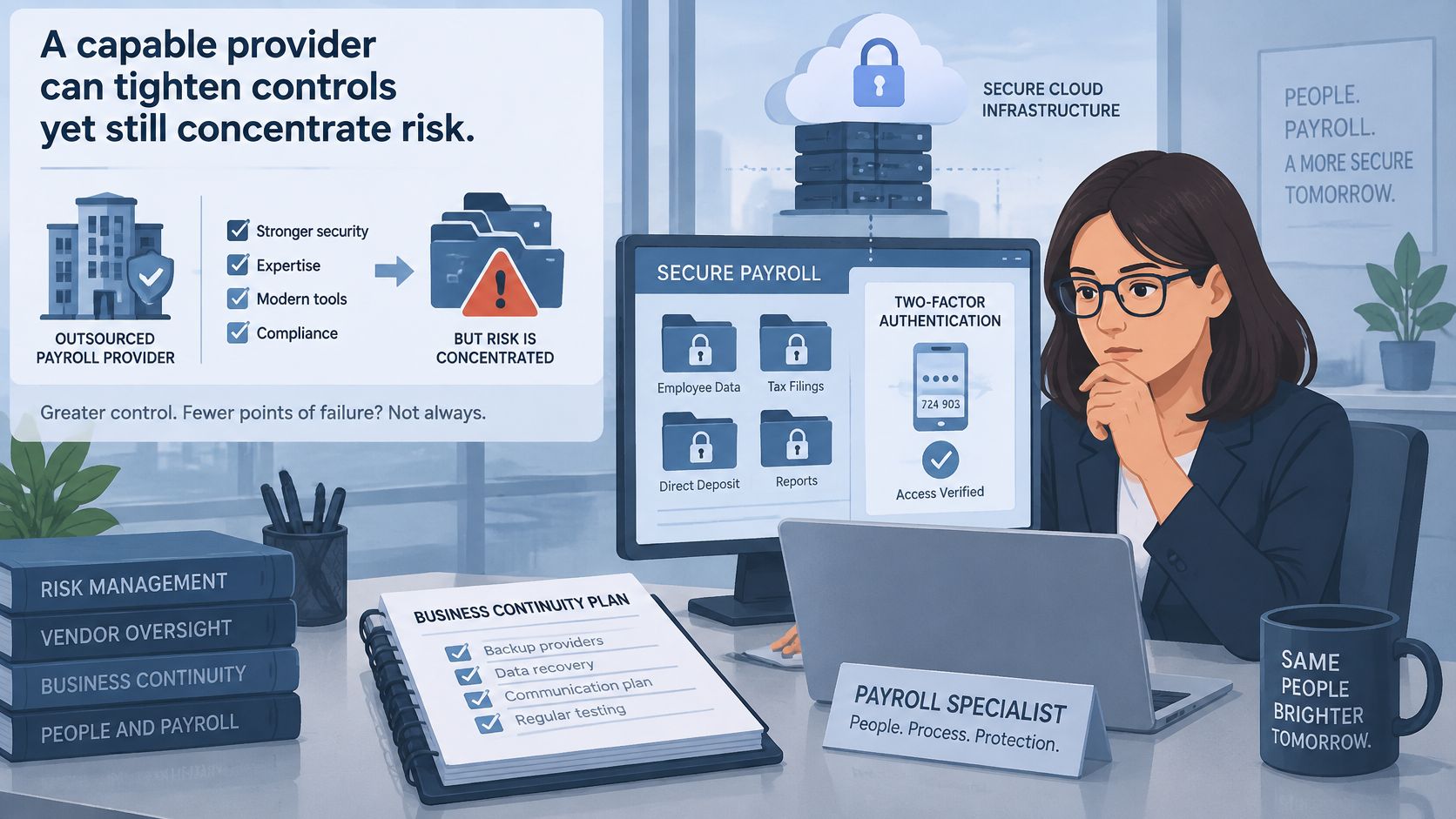
Ask what the provider accepts responsibility for after a breach, and what liability remains with your company. Put a notification deadline in the contract for suspected and confirmed incidents. Require a current list of subcontractors, including the payroll data each can access. Confirm whether your team can review access logs and audit evidence when an exception arises.
Then test the continuity plan against a missed pay date. Ask who can produce a funding file from the last approved register if the platform is unavailable, and how the provider handles ransomware, a platform outage, or provider insolvency. A backup process is useful only if your finance team knows how to approve and fund it.
Apply the same discipline to your own accounts with data security practices for remote operations. Payroll administrators should use individual logins, separate data entry from approval, and keep bank-detail changes out of unsecured email threads. Cross-border payroll may involve your company, a staffing platform, a payment provider, and a local filing partner. Each handoff creates a point where permissions, records, or instructions can diverge.
| Criterion | What to request | Red flag |
|---|---|---|
| Breach notification | Contractual deadline for notifying your team | No committed timing |
| Subcontractors | Named list showing each party's data access | Undisclosed subcontractors |
| Access controls | Least-privilege roles and multifactor authentication for staff | Shared logins |
| Data residency | Stated storage locations for bank, tax, and identity data | Vague or changing answers |
| Recovery | Recovery-time objective and evidence of a tested continuity plan | No test evidence |
| Audit evidence | SOC 1 Type 2 report covering the review period | Design-only report or none |
| Liability | Breach liability terms and cyber insurance coverage | All liability pushed to the employer |
A SOC 1 Type 2 report assesses whether controls operated effectively during the review period, rather than only whether they were designed on paper. Treat it as one piece of evidence, not proof that every payroll or security risk is covered. Require written notice timing, subcontractor disclosure, and a backup pay path, then confirm which party owns each action if an incident affects a payroll cutoff. A security claim without evidence is marketing, not a control.
Treat the move as a controlled payroll lifecycle, not a software switch. Don't start until the ownership table is complete and the vendor has passed your security review. The controlled sequence described in Talenta's payroll internal controls guide runs from a responsibility matrix and payroll calendar through source-system integration, parallel payrolls, reconciliation, documented approval before release, and post-payroll exception reviews.
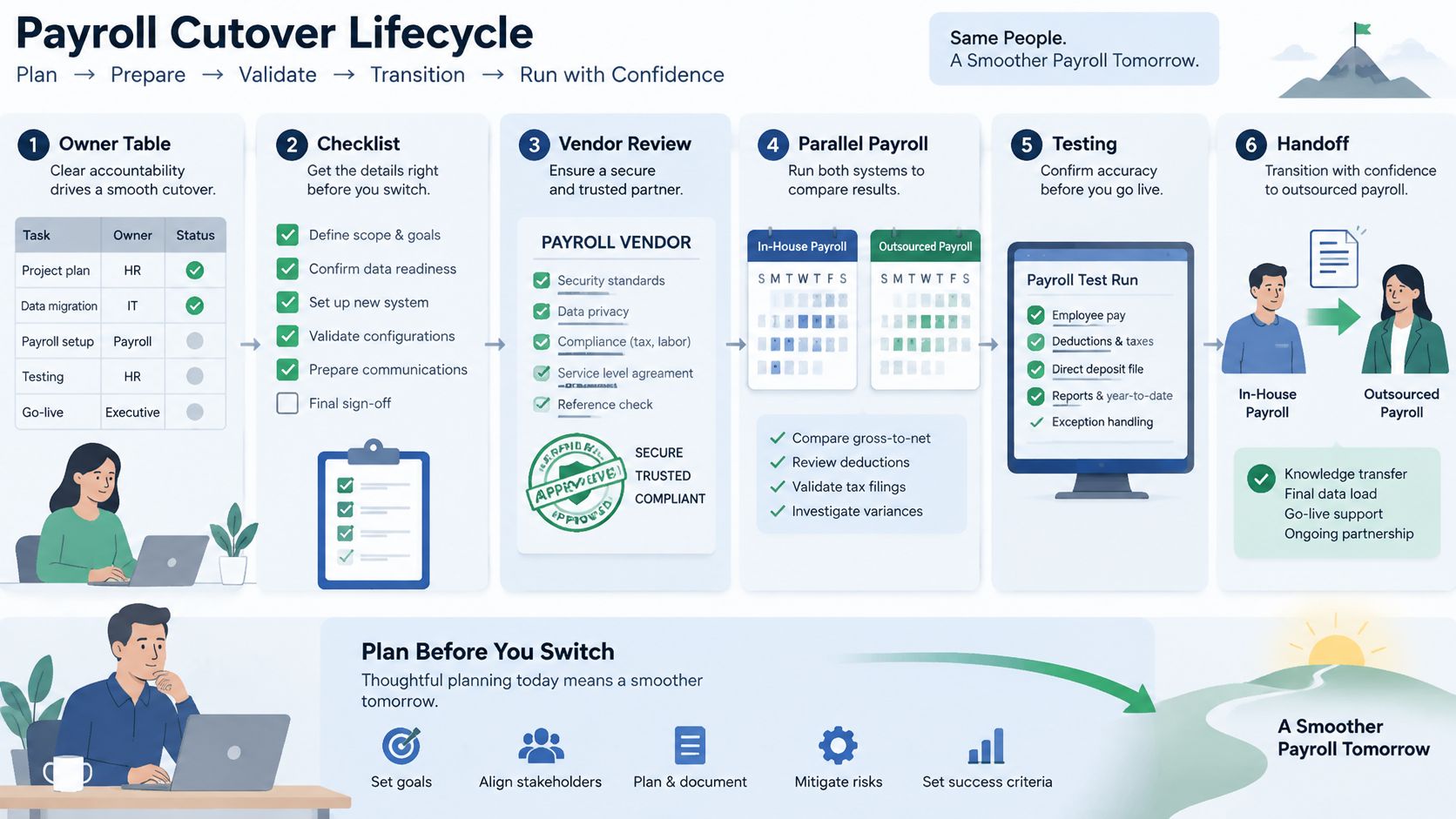
For U.S. and Canadian practices hiring in Latin America, test three awkward events before retiring the old process. Run one offboarding, one foreign-exchange payment, and one missed timesheet through the new workflow. Add a bank-detail change and a retroactive stipend if those occur in your practice.
Do not retire the old process on the first successful payday. Retire it after the new process handles an exception without improvisation.
Go live only when the parallel results reconcile, the business owner has approved the release, and your team knows how to stop a run. A clean demonstration isn't evidence. A reconciled parallel cycle is.
Most payroll failures begin as missed inputs, not faulty arithmetic. A provider can multiply the wrong hours correctly, apply the right deduction to the wrong person, or file a register that nobody compared with the bank withdrawal. Your ongoing control has to inspect transactions, not celebrate that a run finished.
The Chartered Institute of Payroll Professionals' 2023 benchmarking survey found that 77% of respondents reported payroll accuracy between 96% and 100%, but 61% of tracked errors were caused by missed regular or overtime hours. The same survey reported that 66% reported overpayments during the prior tax year, although 89% of those overpayments were recovered.
For remote healthcare teams, hours are the pressure point. The Department of Labor's wage recordkeeping guidance says covered employers must keep records including hours worked each day and week, the regular hourly rate, overtime earnings, deductions, and total wages for each pay period. It also states that payroll records generally must be retained for at least three years, while records supporting wage calculations generally must be retained for two years. Confirm how those duties apply to each worker and location with qualified counsel.
| Indicator | Inspect each cycle | Escalate when |
|---|---|---|
| Payroll accuracy | Exceptions at transaction level, not only a completed run | Result falls below the agreed percent |
| On-time pay and filing | Payment date and filing confirmations | Any missed pay date or filing |
| Corrections per cycle | Changes made after approval | Count jumps versus the prior cycle |
| Late or missing timesheets | Hours still open at cutoff | Any unpaid hours would be omitted |
| Rejected bank or FX files | Funding-file rejects | A reject is still open the same day |
| Variance versus last cycle | Headcount, gross, tax, and net | Movement has no documented cause |
Use the dashboard alongside a payroll compliance checklist for recurring reviews so the checks happen even when your usual approver is away. Require dual approval for manual changes after cutoff, including bank details, one-time stipends, retroactive rate changes, and termination payments. Add mean time to resolve errors and the percentage of exceptions closed before funding as service measures with your provider.
Say a practice approves a retroactive stipend for a bilingual virtual receptionist after the cutoff, and the amount is entered in the funding currency rather than the pay currency. The run can complete on time and still overpay the worker. Transaction-level review catches the currency and effective date. A completed-run check doesn't.
Close each month by reconciling the payroll register, bank withdrawals, tax-deposit confirmations, and quarterly filings before the next cycle begins. Escalate unexplained movement in headcount, gross pay, taxes, or net pay on the same day you spot it. Payroll accuracy is a habit of small reconciliations, not a year-end cleanup project.
Outsource payroll processing when multi-country pay, repeated correction work, or filing risk makes internal calculation harder to control than a well-governed provider relationship. Don't outsource to escape ownership. Your practice still has to supply accurate records, approve the result, verify deposits and filings, and act when an input is late or a payment fails. The provider processes. The employer remains accountable.
Before go-live, confirm six conditions. You've chosen the operating model, named an owner and system of record for every payroll input, reviewed security and continuity terms, reconciled one or two parallel cycles, recorded business-owner approval before release, and scheduled the first-cycle exception review. Treat three findings as no-go signals: no system of record, no breach-notification timing, and no tested way to pay people if the provider is down.
For U.S. and Canadian companies already hiring Latin American professionals, LatHire is one option to evaluate alongside the hire. LatHire's Global Payroll Management provides international payment processing to pay talent across borders, and LatHire handles all cross-border payments in its International Payroll service at no extra cost. Monthly Staffing also includes a Contractor of Record arrangement with compliant contracts, payroll, and IP protection. Judge that option with the same ownership table, security questions, and parallel-run discipline you'd apply to any other provider.
Shortlist two or three providers against your owner matrix, security criteria, and one fully costed messy pay run. If your Latin American hires already come through LatHire, review its payroll support against that same checklist and confirm the retained duties in writing before your next cycle.