

A practice manager may need help with appointment confirmations, insurance checks, or a growing inbox, while a startup founder is trying to find a developer who can work across time zones. In both cases, the job title is only a starting point. The decisions that matter most are what work the person will do, what authority they'll have, where they'll perform it, and what support they'll need to succeed.
To hire remote workers responsibly, define the role and collaboration model first, choose sourcing channels that fit the work, and assess candidates against consistent criteria. Before making an offer, resolve worker classification, payroll, work-location, and legal questions with qualified advisers. Then treat onboarding and retention as operating systems, not tasks to improvise after the hire starts. For medical practices, there's an additional gate: determine how the worker will handle protected health information and whether the role is part of the practice's workforce or a business associate arrangement.
This guide lays out a practical process for startups, small businesses, and U.S. medical practices. It covers role design, sourcing, candidate assessment, pre-offer checks, healthcare safeguards, and the first months of managing a distributed hire.
A reliable process has seven stages:
The first stage is where teams often move too quickly. A title such as “support lead” or “medical assistant” doesn't define the working arrangement. Specify the results you expect, the tools the person will use, the decisions they can make independently, and the issues they must escalate. Set out the hours that need to overlap with your team, too. For a medical practice, that may mean coverage during patient calls or scheduling hours. For a software company, it may mean time available for live incident response.
Consider a hypothetical startup that posts for a remote support lead and later discovers that the role requires several hours of daily overlap with its Central time team for customer escalations. That requirement changes which locations are practical and what the job posting needs to say. If candidates learn about the schedule only after interviewing, both sides may have spent time on a role that was never a good fit.
Fully asynchronous work can broaden the potential hiring pool, but it requires clear documentation and handoffs. Time-zone-aligned work makes quick collaboration easier, while narrowing the range of schedules and locations that fit. Hybrid-remote work can suit roles that benefit from occasional in-person meetings, but the company must make remote participation workable and explain any attendance expectations upfront.
Before opening a channel, write a one-page role card covering:
This card becomes the basis for the posting, interview questions, and onboarding plan. It also exposes whether the role is truly remote-compatible before you begin recruiting.
The right sourcing channel depends on the work. Broad job boards can generate a large pool for generalist roles, while a senior engineer or sales leader may require direct outreach, referrals, or a specialist network. Using one channel for every role can leave you with too many unsuitable applications or too few qualified candidates. For a deeper explanation of how to select and use channels, see this guide to candidate sourcing methods.
| Channel | Strength | Limitation | Best fit |
|---|---|---|---|
| Referrals from current staff | Higher trust and faster vetting | Limited volume and may narrow the pool | Senior or hard-to-fill roles |
| General job boards | Large applicant volume at low cost | Many applicants lack the required skills | Support, scheduling, and administrative roles |
| Remote-specialist job boards | Candidates already choose remote work | Smaller pool and uneven applicant quality | Roles where prior remote experience matters |
| Direct sourcing on professional networks | Reaches candidates who aren't actively applying | Outreach takes sustained time | Specialist engineering, design, and sales roles |
| Nearshore talent platforms such as LatHire | Pre-screened shortlists with time-zone overlap | Less control over sourcing; vetting depends on the platform's process | Teams needing Latin American overlap or recurring hiring |
| Employer-of-record or staffing services | Handles contracting and local payroll | Higher markup and less direct control | Hires in countries where you have no entity |
Channel fees can be structured as per-hire placement fees, monthly employer-of-record fees, staffing markups, or job-board subscriptions. Compare all-in quotes for the same role and overlap requirement, not just headline rates. A low-cost channel can become expensive if it sends applicants who consume substantial interviewer time without meeting the role's requirements.
A common waste of time is publishing a posting without a pay range. Some states, including Colorado and New York, have pay-transparency requirements for certain postings. Requirements vary, so check the rules that apply to your business and the location where the job will be performed with an HR compliance professional or employment counsel.
Another mistake is relying on a single channel and waiting for applicants. Pick two channels for each role, set a review date, and track applicants per channel and time to first interview. A nearshore platform may describe matching candidates in as fast as 24 hours, but a shortlist isn't a completed hire. You still need to check the person's skills, schedule, and fit for the actual work. Compare channels after you've seen the quality and speed of their results, not just the initial promise.
A remote candidate needs to demonstrate both role competence and the ability to collaborate without relying on an office routine. Use a consistent pipeline so each finalist has a fair opportunity to show relevant evidence:
A useful work sample tests how a person handles the handoff, not just whether they can produce an answer. An engineer could document an ambiguous technical decision. A marketer might prepare a brief that a colleague in another time zone can execute. A support candidate could reply to a frustrated customer and explain when they would escalate the issue. Score the result for clarity, handoff quality, and independent execution.
The scorecard below is an example, not a universal formula. Adjust the weights to reflect the job. A patient coordinator, for instance, may need a stronger emphasis on clear patient communication and privacy habits than an engineer would.
| Criterion | Example weight | Strong evidence | Red flag |
|---|---|---|---|
| Role skills | 30% | Completes the work sample with correct, usable output | Needs repeated clarification on basic tasks |
| Written communication | 20% | Clear, structured replies a colleague can act on | Vague updates and unexplained assumptions |
| Independence and ownership | 15% | Names a next step and completes work without constant check-ins | Waits for instructions on routine work |
| Time-zone reliability | 15% | Confirms overlap hours and describes a stable working routine | Unclear availability or frequent schedule conflicts |
| Remote work history | 10% | Explains how they manage priorities and communication without an office | Depends on office routines that don't transfer |
| Privacy and security habits | 10% | Describes secure devices, a private workspace, and careful handling of sensitive data | Dismisses confidentiality or shares logins |
Paid work samples cost money, but they can give both parties a stronger signal about the work. Long unpaid tests can push qualified candidates away, particularly when the task resembles real client work. Keep the exercise limited, relevant, and consistent across finalists. For guidance on designing an assessment, review these pre-employment skills testing practices.
Assess communication against the job's actual requirements, not a candidate's accent or similarity to the interviewer. If the role requires concise written handoffs, score those handoffs. If it involves live patient scheduling, assess clear, respectful spoken communication and the ability to follow an approved script. Apply the same criteria to every finalist, and give candidates the same information about the work sample.
Before an offer, share a collaboration contract: expected overlap hours, response-time expectations, escalation paths, documentation standards, and which tools are used for live versus asynchronous work. A candidate who sees a mismatch can decline early. That's better for everyone than discovering during the first month that the schedule or working style doesn't suit the role.
The worker's classification and work location shape how you hire and pay them. Possible arrangements include direct employment, an independent contractor relationship, an employer-of-record arrangement, or a local entity you establish. Contractors may suit genuinely independent, project-based work, but control over schedule, methods, and integration into the team can raise classification questions. An employer of record can handle local employment and payroll, usually for a fee, while a foreign entity gives the company more direct control and requires more setup.
Don't make the classification decision based only on the contract's label. Have qualified employment counsel review the actual working arrangement. A person's duties, schedule, authority, and relationship to the business can matter more than the title assigned to the role.
| Check | Why it matters | Who confirms |
|---|---|---|
| Worker classification | Control, schedule, and integration can make a contractor look like an employee | Employment counsel |
| Right to work in the worker's country | Authorization to work is tied to where the work is performed | Immigration counsel or local employment adviser |
| Payroll, social security, and withholding | Contributions, leave, and withholding rules differ by country and U.S. state | Payroll provider or local accountant |
| Permanent-establishment exposure | Work location and authority to sign contracts can create a taxable presence | Tax adviser |
| U.S. state obligations for U.S.-based remote hires | Working from a state can trigger withholding and wage rules there | Payroll provider and employment counsel |
| Pay transparency and posting requirements | Some states require pay ranges in certain postings | Employment counsel or HR compliance lead |
For international hires, document where the person will work and what they can do on the company's behalf. OECD guidance summarized by ICAEW on cross-border remote working describes spending less than half of total working time in a home office during the relevant 12-month period as a general indicator against that home office creating a permanent establishment. It isn't a universal safe harbor. Tax risk can still depend on the role's activities and authority, including whether the worker can negotiate or conclude contracts.
For example, a company considering a remote sales development hire in another country should determine whether the person will only identify prospects or will also negotiate commercial terms. If the role touches revenue-generating activities or contract authority, involve a tax adviser before the offer and clearly assign who can approve or sign agreements.
U.S.-based hires need location review, too. An employee working remotely from a different state may trigger state payroll withholding and wage obligations. Ask new hires to disclose their primary work location and require approval before they relocate. Keep a simple record of where work is performed, rather than treating the address on an old application as conclusive.
Write a pre-offer compliance memo that records the proposed classification, work location, responsibilities, payroll approach, and any open questions. Have HR or operations, tax, and counsel review it. Requirements vary by country and state, so confirm specific obligations with qualified advisers. A cross-border hiring compliance checklist can help organize the review, but it doesn't replace professional advice.
For a medical practice, determine whether the remote worker is part of the practice's workforce or whether an outside organization is acting as a business associate before granting access to protected health information. HHS defines a business associate as an organization or person outside a covered entity's workforce that handles PHI for certain services. Billing, claims processing, and related administrative work can involve PHI. When an outside company performs services involving PHI, the practice generally needs a written business associate agreement. Calling an individual an independent contractor doesn't, on its own, remove HIPAA obligations. See HHS guidance on business associates and cloud services.
| Role | Typical tasks | Outside its scope | Escalates to |
|---|---|---|---|
| Virtual medical receptionist | Answers calls, takes messages, routes urgent symptom calls | Does not triage or interpret symptoms | Licensed clinical staff |
| Appointment scheduler | Books, reschedules, and confirms appointments | Does not make clinical scheduling decisions | Practice manager |
| Patient coordinator | Handles intake forms, reminders, and pre-visit tasks | Does not review or judge clinical content | Provider or nurse |
| Insurance verification specialist | Confirms eligibility, coverage, and benefits | Does not determine medical necessity | Billing lead |
| Medical billing support | Tracks claims, follows up on denials, and posts payments | Coding and documentation decisions stay with credentialed staff | Billing lead or certified coder |
| Prior-authorization support | Gathers records and submits authorization requests | Does not decide medical necessity or sign clinical justification | Ordering provider |
| Medical administrative assistant | Manages inboxes, records requests, and internal documents | Access limited to the minimum necessary for the task | Practice manager |
These are administrative roles. They don't diagnose, provide clinical care, perform clinical triage, or make medical decisions. A role's permitted scope may vary by state, so confirm requirements with state regulators or qualified counsel. When a call includes symptoms or a patient asks for clinical guidance, staff should follow a written escalation path to licensed clinical personnel rather than interpret the concern themselves.
HIPAA requires covered entities to have written contracts or other arrangements with business associates that protect PHI. A BAA establishes permitted uses, disclosures, and safeguards, but it doesn't replace the practice's own operating policies. HHS notes that cloud or mobile access to electronic PHI can be permitted when appropriate safeguards are in place and relevant business associate agreements cover service providers that can access the information. See HHS's business associate guidance.
Recommended controls include unique user credentials, role-based access, multi-factor authentication where available, approved devices, a private work location, and no shared logins. Practices should also define approved applications, incident reporting, screen privacy, access termination, and whether PHI may be downloaded or stored locally. HHS doesn't certify tools or people as “HIPAA certified,” so assess safeguards and contractual obligations rather than relying on that label.
A hypothetical practice outsourcing insurance verification should identify the vendor and the specific staff who need access, sign the appropriate BAA, and review access regularly. Keep clinical triage and patient-facing decisions with the practice's qualified staff. For remote calls, give administrative staff a written identity-verification script and an escalation process; don't rely only on caller ID or a familiar voice.
A signed offer does not establish whether a remote hire can do the work or whether the team can support them. Set up onboarding around the role's actual responsibilities and authority, with clear owners, deliverables, and review points. Before the start date, define role-specific success measures, communication norms, system access, equipment needs, and a written 30/60/90-day plan. Assign a peer buddy and name who handles each setup item. If one person provides equipment, another grants access, and the manager owns the plan, make those responsibilities explicit.
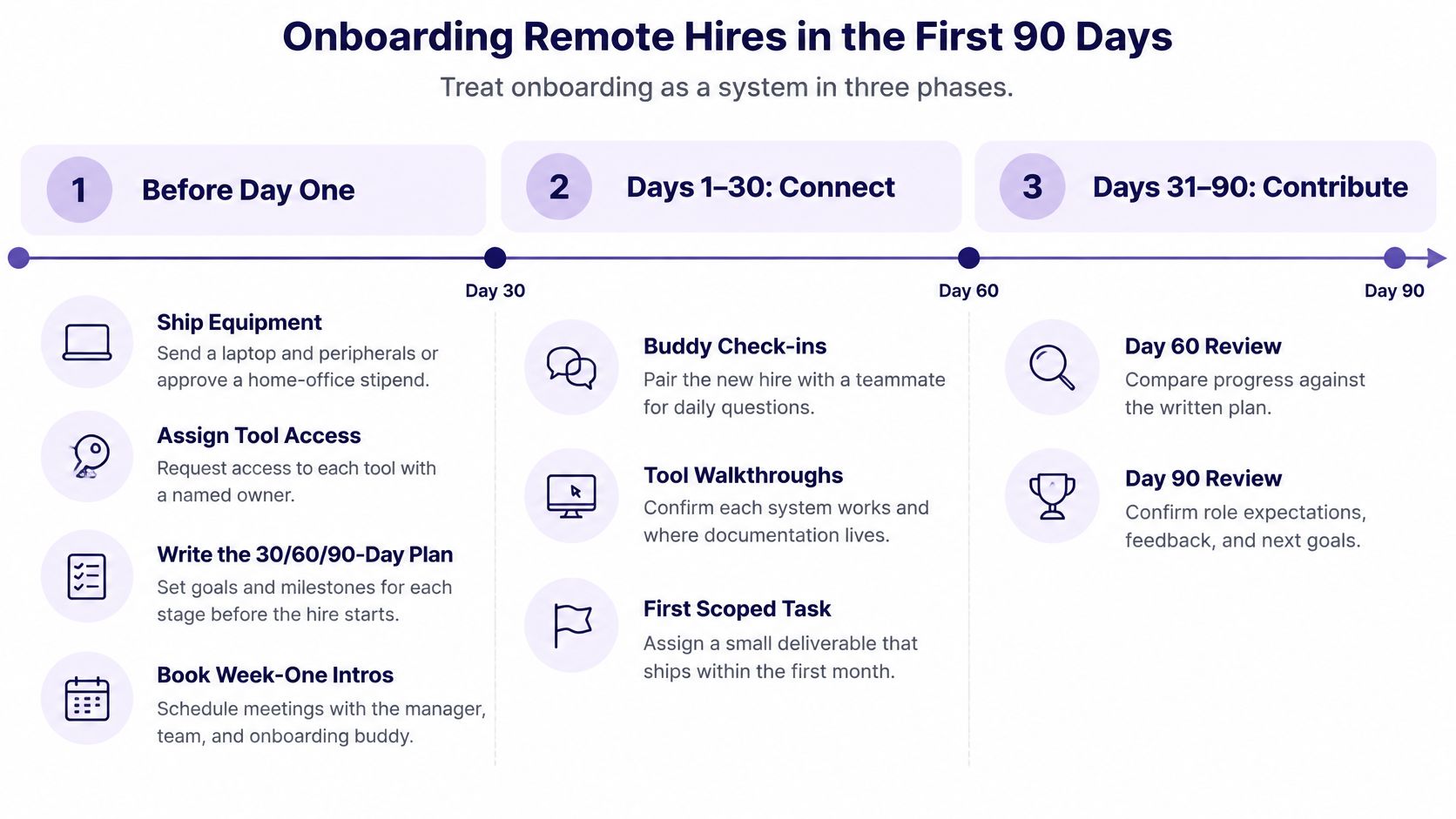
In the first week, schedule regular manager contact, introduce the hire to key teammates, and assign a small real task to test the work setup and access. A remote designer could prepare banner variations for an active campaign. Review them together and confirm that the tools, brief, and feedback process are clear. For a technical hire, a small pull request can test the development environment and review workflow.
Regular contact and an early deliverable give the hire a clear path into the work. Provide structured knowledge transfer rather than expecting a new colleague to infer how decisions are made, where information lives, or who can unblock a task. Set an early deliverable that matches the role's actual authority, so the hire can make progress without waiting on approvals they cannot give.
At the end of the first month, check access, task completion, and understanding of communication norms. At the next review, compare progress with the plan. Look at review-cycle duration, use of documentation, and delays caused by unclear ownership. By the end of the first 90 days, assess milestone completion and agree on the next goals.
Choose measures that fit the work. A practice might check whether scheduling or verification tasks are accurate and escalated appropriately. An engineering team might track time to a first deliverable and review turnaround. Compare employees in similar roles and locations rather than relying on generic productivity claims. Early delivery does not show whether the working relationship is sustainable, so continue checking how the hire is settling into the role.
Onboarding takes manager time, a real cost for a small company. Skipping it can create rework, delayed access, and confusion once the employee handles live responsibilities. Keep the timeline in a shared document, assign a named owner to each item, and revise it after each hire. A clear process helps surface mismatches early, including when the role's decision-making authority or required location differs from what the team assumed.
A remote hire can accept an offer, then discover that the promised flexibility comes with unpredictable hours, little support, or no clear path to grow. Candidates weigh those terms alongside pay and role scope. Robert Half's remote-work statistics and trends analysis offers context on work arrangements, but the practical point for employers is to make the arrangement clear before a candidate joins.
Put the terms in a written remote-work policy. Specify which roles can be remote, required overlap hours, how performance is evaluated, and what process applies if location requirements change. State geographic limits and travel expectations before the person accepts. Predictable equipment and connectivity support, access to advancement, and manager quality also shape whether an employee can do good work and sees a future with the company.
Set a management rhythm that gives people feedback and access to decisions without turning check-ins into attendance checks. Weekly one-to-ones, monthly team reviews, and quarterly goal setting can help managers remove blockers, discuss career development, and share feedback. Document decisions and recognition in channels all remote employees can access.
Measure the work itself. For a scheduler, that might mean accurate bookings and appropriate escalation. For an engineer, it could mean completed deliverables and sound review practices. Calibrate reviews across locations so proximity to a manager does not stand in for contribution. Monitoring software can capture activity without showing the quality or value of the work. Use it only for a defined operational need, and explain what it records and why.
Retention also depends on whether remote staff can contribute to planning and advancement. A remote engineer who is routinely left out of project discussions may lose influence and growth opportunities even while meeting individual goals. For example, an engineer who leaves after months of exclusion from planning meetings may have benefited from standing invitations to relevant discussions and a visible career path. Those steps can address isolation, though they cannot guarantee that an employee will stay.
Managers should check whether employees have the authority and information to carry out their responsibilities, not just whether their output meets targets. If decisions repeatedly stall because a remote hire lacks access to discussions or approval rights, fix the working arrangement before treating the problem as a performance issue. Clear expectations, fair access, and timely feedback make retention part of day-to-day management.
Remote hiring succeeds when you define the work and required overlap before recruiting, use channels suited to the role, and resolve classification, payroll, and location questions before making an offer. Onboarding and retention need the same operational care as hiring: set clear expectations, provide access and support, and review work against role-specific outcomes. For medical practices, determine whether a direct hire or outside vendor will handle PHI before granting access, then put the appropriate agreements and safeguards in place.
Start by writing a role card and selecting two sourcing channels for each opening. Before an offer, prepare a compliance memo for qualified advisers to review; before the start date, assign owners to a written 90-day plan. If you need bilingual English- and Spanish-speaking administrative or medical virtual assistants aligned with U.S. working hours, LatHire can provide a shortlist in as fast as 24 hours, and you can interview each candidate before making a hire.