

The usual advice about companies that hire remote software engineers is to collect recognizable names and apply everywhere. That misses the harder problem: visibility into who's recruiting, which locations qualify, and who employs and pays the engineer. A long directory won't tell you whether you're applying for an internal job, joining a talent network, or accepting an assignment with a client.
For U.S. medical practices, that distinction matters before anyone touches a scheduling integration, patient portal, or reporting database. A software engineer builds and maintains systems; a medical virtual assistant handles defined administrative workflows. Hiring one to compensate for a shortage of the other usually creates an expensive mismatch.
The providers below represent different routes: Latin America-focused recruiting, global talent networks, AI-assisted matching, and staffing arrangements with employment administration. Most are sourcing partners rather than direct employers hiring engineers for their own products. Candidates seeking direct openings can also browse HiredBySkill's remote engineering listings, then verify eligibility on the employer's posting.
Choose by hiring pattern, not brand recognition. The profiles and comparison that follows help applicants assess access and help employers weigh time-zone overlap, screening, payroll responsibility, and trial terms without confusing a promising introduction with a completed hire.
For a U.S. or Canadian company, nearshore hiring can make coordination easier, but it does not remove the work of managing engineers. LatHire's nearshore software development service connects companies with pre-vetted Latin American professionals. Its model combines AI-assisted matching, skills evaluations, and human-led background checks with support for international payroll, benefits, and compliance.
Consider a multispecialty group building an interface between its scheduling system and an internal operations dashboard. The engineer needs access to people who understand appointment types, cancellation rules, and provider availability. Nearby time zones can make those conversations easier to schedule. Confirm each person's actual working hours rather than assuming they match your team's.
LatHire's nearshore software development teams may suit companies that need ongoing engineering capacity. The trade-off is that a hiring platform cannot replace an internal owner who prioritizes requirements, reviews delivery, and decides whether an integration is safe to release.
Practical rule: Agree on overlapping working hours before signing. A candidate's location does not guarantee availability for your morning incident review.
A Latin America-focused search can suit teams that want closer working-hour overlap, though it may not cover every specialized healthcare-interface skill. For an EHR-related project, ask candidates how they would handle failed messages, duplicate records, credentials, and vendor restrictions.
Applicants should make their availability clear, share relevant work samples, and explain technical decisions in writing. Employers should request an itemized quote and written engagement terms, including how the arrangement can end.
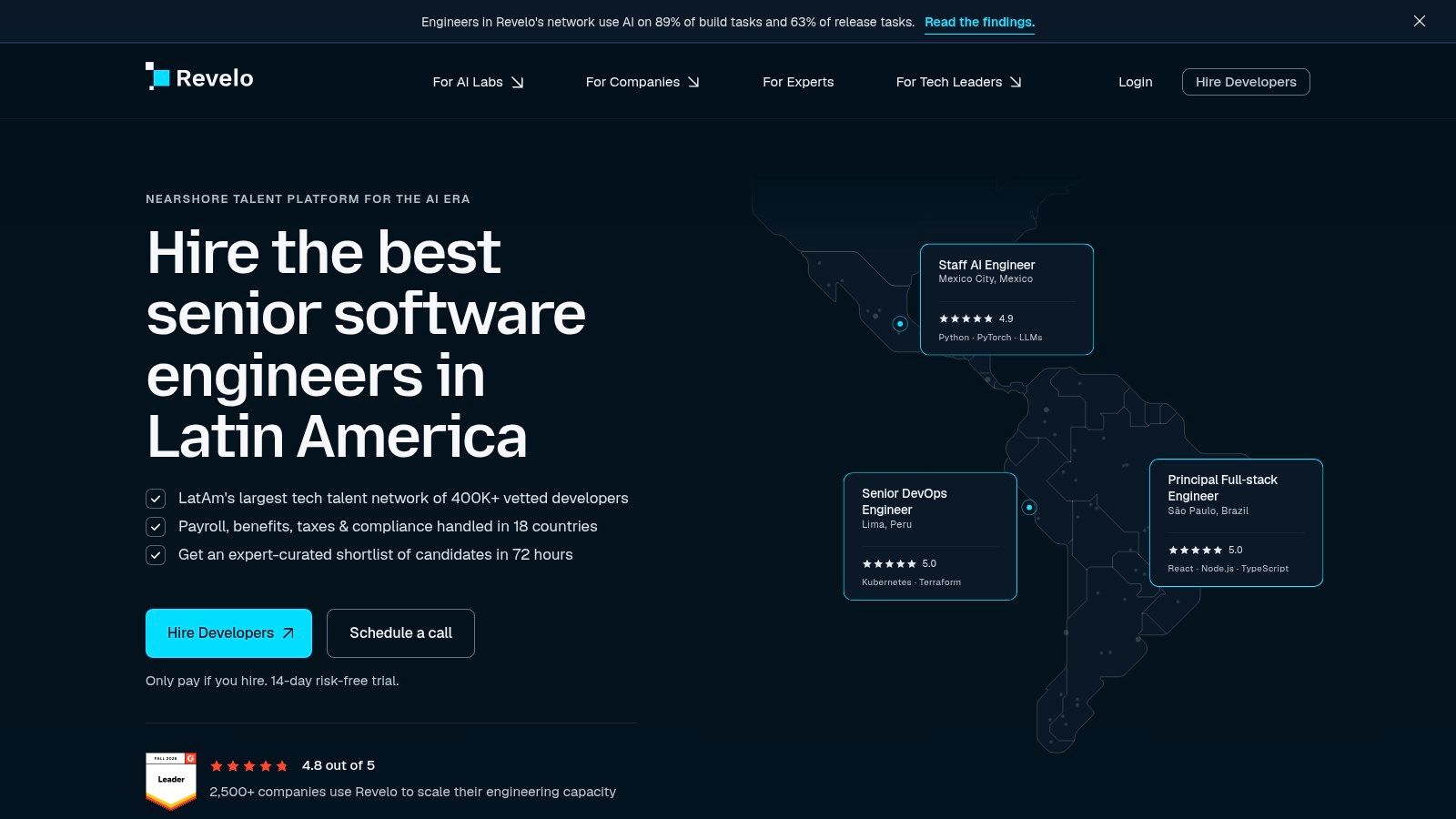
A practice with an existing technical lead needs a different service from a practice commissioning its first custom application. Revelo connects U.S. companies with vetted Latin American engineers and supports both individual hiring and assembled engineering teams. Its recruiting and cross-border administration model makes it a relevant comparison for buyers who want talent plus help with onboarding, payroll, and benefits.
For example, a growing dermatology group might already have a developer maintaining its website but need backend and QA support for a patient-intake integration. Adding complementary specialists can work better than asking the existing developer to own every layer. Before buying a team, however, identify who will make architecture decisions and accept completed work.
Revelo's nearshore orientation can support U.S. working-hour overlap, but confirm each candidate's schedule. Pricing requires a role-specific quote, so compare total employer cost, included services, and termination obligations rather than salary alone.
For a broader sourcing comparison, evaluate the responsibilities involved when you hire Latin American developers. Candidates should ask whether they're being considered for a funded client vacancy or admitted to a network for possible future matching. Those are different stages of an application, and neither should be mistaken for an offer.
Andela is the global-network option in this comparison. It offers technical talent across application engineering, AI, data, cloud, and DevOps, with arrangements spanning individual placements, flexible teams, and managed delivery. That breadth can matter when a healthcare organization needs an unusual combination of skills rather than a general-purpose developer.
The distinction between staffing and managed delivery is particularly important here. With staffing, your organization normally directs the work; with managed delivery, you need a written agreement describing what the provider owns, how acceptance works, and what happens when requirements change. Don't infer project accountability from the presence of a project manager.
Global sourcing expands the search. It doesn't remove the need to agree on working hours, incident coverage, and decision ownership.
A larger healthcare group could use a global search for a cloud migration specialist while keeping its internal application team intact. A small practice seeking help with a broken website form may find that scope unnecessarily elaborate.
If you plan to hire overseas developers, map employment administration separately from technical supervision. Applicants should prepare for technical assessment, English-language screening, and human review, while confirming which client locations they can serve.
For medical practices, global availability also requires a deliberate data-access decision. Have your compliance professional assess the proposed arrangement before granting access to systems containing patient information.
Turing uses AI-assisted matching and technical assessment to source remote software engineers. It's a logical option when you can describe a specific role clearly, such as a backend engineer maintaining an existing application, rather than asking a provider to discover what your organization needs.
Matching technology can narrow a search, but it can't fix an unclear job description. A medical practice asking for someone who knows automation may need API development, workflow configuration, data cleanup, or better use of its existing software. Define the work before deciding which technical assessment is relevant.
The central evaluation problem is whether a candidate can explain, validate, and maintain the work. For a healthcare integration, ask the engineer to debug a synthetic failed transaction, explain retry behavior, and identify where sensitive information could leak into logs.
Ask candidates to disclose how they used AI tools during an assessment. A polished solution matters less than their ability to explain its assumptions, write tests, and recognize unsafe behavior.
Employers should distinguish a provider's advertised trial from their own paid evaluation plan. Confirm the applicable terms in writing before work begins, and don't assume that risk-free means every fee is refundable or that completed work transfers automatically.
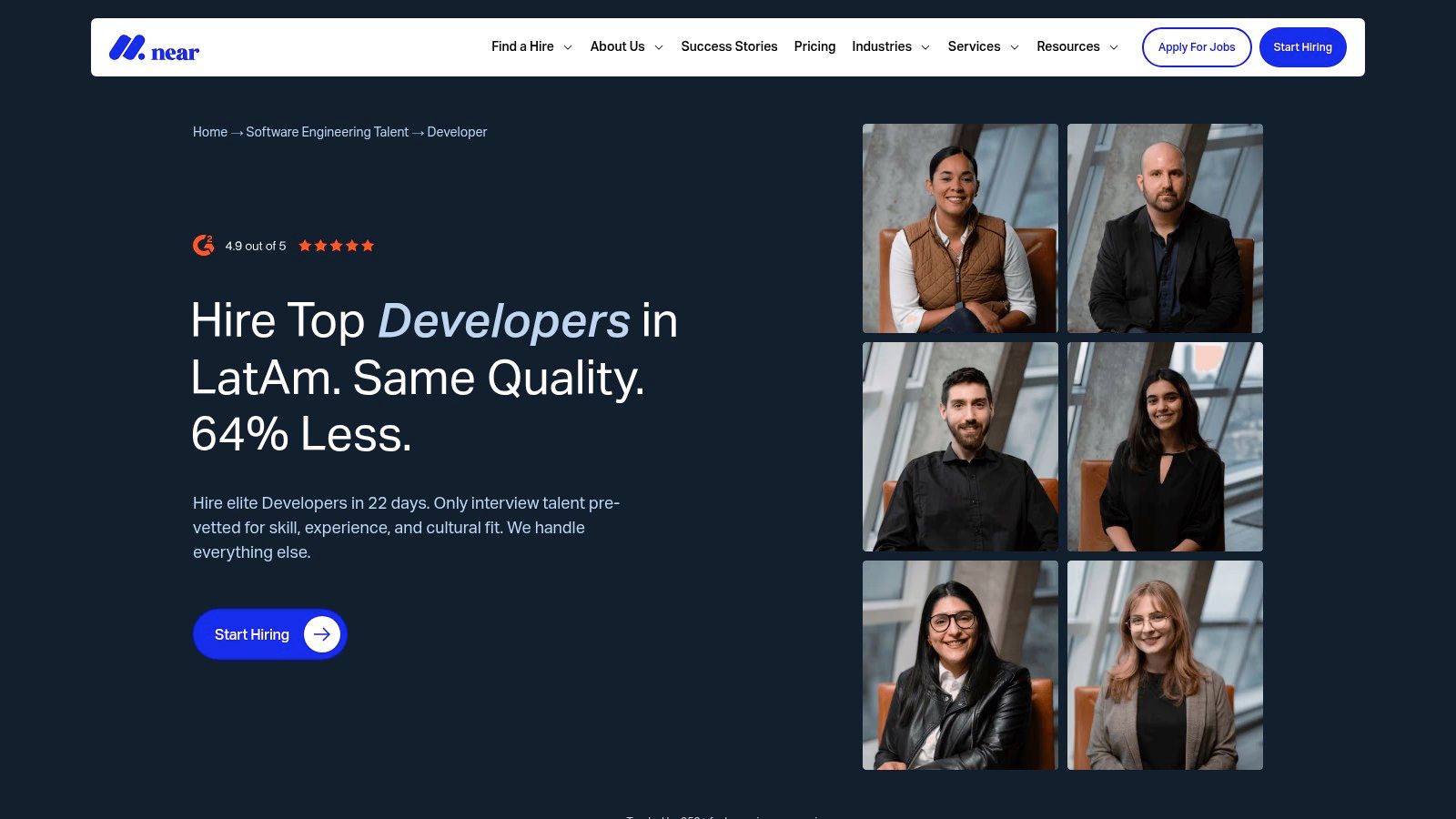
The defining choice with Hire With Near is direct hire versus staffing. The company recruits Latin American professionals for U.S. employers, including software developers, and offers different levels of employment-administration support. That lets buyers compare a recruiting relationship with a more ongoing staffing arrangement.
Direct hire can appeal to an organization that already has suitable international employment infrastructure. Staffing can be more practical when a practice wants help administering payroll and the employment relationship. Neither label tells you enough on its own: establish the contracting entities, payment obligations, benefits responsibilities, and exit process.
Published salary examples can help frame a conversation, but they aren't an all-in proposal. Ask for a quote that separates compensation, recruiting or staffing fees, employment costs, equipment, and any conversion charge.
Say an orthopedic group needs a developer to maintain an internal referral-tracking application. A lasting hire may be appropriate if the application is core infrastructure; a temporary engagement may be more sensible if the goal is to retire it after a migration.
Regional specialization is useful when U.S. collaboration is central, but it narrows the search compared with a worldwide network. Confirm actual experience with your stack before treating location and English proficiency as sufficient evidence of fit.
Uncertain workload calls for an explicit engagement decision, not an indefinite contractor arrangement by default. Terminal offers full-time, contract, and contract-to-hire options across regions including Latin America, Canada, and Europe. Its full-time services can include employment, payroll, benefits, and HR support.
That range can suit a healthcare organization evaluating whether a technical need will persist. A practice consolidating reporting systems may need temporary engineering capacity during migration, then a smaller maintenance commitment afterward. Contract-to-hire can create a transition path, provided conversion terms and costs are agreed before the engagement starts.
Contract safeguard: Write down what happens when the project ends, the client changes direction, or either party wants to convert the relationship.
Terminal's screening includes communication, English proficiency, and domain experience. Employers should still test whether a candidate can explain a failure to a nontechnical practice manager without hiding behind jargon.
The GitLab 2021 Remote Work Report found that only 37% of surveyed remote professionals said their organization did a good job aligning work across projects. For a medical practice, the practical response is a shared issue tracker, written acceptance criteria, and a named person who resolves conflicting requests.
Terminal's multiple regions offer sourcing flexibility but don't guarantee uniform overlap with U.S. clinic hours. Ask for the proposed schedule, emergency coverage expectations, and arrangement-specific billing in the quote.
Applicants should clarify whether they're pursuing employment or a client assignment. Employers should assess handover quality as carefully as coding speed, especially when a temporary engineer will leave others maintaining the system.
Scalable Path emphasizes personalized sourcing and human-led technical vetting for remote developers and other technical professionals. Its model is particularly relevant when you want to add an individual contributor to an existing team rather than hand an entire project to an outsourced delivery organization.
That difference matters for medical practices with an external IT partner. Your IT provider may manage devices and user accounts without having the software architecture expertise to supervise a developer. Before adding engineering capacity, confirm that someone can review code, manage deployment, and own the application after the engagement.
A practice with a capable technical lead could use this approach to add a specialist for a defined integration or application improvement. A practice with only a broad ambition to automate administration needs discovery and workflow design first.
Ask candidates for a walkthrough of a representative repository, using public or appropriately sanitized material. Look for readable changes, tests, useful documentation, and an honest explanation of technical compromises.
For healthcare work, use synthetic patient records during evaluation. Don't ask candidates to demonstrate ability by accessing live patient information or sharing confidential code from a previous employer. The same restraint applies to applicants: evidence of judgment includes knowing what not to disclose.
| Company | Talent Region | Hiring Models | Time to Match | Pricing Transparency |
|---|---|---|---|---|
| LatHire | Latin America | Flexible engagement options | As little as 24 hours | No public rates; potential savings are estimates |
| Revelo | Latin America | Individual hires or engineering teams; month-to-month | 3–5 candidates in 72 hours | Quote-based |
| Andela | Global, 135+ countries | Individual placements, flexible teams, or managed projects | Not listed | Engagement-specific; not publicly listed |
| Turing | Global remote talent | Individual engineer hires | Most roles matched within four days | Rates not clearly published |
| Hire With Near | Latin America | Direct hire or staffing | Not listed | Example salary ranges published; fees vary |
| Terminal | Latin America, Canada, and Europe | Full-time, contract, or contract-to-hire | Not listed | Quote-based; varies by arrangement |
| Scalable Path | Global talent pool | Flexible engagements; individual specialists | Not listed | Costs vary by seniority, location, and specialty |
For employers, choose the hiring pattern before comparing résumés. LatHire, Revelo, and Hire With Near emphasize Latin American sourcing; Andela offers a broader global network and delivery options; Turing emphasizes AI-assisted matching; Terminal offers varied engagement models; Scalable Path emphasizes personalized technical staffing. These approaches overlap, so the contract matters more than the category.
For candidates, direct employment and marketplace admission are different routes. A direct employer recruits for its own team, while a sourcing platform may assess you before a client opportunity exists. State your location, working-hour overlap, employment preferences, and availability clearly, and ask whether the role is accessible from your country.
Medical practices should first decide whether they need engineering or administrative capacity. Appointment scheduling, insurance verification, patient coordination, and billing support generally call for trained healthcare administrative staff; building and maintaining software calls for technical expertise. A developer shouldn't make clinical decisions, and a medical virtual assistant shouldn't be made responsible for production software.
Compare proposals against the same requirements: working-hour overlap, total cost, supervision, payroll responsibility, and exit terms. Have qualified counsel or compliance professionals confirm applicable privacy and employment obligations. Provider screening doesn't replace your own access controls, and a general security promise doesn't establish that a healthcare workflow is appropriate.
Use a two-week paid pilot as an evaluation design, not as an assumption about any provider's trial policy.
Applicants can prepare by presenting an authenticated work sample, explaining an architectural compromise, and showing a concise asynchronous progress update. Don't share proprietary code or patient information to make your application look stronger.
The useful comparison among companies that hire remote software engineers isn't just who has the largest network. It's which route gives you suitable skills, workable collaboration hours, clear employment administration, and accountable delivery.
For medical practices, start with the workflow and name an internal owner before buying technical capacity. Then compare written terms and evaluate a bounded piece of paid work rather than relying on a shortlist or screening badge alone.
If nearshore engineering fits your requirements, ask LatHire for a role-specific shortlist and an itemized proposal covering working hours, payroll support, and engagement terms.