

Those numbers are the easy part. The figure that reframes the decision for a medical practice comes from the American Medical Association: in its survey of 1,000 U.S. physicians, 35% of physicians said their practices employed staff members who worked exclusively on prior-authorization tasks. That is a full queue, already staffed and already costing the practice, whether the person sits at the front desk or logs in remotely.
So the question is not just what a remote assistant charges per hour. Price the practice's own hours around that rate: intake time, payer follow-up, records requests, patient messaging, and the manager time needed to recruit, train, check and cover the role. Add the privacy controls required before anyone touches patient data, including access limits, device rules and documentation.
A low hourly rate attached to heavy supervision is an expensive hire. A higher rate attached to a trained, independent worker with replacement coverage can cost less by the end of the month. I would compare offers by workload, supervision burden and privacy readiness, then judge the hourly rate last.
Work type explains most of the spread in virtual assistant cost. Upwork's published virtual assistant cost data reports a median of $10 to $20 per hour across virtual assistants, with a more detailed rate table listing administrative and data-entry work at approximately $12 to $20 or more per hour, marketing, customer-service and accounting support at $20 to $35 or more, and advanced executive-assistant or technical work at $38 to $50 or more.
Read the fine print before you anchor on those numbers. The same table states the ranges reflect North American freelancers with more than 1,000 hours worked and a 90% success rate, and notes that some figures come from historical worldwide contracts. You're looking at experienced, screened supply, not the floor of the open market.
| Type of work | Reference rate range | Medical practice examples |
|---|---|---|
| Routine administrative and data entry | $12–$20 per hour | Appointment reminders, records requests, data entry |
| Marketing, customer service and accounting support | $20–$35 per hour | Patient communication follow-up, review requests, bookkeeping-adjacent tasks |
| Executive or technical work | $38–$50 per hour | Practice operations reporting, dashboard setup, complex payer reporting |
The medical role placements below are my estimates mapped from those general marketplace bands, not role-specific quotes. Virtual medical receptionists and appointment schedulers sit closest to the routine band when the work is scripted calling, reminder campaigns and calendar management in a system you've already configured. Insurance verification specialists, medical billing support and prior-authorization support usually move toward the middle band, because they need payer-specific training, portal fluency and judgment about when a case is stuck versus pending.
Two people can carry the identical title and deliver completely different output. One insurance verification specialist knows how to read a payer's benefit breakdown, spot a plan that requires a referral before a specialist visit, and document the call reference number. Another types demographics into a field. Both call themselves a medical administrative assistant. Software depth, spoken and written English, bilingual capability, and how much responsibility they can hold without checking with you are what separate the bands.
Practical rule: before you request a single quote, write down your three most time-consuming recurring tasks and assign each one a band. If two of your three tasks are payer follow-up and referral tracking, a quote priced at the routine admin band is telling you something about the candidate's experience, not about your good fortune.
That exercise also protects you from the opposite error, which is paying a specialist rate for reminder calls and inbox sorting. Match the rate to the work, then verify the match in a skills test rather than a profile description.
The same job can be bought four ways, and the model decides who carries recruiting, payroll, supervision and replacement. That allocation matters more than the headline number, because every task you keep is a task your practice manager performs at a manager's cost.
Freelance hourly gives you the lowest advertised rate and the most flexibility. You source the person, handle contractor paperwork and W-9 collection, track hours, and find coverage when they're unavailable during your busiest clinic week. It works well for a bounded project with written procedures already in place, such as cleaning up a referral log or building a recall list.
Part-time dedicated arrangements bill fixed weekly hours, hourly or monthly. This suits a defined queue: 15 hours a week of payer status follow-up, or 20 hours of referral coordination. You get continuity, and the assistant learns your payers and your EHR quirks instead of relearning them each engagement.
| Pricing model | Typical basis | Who handles hiring, payroll and replacement |
|---|---|---|
| Freelance hourly | Rate paid per hour worked | Your practice, including contractor paperwork and coverage |
| Part-time dedicated assistant | Hourly or monthly rate for fixed weekly hours | Depends on the contract; confirm before signing |
| Full-time dedicated assistant | Monthly rate for a full-time role | Staffing provider if it employs the worker; your practice if hired directly |
| Full-service staffing provider | Monthly rate that bundles payroll, benefits and compliance | Provider, with replacement terms set in the contract |
For a full-time administrative seat, the closest official domestic benchmark is the Bureau of Labor Statistics category for secretaries and administrative assistants, where the BLS Occupational Outlook Handbook reports a median annual wage of $48,310, equivalent to $23.23 per hour, in May 2025. That's wages only. Payroll taxes, benefits, paid leave, equipment, recruiting and supervision sit on top of it.
Divide each monthly quote by the scheduled hours in that month, then compare. A bundled monthly rate will usually look higher per hour than a freelancer, and that gap is what you're paying for someone else to handle employment administration and replacement. At LatHire, an Executive Assistant costs $1,900 per month with savings of up to 65%, and a skilled Latin American Customer Service Representative runs $2,000 to $2,500 per month, so you can put a real monthly figure beside an hourly quote instead of guessing.
Ask every provider two questions in writing: which model they're quoting, and what happens if the worker leaves in week six.
Your workload profile sets your budget, not the market's average rate. Prior authorization is the clearest example, because it's measurable and it's usually bigger than practice owners assume. The AMA's prior authorization survey findings report an average of 33 prior authorizations per physician per week, requiring 14.4 hours of physician and staff time, close to two full business days per physician weekly.
Start with arithmetic, not a job posting. Say a practice has three physicians running at that survey average. That's roughly 43 hours of authorization-related time each week before anyone answers a patient message, chases a records request or works a referral. Now add the other queues you intend to hand over, and you have a weekly workload estimate you can defend.
Then discount it. No assistant converts every paid hour into completed tasks. Budget time for:
Divide the weekly workload by realistic productive hours, not scheduled hours, and you'll get a capacity number that survives contact with a real clinic week.
Practices doing frequent procedures that require pre-approval, or working heavily through payer portals, carry more administrative volume than a practice whose visits rarely need authorization. Count your own submissions for two weeks rather than borrowing an average. A medical virtual assistant role scoped around your actual queues is easier to price and easier to supervise than a generic "help with admin" job description.
Draw the line before you hire: the assistant owns document gathering, portal submission, status follow-up and escalation. Medical-necessity judgments and clinical advice stay with the provider.
Role scope and payer rules vary, so confirm that split with your compliance lead and write it into the job description rather than leaving it to interpretation.
Most comparisons stop at the hourly rate, which is why they mislead. A pricing analysis of virtual assistant costs reports that self-hiring can require 15 to 40 hours for sourcing and screening before any work begins, with onboarding, task clarification, rework, software access, leave coverage and ongoing supervision adding further expense after that.
If your practice manager does that screening, you've spent a senior person's week on recruiting. Price it.

Total first-90-day cost equals provider payments, plus fees, plus tools, plus onboarding hours, plus management hours, plus expected rework, plus replacement risk. Run it for each option you're considering.
| Cost line | How to estimate it |
|---|---|
| Provider payments | Rate multiplied by hours billed over 90 days |
| Platform or agency fees | Fee per invoice or monthly percentage |
| Tools and software | Monthly licences for each user |
| Password management | Per user, per month |
| Wire and payment-platform charges | Fee per transfer |
| Onboarding hours | Trainer hours multiplied by the trainer's hourly cost |
| Management hours | Supervisor hours multiplied by the supervisor's hourly cost |
| Expected rework | Tasks corrected divided by tasks completed |
| Replacement risk | Probability of refilling the role multiplied by re-hiring cost |
Consider a hypothetical: a practice hires a low-rate assistant and the manager spends several hours a week re-explaining tasks and correcting submissions, while a higher-rate candidate needs a short weekly review. Value those manager hours at what you pay a practice manager, add them to each invoice, and the ranking often flips. The cheap rate wasn't cheap. It was unbundled.
One virtual assistant cost guide estimates software at $50 to $200 monthly, password management at $4 to $8 per user monthly, and wire transfers at $25 to $50 each. Treat those as single-source estimates and check them against current vendor pricing before you budget. Payment structure matters too, since a per-transfer fee on a monthly invoice is a different cost from a percentage platform fee. Our payroll and compliance support exists to absorb that administration rather than leave it on your desk.
To be fair to the low-cost option: a short, well-documented task with an existing written procedure does suit a cheap freelancer. The hidden-cost model matters least there, and most for ongoing payer work where errors compound.
An hourly comparison hides the cost of safeguards, and in healthcare those safeguards aren't optional line items you can trim to hit a budget. Start with the contract question. Whether an assistant needs a business associate agreement depends on whether they're a member of your workforce or an outside vendor creating, receiving or transmitting protected health information on your behalf. That determination isn't a pricing detail, so confirm it with qualified counsel before access is granted.
The AMA's guidance on the time burdens of prior authorization points to the controls a practice sharing protected health information should plan for: role-based access, minimum-necessary permissions, secure communication procedures, workforce training, audit controls, and a documented process for reporting suspected incidents.
| Safeguard | Status | Cost shape |
|---|---|---|
| Business associate arrangement where applicable | HIPAA requirement, confirm classification with counsel | One-time drafting and review, plus renewal review |
| Role-based, minimum-necessary access | HIPAA requirement | One-time configuration in your EHR, then periodic review |
| Workforce privacy training | HIPAA requirement | Trainer hours at onboarding, then annual refresh |
| Audit controls and access logging | HIPAA requirement | Configuration hours plus monthly log review |
| Documented incident-reporting process | HIPAA requirement | One-time procedure writing, then periodic drills |
| Individual accounts, no shared credentials | Recommended practice | Per-seat licence, monthly |
| Multi-factor authentication where available | Recommended practice | Setup hours, then per-user upkeep |
| Device and access policies, offboarding steps | Recommended practice | One-time policy writing plus per-exit admin time |
| Scheduled permission reviews | Recommended practice | Recurring administrator hours |
Price each row in hours and licences rather than leaving it as a vague overhead. Individual named accounts cost more than one shared login, and that difference is exactly what an hourly quote won't show you.
No provider can legitimately be described as "HIPAA certified." HHS doesn't recognize an official HIPAA certification, so treat that phrase in a pitch as a screening failure, not a credential.
Keep the job description clean about scope. Appointment scheduling, demographic updates, referral tracking and insurance-status follow-up are administrative work. Clinical decisions and medical-necessity determinations aren't, and no rate makes them delegable. These controls raise your total cost, and omitting them creates exposure that no hourly comparison will ever reveal.
Anchor the location comparison to a domestic number first. The BLS Occupational Outlook profile for medical assistants reports a median wage of $21.97 per hour, or $45,690 annually, in May 2025, across an occupation of approximately 833,900 U.S. jobs. That describes the broader medical-assistant occupation, not remote workers specifically, and it excludes payroll taxes, benefits, equipment, recruiting, supervision and paid leave.
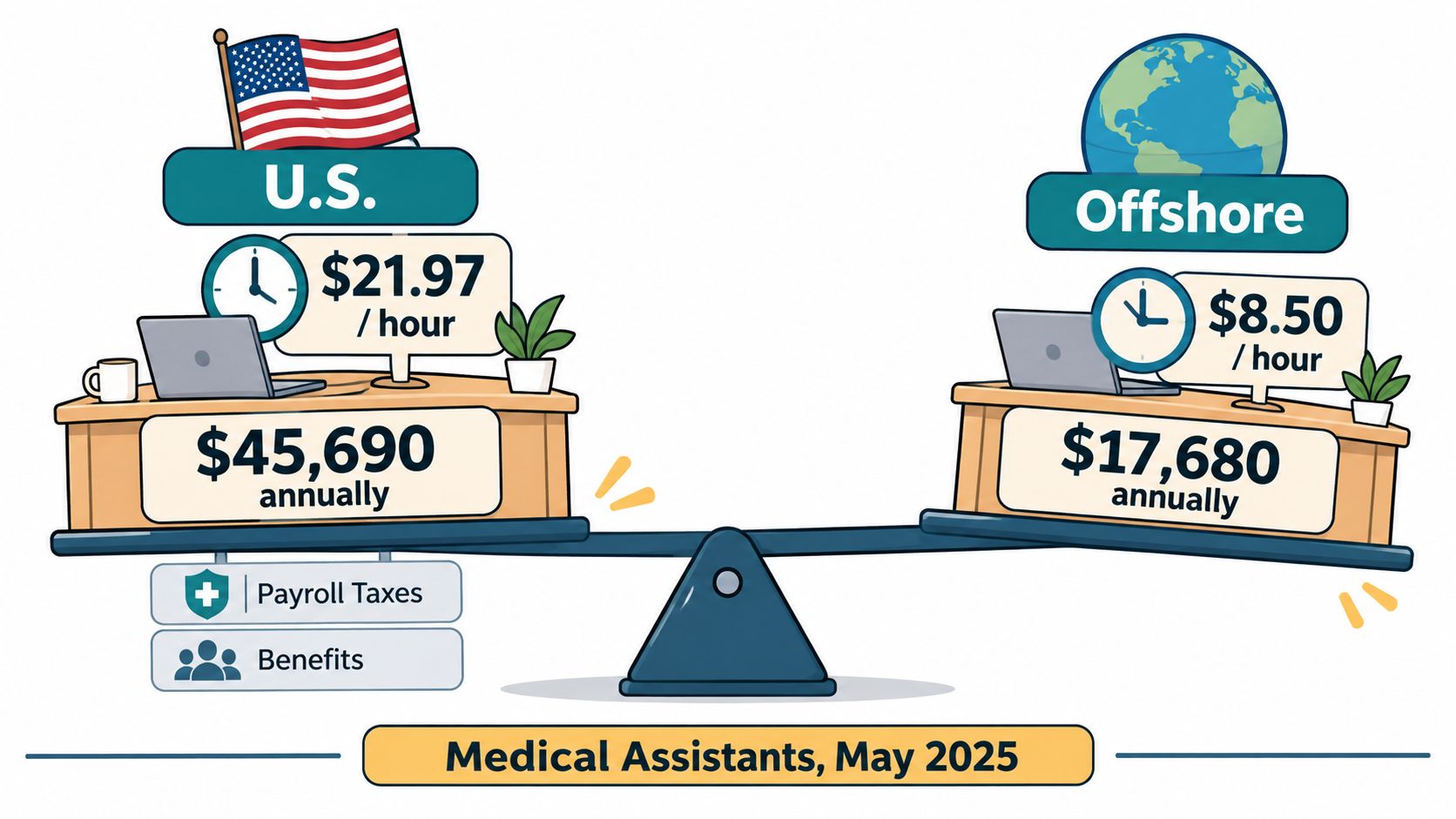
Use it as a reference point, not a promise. A remote quote below that wage can still cost more once service fees, tools and your supervision hours are added. A quote above it can be justified if it includes recruiting, replacement coverage, compliance support and specialized work such as insurance verification and referral coordination. The number that matters is the cost per completed task, including the practice hours spent reviewing work, correcting errors and keeping patient data controlled.
Country is a weak proxy for value. These factors change what you get per paid hour:
Some providers of Medical Virtual Assistants focus on pre-vetted Latin American professionals, which can offer time-zone overlap with U.S. clinic hours. Latin American virtual assistant placements are one option among several rather than a universal answer, so confirm each candidate's English, Spanish and healthcare experience during screening instead of assuming them.
Anything requiring hands on a patient, on-site presence, or licensed clinical judgment stays in the building. Rooming patients, vitals, injections and specimen handling aren't remote work at any rate. Neither is a decision that requires a clinician's license. If your bottleneck is chairside throughput rather than paperwork, a remote hire won't touch it, and the honest move is to fix staffing in the clinic first.
Build the budget from your work, then shop. Six steps, in order:
Check data-access, training and incident-notification terms against your compliance requirements before you accept anything. A lower quote with weak replacement terms can cost more over the same 90 days than a higher bundled quote, because you pay twice for onboarding and lose queue continuity in between.
Write the number down before the first sales call. A budget built from your own hours is the only defense against a quote that sounds reasonable and fits nothing.
The advertised hourly rate is the first line of virtual assistant cost, not the total. The comparison that matters is the cost of the work completed, including your practice manager's supervision hours, the risk of refilling the role, and the privacy controls the work requires before anyone sees a chart.
Three decisions get you there. Match each task to a work-type band so you're not paying specialist rates for reminder calls or expecting payer expertise at an entry rate. Choose the pricing model that fits how predictable your queue is. Then price the first 90 days rather than the first hour, using your own weekly authorization and referral volume as the input. Practices with heavy prior-authorization or referral queues should measure those hours before requesting quotes, and should confirm compliance obligations with qualified counsel before any patient data is shared.
Your next step is concrete: list your recurring tasks with weekly hours, define the access each one needs, and run the quote checklist against every offer on identical terms. If you'd like a shortlist of pre-vetted, bilingual medical virtual assistants who work U.S. hours, send that task list and access scope to LatHire and request a scoped quote built around it.