
A volunteer starts at your front desk on Monday. She'll answer the phone, confirm tomorrow's appointments, and send reminder texts out of the scheduling system. Halfway through onboarding, someone asks the question nobody wants to own: has she been background checked, and is one criminal search enough?
For most medical practices, the honest answer is that a single search is a floor, not a finished process. Background checks for volunteers are a bundle of record searches and verification steps used to decide whether a specific person fits a specific role, and the bundle should be sized to the access that person receives. A volunteer who can see patient names, phone numbers, and appointment times is inside your privacy perimeter even if she never opens a chart.
This guide treats screening the way a practice manager has to live with it: as a documented, repeatable process with consent, fair review, renewal, and an access list that matches the file. It covers what each check reveals, how to tier checks by role, the consent steps that come before you order any report, what to do when a result comes back flagged, and how to fold all of it into one written policy you can hand to the next volunteer who walks in.
A volunteer background check isn't one search. It's a set of steps, usually finished before the first shift, that verify identity and review records relevant to the role: criminal history at state, county, and multi-state level, sex-offender registries, child abuse and neglect registries where state law allows access, and driving records when the role involves driving. Interviews and reference checks belong in the same bundle, because they surface conduct that never produced a conviction.
Patients assume this work happens. In a 2022 U.S. survey summarized by NonprofitPRO, 52% of people who regularly visited organizations that use volunteers expected those volunteers to have had criminal background checks, yet only 33% of surveyed volunteers said a criminal check had been part of their screening. That gap between public expectation and actual practice is the risk you're managing on your own front desk.

Nonprofits have historically screened by risk rather than by blanket rule. A 2017 survey of U.S. nonprofit professionals found that 47.17% of organizations screened all volunteers before onboarding, roughly a third screened only some of the time, and 18% did not conduct checks at all. Screening was far more common for volunteers serving vulnerable populations, at 54.43%, than for short-term or one-time volunteers, at 11.76%.
That pattern gives you a defensible starting point, not a finished policy. The task before you is concrete: list every volunteer role in the practice and mark the ones that touch appointment data, patient messages, referral information, or records. That single column decides the depth of everything that follows.
A volunteer who schedules appointments from home may see patient names and contact details without entering the clinic. A front-desk helper may see the same information in person. The screening options below reveal different pieces of a person's history, and each has limits. Choose them in relation to the access the role receives, then document what was searched and when.
Volunteer screening checks, what they reveal and their limits
| Check | What It Reveals | Main Limit |
|---|---|---|
| State criminal record search | Convictions and some pending cases in state repositories | Misses records held in other states |
| County criminal record search | Local court records | Covers only the counties searched |
| Multi-state or national database search | Records across states from commercial databases | Completeness varies and false matches are common |
| Fingerprint-based check | Criminal history matched by fingerprints | Availability depends on state law and organization type |
| Sex offender registry search | Registered sex offenders | Covers only people on the registry |
| Child abuse and neglect registry | Substantiated findings where state law allows access | Restricted access and a separate request process |
| Motor vehicle record | Driving history | Relevant only when the role involves driving |
| Identity verification | Name, date of birth, identity documents | Confirms who the person is, not their conduct |
| Reference check | Past conduct as reported by supervisors | Quality depends entirely on the referee |
A state search can miss a conviction recorded elsewhere. A commercial multi-state database can widen coverage, but its results may be incomplete or produce a false match. Before acting on a result, compare the identifiers and follow the provider's process for resolving a dispute. A check should inform a decision, not replace a fair review.
The U.S. Department of Justice recommends combining nationwide, state, and local criminal-history checks with sex-offender registries, child abuse and neglect registries where relevant, written applications, interviews, reference checks, training, and documented reporting procedures. The sources cover different risks. References and interviews can also help identify concerns about conduct or access that do not appear in conviction records.
The DOJ cautions that even national fingerprint-based checks cannot prevent every unsuitable person from gaining legitimate access to children. A cleared check records what a database contained on the day it was run. Supervision, limits on system access, and a clear process for reporting concerns help manage risks that a search cannot resolve. For a remote scheduler or patient-messaging volunteer, record which systems and types of patient information the person can access, alongside the screening completed.
Practices can use an external screening provider, request information directly from government sources, or have staff handle the process internally. Whichever route you choose, keep a consistent record of the searches and decisions. Before engaging a provider, get clear written answers to these questions:
Practical rule: Ask which databases, states, and identifiers a provider uses. “National background check” alone does not describe the search.
For a plain-language overview of typical checks, see this explainer on what background checks look at. If a database search cannot resolve a name or identity question, ask the screening provider about its identity-verification service or consult a U.S.-licensed investigator. Services such as private investigator services in London are not a substitute for U.S. volunteer screening or criminal-record searches.
For each volunteer, retain the consent and screening documentation, the scope and date of each search, and the decision made. Link that record to the role's access, then review it when duties or access change. A repeatable process makes it easier to apply the same checks and fair review to each person.
A volunteer who only welcomes patients needs less screening than one who can read patient messages or open billing records. Set the check level by the access each role receives, then document the reasons for each check. Applying one package to every volunteer can waste money on low-access roles while leaving higher-access duties under-screened.
Minimum and added checks by volunteer role tier
| Volunteer Role | Access Level | Minimum Checks | Added Checks When |
|---|---|---|---|
| Non-clinical community helper | No patient information | Identity verification and references | Access to keys, cash, or secure areas |
| Front-desk or greeting volunteer | Names and appointment times visible | State criminal search, identity verification, references | Works in more than one state or handles payments |
| Remote scheduler or patient messaging volunteer | Patient contact details and appointment data | Multi-state criminal search, sex offender registry, identity verification, references | Works with minors' schedules or requests system access |
| Volunteer working with minors or vulnerable adults | Direct contact with minors or vulnerable people | Criminal search, sex offender registry, references | Child abuse registry check where permitted; fingerprint check where required |
| Volunteer with electronic health record or billing access | Patient records and financial data | Criminal search, identity verification, references, documented HIPAA training | Access review at each role change and scheduled re-screening |
U.S.-based databases generally cover U.S. records, while international searches may cost more and provide less complete coverage, as the Nonprofit Risk Management Center's newsletter notes. For a volunteer living or working abroad, consider identity documents, two or more references, and an official police certificate from the person's country if one is available. Record what you could not obtain and why. That documentation makes the limits of the screening clear.
Apply proportionality to every role: collect only information relevant to safety and qualification, restrict access to screening records to people who need them, and publish the policy so volunteers know what to expect. California requires checks for regular volunteers in youth-service organizations, while other roles may warrant lighter screening. Confirm the requirement in each state where the volunteer will work rather than assuming one state's rule applies elsewhere.
Only 32% of respondents reported periodic volunteer re-screening in a 2024 survey of nonprofit organizations. Treat screening as a repeatable process, not a one-time onboarding task. Set review points by access tier: when duties change, at a fixed annual review for records or billing access, and whenever the volunteer's responsibilities expand to a new system.
A check from three years ago describes a person at that time. A volunteer who now handles scheduling for a pediatric clinic has different access, and therefore a different screening need, from someone who sorted donation bins.
Keep the role list current. Add a tier column, assign each volunteer's present access level, and confirm the state requirement for each role. For programs that include camps, screenings, or school outreach, keep the related life support training for clinicians in its own credential file, separate from volunteer screening records.
A volunteer who can view patient messages or manage remote appointments needs a clear screening process before receiving that access. When a practice uses a consumer reporting agency, or screening company, to obtain a report for a volunteer or prospective remote staff member, the Federal Trade Commission's guidance on background checks explains the Fair Credit Reporting Act's general requirements: provide a stand-alone written disclosure that the report may inform an employment-related decision, and obtain the person's written authorization before ordering it. Keep the disclosure separate from the application.
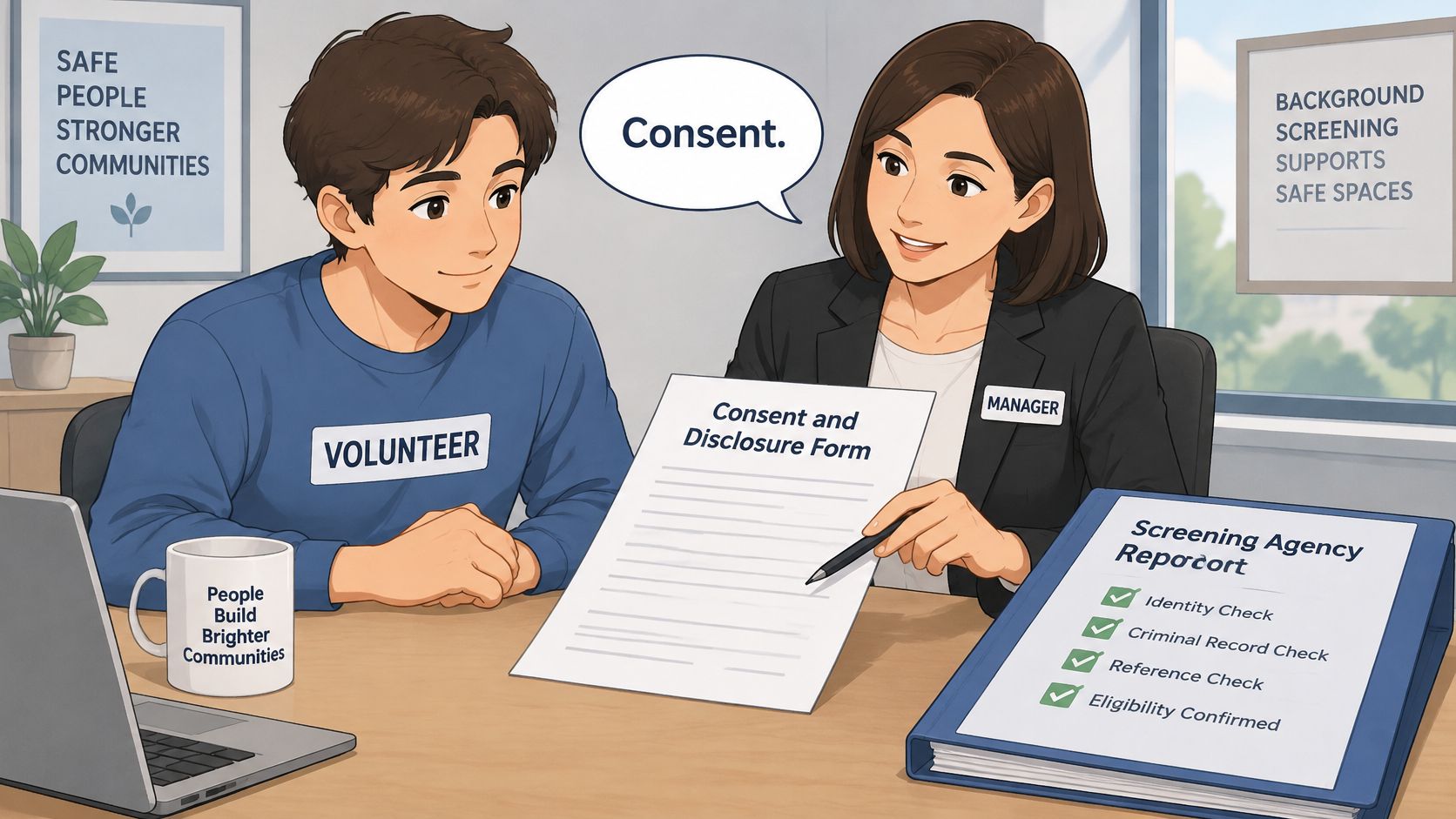
If the practice may conduct further checks during the volunteer's service, state that possibility clearly and conspicuously at the outset. These requirements can apply to unpaid roles when a report is used to decide whether someone will perform work for the organization. State and local rules may add notice requirements, so review the form for each jurisdiction where the volunteer will serve. A single national form may not cover every requirement.
Practical rule: If consent language is embedded in the volunteer application, separate it into its own disclosure and authorization. A distinct form makes it easier to show what the person was told and agreed to.
Rules vary by state and organization type. Review this summary of background check regulations when standardizing forms, then have qualified counsel review any form intended for use across state lines. Youth-serving organizations often publish screening expectations to parents, which can show how plainly to explain your own process. For an example of a youth sports organization's public-facing material, browse Houston youth soccer insights. Keep the explanation specific: what report may be ordered, why it relates to the role, and how the volunteer's information will be handled.
A database hit is a lead to verify, not an automatic exclusion. Public-interest guidance on volunteer screening identifies duplicate names, clerical errors, and expunged records as ordinary causes of false positives, and it warns that screening can discourage qualified applicants because of old offenses, per Volunteer Screening, the Companion Guide. That's the part most screening checklists skip: what happens after the report lands.
Consider two illustrative files. A remote scheduling volunteer's report shows a misdemeanor from twenty years ago that has nothing to do with patient access. A pediatric volunteer's report shows a recent conviction that bears directly on unsupervised contact with children. Treating both the same way is lazy in one direction and reckless in the other, and it's the kind of uniformity that gets a practice into trouble.
Remote and cross-border applicants make step one harder. Names get transliterated differently across documents, a married name doesn't match a passport, and identity papers from another country may not line up cleanly with a U.S. record search. Budget extra time for those files rather than treating a mismatch as a finding.
Practical rule: Under the Fair Credit Reporting Act, before you make a final decision based on a consumer report, give the person a copy of the report and the summary of rights, allow time to respond, and send a final notice if the decision stands.
A risk-based decision with a written rationale is easier to defend than a blanket rule, and it's fairer to the volunteer. Your written policy should name the offenses that disqualify someone for each tier, and say plainly that everything else gets individual review. If you want context on why employers screen in the first place, this overview of why employers run background checks frames the documentation side of the decision.
A cleared background check does not put a volunteer outside your privacy program. HIPAA treats volunteers as part of a covered entity's workforce when they perform duties under the entity's direct control, even if they are unpaid, as the HHS Privacy Rule guidance makes plain. A medical practice cannot assume a volunteer sits outside its privacy obligations because no paycheck changes hands.
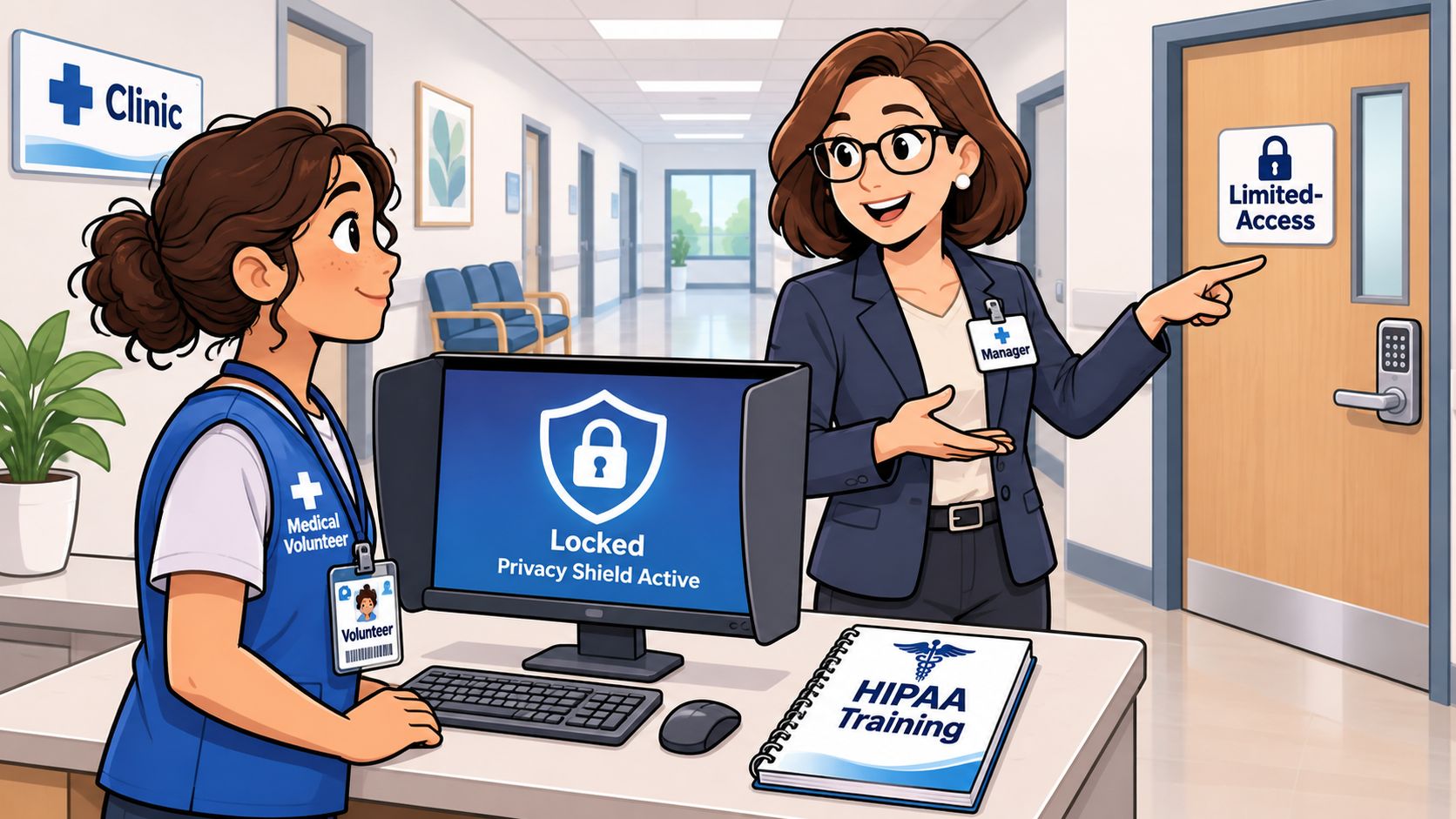
Two duties follow directly from that status. The practice must provide privacy training appropriate to the volunteer's functions, and it must apply appropriate sanctions when a workforce member violates HIPAA policies or the Privacy Rule. For a volunteer medical virtual assistant, that means access to scheduling systems, patient messages, referral information, or electronic health records stays tied to assigned duties and sits behind documented training completed before the first login.
Training and sanctions are the required core. The rest is practice-level discipline that keeps the core from failing: a signed confidentiality agreement, a unique login per person rather than a shared front-desk account, role-based permissions instead of full system access, direct supervision during the first weeks, and a written list of which volunteers may see protected health information and which systems each person uses. Add a removal deadline for logins when a volunteer leaves, because stale accounts outlive the people who created them.
Screening does not substitute for any of it. A clean report tells you nothing about whether a volunteer will paste a patient's lab result into a personal email thread or look up a neighbor's appointment.
Take a remote scheduling volunteer who is given access to the scheduling calendar and the reminder queue only. Any request to open the electronic health record needs documented training and a manager's sign-off on the file, not a verbal yes at the desk. Write the role boundary down as well. A volunteer does not diagnose, advise on clinical care, or make medical decisions, and the practice should define the permitted scope of every volunteer role in writing so nobody drifts into territory that requires a license.
Run that review at onboarding and at every duty change. A volunteer who moves from reminder calls to insurance follow-up has crossed into new data, and the file should show the date it happened.
A practice manager should be able to apply the same written policy to each volunteer without having to reconstruct the process. Keep the document focused on the tools and decisions that govern screening and access.
Treat the policy as an operational document, not legal advice. Requirements differ by state, organization type, and role. Have a qualified attorney or compliance professional review the draft before adoption.
Choose a current volunteer and follow the record from role tier through consent, the ordered search, access approval, and training documentation. Mark each step that lacks a supporting document. Assign an owner and a completion date to every gap, then resolve them before the policy takes effect. This checks whether the written process can be followed in practice, rather than merely listing rules.
For remote medical assistant roles, a pre-vetted shortlist can shorten sourcing. LatHire uses AI and manual checks to vet candidates, including verification of identity and prior work history. That vetting does not replace the practice's consent, screening, or access procedures. Apply the same written policy to each person you hire.
For a remote medical virtual assistant, patient coordinator, or insurance verification specialist, LatHire can provide 3–5 vetted profiles within 24 hours of the intro call. Candidates have certified English proficiency and real-time availability in your time zone. You interview and approve each person before they work on your list; your policy governs the screening and access steps.