

Global HR is the operating discipline of running employees across multiple jurisdictions, covering contracts, payroll, benefits, mobility, and compliance, not a synonym for international recruiting. For a U.S. medical practice, it means building the employment, privacy, payment, and management infrastructure that makes an overseas hire workable before that person handles a patient message or joins the payroll.
You may be in that position now. A remote scheduler in another country looks like the answer to a staffing gap, the candidate is qualified, responsive, and available during your clinic's hours, then the practical questions arrive. Who employs the person? Which country's rules apply? What documentation does the practice need? Can the worker access the scheduling platform, electronic health record, insurance information, or patient portal?
The wrong first move is to treat those questions as administrative cleanup. Global HR starts before the offer, because classification, work location, withholding, privacy, and supervision shape the engagement from the beginning. This guide explains what global HR means, the operating layers it includes, how direct employment compares with an employer of record and independent contracting, and what a small or midsize practice should put in place before the first payment.
A small medical practice finds a bilingual patient coordinator in another country. The candidate can cover appointment requests, reduce the front-desk backlog, and work during U.S. business hours. The practice owner agrees on compensation, sends a contractor agreement, and expects the arrangement to be finished.
That is where the easy assumption breaks. The agreement doesn't answer whether the relationship is independent contracting. It doesn't determine whether the worker needs access to protected health information, whether a business associate agreement is required, how payments should be documented, or whether the worker's location creates local employment or tax obligations. A contractor label is evidence of intent, not a universal answer.
Global HR is the infrastructure behind the hire. It connects the worker's physical location, legal relationship, pay process, access permissions, benefits, management practices, and exit procedure. Recruiting finds a person. Global HR determines whether your practice can engage that person lawfully and operate the relationship without exposing patients, providers, or the business to avoidable risk.
Practical rule: Don't ask, “Where can I find this person?” Ask, “What employment and operating system will support this person once hired?”
The first international hire forces four decisions:
Country risk also deserves a more structured approach than a general internet search. A tool such as the ReloScore explained by ReloMaps can help teams think about relocation and country factors systematically, but it won't replace a role-specific classification, privacy, tax, or employment review.
For a medical practice, this infrastructure matters even when the first role is administrative. A scheduler who never views clinical notes presents a different risk profile from a billing specialist who handles insurance records, or a virtual assistant who routes prescription messages. The job title isn't enough. Your practice must examine the actual tasks, systems, supervision, and information involved.
Domestic HR usually runs inside one legal system. One payroll setup, one tax framework, one benefits structure, one set of employment documents. The work can still be hard, but the operating assumptions stay mostly stable.
Global HR starts the moment your practice asks someone in another country to do real work inside your business. At that point, HR stops being an admin function and becomes infrastructure. You are choosing who employs the person, who owns compliance, how classification is defended, how payroll and withholding are handled, what data they can touch, and whether the way the role is set up could create tax exposure or permanent-establishment questions for the business. If a medical practice suddenly has to run payroll under two tax regimes at once, the front-end workflow may still look familiar. The controls underneath it do not.
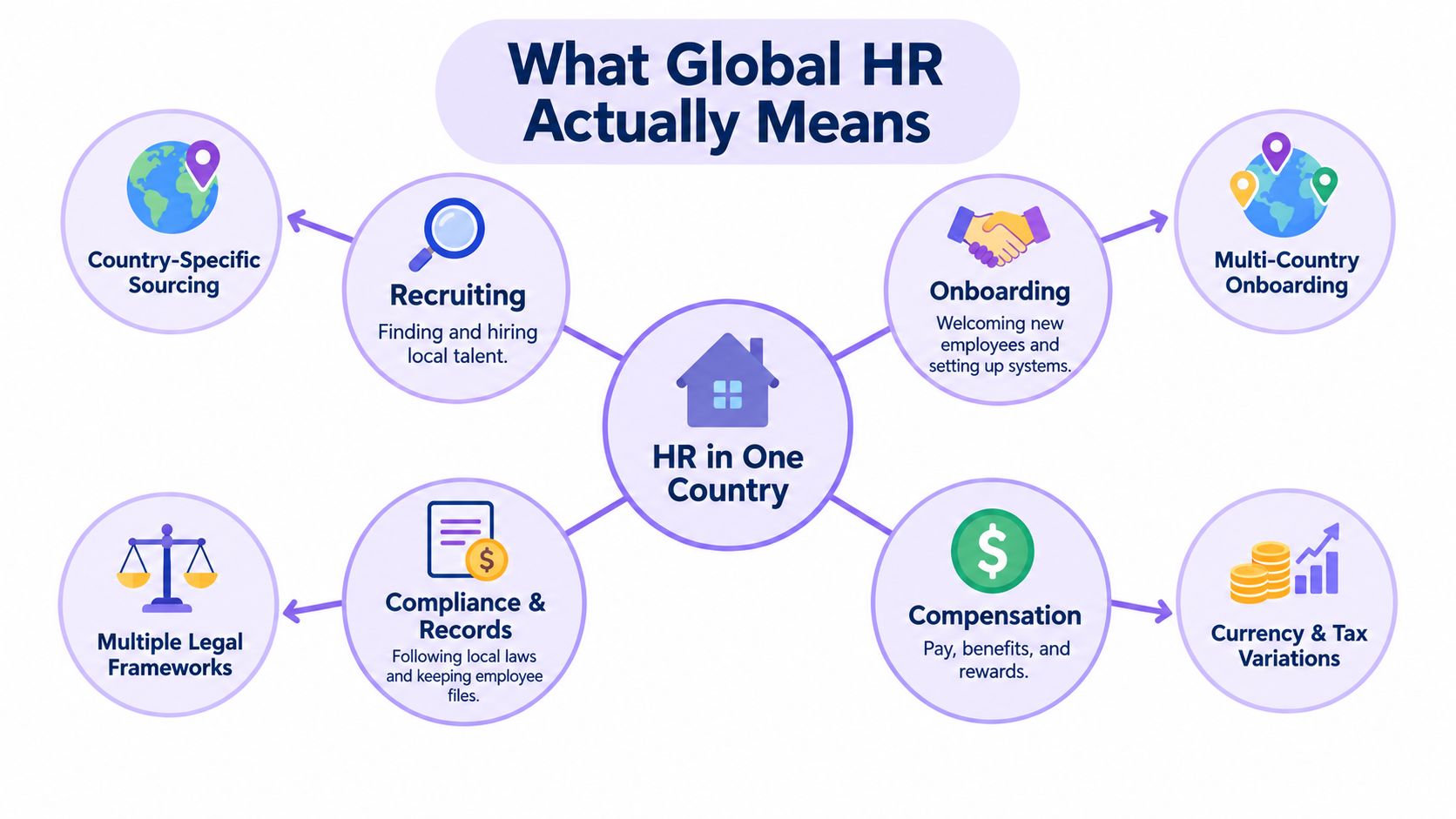
International recruiting solves a talent-sourcing problem. Global HR solves the operating problem that follows. How will the practice employ, pay, supervise, protect, document, and if needed terminate the relationship in a way that fits the country where the person works?
That difference matters fast in healthcare. A practice may find an overseas medical virtual assistant for scheduling, reminders, intake routing, or follow-up. Hiring feels like the milestone. It is not. The harder work is deciding whether the arrangement should be employment, independent contracting, or an intermediary model, and then matching contracts, access, oversight, and payment flows to that choice. Get that wrong and the first issue is rarely recruiting quality. It is usually classification, payroll setup, privacy exposure, or unmanaged local obligations.
Global HR has to cover at least these areas:
Software does not solve this for you. An HRIS can store records, trigger onboarding tasks, and support payroll workflows. It cannot decide whether a worker is misclassified, who carries compliance responsibility, or whether a remote billing specialist's access creates a HIPAA business associate relationship. Technology records decisions after an operator makes them.
The labels international HR, global people operations, and strategic human resource management overlap. In practice, they all point to the same job: align workforce policy with how labor rules change across more than one market. The scale of that challenge is visible in the labor market. The International Labour Organization estimates that approximately 402 million people globally were without a job but wanted to work in 2024, including 183 million officially unemployed, 137 million in the potential labor force, and 82 million willing non-jobseekers. The same source estimated that more than 2 billion workers, about 58% of the global workforce, were in informal employment.
Those figures are a reminder to build country by country, not by assumption. Employment systems, worker protections, payroll practices, and labor-market formalization vary materially. Global HR is a cross-border operating model, not domestic HR with a foreign address added to the file.
A working global HR model has several connected layers. A gap in one layer usually creates work for another. For example, a weak location record can become a payroll error, a withholding problem, a social-security issue, or a corporate-tax question.
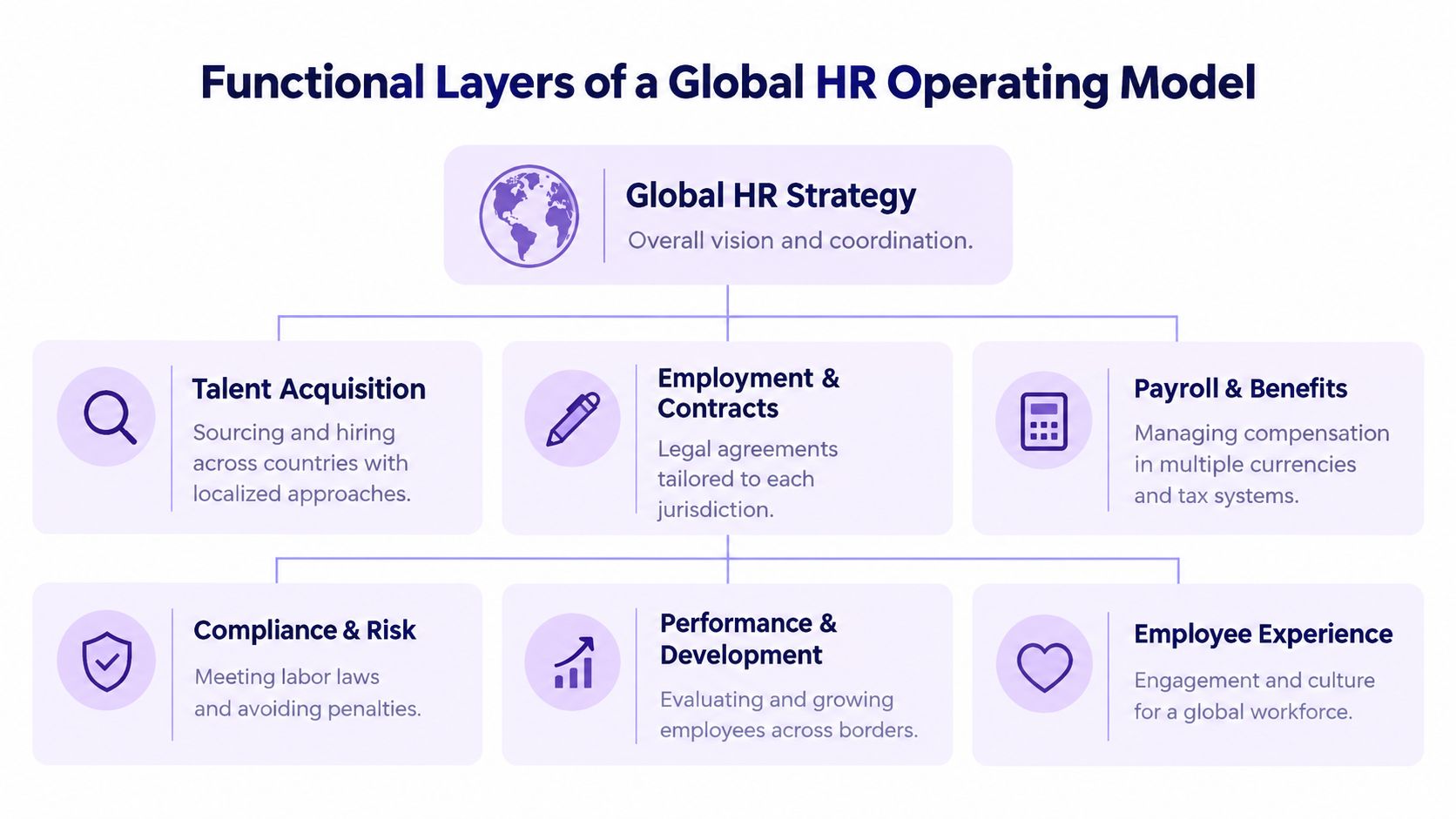
Sourcing must account for the country, language, working hours, credentials, and role boundaries. A bilingual virtual receptionist may be a strong fit for patient communication, while a worker expected to make clinical decisions may need licensing and telehealth review that an administrative role doesn't require.
The contract should match the actual relationship. It should identify the parties, services, pay terms, work location, confidentiality duties, data handling, ownership of work product, termination process, and escalation responsibilities. Local law can affect notice periods, mandatory language, leave, and enforceability.
Payroll isn't just converting a U.S. salary into another currency. The practice must identify the employing or paying entity, applicable payroll jurisdiction, social-security obligations, withholding process, payment schedule, and statutory benefits. A worker's entitlement may depend on local rules rather than the benefits package offered to U.S. staff.
The worker's physical work location also drives tax analysis. Under the treaty framework summarized by EU authorities on employment income and cross-border work, employment income is generally taxable where the work is exercised. A common exception can apply when presence in the other country remains below 183 days in a twelve-month period, the employer isn't resident there, and the remuneration isn't borne by a local permanent establishment. That exception has conditions. It isn't a blanket permission for informal remote work.
Short-term international work can create a different risk profile from a worker who permanently lives abroad. Maintain a day-level work-location record and require approval for international travel, extended stays, or work from a new country. A revenue-generating activity performed from a location can raise permanent-establishment questions, particularly when the worker acts for the business rather than merely providing internal support.
Performance management also needs adaptation. Time-zone alignment is operational, not just cultural. A patient coordinator who misses the practice's call window can disrupt care access even if the person is highly capable. Set measurable outcomes, document response expectations, and provide asynchronous access to decisions so the worker isn't excluded from information because meetings occur in another time zone.
Global HR needs a country register that connects each worker to location, contract type, pay terms, benefits eligibility, systems access, and responsible owners. HR, legal or compliance, payroll, finance, and the practice manager should know which decisions belong to them.
For a healthcare organization, the system should also connect role duties to data access. A scheduling role may require access to appointment details but not unrestricted clinical records. A billing role may need insurance information. A clinical role demands a separate credential, supervision, privacy, and licensure analysis. Build access around the minimum needed for the job, then review it when duties change or the engagement ends.
Most small companies and medical practices choose among three structures. None is universally correct. The right choice depends on control, permanence, country, urgency, compliance capacity, and the worker's actual duties.
| Criterion | Direct local entity | Employer of record | Independent contractor |
|---|---|---|---|
| Who employs the worker | Your local entity | A third-party local employer | The individual or contractor entity |
| Control | Highest operational and contractual control | High day-to-day control, with the EOR handling employment administration | Should be limited to the contracted result and service |
| Compliance ownership | Primarily your organization and advisers | Shared, but the client retains important operational duties | Shared in theory, with material risk remaining with the client |
| Speed | Slower because entity setup and local administration may be required | Usually faster to launch than forming an entity | Often fast to start, but speed can conceal classification risk |
| Cost structure | Entity, payroll, advisers, benefits, and administration | Service fees plus employment and payroll costs | Contract payments and related administration |
| Termination flexibility | Governed by local employment rules | Governed through the EOR's local employment process | Depends on the contract and local classification rules |
| Main risk | Managing a local operation incorrectly | Assuming the EOR absorbs every client obligation | The relationship looks like employment despite the contractor label |
A local entity can make sense when the practice expects a durable presence, needs direct employment control, or plans to hire multiple people in the same country. It gives the organization a direct relationship with the worker and can support a more established local operation.
The trade-off is administrative responsibility. You must manage local payroll, employment documents, benefits, filings, records, and advisers. Forming an entity for one administrative hire is often excessive unless the business has a clear reason to maintain that structure.
An employer of record hires the worker locally while the client directs the worker's day-to-day work. The model can reduce the need to create an entity and can provide local employment administration. A useful overview of how an employer of record works can help owners understand the division between legal employment and operational supervision.
An EOR doesn't remove your responsibility for role design, manager behavior, privacy, access controls, patient information, or workplace safety. In a medical practice, you still decide whether the worker needs access to PHI and whether a business associate agreement or subcontractor analysis applies. Treat the EOR as an execution layer, not a universal shield.
Contracting can fit an independent service provider who controls how the work is performed, serves a defined business purpose, and doesn't function like an employee. It can be appropriate for limited projects or specialist support where the facts support independence.
It becomes dangerous when the practice sets fixed hours, directs every task, provides ongoing supervision, restricts outside work, supplies the tools, and integrates the worker into the ordinary staff structure. A supposedly cheaper contractor can become expensive when the relationship is treated like employment by the relevant authorities. The contract should follow the operating reality, not disguise it.
Before a U.S. practice hires a remote scheduler, create a file that answers who, where, how, and under which rules. Don't wait until the first invoice or payment rejection to collect the information.
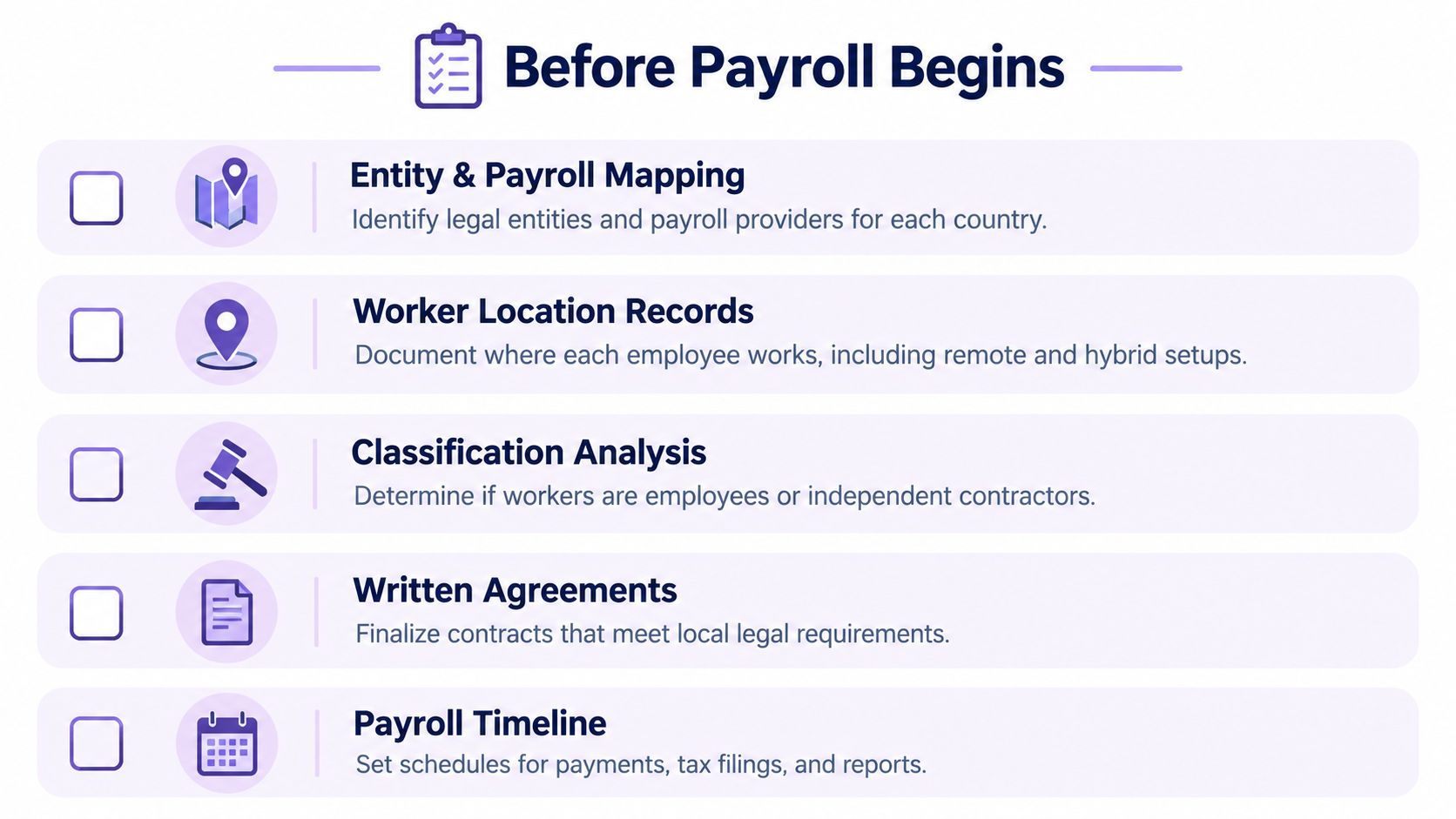
Map the entity and payroll path. Record the U.S. practice, any local employing entity, the payroll provider, the payment route, and the person responsible for approvals. The same worker shouldn't appear under inconsistent names or entities across contracts, payroll, and finance records.
Record the work location. Capture the worker's primary country and require approval before the worker performs services from another country. Keep a day-level work-location log when cross-border presence could affect withholding, social security, or permanent-establishment analysis.
Analyze classification. Review control, permanence, supervision, integration, tools, exclusivity, and the nature of the work. Decide whether direct employment, an EOR, or contracting matches the facts.
Finalize written agreements. Use the appropriate contracting parties and local requirements. Include confidentiality, data security, access restrictions, PHI handling, work hours, payment terms, performance expectations, and exit procedures.
Set the payroll calendar. Establish approval cutoffs, payment dates, invoice rules, tax documentation, leave records, and reconciliation procedures. If the arrangement uses a country-specific wage payment system, document its requirements. For example, managers hiring in the United Arab Emirates should understand the WPS payroll requirements in the UAE before selecting a payment process.
The global payroll setup process should connect finance, HR, operations, and compliance rather than treating payroll as a standalone vendor task.
For an individual foreign contractor, payment documentation may involve Form W-8BEN. The IRS explains the related rules in its guidance for Form W-8BEN-E and foreign payees, including when a foreign entity may provide Form W-8BEN-E. The correct form depends on the payee and payment facts.
A W-8BEN establishes foreign status and may support treaty or withholding treatment. It does not decide whether the person is an independent contractor, an employee, or a worker supplied through an intermediary. Keep the worker's identity, contracting entity, service location, currency, invoicing method, withholding analysis, and record-retention responsibility together.
Before the practice scales the model, obtain qualified tax and employment advice. A payroll form is a control, not a substitute for classification analysis.
A signed contract and a working payment process solve the easy layer. The harder layer is whether international staff can perform, develop, and raise concerns without being measured against unspoken headquarters habits. Most practices stumble here, because the failure is quiet: nobody files a complaint, the remote coordinator just stops contributing in meetings scheduled at midnight local time.
Design the second layer before it breaks. Set global principles that apply to everyone, starting with the compliance baseline covered in global HR compliance: clear role expectations, access to information, security standards, anti-discrimination rules, documented promotion criteria, and fair performance evidence. Then adapt local practices where context requires it, including holidays, communication conventions, statutory benefits, feedback style, and working hours. The split matters. Principles are fixed, practices flex.

Equal treatment doesn't always mean identical treatment. Giving a worker the same U.S. holiday schedule, meeting times, or communication expectations as a U.S.-based colleague can create unfairness rather than remove it. Local statutory benefits and culturally appropriate management often make the employment experience more consistent in substance, even when the surface details differ.
The Global Survey of Working Arrangements surveyed 16,422 college-educated full-time workers across 40 countries in late 2024. Its international scope reinforces a practical point: remote-work preferences aren't uniform, so one market's working norms shouldn't become the default for everyone.
Replace cultural guesswork with measurable systems:
For healthcare teams, fairness reaches patients. A remote coordinator who can't reach the manager during the clinic's operating hours needs an escalation path that is documented, tested, and available across time zones. Global HR succeeds when the team stays coordinated after the initial hire, not merely when the contract gets signed.
What is global HR? It's the operating system for managing people across jurisdictions. For a U.S. medical practice, that means more than recruiting an overseas medical virtual assistant. It means choosing the employment model, documenting classification and withholding, controlling PHI access, tracking work location, managing performance, and ending the relationship correctly.
Before hiring, map the country and payroll path, choose direct employment, an employer of record, or contracting deliberately, document the worker's location, and assign compliance ownership. Then separate consistent standards from locally adaptable practices so international staff aren't forced into headquarters assumptions that undermine performance or fairness.
LatHire curates pre-vetted Latin American professionals with overlap with U.S. working hours and supports cross-border payroll and compliance for companies that want one execution layer. If you're evaluating a remote healthcare role, define the duties and access requirements first, then request a hiring and operating plan that matches the actual work.
Talk with LatHire about your next international hire, and start with the role scope, country, work schedule, and systems the person will need. That gives you a practical basis for choosing the right engagement model before the offer goes out.