
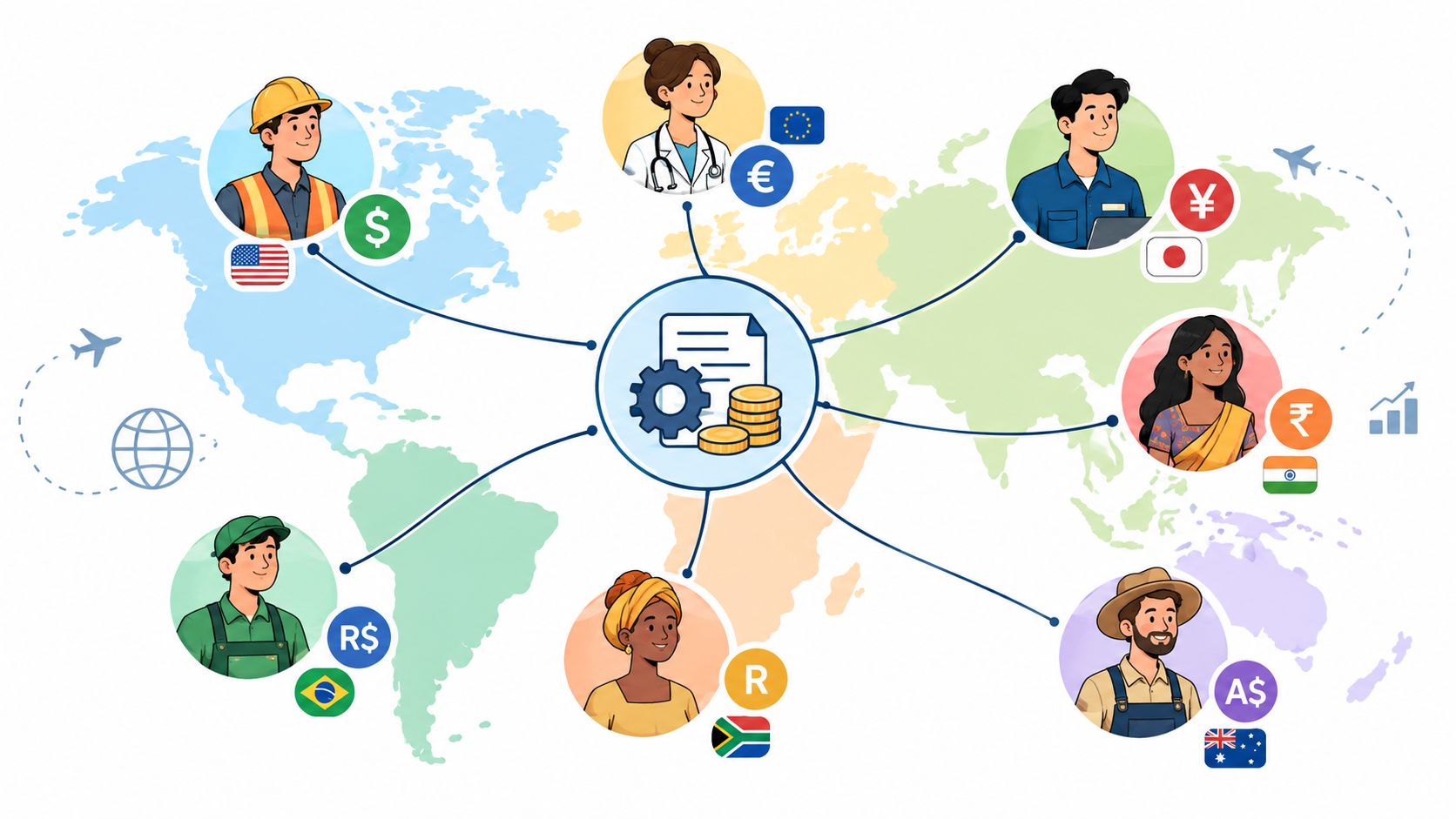
Global payroll is the coordinated calculation of wages, taxes, statutory contributions, payments, and employer reporting across multiple jurisdictions. It differs from domestic payroll because each worker's country, employment status, currency, and local rules can change the calculation and the employer's obligations.
A U.S. medical practice may discover this distinction when it hires a remote medical virtual assistant in Colombia, a bilingual patient coordinator in Mexico, or an insurance verification specialist elsewhere in Latin America. The first payment may look like a simple contractor transfer. Over time, recurring compensation, benefits, work location, worker classification, data access, and local reporting can turn that payment into a broader operating responsibility.
The practical question isn't only whether someone gets paid. It's whether your practice can maintain accurate worker records, apply the right gross-to-net rules, document tax status, protect patient information, meet deadlines, and explain deductions or payment timing to the worker. Global payroll is therefore both a financial operation and a compliance function.
The sections below define the discipline, compare it with domestic payroll, evaluate the main operating models, address W-8BEN and HIPAA touchpoints, identify where payroll fails first, and provide a practical adoption framework for a small U.S. medical practice.
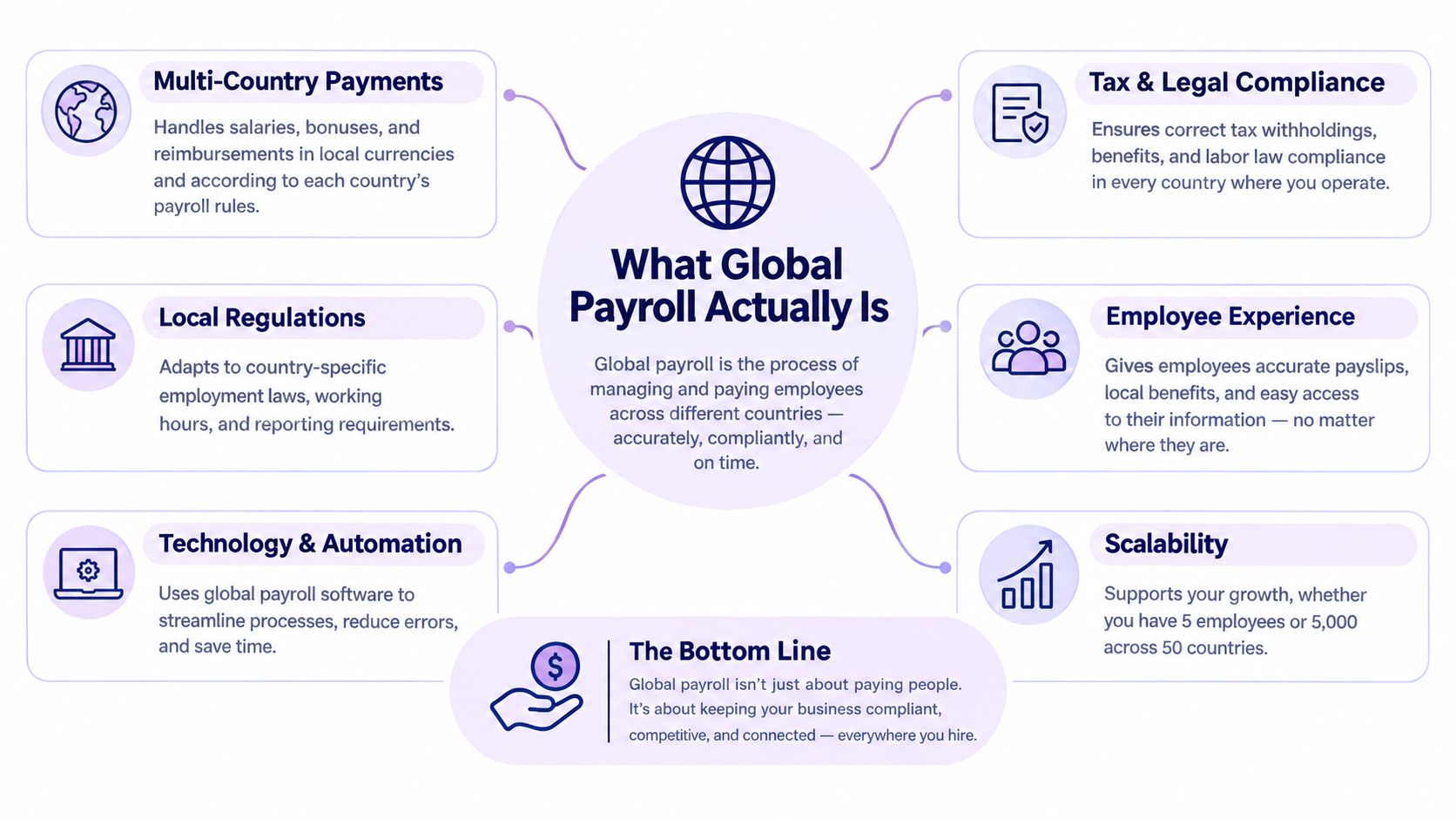
For an operator, global payroll is one approved workflow for worker data, calculation, payment, and proof across countries. Start with the worker's location, status, and access rights before calculating anything. The formal earnings definition includes gross remuneration such as regular wages, paid leave, bonuses, gratuities, and certain allowances, but the operating risk often begins with incomplete or inconsistent records.
A U.S. medical practice feels that risk as soon as it hires abroad. A remote medical virtual assistant in Colombia, a patient coordinator in Mexico, or a billing support contractor elsewhere in Latin America can require different documentation, payment handling, classification decisions, and reporting. The office's U.S. location does not determine the worker's obligations.
Consider a dental group hiring a Spanish-speaking assistant in Colombia to confirm appointments and answer routine administrative messages. Before the first recurring payment, the practice should establish the worker's classification, collect the appropriate U.S. tax documentation such as Form W-8BEN where applicable, define who corrects failed payments, and record the approval trail. It must also decide whether the assistant can access protected health information. If so, the practice needs access controls and a HIPAA-aware arrangement, not just a payment method.
The payroll calculation is only one part of the control system.
Practical rule: Keep the worker record, payment approval, access permissions, and compliance evidence in one accountable workflow.
A basic contractor payment process may fit a limited engagement that is correctly classified and unlikely to develop employment-like features. A structured global payroll model becomes more appropriate when international work recurs, spans multiple countries, includes benefits or statutory deductions, or creates a growing administrative burden.
Choose the model according to the control the practice needs, the presence of local entities, hiring speed, and who owns compliance decisions. A vendor can run calculations and payments, but it cannot repair poor worker data, unclear cutoffs, excessive system access, or unassigned accountability. Those operating choices determine whether payroll remains manageable or becomes a recurring source of errors.
A U.S. medical practice hiring a remote assistant may begin with one recurring transfer. The operating problem appears when the worker's location, classification, access permissions, compensation, and payment records sit in different systems. Global payroll coordinates the data and controls behind gross pay, deductions, employer contributions, payment execution, and reporting across jurisdictions with different employment, tax, social-insurance, banking, and data rules.
The ILO's earnings framework defines gross remuneration before deductions. It can include wages or salaries, compensation for time not worked, bonuses, gratuities, and certain allowances. International payroll may also require checks for statutory minimum wages, working time, employer labor costs, gender pay indicators, and country-specific deductions. These concepts are described in the ILO's wages and working-time definitions.
A controlled international payroll run connects several data sets:
A country change can alter withholding, employer contributions, reporting forms, minimum-pay requirements, and payment deadlines. Changing someone from contractor to employee can alter the entire operating model. A compensation change can affect the worker's net pay and the employer's liability. For a medical practice, the record must also show whether the worker can access protected health information and whether the arrangement includes appropriate HIPAA controls. Where applicable, Form W-8BEN belongs in the tax documentation record, not in an informal email thread.
Global payroll therefore operates as a data-governance system as much as a payment process. A small practice can track first-time-right rate and correction aging for two pay cycles before adding another country. ADP's survey of 1,735 payroll decision-makers across 19 countries reported mean payroll accuracy of 78%, while 32% said mistakes required two or more pay cycles to correct, as reported in its global payroll survey. A correction can affect net pay, tax filings, social contributions, accounting accruals, and staff trust.
Automation does not assign responsibility. The practice still needs checks that validate worker data before calculation, lock approved changes at cutoff, compare the current run with the prior cycle, reconcile payroll to the ledger, and document approval before funds are released.
Track late payments, off-cycle payments, filing timeliness, and reconciliation breaks alongside first-time-right performance. Those measures show whether the process is improving or whether each new country is adding unresolved exceptions. A vendor can execute payroll, but the practice must own the underlying records, access decisions, and approval controls.
Domestic payroll usually assumes one legal employer, one primary currency, one set of tax filings, and a familiar calendar of deductions and reporting. Global payroll has to coordinate several versions of those elements at once.
That difference matters even when the workforce is small. A U.S. practice paying one overseas contractor may not need a full enterprise payroll stack, but it still needs to document the worker's status, payment basis, tax documentation, and access to practice systems. A practice employing people across several countries needs a repeatable process rather than a series of isolated transfers.
| Dimension | Domestic Payroll | Global Payroll |
|---|---|---|
| Legal structure | Usually one domestic employer and one main jurisdiction | Multiple worker locations, entities, partners, or local obligations |
| Currency | Generally one currency and one banking environment | Multiple currencies, exchange rates, funding cutoffs, and local payment rails |
| Tax withholding | Federal, state, and local rules within one national framework | Country-specific income tax, social insurance, employer contributions, and reporting |
| Worker classification | Domestic employee and contractor rules | Classification may change by country, contract, control, and working arrangement |
| Payroll calendar | One main set of pay dates and filing deadlines | Country-level calendars, local holidays, statutory deadlines, and different cutoffs |
| Year-end forms | Familiar domestic forms and records | Different country forms, local reporting, and cross-border documentation |
| Audit trail | One main rule set and approval chain | Country, entity, worker, currency, rule version, and payment evidence |
The scale of formal wage employment helps explain why payroll has become more data-intensive. The ILO estimated approximately 1.75 billion wage and salaried workers in 2019, falling to 1.69 billion in 2020 and nearly recovering to 1.74 billion by the end of 2021. The 2021 total represented 53% of global employment, and wage and salaried employment had increased 36% between 2005 and 2021, compared with a 16% rise in total global employment, according to the ILO's global wage report.
Pay-As-You-Earn systems still use the same basic tax concept, but the OECD describes increasingly complex payroll calculations and electronic employer payments. For practice managers, the lesson is practical: automation expands the number of checks you can perform, but it doesn't decide whether your worker classification or source data is correct.
When compensation is discussed hourly or annually, a separate comparison of hourly and salary offers can help managers understand the underlying pay structure. It doesn't replace country-specific payroll analysis, but it can make compensation inputs easier to review before they enter the payroll workflow.
A small U.S. company hiring abroad usually chooses among three operating models: build local infrastructure, use a PEO or EOR, or work with a global payroll provider. The practical difference is where legal responsibility, data ownership, and operational work sit. The model also determines who maintains records, approves changes, handles exceptions, and responds when a country rule changes.
The 2025 Global Payroll Week survey found that 57% of respondents identified local compliance as their largest challenge, followed by inbound and outbound data automation, according to the survey results reviewed by the PayrollOrg. Use that finding to structure vendor questions. Map which risks you will own, including entity management, data quality, approvals, and access controls. Assign the remainder to the partner in the contract, with clear correction, reporting, and exit procedures.
In-house payroll gives the company the most direct control. The business owns or operates local entities, maintains country-specific processes, manages banking and filings, and controls the underlying employee records.
This approach can fit a stable, strategically important country presence supported by finance or HR expertise. It is difficult to justify for a small medical practice hiring its first remote worker. Entity maintenance, local advisors, registrations, payroll calendars, and statutory updates consume time without advancing patient care. The practice also assumes responsibility for keeping every local process and record current.
A professional employer organization or employer of record can speed up hiring when the provider employs the worker locally or supports employment through its own infrastructure. For a company without a local entity, this model can provide an employment relationship without requiring the practice to establish one immediately.
Control is shared. Confirm who directs the work, owns worker and patient-related data, approves compensation, manages system access, and handles employee issues. The contract should also explain liability, corrections, termination, and records retention. Guidance on California misclassification risks reinforces a practical point for U.S. hiring decisions: a contract label does not settle classification by itself.
A global payroll provider can consolidate calculations, reporting, payment workflows, and employee records across countries. That consolidation helps when several local partners would otherwise produce disconnected outputs. It does not remove the need for accurate inputs, country-level oversight, or a clear understanding of whether the provider relies on its own entities, local partners, or another structure.
For a practice expanding across countries, this model becomes more useful as recurring payroll, benefits, and reporting replace one-off contractor payments. Local dependencies may remain, and concentrating work with one vendor creates its own exposure. Ask how corrections are handled, how data is exported, who controls rule changes, and what happens when the relationship ends.
A provider such as LatHire's employer-of-record model can be compared with other EOR and payroll arrangements. Evaluate the options against worker classification, country coverage, access requirements, data controls, and internal ownership.
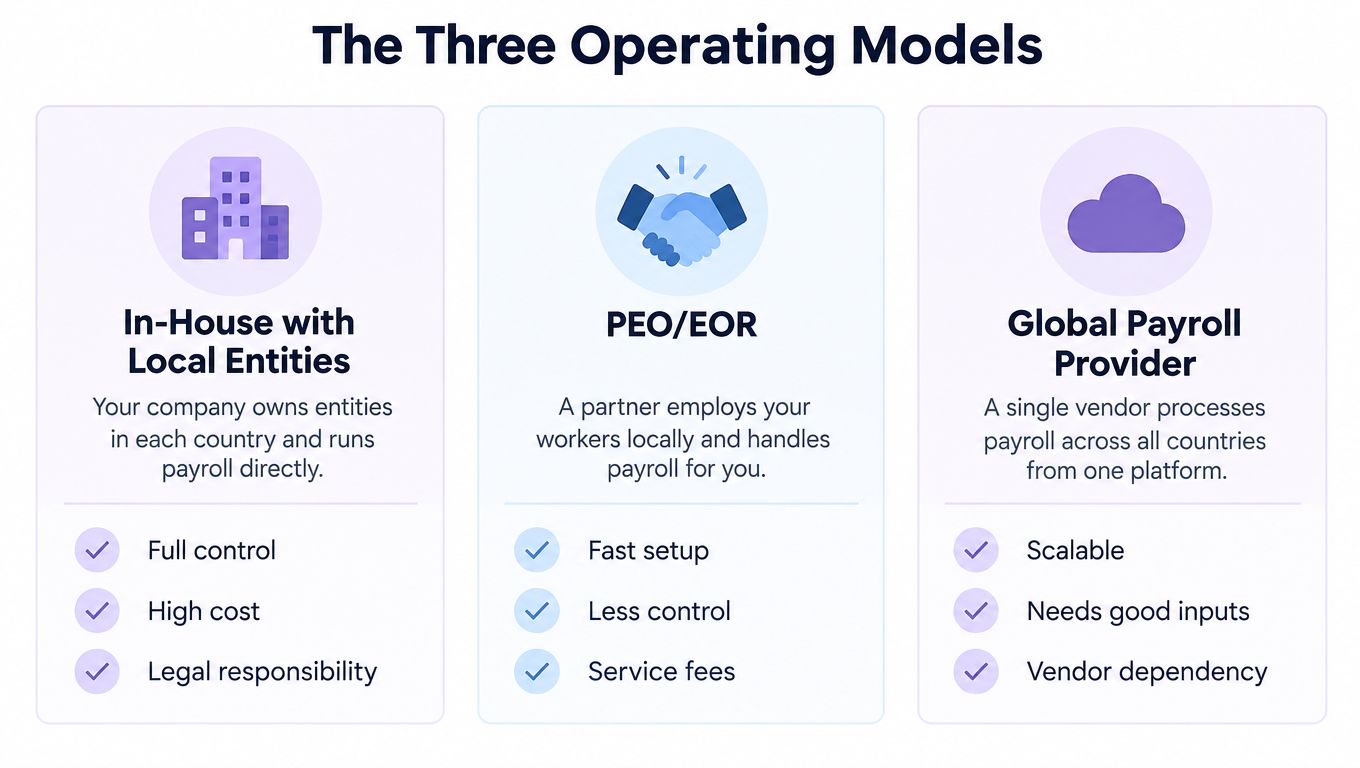
For most small practices, in-house infrastructure creates too much administrative work at the start. An EOR can fit a fast employee hire, while a dedicated payroll provider becomes more useful when the practice needs consolidated reporting and repeatable administration across several jurisdictions.
International payroll doesn't turn a medical practice into a tax department, but it does require the practice to collect the right evidence before work and payment begin. Tax documentation, worker classification, patient-data access, and vendor accountability should be handled as connected decisions.
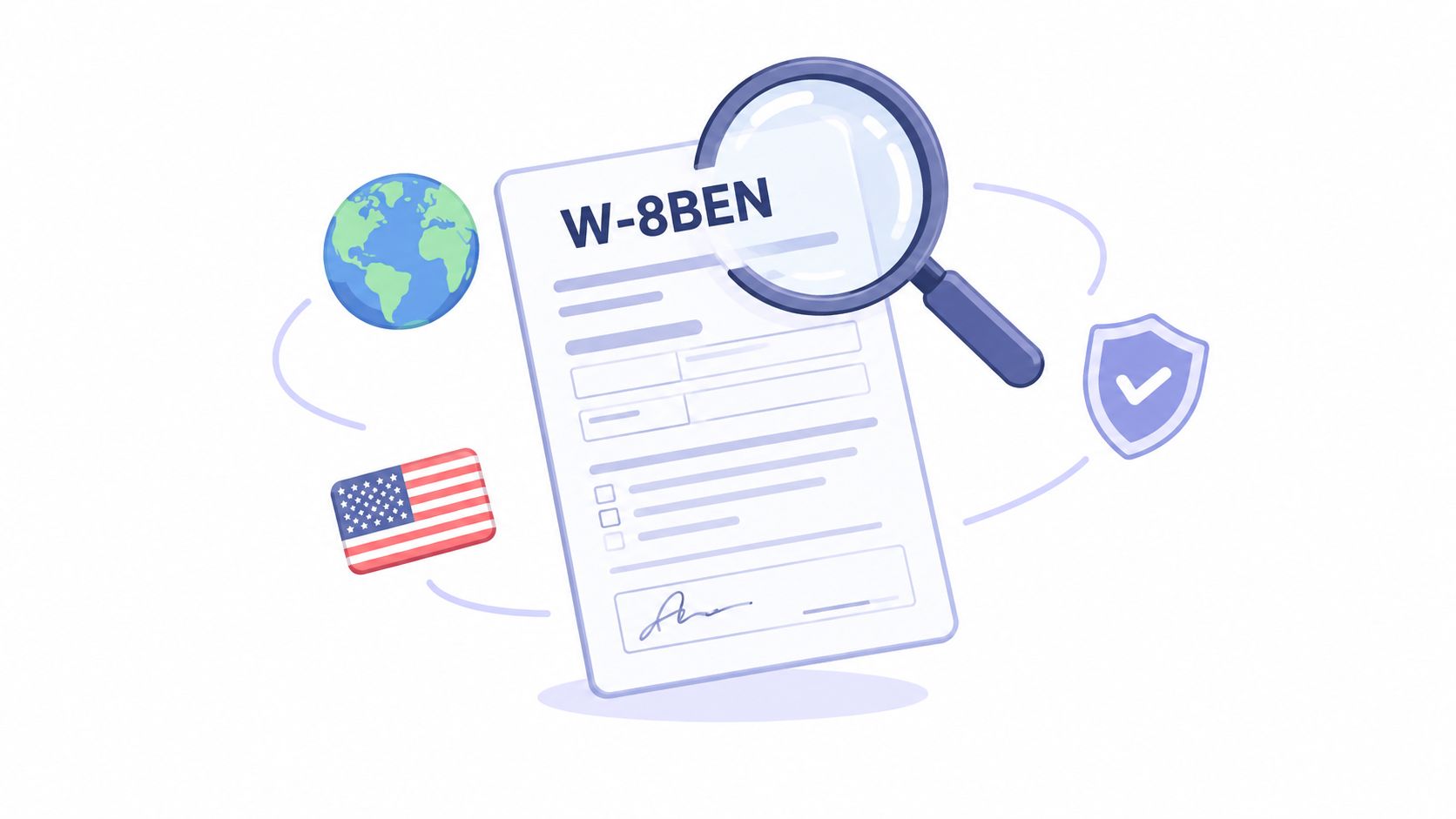
When a U.S. business pays a nonresident foreign individual for services, the payer should obtain Form W-8BEN before making or crediting the payment. The IRS instructions for Form W-8BEN explain that the form documents foreign beneficial-owner status and may support an exemption from U.S. information reporting or a reduced withholding rate under an applicable treaty.
If the worker doesn't provide the form when requested, the payer may need to apply the 30% foreign-person withholding rate or applicable backup withholding. The form doesn't determine whether the person is correctly classified as an employee or contractor, and it doesn't remove obligations imposed by the worker's country.
For example, a practice hiring a remote medical virtual assistant for scheduling should collect tax-status documentation before the first payment, then separately review classification, contract terms, payment records, and local requirements. A general tax compliance guide from Omni Tax Help can provide broader context, but a practice should confirm its specific obligations with qualified tax counsel.
A remote worker who schedules patients, handles referrals, answers messages, or supports billing may access protected health information on the practice's behalf. If that worker or organization qualifies as a business associate, the practice generally needs a written business associate agreement.
HHS says the agreement must define permitted uses and disclosures, prohibit unauthorized use or disclosure, require appropriate safeguards, and require reporting of unauthorized uses, disclosures, or breaches. The HHS sample business associate agreement provisions provide the relevant framework.
A bilingual patient coordinator accessing the EHR from outside the United States is a useful test case. The practice should map the systems the coordinator can access, determine whether a BAA is required, limit access to the minimum necessary information, and identify subcontractors or staffing partners involved in the workflow.
HHS doesn't automatically prohibit remote access to electronic protected health information through mobile devices or cloud systems. It does require covered entities and business associates to use appropriate physical, administrative, and technical safeguards to protect confidentiality, integrity, and availability, as described in HHS guidance on business associates.
Recommended controls include managed accounts, strong authentication, role-based permissions, device controls, secure transmission, workforce training, and prompt access revocation. These are security practices that support HIPAA compliance. They aren't a substitute for a required BAA, and they don't make a worker “HIPAA certified.” HHS doesn't recognize an official HIPAA certification.
CMS guidance says a covered entity using a business associate must require the business associate and its agents or subcontractors to comply with applicable HIPAA requirements. A billing support contractor verifying insurance may never need broad clinical access, but the practice must still define who approves access, handles training, escalates incidents, reports breaches, and revokes credentials.
A payroll compliance checklist for practices can help organize administrative controls, but contracts should match the actual workflow. Payroll location doesn't replace security controls, and an outsourced staffing or employment arrangement doesn't transfer every operational responsibility away from the practice.
Global payroll usually fails upstream of the calculation engine. An incorrect worker address, late time record, unapproved compensation change, missing bank detail, or incomplete tax form can produce a wrong result even when the vendor's software applies its rules correctly. The operating problem is often weak ownership of inputs, not a payment function.
The 2025 Global Payroll Week survey identifies poor-quality inputs, late time records, and post-cutoff changes as major failure sources. It also reports that more than one-third of organizations manage payroll in at least six countries, while 38% of organizations don't track payroll performance at all, as noted in the operating-models discussion above.
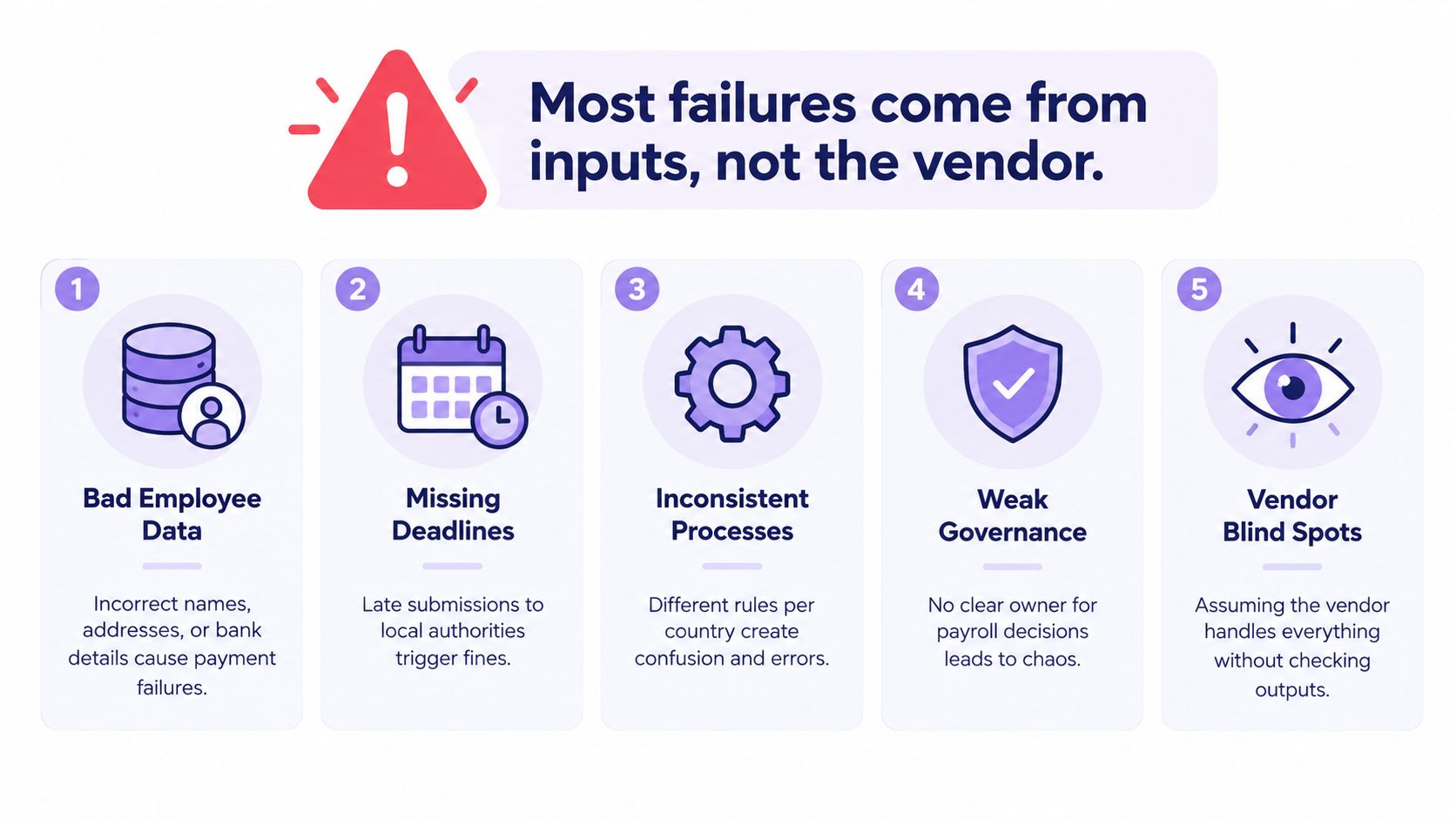
For a workforce spread across five to 20 countries, assign owners and measure the handoffs between worker data, approvals, payroll processing, funding, and reporting. A useful operating review should include:
A vendor can calculate from approved data, but it cannot approve a manager's late bonus change or decide whether a worker should be treated as an employee. Set one owner for worker data, one approval path for compensation changes, a country-level payroll calendar, FX and funding cutoffs, a statutory checklist, and an exception log that preserves inputs and rule versions.
Workers judge payroll through pay dates, currency conversion, deductions, explanations, and support. A process can meet filing obligations while still producing unexplained FX differences, delayed payments, incorrect local deductions, or slow answers.
Data security belongs in the same control system. Recent payroll research found that 93% of surveyed payroll leaders consider data security very or critically important, up from 86% two years earlier, and 44% plan to improve data security in their worldwide payroll functions, according to ADP's global payroll survey. Payroll accuracy and security both depend on controlled access, reliable records, and clear ownership.
Publish pay-date rules, explain the exchange-rate method, describe common deductions, state correction timelines, and identify the support channel. These documents reduce avoidable questions and give managers a consistent explanation when net pay differs from expected gross pay.
A practice doesn't need a global payroll platform merely because its first remote worker lives abroad. The decision becomes more urgent when the arrangement is recurring, the worker receives employee-like benefits, several countries are involved, or managers spend increasing time reconciling payments and questions.
Use these adoption signals:
The contractor-to-employee transition is where many small businesses lose visibility. A person may begin with a narrow administrative assignment and later work set hours, use practice systems, receive recurring compensation, and become central to patient coordination. Those facts don't automatically decide classification, but they justify a fresh review with qualified counsel.
An EOR may provide speed and employment infrastructure. A global payroll provider may provide more consolidated reporting and a broader control layer. Neither option removes the need for clean worker data, approved changes, access governance, and clear accountability. A practice evaluating global payroll software should ask how the system handles contractors and employees, local rules, payment failures, tax documents, audit trails, data exports, and a future country expansion.
The practical milestone is not a particular headcount. It's the point at which a manual payment process can no longer answer, quickly and consistently, who was paid, why that amount was correct, which rules applied, and who owns the exception.
Global payroll is a coordinated system for gross-to-net calculations, statutory contributions, payments, reporting, worker records, and compliance across jurisdictions. For a U.S. medical practice, the first priorities are straightforward: collect Form W-8BEN before the first applicable payment, document classification, map whether the remote worker can access PHI, confirm whether a BAA is needed, and establish secure account and device controls.
Stop assuming that a vendor automatically creates control. Vendor choice comes after ownership, clean inputs, approval cutoffs, audit evidence, and at least one operational metric such as first-time-right payroll or correction volume. This week, write down who owns each decision and whether your current contractor arrangement can support recurring work, benefits, and additional countries.
If you're looking for pre-vetted LATAM healthcare talent, Medical Virtual Assistants can connect U.S. practices with bilingual professionals through an interview-before-hire process, no-deposit onboarding, and shortlists within 24 hours. Review the available roles and decide whether your next hire needs a receptionist, patient coordinator, scheduler, billing support specialist, or medical administrative assistant.
Start by defining the role, country, system access, and engagement model. Then request a shortlist through LatHire's platform, interview the candidates, and confirm the payroll, privacy, and access controls before the first workday.