

A benefits administrator is the operational specialist who keeps employee benefits legally compliant, accurately recorded, and usable across payroll, HR, carrier, and reporting systems. The role supports plans covering more than 155 million workers, retirees, and family members, with about $15 trillion in assets.
For a U.S. medical practice, that definition becomes practical very quickly. A new medical assistant joins, a provider changes employment status, an employee adds a dependent, or a remote healthcare staff member works from another jurisdiction. Each event can affect eligibility, deductions, carrier records, privacy controls, and employee communication. A benefits administrator makes sure those connected tasks don't break apart.
The job is broader than open enrollment and employee questions. It combines plan operations, data quality, vendor coordination, compliance monitoring, fiduciary discipline, and clear communication. In a practice that relies on remote receptionists, patient coordinators, billing support, or medical virtual assistants, the administrator also helps establish safe workflows for sensitive employee and health-related information.
This guide explains what a benefits administrator does, how the role developed, which daily controls matter, when to keep administration in-house or outsource it, and how integrated platforms and AI are changing cross-border benefits operations.
A benefits administrator manages the systems, rules, records, and communications that connect an employee's benefits package to the organization that provides it. That can include health, dental, vision, life, disability, retirement, flexible spending, health savings, employee assistance, voluntary benefits, leave, and continuation coverage.
The administrator usually isn't the person who designs every plan or makes clinical decisions. Instead, the role translates plan documents and employment events into accurate operational actions. When an employee becomes eligible, the administrator ensures the right options appear, the election reaches the carrier, the payroll deduction is correct, and the supporting record can be retrieved later.
That bridge matters in medical practices because benefits often touch employees who work across different schedules, locations, and employment arrangements. A practice manager may handle staffing, payroll coordination, and patient operations at the same time. Without clear ownership, a benefits change can sit in an inbox while payroll, the HRIS, and a carrier hold different versions of the employee's status.
Employer-sponsored benefits became more formal over time. American Express created a private pension plan in 1875 that offered eligible older or disabled employees up to $500 annually after 20 years of service and at age 60, one milestone described in SHRM's history of employee benefits. Early arrangements like this helped establish the pattern of employers administering long-term financial support rather than treating it as an informal favor.
The modern regulatory framework began with the Employee Retirement Income Security Act, or ERISA, in 1974. Before that, the Department of Labor had become involved through the Welfare and Pension Plans Disclosure Act of 1959. ERISA introduced minimum standards for job-based retirement, health, and other welfare benefits, including expectations around reporting, disclosure, and fiduciary conduct.
The U.S. Department of Labor's Employee Benefits Security Administration administers ERISA Title I and oversees more than 837,000 retirement plans, 2.8 million health plans, and 521,000 other benefit plans, according to its mission and history of EBSA. That scale explains why the role can't be reduced to clerical support. A benefits administrator works inside a system intended to protect employee compensation and plan assets.
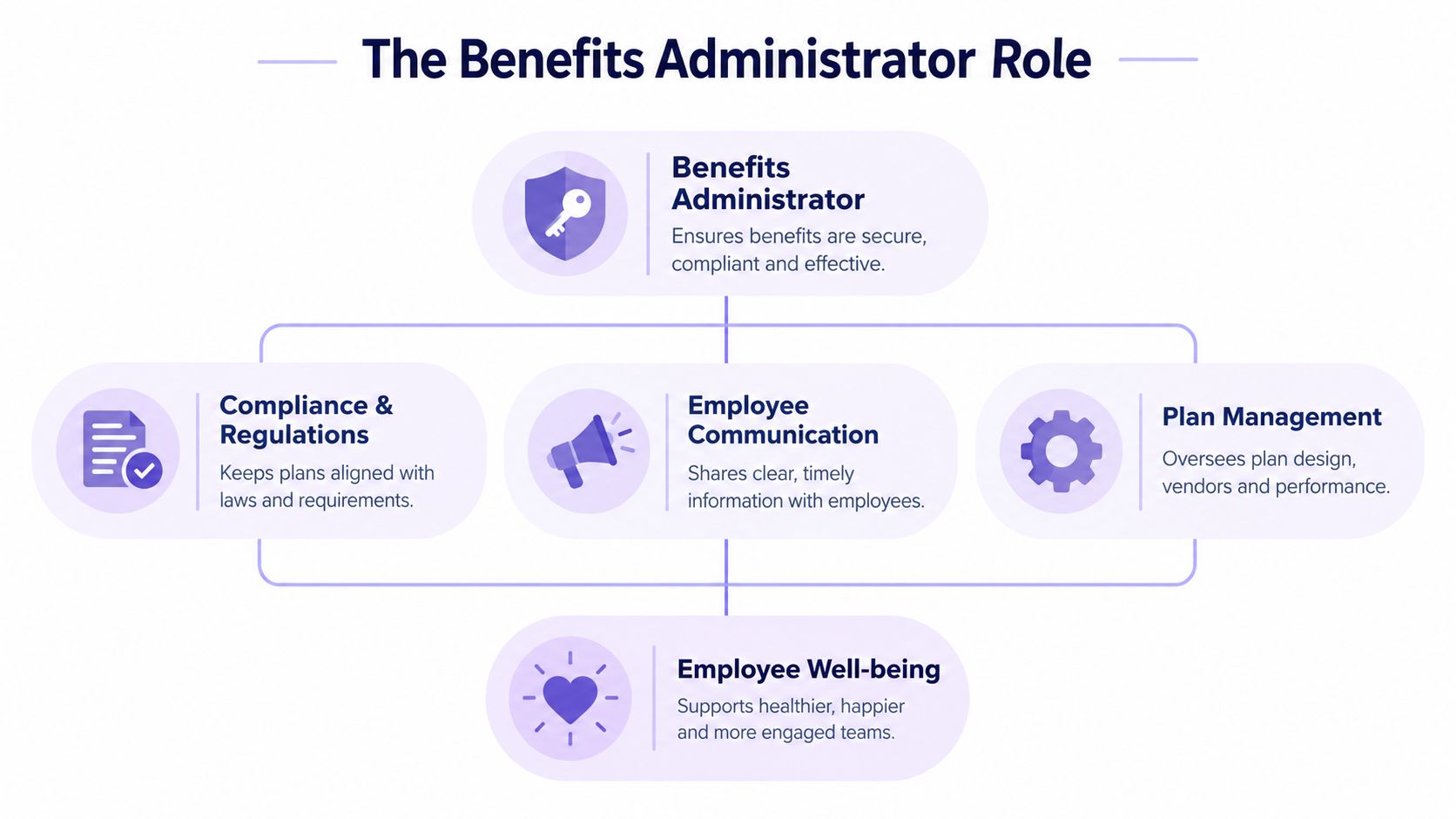
For practice owners, the most useful definition is operational: the benefits administrator protects continuity between the employment record, the plan rules, the payroll result, and the employee experience.
That may involve checking whether a part-time employee meets a plan's eligibility terms, coordinating a new hire's enrollment, documenting a termination transition, or explaining why a deduction changed. In a multi-location practice, the administrator may also apply different eligibility rules to clinical, administrative, full-time, part-time, union, or remote populations.
A remote employee doesn't eliminate the need for administration. It changes the control environment. The practice needs documented approval paths, secure access, reliable records, and a clear division between administrative support and licensed clinical work. A remote medical virtual assistant can help with nonclinical workflows, but shouldn't diagnose patients, make medical decisions, or perform licensed duties without the authority and jurisdictional requirements that apply.
If you're assessing the broader value of employee coverage, start with your full-time employment benefits structure. The administrator's work is what turns that structure into a functioning employee process.
The closest U.S. occupational category, compensation, benefits, and job analysis specialists, is projected by the Bureau of Labor Statistics to grow 5.3% from 2024 to 2034, with roughly 8,500 openings a year and a May 2025 median wage of $78,210 per year, or $37.60 per hour, as reported by SHRM in the source above. These figures describe the broader occupation, not a guaranteed salary for a specific practice role. They do show that benefits administration remains a specialized function rather than a temporary clerical assignment.
The daily work begins with an employee event and ends only when every connected system agrees. A new hire, qualifying life event, leave, transfer, reduction in hours, or termination can require changes in eligibility, elections, deductions, carrier files, notices, and internal records.
A practical administrator watches the entire transaction rather than assuming that one completed form means the work is finished. Paychex's overview of employee benefits administration describes the role as one that sits across HRIS, payroll, carrier feeds, and compliance controls. That is the right operating lens for a medical practice.
Open enrollment is visible, but it isn't the whole job. Year-round administration typically includes:
A medical practice might have a receptionist who changes from part-time to full-time, a nurse who adds a dependent, and a remote billing specialist who takes leave during the same payroll cycle. The benefits administrator must distinguish those events, apply the appropriate rules, and confirm that the resulting records don't conflict.
Benefits data usually moves through several systems. The HRIS stores employment and eligibility details. The benefits platform records elections. Payroll calculates deductions. Carriers maintain coverage. Accounting records employer expenses. A year-end process may use the same information for reporting and validation.
The administrator therefore performs regular checks rather than trusting integrations blindly. Useful reconciliations compare:
ADP's discussion of employee benefits administration software and reconciliation emphasizes that accuracy and timeliness across integrated systems matter more than just answering employee questions. A clean-looking dashboard doesn't prove that a carrier accepted every record or that payroll applied the deduction correctly.
Practical rule: Treat every automated feed as a control that needs monitoring, not as a substitute for ownership.
Open enrollment is a planned campaign with defined dates, communications, decision support, and testing. The administrator configures plans, reviews employee populations, sends instructions, tracks completion, handles exceptions, and produces confirmation records.
A qualifying life event is less predictable. Marriage, divorce, birth, adoption, loss of other coverage, or a change in employment status may require evidence, approval, and a precise effective date. The workflow should prevent an employee from adding a dependent or changing coverage without the necessary documentation and authorized review.
Medical practices should also separate employee support from claims adjudication. An administrator can help an employee understand where to submit a question and can coordinate with a carrier. The administrator shouldn't promise coverage outcomes or interpret clinical necessity outside the role's authority.
For practices that offer life insurance, employees may encounter health-related assessments or underwriting questions. A resource such as this guide to health data in life insurance can help administrators direct general education questions without handling more sensitive decisions informally.
Before assigning benefits work to an internal coordinator or remote healthcare staff member, document:
This structure helps a virtual medical receptionist or administrative assistant support routine communication without granting unnecessary access to plan administration or sensitive records.
The choice between internal and outsourced benefits administration isn't a simple cost comparison. It is a decision about control, capacity, specialized knowledge, continuity, and accountability.
An in-house administrator usually has better context. They understand the practice's staffing patterns, payroll calendar, provider relationships, and employee concerns. They can answer questions quickly and spot unusual events that a third party might miss. The trade-off is concentration risk. If one coordinator owns the process, an absence, turnover event, or growth period can expose gaps.
An outsourced administrator, broker, third-party administrator, PEO, or managed service can provide deeper process experience and additional coverage during enrollment and compliance cycles. The practice gives up some direct control, however, and must manage the relationship carefully. A vendor may follow its standard workflow even when a specialty practice needs exceptions.
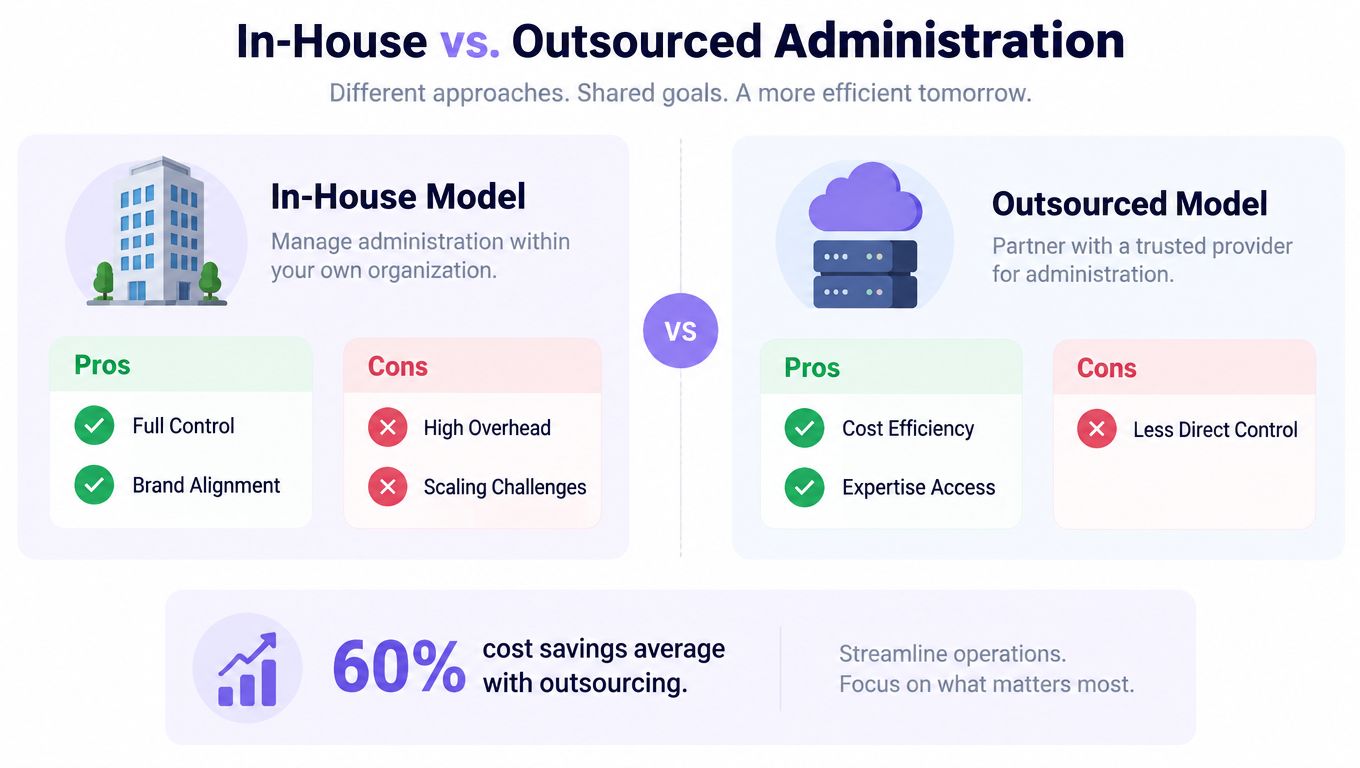
| Consideration | In-house administration | Outsourced administration |
|---|---|---|
| Control | Direct access to decisions, records, and employee communication | Control depends on contract terms, workflows, and escalation rights |
| Practice knowledge | Strong understanding of local staffing and culture | Requires deliberate onboarding and documentation |
| Specialist coverage | May depend on one person or a small HR team | Can provide broader benefits and compliance expertise |
| Scalability | Capacity may strain during growth or enrollment | Usually adds process capacity without internal hiring |
| Data oversight | Easier to see who handles records, but controls still need documentation | Requires vendor due diligence, access reviews, and service monitoring |
| Continuity | Vulnerable to turnover and single-person dependency | More process redundancy, but the relationship can create dependency |
A small practice with stable plans and a capable practice manager may keep routine administration internal. That approach works when the manager has time for reconciliations, knows when to escalate, and can maintain secure records. It fails when benefits become an afterthought between patient scheduling, payroll issues, and staffing emergencies.
Outsourcing makes more sense when the practice operates across states, has several employee classes, uses multiple carriers, or is adding remote workers. It can also help when the internal team lacks experience with COBRA, ERISA documentation, ACA administration, or carrier-feed troubleshooting. The practice still owns the business decision and must verify that the provider's service model matches its obligations.
Start by mapping the work, not by asking vendors for feature lists. Count the recurring processes, exceptions, integrations, reports, approvals, and employee questions that the practice must handle. Then identify which tasks require judgment and which can be safely standardized.
An outsourced arrangement should specify data ownership, access permissions, correction responsibilities, response expectations, audit support, termination procedures, and the boundary between administrative assistance and compliance advice. A low headline fee can become expensive if the practice still performs manual reconciliation, repairs failed feeds, and answers employee questions without support.
For international hires, an employer-of-record structure may be relevant because it can separate local employment administration from the practice's day-to-day supervision. Review how an employer of record arrangement works before assuming it solves every benefits or classification question. It can support local employment processes, but the practice still needs a clear operating model for access, supervision, performance, privacy, and patient-facing duties.
The right model may also be hybrid. Keep employee communication and final approvals internal, while outsourcing carrier administration, filings, or specialized reconciliation. That preserves practice context without requiring a small HR team to master every technical process.
Compliance becomes real when a routine approval affects someone else's coverage, money, or protected information. Consider a medical practice where a benefits administrator approves an eligibility exception, changes a contribution, or instructs a vendor to correct a record. If that person exercises discretionary authority over plan management or assets, the decision may carry fiduciary significance.
The Department of Labor's ERISA guidance explains that fiduciaries generally must act solely in the interest of participants and beneficiaries, for the exclusive purpose of providing benefits and defraying reasonable plan expenses. They must act prudently and follow the written plan document when it is consistent with ERISA.
A practice shouldn't give an administrator broad discretionary access just because the person is trusted. Written procedures should define who can approve an exception, who can change plan configuration, who can authorize a correction, and who reviews the decision.
For example, a remote benefits administrator may identify that a physician's deduction doesn't match the elected coverage tier. The administrator can document the mismatch, pause a correction that requires approval, and route the issue to the designated plan owner. That is safer than allowing the administrator to improvise a retroactive change without preserving the reason, evidence, and authorization.
ERISA obligations can vary with the plan structure and the person's actual authority. Practices should confirm their responsibilities with qualified benefits counsel or a compliance professional rather than assuming a job title determines fiduciary status.
Benefits work in a medical practice may involve employee health-plan information and other sensitive records. HIPAA's Security Rule requires covered entities to develop and implement policies and procedures for authorizing access to electronic protected health information, along with related safeguards. The HHS guidance on remote use and access addresses the need for formal access controls when work occurs away from the practice.
HIPAA requirements aren't the same as every recommended security practice. A secure remote workflow should also consider approved devices, multifactor authentication, private workspaces, role-based permissions, training, supervisor oversight, incident reporting, and access removal. These controls reduce exposure, but they don't make a worker or vendor “HIPAA certified.” HHS doesn't recognize an official HIPAA certification.
Governance principle: Remote access should be granted for a defined task and role, not as a blanket reward for trust.
A medical practice should also keep benefits administration separate from patient-care access wherever possible. A virtual billing assistant may need access to billing workflows but not employee health records. A benefits administrator may need HRIS and carrier access but not unrestricted access to the practice's patient-management system.
For a broader framework covering policies, risk ownership, and implementation planning, this compliance implementation guide can serve as supplemental reading. It doesn't replace a practice-specific review of HIPAA, ERISA, state privacy rules, employment obligations, or vendor contracts.
A worker's location can affect employment administration, leave, tax treatment, privacy expectations, and benefits availability. A U.S. practice hiring remote support in another country shouldn't assume that a domestic plan can be extended without review.
The administrator's job is to identify the jurisdictional question and route it correctly. That may mean involving an employer-of-record provider, benefits broker, payroll specialist, privacy officer, or counsel. A global HR compliance operating model can help practice managers define which decisions belong to the local employer, the U.S. practice, and the service provider.
Cross-border benefits administration fails most often at the handoffs. A practice may have one system for hiring, another for payroll, a carrier portal for coverage, a spreadsheet for exceptions, and email for approvals. Each tool can work on its own while the overall process remains fragile.
An integrated platform connects employee records, benefits workflows, payroll inputs, vendor files, approvals, reporting, and access controls. The benefit isn't that software removes every judgment call. The benefit is that the administrator can see where a transaction stands, what changed, who approved it, and which downstream systems still need attention.

International teams don't have one universal benefits package. Employers increasingly use flexible spending accounts, multi-wallet structures, and country-specific funding aligned with local purchasing power. Forma's global employee benefits trends reports 525% year-over-year growth in median funding for dedicated mental well-being accounts and 458% growth for meals and nutrition accounts. Those figures come from the cited 2026 trend source and shouldn't be treated as a universal benchmark for every employer.
For a medical practice, the operational challenge is balancing local relevance with a consistent employee experience. A worker in one country may receive a statutory benefit through the local employment structure, while another receives a supplemental allowance or private coverage. The administrator needs a common record of eligibility, effective dates, funding, approvals, and employee communications without pretending the underlying benefits are identical.
Recent 2026 coverage from Strada Global on AI in benefits administration describes AI being used for eligibility checks, manual workflow automation, anomaly detection, and consolidation of HR, payroll, and benefits data. These applications are useful when they surface a mismatch before it reaches payroll or a carrier.
The risk is overreliance. An AI system may flag an unusual record, but a trained administrator still needs to determine whether the event is a legitimate exception, a data-entry error, or a jurisdictional issue. The platform should preserve an audit trail, show the data used for a recommendation, restrict high-impact changes, and route uncertain cases to a human reviewer.
For a U.S. medical practice, LatHire is one example of a platform that combines access to pre-vetted Latin American professionals with support for international payroll, benefits, and legal-compliance administration. A practice considering remote healthcare staff should evaluate any provider by the same criteria: role boundaries, local employment structure, data access, escalation procedures, and who remains accountable for each decision.
Integrated technology works when the operating rules are clear first. It doesn't fix incomplete employee records, contradictory plan documents, weak approval controls, or unclear ownership. Before implementation, map the data flow from hiring through eligibility, payroll, carrier communication, reconciliation, and termination.
A benefits administrator is the person or function that keeps employee benefits accurate, understandable, and governed across the full employment lifecycle. The work includes enrollments and employee questions, but it also includes eligibility logic, payroll reconciliation, carrier files, audit records, fiduciary boundaries, privacy controls, and cross-border coordination.
For a medical practice, the right operating model depends on complexity and internal capacity. Keep routine decisions close to the practice when the team can maintain reliable controls. Outsource specialized or high-volume work when the practice lacks the time or expertise, and define responsibilities in writing. Use integrated platforms to reduce handoff failures, but keep humans responsible for judgment, approvals, and unusual jurisdictional cases.
Start with a practical review:
If your practice is hiring remote healthcare staff, Medical Virtual Assistants can help you evaluate pre-vetted LATAM talent for administrative roles such as patient coordination, scheduling, insurance verification, billing support, and medical administration. Define the role boundaries and benefits workflow before you hire, then request a structured shortlist and confirm how privacy, payroll, and cross-border compliance will be handled.
Review your current benefits workflow this week, list every manual handoff and unresolved exception, and use that inventory to decide whether you need an internal benefits administrator, an outsourced partner, or a remote healthcare staffing solution with defined compliance support.