
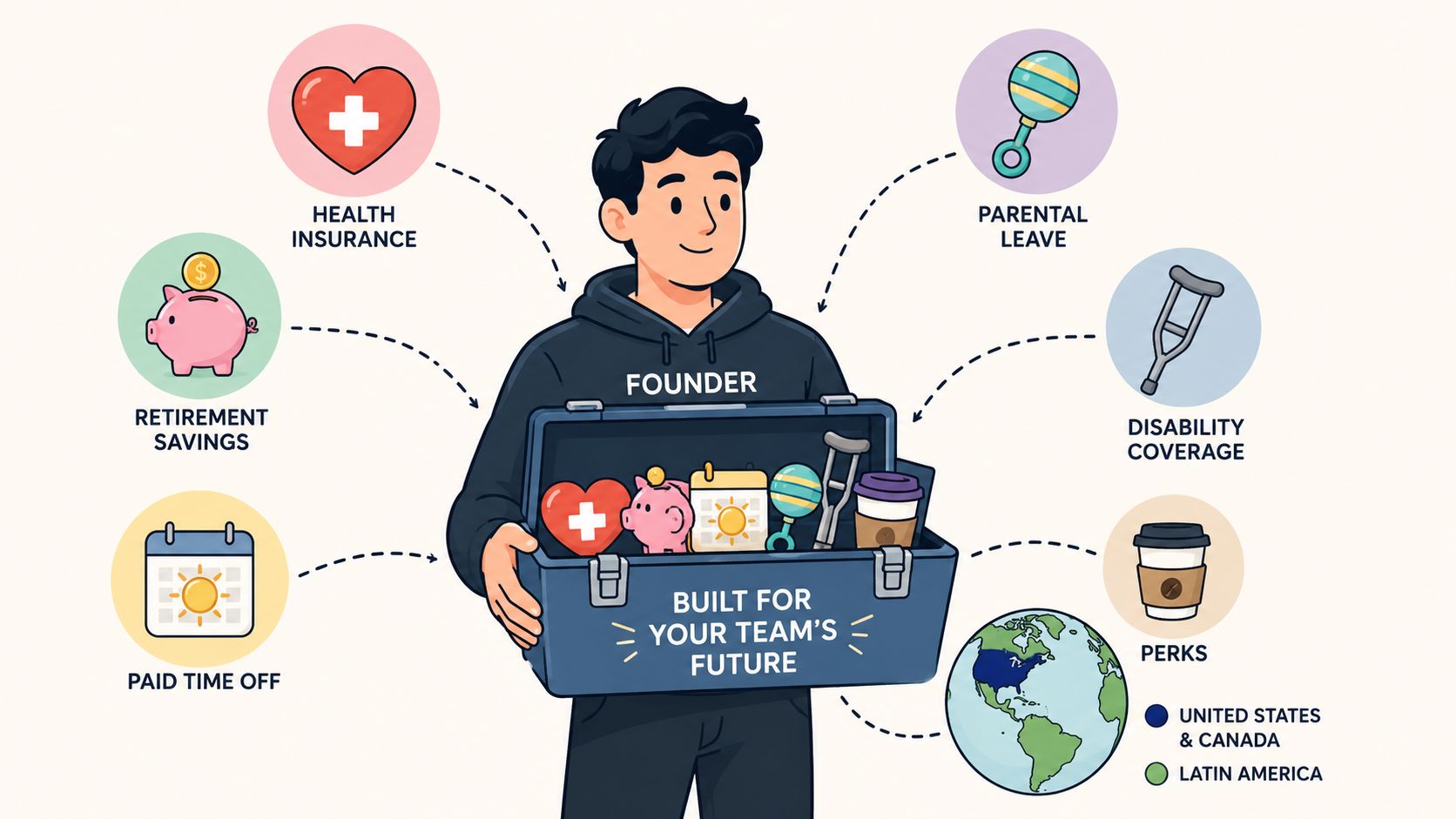
You've finally found the hire. Great operator. Strong references. Can write code, talk to customers, or clean up the mess your last “generalist” left behind.
Then the benefits questions start.
Do you need health coverage? What counts as full-time? Is “unlimited PTO” smart or just LinkedIn cosplay? And if you're hiring across borders, especially in LatAm, who's responsible when paperwork, payroll, and compliance start breeding in the dark?
I've watched founders spend weeks arguing over coffee stipends while ignoring the stuff candidates care about. That's backwards. Full time employment benefits aren't a garnish. They're part of the offer, part of the retention plan, and part of the operating model. Treat them like an afterthought and you'll pay for it in slower hiring, weaker acceptance rates, and endless admin sludge.
Your first full-time hire changes the game. A contractor wants invoices paid. A full-time employee wants a real employment relationship. That means security, structure, and some proof that you're building a company instead of a group chat with a bank account.
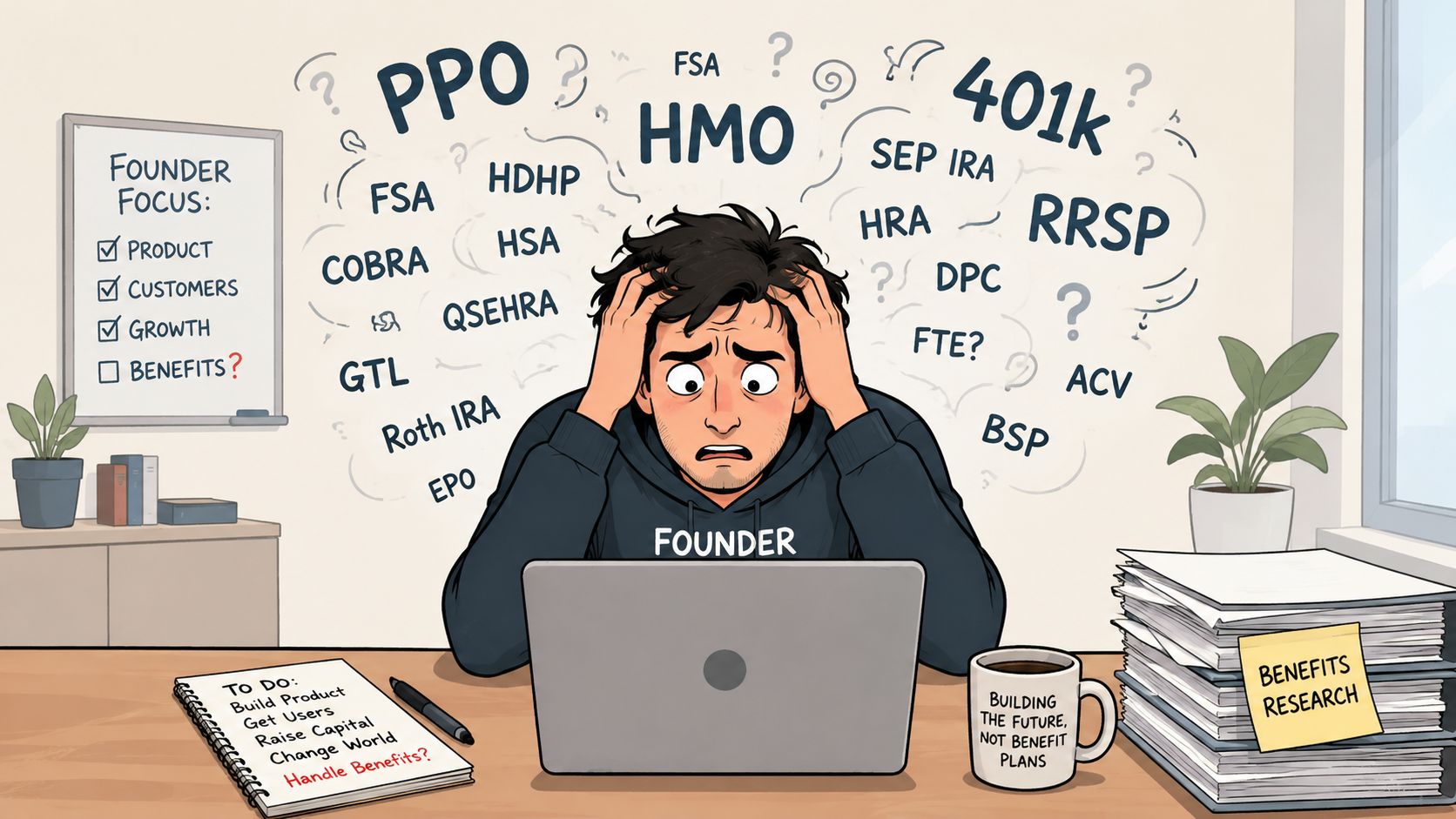
The legal definitions matter, sure. But in practice, full time employment benefits are the bundle that tells a candidate, “You can build a life here.” Health coverage. Time off. Retirement support. Leave policies. The boring stuff that stops being boring the minute somebody gets sick, has a kid, or burns out after shipping your product through three chaotic launches.
Here's the part founders miss. Full-time status isn't just about hours. It's the social contract around the job.
In the United States, 89% of full-time civilian workers have access to medical care benefits compared to only 25% of part-time workers according to the Bureau of Labor Statistics employee benefits data. That gap gets wider in the private sector. Translation: when people hear “full-time,” they don't just hear “more hours.” They hear “actual safety net.”
That's why sloppy benefits design costs you more than founders think. The best candidates compare offers as whole packages, not just salary lines. If your offer says “competitive pay” but your benefits feel duct-taped together, they notice.
Practical rule: If a candidate has to ask three times how healthcare, leave, or retirement works, your package is underbuilt.
Founders love to obsess over compensation bands and equity refreshes. Fine. You should. But benefits are where a lot of trust gets won or lost.
A few things that usually matter more than founders expect:
If you need a grounded starting point for tailored benefits for businesses, work with someone who can translate the insurance maze into plain English before you hand candidates a confusing PDF and call it a strategy.
I learned this the expensive way. Toot, toot. Benefits aren't just HR administration. They're part recruiting, part retention, part risk management. Get them right early and scaling gets easier. Get them wrong and you'll spend your afternoons decoding acronyms instead of building the company.
Before perks, before culture decks, before somebody suggests a wellness app no one will open, handle the legal baseline. This is the price of admission.
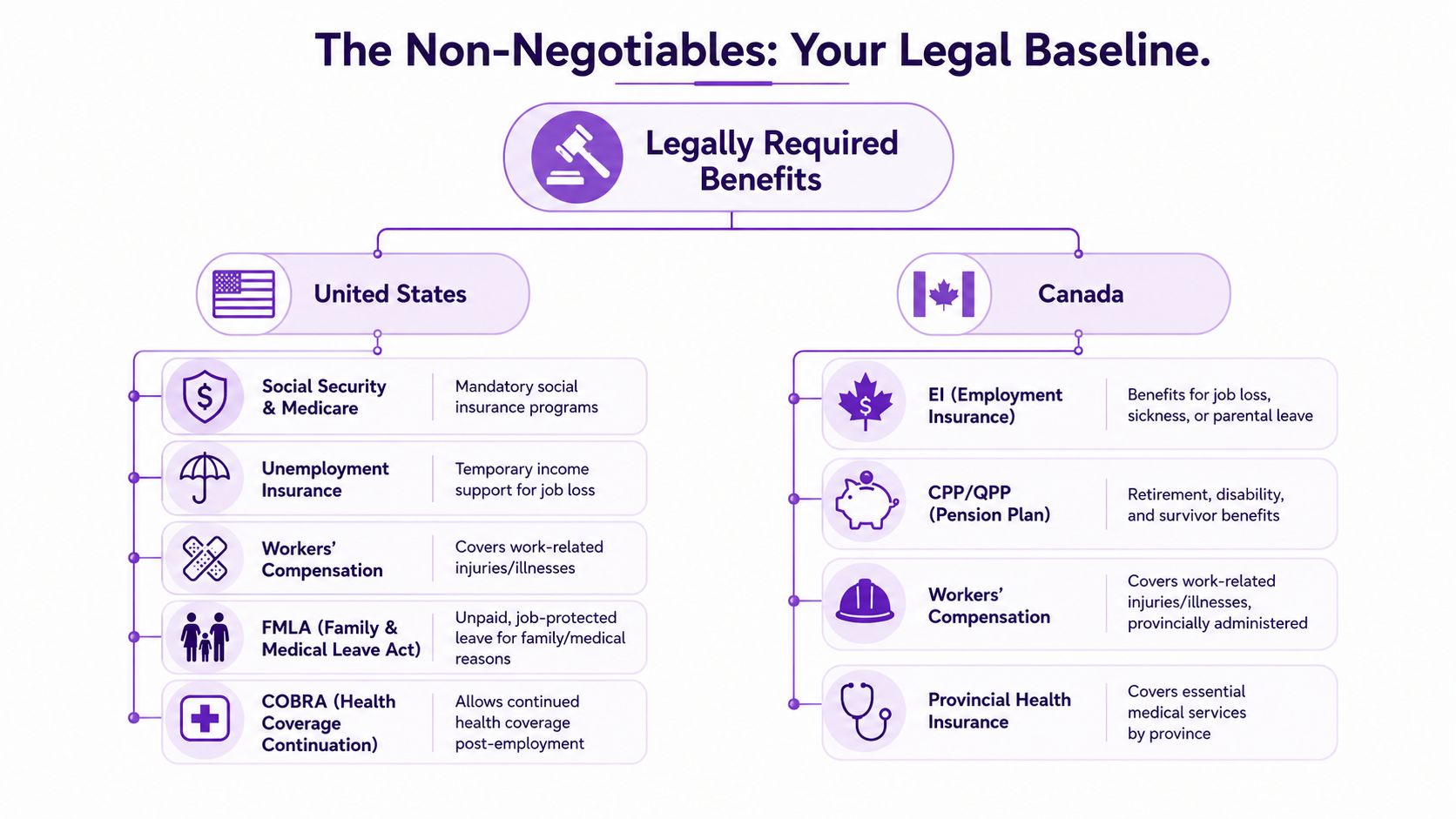
In the US, a compliant full-time hire usually means mandatory contributions and legally defined obligations around payroll taxes, unemployment coverage, and workers' compensation. In Canada, the framework changes, but the principle doesn't. Government-mandated contributions come first. Your “generous” extras come later.
Under the Affordable Care Act, an applicable large employer with 50+ full-time employees must offer health insurance to employees who average at least 30 hours of service per week or 130 hours per month, as explained in this ACA employer guide from Paychex. That's the kind of threshold founders ignore right until it bites them.
Startups frequently get cute, only to get burned. A worker at 32 hours a week can still trigger full-time treatment under the ACA. Calling someone “part-time” in Slack doesn't magically rewrite federal rules.
Think about legal benefits in layers:
A clean employment setup matters here. If you're still patching together offer letters from old Google Docs, fix that first. Start with actual employment contract templates that match the reality of how you hire.
Compliance is boring until it becomes the only thing anyone in the company talks about.
It's not. Canadian employers are legally required to contribute to CPP and EI, which creates a mandatory retirement and safety-net structure that US companies often have to recreate voluntarily if they want comparable offers, as summarized in this employment law overview for the USA and Canada context.
And if your team includes veterans or reservists in the US, don't wing that either. Read up on veteran employment rights so your policies don't accidentally conflict with protections you should have understood before hiring.
Here's my opinion. Founders should stop resenting mandatory benefits. These aren't annoying extras. They're the floor that keeps your hiring model from collapsing under legal and financial risk.
Once the legal minimum is covered, you need a package that people actually want. Not “our recruiter says this is market.” Not “our competitor offers kombucha.” A package that helps good people say yes and stay sane.
The core package is usually three things: health, retirement, and time off. Everything else sits on top of that.
If your health plan is weak, candidates clock it fast. A cheap plan with a miserable employee experience can do more harm than good. People don't just evaluate monthly premium deductions. They think about actual use. Prescriptions. Therapy. Maternity care. Surprise bills. The stuff that stops feeling hypothetical at the worst possible time.
If your team is young, founders often default to high-deductible coverage and pat themselves on the back for “financial discipline.” Sometimes that's fine. Sometimes it's penny-wise, talent-dumb. At minimum, explain the tradeoff clearly and make sure employees understand how to use the plan.
For families evaluating account types and care expenses, practical guides like resources on funding perinatal support can help employees understand whether different health spending arrangements fit their lives. That's more useful than dumping acronyms in a welcome packet.
Early-stage startups love to tell themselves equity is enough. Sometimes that works for a twenty-something engineer who enjoys risk and instant noodles. It works far less often for experienced operators with mortgages, kids, or any memory of a downturn.
You don't need a maximalist retirement plan on day one. You do need a coherent answer. If there's no retirement support, say so plainly. If there is, make it easy to understand. Confusing matching rules and hidden waiting periods don't make you impressive. They make you look disorganized.
If you can explain your cap table in detail but can't explain your retirement benefit in two sentences, your priorities are showing.
I'm suspicious of unlimited PTO. Not morally. Operationally.
Unlimited sounds generous, but it often shifts the burden onto employees to guess what's acceptable. Strong performers usually take less, not more. Then leadership brags about flexibility while people are reluctant to take real breaks. Congratulations, you invented guilt as a policy.
A cleaner approach is simple:
One nuance founders should understand. A study discussed in the National Library of Medicine article on work absence and benefits access found a counter-intuitive benefits cliff: health-related work absence was 39.9% among full-time workers versus 31.0% among part-time workers. That doesn't mean benefits are bad. It means when people have insurance and paid sick leave, they use them. Build your staffing model accordingly instead of acting shocked when humans behave like humans.
Most perk lists are junk food. Sweet on the careers page. Useless in real life.
Nobody stays because you reimbursed a meditation app and bought branded hoodies. People stay because the company helped them through an actual life event without making them beg.

If you want modern benefits with real retention value, start here.
Some benefits are pure vanity.
Free snacks for remote workers? Cute. Team merch? Fine. Quarterly surprise boxes? Better than setting money on fire, but not by much. If your core package is thin, these add-ons just advertise that leadership prefers visible perks over useful ones.
That gets even more obvious in cross-border hiring. A remote worker in LatAm doesn't need your company picnic budget. They need reliable payroll, clear leave rules, and benefits that fit local expectations.
Tenure-based vacation is a smart forcing function. In Canada, paid vacation legally steps up with service: two weeks after one year, three weeks after five years, and four weeks after ten years, according to this overview of Canada employee benefits and vacation rules. That structure pushes employers to think about long-term retention instead of pretending every employment relationship is temporary.
The perk that matters most is the one employees would notice disappearing tomorrow morning.
That's the test. If removing it would trigger immediate panic, confusion, or resentment, it's probably real. If nobody would notice for six months, it's probably fluff.
I'd rather fund parental leave and learning budgets than spend the same money staging a fake culture. One builds loyalty. The other builds a decent LinkedIn post.
Let's get practical.
Before you add a single voluntary benefit, mandatory contributions like social security, unemployment, and workers' comp can add 12% to 20% on top of base salary, based on this breakdown of full-time employee cost structure. That's your floor, not your deluxe plan.
So stop budgeting salary in isolation. Salary is the headline. Total employment cost is the bill.
I'd frame startup packages in two tiers. Not because every company needs labels, but because founders need guardrails.
| Benefit Component | Scrappy Startup Package | Scaling Contender Package |
|---|---|---|
| Health coverage | Basic employer-sponsored plan with clear employee education | Stronger employer-sponsored plan with broader support and easier navigation |
| Retirement | Simple retirement access, minimal complexity | Retirement plan with a more meaningful employer contribution strategy |
| PTO | Defined PTO policy with clear sick leave rules | Defined PTO plus stronger leave design and manager training |
| Parental leave | Basic written policy, modest but real support | More robust policy designed to retain experienced talent |
| Disability | Optional if budget is tight, but add early if possible | Included as part of a mature risk-protection package |
| Professional development | Small annual learning budget or course reimbursement | Structured development support tied to role growth |
| Remote support | Essential tools only | Formal remote stipend or equipment support |
| Admin model | Keep complexity low and documentation clean | Use a more scalable operating model with compliance support |
This package is for startups that need to hire adults without pretending they're a public company.
Keep it simple:
This is the package for companies that want stronger retention and fewer awkward negotiations.
Add depth where it counts. Better health support. Better leave. Disability protection. Learning budget. A retirement approach mature candidates won't laugh at. You're not trying to impress everyone. You're trying to remove the obvious reasons strong people say no.
Budget benefits as part of role design, not as a year-end patch after finance finds leftover money.
That one change saves a lot of nonsense.
Choosing benefits is one problem. Administering them is a significant tax.
Most founders have three delivery models. Go direct to carriers. Use a broker. Or use a PEO or employer-of-record style setup. I've seen companies try all three. The wrong choice doesn't just waste money. It drains founder time, creates compliance risk, and turns hiring into a side quest.
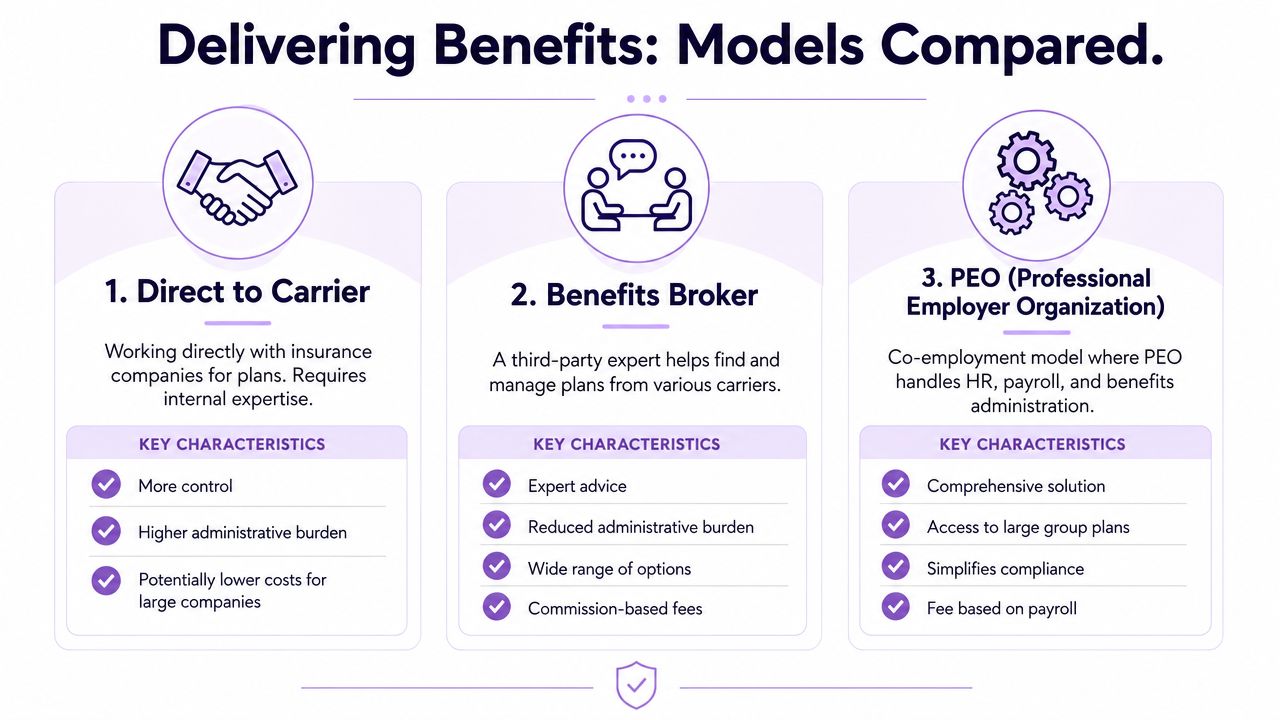
Going direct gives you control. It also gives you paperwork, renewals, eligibility headaches, onboarding issues, and a front-row seat to every confused employee question. If you have an experienced HR and finance team, fine. If you're a small startup, this is how founders end up doing insurance admin at 9:30 p.m.
A good broker can absolutely simplify plan selection and carrier coordination. That matters. But brokers don't magically absorb all operational burden. Someone on your side still owns payroll alignment, policy rollout, onboarding timing, terminations, and the hundred tiny compliance details nobody puts in the sales demo.
If you're hiring internationally, especially in LatAm, this is usually the move. Not because it's glamorous. Because it turns a pile of fragmented obligations into one operating model.
Here's the blunt comparison:
For teams hiring across countries, read up on international benefits administration before you assume your domestic setup can stretch across borders without snapping.
And yes, one platform option is LatHire, which supports hiring and operational workflows for Latin American talent, including HR, international payroll, benefits, and legal compliance. That's useful if you want one system around cross-border hiring rather than stitching together vendors and hoping they cooperate.
My opinion is simple. If you're a startup hiring in LatAm and trying to DIY benefits delivery, you're playing accountant, HR lead, and compliance officer because you don't want to pay for a grown-up system. That's not lean. That's expensive denial.
The founder-friendly version is simple.
Know your legal floor. Build a core package around health, time off, and financial protection. Add modern perks that solve real life, not vanity problems. Then choose a delivery model that doesn't turn your ops team into a benefits help desk.
That last part matters most when hiring in Latin America. Cross-border employment adds local rules, payroll complexity, benefits administration, and contract issues that don't care how “nimble” your startup says it is. The cost of getting this wrong isn't just legal. It's slower hiring, confused employees, and managers cleaning up preventable messes.
If you're still treating international hiring like domestic hiring with extra Zoom calls, fix that. Start by understanding what an employer of record is. It's often the cleanest way to hire full-time talent in another country without building local infrastructure first.
My no-BS recommendation: if you're hiring top talent in LatAm, don't assemble benefits from random vendors and vibes. Use a model that packages compliance, payroll, and benefits delivery together. Founders should spend time on product, customers, and recruiting strong people. Not on deciphering healthcare forms and leave rules in three jurisdictions.
That's the smart play. Less chaos. Better offers. Fewer ugly surprises.