

The most popular advice about LATAM outsourcing is also the least useful: “Go there because people cost less.” That pitch is outdated, lazy, and guaranteed to attract the wrong vendor. Latin America has become a North America-first delivery base, built around overlapping workdays, closer collaboration, bilingual talent, and operational maturity. Cost still matters, but it's no longer the whole argument.
That shift changes how you should hire. You're not shopping for cheap headcount. You're designing a distributed operating model that can survive hiring pressure, compliance reviews, manager bandwidth limits, and the occasional spreadsheet ambush. Here's what works.
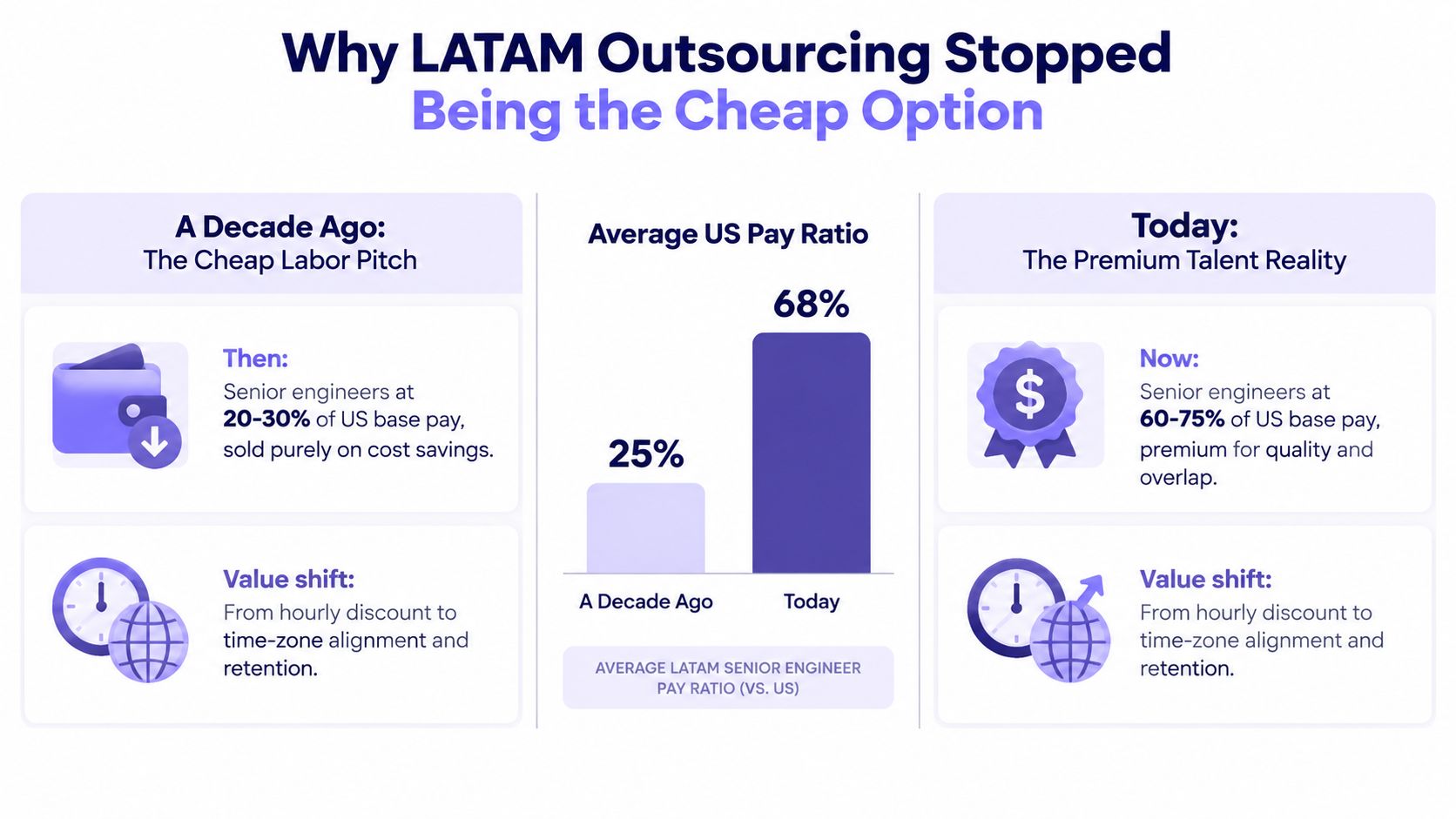
Senior Latin American engineers aren't generally priced like bargain-bin labor anymore. The old pitch put senior talent at a small fraction of U.S. base pay. Today, strong candidates often price themselves against U.S. remote-first employers and North American clients, not only against local salary benchmarks.
That premium is structural. North American companies pay in dollars, remote hiring has widened the comparison set for experienced professionals, and capable engineers know the value of shipping production software inside a U.S.-aligned workday. If your entire strategy depends on finding a senior engineer at a dramatic discount, your strategy is already wobbling.
The advantage is operating proximity. Teams in Latin America can often collaborate during the same working day as U.S. and Canadian colleagues. That makes architecture reviews, product decisions, customer escalations, and “this bug is somehow in production” conversations much easier than they are across a large offshore time difference.
In 2016, only 44% of Latin American shared-services operations supported North America. By 2024, that share had reached 84%, making North America the region's top client market, according to Auxis' analysis of Latin American shared services and outsourcing. That isn't a temporary pricing trick. It's a structural migration toward nearshore delivery.
Practical rule: Pay for the capability your workflow needs, then measure the output. Hourly discount is a terrible substitute for ownership.
The buyer mindset has to catch up. Founders now choose between talent quality, communication, retention, and integration depth, not merely between one hourly rate and another. If the role touches product direction, customer context, or regulated data, the cheapest available option can become the most expensive person on the org chart.
A useful cost-effectiveness analysis of hiring remote talent from Latin America should therefore include collaboration quality and management load, not just compensation. LATAM outsourcing stopped being “cheap” because the best talent became more valuable. That's a good problem. It means the region is competing on delivery, not pleading for work.
The market is large enough that calling LATAM outsourcing a niche experiment now sounds like someone still faxing purchase orders. The Latin America outsourcing services market generated an estimated USD 182.4 billion in 2024 and is projected to reach USD 320.0 billion by 2030, with a projected 10.1% compound annual growth rate from 2025 to 2030, according to Alcor's overview of nearshore outsourcing in Latin America.
Engineering services outsourcing was the market's largest revenue-generating service type in 2024 and its fastest-growing segment over the forecast period. That detail matters. Buyers aren't using the region only for repetitive support queues or back-office processing. They're placing engineering, product development, and specialized business work there.
Brazil is projected to post the highest CAGR among Latin American markets from 2025 to 2030, according to the same market analysis. The broader pattern is clear: companies are building delivery capacity in several countries rather than treating the region as one giant labor pool with different flags. Our country-by-country guide to hiring developers in Latin America shows where each market fits.
The strongest segments include software engineering, cloud and DevOps, AI and machine learning, customer support, finance, HR, and back-office operations. The right choice depends less on the region's headline price and more on the role's communication intensity, specialization, customer exposure, and compliance requirements.
Organizations already operating shared services in Latin America report 87% satisfaction or very high satisfaction with results. The same research reports that 68% see labor savings of 20% to 40% compared with equivalent U.S. operations, while 18% report savings above 40%, as detailed in the operator and non-operator risk comparison.
| Country | Senior Engineer Salary (USD) | Talent Pool Size | English Proficiency (EF EPI) | Time-Zone Overlap with US | Regulatory Maturity |
|---|---|---|---|---|---|
| Mexico | Varies by role and seniority | Deep and broad | Varies by city and profile | Strong | Mature but country-specific |
| Colombia | Varies by role and seniority | Strong in technology and services | Varies by city and profile | Strong | Requires local review |
| Brazil | Varies by role and seniority | Very deep | Varies by city and profile | Partial to strong by U.S. hub | Complex and established |
| Argentina | Varies by role and seniority | Strong in STEM and software | Strong in many professional profiles | Strong | Requires careful local review |
| Chile | Varies by role and seniority | Specialized | Strong in many professional profiles | Strong | Relatively mature |
| Costa Rica | Varies by role and seniority | Specialized | Strong in professional services | Strong | Stable, still needs diligence |
The table is a decision aid, not a salary sheet. Treat country averages as a starting point, then validate the actual role, city, seniority, language ability, employment model, and expected output.
A lower salary can still produce a higher bill. That happens when leaders compare base pay while ignoring total cost of ownership, including recruiting, management, benefits, compliance, equipment, ramp time, rework, and turnover.
The sticker price is the easiest line item to see, which is why pitch decks love it. The difficult costs live in the gaps between teams. A manager spends time clarifying vague tickets, a senior engineer leaves during a critical release, or a compliance review discovers that nobody documented the engagement model. Congratulations, you saved money per hour and bought yourself a second job.
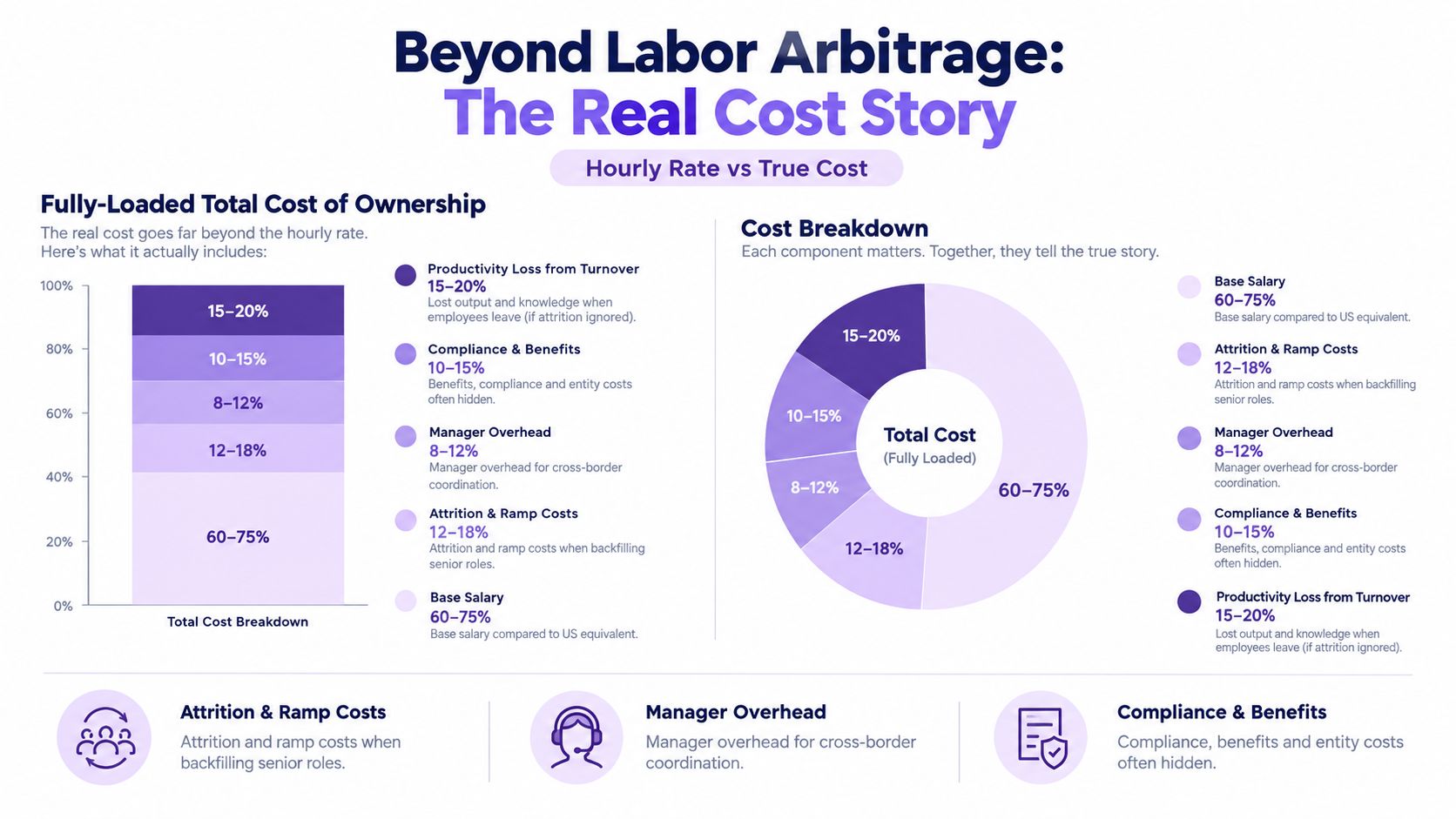
For a senior full-stack role, compare the fully loaded cost of a nearshore hire with the fully loaded cost of an Austin-based hire. Include recruiting fees, benefits, equipment, learning budget, manager time, payroll administration, and the cost of replacing someone who leaves. Then compare shipped work, response time, defect rates, and retention.
The available research identifies the following cost categories for a realistic model:
The exact economics vary by country and role. Engineering, customer support, finance, and product work carry different supervision and security requirements. A ticket-based function may tolerate more separation than a product squad making decisions together every morning.
The CFO question isn't “What's the hourly rate?” It's “What will one reliable unit of output cost us after every avoidable failure?”
Nearshore wins when collaboration is central, the role is difficult to fill locally, and the company has a capable manager. Savings disappear when leaders outsource accountability along with the work. Don't do that. Keep product ownership, quality standards, and escalation paths inside your operating system.
Start with the role, not the country. “We need two developers in Mexico” is a location preference pretending to be a hiring plan. Define the outcome first, such as owning a service, reducing a backlog, improving release reliability, or supporting a customer workflow.
Define the outcome and cost envelope. Write the role around results, decision rights, required technical depth, communication expectations, and a budget tied to the comparable U.S. role.
Shortlist countries by operating fit. Score time-zone overlap, English fluency, talent density, infrastructure, employment rules, and hiring volume. The lowest salary is not a strategy. It's a sorting mistake.
Pick the engagement model. Direct employment gives control but requires local infrastructure. An Employer of Record can handle local employment administration while you manage the work. An outsourcing firm can provide a managed team, but you'll need to inspect who does the work and how accountability operates.
Run a structured evaluation. Use the same interview rubric for every candidate, test written communication, inspect real technical decisions, and include a paid trial task. A polished résumé is not evidence of production judgment. It's evidence that someone owns a document editor.
Close and onboard like they're part of the company. Use a credible compensation band, make overlap hours explicit, document access rules, and schedule reviews at 30, 60, and 90 days. The best practices for hiring remote workers from Latin America should show up in your calendar, not sit unread in a bookmarked tab.
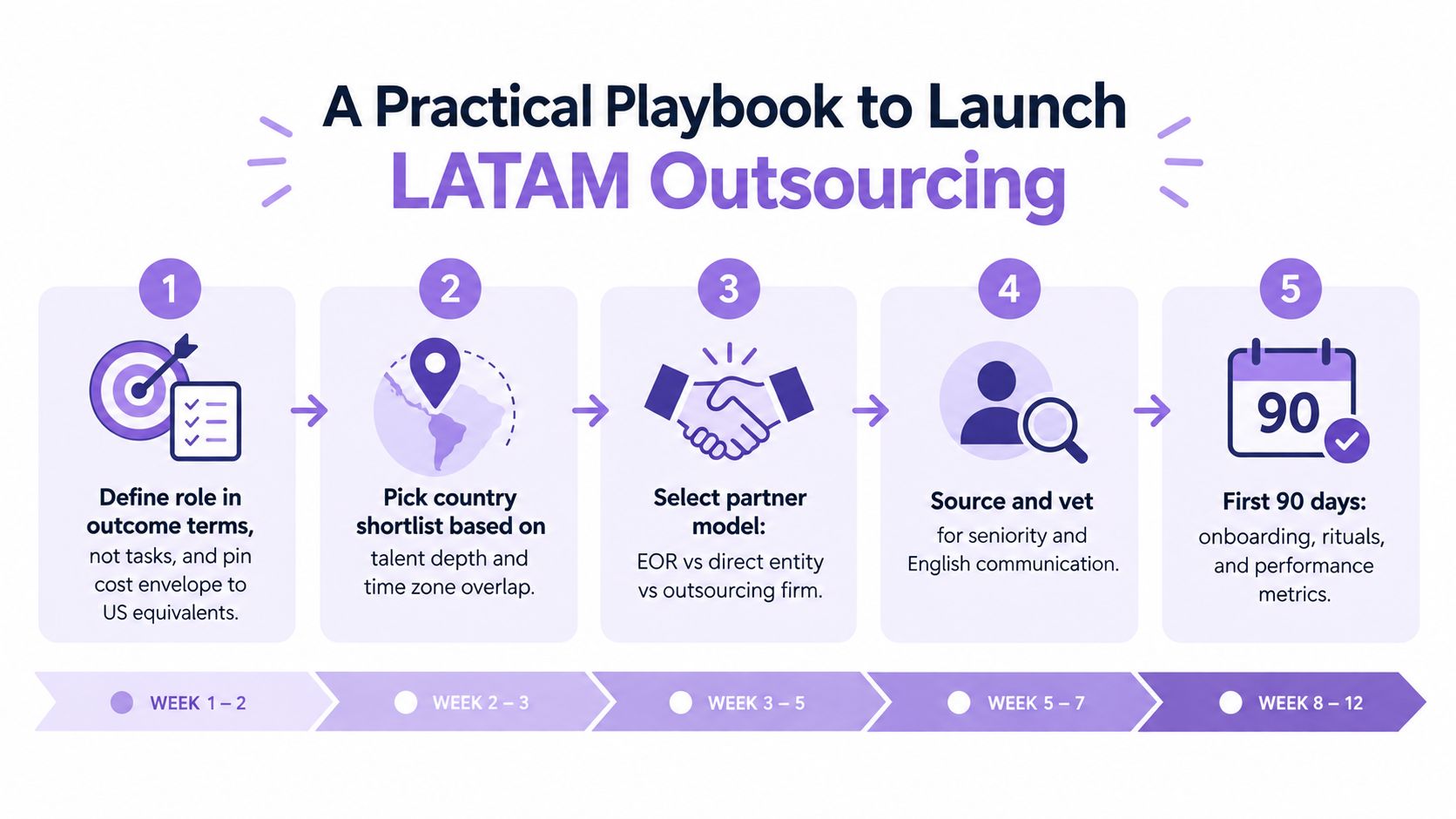
That timeline is deliberately boring. Boring is good. It beats improvising international employment while a launch date approaches like a hungry dog.
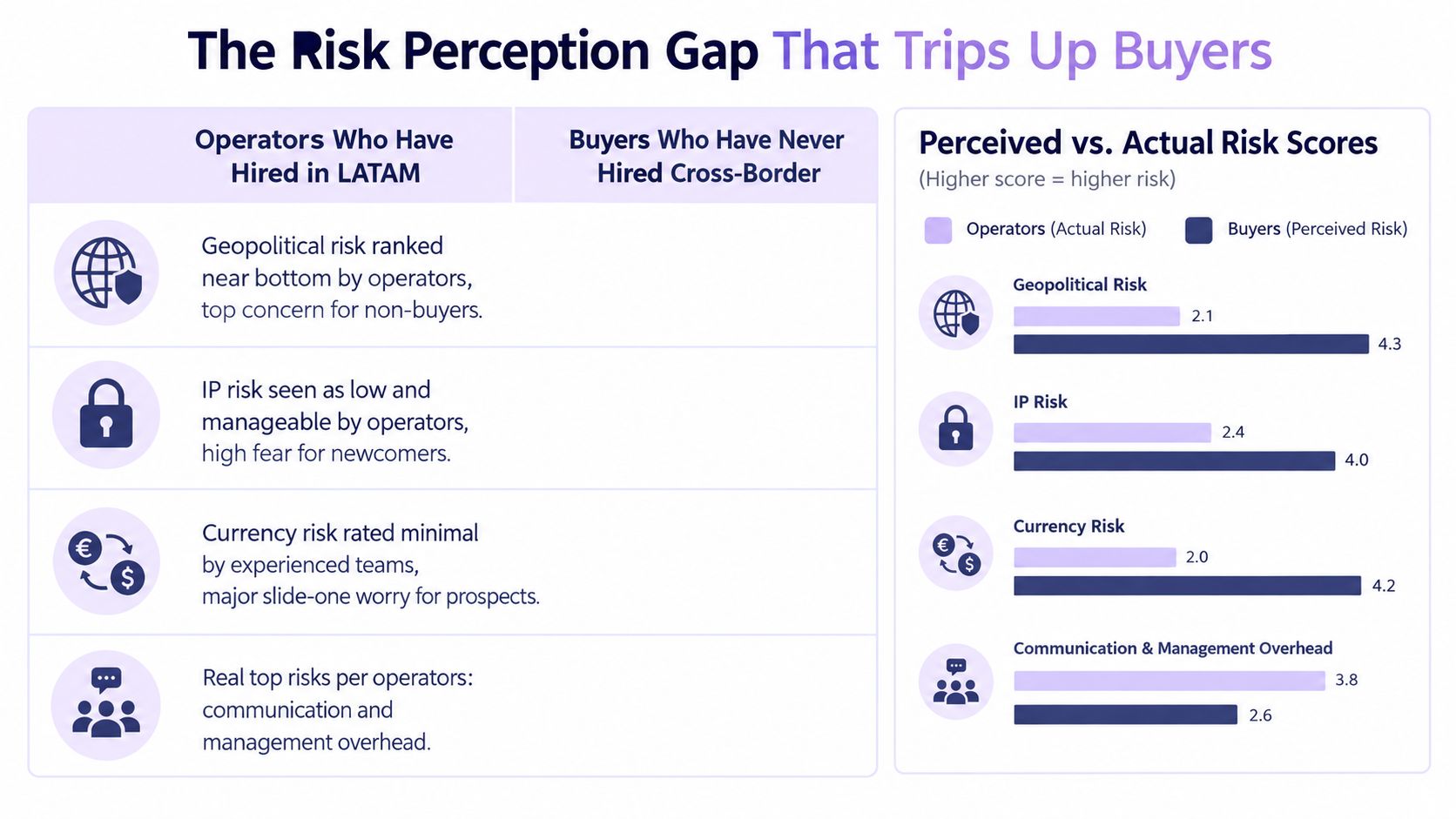
Non-operators often fear the wrong things. Research on shared-services operators found that 89% of non-operators worried about data security, compared with 29% of current operators, while 87% of operators reported satisfaction or very high satisfaction with their results, according to the LATAM outsourcing risk analysis. Experience doesn't eliminate risk. It replaces vague fear with controls.
The practical risk isn't “Latin America” as a single category. It's choosing a country without due diligence, using the wrong worker classification, failing to assign IP properly, or giving an overloaded U.S. manager another team with no operating playbook.
A startup scaling engineering in Argentina may worry about currency volatility. The operator response is to define compensation mechanics, document payment terms, and choose an employment structure that can handle local conditions. The risk doesn't vanish, but it becomes a managed operating variable rather than a scary board slide.
A fintech hiring in Colombia may face a regulatory change affecting payments or data handling. The correct response is local legal review, restricted access, audit trails, and clear responsibility for compliance. A retailer hiring in Brazil may encounter payroll complexity and local benefits expectations. Again, the answer is not panic. It's country-specific employment administration and a proper compliance owner.
The research points to lack of knowledge as the primary barrier for 48% of non-adopters, which is why structured diligence beats broad stereotypes. Create a country risk scorecard, review worker classification and data flows, validate the provider's controls, and run a contained pilot before scaling.
Board briefing language: “We're not claiming zero risk. We're naming the risks, assigning owners, testing the model, and setting conditions for expansion.”
Operators tend to surface hiring-manager bandwidth, communication drift, and unclear performance standards as more immediate problems. Those risks are manageable, but only if someone owns them. If nobody does, the outsourced team becomes a very expensive group project.
LATAM isn't one labor market. Treating it like one is how companies overpay in one country while missing the talent they need in another. Choose by role first, then validate the country through talent density, English communication, remote-work readiness, compliance, and overlap with the U.S. team.
Remote talent has expanded, but specialist supply remains uneven. The Inter-American Development Bank notes that remote work in Latin America remains limited and concentrated in higher education, data analysis, and technology, as described in its analysis of remote work in the region. Separately, reported remote-work talent growth reached 35% from 2020 to 2023, with Mexico, Brazil, and Colombia leading expansion, while Argentina and Chile had over 40% of tech professionals working remotely, according to LATAM remote-work talent coverage.
São Paulo and Buenos Aires are strong engineering bets. Mexico City and Monterrey work well for operations and customer-facing teams. Medellín and Bogotá are useful product and services hubs, while Santiago is a compelling fintech market. Uruguay, Costa Rica, and the Dominican Republic deserve attention as second-tier options when stability, language, or specialized availability matters.
| Country | Top Cities | Strongest Roles | English Score | Remote Readiness |
|---|---|---|---|---|
| Mexico | Mexico City, Monterrey, Guadalajara | Engineering, operations, support | Candidate-specific | Strong |
| Brazil | São Paulo, Rio de Janeiro | Engineering, finance, operations | Candidate-specific | Strong in major hubs |
| Argentina | Buenos Aires, Córdoba | Engineering, STEM, design | Often strong in professional profiles | Strong |
| Colombia | Bogotá, Medellín | Product, support, fintech | Candidate-specific | Strong in major hubs |
| Chile | Santiago | Fintech, engineering, finance | Candidate-specific | Strong |
| Costa Rica | San José, Heredia | Technology, support, professional services | Often strong in professional profiles | Strong |
| Uruguay | Montevideo | Engineering, product, finance | Candidate-specific | Developing and specialized |
| Dominican Republic | Santo Domingo | Support, operations, services | Candidate-specific | Developing |
Don't trust a country label as a substitute for candidate validation. Search LinkedIn for actual role density, compare local compensation benchmarks, test English in writing and live discussion, and verify working-hour overlap with your U.S. hub.
Also review hiring pitfalls to avoid before you launch sourcing. The biggest errors usually happen before the first candidate enters the funnel, especially vague requirements, weak evaluation standards, and compensation assumptions that ignore the market you're targeting.
LATAM outsourcing is a strategic operating decision, not a coupon code for payroll. Companies that use it well build durable capability near their customers and product teams. Companies that use it badly chase a cheap rate, lose a good hire, and then blame geography for a management problem.
Anchor hiring on overlap and communication. Test English directly and define required collaboration hours. Country stereotypes are a poor substitute for evidence.
Run a 60 to 90 day pilot. Give the pilot measurable output KPIs, a named internal manager, and a clear stop or expand decision.
Protect the contract. Your MSA should address IP assignment, confidentiality, data residency, security controls, offboarding, and access revocation. “We'll sort that out later” is how legal departments acquire gray hair.
Train managers. Cross-cultural remote leadership requires explicit feedback, written context, calibrated expectations, and consistent one-on-ones. Do not hire internationally and manage casually.
Track TCO quarterly. Review compensation, provider fees, benefits, compliance, manager time, retention, rework, and output. If you only track the hourly rate, you're measuring the least interesting number.
For companies that want a sourcing and administration option, LatHire connects U.S. and Canadian companies with pre-vetted Latin American professionals and provides support for HR, international payroll, benefits, and legal compliance. Treat it as one possible channel, then compare it with direct hiring, an EOR, and a managed outsourcing provider against your role and risk requirements.
Use this 10-point pre-launch checklist tomorrow:
If you're planning a LATAM team, start with one role, one accountable manager, and one measurable outcome. Build the country shortlist, run the diligence, and compare fully loaded economics before signing a long-term agreement. That's how you turn LATAM outsourcing from a cheap-labor slogan into an operating model that ships.
Talk with your hiring and finance leads this week, choose the first role to pilot, and write the outcome, budget, country criteria, and 90-day success measures before contacting vendors.