

You're hiring a remote medical virtual assistant, patient coordinator, or billing specialist in Canada. The candidate is qualified, your practice is ready, and then the practical questions arrive: Which province governs the employment relationship? Who withholds payroll deductions? Who is responsible if records are incomplete or a termination is mishandled?
An employer of record in Canada can solve much of that administrative problem. The EOR becomes the legal employer, while your U.S. medical practice directs the employee's daily work. It manages contracts, payroll processing, statutory deductions, and employment records without requiring your practice to establish a Canadian subsidiary immediately.
That arrangement is useful for testing the Canadian talent market or hiring a small number of remote healthcare staff. It isn't a complete corporate tax shield, and it may not remain the most economical structure as your Canadian workforce grows. Canada's employment framework combines the federal Canada Labour Code with 13 provincial and territorial regimes, each with its own rules for wages, overtime, vacation, and termination (Payoneer's summary of Canadian employment law).
This guide explains how the model works, what payroll really costs, where permanent establishment risks remain, and when a subsidiary, contractor arrangement, or nearshore LATAM team may make more sense for a healthcare organization.
An EOR separates legal employment from operational management. The EOR signs the employment agreement, administers payroll, handles statutory deductions, and maintains required records. Your practice still sets the employee's schedule, assigns tasks, reviews performance, and decides how the person supports your workflows.
For a medical practice, that could mean your practice manager supervises a Canadian virtual receptionist who answers patient calls, a scheduling specialist who manages appointment requests, or an insurance verification employee who follows your internal procedures. The worker may feel like part of your team, but the EOR remains the statutory employer for the employment relationship.
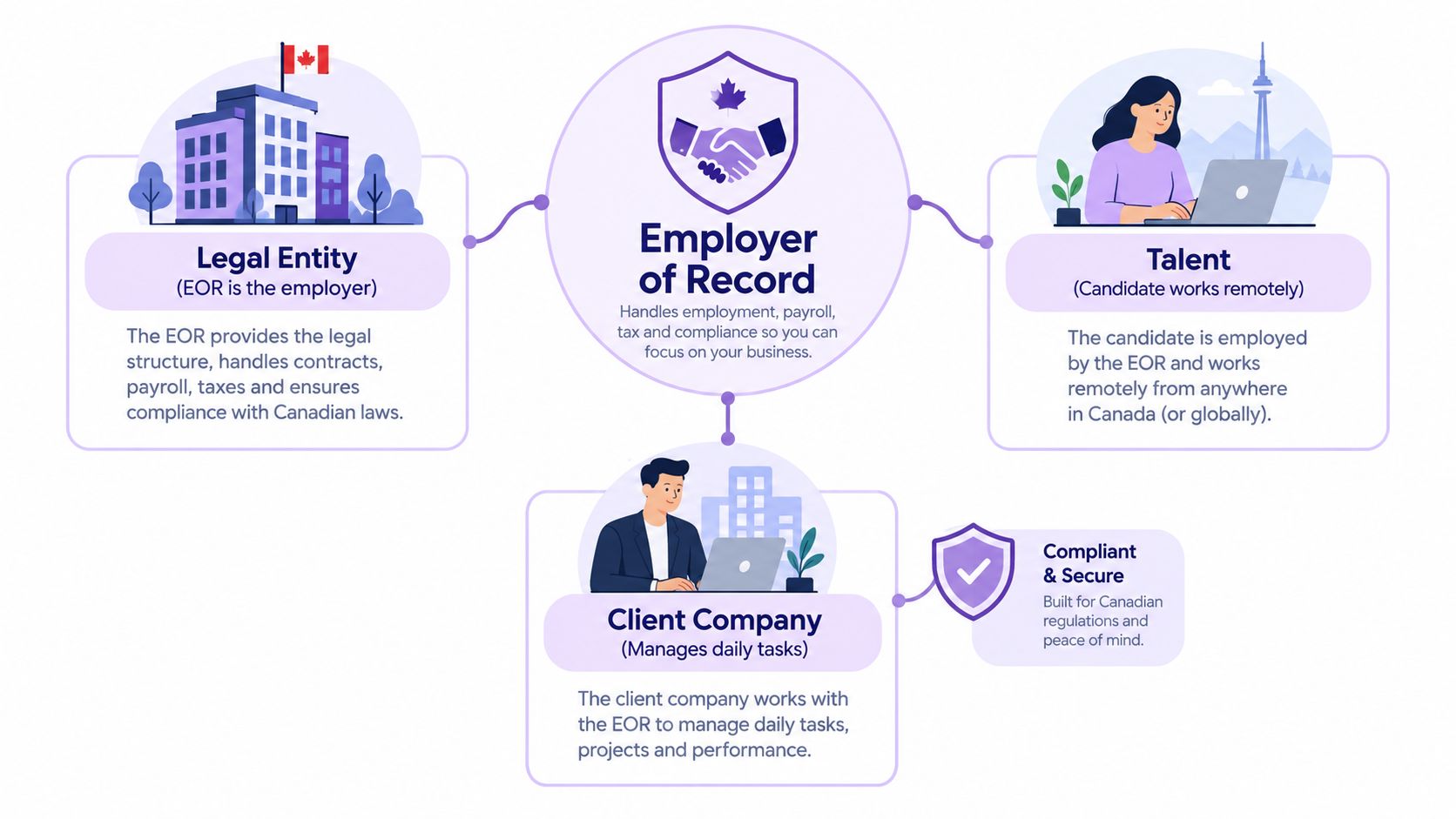
Canada doesn't have one standalone federal or provincial law governing outsourcing across every sector. Osler's Canada outsourcing guide explains that Canadian law has no single set of outsourcing rules applicable to all sectors, while Canadian legal analysis also recognizes that a client and service provider can sometimes be treated as one employer when an arrangement isn't a genuine outsourcing transaction (Osler's legal guide to outsourcing in Canada).
That makes the contract and the actual working relationship important. An EOR agreement should identify who handles payroll, statutory leave, workplace obligations, record retention, employee complaints, and termination administration. It should also explain what happens when your practice wants to change a worker's duties or end the relationship.
The EOR reduces the need for your practice to build local payroll and employment infrastructure from scratch. It doesn't erase your responsibility to manage the relationship carefully. Your practice still needs to provide accurate job duties, expected hours, compensation terms, reporting lines, and work location.
A capable provider should manage the administrative workflow from onboarding through separation:
For healthcare organizations, also define who controls access to practice systems, patient communication tools, scheduling platforms, and employee files. Canadian privacy regulators recommend written remote-work policies covering secure access to networks, information, and work accounts. Employees also have rights concerning access to their personal information and the accuracy of their records (Office of the Privacy Commissioner of Canada guidance for remote work).
A U.S. practice can agree on a salary in dollars, hire through an EOR, and still produce the wrong Canadian payroll if the employee's province, work location, and taxable benefits are configured incorrectly. The EOR must apply the relevant provincial or territorial rules, calculate employee withholdings, account for employer contributions, and complete reporting to the Canada Revenue Agency.
The Canada Revenue Agency employer payroll guide places responsibility for deducting, remitting, and reporting CPP contributions, EI premiums, and income tax on employers. A non-resident employer with people working in Canada generally faces the same underlying withholding, remitting, and reporting duties as a Canadian resident employer. An EOR administers those obligations on your behalf. It does not remove them.
The following figures are the specific 2026 examples provided in the available Canadian payroll guidance. Confirm them with the EOR and a qualified payroll adviser before approving a hiring budget.
| Deduction Type | Employer Rate | Maximum Insurable/Pensionable Earnings |
|---|---|---|
| CPP | 5.95% | CAD 74,600 |
| CPP2 | 4% | CAD 85,000 |
| EI | 2.28% | CAD 68,900 |
| Federal and provincial income tax | Employer withholds employee tax, not an employer contribution | Based on applicable payroll calculations |
The Canada payroll cost guidance identifies the CPP, CPP2, and EI figures above and explains why payroll systems need province-specific tax logic. Ontario's minimum wage was reported at CAD 17.60 per hour effective October 2025, reinforcing the need to include work location in the employment budget (Payoneer's Canadian employment law overview).
For province-by-province withholding logic, see our payroll guide for remote employees.
Request an itemized estimate that separates:
Canadian employers may make statutory deductions unless another deduction is authorized in writing. The federal government identifies income tax, EI, and CPP as statutory deductions and states that employers cannot withhold wages for set-offs or counterclaims (federal payroll deduction guidance).
Use the fully loaded monthly cost by employee, province, role, and benefit package when comparing providers. As headcount becomes stable, recurring EOR fees can make a Canadian subsidiary worth evaluating, even before payroll complexity increases. For a medical practice, also confirm that the provider can produce payroll reports your accountant can reconcile with the U.S. books.
An EOR can administer Canadian employment obligations, but it doesn't automatically prevent your U.S. practice from creating Canadian corporate tax exposure. That distinction is easy to miss because EOR marketing usually focuses on hiring, payroll, and employee compliance.
Permanent establishment is a tax concept that can arise when a foreign business has a sufficiently meaningful business presence in another jurisdiction. The exact analysis depends on the facts, the applicable tax treaty, the employee's authority, and the nature of the business activity. A Canadian EOR doesn't decide those questions for your practice.
A remote healthcare support employee who follows documented administrative procedures may present a different risk profile from an employee who manages sales, negotiates commercial terms, or exercises substantial authority on behalf of the U.S. company. The EOR's employment contract does not change what the employee does each day.
Potential issues can include:
For a U.S. medical practice, a Canadian patient coordinator handling administrative communications may not create the same facts as a Canadian-based executive developing a market, managing vendors, or signing agreements. That example is illustrative, not a legal conclusion. The practice should have counsel or a tax professional review the actual duties, authority, location, customer base, and duration of the arrangement.
The EOR may be responsible for hiring administration, payroll deductions, employment records, and local employment standards. Your practice remains responsible for deciding how the worker supports the business, what systems they access, and whether the wider business activity creates tax or regulatory exposure.
Practical rule: Treat EOR compliance and corporate tax nexus as two separate workstreams. A payroll provider can administer employment correctly while your company still needs independent tax analysis.
The Canadian EOR overview from Deel makes the same operational distinction in practical terms. The EOR handles employment administration, while the client retains day-to-day control. Before onboarding a Canadian employee, document the person's duties, authority, reporting structure, customer interactions, and expected duration. That file gives your advisers something concrete to review instead of forcing them to analyze a vague “remote employee” label.
The right structure depends on more than headcount. Your timeline, expected permanence, role design, tax profile, management requirements, and tolerance for administrative work all matter.
An EOR is usually attractive when you need to hire quickly without forming a local entity. A Canadian subsidiary offers more direct control over employment and local operations, but it introduces incorporation, bookkeeping, payroll administration, tax filings, and ongoing entity maintenance. An independent contractor can be appropriate for genuinely independent project work, but using that label for a person who works like an employee creates classification risk.
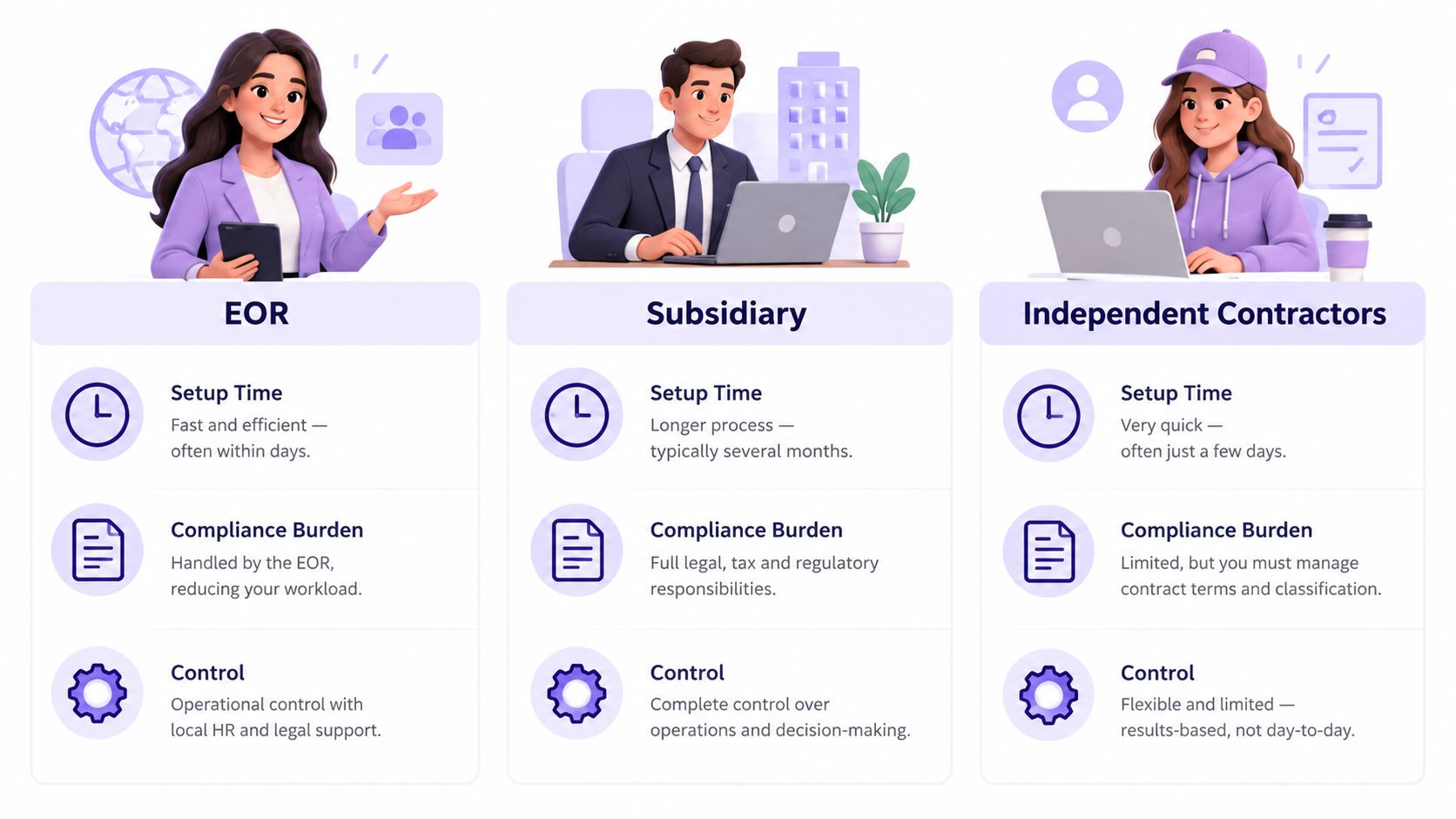
| Situation | EOR | Canadian subsidiary | Independent contractor |
|---|---|---|---|
| Need to hire one or a few employees quickly | Strong fit | Usually disproportionate at the beginning | Only if the work is genuinely independent |
| Expect a durable Canadian operation | Useful for initial entry | May become more suitable | Usually weak if the person works continuously under your direction |
| Need direct local entity ownership | No | Yes | No |
| Want the EOR to administer payroll | Yes | Your entity must arrange it | Contractor handles their own business obligations, subject to classification |
| Need operational control over a regular staff member | Yes, with legal and operational roles separated | Yes | Control can undermine contractor status |
The EOR's convenience comes with a recurring service fee layered on top of salary, statutory contributions, and benefits. A subsidiary has its own one-time incorporation costs and ongoing accounting, payroll, tax, and maintenance costs. The inflection point depends on your actual headcount and how long you expect to employ people in Canada, so a provider's generic quote can't answer it.
Build two scenarios:
Compare both scenarios across your planned hiring horizon. An EOR may be financially sensible while you validate demand, then less attractive once you maintain a larger, stable Canadian team. That doesn't mean you should incorporate immediately. It means you should set a review trigger rather than allowing a temporary structure to become permanent by default.
Contractor classification deserves separate attention. A person who follows your schedule, performs an ongoing core function, uses your systems, and reports to your manager may look operationally like an employee even if the contract uses the word “contractor.” For a broader perspective on how contractor and employee arrangements differ across markets, the LatoJobs comparison of pay models in Brazil and Mexico is a useful reference, though Canadian classification must be analyzed under Canadian rules.
A Canadian EOR is most valuable when the role benefits from Canadian employment. That can include a Canada-based patient liaison, a local operations manager, or a role requiring a Canadian presence. It may be unnecessary for every function your practice wants to scale.
Medical practices often have a mix of work. Patient-facing scheduling may require specific hours and communication skills, while billing support, administrative coordination, reporting, recruiting, and technical operations can often be performed remotely from another country if your privacy, access, supervision, and workflow controls are sound.
A practice could use a Canadian EOR for a role that benefits from Canadian location and hire nearshore LATAM professionals for functions such as:
These roles must remain administrative unless the individual holds the required license and authorization for the work. A virtual assistant shouldn't diagnose, interpret clinical information for patients, make medical decisions, or represent themselves as a licensed healthcare professional.
LatHire is one option for companies seeking pre-vetted Latin American professionals and support with international payroll, benefits, and local compliance. For a medical organization, the relevant evaluation points are time-zone overlap, bilingual communication, healthcare workflow experience, privacy controls, supervision, and the provider's process for handling sensitive information. The guide to building a remote team can help structure those decisions.
Nearshoring isn't a shortcut around management. Before a worker receives access, create role-based permissions, escalation rules, approved communication scripts, documentation standards, and a clear process for reporting incidents.
A practice should also decide which tasks remain in the United States. Clinical judgment, treatment recommendations, patient triage, and licensed services should stay with appropriately authorized personnel. Remote administrative staff can extend capacity, but they shouldn't blur the line between support and care delivery.
The result can be a more deliberate workforce design. Keep location-sensitive responsibilities with Canadian or U.S.-based staff where appropriate, and place repeatable administrative work with a supervised nearshore team. That approach avoids making every new hire a Canadian employment and payroll decision.
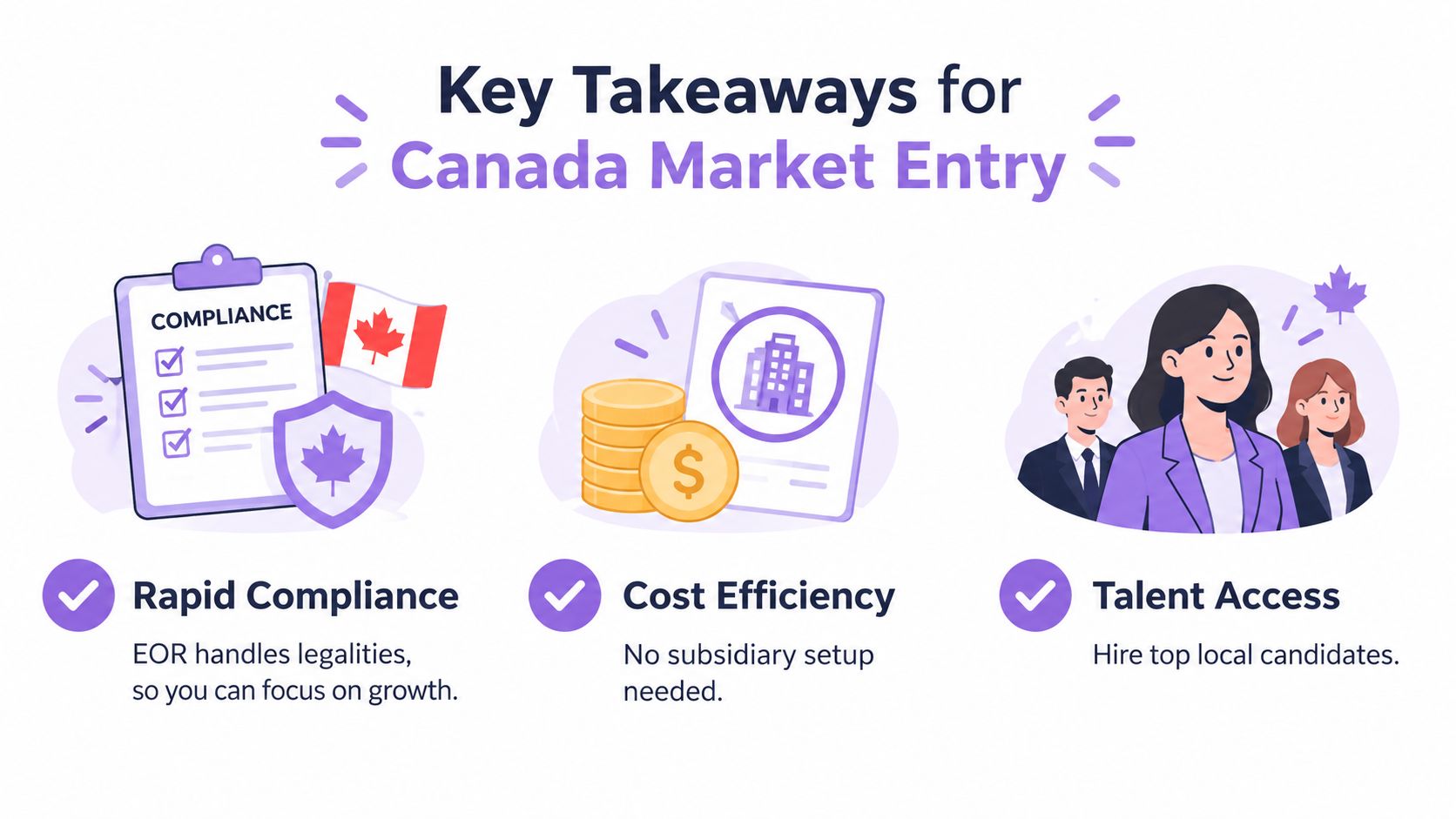
An employer of record in Canada is a practical entry structure for medical practices that need Canadian employees without immediately creating a subsidiary. The EOR handles the legal employment relationship, payroll administration, statutory deductions, and local records, while your practice manages daily work and performance.
It doesn't eliminate corporate tax nexus questions, and it doesn't guarantee that an employee classification or work arrangement is compliant because an EOR is involved. Treat the EOR as an employment administration partner, not as a substitute for tax planning or operational governance.
Before signing, ask the provider to show:
In practice, use an EOR for speed and local employment administration, review the structure as Canadian headcount becomes durable, and avoid using contractors for roles that operate like regular employees. For broader capacity, combine location-sensitive Canadian hires with carefully supervised nearshore healthcare support.
If you're planning to hire a Canadian remote healthcare worker, map the role, province, access requirements, fully loaded payroll cost, and expected duration before requesting EOR quotes. Then have your accountant or cross-border counsel review the arrangement and compare it with a subsidiary and a nearshore staffing model before you make the offer.
Start by documenting your first role and its province, then request an itemized EOR estimate and a separate tax-nexus review. That two-part assessment will show whether a Canadian hire, a subsidiary, or a supervised nearshore medical virtual assistant is the most practical next step for your practice.