

The most popular advice about payroll for remote employees is also some of the most dangerous: “Just pay the person, send the form, and sort out the rest later.” That works right up until the worker's home address creates a new tax obligation, the contractor looks suspiciously like an employee, or a supposedly remote hire creates corporate tax exposure in another country.
Remote work is now a normal payroll pattern, not an edge case. The U.S. Bureau of Labor Statistics began tracking telework questions in the Current Population Survey in October 2022. In March 2026, 22.6% of U.S. workers teleworked or worked at home for pay, with the rate holding between 21.5% and 23.0% during the prior year, according to the Bureau of Labor Statistics. That means your payroll system needs to know where work happens, not merely where your company is incorporated.
I've hired across continents, and I've learned the expensive way that payroll is a business decision. It affects hiring speed, cash planning, contracts, tax registration, employee trust, and sometimes your next funding round. The fix isn't panic. It's choosing the right model before the first payment.
Remote payroll is a tax and operating decision disguised as a payment task. Once someone works for your company from another jurisdiction, you must address employment classification, payroll withholding, social contributions, local filing duties, and corporate tax exposure before money changes hands.
Start with the worker's physical location. Payroll obligations usually follow where the employee performs the work, not where your headquarters sits. A hire in another U.S. state can create tax nexus, registration requirements, withholding accounts, unemployment insurance obligations, and separate filing calendars, as explained in this multistate payroll compliance analysis.
State withholding is only the first checkpoint. Your remote worker may also create permanent establishment risk in their country.
The issue is whether the person's home office, decision-making authority, fixed presence, or revenue-generating activity gives local tax authorities grounds to tax your company. That exposure can exist even when payroll withholding appears correct.
This matters across Latin America. A “contractor” in Colombia or Mexico may write code, but they may also negotiate local deals, represent the company, or perform core commercial work. Those activities can create corporate tax questions that a contractor agreement does not solve. Review this permanent establishment risk discussion for remote workers before approving the engagement. The outcome depends on local law and the actual facts, not the title on the contract.
Practical rule: If the worker can bind the business, close revenue, or make important decisions locally, include corporate tax review in onboarding.
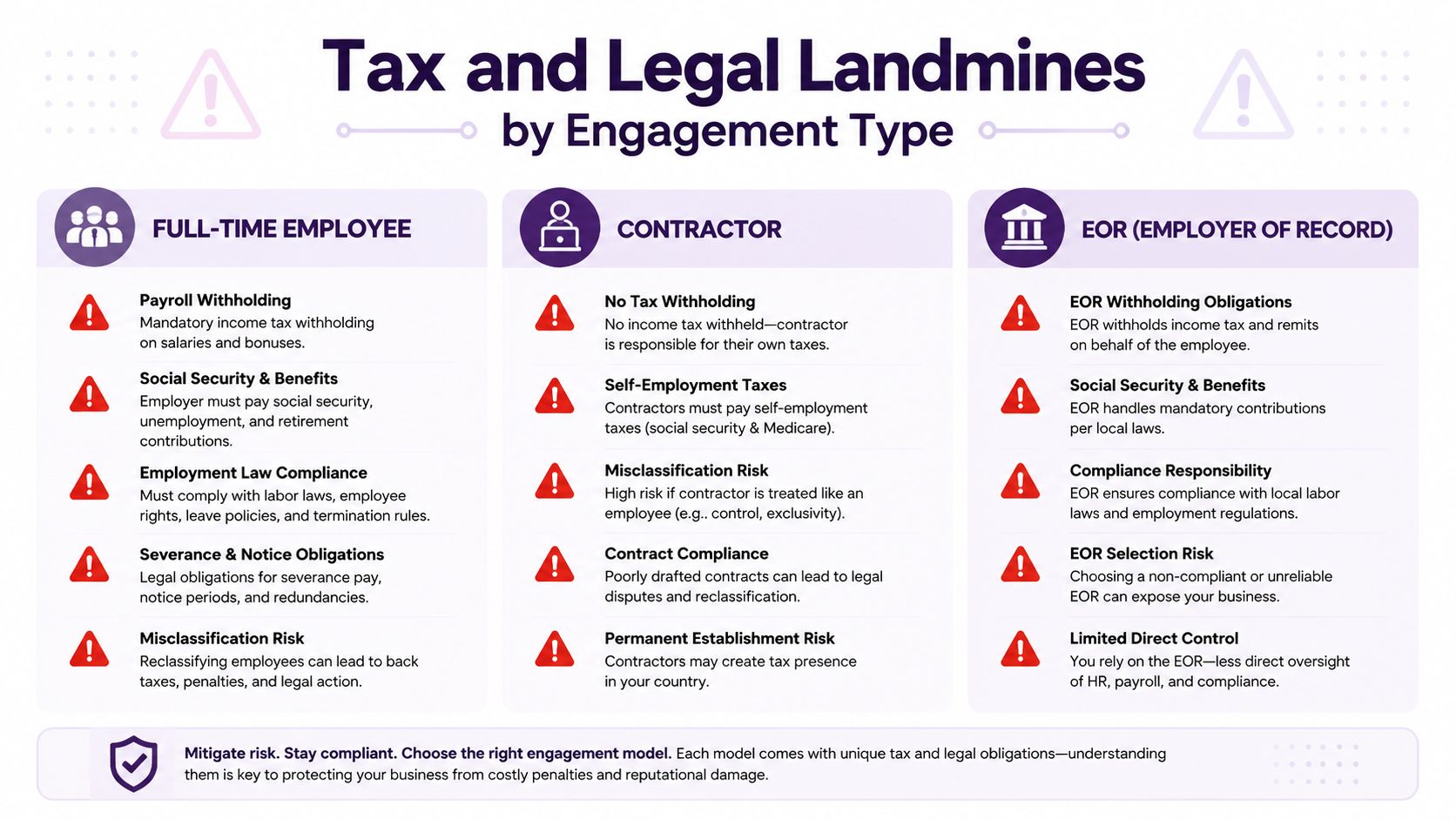
A contractor label does not override the working relationship. If you set the hours, control the process, provide equipment, and manage the person like staff, a labor authority may classify the worker as an employee regardless of the contract.
Currency creates a separate problem. The World Bank found that worker location explains almost one-third of wage variation, and that remote wages in local currency move almost one-for-one with the dollar exchange rate in the worker's country. Its international price of remote work study also documents a strong relationship between remote wages and GDP per capita in the worker's location.
Put the currency promise in writing. State whether compensation is a fixed local-currency amount or a fixed foreign-currency amount. Leave that unclear and every exchange-rate movement becomes a payroll dispute.
For founders comparing legal structures, this Employer of Record overview offers a useful starting point. An EOR can separate local employment administration from your operating company, but it does not erase every corporate tax question. Use it to organize the workflow, not to avoid reviewing the worker's authority, location, and commercial activities.
There are three practical ways to pay a distributed worker: establish your own local entity, use an Employer of Record, or engage a genuine independent contractor. None is universally superior. Anyone selling one model as the answer to every hiring problem is probably trying to improve their commission statement.
A local subsidiary gives you control over employment contracts, payroll, benefits, banking, and long-term workforce planning. It also gives you the bill for registration, accounting, local legal support, payroll administration, and ongoing filings.
This model makes sense when you're building a durable presence in one country, hiring repeatedly there, or need employment terms an EOR can't comfortably support. It's usually overkill for a single exploratory hire.
An EOR legally employs the worker in the country and handles local payroll, withholding, statutory contributions, and employment administration. You direct the person's daily work, while the EOR handles the local employer obligations.
The trade-off is cost and control. EOR pricing is commonly described in the market as a per-employee monthly fee, but you should demand a country-specific quote rather than rely on a generic sales page. Equity, unusual benefits, intellectual-property language, and custom termination terms may also require negotiation.
Contractors offer speed and administrative simplicity when the relationship is independent. They're a sensible option for defined projects, specialist work, or people who control how and when they deliver.
They're a poor choice for a full-time team member with fixed hours, ongoing duties, company equipment, and managerial supervision. In that situation, the cheaper model can become the most expensive one.
| Factor | Direct Entity | Employer of Record (EOR) | Contractor Payments |
|---|---|---|---|
| Control | Highest | High over daily work, lower over legal employment mechanics | Flexible, but must preserve independence |
| Setup speed | Slowest | Fast | Fastest |
| Compliance responsibility | Yours | Shared operationally, with the EOR managing local employment | Mostly yours to assess and monitor |
| Best fit | Sustained country presence | Employees in new or uncertain markets | Genuine project-based relationships |
| Main risk | Administrative overhead | Vendor quality and contract flexibility | Misclassification and permanent establishment |
| Scalability | Strong once established | Strong across multiple countries | Limited when worker relationships become employment-like |
At one hire, contractors may be efficient if the facts support it. At five, an EOR often buys valuable operating capacity. At twenty in one market, model the cost of a local entity instead of blindly renewing EOR contracts. The right answer depends on hiring velocity, market permanence, and how much compliance work your team can absorb.
For teams that need outside operational support, compare the scope carefully in payroll outsourcing services. Ask who files, who funds payroll taxes, who owns errors, and what happens when a worker changes location.
The legal label on the contract is only one piece of evidence. Authorities look at the relationship itself, including control, dependency, working hours, supervision, equipment, exclusivity, and the worker's economic reality.
An employee arrangement is administratively heavier, but it's usually the cleanest structure when the person works continuously inside the business. You'll need to manage withholding, employer social contributions, statutory benefits, employment records, leave rules, and local termination requirements.
Country details matter. Brazil may require a 13th salary, while Mexico has the aguinaldo obligation. Those aren't decorative benefits you can remove because the employee works from a kitchen table. Local labor law follows the employment relationship.
Contractor status works when the person operates an independent business and delivers agreed outcomes without being managed like staff. It gets risky when the company controls the worker's schedule, tools, priorities, and daily method.
For U.S. relationships, review the applicable IRS classification factors rather than treating a 1099 as a magic spell. In Latin America, courts may apply a presumption often described as laboralidad, meaning the facts can point toward employee status even when the agreement says “services.”
For U.S. workers who believe they were treated as independent contractors incorrectly, Form 8919 explained provides useful context on uncollected Social Security and Medicare taxes.
Part-time, fixed-term, and project-based contracts aren't automatically safer. A fixed-term worker who renews continuously, follows company hours, reports to a manager, and performs a core function may still resemble an employee.
Permanent establishment deserves its own review. A contractor who negotiates local commercial agreements can create a different type of exposure from a developer who works under tightly defined project terms. The two people may receive the same payment method, but the corporate tax implications can be worlds apart.
Treat Brazil, Mexico, and Colombia as markets requiring serious classification discipline. Don't assume Argentina is simple either. Local rules, enforcement posture, currency controls, and labor-court practice can change the practical risk.
Tax treaties can reduce double taxation, but they don't necessarily remove payroll mechanics. A cross-border worker may still require local registration or a shadow payroll, even where treaty relief prevents the same income from being taxed twice. That distinction is documented in EY's cross-border remote-working guidance.
If you're deciding between models, use a formal contractor classification review before signing. A short review is cheaper than reconstructing years of employment records after an audit.
Run setup in this order. Skipping ahead creates the kind of administrative spaghetti that makes founders consider becoming employees themselves.
Decide whether the worker will be an employee through your entity, an employee through an EOR, or a genuine contractor. Write down why the classification fits the facts, where the worker will perform services, and whether their role could create permanent establishment exposure.
Don't let the candidate's preferred payment app make the legal decision. That's like choosing your company's incorporation state based on which airport has better coffee.
For a U.S. employee, collect the applicable federal and state withholding forms, such as Form W-4 and any required state form. For a U.S. contractor, collect Form W-9. For an international contractor, obtain the appropriate foreign-status documentation, such as Form W-8BEN, and confirm whether local rules require additional forms.
Register with the relevant tax and unemployment authorities before the first pay run. Employers may also need workers' compensation coverage and local registrations. Location-driven tax logic for remote payroll explains why the system should store both home address and actual work location.
Decide whether compensation is denominated in local currency or another currency. State the currency, conversion reference, conversion date, payment method, fees, and responsibility for intermediary-bank charges in the agreement.
Use business-controlled payment accounts. Don't run recurring payroll through a personal Wise account because the setup feels convenient. The fix is straightforward: open an account owned by the company, document approval controls, and reconcile every payment to the payroll register.
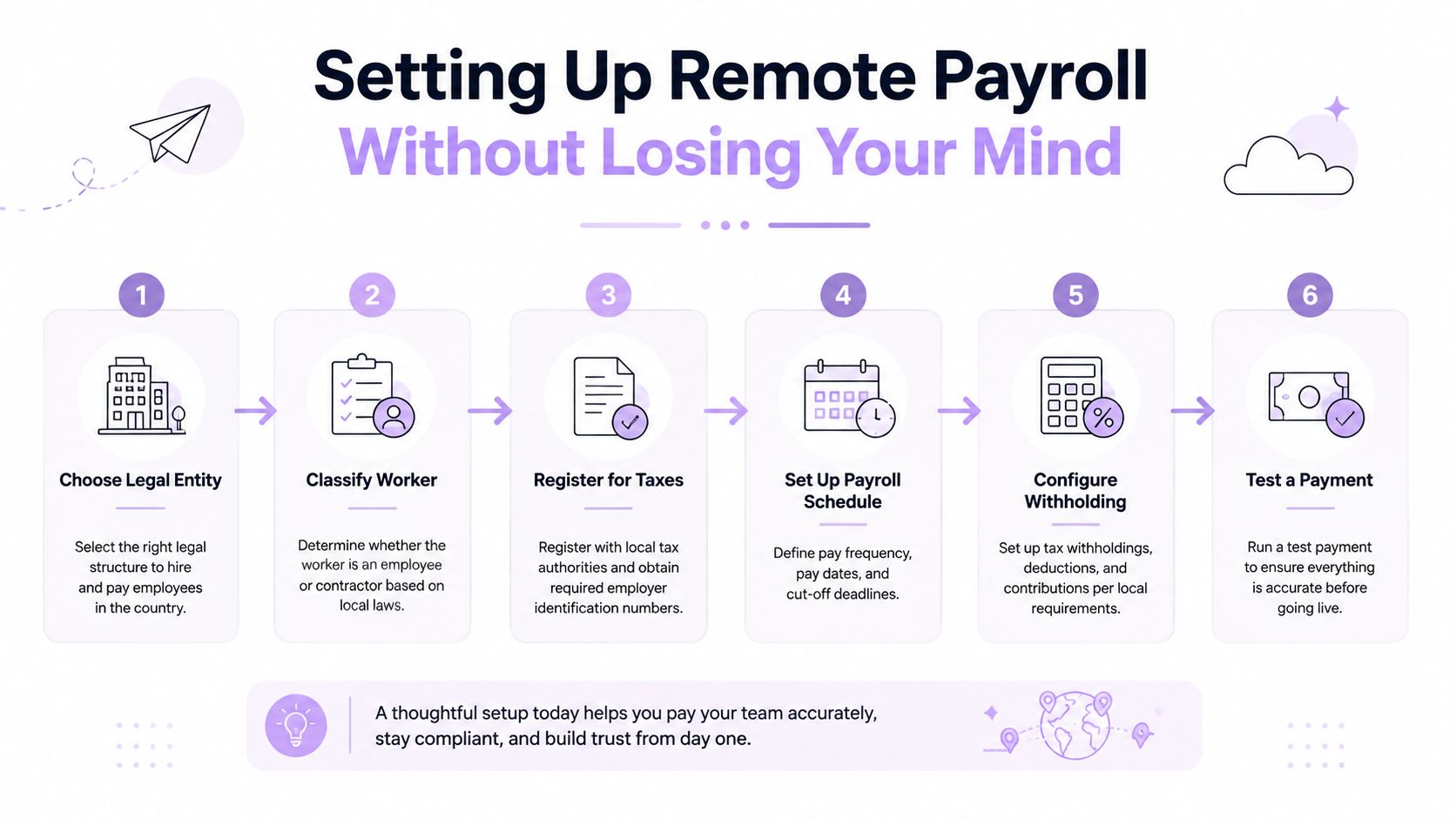
Record pay dates, tax deposits, unemployment filings, benefits deadlines, contractor reporting, exchange-rate checks, and document renewals. Assign an owner for each task and a backup. “Finance handles it” isn't ownership. It's a future blame meeting.
Before the first payment, test the calculation, approval workflow, bank details, payslip, withholding, and accounting entry. While reviewing operational resilience, founders may also want to consider business owner life insurance via Coveredly, especially when payroll depends heavily on one operator.
Spreadsheets work for budgets. They become fragile when used as a global payroll engine.
Manual payroll creates more opportunities for calculation mistakes, missed deadlines, inconsistent approvals, and weak records. Automated platforms reduce repetitive work by applying rules consistently, preserving an audit trail, and making exceptions easier to review. They do not remove risk. Incorrect worker location, residency, or engagement data can still produce incorrect filings and may contribute to permanent establishment or corporate tax exposure. As the 2026 payroll compliance analysis indicates, remote-worker payroll needs tax review beyond calculating net pay.
For LATAM hiring, test the countries and worker types you use. “Global coverage” means little until the provider demonstrates the relevant local workflow, payment rail, and compliance responsibilities.
Ask the provider to run a realistic scenario, including a worker who changes location or classification. Then verify:
I prefer providers that show exception handling, not just a polished demo. Ask them to process a worker who moved countries halfway through the month, changed status, or submitted a late expense. Clean payroll runs are easy to present. The difficult cases reveal whether the provider can protect your records, meet filing obligations, and flag risks before they become expensive.
A strong LATAM hiring workflow starts before the job post. First define the role, reporting line, working relationship, expected schedule, payment currency, and countries you're willing to support. Then screen candidates for both skills and engagement fit.
A developer in Brazil, a sales professional in Mexico, and an engineer in Colombia may all work remotely, but their labor rules, benefits, tax registrations, and practical payment requirements won't be identical. Argentina adds its own employment and currency considerations. Treat “Latin America” as a region for sourcing, not as one payroll jurisdiction.
The process should look like this:
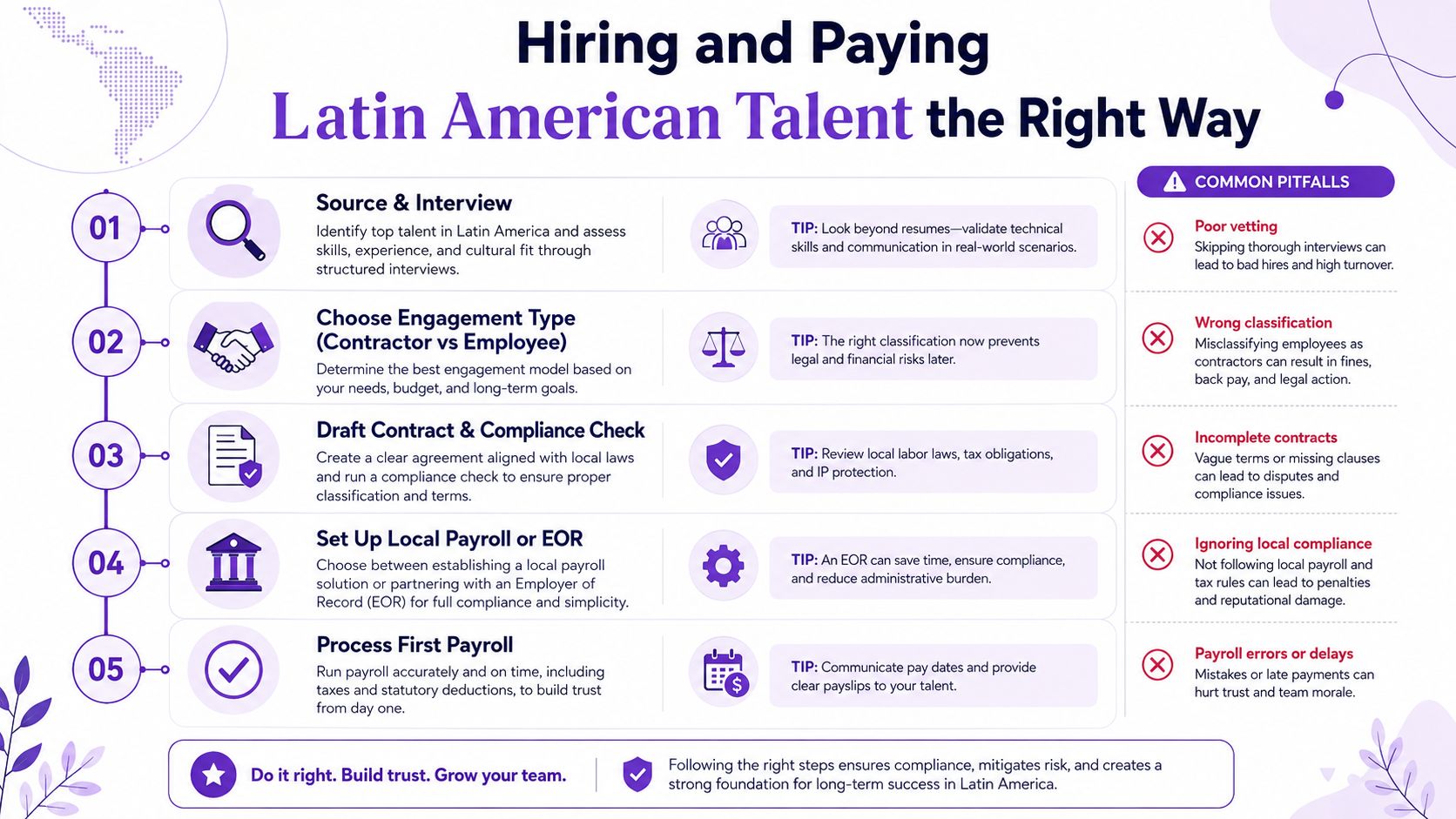
LatHire can sit inside this workflow as one option for companies hiring Latin American professionals. Its stated service covers candidate matching, compliance screening, contract generation, international payroll, benefits, and legal support in a connected process. The useful question isn't whether a platform sounds smooth. Ask whether it supports the exact country, worker classification, payment method, and documentation your hire requires.
Use contractors for independent work with clear deliverables. Use an EOR when you need an employee quickly in a market where you don't have an entity or don't yet understand the local administration. Establish an entity when the country has become a durable hiring market and your headcount justifies owning the infrastructure.
Currency volatility also belongs in the operating plan. Decide whether the worker carries exchange-rate risk or the company does, and document the answer before compensation negotiations become a monthly economics seminar.
Use four variables: headcount, geography, engagement type, and risk tolerance.
Before issuing the first payment, confirm these essentials:
Payroll infrastructure is a competitive advantage because it lets you hire where talent exists without turning every new country into an emergency. Get it right early, and competitors relying on “just wire the money” won't be competing with you for long.
Before you make another remote hire, create a location and classification register for every worker, then have a qualified payroll or tax adviser review the highest-risk roles. If you're hiring in Latin America, request a country-specific workflow that covers contract structure, payroll execution, and EOR or contractor suitability before you send an offer.