
Most diversity and inclusion advice starts in the wrong place. It tells you to hire more underrepresented people, publish a polished statement, run unconscious bias training, and wait for culture to do the rest. That's like buying a gym membership and expecting your knees to get stronger through brand association.
Remote teams expose the flaw quickly. A person can be recruited from a broader talent pool and still be excluded by meeting times, unclear promotion rules, English-native communication habits, invisible sponsorship networks, or managers who reward online presence over outcomes. Representation gets someone through the door. Operating systems determine whether they can build a career once inside.
The practical question isn't whether your company has a diversity initiative. It's whether your calendar, documentation, hiring workflow, benefits, feedback loops, and leadership reviews make participation fair across countries and cultures.
The most popular assumption is simple: hire diverse talent and inclusion will follow. It won't.
A new hire enters the system you already built. If that system favors people who speak first in live meetings, work the headquarters time zone, understand unspoken cultural references, or know how to lobby a manager informally, recruitment only creates a revolving door. You may improve the demographic profile while preserving the same daily experience.
That gap matters because diversity and inclusion aren't synonyms. Diversity concerns who gets access and representation. Inclusion concerns who gets heard, trusted, promoted, and given meaningful work. Equity asks whether the rules and resources produce fair opportunity across different circumstances.
The blunt test: If a new hire has to imitate the dominant culture to succeed, your company has diversity on paper and conformity in practice.
Distributed work removes many informal signals that office-based employees take for granted. A colleague in Bogotá may miss the meeting where an important decision gets shaped because it happens in a North American afternoon. A team member in São Paulo may write excellent technical updates but get judged as less capable because their spoken English is less fluid. Someone working across a different cultural communication style may appear “quiet” when they are being deliberate.
Managers often treat these outcomes as individual performance issues. That's lazy management. The key questions are operational:
A company can't answer those questions with a recruiting dashboard. It needs a management system that makes exclusion observable.
The legal history of workplace inclusion reinforces this point. Title VII of the U.S. Civil Rights Act of 1964 banned employment discrimination based on race, color, religion, sex, or national origin, creating a legal anchor for modern workplace inclusion policies. Executive Order 11246 followed in 1965, requiring federal contractors to take affirmative action to ensure equal opportunity. Comparable developments appeared through the Treaty of Rome, the UN Convention on the Elimination of All Forms of Racial Discrimination, and the European Union's Treaty of Amsterdam, which expanded protections across additional characteristics, as documented in this historical overview of workplace diversity and inclusion.
Start by auditing how work gets assigned, evaluated, and recognized. If high-profile projects are distributed through private conversations, remote employees lose before the work begins. If performance reviews rely on “executive presence,” managers can smuggle cultural preference into a supposedly objective process.
A useful guide to cultural diversity in the workplace can help teams identify cultural differences, but awareness is only the starting point. Your managers still need explicit meeting norms, written criteria, rotating schedules, transparent project allocation, and feedback channels that don't depend on hallway access.
D&I fails when leaders measure hiring as the input and culture as a vague hope. Inclusion improves when leaders treat every recurring point of friction as a design problem.
The business case for D&I is real, but representation alone does not create profit. Diverse leadership can improve decisions when managers build conditions for disagreement, information sharing, and accountability. In distributed teams, those conditions must be designed into meetings, documentation, promotion processes, and decision rights. A headcount chart cannot show whether remote employees can influence the work.
The strongest commonly cited evidence links leadership diversity with financial performance. Organizations in the top quartile for gender diversity on executive teams were reported as 39% more likely to outperform peers on profitability, while those in the top quartile for ethnic diversity showed a 27% financial advantage, according to McKinsey's analysis of diversity and comprehensive impact. The executive-level focus matters because strategic and operational decisions concentrate there. A diverse entry-level workforce cannot shape decisions it is never invited to make.
The evidence worth keeping in view:
| Study / Source | Key Finding | Metric |
|---|---|---|
| McKinsey | Top-quartile executive gender diversity was associated with a greater likelihood of outperformance | 39% more likely |
| McKinsey | Top-quartile executive ethnic diversity showed a financial advantage | 27% |
| SHRM summary | Global diversity and inclusion progress remains incomplete, even in stronger regions | 52 out of 100 overall, 70 out of 100 best regional score |
| Global company representation data | Women's representation is higher on boards than in executive roles | 28.9% of board seats, 21.1% of executive roles in 2025 |
The SHRM figures should stop leaders from declaring victory. The world's overall diversity and inclusion score was reported at 52 out of 100, while the strongest regional score reached only 70 out of 100, according to this SHRM diversity and inclusion summary. Progress exists, yet a better score does not prove that employees experience fair access, voice, or advancement.
Representation is a lagging indicator. It shows who joined, not who can influence outcomes. A company can report more women on boards while women still hold a smaller share of executive roles. In 2025, women held 28.9% of board seats but 21.1% of executive roles among the world's 500 largest companies, a gap that points to weaknesses in advancement and leadership pipelines.
Track the operating signals behind the headline numbers:
Remote culture is built through repeatable routines, so practical guidance on company culture in remote teams can help managers examine how those routines operate across locations. Teams designing fairer work practices should also consult this neurodiversity 2026 resource when considering different cognitive styles and workplace needs.
Put retention gaps, promotion patterns, decision access, and employee experience beside the representation chart. That operating view shows whether inclusion is changing daily work or merely improving the presentation to the board.
A workable framework needs three separate lenses.
Diversity asks who is represented. Inclusion asks who participates and influences decisions. Equity asks whether the system removes structural disadvantages instead of giving everyone identical treatment and calling the result fair.
Remote teams need metrics attached to each lens. Otherwise, leaders collect demographic data, schedule a training session, and declare victory before lunch.
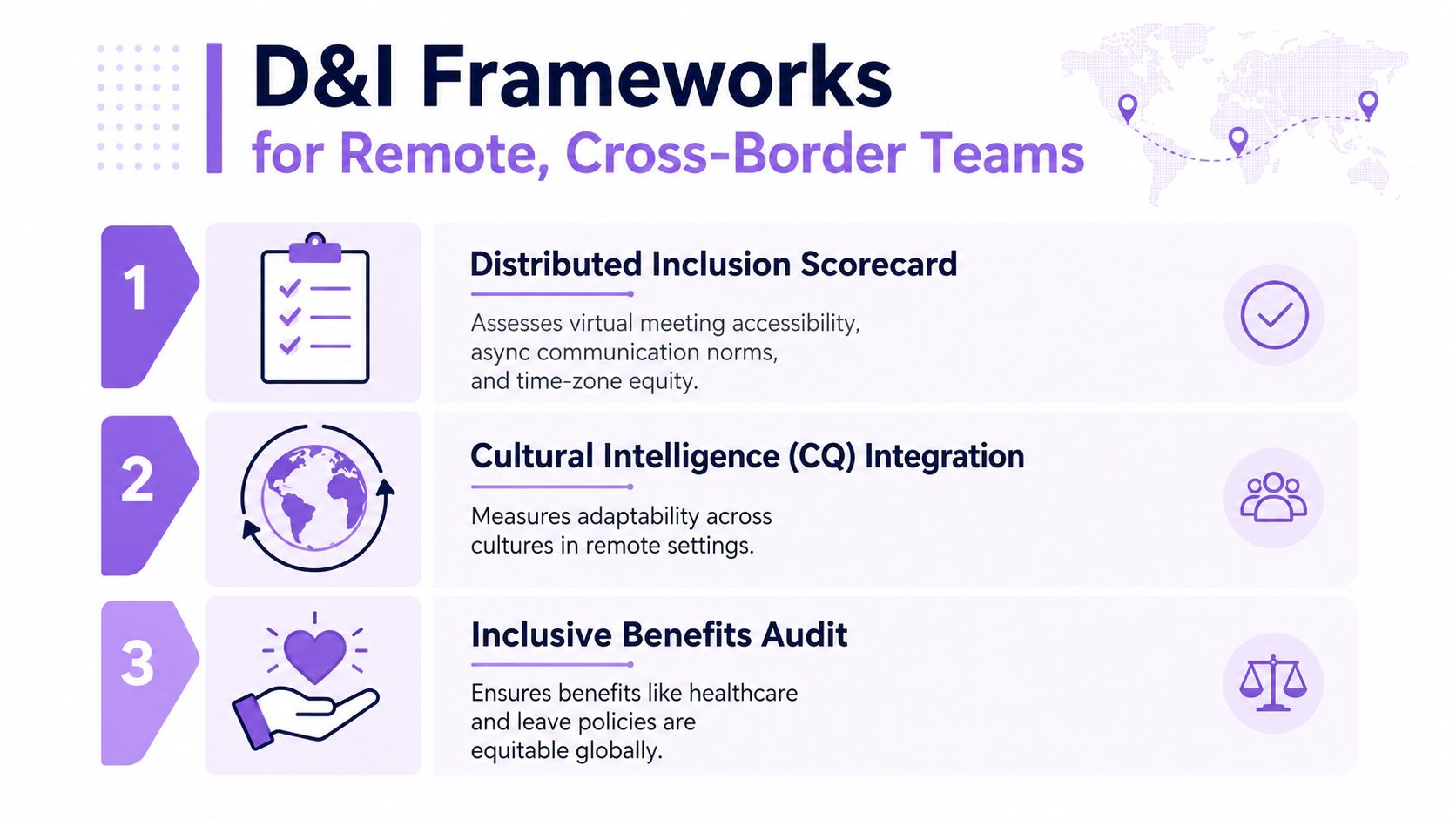
Start with a monthly or quarterly scorecard. Keep it small enough that managers use it.
A good scorecard creates a management conversation. A bad one creates a spreadsheet nobody opens after the annual review.
Total diverse hires can rise while diverse employees leave quickly. Training completion can reach its target while managers continue to interrupt, overlook, or under-sponsor the same people. Treat those figures as activity measures, not proof of inclusion.
Track whether managers change decisions:
Teams that want a stronger analytical layer can explore talent analytics for workforce decisions. The tool matters less than the discipline. If leaders won't review the data and change staffing, promotion, or manager behavior, analytics is just expensive wallpaper.
Hiring bias rarely arrives wearing a villain costume. It shows up as “polish,” “culture fit,” “strong communication,” or “someone I'd want on a difficult project.” Those phrases sound practical because they're vague enough to protect the decision-maker.
A better workflow removes discretion where it creates noise and preserves it where judgment is necessary.
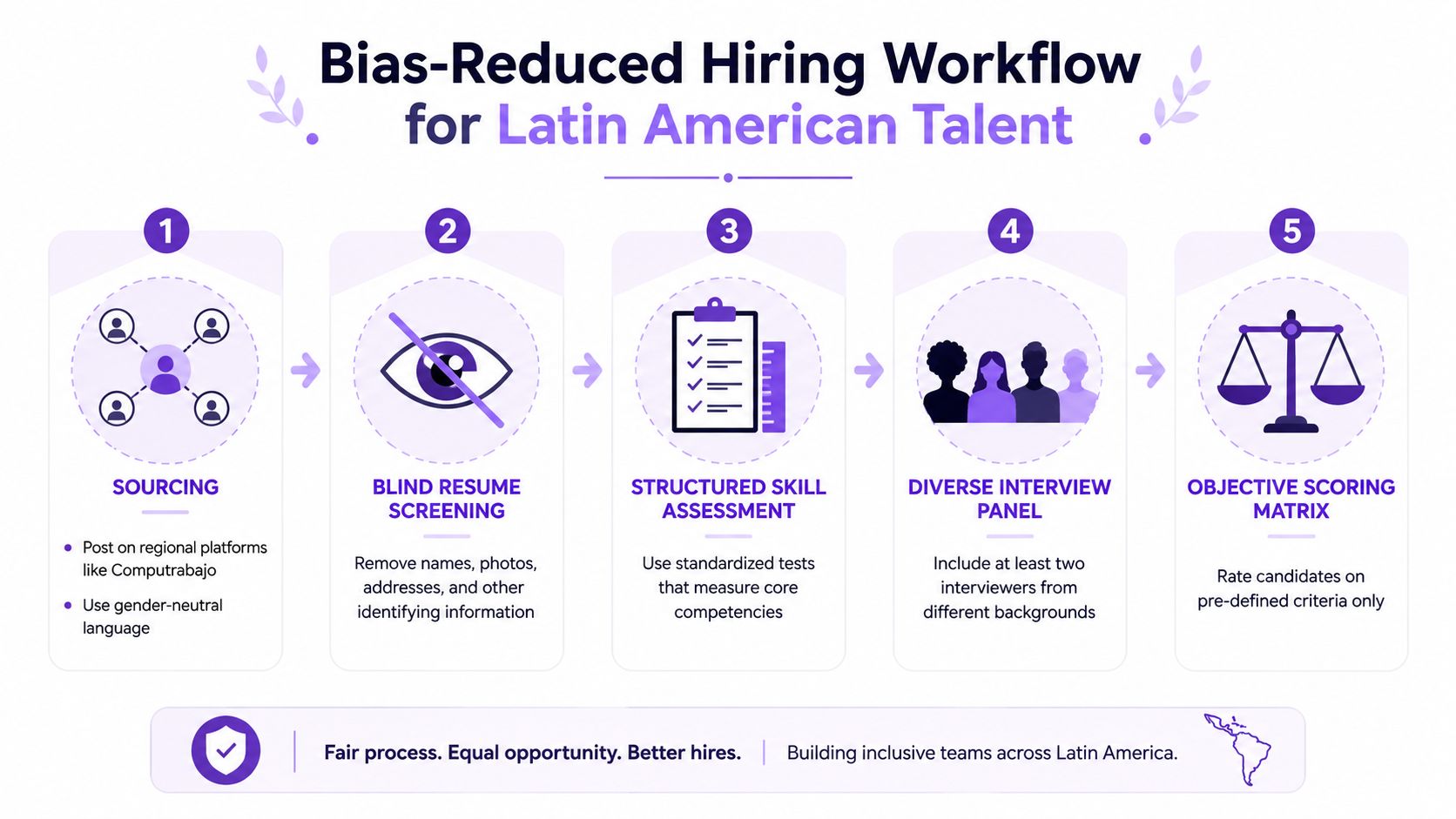
For Latin American talent, don't rely on the same LinkedIn searches and referrals that reproduce your existing network. Use regional job boards such as Computrabajo, professional communities, university networks, local technology groups, and specialist communities relevant to the role.
Write the job description around outcomes and core capabilities. Avoid inflated requirements that screen for confidence, access to elite institutions, or native-level English when the job only requires clear written collaboration.
Before: “We need a native English speaker who thrives in a fast-paced culture and has a top-tier university background.”
After: “You'll document technical decisions, collaborate across time zones, and explain complex work clearly in writing and conversation. We'll assess these skills directly.”
That change is not cosmetic. It tells candidates what success looks like and gives the hiring team something concrete to evaluate.
Use a standardized work sample tied to the actual job. For an engineer, that may involve reviewing a small codebase or explaining tradeoffs. For a marketer, it could be a brief campaign analysis. For an operations hire, it might be a written process redesign.
Blind resume review can remove names, photos, addresses, and other signals that invite snap judgments. Keep the information necessary to evaluate relevant experience, but don't pretend a blind screen fixes the whole process. A biased work sample or an interviewer's “gut feel” can reintroduce the same problem later.
Build an interview panel with different backgrounds and give each interviewer a defined competency. Assess communication for clarity, listening, and reasoning, not accent or conversational similarity. If a candidate's English is adequate for the role, stop using fluency as a proxy for intelligence.
Support resources can matter too. Employers that want to understand identity-related barriers should review responsible material such as sexual identity counselling from THERAPSY, while keeping hiring decisions focused on job-relevant evidence.
Ask:
LatHire is one option for companies that want access to pre-vetted Latin American professionals, skills evaluations, background checks, and cross-border HR, payroll, benefits, and compliance support. It doesn't replace a fair hiring design. It can, however, reduce administrative friction when the workflow is already disciplined.
Inclusion is visible in boring moments. A manager sends the agenda early. Someone in a different time zone gets a real chance to comment. The decision lands in a shared document instead of disappearing into a private chat. Nobody applauds, because this is what competent operations looks like.
Onboarding creates the first test. A remote employee shouldn't have to decode U.S.-centric holidays, idioms, meeting etiquette, or unwritten expectations through trial and error. Give them a written first-month plan, a glossary for internal language, clear ownership for introductions, and multiple ways to ask questions without performing confidence in public.
Communication architecture matters just as much. Use synchronous meetings for decisions, conflict resolution, and work that benefits from live exchange. Use asynchronous documents for context, proposals, updates, and questions that deserve considered responses. Rotate meeting times when live attendance is necessary, and record or document outcomes for anyone who can't attend.
Practical rule: If an important decision exists only in a meeting, it isn't available to a distributed team.
A manager also needs to replace the body-language shortcuts of an office. Ask for written reactions, run anonymous pulse checks, create private feedback routes, and schedule regular one-to-ones that aren't reserved for people who raise their hands. Watch for isolation through changes in participation, delayed responses, missed context, and declining ownership. Don't wait for resignation data to tell you someone disappeared months earlier.
| Scenario | Exclusionary Default | Inclusive Alternative |
|---|---|---|
| Onboarding | New hire learns norms by observing local colleagues | Written onboarding plan, regional context, named support contacts |
| Team meeting | Headquarters time zone controls attendance | Rotating times, async input, documented decisions |
| Performance review | Manager rewards visibility and verbal confidence | Outcome-based rubric with evidence from multiple channels |
| Career growth | Promotion depends on informal proximity to leaders | Published criteria, sponsorship, and access to strategic work |
| Feedback | Employee must raise concerns publicly | Private, anonymous, and manager-led feedback options |
Career pathing deserves special attention for remote Latin American team members who can't “walk the halls.” Publish the skills and outcomes required for advancement. Give managers responsibility for sponsorship, not just mentorship. A mentor offers advice. A sponsor uses their influence to put someone forward for important work.
Teams that treat inclusion as a Slack emoji reaction create pleasant moments. Teams that build it into calendars, documents, review rubrics, and promotion decisions create durable access.
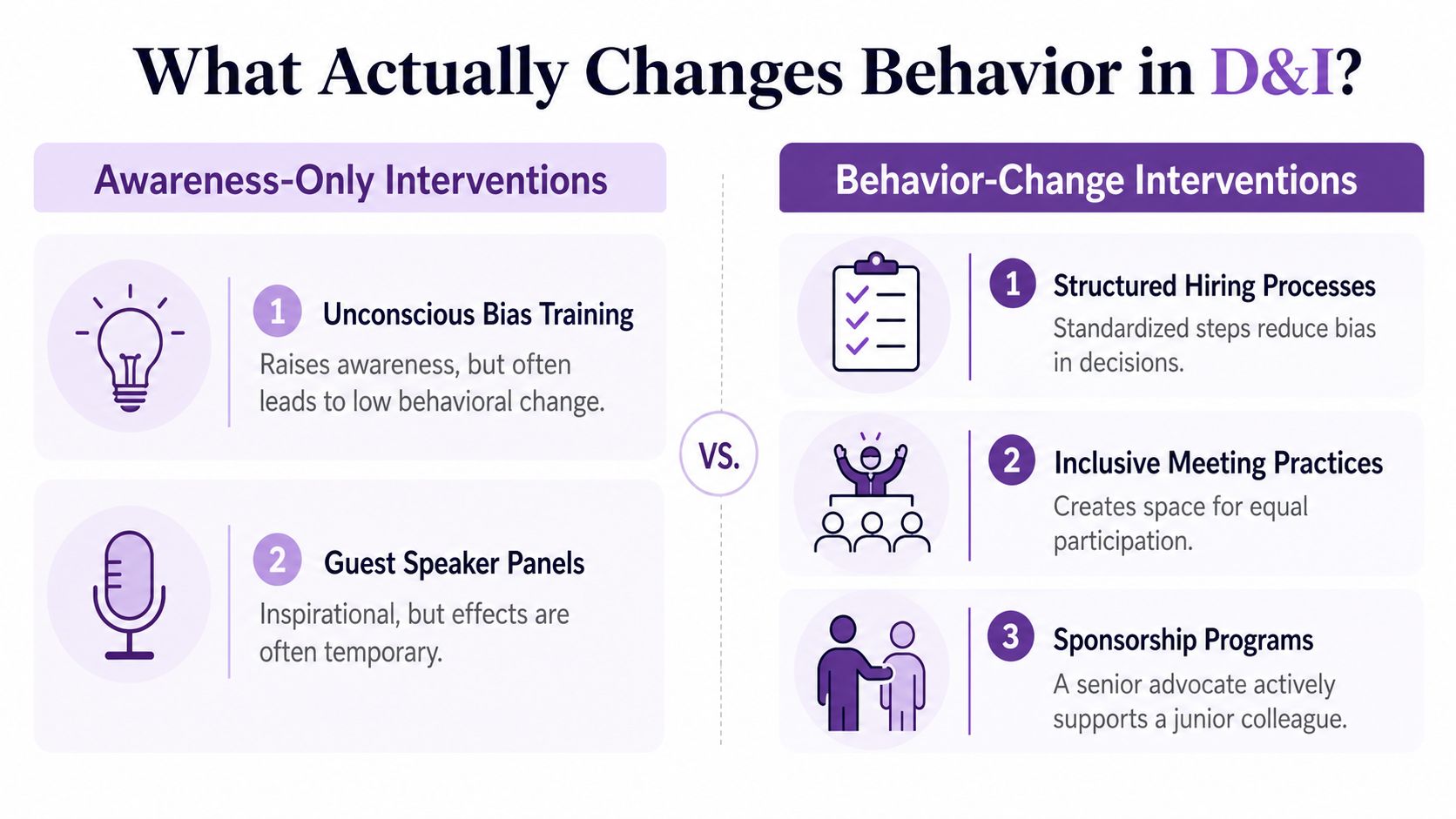
Awareness is useful. It's also easy to confuse with progress.
A systematic meta-review of 37 reviews across 13 years mapped 12 categories of diversity and inclusion interventions to 22 outcomes, finding that accommodations and job training produced positive outcomes for age and disability diversity. It also found that diversity training had comparatively stronger evidence, but mainly improved awareness and learning rather than behavior or performance, as summarized in this systematic meta-review of organizational diversity and inclusion interventions.
That distinction should change your budget.
| Intervention | Likely value | Operator's verdict |
|---|---|---|
| Unconscious bias training | Raises awareness and gives teams shared language | Keep it, but never treat completion as an outcome |
| Structured hiring | Constrains inconsistent judgment at the decision point | Fund it and audit results |
| Blind evaluation | Removes some irrelevant identity signals | Use where it preserves job-relevant evidence |
| Cross-group mentoring | Builds relationships across organizational boundaries | Tie it to career goals and access |
| Sponsorship | Gives underrepresented employees senior advocacy | Make senior leaders accountable |
| Employee resource groups | Creates community and insight | Give them budget, access, and a route to decisions |
| Diversity councils | Coordinates priorities | Require owners, deadlines, and published follow-through |
| Self-managed teams | Distributes authority and reduces dependence on one gatekeeper | Test where roles and decision rights are clear |
The meta-review supports a structural conclusion: training works best when paired with changes to the work itself. A manager who learns about bias but still uses an unstructured interview has good intentions and the same old mechanism.
Mandatory programs can also trigger defensiveness when leaders experience them as accusation rather than operational improvement. Diversity statements without ownership signal that executives know the approved vocabulary. Metrics without consequences turn reporting into theater.
Use a simple decision rule. Before funding an intervention, name the behavior it should change, the system where that behavior occurs, the metric that will reveal movement, and the leader responsible for acting on the result. If you can't answer those questions, you're buying optics.
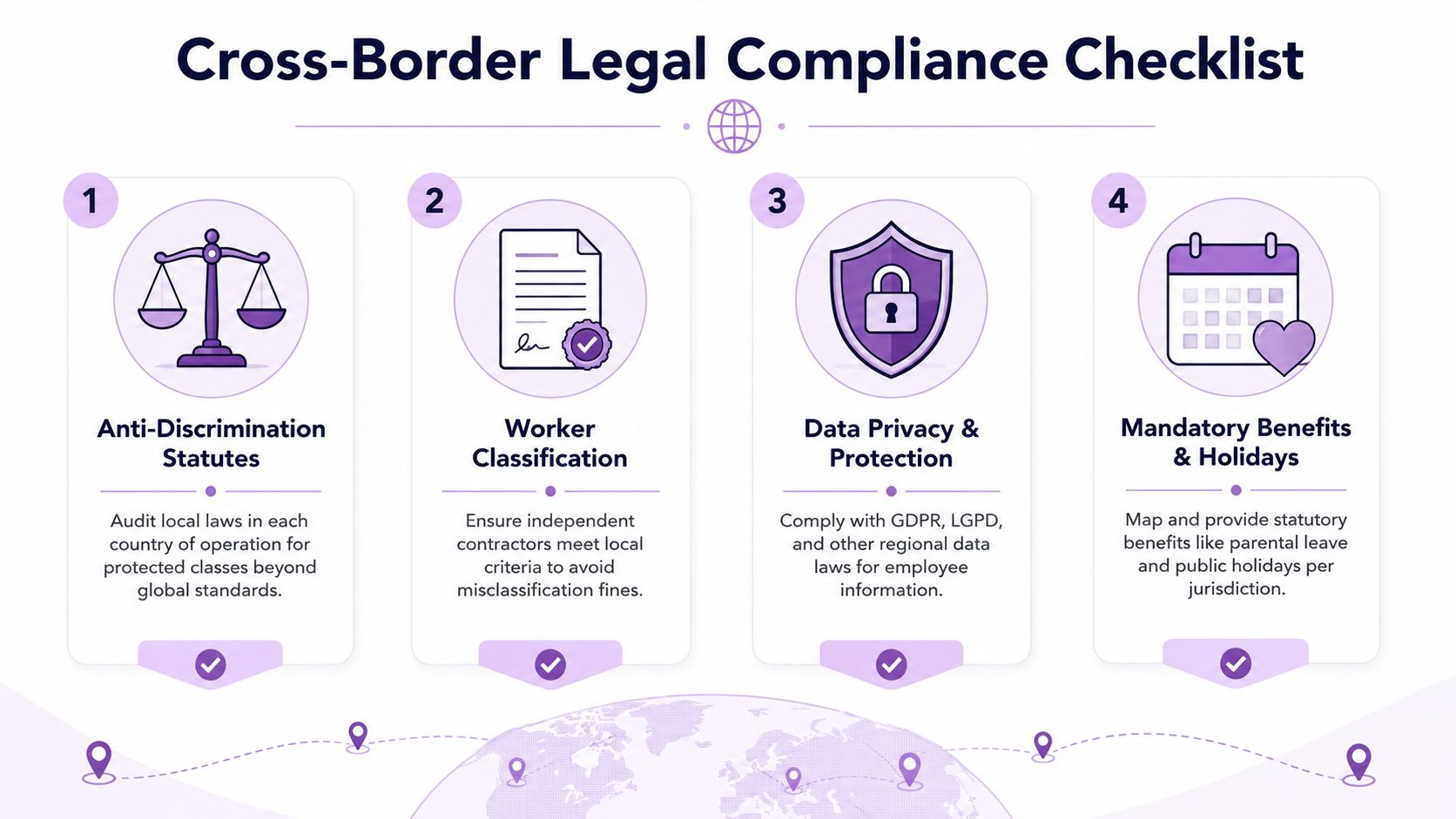
Cross-border inclusion isn't only a culture project. It's an employment, privacy, benefits, and classification project with human consequences.
The legal foundation developed over time. U.S. Title VII created protections against discrimination based on race, color, religion, sex, and national origin, while later policy developments expanded the conversation across jurisdictions and protected characteristics. The global lesson is practical: you can't export one country's employment assumptions and call the result compliant inclusion.
Remote hiring across Latin America requires local review. Brazil's data protection framework, known as LGPD, affects employee information. Mexico and Colombia have their own labor and anti-discrimination requirements. Benefits, leave, holidays, accommodations, payroll, and worker classification can differ substantially by jurisdiction. Get local legal advice before treating a contractor template as a global operating model.
The employer-of-record versus contractor choice affects more than tax administration. A contractor who works like an employee but receives none of the protections, benefits, or accommodations available to employees may reasonably see the arrangement as second-class treatment. Misclassification also creates legal and financial exposure.
Use a country-by-country checklist:
Data quality deserves particular care. A 2025-26 UK government-style workforce report found roughly 30–31% of disability data was blank or unknown, while another report showed 91.5% of sexual orientation reporting was blank or unknown and only 7.9% was known, according to the UK government equality, diversity and inclusion annual report. Missing data doesn't prove an organization lacks inclusion, but it does limit what leaders can responsibly conclude.
A credible program explains the purpose of collection, protects confidentiality, and never pressures employees to disclose. Legal compliance is the floor. Trust is what gets people to step onto it.
The next move is straightforward. Audit your hiring funnel, promotion rules, meeting calendar, data practices, and cross-border contracts this quarter. Then assign an executive owner to every gap, publish the operating changes to your team, and review whether employees experience greater access, safety, and influence. That's how diversity and inclusion stops being a statement and becomes the way your company runs.