

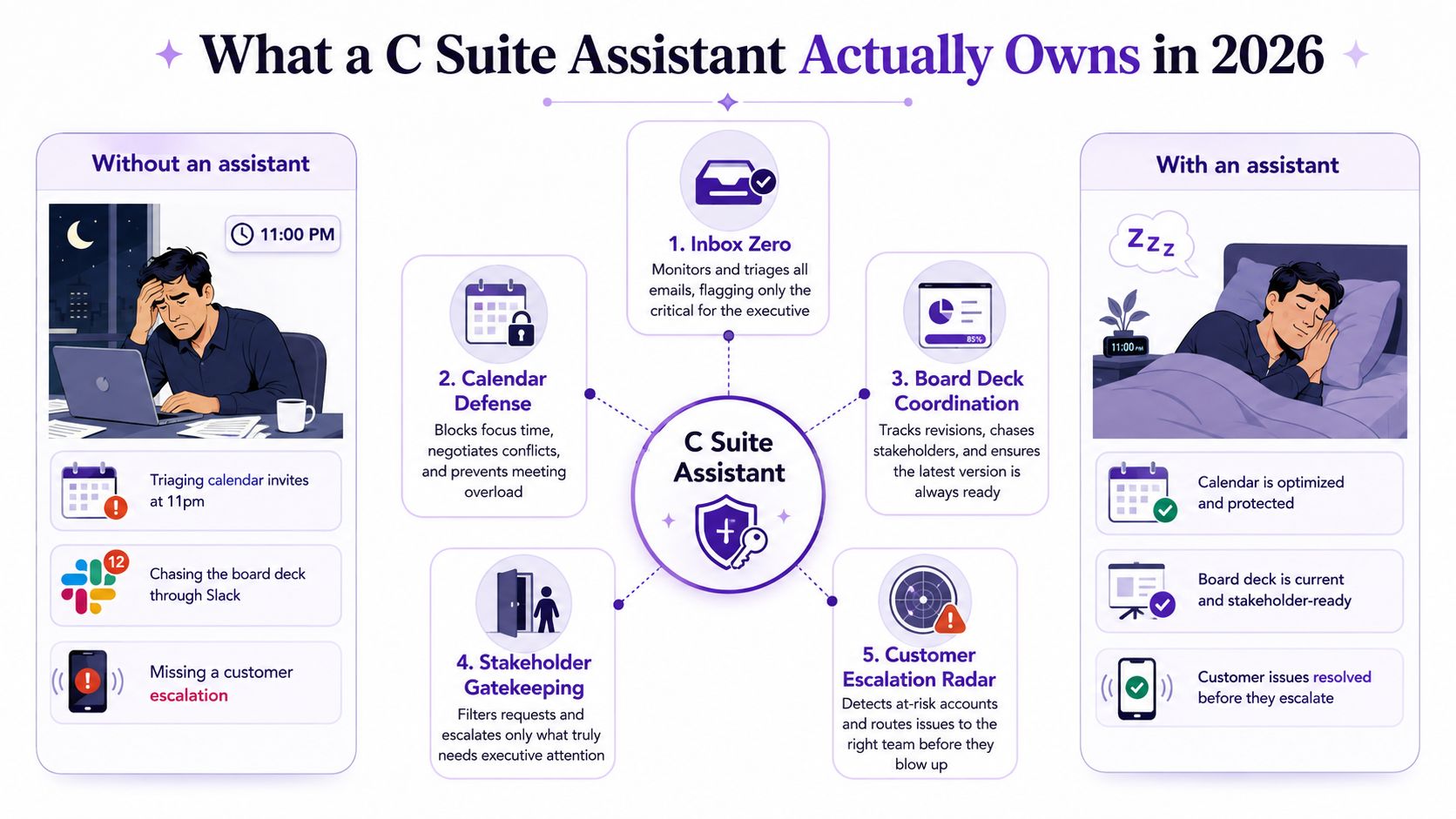
It's 11 p.m. You're triaging calendar invites, chasing a board deck through Slack, and wondering why a customer escalation sat unread while you were negotiating tomorrow's investor dinner. Your inbox has become a second job, your calendar has become a game of Tetris, and the business is paying an executive salary for clerical work.
That's the reason C-suite assistants matter. The right hire doesn't just make appointments. They protect executive attention, create operating rhythm, and stop small coordination failures from reaching the CEO's desk. The wrong hire adds another person to manage, which is a particularly expensive way to buy more notifications.
A modern C-suite assistant owns the executive's operating surface. That starts with calendar and time architecture, not calendar decoration. They decide which meetings deserve access to the executive, protect focus blocks, negotiate conflicts, build preparation time around important conversations, and prevent every internal request from becoming a meeting.
The second zone is inbox and stakeholder triage. A capable EA sorts messages by urgency, drafts replies, routes routine requests, tracks unanswered commitments, and escalates only what needs executive judgment. They're also the human firewall between a senior leader and the company's endless stream of “quick questions.”
Travel and logistics form the third zone. The EA coordinates flights, hotels, ground transport, visas, meeting locations, dinner constraints, changes, and contingency plans. Travel planning is operational risk management with nicer restaurants. For complex executive trips, Haute Black's 2026 travel guide is a useful reference for the level of detail a polished itinerary may require.
The fourth zone is project and operations support. That can include board preparation, investor-update coordination, vendor management, light research, meeting briefs, follow-up tracking, and making sure the latest document is the latest document. The EA doesn't own company strategy, hiring decisions, or product opinions. They own the machinery that lets the executive make those decisions without hunting through six Slack threads.
Day to day, expect the EA to operate across Google Workspace, Notion, Slack, Calendly, TripActions or Navan, Linear or Asana, and increasingly, AI copilots. The tools matter less than the operating judgment behind them. A person can know every keyboard shortcut in Google Calendar and still fail if they can't distinguish a board request from a low-value internal sync.
The productivity benchmark is concrete. Executives with full executive-assistant support reclaim an average of 12.4 hours per week for strategic work, rising to 15.7 hours per week after more than 12 months with the same assistant, according to Stealth Agents' executive assistant productivity benchmark. The same benchmark reports that 67% of executives spend more than 10 hours per week on tasks a skilled assistant could handle.
Practical rule: A great EA should give the executive back 15 or more hours a week of focus time. Track the reclaimed hours, meeting load, response time, and unresolved follow-ups. If you can't measure the relief, you're managing vibes.
The hiring mistake I see most often is asking one person to be an EA, Chief of Staff, operations lead, and occasional therapist, then offering EA compensation. That job description doesn't attract a unicorn. It attracts confusion.
An Executive Assistant owns logistics and executive access. A Chief of Staff owns cross-functional execution and strategic follow-through. Both roles can be excellent. They solve different problems.
| Duty | Executive Assistant | Chief of Staff |
|---|---|---|
| Calendar and inbox | Owns triage, scheduling, access, and follow-up | Reviews executive priorities but usually doesn't run daily logistics |
| Travel | Plans itineraries, bookings, changes, and contingencies | May support travel tied to strategic events or leadership priorities |
| Meeting preparation | Builds agendas, briefs, materials, and action lists | Connects decisions to company-wide initiatives |
| Cross-functional projects | Coordinates owners and deadlines | Drives projects across teams and removes execution blockers |
| OKR tracking | Maintains updates and reminders | Owns cadence, accountability, and escalation |
| Board reporting | Coordinates inputs and version control | Shapes reporting rhythm and synthesizes company performance |
| Hiring pipelines | Schedules interviews and manages logistics | May manage executive hiring priorities and recruiting follow-through |
| Executive access | Filters requests and protects time | Helps leadership align around decisions and tradeoffs |
My founder rule is simple. Under 50 people with one executive drowning, hire an EA. Over 50 people, or with two or more executives needing support, evaluate a Chief of Staff. If you're a solo founder spending $2,000 or more per month on a VA, you're probably under-hiring an EA and still doing the judgment-heavy work yourself.
The hybrid trap is worse than either choice. Don't post a Chief of Staff JD at EA pay. You'll filter out the operators you want, annoy the experienced referrals, and end up interviewing people who can schedule meetings but can't move a cross-functional priority.
For a practical look at the remote operating side of the senior role, see the role of remote Chiefs of Staff from top LatAm talent. Hire the role your bottleneck requires, not the title that sounds impressive in a leadership meeting.
Your JD should let a strong candidate understand the job before they apply. If it reads like a museum exhibit of corporate nouns, the best applicants will leave.
Start with a two-sentence company snapshot. Say what the company does, who it serves, and why the executive needs support now. Don't write a manifesto about changing the world unless the job requires someone to attend the manifesto meetings.
Then define the outcome. “Manage the CEO's calendar” is a task. “Give the CEO back 15 hours per week for customers, strategy, and hiring” is a result. The second version attracts people who think in systems.
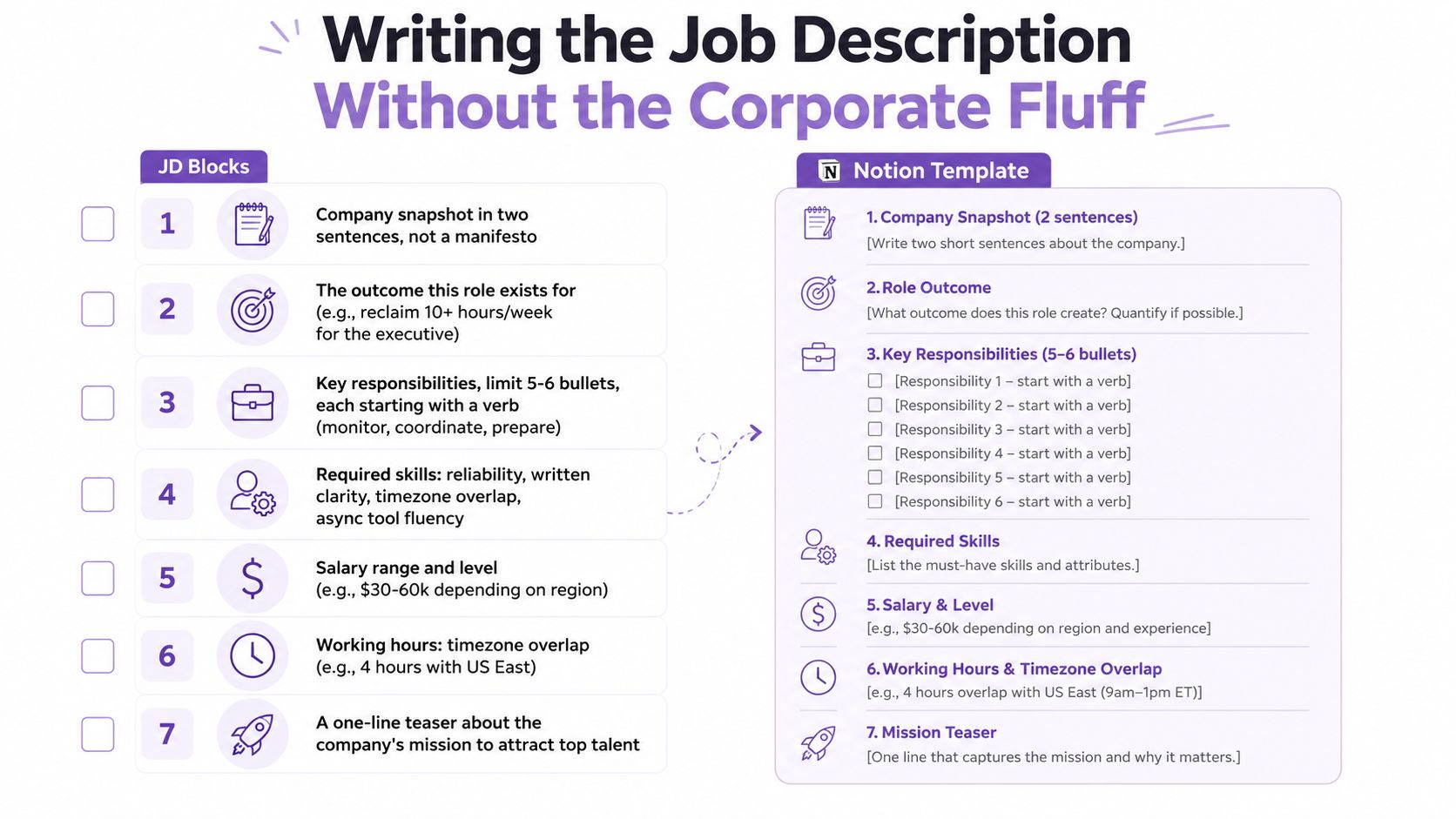
Use these blocks in a Notion page:
Skip the laundry list of generic soft skills. “Excellent communication, teamwork, flexibility, and attention to detail” tells candidates nothing. Show them the work and make them decide whether they want it.
The best applicants read your JD like a test. Write it like one.
There are four sensible sourcing lanes, and each fits a different operating problem.
Local recruiters and executive search firms make sense when the EA will handle sensitive board work, public-facing relationships, or a demanding in-office rhythm. Expect fees in the $8,000 to $25,000 range and a process of roughly four to eight weeks, based on the sourcing guidance provided for this market. You're paying for access, screening, and local-market knowledge. Don't pay retained-search prices for a calendar that can be managed remotely.
Specialty EA agencies such as Boldly, Athena, and River can provide more structure and screening around discretion, calendar triage, and executive support. The typical signal is $4,000 to $10,000 per month all-in, which can work when you need a polished service quickly and don't want to build the hiring process yourself.
Platform marketplaces such as Belay, Time Etc, and Wishup are better for a bounded contractor scope. They can help you start within 72 hours, particularly when the role is under 30 hours per week. The tradeoff is that you'll usually do more of the executive-specific calibration yourself.
Remote LatAm staffing through Deel, Pearl, or local agencies can find bilingual assistants with US timezone overlap in the $1,800 to $3,500 monthly range, according to the sourcing benchmarks in this brief. That's often the smarter first test for calendar, travel, inbox, and project execution.
Founders with fewer than 25 admin hours per week should start with a platform or LatAm agency. Escalate to retained search when the role crosses 40 hours per week or supports a public-facing CEO. For broader context on the mechanics of master executive search in 2026, review how search firms distinguish senior hiring from ordinary recruiting.
A useful LinkedIn search string:
("executive assistant" OR "chief executive assistant" OR "C-suite assistant") AND (calendar OR "board prep" OR gatekeeping OR "travel management") AND (remote OR hybrid)
Also lurk in The Assistant's Lounge and Executive Assistant Network on Slack before posting. Communities reveal how candidates talk about bad bosses, unrealistic availability, and vague roles. That intelligence is free, and it can save you from writing an expensive mistake.
For a direct route into nearshore hiring, hiring remote assistants from LatAm gives you a starting point for evaluating agencies, contractors, and compliance paths.
A polished resume proves someone can describe support work. It doesn't prove they can protect an executive's time when three urgent requests collide. Use a short, structured process and test judgment before chemistry gets involved.
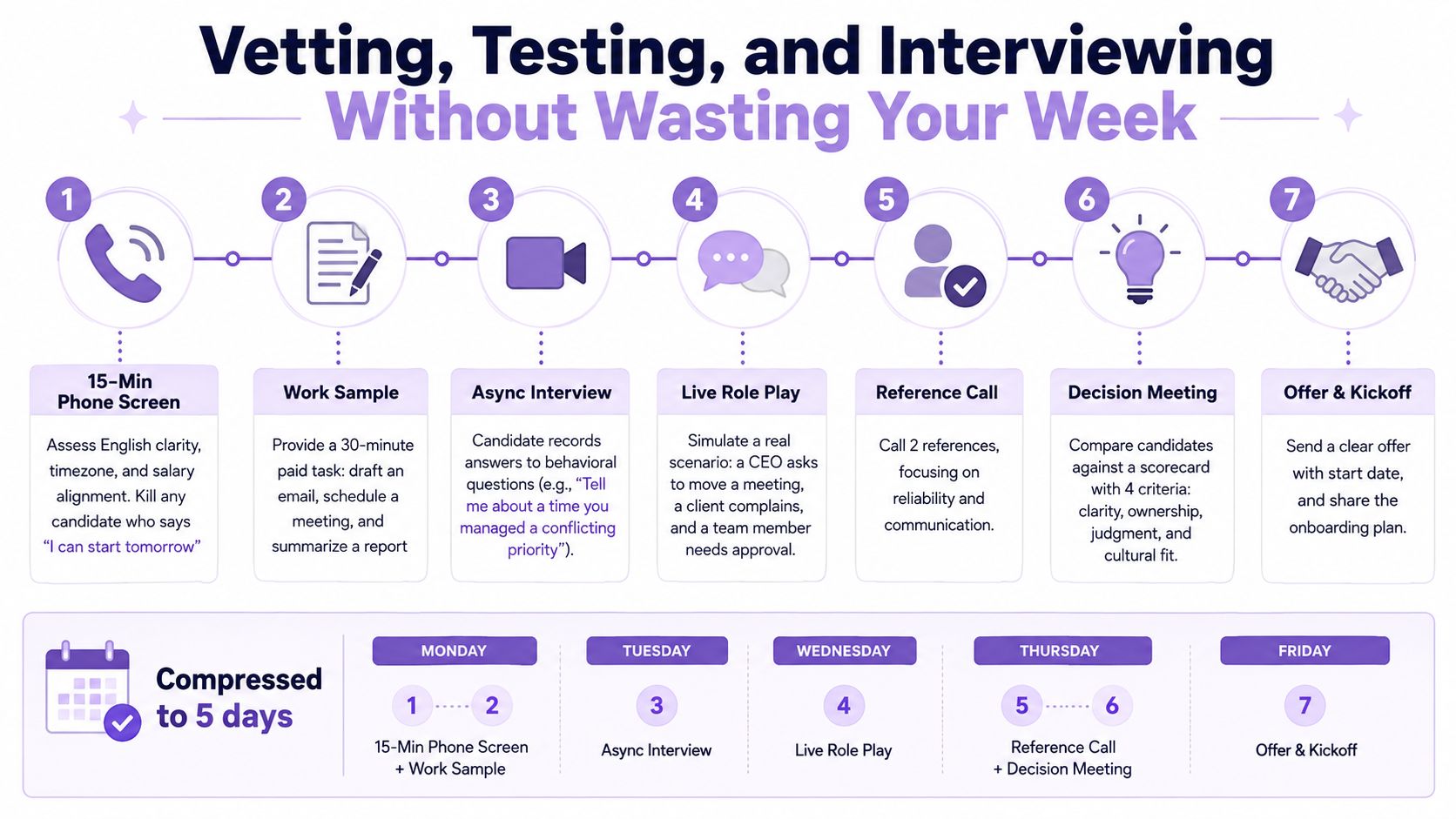
Run a 15-minute phone screen. Check English clarity, timezone overlap, availability, and salary alignment. Eliminate generic answers such as “I can start tomorrow, all hours.” That usually signals eagerness without a defined operating model.
Send a written async exercise. Give the candidate a 12-email inbox dump and ask them to rank priorities, draft replies, and propose a calendar plan. Score judgment, tone, completeness, and escalation logic. Grammar matters, but judgment matters more.
Run a live scheduling simulation. Put a conflicting board meeting, red-eye flight, and investor dinner into the same window. Ask the candidate to explain what they'd move, what they'd protect, and what they'd ask before acting.
Check references with pointed questions. Ask: “When was the executive wrong, and how did the candidate handle it?” Then ask how the person behaved under conflicting priorities and what the previous manager had to keep repeating.
Pay for a three-hour trial shift. Use $25, $50, or $100, depending on the market and scope. Give real but controlled work, not unpaid production disguised as an interview.
Test cultural fit through operating behavior. Ask about discretion, pushback, async writing, mistakes, and boundaries around personal coordination. You're not looking for a personality clone. You're looking for someone who can tell you bad news early.
Verify identity and background for cross-border hires. Complete the checks before granting access to sensitive systems, documents, financial information, or executive communications.
Use these exactly:
Auto-disqualify candidates who show any of these five signals:
Compensation should reflect access, judgment, confidentiality, and the cost of executive downtime. It shouldn't reflect your fear of losing a candidate. The US market gives you a useful anchor: executive assistants have a median annual wage of $76,590, or $36.82 per hour, with wages ranging from $50,560 at the 10th percentile to $109,850 at the 90th percentile in the cited wage data (GlobalCybers' executive assistant career guide).
The occupation is also substantial, with about 459,910 executive secretaries and executive administrative assistants employed in the May 2025 US wage data (Bureau of Labor Statistics wage release). The broader secretaries and administrative assistants category had a $48,310 median annual wage in May 2025, which shows how much the executive role changes the compensation baseline (BLS category data).
| Role / Region | Base Range (Annual) | Fully Loaded Annual Cost | 2-Year Total |
|---|---|---|---|
| US executive assistant, median benchmark | $76,590 | Varies by benefits and payroll structure | Varies |
| US executive secretary or executive administrative assistant, middle half | $61,390 to $94,390 | Varies by benefits and payroll structure | Varies |
| LatAm senior EA, contractor benchmark | Based on regional monthly rates | Roughly 1.15x contractor cost | Depends on scope and engagement |
| US versus LatAm modeled senior EA example | Not a universal salary quote | $208,000 US all-in versus $91,000 LatAm contractor | Roughly $117,000 difference over two years |
The middle half of US executive secretary and executive administrative assistant wages falls between $61,390 and $94,390, with a $76,590 median, according to executive assistant salary benchmarks. For LatAm, the cited planning ranges are $2,400 to $3,800 per month for a senior EA in Mexico City or Buenos Aires, and $1,800 to $3,200 per month in Colombia or Brazil.
The hidden costs matter. Local employment adds benefits, payroll taxes, equipment, and medical insurance escalation. Cross-border arrangements require attention to classification, local obligations, potential severance and unemployment exposure, and EOR fees of 3% to 6% in the modeled comparison. Use compensation benchmarking for remote talent before you anchor an offer to a random online salary post.
Hire locally when the role touches sensitive board work, hiring, or M&A. Hire cross-border when the work is calendar, travel, inbox, and project execution. Run a 90-day remote pilot before making the arrangement permanent.
The first month decides whether your EA becomes leverage or another dependency. Don't hand over a password vault and say, “Let me know if you need anything.” Give the person a narrow operating brief, real context, and ownership that starts immediately.
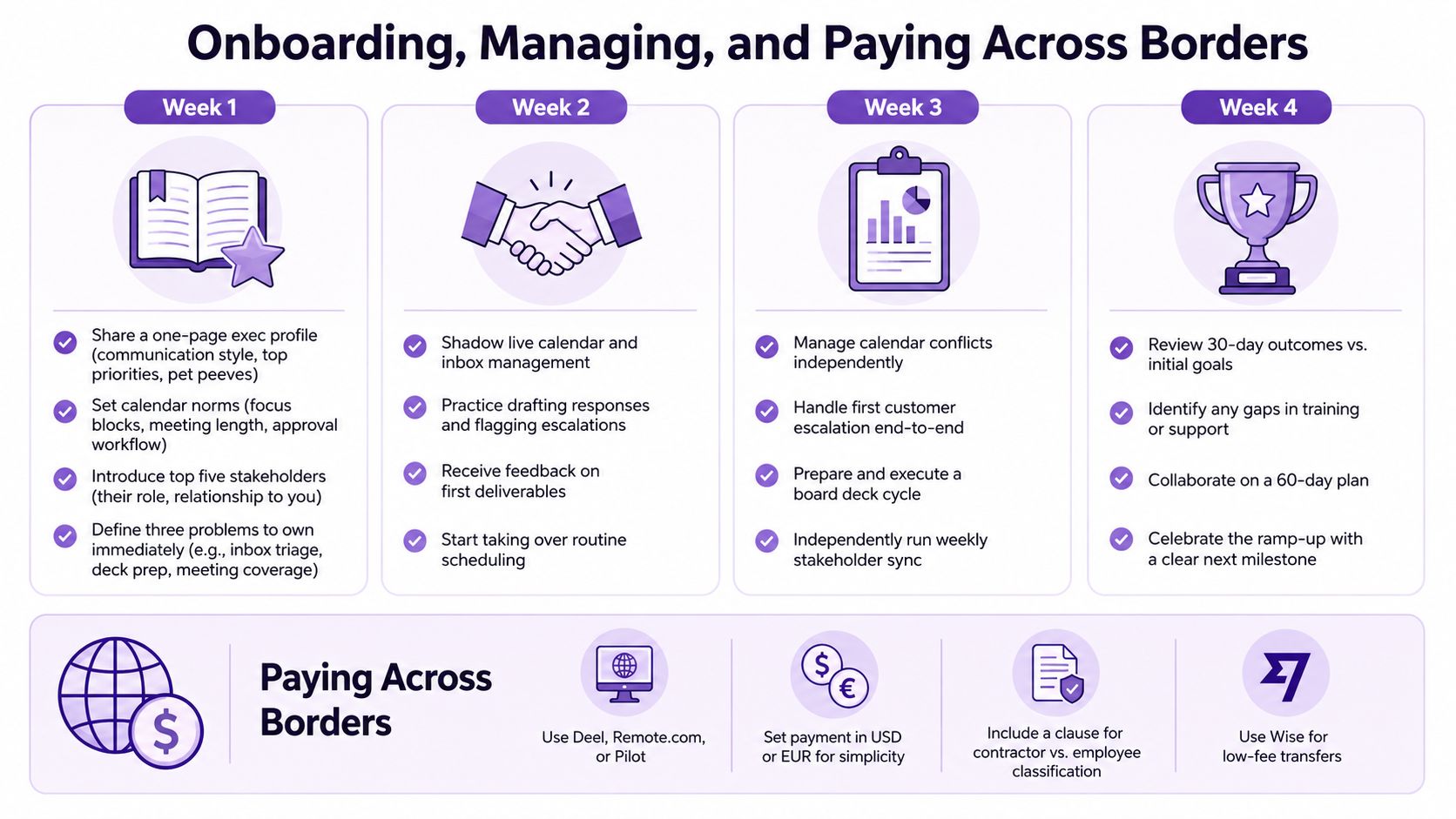
Week one is context and boundaries. Share a one-page executive profile covering communication style, priorities, pet peeves, decision preferences, calendar norms, and the top five stakeholders. Define three problems the EA owns immediately, such as inbox triage, board-deck coordination, or meeting coverage.
Week two is supervised execution. Let the EA shadow live calendar management, draft inbox rules, practice escalation decisions, and co-author a Notion playbook. Document tone, response times, approval requirements, and the difference between “keep me informed” and “wake me up.”
Week three introduces recurring ownership. Hand over a meeting series, stakeholder follow-up loop, or travel workflow. The EA should manage conflicts independently while bringing judgment calls to you with options, not a paragraph of panic.
Week four tests the operating cadence. Have the EA run the weekly rhythm solo, then review what worked, what broke, and what still depends on you. A successful ramp doesn't mean the EA never asks questions. It means the questions become sharper and less repetitive.
A simple management rhythm works best:
The broader assistant workforce is under pressure. In the National Association of Independent Schools survey summarized by Prialto, 833 respondents reported a median of 12 job duties; more than eight in 10 handled calendaring, event arrangements, and expense submission, while 40% said they had too much to do or were being pulled in too many directions (the assistant workload summary). Don't recreate that chaos by giving one person every undefined task in the company.
Use a clear access ladder. Start with the calendar, scheduling tools, and the specific project workspace. Add inbox, travel, financial, or board access only when the EA has demonstrated judgment and you've documented the approval rules.
Require a confidentiality and IP assignment agreement. Confirm right-to-work documentation before system access goes live, and keep a record of which systems contain personal, financial, customer, or board-sensitive information.
For US hires, use a W-2 structure through your payroll provider when the role functions like employment. Avoid misclassifying US contractors. For LatAm hires, an Employer of Record such as Deel, Remote, or Atlas can handle local contracts, taxes, and benefits, with the provided planning range of $50 to $150 per month per employee. Have counsel or your EOR confirm the applicable classification and local requirements instead of copying a contract from a founder forum.
Use a dated operating sequence:
The biggest advantage is defining what the EA owns in week one, not what they might do someday. Hire narrow, expand fast, and stop paying a senior operator to discover that “help the CEO” means everything and nothing.
Open your Notion workspace today and write the six-line version of the role: the executive's bottleneck, the hours you want back, the three workflows the EA will own, the timezone requirement, the compensation model, and the one behavior that disqualifies a candidate. Then run the phone screen, inbox exercise, and paid trial before you spend a week admiring resumes.