

You're probably in this exact spot right now.
You found a strong candidate in Latin America. Maybe it's a backend engineer in Brazil, a product designer in Mexico, or an SDR in Colombia. The interview went well, your team likes them, and now you need to make an offer without embarrassing yourself or lighting money on fire.
That's where most founders screw it up.
They open three browser tabs, skim a few salary pages, ask one recruiter friend, then toss out a number that feels “reasonable.” Sometimes the offer is so low the candidate mentally checks out before the call ends. Sometimes it's so high the company locks itself into a comp structure it can't sustain. Hope you enjoy revisiting every future offer with a spreadsheet and mild panic.
Compensation benchmarking is what separates deliberate hiring from salary improv. And if you're hiring across Latin America, generic US advice won't save you. It usually makes things worse.
A founder I know did the classic move. Great candidate. Strong portfolio. Clean communication. Time-zone overlap. The whole “finally, an adult in the room” feeling.
Then came compensation.
He based the offer on a quick search, plus some fuzzy logic about “remote rates.” The candidate went quiet. Not rude. Just that polite, unmistakable silence that says, “You have no idea what this role is worth.” He had matched the person's title, not the market, not the actual scope, and definitely not the competitive reality of hiring in Latin America.
That's the first version of the mistake. Underpay, and the best candidates disappear.
The second version is sneakier. You panic after losing a few candidates, then start overcorrecting. Now you're offering above what you can support long term, with no framework for leveling, raises, or internal consistency. Congrats. You didn't build a comp strategy. You built a future headache.
Compensation mistakes don't stay isolated to one offer. They spread.
If you're trying to understand the downstream hiring cost, use a proper cost per hire calculator and then ask yourself how much wasted time came from compensation confusion alone.
Practical rule: If you can't explain exactly why an offer sits where it does, you're not benchmarking. You're guessing in business casual.
And yes, I've made this mistake too. Toot, toot.
The fix isn't “pay more.” It's stop making offers from vibes. When you benchmark correctly, you know whether you want to lead the market, match it, or stay conservative for certain roles. What's more, you can explain that decision clearly to candidates and your own team.
That's what sane companies do. Not bigger companies. Sane ones.
“Compensation benchmarking” is often mentally filed under HR wallpaper. Beige. Slow. Optional.
It's not optional.
Compensation benchmarking is your salary GPS. It tells you where your pay sits relative to the market, so you can choose your route on purpose instead of taking random turns and hoping payroll survives the trip.
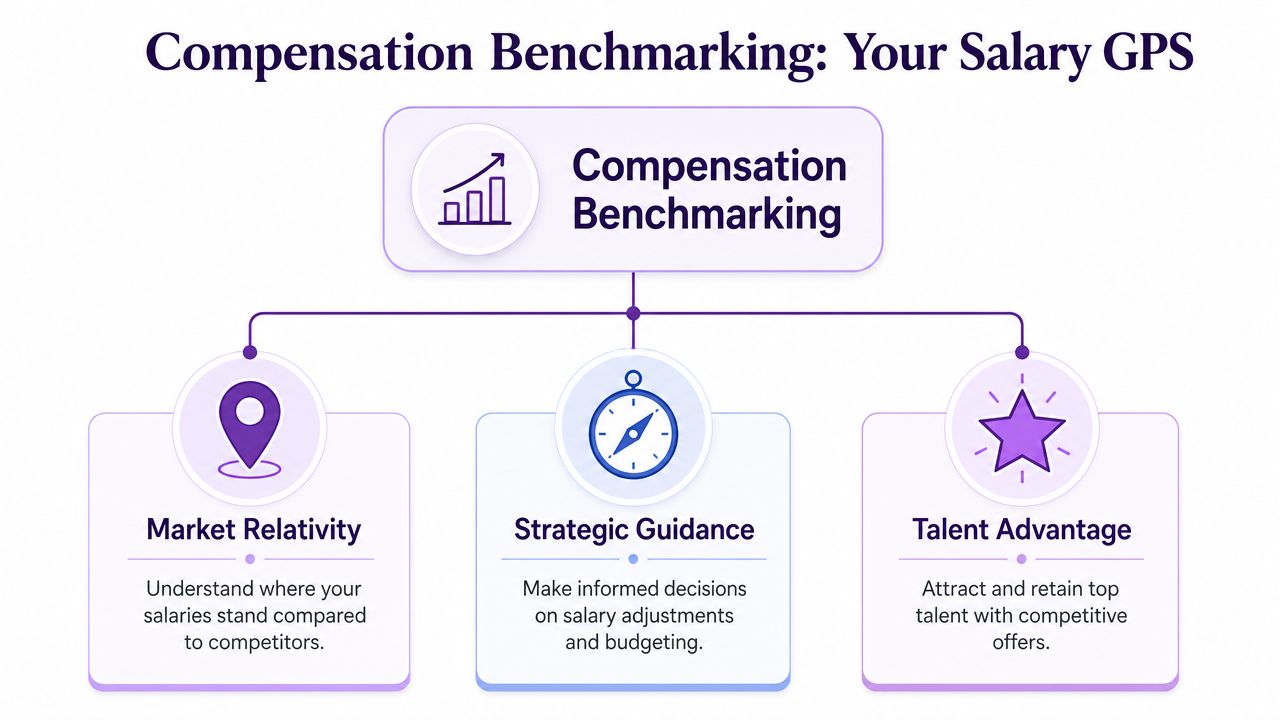
The core of benchmarking is simple. You collect relevant market data, match the job properly, then decide where you want to pay within the market range.
According to Meridian Compensation Partners on benchmarking best practices, compensation benchmarking relies on analyzing market data using specific percentiles, typically the 25th, 50th, and 75th, to establish actionable pay ranges. That same source notes a company aiming to be a top-tier payer might target the 75th percentile.
In plain English:
| Percentile | What it means | What it signals |
|---|---|---|
| 25th | Lower end of the competitive range | You're paying conservatively |
| 50th | Middle of the market | You want to match the market |
| 75th | Higher end of the market | You're using pay to attract stronger talent |
That doesn't mean every role should sit at the same point. That's lazy. A startup might pay closer to the middle for support roles and push harder for hard-to-fill engineering or revenue roles.
Founders often get tripped up. They think benchmarking means finding one number and calling it a day.
Wrong.
Real benchmarking helps you answer questions like these:
If you want a practical comparison point while building ranges, GENTY recruitment's salary benchmarks are useful as a directional resource. Just don't confuse any single source with a full compensation strategy.
Good benchmarking doesn't tell you what to pay. It tells you the market reality so you can choose what kind of employer you want to be.
That's the whole game. Deliberate pay beats reactive pay every time.
If your plan is “take a US number and haircut it,” throw that plan in the trash.
That approach is lazy, and strong candidates can smell it immediately.
Hiring in Latin America is not a discount-code version of US hiring. You are not shopping for cheaper humans. You are competing in a cross-border market where talented people compare offers from local companies, regional startups, US employers, global platforms, and direct clients all at once.
A lot of teams lean on familiar salary sites and broad US benchmarks, then try to adjust with gut feel. The result is usually nonsense.
You end up missing basic realities like:
And yes, the labor arbitrage conversation is real. If you want the clean version of that idea, this breakdown of labor arbitrage in LATAM hiring is worth reading. But too many founders hear “arbitrage” and immediately become sloppy with compensation.
Recent data shows 78% of US tech firms now benchmark remote international hires against local Latin American rates rather than US equivalents, yet no mainstream HR publication explains the compliance risks or equity implications of this approach, leaving companies vulnerable to pay disparity lawsuits and employee disillusionment, according to this compensation benchmarking guide.
That stat matters, but not because you should blindly copy the crowd.
It matters because it exposes the underlying issue. Most companies are already localizing pay for international hires, but many are doing it without a consistent framework for fairness, communication, or legal defensibility. They're following a pattern they barely understand.
If your pay model only works when nobody asks hard questions, it's a weak model.
Another ugly mistake. Companies create one “Latin America salary band” as if Mexico City, Buenos Aires, Bogotá, and São Paulo all behave the same way.
They don't.
The talent pool, language expectations, role maturity, employer competition, and local norms all vary. Even when two candidates have the same title, the market context can be very different. If you flatten that into one band, you'll either miss talent in stronger markets or overspend in weaker ones.
Here's the blunt recommendation:
| Bad approach | Better approach |
|---|---|
| Use US salary data and discount it | Benchmark against the actual hiring market for the role |
| Apply one LATAM-wide number | Build ranges by country, role level, and scarcity |
| Focus only on base pay | Model total employment cost and candidate expectations |
| Hide the logic | Explain the range and growth path clearly |
The old playbook worked when remote hiring was ad hoc. It doesn't work when cross-border hiring is a real operating model.
A founder in Miami hires a senior SDR in Colombia, uses a U.S. benchmark with a flat discount, and feels clever for about two weeks. Then candidates push back, the best one drops out, and the “cost savings” vanish because the range was wrong from the start.
Use a method that matches how remote hiring in Latin America works.
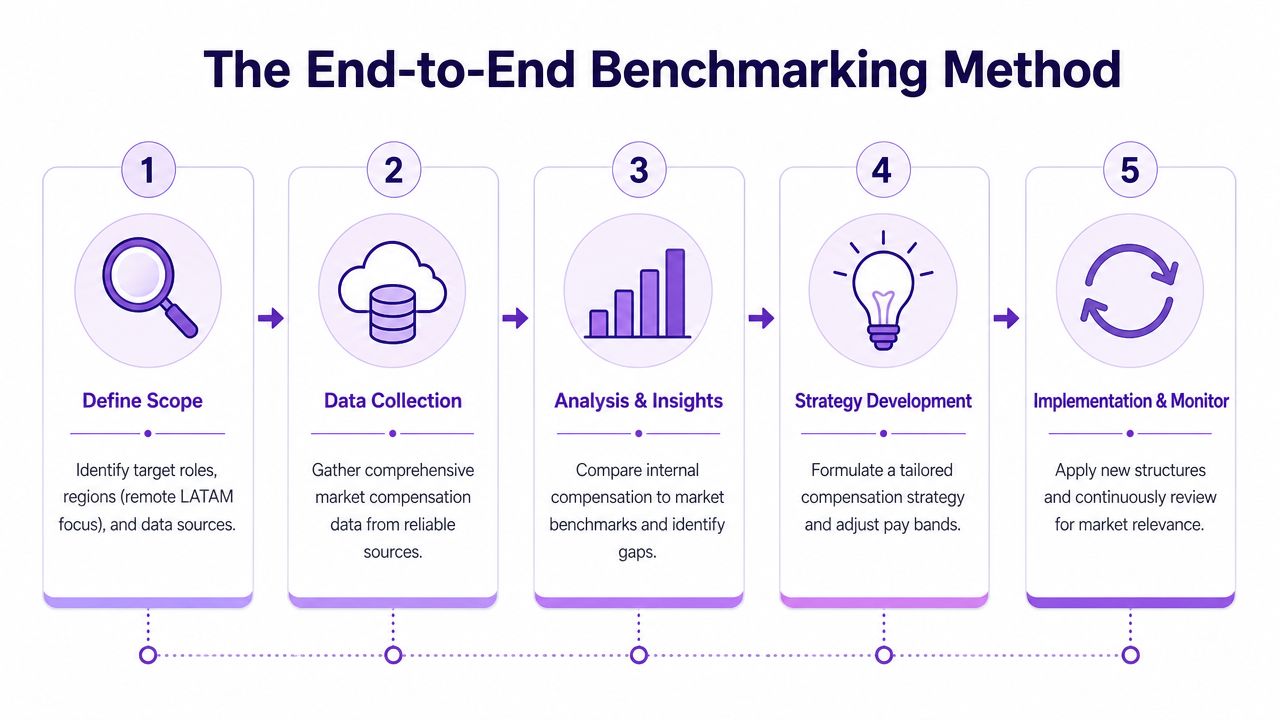
Benchmark against the market you are recruiting from, not the one your leadership team knows best.
That sounds obvious. Companies still screw it up every day. They pull U.S. numbers, apply a LATAM discount, and call it a compensation strategy. It is lazy, and strong candidates can tell.
Start by defining four things before you look at a single salary number:
A bilingual SDR in Mexico serving U.S. buyers is not priced like a local-only SDR in a secondary market. If you are hiring for revenue roles, use a country-specific reference point such as this LATAM SDR salary cost guide for 2026 to ground your first draft range.
One source gives you direction. Multiple sources give you a defendable range.
Use a mix of:
If you need to collect public market signals at scale, this web data extraction tutorial is a practical way to support your research process.
Generic databases can help with orientation. They should not decide your final number. Cross-border hiring moves too fast, and LATAM markets are too uneven, for one blunt dataset to do the job.
Founders fixate on base salary because it is easy to compare in a spreadsheet. Finance pays for that mistake later.
Your benchmark has to reflect total employer cost, including statutory contributions, local benefits, contractor risk, exchange-rate exposure, and any premium required to win bilingual or internationally experienced talent. A role can look cheap on salary alone and become expensive once the actual hiring setup is in place.
Run every benchmark through these filters:
Remote hiring in Latin America often gets mispriced. The salary might be lower than in the U.S., but the right benchmark is not “how cheap can we hire.” It is “what range wins strong talent at a healthy margin.”
Titles are messy. Scope is what matters.
According to WorldatWork's explanation of compensation benchmarking, accurate benchmarking depends on segmenting data by factors like experience, skills, and company size, then using percentiles such as the 25th, 50th, and 75th to build usable pay ranges.
A “Senior Developer” can mean a solid individual contributor, or the person everyone trusts to make architecture decisions and mentor half the team. Those are different jobs. Pay them differently.
Use an internal leveling framework before you benchmark externally:
| Step | What to define internally |
|---|---|
| Role family | Engineering, design, sales, ops |
| Level | Junior, mid, senior, lead |
| Scope | Execution, ownership, strategy, team influence |
| Skill depth | Core tools, specialty expertise, communication expectations |
| Hiring market | Country, region, and competitive context |
If two people share a title but own very different outcomes, they should not sit in the same salary band.
A benchmark is useless if recruiters ignore it, hiring managers override it, and candidates get different stories from different people.
Set a target percentile for each role type. Decide when you will pay above the midpoint. Define what justifies exceptions. Write down how geography, English fluency, niche skills, and urgency affect the final offer. Then train your team to use the policy the same way every time.
That is the full method. Define the market. Gather inputs. model full cost. Match by level. Turn it into a hiring rule your team can follow.
That is how you hire top LATAM talent without overpaying or getting laughed out of the process.
You post a role for a bilingual SDR in Colombia or a data engineer in Peru, open your usual salary tool, and get a range so wide it might as well say, “good luck.” That is how companies end up overpaying average hires or lowballing great ones.
Thin markets punish lazy benchmarking. Generic US-heavy datasets miss too much context in Latin America, especially for roles shaped by English fluency, overlap with US hours, contractor norms, and fast-changing local demand. If you want a salary band you can defend, use triangulation. Pull from multiple imperfect inputs and force them to agree closely enough that you can make a real offer.
As noted earlier, global benchmarking platforms describe this approach well. The point is simple. One source is a guess with formatting.
Start with three inputs, then compare them hard:
The third input matters more than founders admit. If strong candidates in Mexico, Brazil, or Argentina keep reacting the same way to your range, your spreadsheet is wrong for the market you are hiring in. I trust repeated candidate behavior faster than a polished dashboard built on thin LATAM coverage.
Use recruiter input carefully. Some recruiters inflate ranges because higher salaries mean easier closes and bigger fees. Push for specifics. Ask what offers got accepted in the last 60 days, in which country, for what level, under what employment setup. If they cannot answer that cleanly, their advice is noise.
Public job data can help too, but only as a directional check. If your team wants to collect that data at scale, this web data extraction tutorial shows one practical way to pull salary clues from job posts and hiring pages. Scraped numbers are messy, inconsistent, and often incomplete. Treat them as supporting evidence, not the number you build your comp policy around.
Sales hiring is a good example. OTE, base-to-variable mix, territory, and English requirements can distort the market fast. If your SDR benchmarks feel thin or contradictory, review this guide to LATAM SDR salary costs as a reality check before you set the band.
My rule is blunt. If two of your three sources disagree sharply, you do not have a benchmark yet. You have research in progress.
The best range in a thin LATAM market is the one backed by local context, recent hiring signals, and a clear explanation your recruiters and hiring managers can repeat without improvising.
You hire a strong backend engineer in Colombia at what feels like a smart number. Three months later, your top candidate in Mexico rejects you for being under market, your internal team finds out the new hire came in higher than they did, and your finance lead starts asking why payroll is drifting. That mess usually starts with bad benchmarking, not bad recruiting.
Comp strategy breaks through undisciplined choices. A copied US salary band. A hiring manager who negotiates by gut. A founder who says, "We hire in LATAM, so we should get a discount," without defining what fair and competitive means by country, level, and role.
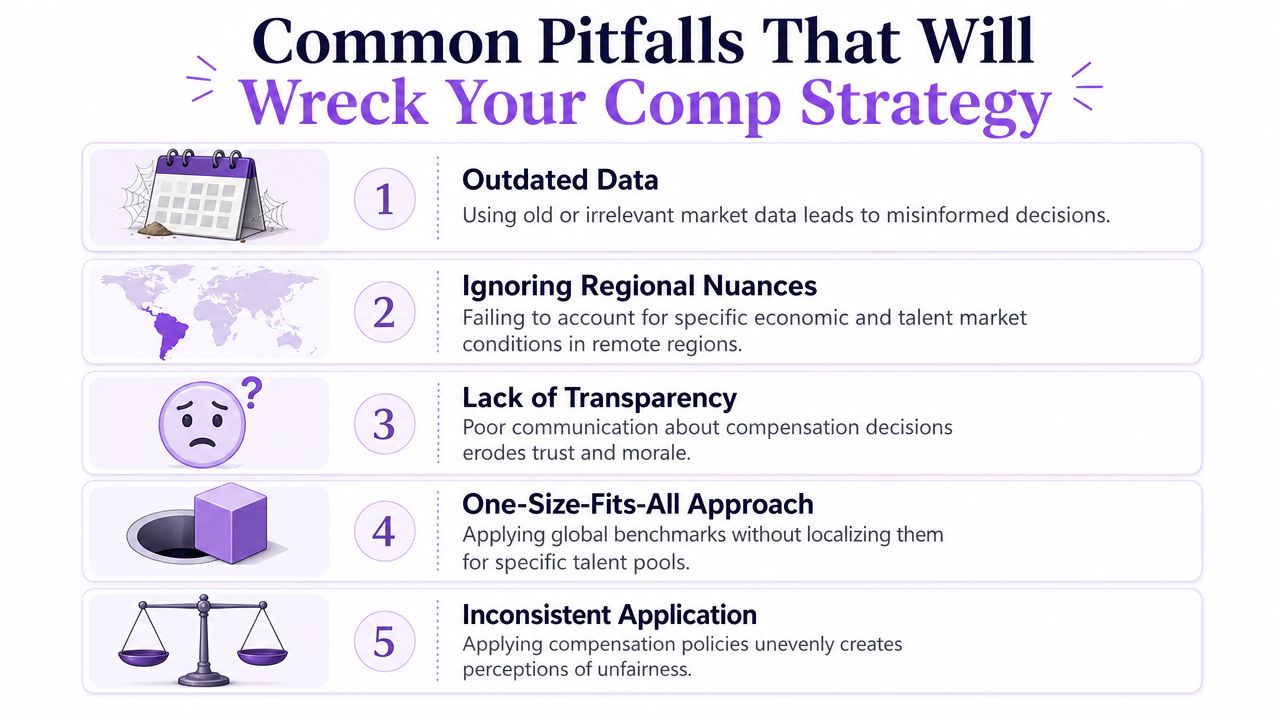
The biggest mistake is using logic built for domestic US hiring and forcing it onto cross-border hiring. That is how companies end up overpaying for easy-to-fill roles, underpaying for scarce bilingual talent, and creating pay decisions they cannot defend.
Here are the failures that show up again and again:
Using US-centric benchmarks as the starting point
A San Francisco or New York median tells you almost nothing about a remote accountant in Argentina or a product designer in Brazil. If your source data is centered on US employers and US cost structures, your range is already distorted.
Treating LATAM like one market
Brazil is not Colombia. Mexico is not Argentina. English fluency, local employer competition, contractor versus employee setup, and dollar volatility all change what a candidate will accept.
Confusing cheap with competitive
Founders lose great candidates because they anchor on savings instead of close rates. The goal is not to pay the lowest number a spreadsheet can justify. The goal is to make an offer strong enough to win without importing US payroll bloat.
Ignoring total employer cost
Base salary is only part of the decision. Employer taxes, benefits, equipment, statutory requirements, exchange rate risk, and EOR fees can turn a "great deal" into an expensive surprise.
Letting managers create side deals
One candidate gets a sign-on bonus. Another gets an extra week off. Another gets a title bump to justify comp. Soon your bands mean nothing and every new offer becomes a political negotiation.
Hiding the logic
If recruiters, managers, and candidates hear different explanations for the same pay range, trust disappears fast. A vague comp philosophy creates more damage than a strict one.
| Pitfall | Smarter move |
|---|---|
| US-heavy benchmark inputs | Build ranges from LATAM-relevant data first, then sanity-check against your budget and role impact |
| One regional band | Set pay by country cluster, role scarcity, and English requirement |
| Savings-first offers | Price to win strong candidates, not to brag about arbitrage |
| Salary-only math | model full employer cost before approving the band |
| Manager exceptions | Require approval rules for off-band offers, title changes, and one-time incentives |
| Opaque pay decisions | Give recruiters and hiring managers a simple explanation they can repeat word for word |
One rule fixes a lot of this. Write down why a role sits in a band, what can move it up or down, and who can approve an exception. If that policy only lives in the founder's head, it is not a policy.
People can accept a pay system they dislike. They will not trust one that feels random.
My advice is blunt. Stop building compensation around anecdotes, copied US survey cuts, and last-minute exceptions. For remote LATAM hiring, that approach burns time, weakens offers, and creates internal resentment you will pay for later.
A strong candidate in Brazil asks why your offer is lower than a US company's, but higher than another remote offer they already have. If your answer is vague, you lose.
The win is not just having a number. The win is having a compensation system you can defend in plain English. For remote LATAM hiring, that means your range reflects local market reality, role scarcity, English requirements, and the full cross-border cost to employ. Generic US salary data cannot do that for you. It was never built for this job.

Founders who benchmark compensation well hire faster because they stop rebuilding pay logic for every candidate. Recruiters get a range they can explain. Hiring managers stop freelancing exceptions. Candidates hear a clear story instead of whatever version happened to come up in Slack that day.
That matters more in Latin America than many US companies realize. The market is fragmented by country, currency, seniority norms, and employer brand. A Chilean product designer, a Colombian SDR, and a Brazilian backend engineer should not be priced with the same lazy regional shortcut. The companies that figure this out get better talent at sane cost. The companies that do not either underpay and lose people, or overpay and destroy the savings that made remote hiring attractive in the first place.
Use this as your operating standard:
Good compensation benchmarking also exposes where your hiring process is weak. If candidates keep pushing on fairness, leveling, or contract terms, the problem is usually not the question. The problem is that your system is sloppy. The teams that answer those objections well tend to have the same kind of operational clarity you see in these common questions about digna.
This is the payoff. Compensation benchmarking stops being an admin task and starts acting like a competitive edge.
Do it right, and you will win stronger remote talent across Latin America without paying panic prices.
You make an offer to a great engineer in Brazil, they ask two sharp questions about pay logic, and your hiring manager gives a different answer than your recruiter. That is how good candidates walk.
Here are the questions founders should be able to answer without improvising.
| Question | Answer |
|---|---|
| How often should I benchmark compensation? | Recheck your ranges at least twice a year, and review faster for roles where demand shifts quickly. AI, data, senior engineering, and revenue roles can move fast. If you wait until offer declines pile up, you are already behind and you will pay more to recover. |
| Should I use one pay differential across all of Latin America? | No. Set pay by country, role, level, and hiring difficulty. Mexico, Brazil, Colombia, Argentina, and Chile do not move the same way. A single LATAM discount versus US salaries is not a strategy. It is a shortcut that leads to weak offers in one market and inflated offers in another. |
| What if candidates ask hard questions about fairness? | Answer them directly with a clear method. Show how you set the range, what level they are being hired into, and which factors affect the final number. If your team cannot explain that cleanly, your system is the problem. If you want a good example of the kind of clarity people expect, review these common questions about digna. |
| Is compensation benchmarking just salary benchmarking? | No. Cross-border hiring costs more than base salary. You need the full picture: bonuses, equity, benefits, contractor versus employee setup, local market expectations, and your actual employer cost after compliance and payroll. Founders who miss this either lose candidates or erase the savings they thought remote hiring would create. |
If you want one system to handle compensation, compliance, and candidate flow for LATAM hiring, LatHire is a strong place to start.