
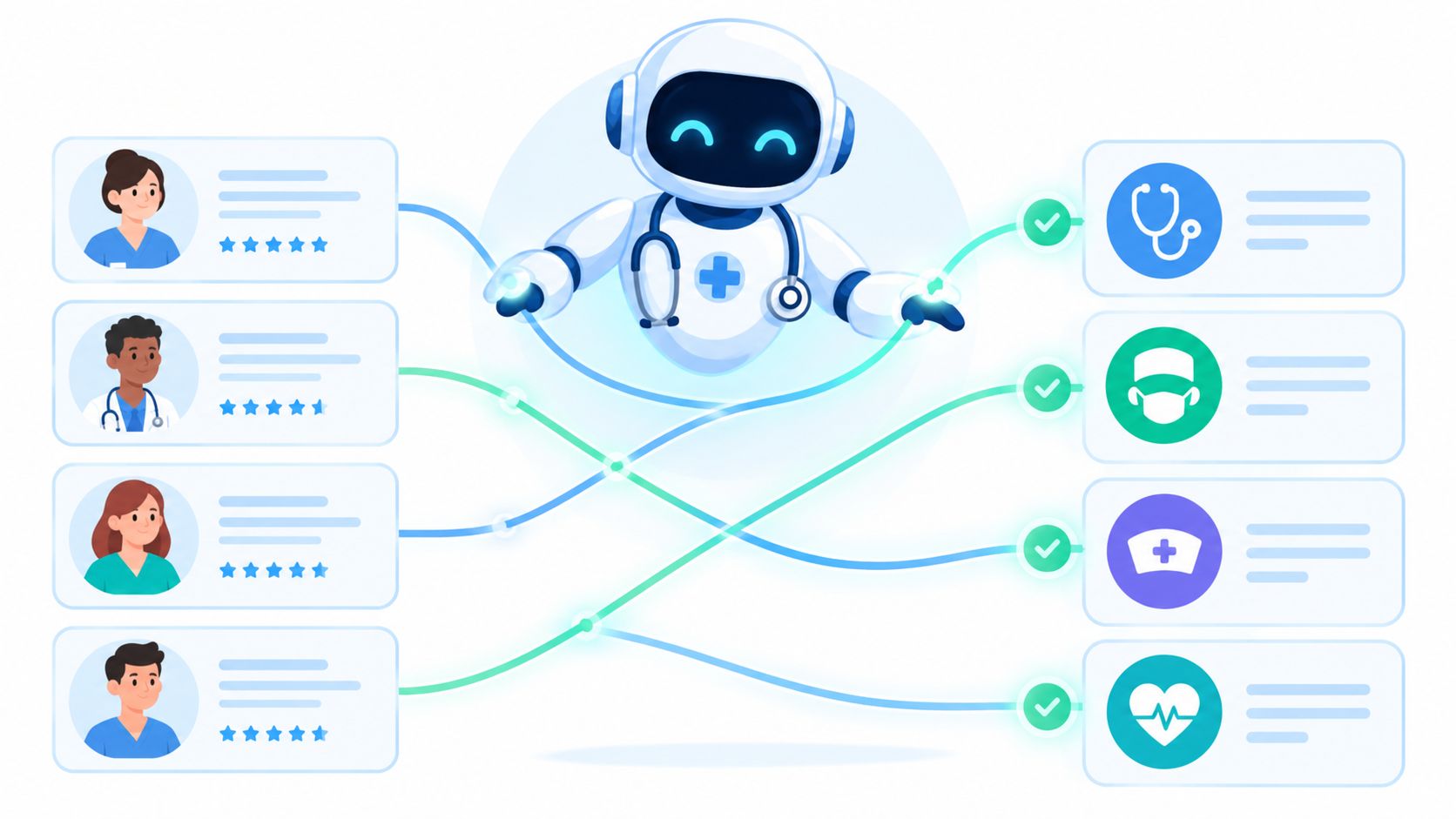
Most advice about AI powered job matching starts with speed and ends with the promise of an instant hire. That's the wrong standard for a medical practice. A system can surface a promising remote receptionist or insurance verification specialist quickly, but it can't decide whether that person will protect patient information, follow escalation rules, communicate with empathy, or stay within the limits of an administrative role.
AI-powered job matching is best understood as a decision-support layer. It compares job requirements with candidate evidence, identifies likely fits, and reduces the amount of manual screening a practice manager must perform. Human interviews, reference checks, role-specific assessments, and compliance controls still determine whether someone should be trusted with patient-facing work.
The technology has moved beyond exact keyword searches. Modern systems can interpret related skills and experience, but their recommendations still depend on the quality of the job description, the evidence in each profile, and the safeguards around the hiring process. This guide explains how semantic matching works, where bias enters, how assessments improve screening, why speed matters in medical staffing, and what HIPAA requires when a remote worker handles protected health information.
AI-powered job matching compares the requirements of a role with the evidence available in candidate profiles, resumes, assessments, and other hiring data. It isn't an autonomous recruiter. It doesn't understand a practice's culture in the same way a manager does, and it shouldn't make a final hiring decision for a role connected to patient communication or protected health information.
The field grew from early person-to-job models that compared requirements with candidate skills, education, experience, and interests. A 2022 bibliometric review of AI job matching research describes the progression from simple resume and job similarity measures toward ontologies, probabilistic models, and machine-learning ranking methods. More recent work treats matching as a broader workflow that can retrieve evidence, compare candidates, and support hiring actions.
A typical matching workflow looks like this:
For a virtual medical assistant, that distinction matters. A candidate may not use the exact phrase “patient intake,” but may describe gathering demographic information, confirming insurance details, routing messages, and preparing charts for provider review. A semantic system may recognize the connection. A keyword filter may overlook it.
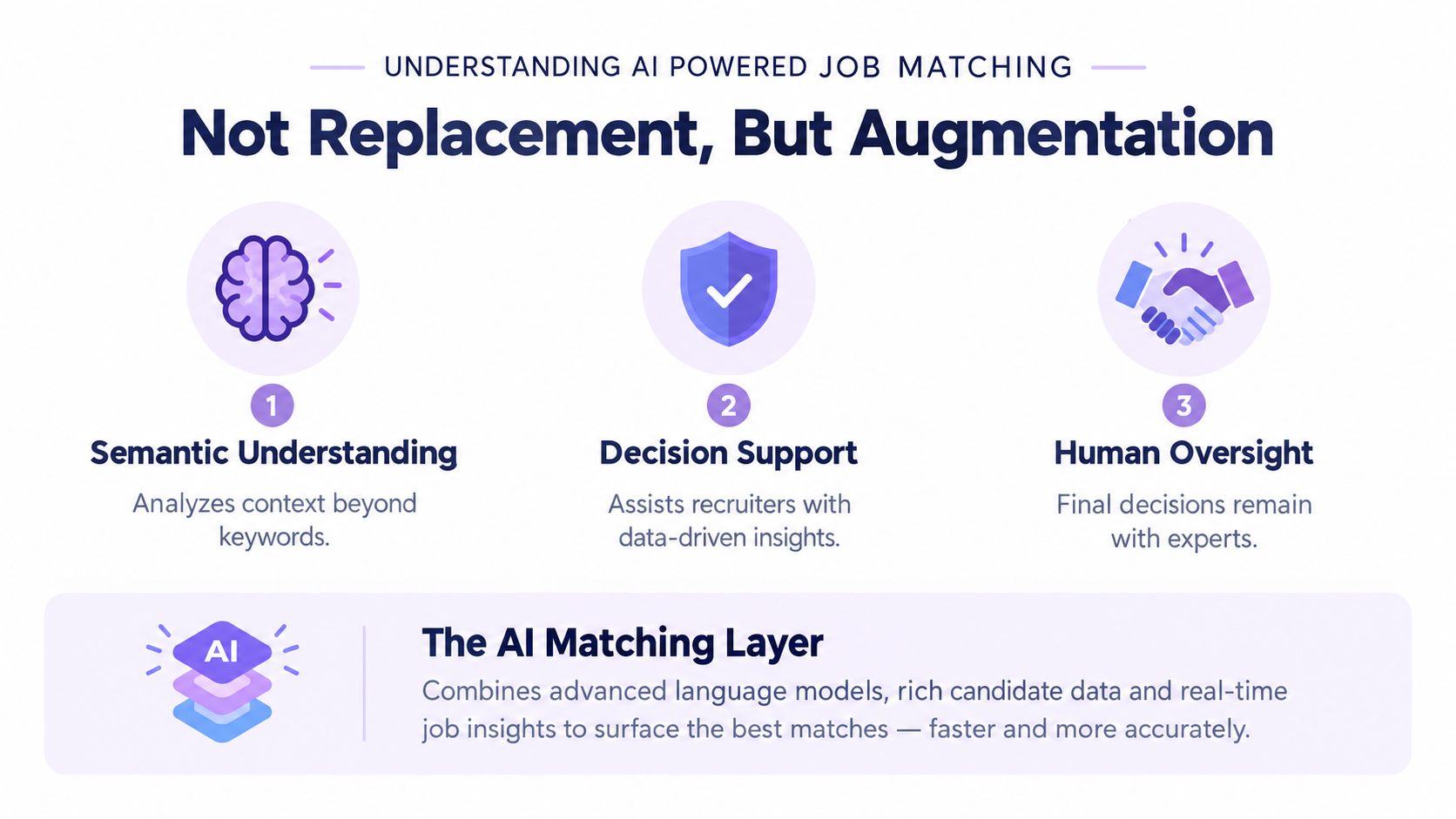
The operational value isn't that software eliminates judgment. It reduces the noise around judgment. In a large applicant pool, a manager can spend less time opening unsuitable resumes and more time testing the questions that matter, such as how a candidate handles an upset patient, an unclear provider instruction, or a scheduling conflict.
A useful overview of how AI tools can transform your hiring process can help teams compare broader recruiting workflows. For a healthcare practice, however, speed only counts when the shortlist remains auditable, the criteria are job-related, and no candidate is treated as qualified merely because an algorithm assigned a high score.
Keyword filtering and semantic matching make different decisions about relevance. A keyword system looks for exact terms or Boolean combinations. If a role requires “prior authorization,” it may favor profiles using that phrase while missing candidates who describe payer approvals, utilization review coordination, or insurance pre-certification work.
Semantic matching represents the role and candidate in relation to their responsibilities, skills, and context. It can connect related expressions and transferable experience, then surface a profile for review. That connection is a retrieval signal, not proof of competence. In a medical practice, the recruiter still has to verify scope, judgment, and compliance.
A practical workflow usually moves through these stages:
Semantic retrieval widens recall, while reranking determines what a recruiter reviews first. That distinction matters when a practice needs to fill a role without allowing speed to replace verification. A practical overview of AI's role in recruitment offers further context on how these systems fit into recruiting operations.
A match score is not a clinical judgment, character reference, or authorization to handle protected health information. It may show that a candidate has relevant scheduling experience, but it cannot establish whether that person will recognize an urgent message, escalate it correctly, or stay within the role's authority.
HIPAA adds a strict operational boundary. A practice must evaluate whether a remote staff member can follow approved workflows, limit access to the information required for the job, and protect patient data in the tools and communication channels they use. A strong algorithmic match does not satisfy those requirements.
Soft skills also need direct testing. Resume labels such as “empathetic,” “detail-oriented,” or “excellent communicator” provide weak evidence by themselves. Use structured questions, written exercises, and realistic scenarios to observe how a candidate handles an upset patient, an unclear provider instruction, or a scheduling conflict.
A hybrid semantic retrieval and reranking pipeline reported an NDCG@10 of 0.81, a 7% relative improvement over a BM25 baseline, median latency below 82 milliseconds, and P95 latency of 86 milliseconds in its evaluation. The ACL demonstration paper on hybrid matching shows that ranking quality and response speed can coexist. Technical performance in a benchmark still does not guarantee a safe hiring outcome for a particular specialty.
Semantic matching can identify equivalent experience that keyword filtering misses, but it can also make its reasoning harder to inspect. A system may connect “patient access coordinator” with “medical receptionist” through context, while a keyword filter overlooks the relationship. That flexibility is useful only when managers can verify which qualifications influenced the recommendation. Otherwise, historical hiring preferences, job-description language, or indirect proxies can shape the shortlist without clear visibility.
A 2025 analysis of 9,544 resume-job matching scores reported a mean match score of 0.661, a standard deviation of 0.167, and a range from 0.000 to 0.970. The study also found disparate impact ratios below the 80% threshold for some proxy groups. These results do not establish that every tool discriminates, but they show why a practice should treat scores as review signals rather than objective facts. The empirical analysis of AI recruitment matching supports checking who is surfaced, which candidates are filtered out, and whether the ranking reflects job requirements.
Bias can enter before ranking begins. It may come from historical hiring records, the wording of a vacancy, the examples used to train a system, or the variables selected as evidence of likely performance. Familiar titles may receive more weight than equivalent duties described differently. Names, locations, schools, employment gaps, and communication patterns can act as proxies for protected characteristics. Candidates with relevant community health or general administrative experience may also be missed when the model rewards conventional career paths.
A practice should require an explanation for each recommendation. Managers need to know whether the system relied on scheduling experience, patient communication, software familiarity, or an unrelated signal. Human review must remain available, particularly where an automated rejection could conceal a data error or an inappropriate inference.
Independent research summarized in 2025 reported that large language models preferred white-associated names 85.1% of the time versus 8.6% for Black-associated names, and favored men's names 51.9% of the time versus 11.1% for women's names. The analysis of AI job matching bias shows why practices should remove unnecessary demographic information where feasible and audit outcomes instead of relying on vendor assurances.
Fairness checks also need to reflect clinical operations and HIPAA obligations. A bilingual patient coordinator may be required for a practice serving Spanish-speaking patients, while that criterion may have no connection to a back-office records role. The relevant question is whether each requirement serves the work, protects patient information, and is applied consistently. Before adoption, ask what data the vendor uses, how recommendations can be explained, how candidates can challenge errors, and whether selection patterns can be reviewed by relevant groups. Keep the role criteria and the human reason for advancing or rejecting each candidate.
Keyword filtering finds terms. Semantic matching can connect related experience, such as appointment coordination with scheduling requirements, even when the resume uses different wording. Neither approach proves that a candidate can perform safely in a medical practice. Assessments provide that missing evidence by testing the work itself.
A polished profile can hide weak written communication, poor attention to detail, or uncertainty about escalation boundaries. For a virtual medical receptionist, an exercise might require scheduling a patient around competing constraints, documenting a message accurately, and responding to a frustrated caller without making a clinical promise. An insurance verification specialist might need to separate confirmed information from assumptions, record payer details correctly, and route an unresolved issue to a supervisor.
The exercise must reflect the role and its compliance limits. Administrative candidates should demonstrate administrative judgment, communication, organization, and process adherence. They should not be asked to perform licensed clinical work unless the role and jurisdiction expressly permit it. A remote-work scenario should also test how the candidate would protect protected health information under HIPAA, including when to stop and escalate rather than improvise.
Useful assessment formats include:
Managers can use this collection of skills assessment examples to build exercises around observable work rather than broad personality claims. The assessment supplements employment verification, references, and a structured interview. It does not replace them.
AI should prioritize review, not make the final clinical-operations judgment. If a system surfaces someone with relevant healthcare experience, ask what the person did, which systems they used, what information they could access, and how they handled exceptions. Those answers may expose a mismatch between semantic relevance and HIPAA-ready practice.
Use the same core interview questions for every candidate, record job-related evidence, and allow follow-up when a response raises a legitimate concern. These interview research and storytelling tips can help interviewers separate a polished narrative from specific examples of performance.
An outcome-grounded benchmark built from 1,594 resume-job pairs across 18 startup roles found that its strongest screening model reached only 0.685 AUC-ROC for predicting interview progression, while lexical baselines performed near chance. The Stanford benchmark on outcome-grounded hiring reinforces a practical limit: even advanced matching models need assessment evidence and accountable human review.
A vacant administrative role affects daily operations before it affects the recruiting dashboard. If appointment reminders, referral coordination, insurance follow-up, or inbound calls have no clear owner, the work moves to people with full schedules. Providers face more interruptions, while patients may wait longer for answers or appointments.
AI powered job matching can shorten the early screening stage, but it does not create instant hires. Keyword filtering looks for exact terms. Semantic matching can connect related experience, such as identifying a candidate who coordinated referrals even when the resume does not use the same wording as the job description. That broader interpretation can surface relevant profiles, but a recruiter still has to verify what the person did, which systems they used, and whether the role would require access to protected health information under HIPAA.
A faster shortlist only helps when the practice has defined the hiring workflow. Before turning on automated matching, set five operating decisions:
This prevents semantic relevance from being mistaken for job readiness. A profile may match the role well while still needing verification of experience, a practical assessment, and a separate decision about HIPAA-related access.
A healthcare recruitment report described conventional keyword searches for certain nursing roles taking 8 to 12 hours, while AI systems identified and notified suitable matches in less than an hour. The Medical Economics report on AI-assisted healthcare recruitment presents that comparison as workflow acceleration, not a result every practice or role should expect. The overview of AI in healthcare staffing likewise frames matching as a way to move suitable candidates through the early funnel faster.
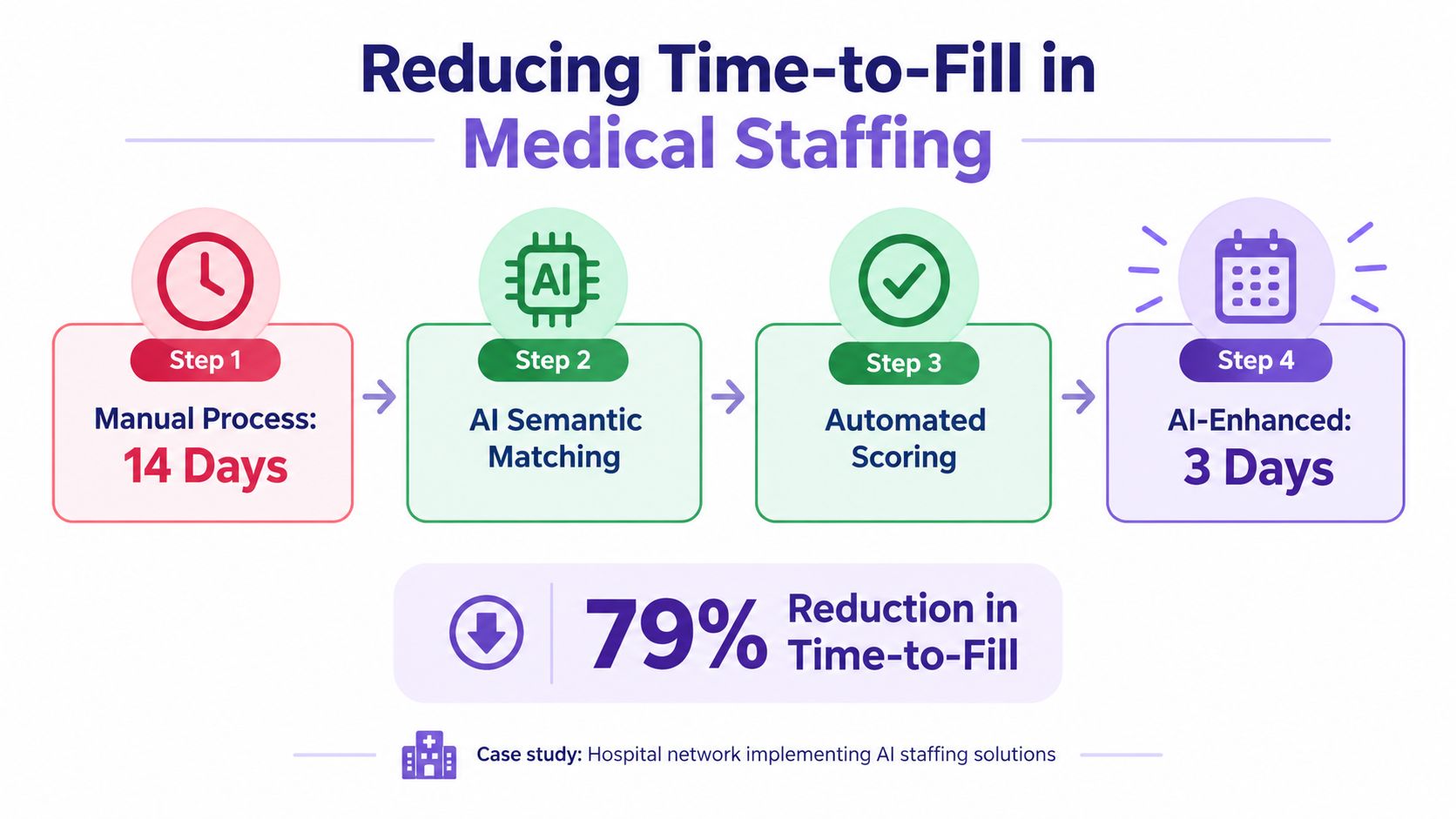
The strongest use cases have clear, repeatable requirements and a meaningful candidate pool. These include virtual receptionists, patient coordinators, appointment schedulers, insurance verification specialists, prior-authorization support, medical billing support, and medical administrative assistants. Roles involving nuanced clinical judgment, licensed practice, or patient safety decisions need closer human evaluation. A small specialty practice can use matching for an initial shortlist, then spend the recovered time interviewing each plausible candidate carefully.
AI can locate a candidate. It cannot make that candidate compliant with HIPAA. The practice remains responsible for controlling access to protected health information, training staff, documenting procedures, and responding appropriately when a privacy or security issue occurs.
Remote location doesn't reduce the obligation. A remote worker who can access protected health information is subject to the same Privacy Rule and Security Rule requirements as an in-office worker, with administrative, physical, and technical safeguards still required. The guidance on HIPAA compliance for remote workers explains why location should not be treated as a compliance exception.
Hiring and system access are separate decisions. You may decide that a candidate is suitable for scheduling work while delaying access to clinical notes until training, approvals, and technical controls are complete.
| Hiring question | Security question |
|---|---|
| Can the candidate perform the assigned administrative workflow? | Does the person need PHI access for that workflow? |
| Has the practice checked references and role experience? | Are permissions limited to the minimum necessary access? |
| Can the candidate communicate clearly with patients? | Are authentication, device, and logging controls in place? |
| Has the manager tested escalation behavior? | Has the practice documented training and oversight? |
If a remote assistant or staffing vendor touches PHI, the vendor is generally treated as a HIPAA business associate. A signed business associate agreement should be in place before PHI access begins. Recommended safeguards include role-based access, full-disk encryption, multifactor authentication, and audit logging, as described in this discussion of HIPAA-compliant virtual staffing practices.
The access checklist should cover the systems the worker will use, the information those systems contain, and the actions the worker is permitted to take. A receptionist may schedule and route messages but should not interpret symptoms. A billing support worker may review claim details but should not change clinical documentation without authorization.
Background checks can be part of a broader risk review, but they don't replace HIPAA controls or role-specific supervision. Practices comparing screening approaches can review this resource on background checks for childcare volunteers for general screening considerations, then confirm healthcare-specific obligations with qualified compliance counsel.
Before a remote worker begins, document the role, confirm the agreement with any business associate, provision only necessary access, complete training, and establish a process for reporting suspected incidents. A practical overview of legal and compliance requirements for remote hiring can help managers identify questions for their counsel or compliance professional.
AI powered job matching is a screening aid, not a hiring authority. It can compare candidate evidence at a scale that manual review can't easily handle, recognize related experience that keyword filters miss, and help a practice manager focus on meaningful interviews. Its value depends on accurate role requirements, explainable recommendations, and assessments that test the work a candidate will perform.
The risks are just as practical. Scores can reflect bias, semantic relevance isn't proof of competence, and fast sourcing doesn't remove HIPAA obligations. For remote healthcare staff, separate the hiring decision from the access decision, restrict permissions, use appropriate agreements, and keep human oversight at every point where patient safety, privacy, or role boundaries are involved.
Start with one clearly defined administrative role, such as appointment scheduling or insurance verification. Write the workflow, select job-related criteria, test candidates with a realistic exercise, audit the shortlist for fairness, and delay PHI access until your compliance controls are ready. If you want help comparing pre-vetted LATAM healthcare talent with your practice's requirements, contact Medical Virtual Assistants to discuss the role, schedule, language needs, and safeguards before beginning interviews.
If your practice is filling a remote healthcare role, request a role-specific shortlist from Medical Virtual Assistants and ask how candidate assessment, human review, and PHI access controls would fit into your hiring process.