

Your front desk is answering calls while patients wait to check in, appointment requests are accumulating, and the practice manager is considering a remote medical virtual assistant. Finding someone available feels urgent. But who will teach that person your scheduling rules, authorize access to patient information, review their work, and decide whether the arrangement is working?
Talent management is the connected process of hiring, onboarding, developing, retaining, and managing the performance of the people your practice needs. Recruiting fills the vacancy. Talent management makes the hire useful, accountable, and appropriately supported after they start.
For U.S. medical practices, that distinction matters because remote administrative work can involve sensitive patient information and consequential handoffs. A missed escalation, an unclear authorization responsibility, or inappropriate system access isn't just an employee-performance issue. It can create operational and privacy risks that the practice must manage.
You don't need a large HR department to build a workable system. You need a named owner for each component, clear boundaries around each role, and a small set of measures that lead to decisions. Before your first remote hire starts, you should know who owns their training, what they're allowed to access, what successful work looks like, and when someone will review the results.
Say you hire a remote scheduler with strong communication skills, but nobody explains which appointment types require a referral review. The scheduler books patients confidently, providers discover routing errors, and the manager concludes that the hire wasn't suitable. The failure may have occurred during onboarding, not selection.
Talent management connects those decisions instead of treating each as a separate HR task. Recruiting is buying the ticket; talent management runs the journey after the person arrives. Payroll supports the employment relationship, but it doesn't establish capability, accountability, or development.
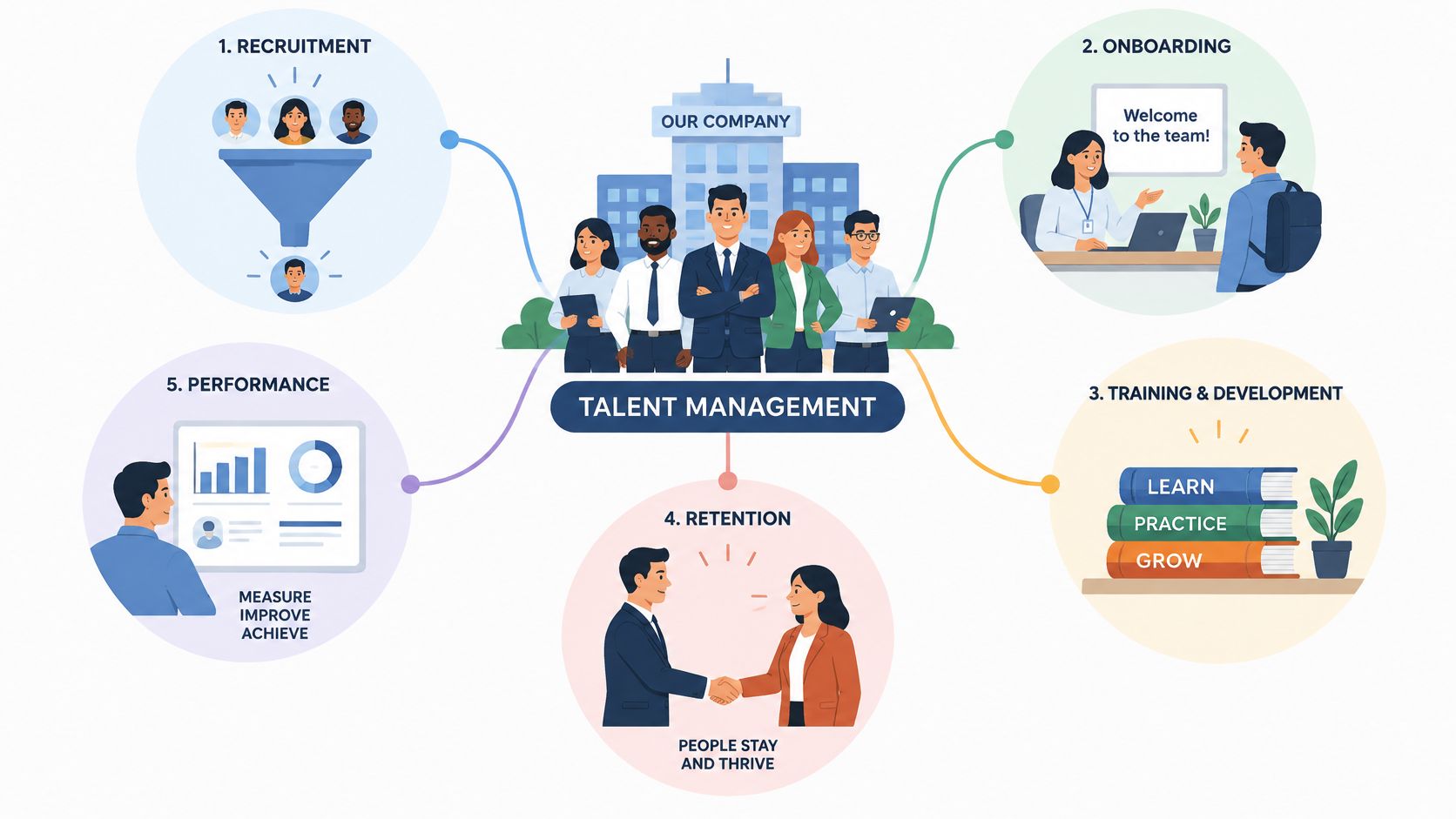
| Component | Core question | Typical activities | Example measure |
|---|---|---|---|
| Acquisition | Can we find and hire the right people? | Role scoping, sourcing, skills screening, offer | Time to fill, offer acceptance rate |
| Onboarding | Can new hires work productively from the start? | Duty-specific training, authorized account setup, supervised practice, escalation guidance | Time to first independently completed task |
| Development | Are people building the skills the work needs? | Skills mapping, training, stretch assignments, coaching | Training completion, skill-gain scores |
| Retention | Do the people we need stay? | Stay interviews, career paths, recognition, workload review | First-year retention, regrettable attrition |
| Performance management | Is work measured against clear expectations? | Goal setting, recurring feedback, reviews, corrective plans | Goal attainment, review completion rate |
The components feed each other. Weak onboarding can appear later as early departures, while vague performance standards make development difficult because nobody can identify what the employee needs to improve. An insurance verification specialist, for example, needs a clear definition of a complete verification before a manager can assess readiness for more complex work.
Organizations draw the boundaries differently. A small practice might put coordination with the office manager; a larger group might divide responsibility among HR, operations, IT, and clinical leadership. Whatever the structure, assign one accountable owner per component, even when several people contribute.
For broader organizational options, Pebb offers a useful resource to explore approaches to managing talent. Adapt the approach to your practice's workflows rather than adopting every available HR program.
Start by listing which components nobody currently owns. An unassigned responsibility is a more immediate problem than an imperfect software platform.
Settle the workforce-member or business-associate classification before granting access to patient information, and preferably before finalizing the staffing arrangement. A job title or contractor agreement alone doesn't answer the question.
The HHS business associate guidance describes business associates as people or organizations performing functions or services involving protected health information for a covered entity, including billing, claims processing, data analysis, and practice management. Someone under the practice's direct control may instead qualify as a workforce member; an outside provider handling PHI may require a business associate agreement, or BAA.
| Arrangement | Likely classification | What to document |
|---|---|---|
| Employee on the practice's payroll | Workforce member | Privacy training record, sanction policy acknowledgment, role-based access list |
| Contractor working under the practice's direction | Often a workforce member; confirm with counsel | Training record, access list, written scope of duties |
| Outside staffing or virtual assistant provider | Business associate when its services involve PHI; assess the arrangement | Signed business associate agreement, safeguard description, breach-reporting terms, return or destruction terms |
A BAA must address permitted uses and disclosures, safeguards, breach reporting, equivalent restrictions for relevant subcontractors, and return or destruction of PHI when the relationship ends. Treat the table as a starting point for classification, not a substitute for reviewing who controls the work and which organizations receive information.
Under the HHS Privacy Rule summary, covered entities must train workforce members as appropriate to their functions and apply appropriate sanctions for violations. A remote receptionist therefore needs instruction on the practice's patient-identification, disclosure, and escalation procedures, not just a generic confidentiality document.
The HHS guidance on remote use of electronic PHI calls for risk analysis, appropriate risk-reduction measures, security-awareness training, and properly authorized access. Translate those duties into a permission list: a scheduler shouldn't receive billing-system access merely because another administrative employee has it.
HHS also explains in its cloud-computing guidance that remote access requires appropriate administrative, physical, and technical safeguards, along with required BAAs. Approved devices, multi-factor authentication, controlled messaging tools, and documented incident procedures are practical security choices to evaluate through that risk-management process, not a claim that every recommendation is an identically prescribed HIPAA requirement.
Practical rule: No account should become active until someone has confirmed the worker's duties, training, and authorized permissions.
Assign a practice privacy or security owner to approve access, coordinate incident reporting, and remove or change permissions promptly when responsibilities change. Don't accept “HIPAA certified” as proof of compliance; HHS doesn't recognize an official HIPAA certification. Request documented training and the agreements appropriate to the relationship.
Our overview of legal and compliance requirements for remote hiring provides additional staffing context. State requirements and contractual arrangements can differ, so confirm obligations with qualified counsel or your compliance professional.
A remote hire who handles patient information needs a clear role, a defined manager, and a measurable readiness standard before starting. Write the role as outcomes before duties. For an appointment scheduler, outcomes might include correctly routed bookings, completed confirmation queues, documented patient messages, and timely escalation of exceptions. Set workload and quality expectations before assigning volume targets.
Sourcing also requires attention. In its survey of employers across participating countries, ManpowerGroup's 2024 Global Talent Shortage survey found that 74% of employers across 41 countries reported difficulty filling roles. That figure describes the broader labor market, not medical-practice vacancies.
Use the same assessment sequence for each candidate so interview polish does not outweigh job performance:
At LatHire, the AI and expert human team review the video application, CV, and written answers. LatHire also verifies that candidates presented themselves accurately, including confirming prior work history. Your practice still needs to assess candidates against its own workflow requirements.
Start a remote scheduler with booking rules and supervised practice. Add billing, referrals, and administrative exceptions as the person demonstrates readiness. Assign an owner to each onboarding task:
For a practical framework to track onboarding metrics that support retention, adapt the measures to duty-specific readiness. For example, track whether the hire completes assigned work accurately, documents patient messages correctly, and escalates exceptions appropriately.
A narrow overlap window makes written procedures a larger part of training. Specialty and practice size also shape the work: a multispecialty group needs cross-department routing knowledge, while a single-specialty practice may require deeper familiarity with a narrower payer mix. In a small office where one person handles intake, scheduling, and billing questions, document which clinical decisions and owner-level exceptions must go to practice personnel.
A competency matrix turns development from a general promise into a staffing decision. Put roles down one side and required capabilities across the other, then record demonstrated proficiency rather than self-reported confidence. Start with scheduling, patient coordination, insurance verification, billing support, and prior-authorization support, or just the roles your practice uses.
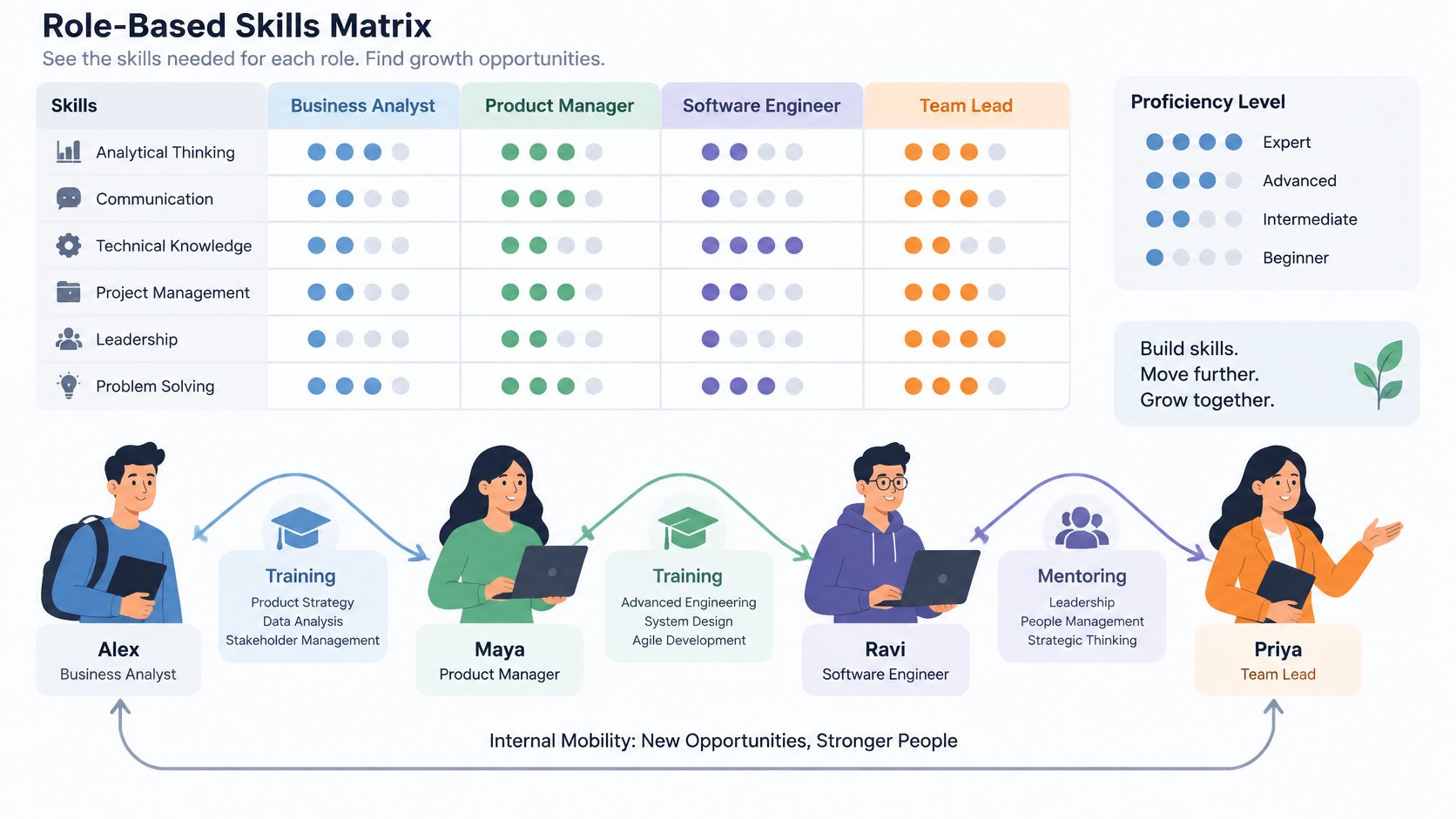
A practical matrix can use four proficiency levels: learning, supervised execution, independent execution, and coaching others. For each level, attach an assessment, a learning resource, a project assignment, and an advancement criterion. A course completion alone shouldn't establish readiness.
For insurance verification, that could mean progressing from explaining the practice's checklist to completing a fictional case, handling routine live work under review, and finally managing documented exceptions independently. Advancement should require accurate work and appropriate escalation, not faster processing.
The urgency extends beyond healthcare. The World Economic Forum's 2025 Future of Jobs report found that employers expect 39% of workers' core skills to change by 2030, a projection that supports reviewing capabilities rather than relying on static job titles.
A systematic review of inclusive talent development indicates that broad access to development can support individual growth and organizational performance, while acknowledging limitations in the evidence base. Don't reserve every learning opportunity for employees already labeled high performers; a quiet, accurate scheduler may have strong potential for referral coordination.
Use The OKR Hub's employee development guide to connect learning objectives with observable work. Our explanation of skill-gap analysis can help distinguish a teachable capability gap from a role that needs redesign.
A skills matrix is useful only when someone changes an assignment, training plan, or advancement decision because of it.
Internal movement can preserve knowledge, but it can also leave a difficult vacancy behind. In a small practice, broader capability may be more realistic than promotion; don't promise a management position that the organization won't need.
Pay matters, but a raise won't fix contradictory instructions, an unmanageable queue, or a manager who rarely answers questions. A systematic review of 43 studies on talent management and retention found that talent practices influence retention primarily through engagement and reduced turnover intention, with performance management, development, training, and selection contributing to that relationship.
That doesn't mean compensation is unimportant or that development guarantees loyalty. It means retention decisions should address how the employee experiences the job, not assume every departure has the same explanation.
Set role-specific objectives that combine output, quality, and escalation. A billing-support employee shouldn't be judged only on items processed if incomplete submissions create rework elsewhere. Likewise, a patient coordinator shouldn't feel pressured to close messages that need clinical review.
Hold a brief weekly or biweekly one-to-one, then conduct a formal quarterly review with a development plan. Keep routine conversations focused on decisions:
At LatHire, we offer expert guidance for managing remote teams and a tracking solution through which talent reports worked hours. Use hours reporting to plan coverage and understand workload, not as a substitute for evaluating work quality or as continuous surveillance.
Consider stay interviews at three, six, and twelve months as a recommended schedule. Ask what makes the work sustainable, which recurring problems create frustration, and what would make another role attractive. Don't promise changes you can't authorize; record what you'll investigate and return with an answer.
Management judgment: If the employee is carrying an impossible workload, coaching them to be more resilient isn't a staffing solution.
A small practice may have no formal career ladder. Skill-based pay milestones, responsibility for a defined workflow, or a path into a broader administrative role can provide credible progression without inventing titles.
Keep administrative boundaries intact as responsibility grows. A more experienced medical virtual assistant may coordinate messages or prepare documentation, but that doesn't authorize independent clinical decisions. Use the KPI framework below to evaluate whether management changes improve outcomes, rather than treating completed conversations as proof of retention success.
| Metric | Type | How to calculate | Healthy signal |
|---|---|---|---|
| Time to fill | Leading | Days from approved requisition to accepted offer | Stable or falling for repeat roles |
| Time to productivity | Leading | Days from start to first independently completed task set | Shortening with each hiring cohort |
| Development plan completion | Leading | Share of staff with a current plan reviewed in the last quarter | Close to complete for core roles |
| Engagement score | Leading | Favorable pulse-survey responses on manager, development and workload | Rising trend, with comments reviewed |
| First-year retention by cohort | Lagging | Share of a start-month group still employed at 12 months | Better than the prior year's cohort |
| Regrettable attrition | Lagging | Leavers you wanted to keep, divided by average headcount | Trending down quarter over quarter |
| Internal fill rate | Lagging | Share of openings filled by current staff | Rising, and paired with performance after the move |
These are directional signals, not universal benchmarks. Choose a manageable set and define each measure before collecting it. For example, time to productivity needs an agreed task set and quality standard; otherwise, managers will record different milestones under the same label.
Leading indicators help you spot developing problems; lagging indicators confirm what happened. Faster readiness is encouraging only when the employee's work remains accurate. Higher internal fill rates aren't automatically positive if transferred employees struggle or leave their previous teams understaffed.
Engagement captures whether people are psychologically invested in their work. Gallup's State of the Global Workplace reports that 20% of employees globally were engaged in 2025 and estimates that low engagement cost approximately $10 trillion in lost productivity that year. These global estimates explain the business significance of engagement, but they aren't targets or cost estimates for your practice.
Group hires by start month and compare retention at twelve months rather than averaging together new and established employees. In a small practice, percentages move sharply when one person leaves; review trends across several quarters and read survey comments alongside scores. Protect confidentiality when a role or team is small enough to make respondents identifiable.
The UK-based CIPD 2026 Resource and Talent Planning report found that only 37% of organizations collect data to identify retention issues, while 16% evaluate the success of retention initiatives. Treat that as a warning about measurement discipline, not a description of U.S. medical practices.
Before buying a retention tool or raising pay across the board, identify the cohort and reason behind your last few departures. Separate employees you wanted to retain from planned transitions, unsuitable matches, and healthy internal moves.
Our guide to talent analytics provides additional context for connecting workforce measures with decisions. Assign each selected KPI an owner, a review date, and an action trigger, such as investigating a longer readiness period or a recurring manager-level departure pattern.
Use a short readiness review this week. The purpose isn't to produce a polished HR manual; it's to identify decisions that would otherwise fall to a busy manager after the employee starts.
Ask what happens when the remote employee encounters an unfamiliar request while the practice manager is unavailable. If nobody can identify the backup contact, permitted response, and handoff method, the role isn't ready for independent coverage.
Also check your management capacity. A provider can help with sourcing and employment administration, but the practice still needs someone available to direct the work, resolve exceptions, and maintain patient-service standards. Delegating a task doesn't remove the need for an accountable practice owner.
Effective talent management connects hiring decisions with secure access, practical training, demonstrated capability, and consistent management. For medical practices evaluating remote healthcare staff, the strongest starting point isn't a larger candidate pool. It's a clear operating plan that someone owns.
Build that plan before opening accounts or accepting a start date. Begin with the unowned component, define the role's outcomes, and select measures you'll review.
If sourcing is your bottleneck, tell us the role you need at LatHire. You can browse and hire directly or receive a customized shortlist within 24 hours; we handle backend HR and international payroll while you manage the person's work. Start by naming the practice manager who will own that relationship.