

Hiring someone who knows local payroll deductions isn't enough. A global payroll specialist turns employment rules into accurate pay, but also checks employee master data, calculates earnings and deductions, produces payslips and payment files, maintains exception logs, and prepares a pre-close liability forecast. For a U.S. medical practice employing remote healthcare staff, that means knowing not just what each person should receive, but what the practice must fund, in which currency, and before which cutoff.
The distinction matters when you hire a LATAM patient coordinator, insurance verification specialist, or medical billing assistant. A correct salary calculation won't prevent a missed payday if the funding request reaches finance after the bank's deadline. Equally, paying someone through a compliant arrangement doesn't automatically make their access to patient records appropriate.
Hiring principle: Evaluate the person who can explain and control the entire payment process, not just operate the payroll software.
A smaller practice may need a capable specialist coordinating with an employer of record, rather than a dedicated payroll department. A multi-entity healthcare organization may need separate processing, management, treasury, and tax responsibilities. The practical questions are the same: who checks the inputs, who approves exceptions, who releases cash, and who can prove afterward that the right employee received the right amount?
Accurate local deductions are necessary, but they aren't the whole job. The specialist owns a repeatable process connecting approved employment information to gross-to-net calculations, funding requests, employee payments, and an audit file finance can trust. Gross-to-net means the calculation from earnings before deductions to the amount the employee receives.
The scale of wage administration helps explain the need for this role: worldwide wage employment increased by approximately 50% between 2000 and 2023, according to the ILO Global Wage Report. More wage-based employment means more relationships requiring reliable payment processes, not just more transactions to enter.
The ILO's Global Wage Report executive summary found that, in its 2021 global wage distribution, the lowest-paid 10% of full-time wage workers earned less than US$250 monthly in purchasing-power-parity terms, while the highest-paid 10% earned more than US$4,199, a difference of at least 16.8 times. Those figures describe global wage distribution, not salary benchmarks for payroll specialists.
The operational lesson is that one compensation policy can't be copied across countries. A practice can standardize approvals, evidence requirements, and reporting formats while retaining country-specific earnings codes, deductions, payment requirements, and calendars.

A useful role description distinguishes operational accountability from decisions requiring another professional:
Say your practice hires a patient coordinator in Latin America. Adding the coordinator to payroll is an employment administration task; granting access to charts is a separate privacy and access-control decision.
That boundary also protects the specialist's effectiveness. Someone who spends the morning resolving net-pay discrepancies shouldn't become the default owner of every remote-staffing issue, from patient complaints to clinical scheduling decisions.
A dependable payroll close begins before calculation day. Build the calendar backward from the employee's required payment date, allowing time for review, correction, approval, and funding. Use the employee's actual local pay cycle rather than assuming every country follows the practice's U.S. schedule.
ILO Convention No. 95 provides a useful governance baseline by defining wages broadly and establishing the principle of direct payment to workers, subject to specified exceptions. It isn't a substitute for domestic rules on minimum wages, bonuses, social insurance, severance, payment currency, or wage statements.
| Category | Done looks like | Typical slip |
|---|---|---|
| Inputs | Written cutoff for hires, terminations, hours, leave, allowances, and one-time pay; HR sources and payroll checks | Late joiner or leaver keyed after the freeze |
| Gross-to-net | Country earnings codes, statutory and voluntary deductions, and a documented basis for every deduction | A global convention used as if it were local law |
| Outputs | Payslips in the required language and currency, bank or wallet file, and a payment-date record | File sent in the wrong currency or after the bank cutoff |
| Exceptions | Negative net, missing tax IDs, retro pay, and off-cycle terminations, each with an owner and an aging limit | An exception with no owner still open on payday |
| Evidence | Exchange rate used, approval, and retained wage statements | Rate or approval missing from the audit file |
Inputs need a controlled freeze. HR should provide approved employment changes, while payroll checks effective dates, missing identifiers, duplicate records, and conflicting instructions. An urgent correction after the cutoff should enter an exception process, not arrive through an untracked chat message.
For gross-to-net, keep a visible trail from the approved earning to each deduction and final payment. A deduction needs a legal or contractual basis and employee authorization where applicable; a familiar U.S. deduction code doesn't establish permission elsewhere.
Outputs require a separate review from calculations. A correct payroll register can still produce a rejected bank file because the account format, currency, or payment date is wrong. Confirm that the selected payment channel is permitted and retain evidence of submission and settlement.
Consider a LATAM remote engineer supporting your practice's internal systems, paid in local currency while the practice keeps its books in dollars. The engineer's employment calculation, local payment amount, and dollar accounting entry must remain connected without being treated as interchangeable figures.
For exceptions, assign both an owner and an escalation deadline. Missing tax information may need HR involvement; a retroactive adjustment may need local payroll advice; a termination may require an off-cycle process rather than waiting for the next regular run.
Finally, retain evidence that another reviewer can follow without reconstructing conversations. Paying clinicians is still wage administration and doesn't itself justify access to patient records. Before adding another country, write the cutoff calendar and identify who can authorize a change after the freeze.
| Level | Scope that fits the title |
|---|---|
| Payroll clerk | One country, data entry, payslip distribution |
| Global payroll specialist | Several countries, gross-to-net, filings support, exception log |
| Senior global payroll specialist | Calendar owner, FX variance, audits, vendor invoice match |
| Global payroll manager | Team or vendor oversight, policy, CFO reporting, escalations |
Use this as a scope framework, not a salary survey. A defensible U.S. or LATAM dollar band requires current compensation evidence matched to the role, employment market, and hiring arrangement. Without that evidence, publishing precise salary ranges would create false confidence.
Titles are inconsistent. A specialist may already coordinate country vendors and own the close calendar, while a manager at another employer may still spend most of the week entering changes. Compare responsibilities, decision rights, and complexity before comparing offers.
Start a compensation benchmarking exercise with the countries the person must cover, the systems they'll use, and the decisions they'll be expected to make independently. Separate essential experience from experience that a local provider can supply.
For a medical practice, the distinction between payroll expertise and healthcare administration is particularly important. Experience scheduling patients or verifying insurance doesn't demonstrate competence in foreign payroll reconciliation, and strong payroll experience doesn't establish readiness to handle patient communications.
The hiring market also changes the comparison. Evaluate a U.S.-based employee, a locally employed LATAM specialist, and an outsourced service on a comparable scope and total-cost basis. Don't assume the lowest salary produces the lowest operating cost if the practice must purchase substantial additional supervision or specialist advice.
Include more than base compensation:
Country coverage, variable compensation, language requirements, and ownership of vendor invoices all affect the level you need. A bilingual specialist who must explain adjustments to employees and resolve invoice discrepancies has a different assignment from a processor following a settled runbook.
A small practice with a stable remote team may reasonably choose a senior specialist supported by local providers. A growing healthcare group with multiple entities, frequent acquisitions, and competing pay calendars may need a manager coordinating processors and vendors.
Neither model is superior. Buy the level of judgment your workflow requires, then benchmark that scope against current hiring evidence rather than paying for a title.
The overlooked responsibility is forecasting what must be funded, in which currency, and by which cutoff. Knowing the final payroll liability isn't enough if finance learns it too late to obtain currency or release funds through the required approval chain.
A 2026 survey reported by Thomson Reuters, covering more than 500 senior finance executives in the U.S. and Canada, found that 97% experienced currency-driven changes in cross-border payroll costs during the prior year and 79% said payroll timing affected short-term cash planning. In the same survey, 84% had visibility into total liabilities before each cycle, but only 33% had full real-time or near-real-time visibility, while 51% required manual consolidation.
The specialist should give finance a preliminary liability forecast, label unresolved items, and replace estimates with approved amounts as the close progresses. Include net salaries, employer liabilities, provider charges, and any funding buffer approved by finance, without hiding that buffer inside employee earnings.
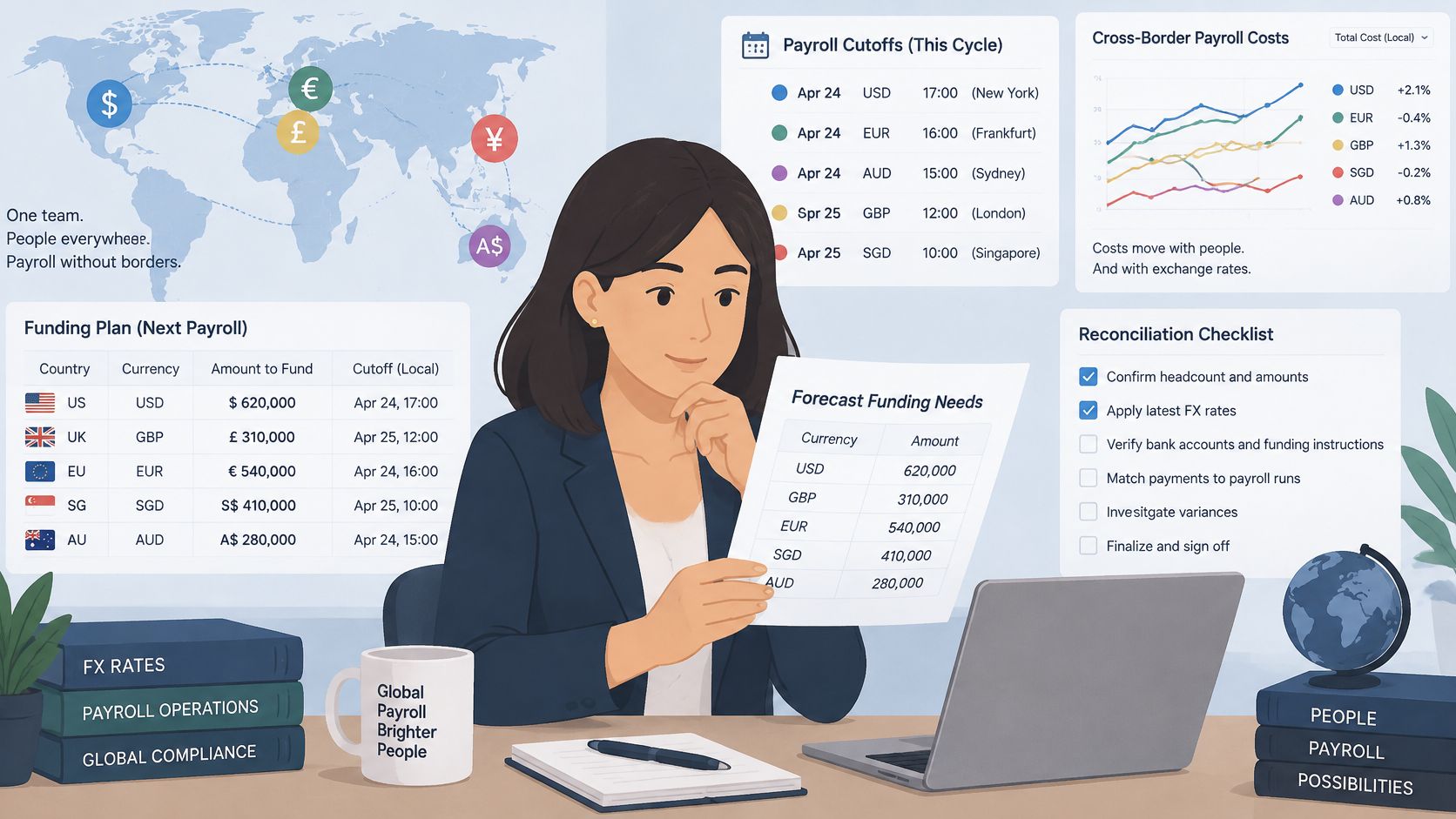
Set the funding date early enough to accommodate bank processing, local holidays, and employer-of-record requirements. The right date comes from the actual payment route and provider terms, not a universal rule about how early payroll should be funded.
If an employee's agreed salary is in local currency, don't silently reduce that salary because the practice's dollars bought less currency.
Finance should approve how the company records exchange differences under its accounting policy. Payroll supplies the transaction evidence and explains the variance; it shouldn't independently choose a hedging strategy or transfer currency risk to the employee.
Match approved compensation to the payroll calculation, then bridge the calculation to the bank or employer-of-record funding request. These totals won't necessarily equal one another because employer charges and service fees can sit outside net pay, but every difference should be explainable.
A weekly dashboard should highlight:
Say a practice employs remote staff in Mexico and Colombia and misses its provider's funding cutoff. An urgent conversion may carry a less favorable rate, while the payment date may also be at risk. The specialist's job is to surface that exposure before finance authorizes the file, not merely explain it afterward.
Work location matters, but payroll shouldn't issue treaty opinions. Under Article 15 of the OECD Model Tax Convention, employment income is generally taxable in the residence state unless employment is exercised in another state, which may then tax it; the short-stay exception requires all three conditions, including presence of no more than 183 days during the relevant 12-month period, remuneration paid by or on behalf of a nonresident employer, and remuneration not borne by a permanent establishment there.
That model isn't a universal exemption or a substitute for checking the applicable treaty and domestic law. The specialist needs enough understanding to collect the right facts and escalate uncertainty before withholding or filing decisions are made.
| Control | Global payroll specialist | Tax | HR | Finance |
|---|---|---|---|---|
| Day-count ledger | Maintains by employee and country | Interprets the day-count test | Supplies travel and location | Uses for entity reporting |
| Economic employer | Flags contract versus who directs the work | Confirms treatment | Owns the contract | Identifies recharge |
| Permanent establishment or recharge | Checks whether remuneration appears borne locally and flags exposure | Owns the conclusion | Provides assignment facts | Owns intercompany charge |
| Funding cutoff and FX | Proposes date, rate, and variance | Advises if withholding changes | Confirms leaver pay | Approves cash and books variance |
| Local registration and filing | Prepares or checks the file | Reviews exposure | Provides starter data | Pays the liability |
| LATAM remote employment | Maintains local payroll requirements and checks provider invoices | Confirms local tax treatment | Confirms work location and employment arrangement | Reconciles charges and funds obligations |
A coordinator who lives and works only in Colombia for a U.S. practice isn't on a short-term overseas assignment. The practice needs advice on the applicable local employment, social-security, bonus, payment, and registration rules rather than assuming a travel-day test resolves the arrangement.
Use a cross-border payroll compliance checklist to organize questions and evidence, not as a substitute for a qualified adviser's conclusions. An employer of record may execute local employment obligations, but the practice still needs to verify that invoices reflect approved compensation and actual staff changes.
Patient information belongs in a separate access map. HHS guidance on business associates explains that functions and the relationship determine business-associate treatment, and that required satisfactory assurances must be documented in writing, typically through a business associate agreement.
A payroll title doesn't settle that classification. Determine whether the person is part of the practice's workforce or works through a separate organization, then assess their tasks and information access. Before the next close, name an accountable person for every function in the matrix, even if a small practice uses outside advisers instead of internal departments.
The strongest candidates combine calculation ability with disciplined escalation. They can read a local adviser's memo, translate it into a processing rule, test the result, and explain where they still need advice. They don't mistake familiarity with software for authority to interpret unfamiliar law.
Look for multi-country gross-to-net experience, spreadsheet controls, basic foreign-exchange understanding, reconciliation, and clear writing. Prior in-house or payroll-bureau experience can help, as can a recognized payroll credential relevant to the employer's needs; a degree alone is a weak substitute for demonstrated country coverage.
Communication deserves a practical test. StoryCV's guidance on demonstrating interpersonal skills in interviews is useful context for asking candidates to show how they explain a problem, rather than merely describe themselves as collaborative.
Give the candidate a fictional late-change request from a practice manager. Ask them to explain what can still be changed, what needs approval, and what might affect the payment date, without burying the manager in payroll terminology.
Your core stack needs a system of record, a country calendar, a secure file channel, and an exception log. Evaluate global payroll software options by their approval controls, country coverage, exportability, and audit history rather than dashboard appearance.
The automation opportunity also creates oversight responsibilities. A global payroll survey summarized by HRD, covering 1,816 senior stakeholders across 20 countries, found that approximately one-third used AI for activities such as data entry or error detection, while 70% had experienced a payroll-impacting cybersecurity incident during the previous two years.
Set an explicit approval standard:
Automation boundary: Let software identify a suspicious payment. Keep an accountable person responsible for deciding whether it is wrong.
In PayrollOrg's published review of the 2025 Global Payroll Week survey, 57% of respondents identified ensuring local compliance as their biggest global-payroll challenge. Requirements vary, so country-rule validation and uncertain filings still need qualified local advice, not unquestioned automated output.
Consider a payroll processor supporting a practice's established domestic workflow. They reliably collect approved changes, check missing fields, and distribute payslips. The next step isn't processing a larger file; it's accepting responsibility for problems that don't arrive with a ready-made answer.
A processor learns control over inputs and routine outputs within a defined country process. A specialist takes responsibility across countries, maintains the exception log, and explains discrepancies without handing every question to a supervisor.
A senior specialist coordinates the calendar, challenges provider invoices, prepares audit samples, and gives finance a credible pre-close cash estimate. This can remain an individual-contributor role, even when colleagues rely on the person's technical judgment.
A manager becomes accountable for other people or an interconnected group of vendors, policy decisions, budgets, and executive reporting. A manager who must personally key every file may lack either sufficient processing support or a workable delegation model.
| Promotion evidence | What it demonstrates |
|---|---|
| A complete audit sample | The candidate preserves evidence another reviewer can follow |
| A documented close runbook | The process doesn't exist only in the candidate's memory |
| A discrepancy caught before release | The candidate investigates rather than merely transmits |
| A clear escalation memo | The candidate distinguishes facts, risks, and decisions |
The hiring context supports developing existing staff. In ADP's 2025 payroll findings, 61% of multinational organizations said skills shortages affected payroll service delivery, and 53% struggled to source payroll skills externally.
Separately, ADP's global payroll survey overview reported that 81% of organizations were upskilling existing payroll staff and changing how they work in 2025. Those findings describe broader organizations, not medical-practice-specific hiring outcomes.
For practice owners, the useful response is to develop a reliable processor deliberately rather than leave them to learn during an emergency. Assign a supervised reconciliation, then a country calendar, then responsibility for explaining a provider discrepancy.
For LATAM professionals serving U.S. employers, assess English communication and working-hour overlap against the actual workflow. Spanish can be useful for employee communication and local provider coordination, but it doesn't replace knowledge of the relevant country's payroll process.
Keep a deep technical track alongside the people-manager track. A strong senior specialist shouldn't have to become a reluctant supervisor to receive recognition for higher-risk work, and a capable manager shouldn't be evaluated solely on calculation speed.
Start with the level your practice needs, then ask candidates to demonstrate the work with fictional or anonymized materials. Never request a former employer's identifiable payroll records as proof of competence. The interview should reveal judgment without creating a privacy problem.
| Assessment | Strong evidence | Warning sign |
|---|---|---|
| Relevant country coverage | Explains actual local processes and where advisers were involved | Claims universal expertise |
| Monthly-close walkthrough | Connects inputs, review, funding, and settlement | Describes only pressing the calculation button |
| FX or retro-pay exercise | Separates employee entitlement from accounting adjustments | Changes net pay to make totals match |
| Exception management | Assigns an owner, deadline, and escalation route | Relies on memory or private messages |
| Finance explanation | States the amount, cause, risk, and required decision clearly | Gives a technical narrative without a conclusion |
Treat serious control failures as hiring concerns, not gaps that a polished interview can cancel out. A candidate who casually shares confidential records or bypasses payment approval needs more scrutiny regardless of their country experience.
Begin with countries, entities, pay dates, provider contacts, and funding deadlines. Then grant least-privilege access, test representative gross-to-net calculations, assign responsibility for exchange differences and provider invoice matching, and document the route to tax advisers and counsel.
Require a supervised close before granting independent operational authority. Even afterward, preserve separate payment approval where feasible; passing onboarding shouldn't automatically give one person unrestricted control over employee records and cash release.
If the role involves patient information, translate the relationship assessment into enforceable controls. HHS business-associate guidance describes agreement requirements covering permitted uses, safeguards, reporting, subcontractors, HHS access to relevant records, and return or destruction of information when feasible.
HHS Security Rule guidance also makes clear that applicable safeguards extend to business associates. Recommended implementation measures include named accounts, protected devices, access reviews, incident escalation, and prompt offboarding; don't confuse a general confidentiality promise with a complete security program.
For cloud-based work, HHS cloud-computing guidance permits remote and mobile access when appropriate safeguards and required agreements are in place. Map the actual systems and vendors involved instead of treating remote location alone as either permission or prohibition.
For sourcing, LatHire is one option for pre-vetted Latin American operations talent, alongside direct recruitment and specialist payroll providers. Medical Virtual Assistants is a relevant source for healthcare administrative roles, but patient-coordination experience shouldn't substitute for payroll expertise. Confirm employment, tax, and privacy obligations with qualified advisers before access or processing begins.
A global payroll specialist should give your medical practice dependable pay calculations, an actionable funding forecast, controlled exceptions, and records that survive review. The strongest hire understands where payroll accountability ends and where finance, tax advisers, HR, and privacy leadership must decide.
Choose the role by scope rather than title, benchmark compensation against current evidence, and test the candidate with a realistic close exercise. Keep patient-data access separate from payroll administration, then onboard through a supervised cycle with documented approvals.
Before opening the role, build your country-and-cutoff calendar and use the scorecard to write the job description. Bring that document to your finance lead and local advisers, resolve ownership gaps, and interview only against the responsibilities your practice needs.