

You just offered a remote scheduler a start date. That person will sit in your phone queue, open the EHR, and see home addresses, insurance numbers, and appointment notes. Before you send a login, your office manager asks whether a background check is worth the delay. That question is why employers do background checks, and the useful answer is narrower than "run everything on the menu."
Employers screen to limit harm to patients, staff, property, and data, to meet legal duties that apply to the role, and to test whether identity and work-history claims hold up. A check is a hiring control, not a character verdict. For a U.S. medical practice, scope follows duties. A virtual receptionist who confirms demographics needs a different file from a billing specialist with payer-portal access. Neither needs a driving record if nobody drives for the clinic.
A thin check can miss a real risk. An overbroad one can create a different risk: a discriminatory decision, a defective consumer-report process, or a false read of a foreign record. You'll see the three reasons checks exist, what each search shows, how to weigh a criminal record without a blanket ban, the steps before you order a report, how to handle candidate data, and how to treat a missing file when the candidate works from another country.
Employers check candidates to control three kinds of exposure. Risk mitigation is the chance a new hire harms a patient, a coworker, practice property, or data. Legal and compliance covers screening duties set by federal or state law, plus a record that you took reasonable precautions. Quality assurance asks whether the résumé is true: the name, the work dates, and the credentials.
A Society for Human Resource Management study cited by the Society for Industrial and Organizational Psychology reported that, in 2012, 86% of U.S. employers conducted criminal-history checks for at least some jobs, and 69% checked every applicant. The leading reasons were reducing negligent-hiring lawsuit risk, cited by 52%, and maintaining a safe workplace, cited by 49%. Those figures are dated, and they describe intent, not proof that checks prevented harm. Among employers that ran criminal checks, intensity followed duties: 69% considered criminal history for fiduciary or financial work, 66% for access to confidential information, 55% for roles involving property, including technology, and 37% for safety-sensitive work such as transportation or heavy equipment.
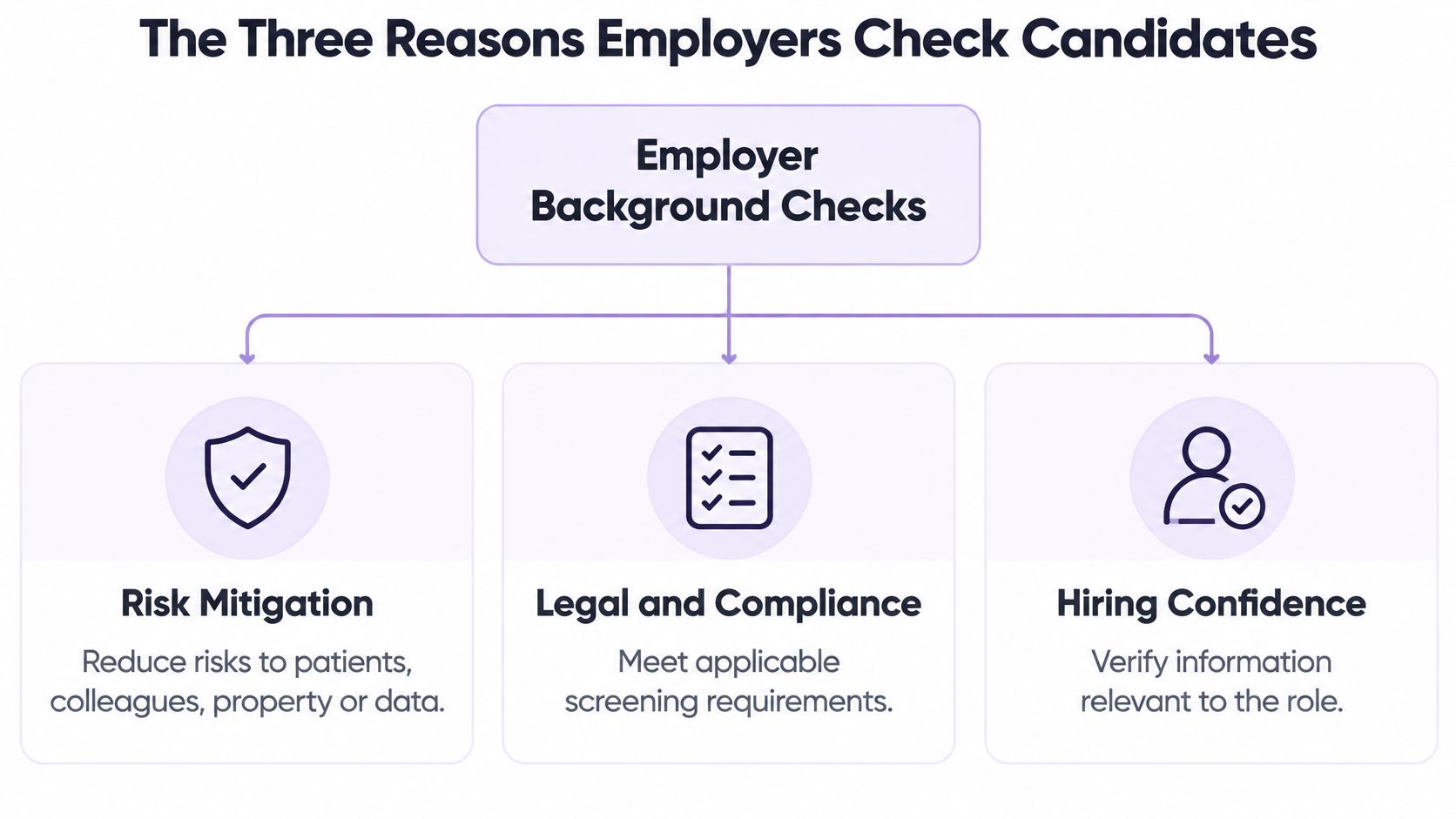
Name the exposure before you pick the search. The table is the working map for a clinic, not a universal order form.
| Reason | Exposure it addresses | Checks it typically drives | Medical-practice example |
|---|---|---|---|
| Risk mitigation | Harm to patients, staff, or property, and negligent-hiring claims | Role-linked criminal-history search and structured reference checks | A remote scheduler who handles patient calls and follows practice protocols |
| Legal and compliance | Mandated screening in some sectors, plus consumer-report and anti-discrimination obligations | Written disclosure and authorization, and exclusion-list checks where federal health programs apply | Billing support staff who touch federally billed claims |
| Quality assurance | Inaccurate résumés, misstated credentials, and identity mismatches | Identity, employment, and education verification | A medical assistant who claims prior hospital experience |
Practical rule: If you can't name the exposure in one sentence, you don't yet know which search belongs on the order.
A virtual receptionist with patient demographics is not the same file as a billing specialist with payer-portal logins. Write the reason next to the role, then stop adding searches that don't serve it.
A remote billing applicant may handle patient records and payment systems, while a receptionist may only schedule appointments. Their screening should reflect that difference. A background check combines separate searches, and each answers a limited question. Start by confirming identity, then choose checks that match the role's access and duties. Overbroad or inconsistent screening can create hiring risk, especially when a result is read without context.
Identity verification helps establish that records belong to the candidate, which matters for remote hires accessing patient or payroll information. An SSN trace can surface names and address history to guide searches, but it does not prove identity on its own. Check that identifiers and records align, and resolve mismatches before drawing conclusions. Screening programs use different combinations of checks, so the scope should follow the role rather than a standard package for every applicant, as described in employer screening programs.
Criminal-history searches also vary in coverage. A county court search can show convictions and pending cases in places where the candidate has lived. National or federal database searches may add records, but can miss local cases or require confirmation. Ask the provider which courts and databases it searched. Treat a database result as a lead, then verify relevant records at the source and review their context.
Employment, education, and credential checks compare a candidate's claims with information from prior employers, schools, and issuing bodies. They can identify dates that do not align, a title that described a temporary assignment, or a certificate the named body did not issue. A discrepancy calls for a specific question, not an automatic rejection. Reviewing spotting red flags in employment histories can help you notice gaps or shifting titles, but weigh each against the candidate's explanation and the job's requirements.
| Check type | What it verifies | Typical source | Where it fits |
|---|---|---|---|
| Identity verification | Name, date of birth, Social Security number, and address history | SSN trace and identity database | Remote hires who will access patient or payroll records |
| County criminal-history search | Convictions and pending cases where the candidate has lived | County court records | Patient-facing and data-access roles |
| Federal and national criminal database | Federal cases and aggregated national records | Federal and database sources | A supplement to county searches, not a substitute |
| Employment verification | Dates, titles, and reason for leaving | Prior employers | Roles where prior experience is a stated requirement |
| Education and credential verification | Degrees, certificates, and training completion | Schools and issuing bodies | Medical assistant and certified roles |
| Exclusion and sanctions lists | Whether the person is barred from federal health programs | HHS-OIG exclusion list and state Medicaid exclusion lists | Roles connected to billed claims |
| Professional license verification | Active status and disciplinary history | State licensing board | Licensed clinicians |
| Motor vehicle record | Driving history | State motor vehicle agency | Roles that drive for the practice |
For a remote administrative hire, identity checks, a role-appropriate criminal-history search, and verification of required experience may address the main exposures. Add exclusion screening when the role involves claims, and license verification for licensed clinical work. Driving records belong to jobs that include driving. Credit reports rarely fit scheduling, reception, or billing support; they are also tightly regulated. A longer screening package is not automatically safer if it adds searches unrelated to the work.
Exclusion lists matter when a practice bills federal health programs. The HHS Office of Inspector General maintains the List of Excluded Individuals and Entities. A solo cash-pay practice and a multi-site group enrolled in Medicare do not have the same exposure. If you lack compliance staff, confirm with counsel or your billing company whether exclusion searches fit the role and practice.
Check license-board records for licensed clinicians, not virtual receptionists or prior-authorization coordinators. Those administrative roles schedule visits, verify coverage, and move paperwork; they do not diagnose or treat patients. For candidates working across borders, define in advance which identity documents and local record sources you will accept. Records and verification practices vary by jurisdiction, so apply consistent role-based criteria while assessing each source's limits.
A search result is the start of a review, not the decision. The common mistake is letting a hit auto-reject the candidate, then calling that "being careful."
The EEOC's guidance for small employers on criminal records recommends three factors: the nature and seriousness of the offense, the time elapsed since the offense or completion of the sentence, and the nature of the job. An arrest alone isn't proof that the person committed a crime. Check the disposition before you draw a conclusion.
A policy that rejects every applicant with any record can conflict with Title VII when it disproportionately excludes a protected group and isn't job-related and consistent with business necessity. The same standard has to apply to similar candidates. National origin, race, and the other protected categories don't change the worksheet.
Picture two finalists for remote billing support. One has a minor offense from years ago, sentence completed, no later pattern. The other has a recent offense involving payment fraud. The second record sits closer to payer portals, patient balances, and refund workflows. Both still need an individualized look and a written reason. You connect the record to duties such as protected health information, patient calls, billing systems, or work with little supervision. You don't apply one ban to every remote seat.
Working rules that hold up better in practice:
A record you can't connect to the duties is a weak reason to lose a qualified scheduler.
Some states and cities limit when you may ask about criminal history, and some limit what you may consider. Confirm those local rules with counsel before you put a question on an application. A consistent, documented review is also part of inclusive hiring practices for clinics that hire beyond their own zip code.
In 2024, compliance with federal and state laws was the most frequently cited reason organizations gave for conducting background checks, according to Checkr's State of Screening Compliance report. For a medical practice, that means the paperwork is part of the check, not a cover sheet you add later.
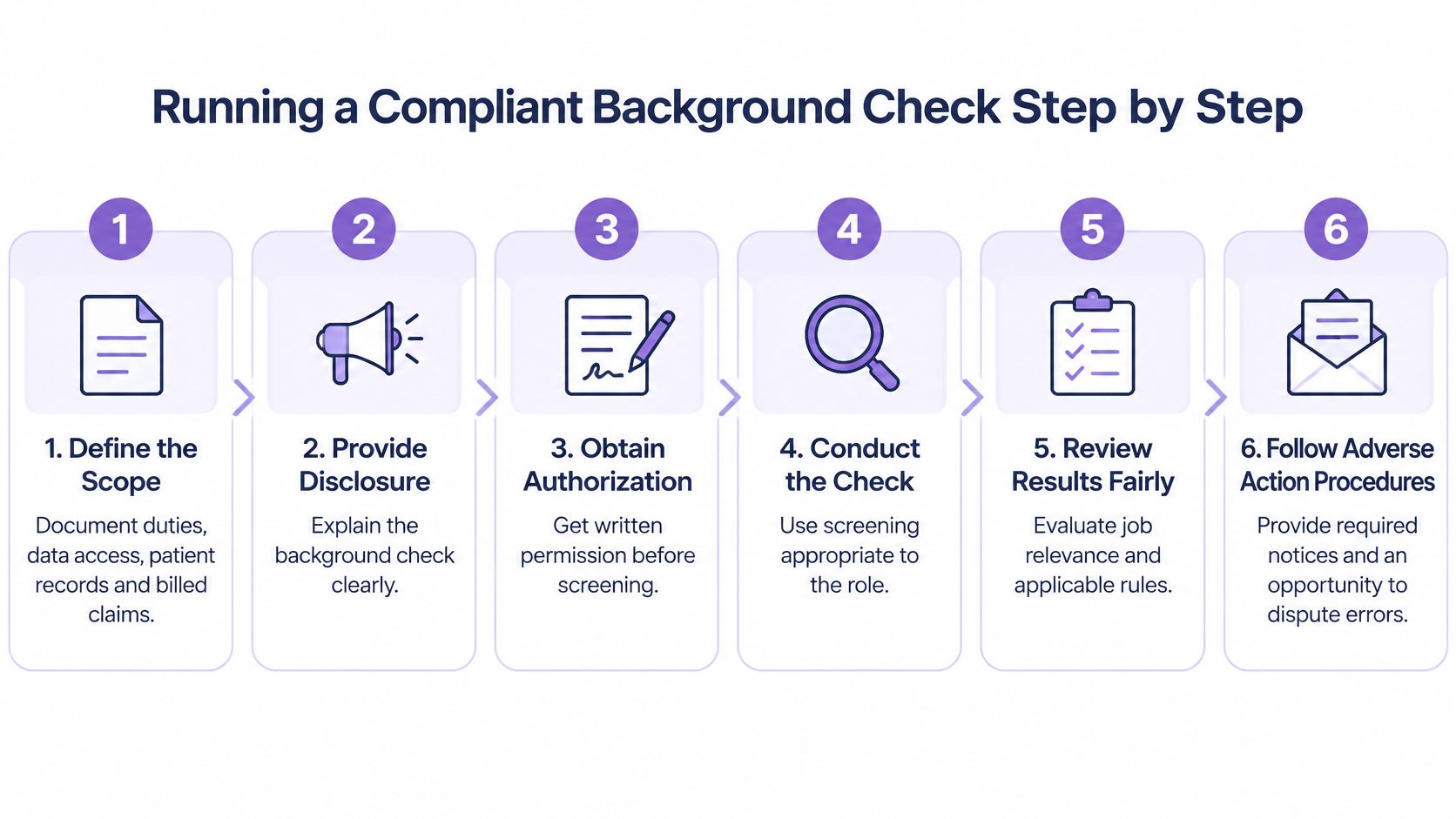
The FTC's employer guidance on consumer reports is the federal starting point when a screening company prepares the report. It isn't legal advice for your state, and it doesn't replace counsel when a role is unusual.
State law can add timing rules, extra notices, or limits on what you may consider. Treat the federal sequence as the floor, then confirm add-ons with counsel before you scale the process across every remote seat.
A clinic can expose candidate data even when it handles patient records carefully. A screening file may hold identity numbers and criminal-history details, so set access and retention rules for it rather than treating it as ordinary paperwork.
HIPAA governs protected health information held by covered entities and their business associates. Employment records maintained by a practice as an employer generally fall outside that definition, which means a background report usually is not PHI by itself. Benely's guide to employee health privacy explains the distinction between workforce health information and standard HR records. Keep that boundary clear, especially when the same coordinator handles hiring files and patient charts.
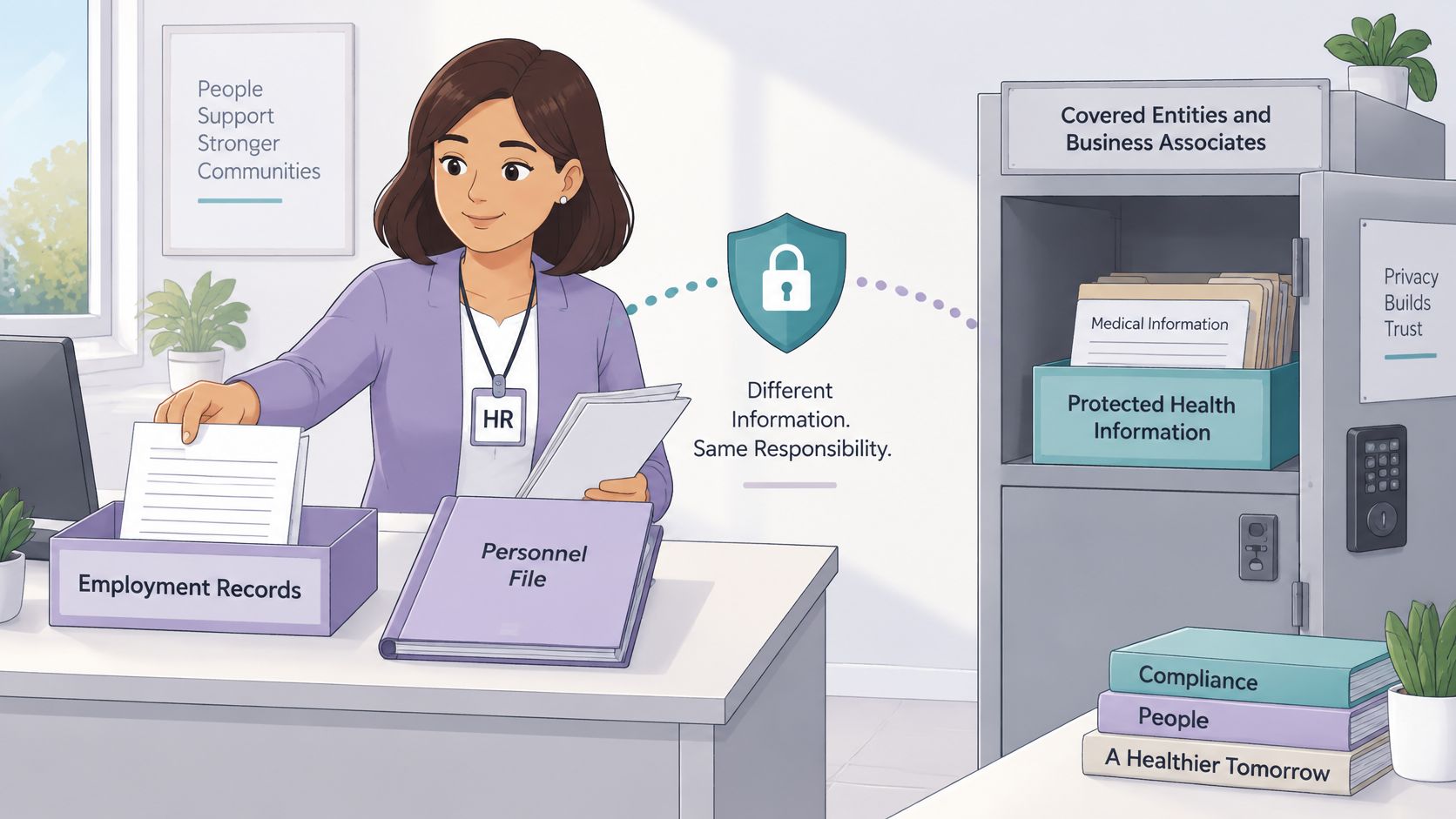
The HHS Security Rule's safeguards for electronic PHI include role-based access, encryption, audit logs, and minimum-necessary access. Those controls are also sensible for screening files, even when HIPAA does not require them for that folder. Avoid describing a vendor, person, or workflow as “HIPAA certified.” HHS does not recognize an official certification of that kind.
Candidates care about where their information goes. HireRight's 2025 global benchmark announcement reports that 74% of respondents would withdraw if they learned their data had been accessed overseas, while 76% wanted clear disclosure about where information was stored, viewed, and transmitted. These are global figures, not figures limited to U.S. candidates. Explain the purpose and handling of the information before collection.
Tell candidates where the file will be stored and who can access it before they sign, including whether a vendor's subcontractor may handle it.
State privacy laws may add duties to federal consumer-report rules. Confirm applicable requirements with a privacy professional, and include screening procedures in your legal and compliance requirements for remote staff. Set the scope according to the job and apply it consistently. Broad collection creates more sensitive data to protect, while inconsistent checks can raise hiring risk and undermine fair decisions.
Records aren't equally available in every country, and a missing file isn't a failed candidate. The FTC's plain-language guide for employers says you may generally request background information, and any employment decision based on it still has to comply with federal laws covering race, color, national origin, sex, religion, disability, genetic information, and age. The same individualized standard you use for a domestic record applies here. The rest of the work is how you verify when the paperwork doesn't look like a U.S. county printout.
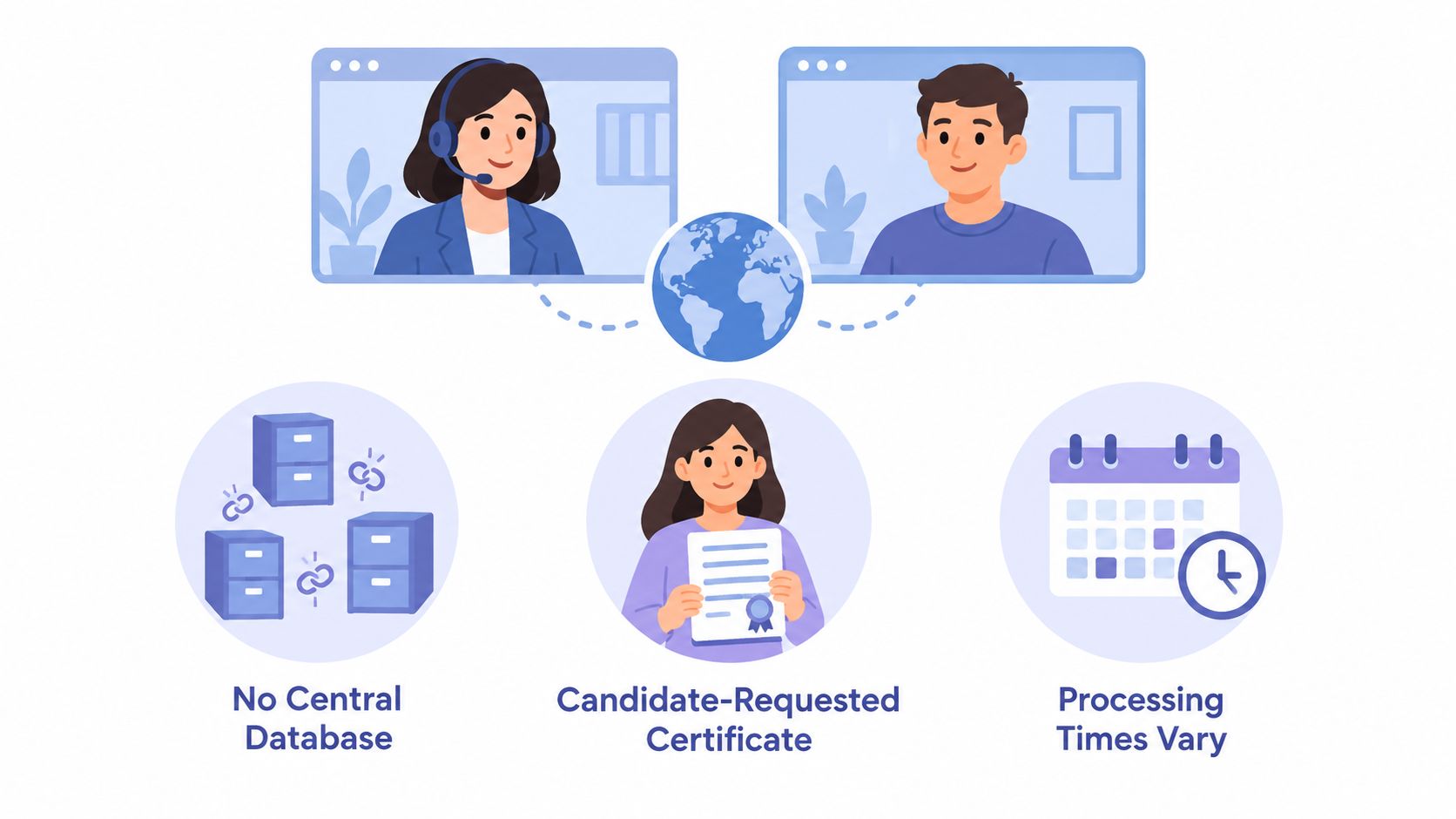
Some countries have no central criminal-record database. Some issue a certificate only when the person requests it. Processing times differ, and a delay is not evidence of dishonesty. Names get transliterated. Offense labels don't map cleanly onto U.S. terms. A bilingual reviewer, or the screening provider, should interpret the document before anyone decides.
| Situation | What it may mean | Consistent response |
|---|---|---|
| Country has no central criminal-record database | Records exist but are held locally | Request a candidate-provided certificate or document the search attempt |
| Certificate issued only on candidate request | Delay, not a negative result | Build request time into the hiring calendar and pause the decision |
| Name transliteration or unfamiliar record terms | Possible false match or misreading | Have a bilingual reviewer or the screening provider interpret before deciding |
| Record found with unclear disposition | Arrest or pending matter, not proof of conduct | Verify the disposition and apply the same individualized review used for domestic records |
| Record cannot be verified at all | Unknown, not adverse | Document attempts, rely on identity and reference checks, and decide on job-related criteria |
Apply that table the same way for every similarly situated candidate. Don't treat a Latin American professional's harder-to-get certificate as a character flaw while you wait patiently for a domestic county clerk.
Also say where data will be processed and stored. Overseas access is a trust issue for many candidates, and it can raise foreign privacy rules as well as FCRA duties. Put the extra days on the hiring calendar so nobody "just decides" because a clinic is short-staffed on Monday. International hiring compliance gets harder when each country combination has its own access rules, so confirm with counsel how U.S. consumer-report law and the other country's data rules apply before you standardize the workflow.
A practice hiring a remote scheduler needs a clear record of what was checked, where candidate data went, and who reviewed any findings. LatHire connects U.S. and Canadian companies with Latin American professionals and packages candidate vetting. Its roles include medical virtual assistants, receptionists, appointment schedulers, insurance verification specialists, billing and prior-authorization support, and administrative medical assistants. These positions may handle scheduling, records, and payer communication, but they do not diagnose or make medical decisions.
The screening scope should match the work. A single package can leave gaps if it does not cover a role's actual duties, and overly broad checks can create risk when findings are read without context. Remote and cross-border hiring also requires clarity about data access and handling.
Your practice remains responsible for the hiring decision and for applying a consistent, role-related screening policy. Before relying on a LatHire shortlist, request its current written screening scope, expected turnaround times, fee terms, data-handling details, and human-review steps. Confirm which sources are checked, where data is processed and stored, who can access it, and how unclear or adverse findings are reviewed. Ask how results are shared and what documentation is available if you need to send a pre-adverse notice.
A provider's file is input, not a substitute for your process. If the written scope does not cover the duties or applicable requirements for a position, arrange the missing check or do not treat the file as a complete screen. Consider the trade-off: narrower screening can reduce unnecessary collection, while insufficient screening may leave role-specific questions unanswered. Apply the same standards to comparable candidates, including those applying from abroad.
Employers run background checks to limit harm, meet legal duties, and test whether claims about identity and experience are true. For a medical practice, the scope should follow the job. A remote scheduler, a billing specialist, and a licensed clinician aren't the same risk, so they shouldn't get the same packet by default.
A criminal-record hit needs the three-factor review, a written reason tied to duties, and the consumer-report notices before any adverse step. A missing or slow foreign record isn't a negative result. Candidate trust also depends on collecting less, saying where the file goes, and giving people a way to fix a wrong match.
Write a screening scope for each medical role you hire. Confirm your disclosure and authorization flow with counsel, since state rules differ. Review who can open screening files, and ask any vetting provider for its written scope, data locations, and human review steps before you treat its packet as complete.
If you want to see whether LatHire's written screening scope matches your remote receptionist, billing, or scheduling seats, ask for that scope, the data-handling details, and a sample shortlist before you decide. Compare it with your own role worksheet, and keep the employment decision inside the practice.