

A practice manager closing the clinic may still have a stack of applications to review for a remote medical receptionist, patient coordinator, or scheduling assistant. Some candidates have handled patient calls and insurance checks for years; others have résumés that use unfamiliar job titles or describe the same skills differently. AI for candidate screening can sort and compare applications against defined job criteria, helping a hiring team focus its attention. It shouldn't make the hiring decision or replace a manager's review.
For medical practices, the challenge is not just saving review time. A screening tool can overlook qualified applicants, reward résumé language rather than job ability, or create barriers for candidates who need an accessible assessment. Those risks matter when a hire will communicate with patients, manage scheduling information, or handle administrative work around sensitive records.
This guide covers how screening systems move from application intake to a shortlist, where they can help, and what tends to fail in healthcare hiring. It also provides a practical way to test a tool, understand relevant employment rules, and fit screening into an existing workflow without treating a score as a verdict.
A screening tool usually takes applications, extracts information such as work history and skills, and compares that information with criteria set for a role. It may rank candidates or flag profiles for a manager to review. For a remote medical scheduler, those criteria might include experience coordinating appointments, familiarity with patient-facing workflows, and the ability to use scheduling software.
That's useful when the practice has more applications than its manager can review carefully. But a shortlist is only a sorting aid. The system doesn't make the hire, verify clinical judgment, or establish that someone can handle patient communication responsibly. A manager still needs to check experience, ask structured interview questions, and confirm role-specific requirements.
A practice might use screening software to identify applicants whose résumés mention insurance verification or prior authorization. It shouldn't treat the absence of those exact phrases as proof that someone lacks the relevant experience. Candidates may describe similar work in different terms, especially across countries or healthcare systems.
Nor should a general hiring screen receive patient records or other protected health information because the practice uses the tool elsewhere in its operations. Keep candidate evaluation separate from patient workflows unless a qualified compliance professional has reviewed the system and its data handling.
For managers considering broader automation, local business AI automation services can provide context on how automation fits into routine business processes. The practical question for a clinic is narrower: does the screening step improve the quality and consistency of the shortlist without creating an unreviewed barrier for applicants?
A screening workflow often has five stages. Knowing where each stage can go wrong helps a practice decide what to check before relying on the output.
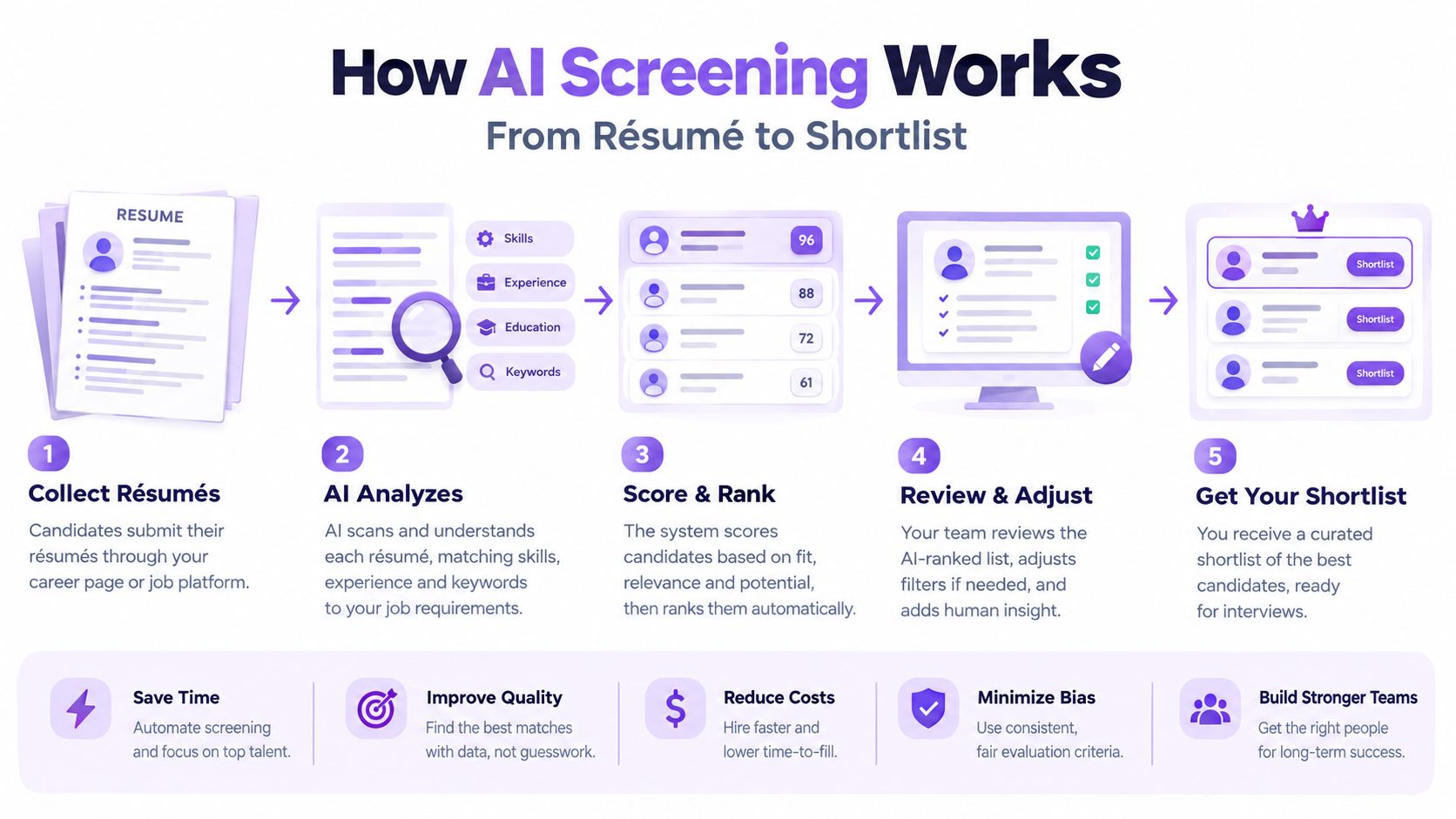
A résumé parser trained on general office roles might miss a relevant medical billing credential. A ranking model might treat an employment gap as a negative signal, even when the candidate stepped away for caregiving. And a screen for bilingual patient coordination might mistake polished résumé wording for evidence of spoken English or Spanish ability.
These aren't problems a practice can solve by asking for a more confident score. Define the job requirements first, check how the tool interprets different candidate profiles, and use an appropriate skills assessment or structured interview to validate claims. For example, ask each patient coordinator candidate the same scenario-based questions about routing a scheduling request, without asking them to disclose patient information.
AI screening can reduce repetitive résumé sorting and apply a common set of criteria across applications. That can give a small practice more time for interviews and reference checks, particularly when it hires for recurring administrative roles. A tool may also surface relevant experience described in unfamiliar terms, provided the system can show why it matched that experience to the role.
Those advantages aren't automatic. A narrow filter can consistently apply the wrong criteria, while an opaque ranking can make it difficult for a manager to spot a weak recommendation. Treat speed and consistency as process features to test, not proof that the screening is fair or accurate.
| Screening approach | What it can help with | What still needs attention |
|---|---|---|
| Manual résumé review | Context and judgment | Reviewer capacity and inconsistent interpretation |
| ATS keyword filters | Applying explicit terms consistently | Missing synonyms and transferable skills |
| AI ranking | Comparing profiles against broader criteria | Whether the criteria and recommendations are valid |
The manager's role matters, but showing a person an AI recommendation doesn't guarantee an independent decision. A 2025 resume-screening experiment with 528 participants found that people followed a biased AI recommendation as much as 90% of the time, according to the California guidance summary discussing the experiment and employer obligations. That finding is a reason to structure human review, not a prediction of how every clinic's staff will behave.
A reviewer should see the evidence behind the score, have permission to advance a lower-ranked candidate, and record the reason for an override. If a tool emphasizes a specific EHR name, for instance, the manager should check whether the role requires that exact system or whether comparable experience would do. For a broader discussion of AI decision support in clinical settings, see this AI clinical decision support guide. Hiring screens and clinical support tools serve different purposes, but both call for clear human accountability.
Buying a screening product isn't validation. Before a clinic lets a model shape who advances, it should define what a qualified candidate can do, test how the model applies those criteria, and document how people can challenge its recommendations.
Start with a job analysis. Turn each requirement into a rubric a reviewer can apply consistently. For a remote medical administrative assistant, that might mean separately assessing patient communication, appointment coordination, and experience handling administrative information. Don't substitute vague concepts such as “culture fit” for observable, job-related evidence.
A job-related skills assessment framework can help a practice think through how to test capability directly rather than relying on résumé wording. Assessment design still needs to reflect the actual role, and candidates should have a way to request an accommodation or an alternative process.
California guidance emphasizes that employers remain responsible for discriminatory outcomes when they use automated screening. New York City has its own bias-audit and candidate-notice requirements, discussed below. A practice should ask the vendor for the audit method, the population tested, and results that distinguish measured findings from estimates. If the vendor won't explain what it tested or how a reviewer can challenge a recommendation, the practice doesn't have enough information to rely on the tool.
The rules a practice needs to consider depend on where it hires and how the tool influences decisions. A vendor's general compliance statement doesn't determine whether a particular workflow meets employment, accessibility, or privacy obligations. Document the tool's role in the process and confirm jurisdiction-specific requirements with qualified counsel or a compliance professional.
| Area | What the verified guidance says | Practical checkpoint |
|---|---|---|
| New York City | Local Law 144 applies to certain automated employment decision tools used for hiring or promotion. The rules require a recent independent bias audit, a published audit summary, and candidate notice describing the tool and the qualifications or characteristics it evaluates. | Verify applicability, audit timing, published summary, and notice before use. |
| California | The state's guidance addresses automated screening broadly and says employers remain responsible for discriminatory outcomes. | Ask what data and criteria the system uses, and retain evidence of testing and review. |
| Disability access | The EEOC and DOJ warn that automated hiring tools can screen out applicants with disabilities who could perform the job with or without reasonable accommodation. | Offer an accommodation process and an accessible alternative when needed. |
| European Union | The AI Act classifies systems intended for recruitment or selection as high-risk when they meaningfully affect access to employment. | Consider whether the practice or its providers fall within the framework when hiring crosses borders. |
| HIPAA | HIPAA governs protected health information, not every piece of information in a job application. | Keep pre-hire data handling distinct from patient data workflows, and review any later access to protected information. |
New York City's rules can apply when a tool substantially assists or replaces discretionary employment decisions, including when an employer relies on its output exclusively, gives it more weight than other criteria, or uses it to overrule other evidence. A manager who merely approves the top-ranked candidates may not be providing meaningful review. The practice should specify what reviewers check and how they can challenge a result.
For applicants with disabilities, don't treat an assessment score as an automatic rejection. Provide a route to request an accommodation and an alternative where a disability affects participation, without requiring candidates to disclose a diagnosis through the assessment. A background-check process overview can help managers distinguish screening stages, but it doesn't replace a review of the specific rules that apply to automated hiring.
HIPAA also shouldn't be used as a catch-all label for pre-hire screening. If a new hire will later handle patient information, assess that access as part of onboarding and the practice's privacy and security procedures. HHS doesn't recognize an official "HIPAA certification," so examine a screening vendor's claims and ask what protections its contract and system provide.
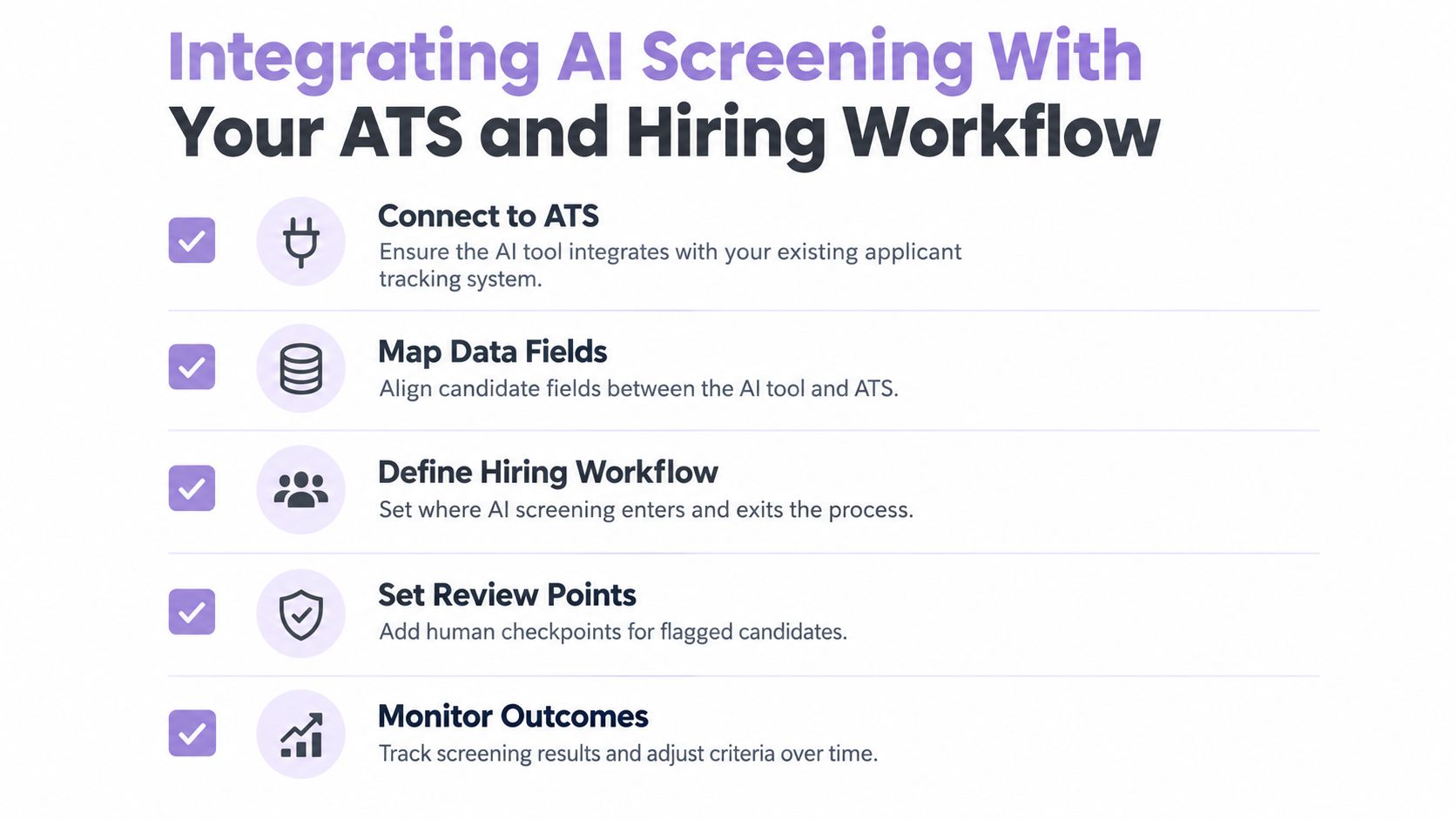
A screening tool works best when its place in the hiring process is clear. Before connecting it to an ATS, decide which information it reads, when it makes recommendations, and who can see or change those recommendations. A score that appears without an explanation can become a de facto decision, especially when a busy manager is trying to fill a schedule gap.
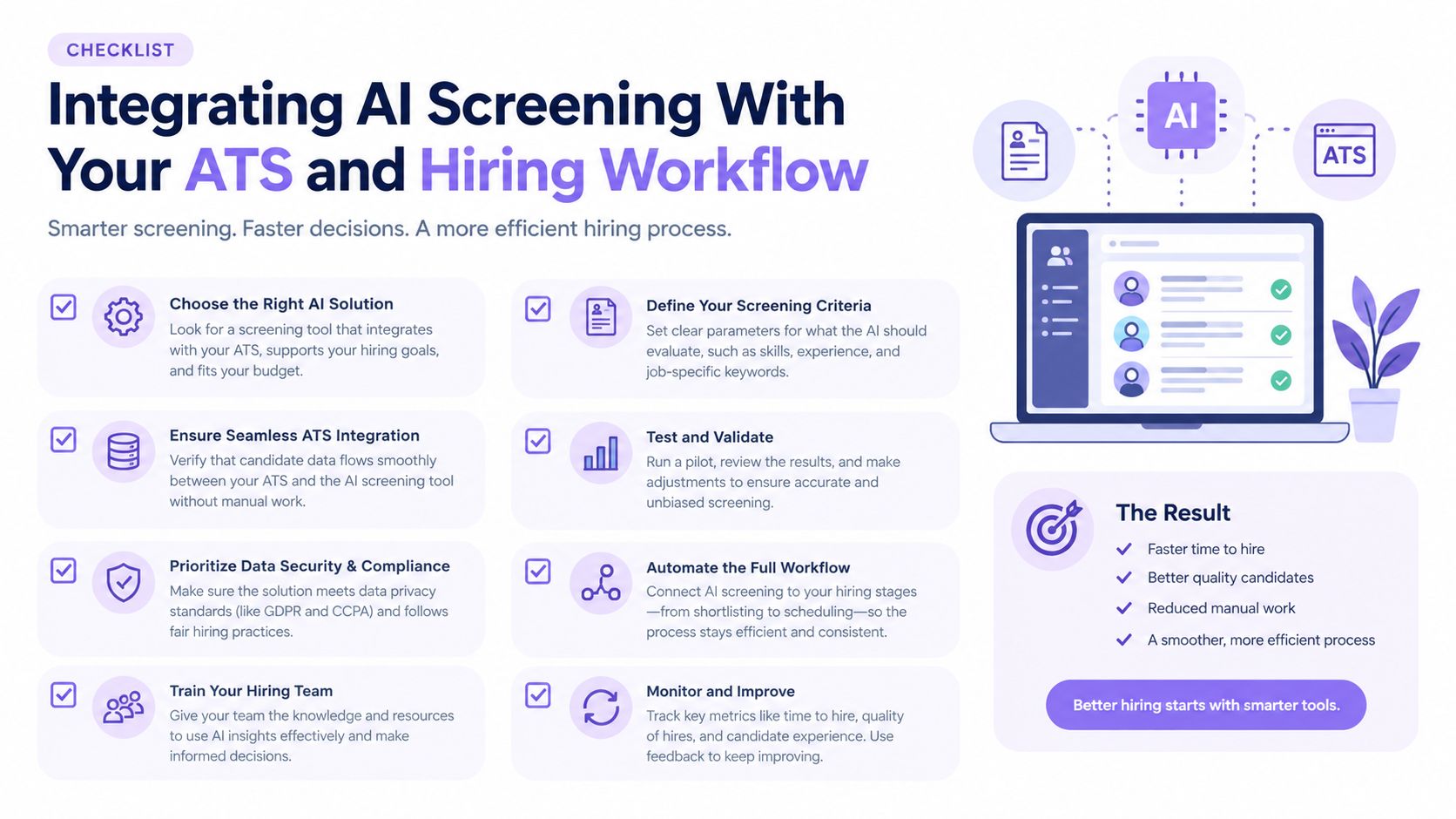
Confirm how the tool handles applications from the ATS, whether scores and supporting evidence appear in the candidate record, and how interview stages are triggered. Then define a human review point before any automated rejection. Train reviewers to check the evidence, record overrides, and flag recurring parsing errors rather than accepting ranks at face value.
For a pilot, choose a role with clear responsibilities, such as appointment scheduling or insurance verification. Compare the tool's recommendations with the current structured review process, and inspect disagreements before changing the live workflow. Avoid testing a tool across unrelated roles at once, because a criterion that works for a scheduler may not be relevant to a billing support position.
Track time-to-shortlist, candidate completion, reviewer overrides, and post-hire indicators that the practice already uses, such as performance reviews or retention. These measures answer different questions: a faster shortlist may still be poor if qualified candidates disappear, while a high override rate may signal unclear criteria or a mismatch between the tool and the role.
For cross-border hiring, have reviewers assess credentials in context rather than assuming every country uses the same degree names or résumé conventions. Evaluate language proficiency separately from other skills when it is required for patient communication. Offer an alternative to video, voice, or timed assessments when a candidate can't complete that format, and have the appropriate professional review how applicant data is transferred and retained across jurisdictions.
A talent management platform can help coordinate stages beyond initial screening; for example, this overview of talent management platforms describes the broader category. Whatever system a practice selects, ask the vendor to explain what data it collects, how reviewers access evidence, how decisions are logged, and how the practice can export its records if it changes tools.
AI for candidate screening can help a medical practice organize applications and focus human review, but a ranking isn't evidence that a candidate is qualified or that a process is fair. Before relying on a tool, write job-related criteria, test outcomes across candidate groups, inspect proxy signals, document accommodation routes, and log reviewer overrides.
Keep the evaluation practical. Track time-to-shortlist, post-hire performance, and how often reviewers challenge recommendations. If you're considering an external talent partner, LatHire offers AI-assisted matching across a pre-vetted LATAM candidate pool, including English/Spanish bilingual professionals, with an interview-before-hire model. Compare it with other options against your role criteria and review process.
First confirm whether the tool and workflow fall under Local Law 144. If they do, publish the required summary of the most recent independent bias audit before using the tool, and notify New York City resident candidates that it will be used, including the qualifications or characteristics it evaluates. Build the notice into the application process so it doesn't depend on a manager remembering later.
The reviewer must evaluate relevant evidence and be able to disagree with the tool. Merely approving a ranked list or allowing the score to overrule other information is not a meaningful safeguard. Record what the reviewer considered and why a recommendation was accepted or challenged.
Ask the vendor where applicant data is stored, who can access it, how long it is retained, and how it can be deleted or exported. Have qualified privacy or legal professionals assess transfers and obligations for the jurisdictions involved. For demographic audit data, employers may not infer or impute information when it's unavailable; ask vendors to identify the validation population and distinguish measured results from estimates, as described in this Local Law 144 audit guidance.
Give the candidate a clear way to request an accommodation, respond without requiring unnecessary medical disclosure, and offer an accessible alternative when the assessment format creates a barrier. Don't let the original score become a final rejection while the request is being addressed.