
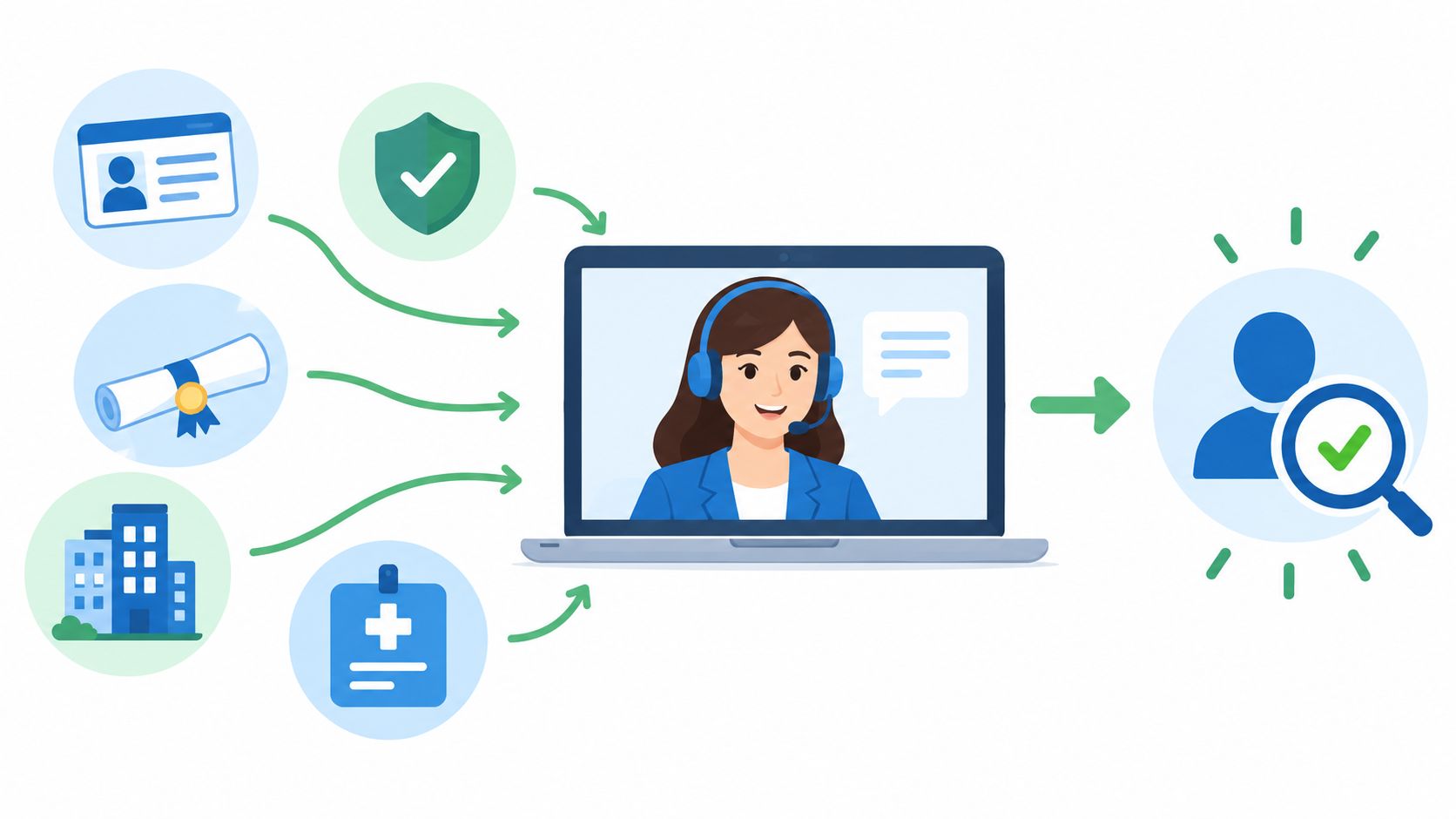
A practice manager has selected a remote appointment scheduler, but the candidate will soon handle patient calls, demographic information, referrals, and insurance details without sitting in the same office. The interview went well. References sound positive. The remaining question is practical: what does a background check look like for a medical virtual assistant, and what should a U.S. medical practice expect before granting system access?
A professional check isn't a single database search or an automatic pass-or-fail decision. It is a staged process that usually starts with consent and identity confirmation, then reviews criminal history, employment, education, credentials, and healthcare-specific exclusions. The final result is a composite report that requires human review, documented decision-making, and, when necessary, candidate notices and dispute rights.
For medical practices evaluating remote staff from Latin America, the process also has an international dimension. Identity records, privacy expectations, references, and credential systems may differ by country. This guide explains how the workflow operates, which checks match different healthcare roles, what happens after a result raises concern, and how structured human verification can make remote hiring more reliable without treating screening as a substitute for sound management.
A busy practice may hire a virtual receptionist to answer calls, confirm appointments, route patient messages, and update demographic information. An insurance verification specialist may work with eligibility details and payer portals. Neither role necessarily provides clinical care, but both can touch information that patients expect the practice to protect.
That changes the hiring question. A background check is part of a broader risk-control process, not merely a way to collect adverse information about a candidate. It helps the practice confirm that the person is identifiable, that their stated work and education history can be verified, and that role-specific concerns receive appropriate review before access is granted.
A remote arrangement doesn't remove the practice's responsibility. It changes how the practice establishes trust.
Practical rule: Screen the access and responsibilities attached to the role, not just the job title.
A basic administrative position may need identity confirmation, employment verification, education verification where relevant, and references. A role involving payer communications, financial information, or regulated healthcare workflows may require additional credential, sanctions, exclusion, or license checks.
The appropriate package depends on role risk. A virtual medical receptionist who only schedules appointments shouldn't automatically receive the same screening package as a person supporting billing, prior authorization, or a licensed clinical function. Conversely, a practice shouldn't assume that remote administrative work is low risk just because the employee isn't physically present.
A useful role review asks:
For a candidate based in Latin America, the screening process may involve identity documents and employment or education records that don't resemble U.S. records. A practice should define what evidence it needs before the search begins and explain how information will be collected, used, stored, and reviewed.
That transparency supports the candidate experience as well as the practice's documentation. It also prevents a common operational mistake, rushing to compare candidates before establishing a consistent process. A clear workflow is easier to apply to a bilingual patient coordinator, a remote billing assistant, or an appointment scheduler than an informal check performed differently for every applicant.
A professional employment screen follows a defined sequence. The practice obtains consent, collects identifying information, confirms identity, and then orders the searches that fit the role. That order protects both sides. An incorrect name, birth date, or identifier can attach another person's record to the applicant.
The workflow in this overview of pre-employment screening separates information collection from report evaluation. The screening provider returns records, status updates, and findings. The medical practice still decides which criteria apply to the job, documents its reasoning, and handles candidate communications consistently.
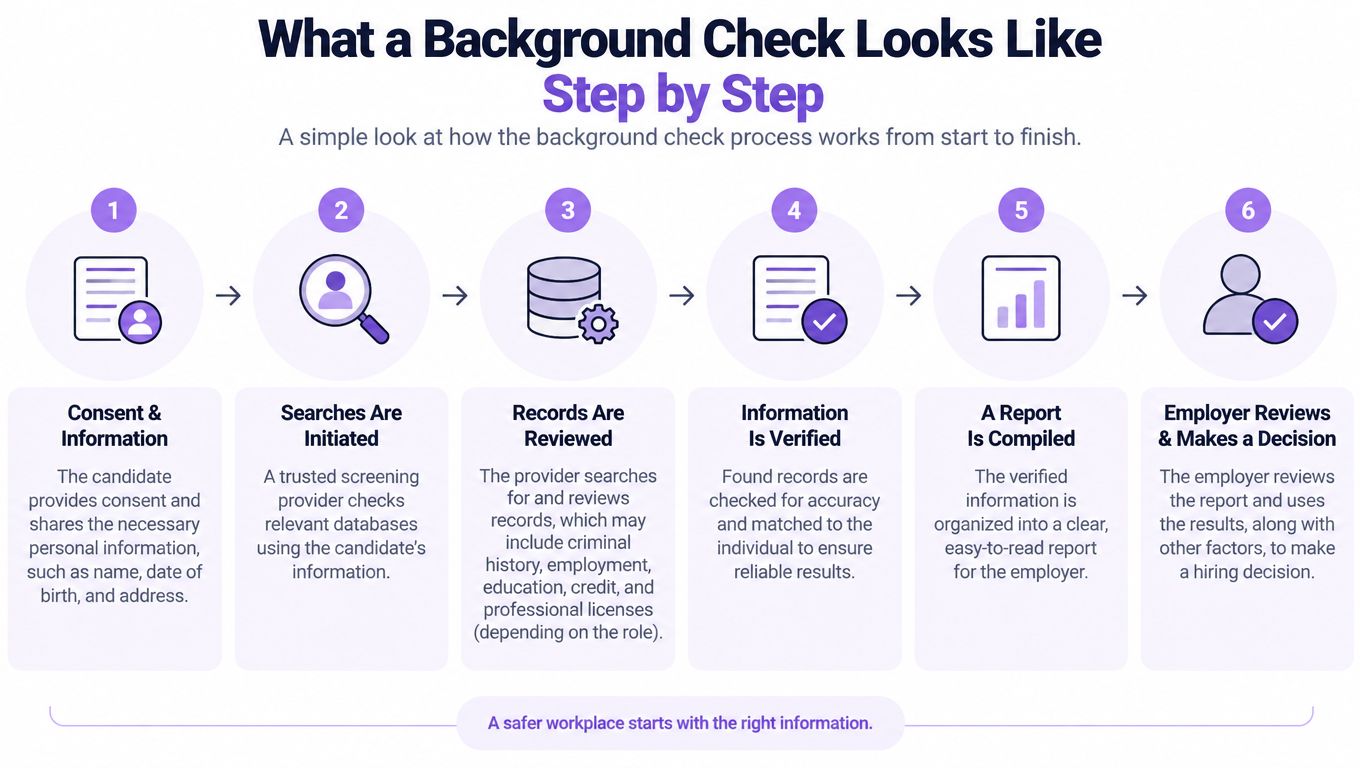
1. Consent and candidate identifiers. The practice explains the proposed check, obtains the required authorization, and gathers the legal name, prior names where relevant, date of birth, address history, and applicable employment or education details. A U.S. employee may provide an SSN for trace matching. An international candidate may need an equivalent identity process based on the records available in that jurisdiction.
2. Identity and trace matching. The provider compares the applicant's information with government and credit-header records or other permitted identity sources. Automated identity checks can finish in seconds to minutes, according to background-check workflow guidance. A mismatch is a reason to investigate, not proof of misconduct. Name variations, incomplete histories, and ordinary data errors can produce the same result.
3. Criminal record searches. Depending on the role and package, the provider may search national databases, county records, federal records, and local court sources. County-level searches often take one to three business days, while manual courthouse searches can extend to five to thirty days because access and procedures vary by jurisdiction.
4. Employment and education verification. The reviewer checks dates, titles, institutions, degrees, responsibilities, and references against the application. For a medical administrative assistant, verification may clarify whether prior work included patient scheduling or insurance workflows. The result does not establish job performance, so interviews and skills assessments remain part of the decision.
5. Credential and healthcare checks. If the position requires a license, certification, payer familiarity, or another defined qualification, the practice verifies the relevant record. Administrative staff must not be described as licensed professionals or given clinical authority they do not hold.
6. Report review and decision documentation. The final output is a screening report, not an automatic verdict. It may combine identity records, criminal databases, employer responses, and education registries. Operational timing guidance indicates that standard U.S. employment screening packages commonly return in three to five business days, while manual employment verification, federal checks, or international records can extend the process to thirty days or more.
A report may list completed searches, pending items, verification notes, discrepancies, and records that require review. It may also show that a search could not be completed because a source was unavailable or a foreign institution did not respond. A pending or incomplete component is not the same as a negative finding.
The practice should give the candidate a clear way to address an apparent mismatch before treating it as disqualifying. Keep the report, communications, decision criteria, and final rationale together. If the result may lead to rejection or another adverse employment decision, follow the required notice and review process rather than relying on a verbal explanation.
A nonprofit or community organization comparing screening resources may find nonprofit background check tools useful for seeing how different checks are organized. A medical practice should select a workflow that produces reliable role-specific information and preserves the records needed for a fair decision.
Build hiring time around the slowest plausible component. Do not promise a start date based only on an automated identity result while international education or employment verification remains open.
Healthcare hiring carries added compliance duties because a practice may handle patient information, maintain payer relationships, provide regulated services, and participate in public programs. A vendor can collect and organize records, but the employer still owns the hiring decision and the process behind it.
Employee background checks in healthcare must comply with the Fair Credit Reporting Act, or FCRA, and applicable state law. Before requesting a third-party consumer report, the employer generally needs the applicant's separate written authorization. If information from a report may affect the decision, the applicant must receive the required disclosures and an opportunity to respond, as described in this healthcare employment screening guidance.
Start with the duties, access level, and credential requirements of the position. A criminal search by itself can leave material gaps. Depending on the role and jurisdiction, a package may include:
The healthcare background check requirements summary explains how to match screening components to the position and its risks.
Before finalizing the package, review the background check regulations that govern healthcare hiring. Set an owner for authorization forms, vendor instructions, review deadlines, and record retention. That structure helps prevent a practice from ordering checks it cannot lawfully use or failing to document why a particular search was selected.
For medical practices, the HHS OIG exclusion list requires specific attention before hiring. A practice should also consider monthly screening of employees and contractors against the relevant exclusion list. Healthcare employee screening guidance discusses this practice in relation to overpayment and civil monetary penalty risk. Assign responsibility for reviewing potential matches and escalating them rather than treating an automated result as a final decision.
A record or discrepancy should prompt verification and a documented assessment. Confirm that the information belongs to the candidate, determine whether it relates to the actual duties, apply the same criteria used for comparable applicants, and record who reviewed the result and why.
If a third-party report may lead to rejection, follow the applicable pre-adverse and adverse-action process. Provide the required notice and report information, allow the candidate to identify an error or dispute the result, and send the final notice if the decision remains unchanged. State and local rules may impose additional limits, particularly for criminal history and credit information.
Compliance safeguard: Have qualified counsel or a compliance professional review the process for the states and countries involved. Healthcare and privacy obligations vary by jurisdiction, role, and practice type.
A pre-employment report is a snapshot. It can establish useful facts before hire, but it doesn't answer every question that arises after the person starts work. A role may change, access may expand, credentials may expire, or the practice may discover that a previously verified responsibility no longer matches the employee's current duties.
The modern alternative isn't necessarily to run every possible check on every worker at every interval. It is to create a customized verification program. Recent industry guidance describes movement toward workforce monitoring and rescreening, verifiable credentials, and AI-assisted verification, with greater attention to choosing checks based on the position rather than applying one broad package to everyone. The practical discussion appears in current background screening coverage.
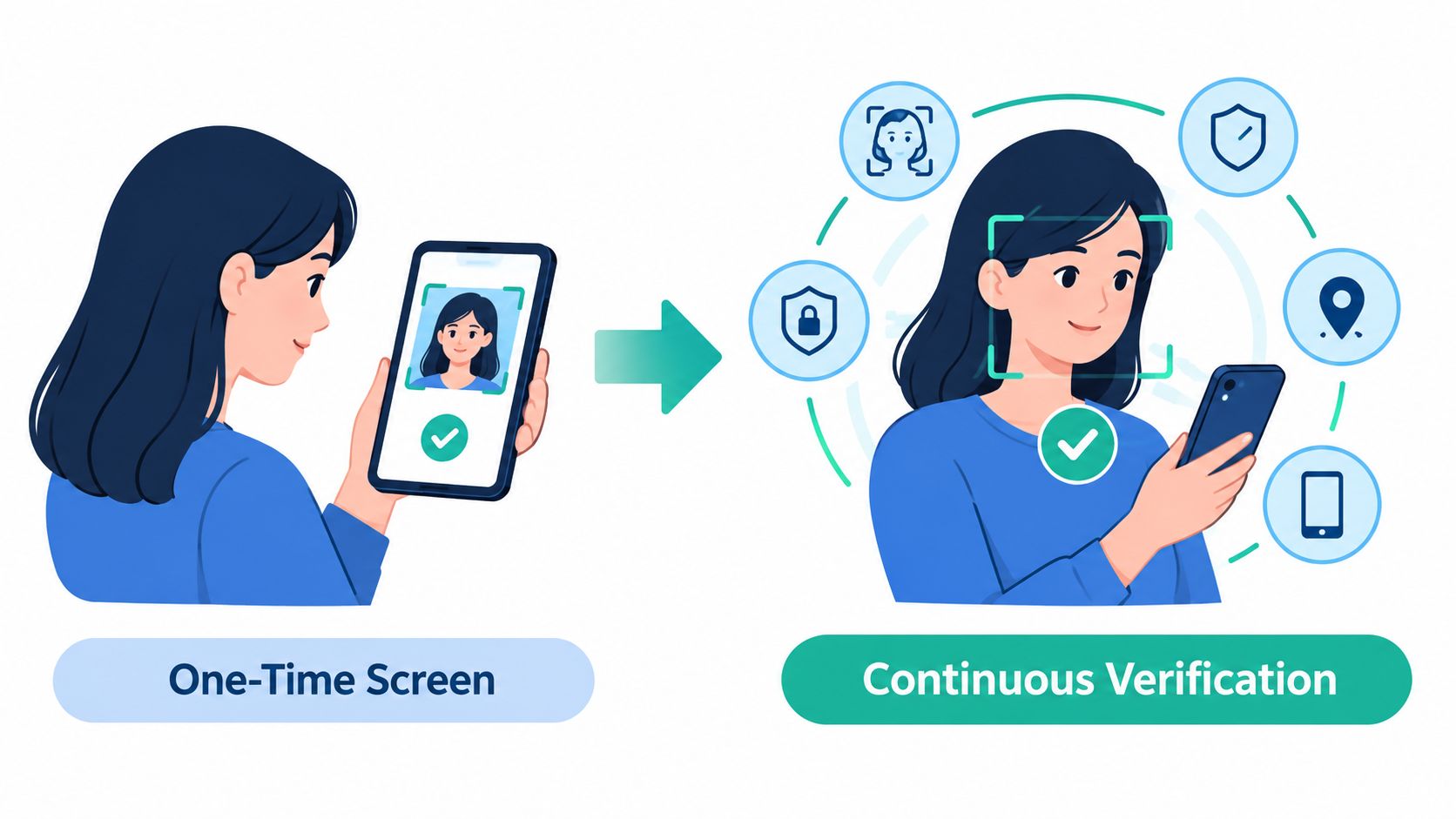
| Screening model | What it does well | Where it falls short |
|---|---|---|
| One-time broad screen | Establishes a baseline before access and creates a consistent starting record | May miss later changes, expired credentials, or new role-specific risks |
| Tailored recurring verification | Aligns checks with duties, access, credentials, and changing risk | Requires a documented schedule, clear notices, and careful privacy management |
| Human review with automated alerts | Combines faster detection with context and discrepancy resolution | Still depends on accurate source data and qualified reviewers |
For example, a practice might verify identity, employment history, and references before hiring a virtual receptionist, then use access controls and periodic policy review rather than repeating every conceivable search. A person supporting billing or prior authorization may require a different review plan if their responsibilities or access change. A licensed worker needs credential monitoring appropriate to the license and jurisdiction.
Many explanations stop when the report arrives. In practice, the process continues if a result may affect hiring. The employer should document the decision, provide a pre-adverse-action notice when required, share the relevant rights information, and allow the candidate to review or dispute inaccurate information before a final adverse-action notice.
Global hiring adds another layer. A candidate in Latin America may be subject to local privacy rules, access rights, or consent expectations that differ from those governing a U.S. employee. The practice should identify where data is collected and stored, limit access to people with a business need, and explain the screening purpose in understandable language.
The background verification process guide can help managers think about verification as an operational workflow rather than a single report. Continuous verification is most useful when it has a defined purpose, a responsible owner, and a process for responding to alerts without making unreviewed assumptions.
Automated searches are efficient at identifying possible matches and organizing records. They aren't equally good at understanding context. A common name, a translated institution name, a changed job title, or an incomplete international record can produce a discrepancy that requires a person to investigate.
LatHire uses human-led background verification alongside its broader candidate-vetting process. Reviewers can validate education records, employment history, professional licenses, and reference consistency before a candidate is presented to a practice. That doesn't eliminate risk, and it shouldn't replace the medical practice's own role-specific policies, consent procedures, or legal review. It does add a second layer between raw information and a hiring decision.
A human reviewer can ask whether a work-history conflict is material or administrative. They can distinguish an unconfirmed reference from a proven misrepresentation and flag missing documentation before the candidate reaches the final interview stage. That distinction matters for remote hiring because the practice can't casually walk to a former employer's office or inspect a physical credential.
LatHire curates pre-vetted Latin American professionals who may align with U.S. working hours and may bring prior U.S. healthcare experience. Those characteristics can be relevant when a practice needs a bilingual English and Spanish virtual medical receptionist, an appointment scheduler familiar with U.S. patient communication, or an insurance verification specialist who understands the importance of accurate payer information.
The practice still needs to define the job clearly. A medical virtual assistant can support scheduling, patient coordination, billing administration, or prior-authorization preparation, but shouldn't independently diagnose a patient, make clinical decisions, or perform licensed work without the authority and jurisdiction required for that function.
Human-led verification is most useful when it produces clear records. A practice manager should be able to see what was checked, which items were confirmed, what remains pending, and which issue requires direct discussion with the candidate.
For specialized or unusual situations, a practice may also consult an independent investigator, such as a service offering to hire a private investigator in London, when a lawful, jurisdiction-specific investigation is necessary. That isn't a default step for every remote hire, and any investigation still needs a defined purpose and appropriate legal controls.
A sensible operating model looks like this:
This combination improves clarity and reduces avoidable errors, but no screening method guarantees a safe hire. Interviews, supervision, least-privilege access, security training, and ongoing performance management remain necessary.
Understanding what a background check looks like starts with recognizing that it isn't a pass-or-fail button. The process typically begins with consent and identity confirmation, then moves through criminal, employment, education, credential, and healthcare-specific exclusion checks. The result is a composite report that needs careful interpretation and documented decision-making.
For a medical practice hiring remote staff, the right approach is to match screening to the role, follow FCRA and applicable state requirements, respect international privacy and consent obligations, and prepare for the post-report workflow. That includes candidate notices and dispute opportunities when a third-party report may affect the decision. Ongoing verification and human review can add useful protection where responsibilities, credentials, or access change after hire.
If you're evaluating remote receptionists, patient coordinators, insurance verification specialists, or billing support, explore how LatHire's pre-vetted talent and structured screening process can support a more organized, transparent hiring workflow.
Start by documenting the role, its system access, and the checks you expect before you interview candidates. Then speak with LatHire about a shortlist of remote healthcare support professionals aligned with your practice's schedule and administrative needs.