
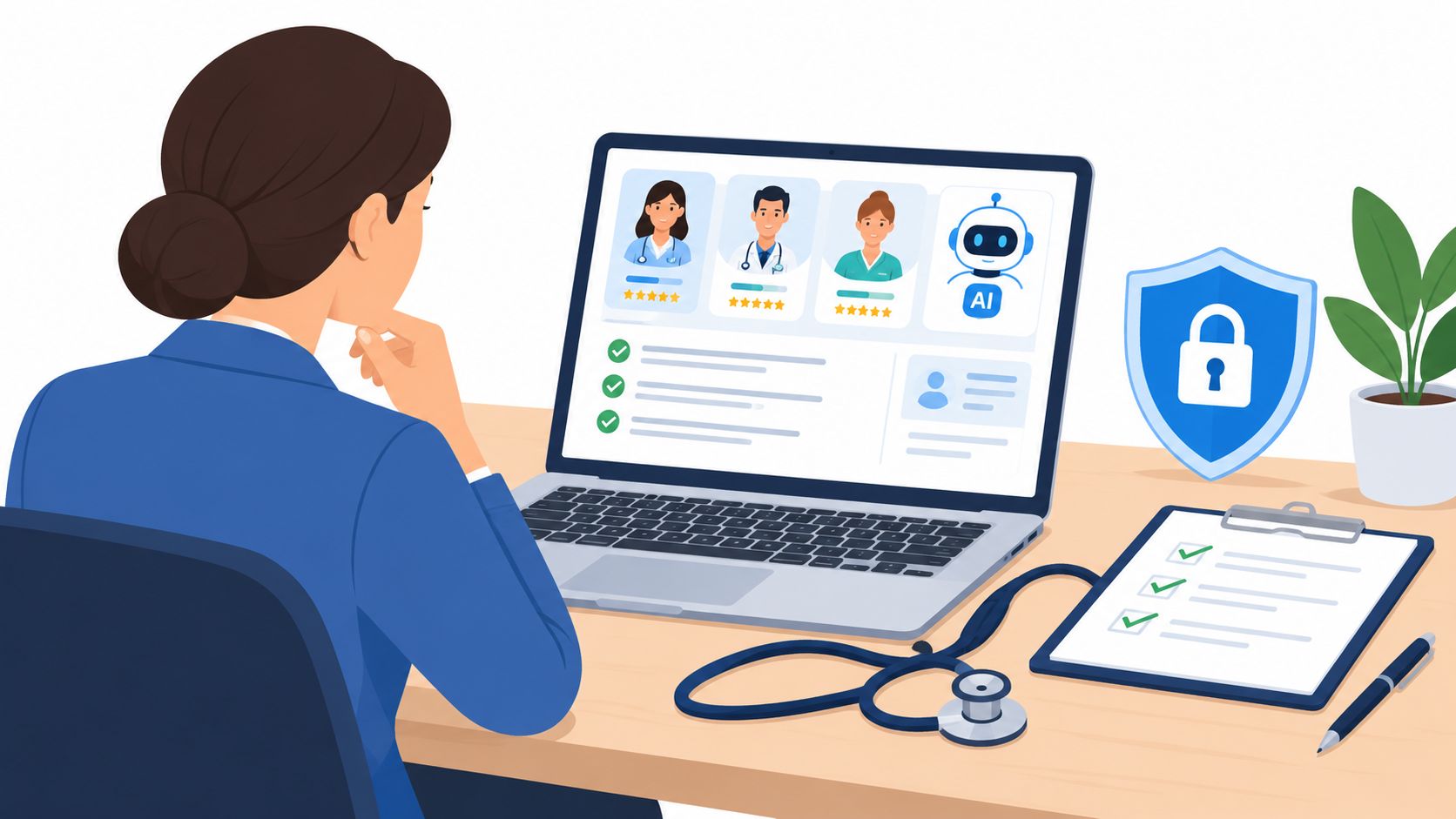
You're reviewing a remote medical virtual assistant's work and facing a familiar trade-off: the appointment queue is moving, but a few messages were routed incorrectly. A fast task count won't tell you whether the person understands escalation rules, uses approved systems, or can explain how they handled an ambiguous request. A general employee review won't answer those questions either.
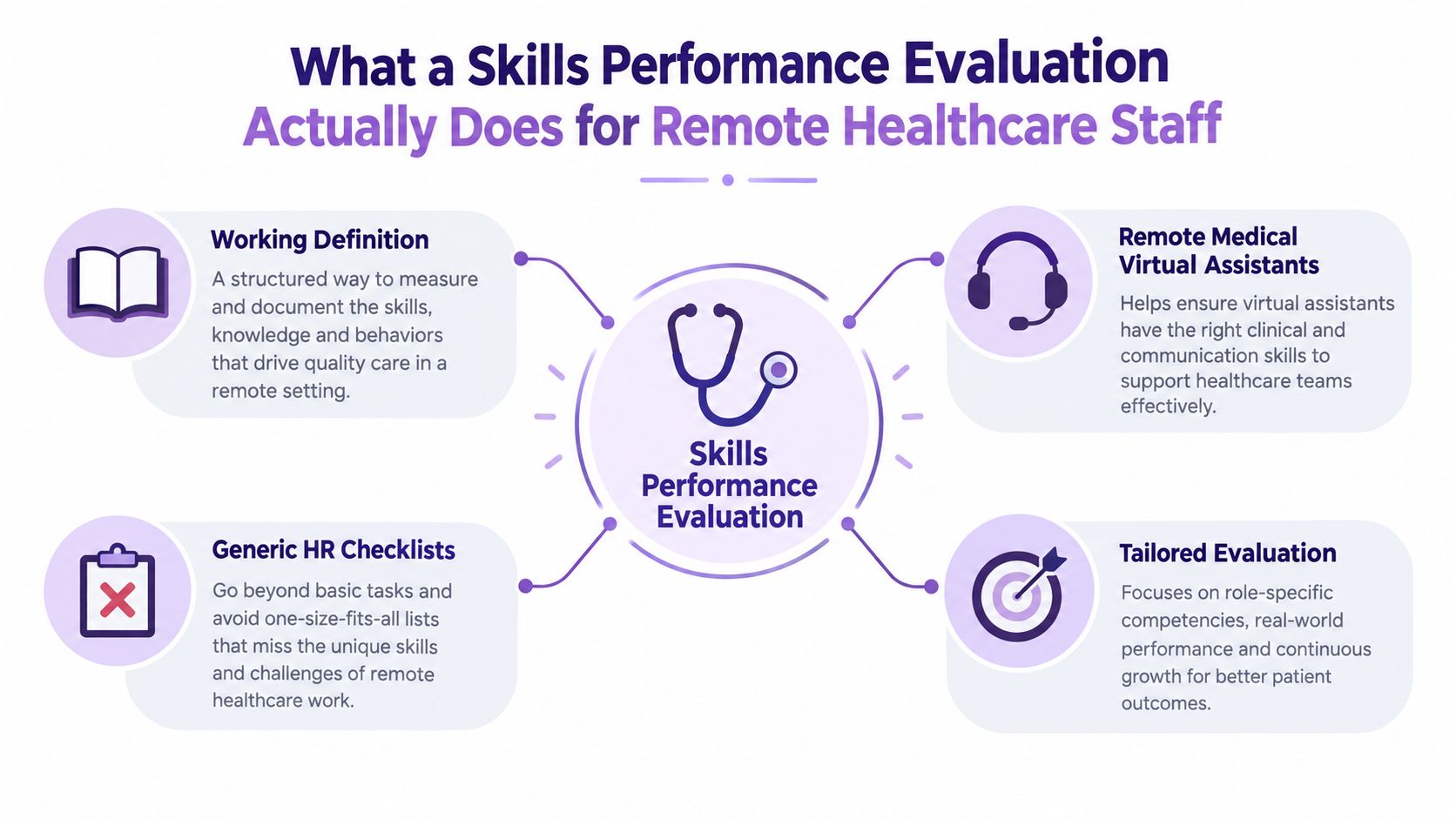
A skills performance evaluation is a structured way to measure whether someone can perform the actual tasks of a role to a defined standard. For a medical practice, it should help you make decisions about hiring, role assignment, retention, and development. It shouldn't replace provider judgment, assess clinical decisions outside the worker's scope, or treat a résumé, certificate, or confident interview as proof of job-ready skill.
A useful system starts with the work, tests observable behavior in realistic conditions, and compares results with clear criteria. It also accounts for privacy responsibilities and separates a person's unaided capability from the quality or speed they achieve with approved technology. The sections below cover how to define the evaluation, build role-specific tests, assess AI-assisted work, run a repeatable process, test privacy skills, and turn results into fair decisions.
A practice manager often has to judge a remote worker from a narrow slice of visible output: calls answered, appointments entered, claims checked, or messages routed. Those figures matter, but they don't show the whole job. A skills performance evaluation connects the visible work to the capabilities behind it, such as accuracy, judgment about when to escalate, clear patient communication, and consistent use of approved workflows.
The evaluation begins with a practical question: What must this person demonstrate to perform this role safely and reliably? For a virtual medical receptionist, that may include confirming identity using the practice's process and directing clinical questions to the right team. For an insurance verification specialist, it may mean documenting what was checked and flagging uncertainty instead of guessing. The standards should reflect assigned administrative duties, not imply that the worker diagnoses patients or makes clinical decisions.
Credentials, years of experience, and self-reported confidence can help you decide what to investigate, but they don't directly show how someone handles your workflows. The OECD's PIAAC program offers an international example of skills evaluation grounded in demonstrated capability: its first assessment cycle ran across three rounds from 2011 to 2018, covered 39 countries, and surveyed approximately 245,000 adults, representing about 1.15 billion people. It assesses adults aged 16–65 in information-processing capabilities such as literacy, numeracy, and problem-solving, rather than relying only on educational credentials or self-reported competence. The OECD skills outlook describes a standardized approach that reports both average scores and distributions across proficiency levels.
For a practice, the useful lesson is not to copy a population assessment. It's to define the capabilities a role requires, test them directly, and distinguish adequate from inadequate performance on each important task. A single overall impression can hide a serious gap in a narrow but consequential responsibility.
The evaluation can support hiring, role assignment, retention, and development. It can show whether someone is ready to schedule appointments independently, needs coaching on message routing, or should not handle a task that requires a skill they haven't demonstrated. It cannot authorize a worker to perform licensed clinical duties, replace provider judgment, or establish that someone is generally competent for every healthcare role.
Specialty context also matters. For example, practices considering nursing roles can review Hyperbaric Business Solutions nurse insights to understand how responsibilities in a particular care setting differ from administrative support duties. The same principle applies to remote staff: test the work they'll perform, with boundaries that are clear to the worker and the practice.
A defensible assessment starts with job analysis, not with a generic quiz. Write down the role's critical tasks, work behaviors, and required knowledge, skills, abilities, and other characteristics. Then sample those requirements in the evaluation. The Society for Industrial and Organizational Psychology (SIOP) emphasizes documenting reliability, validity, job-relatedness, and adverse-impact monitoring; the SIOP principles for personnel selection offer a foundation for building a process that can be explained and reviewed.
For each task, describe what success looks like in observable terms. “Good communicator” is too broad to score consistently. “Routes a patient message to the correct queue, records the caller's concern without adding a diagnosis, and follows the escalation protocol when the message may be urgent” gives an assessor something concrete to observe.
A practical design sequence is to identify the task, define the expected behavior, create a realistic sample, and decide in advance how you'll score it. A scheduling assessment might ask a candidate to resolve a conflict between a patient's preferred time and the practice's scheduling rules. An insurance verification exercise might test whether the worker records an unknown or unconfirmed detail accurately, rather than filling in a plausible answer.
| Role | Critical task | Observable success criterion | Recommended assessment |
|---|---|---|---|
| Virtual medical receptionist | Handle a patient call | Confirms the information required by the practice, communicates clearly, and routes clinical questions appropriately | Simulated call with an anchored rubric |
| Appointment scheduler | Book or change an appointment | Follows scheduling rules, records the correct details, and identifies conflicts for review | Scheduling work sample using fictional records |
| Insurance verification specialist | Check coverage information | Separates verified facts from uncertainty and documents the source of each finding | Structured verification exercise |
| Prior-authorization support | Prepare an administrative submission | Follows the practice's checklist, identifies missing information, and escalates unresolved items | Case-style work sample based on fictional data |
| Patient coordinator | Coordinate a referral | Records the status accurately and communicates the next administrative step without promising a clinical outcome | Referral scenario and structured interview |
Use standardized instructions and scoring criteria so candidates are evaluated against the same expectations. Train assessors to use behavioral anchors, then compare sample ratings before applying the rubric to real candidates. Without that calibration, two managers may assign different scores to the same performance because one values speed and another prioritizes documentation.
The U.S. Office of Personnel Management reports validity coefficients of approximately .54 for work-sample tests and .51 for structured interviews, with corrected estimates around .63 for each. Its guidance also notes that work samples have high content validity when the tasks closely represent actual job duties. OPM's assessment and selection guidance helps explain why a short work sample can be more relevant than broad questions about general competence.
Avoid testing skills that aren't needed, giving assessors unrestricted discretion, or validating an assessment against vague outcomes such as “seems successful.” Decide what later job evidence you'll compare against, such as appointment-entry accuracy or message-routing quality. If you later use a score for a different role or applicant population, don't assume the original validation automatically applies.
A remote worker may use AI to draft patient-facing administrative text, summarize nonclinical instructions, or organize information, if the practice permits that use and the tools and data handling meet its requirements. The assessment question isn't whether the final output looks polished. You need to know whether the person can perform the underlying task, use approved tools appropriately, verify the result, and protect sensitive information.
A 2025 study of 1,421 job candidates found that people who believed artificial intelligence was evaluating them emphasized analytical abilities while downplaying intuitive and emotional strengths. The report on the study illustrates why assessment conditions can shape what candidates choose to demonstrate. For a medical practice, the practical question is whether you're measuring unaided skill, AI-assisted output, or the worker's ability to direct and verify AI.
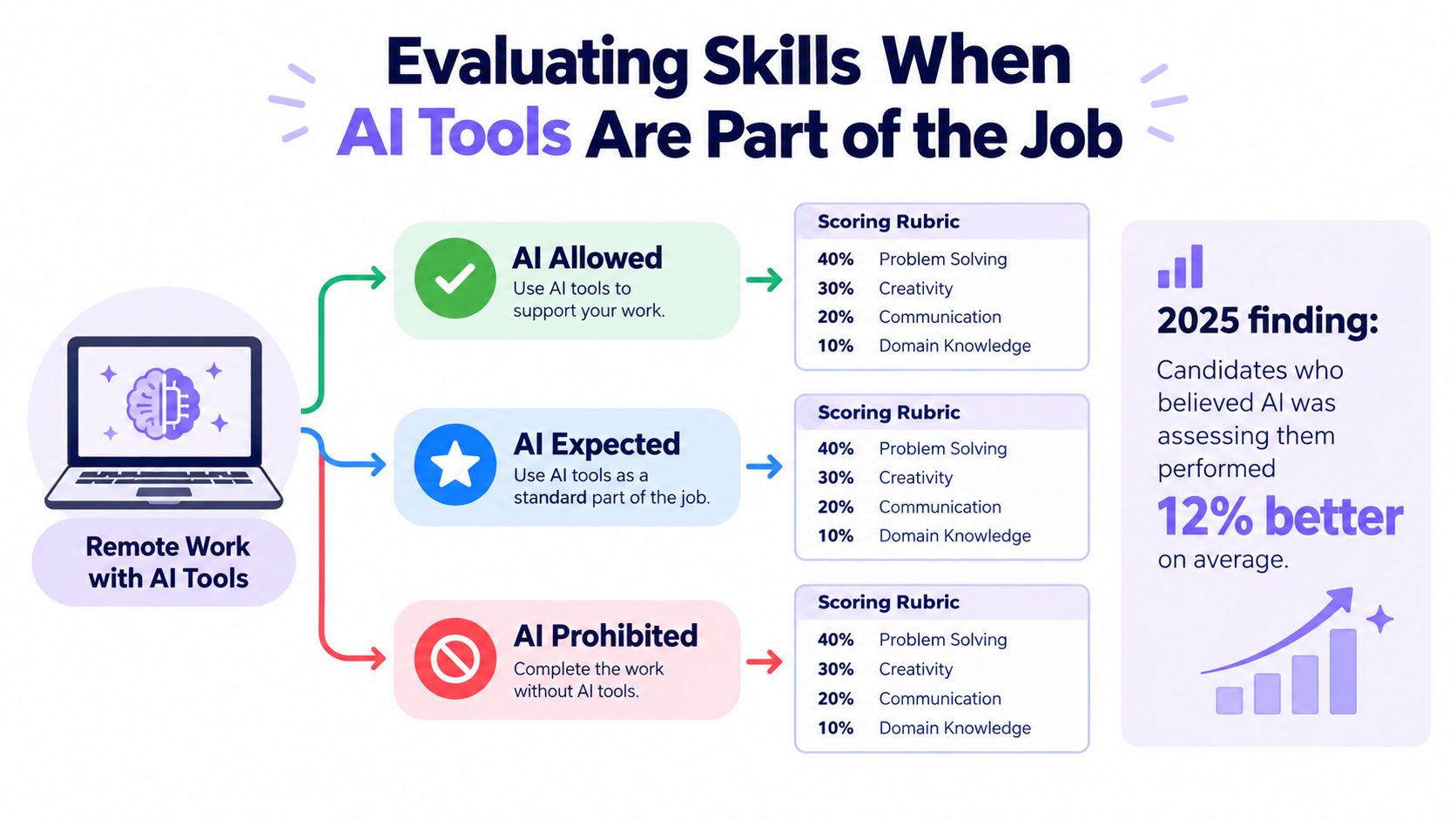
A useful rubric separates four dimensions. Baseline capability tests whether the person can complete the task without AI, where that is relevant to the role. Tool-augmented productivity measures what they can achieve with an approved tool. Reasoning and verification checks whether they catch omissions, inaccuracies, or unsuitable wording. Security awareness tests whether they avoid entering protected information into tools that the practice hasn't approved.
These dimensions answer different questions. A worker might draft an accurate response with an approved tool but struggle to identify a message that requires escalation. Another person might produce a slower first draft yet reliably catch errors and follow privacy procedures. Scoring only speed or final polish would blur that distinction.
Tell candidates whether AI is allowed, expected, or prohibited, and define which tools or inputs are permitted. For example: “Use the approved tool if you normally would for this task. Do not enter real patient information. Submit the final output and briefly identify what you checked before using it.” If AI is prohibited for a particular exercise, say so clearly and explain that the purpose is to assess independent task performance.
When AI is allowed, ask candidates to show their verification process, not just their finished work. A reproducible result, with the relevant steps and checks documented, is more informative than raw speed. Don't treat a polished answer as evidence of sound judgment until you know how the person produced and reviewed it.
A useful evaluation shouldn't depend on one interviewer's instincts or a single strong first impression. Keep the process short enough to run consistently, but complete enough to connect hiring evidence with actual work. A practical cycle can combine a pre-hire work sample, a scenario-based interview, and a post-hire observation period.
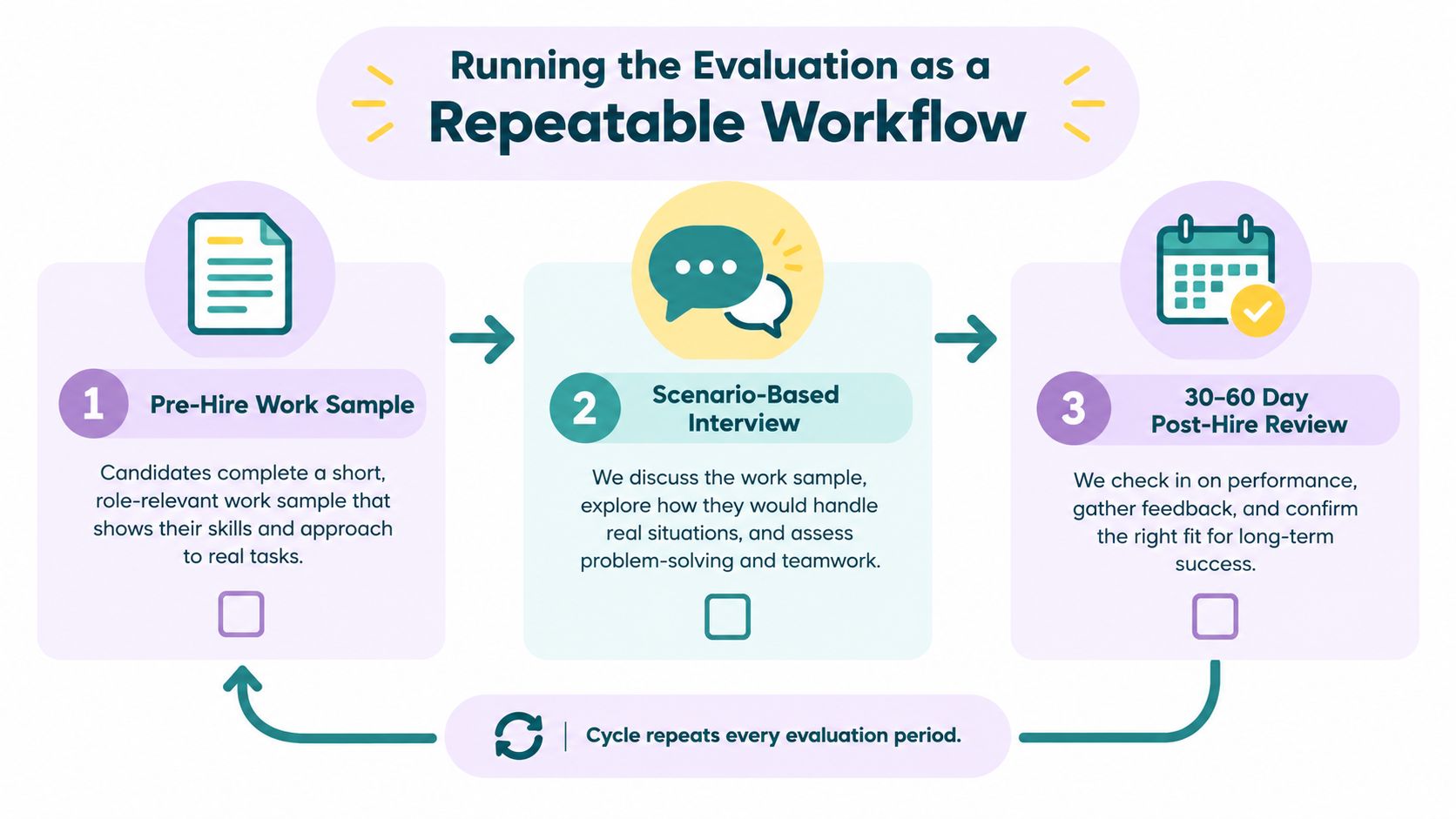
Start with a short work sample built from fictional or safely de-identified information. Ask candidates to perform tasks close to the role, such as entering a mock appointment, drafting a response to a routine administrative question, or identifying which message should be escalated. Score accuracy, completeness, process adherence, and communication separately so one strength doesn't conceal a weakness elsewhere.
Follow with a structured interview. Give candidates the same scenario and core questions, then use behavioral scoring criteria to assess how they explain their decisions. Questions should probe what they would do when information is missing or a request falls outside their authority. Reward appropriate escalation, not confident guessing.
After hiring, compare the initial assessment with observed job performance. A 30–60 day post-hire review can examine role-specific evidence such as appointment-entry accuracy, message-routing correctness, documentation completeness, and patient-communication quality. This follow-up helps you see whether the assessment predicted the work you care about and whether onboarding or unclear procedures affected the result.
Train assessors on the rubric before they evaluate candidates. A brief calibration session can expose differences in how managers interpret terms such as “complete,” “accurate,” or “escalates appropriately.” Record what the candidate did, what standard applied, and how the score followed from the evidence. Avoid notes about personality or impressions that don't connect to job behavior.
For practices updating their staff-development approach, compliance training for healthcare agencies can provide context on the kinds of training topics healthcare organizations may need to address. Training can support performance, but it doesn't replace role-specific assessment or observation.
Use post-hire results to revise the process. If candidates score well on a test but repeatedly struggle with a particular workflow, investigate whether the test is incomplete, the procedure is unclear, or onboarding leaves a gap. A repeatable cycle gives you a basis for improving both hiring decisions and the conditions in which staff work.
Privacy shouldn't be treated as a checkbox that a worker passes by saying they understand confidentiality. A remote virtual assistant who creates, receives, maintains, or transmits protected health information (PHI) on a medical practice's behalf may qualify as a HIPAA business associate, depending on the relationship and work performed. HHS describes a business associate as an outside person or entity that performs services involving access to PHI. The practice should confirm its obligations with qualified counsel or a compliance professional, rather than assuming that an independent contractor is automatically outside HIPAA's requirements.
Test what the worker can do in the actual workflow: identify PHI, use approved systems, follow access controls, recognize an improper disclosure, and escalate a suspected incident. For a medical virtual assistant, scenarios can involve appointment scheduling, insurance verification, referral coordination, and patient-message handling. Use fictional data in candidate exercises, and don't expose real patient information to an assessment tool or outside service without confirming that the arrangement is appropriate.
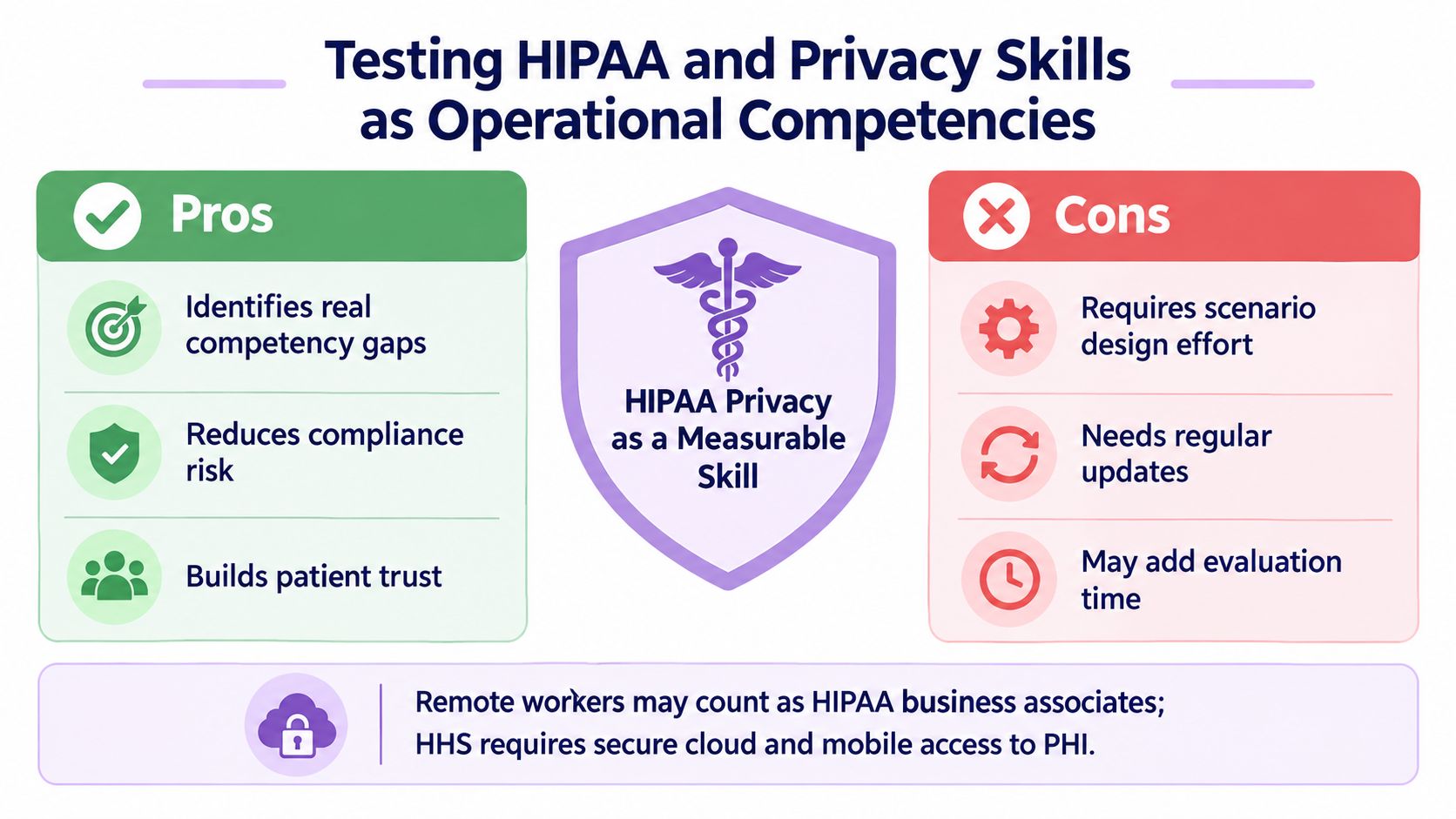
HHS permits cloud and mobile access to electronic PHI when appropriate physical, administrative, and technical safeguards are in place, along with appropriate business associate agreements for third parties that access the information. HHS guidance on cloud computing and PHI explains the safeguards context. A scenario test can reveal whether a worker understands how to use approved systems, avoid unauthorized access, and report a suspected problem, while a structured interview can reveal their reasoning but may not show what they'll do under task conditions.
A work sample can assess whether someone follows a secure workflow, such as choosing the approved channel for a mock message. A gamified assessment may help explore responses to changing situations, but it can add design work and may not closely represent the actual duties. Use a balanced scorecard rather than expecting one format to prove privacy readiness.
Recommended practices can include requiring multifactor authentication where the practice's systems require it, avoiding local downloads of PHI, maintaining a private workspace, and reporting lost equipment or suspected credential compromise. Distinguish these practice-specific safeguards from general legal requirements, and evaluate observable behavior rather than relying on a certificate or verbal assurance.
A business associate agreement addresses permitted and required PHI uses, safeguards, reporting unauthorized disclosures and breaches, subcontractors, and return or destruction of PHI when the relationship ends. HHS sample business associate agreement provisions can help practices understand those contractual elements. Build your rubric around the worker's assigned duties and the safeguards that apply to those duties.
For additional context when reviewing organizational obligations, consult legal and compliance requirements for remote staffing. Don't treat general administrative experience as evidence of HIPAA readiness, and don't grant access to PHI before the practice has addressed appropriate safeguards, agreements, and role-based access.
A scorecard is useful only if it supports a decision that's tied to the job. Combine assessment results with evidence from actual work, periodic quality checks, and scenario reviews. Avoid letting one overall score hide a high-risk weakness, such as consistently routing urgent messages incorrectly despite fast task completion.
A medical practice might weigh appointment-entry accuracy, completeness of documentation, communication quality, adherence to approved workflows, and escalation judgment. The appropriate measures differ by role. Diagnostic accuracy may be relevant to a qualified clinical role, but it isn't an independent performance measure for an administrative virtual assistant who doesn't diagnose. For that worker, assess administrative execution and the correct transfer of clinical questions to the responsible team.
Choose assessment methods according to the task and the practice's capacity to administer them. A small practice may rely on a focused work sample and structured interview; a larger organization may add multiple assessors, periodic audits, and more formal monitoring. Neither approach is automatically fair or accurate unless it measures job-related behavior consistently.
| Method | What it can show | Main limitation | Best fit |
|---|---|---|---|
| Work sample | How a person handles a task resembling the job | Requires a well-designed, role-specific exercise | Scheduling, documentation, verification, and administrative workflows |
| Scenario test | How someone responds to an unfamiliar or sensitive situation | A hypothetical answer may not match actual behavior | Escalation, privacy, and patient-message routing |
| Structured interview | How a candidate explains decisions using common questions | Answers rely on self-report and interviewer scoring | Reasoning, communication approach, and past work examples |
| Gamified assessment | How someone responds to designed interactive prompts | May not reflect the real workflow closely | Selectively, when the task requires context-specific adaptability |
Calibrate assessors by reviewing examples and discussing how the rubric applies. Monitor whether results differ across relevant demographic groups, and investigate whether any difference reflects a job-related requirement or a flaw in the assessment. A high score alone doesn't establish general employability or eliminate the need to review the process.
For hiring, define in advance which capabilities are essential and which can be developed after onboarding. For development, turn the result into a specific plan: a worker who accurately enters appointments but needs improvement in routing messages may receive targeted practice and closer review on that workflow. Give the employee an opportunity to explain relevant context or challenge a score they believe is incorrect, and document how the practice reviewed the concern.
Feedback is more useful when it names an observable behavior, explains its impact, and identifies a practical next step. Practices considering ways to organize mentoring conversations may find mentor mentee feedback software relevant to those discussions. For a structured look at capability gaps and development priorities, see a skills gap analysis approach. Use evaluation results to improve the match between the person, the role, and the training, not to turn one test into a permanent label.
A defensible skills performance evaluation is job-specific, privacy-aware, and consistent. It measures demonstrated capability against observable criteria, separates unaided skill from approved tool-assisted work, and treats privacy behavior as an operational competency. It can inform hiring, role assignment, retention, and development, but it doesn't replace provider judgment or expand a worker's authorized scope.
Over the next 30 days, choose one remote role and complete a short job analysis. Build two fictional work samples, document a privacy scenario test, and pilot the scorecard with one current remote worker. Review the evidence with the worker, note where the rubric or workflow needs clarification, and revise before using it more broadly. A talent management platform for organizing evaluation and development workflows may help practices coordinate those processes.
If you're preparing to staff or scale remote healthcare support, LatHire connects U.S. medical practices with pre-vetted LATAM healthcare talent. Review candidates against the specific tasks and safeguards your practice requires before making a hiring decision.