

A 12-physician U.S. primary care group hires a remote billing coordinator in the Philippines and a part-time prior-authorization nurse in Colombia. The practice manager quickly discovers that issuing U.S. W-2s isn't the answer. Each worker may require a different contract, local deductions, payment method, reporting schedule, and compliance review.
International payroll services solve that operational problem by calculating gross-to-net pay, handling country-specific taxes and social contributions, producing compliant payslips, and delivering funds in the worker's local currency. They may also support onboarding, benefits, employment records, reporting, and integrations with HR and finance systems. The right model depends less on a vendor's feature list than on whether your practice already has a legal entity in the country where the worker lives.
This guide explains what international payroll services handle, compares local entities, payroll-only providers, PEOs, and EORs, and shows where medical-practice pay runs usually fail. It also covers compliance, pricing, integrations, provider evaluation, and a practical decision framework for hiring remote coordinators, billers, assistants, and other healthcare support staff abroad.
International payroll is not just domestic payroll with a currency converter added. It combines payroll calculation, local employment rules, tax administration, payment execution, and worker records across jurisdictions. For a medical practice, that distinction matters because a remote receptionist, billing specialist, or authorization coordinator may be working in a country with entirely different rules for withholding, benefits, leave, reporting, and worker classification.
The core service usually covers five jobs:
A payroll-only service generally assumes your practice already has the legal structure and registrations needed to employ people in that country. An employer of record can take on the local employment relationship when you don't have an entity. That difference determines who signs the employment contract, files taxes, manages statutory benefits, and handles termination procedures.
A domestic U.S. payroll run usually operates within one broad tax and employment framework, even though state and local requirements still vary. Cross-border payroll adds multiple currencies, country-specific deductions, local filing deadlines, employment protections, and possible entity requirements. The provider must also account for whether the worker is an employee or contractor under local rules.
International payroll services are designed to process employee and contractor payments while supporting local tax obligations, benefit deductions, required reporting, and privacy controls, as described in this overview of international payroll services. That means a practice should evaluate more than whether money arrives in a bank account. It should ask whether the provider can produce evidence showing how the amount was calculated and which obligations were paid.
A remote healthcare worker may handle scheduling, insurance verification, billing follow-up, or patient messages. Those responsibilities don't automatically authorize clinical decision-making. A virtual medical receptionist can route calls and confirm appointments, while a billing coordinator can review claim status. Neither role should diagnose patients, interpret clinical findings, or perform licensed work unless the role and applicable jurisdiction expressly permit it.
You also need a separate privacy and access review. Payroll data includes personal, tax, and banking information. The worker's operational role may also involve protected health information, which creates a different set of contractual and security questions from payroll administration.
Practical rule: Decide the worker's legal classification, job scope, country, and access to patient information before choosing a payroll structure. The payroll tool can't repair an incorrect employment model.
For a practical starting point, use this payroll resource for remote employees alongside advice from qualified employment and tax professionals. Requirements vary by country and worker circumstances, so a U.S. practice should confirm its obligations before the first contract is signed.
The operating model determines who carries the legal employment relationship. That's more consequential than whether a platform has a polished dashboard. A practice with two remote staff and no foreign entity faces a different decision from a medical group with established subsidiaries and a large international revenue-cycle team.
With a subsidiary or branch, your practice, or its local affiliate, is the employer. You sign the employment contract, register for local payroll and taxes, administer statutory benefits, and manage terminations under local law. This model gives you the most control over policies, worker experience, data flows, and long-term costs.
The trade-off is operational weight. You may need local legal, accounting, banking, payroll, and HR support. The model can make sense when headcount is stable and substantial in one country, but it's usually a poor first move for a practice testing whether a remote coordinator or biller will become a permanent staffing channel.
A payroll-only provider processes pay for an entity you already own. Your practice remains responsible for employment contracts, tax registration, statutory compliance, benefits, worker classification, and termination decisions. The provider supplies the calculation and administration layer.
This is efficient when your local structure is already sound. It isn't a substitute for one. A practice that hires a worker abroad and purchases payroll software without confirming its employer obligations may create a compliance gap rather than solve one.
A PEO typically uses a co-employment structure. The practice retains substantial control over daily work, while the PEO supports payroll, HR administration, benefits, and employment processes. The exact legal arrangement varies by jurisdiction, so the contract should specify who handles filings, contributions, records, claims, and termination actions.
PEOs can be useful for a small remote team that wants broader HR support without building every process internally. They may be less straightforward when your workers are spread across countries with different rules or when the provider's PEO structure doesn't operate in the target jurisdiction.
An EOR becomes the local legal employer, signs the employment contract, runs payroll, handles local filings, and administers statutory employment requirements. Your practice directs the worker's daily activities, sets performance expectations, and controls the healthcare workflow, subject to the contractual boundaries.
For a first international hire, an EOR often removes the need to establish a local entity. It doesn't remove your responsibility to define the role, protect patient information, verify qualifications where relevant, and supervise work appropriately.
| Model | Employer of Record | Speed to First Hire | Compliance Ownership | Best Fit For |
|---|---|---|---|---|
| Local entity | Your local subsidiary or branch | Slower, because setup and registrations are required | Primarily the practice and its local advisers | Established teams and sustained country presence |
| Payroll-only provider | Your existing local entity | Fast once registrations and banking are ready | Primarily the practice, with processing support from the provider | Practices that already employ workers legally in-country |
| PEO | Shared or co-employment structure, subject to local law | Moderate | Shared according to the agreement | Small teams needing HR and payroll support |
| EOR | The EOR's local entity | Often faster than establishing your own entity | EOR handles agreed local employment obligations | One or a few hires in a new country |
Healthcare operations add questions that generic vendor comparisons often miss. If a coordinator sees patient information, review access controls, data processing terms, and any required HIPAA Business Associate Agreement separately from the employment contract. If a prior-authorization nurse has a clinical credential, verify the role's permitted activities and supervision requirements. If staff work U.S. hours from another time zone, document schedules, overtime approval, holidays, and on-call expectations before payroll begins.
Local compliance is usually the hardest part of international payroll, not the bank transfer. In a 2025 global payroll survey, 57% of respondents identified local compliance as their biggest challenge, ahead of automating inbound and outbound data, according to the survey results reviewed by the American Payroll Association. PwC's global payroll complexity work also describes regulations as changing more quickly while scrutiny increases.
A country file should cover at least:
Some Latin American jurisdictions include additional salary or bonus obligations, and country-specific health or social programs can affect employer cost and administration. A worker in the Philippines may involve local statutory programs such as PhilHealth. A worker in Colombia may involve health coverage through the EPS system. Those examples aren't interchangeable, and the provider should explain precisely which registrations and contributions apply to the proposed worker.
Reporting calendars also don't necessarily match your U.S. payroll calendar. Monthly declarations, quarterly reconciliations, annual income-tax reporting, and social-insurance remittances can have different due dates. A practice manager should maintain a country compliance calendar with named owners, evidence requirements, and escalation procedures.
Payroll vendors handle sensitive worker records. If the same environment stores patient information, review data access, retention, transfer, and breach procedures carefully. A vendor shouldn't receive protected health information merely because it processes payroll, and a practice shouldn't assume that a payroll platform is a HIPAA Business Associate without reviewing the actual service scope and agreement.
A missed filing can produce penalties, interest, rework, and employee distrust. The cost isn't limited to the provider's monthly fee. Use a payroll compliance checklist to document registrations, filings, approvals, payment evidence, and country-specific changes, then have qualified counsel or a compliance professional confirm the checklist for each jurisdiction.
Immigration and employment authorization are separate from payroll. If a practice hires in a jurisdiction where work authorization is relevant, guidance on securing a work permit in UAE illustrates why payroll planning should sit alongside, rather than replace, local labor and immigration review.
A reliable pay run starts well before the provider calculates net pay. The supervisor approves time, bonuses, leave, and exceptions. HR confirms worker status and changes. Finance confirms funding. The provider then applies local rules, converts currency, and sends the payment through the appropriate rail.
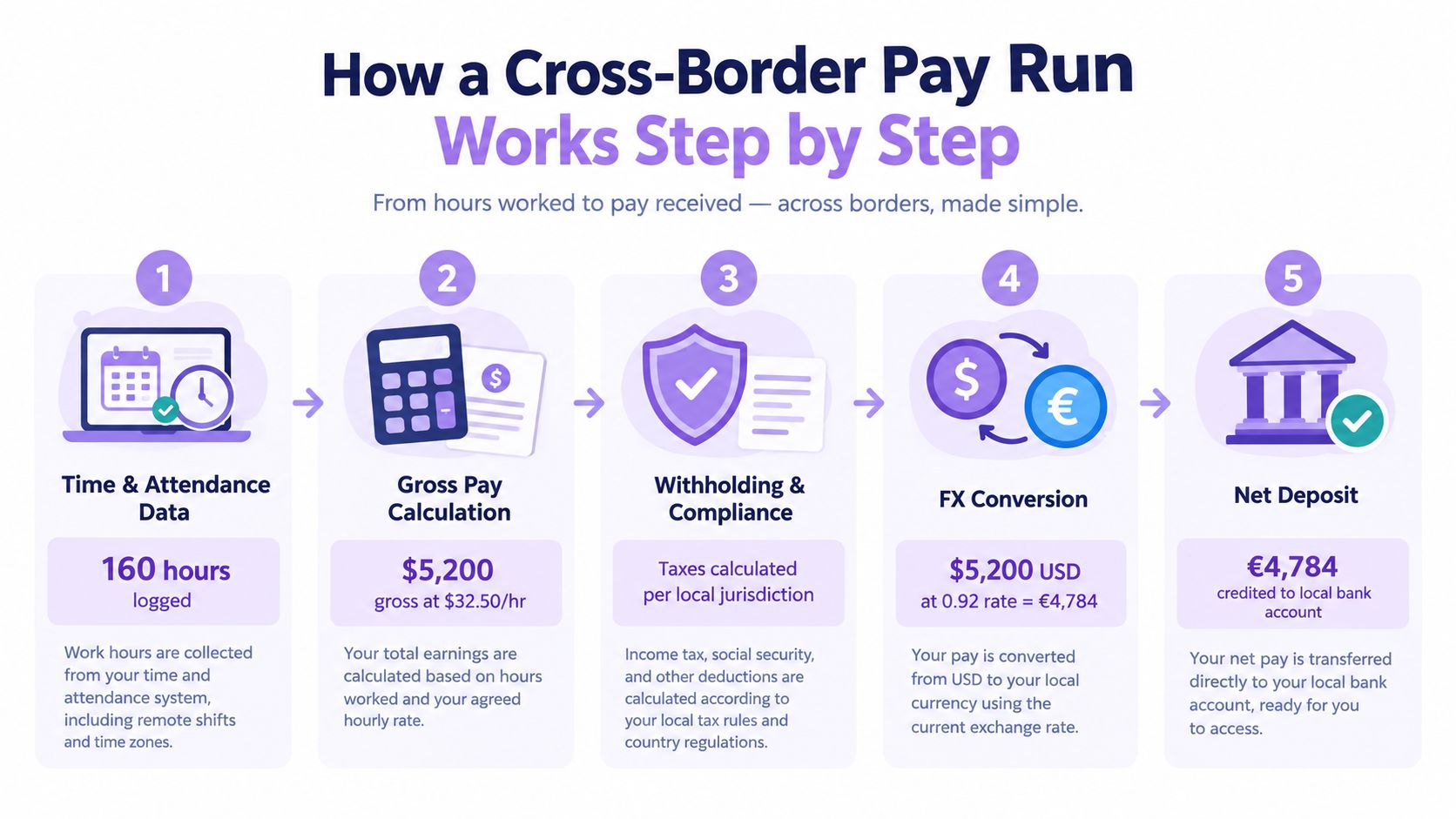
The common failures are upstream. A clinical-adjacent bonus may be coded as ordinary hourly pay. A biller working across multiple practices may be assigned to the wrong cost center. A mid-cycle hire may trigger incorrect proration if the start date, pay frequency, and local contract terms don't align. Validate the source data before optimizing the final payment step.
International payroll pricing usually follows one of three structures. A provider may charge a fixed fee per worker, calculate a fee as a percentage of payroll, or include payroll inside a broader PEO or EOR bundle. The right comparison is total operating cost, not the headline subscription.
| Cost Component | Per-Employee Model | Percentage-of-Payroll Model | PEO/EOR Bundle |
|---|---|---|---|
| Core administration | Fixed charge per worker | Varies with payroll volume | Included in a broader monthly charge |
| Salary changes | Usually predictable | Rises with compensation | May be included or separately charged |
| Country setup | Often separate | Often separate | May be bundled or itemized |
| FX handling | Review the exchange-rate spread | Review the exchange-rate spread | Usually embedded in funding or invoice terms |
| Benefits and statutory costs | Usually passed through | Usually passed through | Often administered through the bundle |
| Best comparison method | Monthly cost per active worker | Effective percentage plus fixed fees | Total landed employment cost |
A practice should request an itemized quote for each target country and worker type. Ask whether onboarding, offboarding, year-end filings, expense processing, benefits administration, contract amendments, and special payroll runs are included. Also ask how the provider makes money on currency conversion. A small difference between the quoted rate and the market rate can become meaningful across recurring payroll.
The missed costs are often operational rather than technical:
Don't build a business case around salary alone. For each worker, calculate base compensation, employer obligations, service fees, expected currency cost, benefits, setup charges, and internal administration. Then compare that total with the cost and control of employing through a local entity.
Payroll should become part of the practice's operating system, not a second spreadsheet maintained by one administrator. A medical group may already use an ATS for recruiting, an HRIS for employee records, an EHR or practice-management system for workflow data, and a general ledger for financial reporting. The international payroll layer needs clear ownership at every handoff.
The ATS or hiring workflow should provide approved identity, role, start date, compensation, country, and contract information. The HRIS should manage worker status, leave, documents, and changes. Timekeeping should send approved hours and overtime. The practice-management or revenue-cycle system may provide productivity inputs for billing and coding support, but those inputs need review before they become compensation data.
The general ledger needs consistent entity, department, location, and cost-center mapping. If a remote biller works for several practices, the payroll report should preserve that allocation rather than posting the full amount to one department. A single incorrect mapping can distort staffing costs and create a reconciliation problem even when the worker is paid correctly.
Standalone payroll provider. This can offer deeper country payroll expertise and keep payroll separate from recruiting. The trade-off is more data movement, often through API, SFTP, or controlled imports. Define which system is the source of truth for each field.
PEO or EOR platform. A consolidated platform may combine contracts, onboarding, payroll, benefits, and worker records. That reduces handoffs, but country-specific portals or limited accounting exports can make detailed reconciliation harder.
Hiring platform with payroll support. A platform such as LatHire can combine talent sourcing, onboarding, and international payroll support in one commercial relationship. That may suit a practice that wants one workflow for finding and engaging remote administrative staff, but you should still verify the exact employer model, country coverage, data controls, and reporting exports.
SSO compatibility matters in a HIPAA-aligned environment, but SSO alone isn't a HIPAA requirement. Review role-based access, audit logs, encryption, retention, incident response, and whether a Business Associate Agreement is needed for the services being used. If the system exchanges tax or worker data rather than PHI, the privacy review still matters because payroll records are sensitive.
Integration test: Send one realistic worker record, one approved time file, one bonus, one leave event, and one termination scenario through the proposed workflow before signing.
Tax data can also touch vendor and finance processes. For workflows involving indirect-tax identifiers, teams may find tools such as automatic VAT number checks useful, but that capability doesn't replace payroll, employment, or worker-classification review. Document what the tool validates and what remains a human approval.
For a broader platform comparison, review international payroll systems for distributed teams and match the feature set to your actual countries, roles, and integration requirements.
Treat provider selection as an operational test, not a software demonstration. A dashboard can look complete while the provider relies on partners in the countries you need, assigns compliance responsibility to your practice, or provides weak evidence when a payroll exception occurs.
Create a shortlist based on the countries where you plan to hire. For each provider, record whether it owns the local entity, uses a partner, provides payroll-only support, or acts as EOR. Ask who signs the contract, who files taxes, who manages statutory benefits, and who handles termination.
Then test the healthcare fit. A provider should understand that a remote medical receptionist, insurance verification specialist, prior-authorization support worker, and billing assistant have different access, supervision, and workflow needs. It shouldn't imply that administrative talent can diagnose patients or perform licensed work.
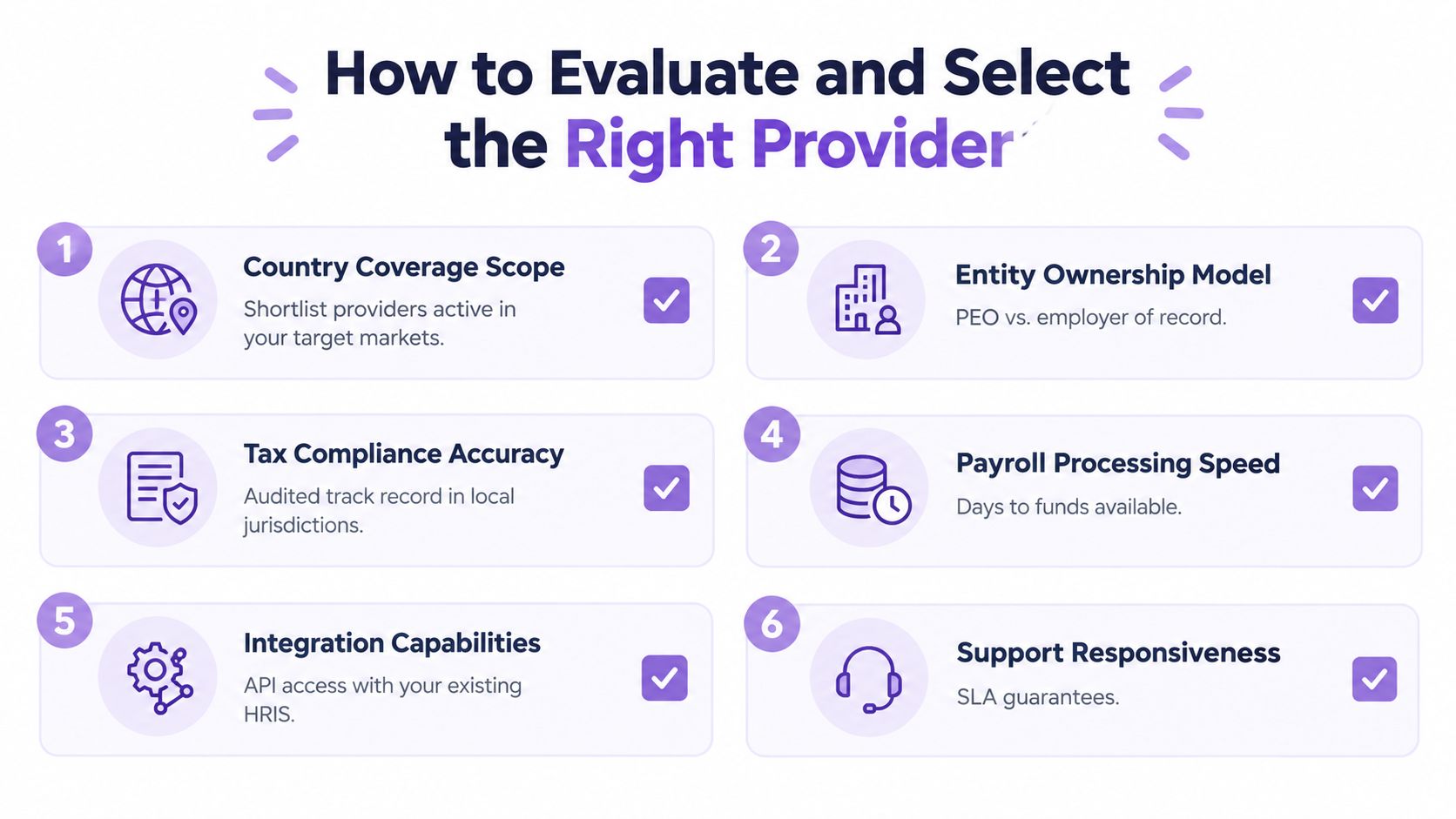
Request references from two medical practices of similar size and ask a direct question: What broke during your last country launch? Listen for specifics about missing data, delayed approvals, wrong deductions, payment returns, support gaps, or unexpected charges.
Require a sandbox pay run using representative data. Include a new hire, a worker with approved leave, a bonus, a reimbursement, a currency conversion, and a termination calculation if relevant. Compare the output with an independent review from local payroll counsel or an experienced payroll professional.
Check the agreement for fee escalators, FX language, deposit requirements, liability allocation, termination costs, data retention, subcontractors, and correction procedures. Provider guidance on payroll outsourcing in Singapore is a useful reminder that country-specific outsourcing questions deserve country-specific answers, even when your practice is hiring elsewhere.
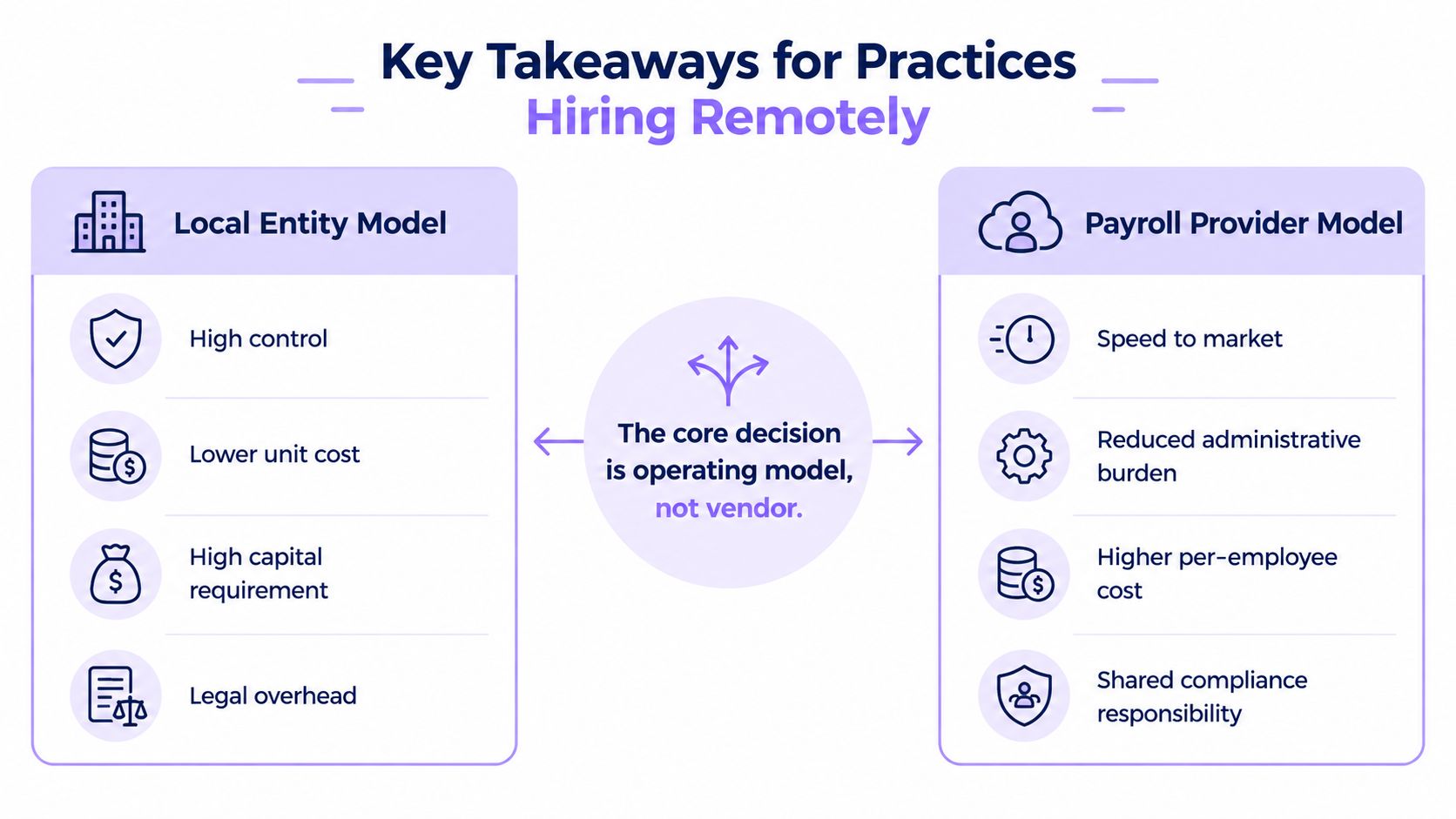
The central decision is the operating model, not the vendor. A local entity offers control and may become efficient with sustained headcount, but it brings legal, banking, tax, HR, and administrative obligations. A payroll-only provider works when you already have the entity. A PEO can combine payroll and HR support through a co-employment structure. An EOR can employ workers through a local entity when your practice doesn't have one.
For a first remote coordinator, biller, scheduler, or administrative assistant abroad, an EOR or integrated hiring-and-payroll arrangement often reduces the structural work required to start. That doesn't eliminate practice responsibilities. You still need to define the role, control access to patient information, approve time and compensation changes, verify classification, and review every payroll report.
International payroll services work best when the provider is treated as an operating partner rather than a payment button. Before hiring your first remote healthcare team member, map the role, country, data access, employer structure, payroll calendar, and approval chain. Then request an implementation plan and a country-specific quote from a qualified provider so you can make the decision with the full operational cost visible.
If you're preparing to hire a remote coordinator, biller, scheduler, or medical administrative assistant, start with a country-and-role review before signing an offer. Talk with LatHire about available healthcare support talent, onboarding, and international payroll options, then confirm the proposed structure with your employment and compliance advisers.

