
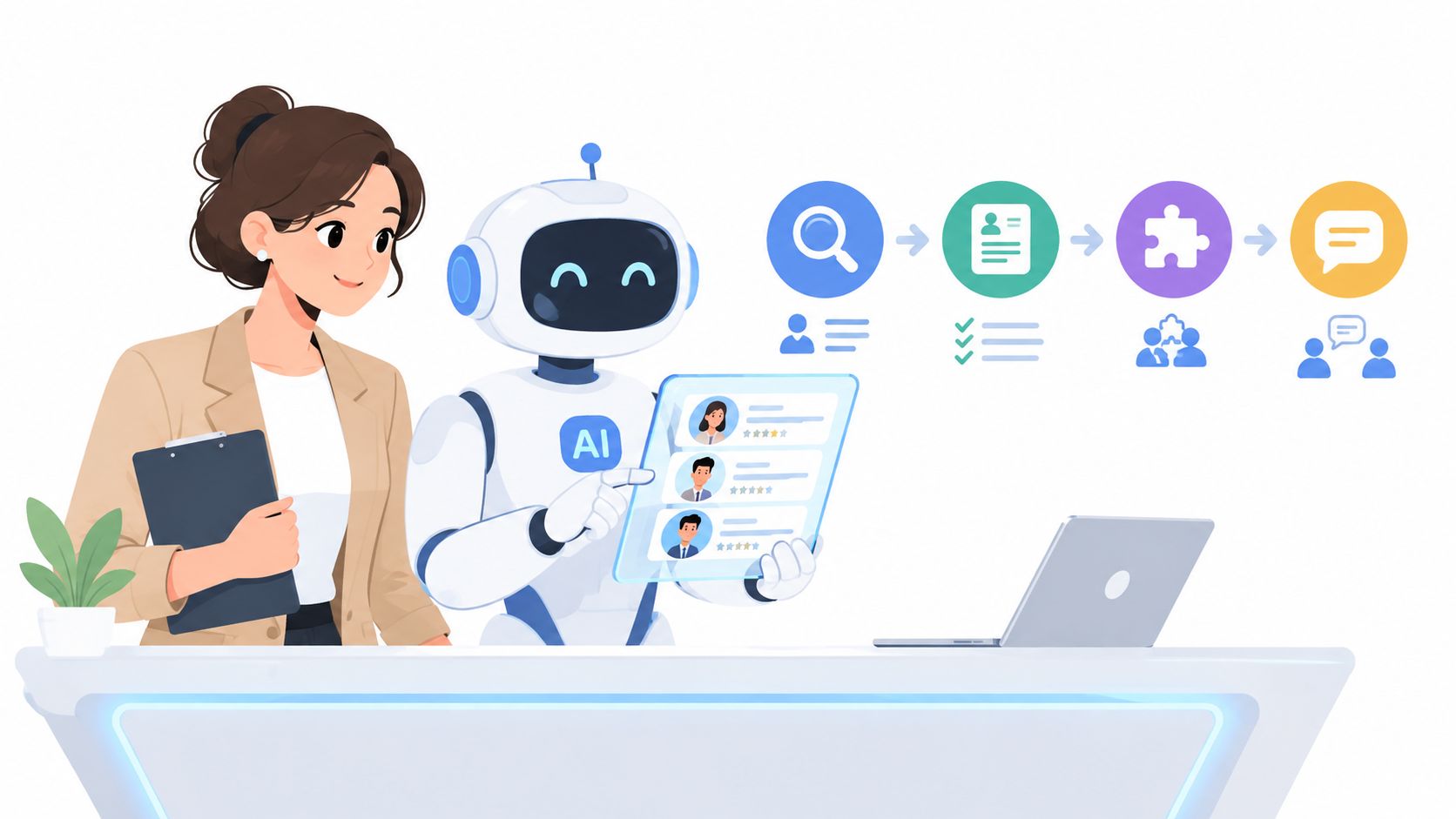
Hiring teams didn't adopt AI gradually. They hit the gas. In 2025, 43% of organizations used AI for HR tasks, up from 26% in 2024, according to SHRM 2025 Talent Trends research summarized here. For practice managers and business owners, that matters because recruiting is one of the first places AI shows up in a very practical way. It helps sort, match, schedule, summarize, and surface people who might otherwise get missed.
That's the simplest answer to the role of AI in recruitment. AI is a hiring assistant across the workflow, not a replacement for human judgment. It can help medical practices handle repetitive, high-volume tasks like sourcing remote staff, screening administrative applicants, organizing interviews, and keeping candidates informed. It should not be the final voice on fairness, context, culture fit, or legal risk.
In healthcare hiring, that distinction matters more than usual. A family practice hiring a remote scheduler, an orthopedic group looking for a bilingual patient coordinator, and a billing company recruiting virtual support staff all have different needs. The tasks may be administrative, but the consequences touch patient access, protected information, compliance, and team reliability.
If you're evaluating AI for recruiting, the useful question isn't “Should we use AI or not?” It's “Where should AI help, where should people stay in control, and what checks make the process safe?” That's where most confusion sits, especially for medical practices considering remote healthcare staff and medical virtual assistants.
A single remote medical receptionist opening can draw dozens of applications overnight. For a practice manager, the bottleneck is rarely finding applicants. It is sorting them fast enough to keep good people from disappearing into the pile.
For a role like this, AI works like a first-pass coordinator. It can group applicants by baseline requirements such as U.S. schedule overlap, front-desk or call-handling experience, bilingual ability, and familiarity with insurance verification or patient scheduling systems. If 80 people apply and 15 clearly meet the must-haves, the tool helps your team get to those 15 sooner instead of spending hours manually opening every resume.
That time difference matters. A hiring lead might spend two to three minutes on each early screen just confirming basic fit. Across a large applicant pool, that can easily turn into several hours of admin work before anyone has had a real hiring conversation. AI cuts that clerical step down by organizing the queue, highlighting likely fits, and drafting routine follow-up so your team can spend more time judging communication, judgment, and reliability.
Medical practices feel this value quickly because many remote administrative roles have repeatable filters. Appointment schedulers, prior-authorization support, insurance verification specialists, patient coordinators, virtual medical receptionists, and medical administrative assistants all need some mix of schedule coverage, patient-facing communication, documentation accuracy, software comfort, and workflow discipline. AI helps surface those signals earlier in the process.
AI use in recruiting has grown quickly, as noted earlier in the article. In day-to-day hiring, though, the important point is less about the headline number and more about the actual jobs these tools are doing. For many teams, AI is handling the front half of the workflow. Screening for minimum criteria, sorting resumes into clearer groups, proposing outreach, and helping move interview scheduling along.
The safer way to view it is simple. AI assists across the hiring lifecycle. People still decide what the role requires, which trade-offs are acceptable, and whether a candidate should move forward.
Practical rule: Use AI for repetitive, high-volume steps. Keep human review for context, fairness, and final decisions.
Success depends on trust, and trust comes from checks. A tool that works well for a high-volume receptionist search may perform poorly for a bilingual patient coordinator or a billing support role if the criteria are vague or biased. That is why strong teams review role-level results, test for patterns that could filter out good candidates unfairly, and keep clear human ownership at every decision point.
If AI feels abstract, use this analogy. It reads patterns across resumes, job descriptions, assessments, and messages, then helps organize what deserves a closer look.
When a recruiting system says a candidate is a “match,” it usually means the tool found overlap between the role and the applicant's data. That overlap might include skills, titles, certifications, shift availability, software exposure, language ability, or work history.
For a medical billing support role, the tool may notice terms tied to claims follow-up, eligibility checks, and payer workflows. For a patient coordinator role, it may notice scheduling, patient communication, and bilingual English-Spanish experience. It's not “understanding” a person the way a hiring manager does. It's sorting based on patterns and rules.
Practice managers often get confused at this point. A ranked list is not a hiring decision. It's a prioritized stack.
A good AI tool can help answer questions like:
Autonomous decision-making is a different category. That's when a system goes beyond organizing and starts making pass-fail judgments with little review. In healthcare recruiting, that's usually where caution should rise.
AI should narrow the review burden, not quietly become the reviewer of record.
AI tools work from inputs. If the job description is vague, if your “must-haves” and “nice-to-haves” are mixed together, or if old hiring patterns baked in bad habits, the system won't fix that. It will repeat it faster.
That's why the setup matters:
For medical practices, this point is easy to miss when hiring remote staff. If your posting says “medical assistant” but you really need a non-clinical virtual scheduler, the tool may pull the wrong people. Precision matters because AI follows the role definition you give it.
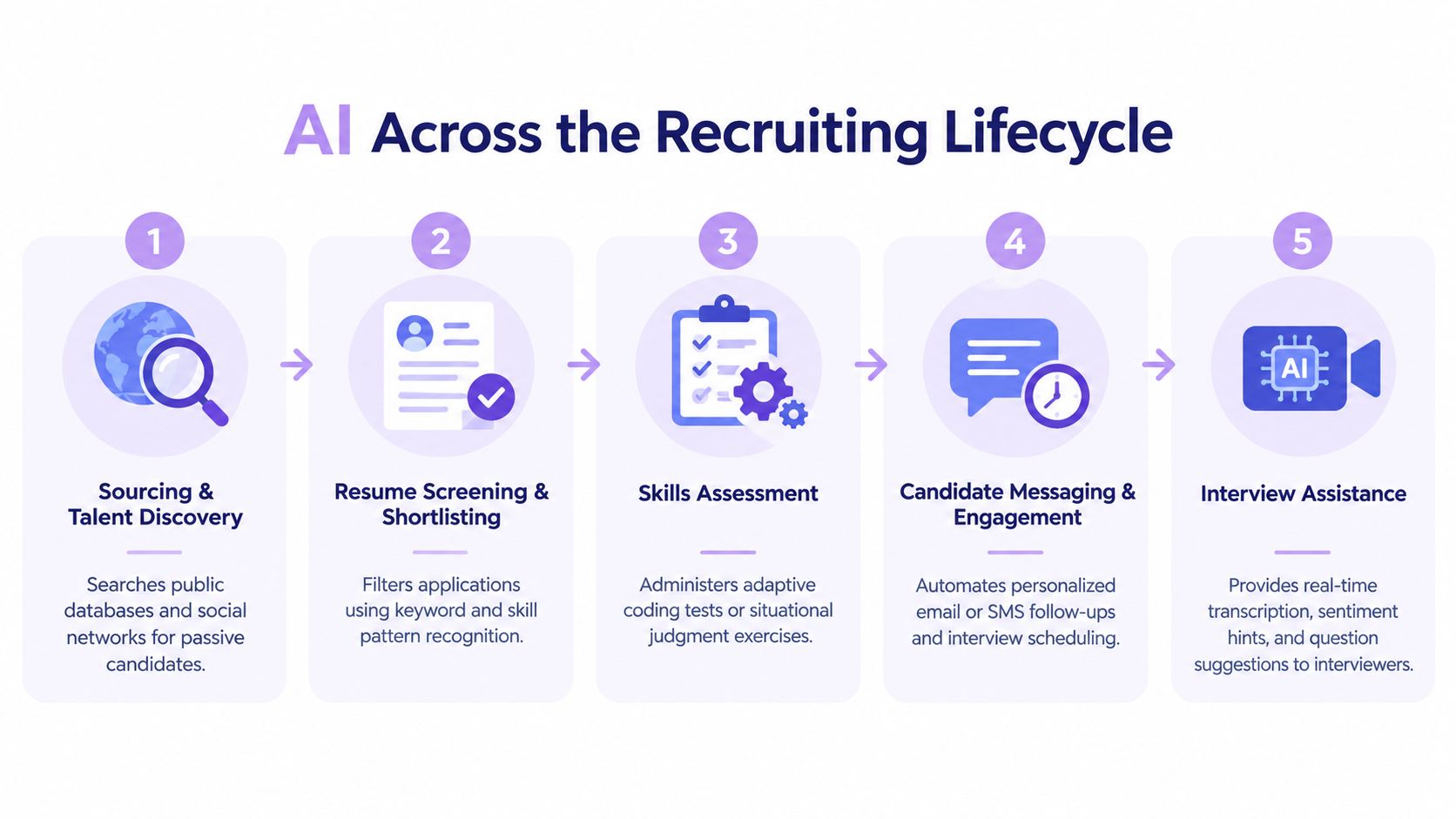
Recruiting works best when you see it as a chain of steps, not one decision. AI can support each step differently. That's why the role of AI in recruitment is better understood as lifecycle assistance.
The first job is finding people. Historically, many organizations leaned heavily on their own networks. That's changing. The UK government's AI Labour Market Survey 2025 found that the difficulty organizations faced in filling AI vacancies fell from 69% in 2020 to 35% in 2025, while the share of vacancies filled via word of mouth dropped from 42% to 15% and social media became the second-most used route at 13%, as summarized in this review of AI recruitment statistics.
For hiring teams, the broader lesson is clear. AI-supported sourcing expands the market beyond who you already know.
A specialty clinic looking for a bilingual remote patient coordinator is a good example. Without AI-assisted search, the practice may rely on referrals and job boards alone. With AI tools, the team can search wider candidate pools, identify people with the right scheduling or patient-facing backgrounds, and surface applicants outside the immediate network.
Screening is where many teams first feel AI's value. Instead of reading every resume line by line, recruiters can start with a shortlist based on criteria they defined in advance.
That's especially helpful for administrative roles where the first-pass filters are concrete:
Human review still matters because resumes don't always tell the whole story. A strong candidate may come from dental, behavioral health, or general administrative support and still adapt well to a front-desk healthcare workflow.
Some tools go beyond resumes and evaluate specific abilities. For a medical virtual assistant, that might include written communication, documentation habits, calendar coordination, or scenario-based judgment. For billing support, it may focus on process accuracy and payer follow-through.
This stage is useful because titles can be misleading. “Coordinator” in one company may mean logistics. In another, it may mean patient service and referral management. AI can help compare people based on tasks rather than title labels alone.
If you're refining role requirements, a founder's guide to hiring with AI can be useful for structuring clearer job descriptions before matching begins.
This is the least glamorous use case and often the most immediately helpful. AI can help draft outreach, answer routine questions, send reminders, and coordinate calendars. In a busy medical practice, that can remove a lot of friction.
A multisite group hiring several remote insurance verification specialists may benefit here. Instead of staff manually emailing every applicant and juggling schedules, AI-assisted workflows can keep communication moving while the hiring team focuses on evaluating finalists.
Some systems now summarize interviews, transcribe conversations, or suggest follow-up questions. Used carefully, this can improve consistency. It can help interviewers remember what was said instead of relying on thin notes taken between patient issues and operational fires.
Still, restraint matters. AI can support note-taking and structure. It shouldn't become the hidden judge of tone, expression, or “fit” without scrutiny.
The safest use of AI in interviews is administrative support and structured documentation. The riskiest use is invisible scoring that no one on your team can explain.
AI can make recruiting smoother, but it doesn't improve every hiring problem. Some bottlenecks are process issues, not technology issues. If your practice has unclear role ownership, inconsistent interviewers, or weak onboarding, AI won't cure that.
The strongest gains usually show up in repetitive work. Shortlisting, scheduling, outreach drafts, and structured comparisons are all reasonable places to use AI. That's particularly true for practices hiring at volume or replacing roles that turn over often, such as front-desk support, scheduling, verification, and billing administration.
There's also a consistency benefit. When the same role-based criteria are applied across applicants, the first screening pass can become more stable than ad hoc manual review.
For teams trying to pair better data with hiring judgment, this overview of using analytics to avoid bad hires is a helpful companion to AI workflows.
AI is weaker when the role depends on nuance that doesn't appear cleanly in historical data. Senior operations hires, highly specialized clinical support roles, and positions requiring unusual interpersonal judgment often need more human-led evaluation.
Candidate experience can also suffer if automation takes over too much of the process. Applicants can tell when every message feels machine-written and every stage feels opaque. That's one reason many teams are rethinking what to do about AI hiring problems, especially when efficiency gains create new trust issues.
| Recruiting Task | AI Suitability | Human Oversight Needed |
|---|---|---|
| Candidate sourcing | High | Review whether the pool reflects the real role and market |
| Resume triage | High | Check for strong nontraditional applicants who may be filtered out |
| Interview scheduling | High | Minimal, mainly exception handling |
| Skills pre-screening | Moderate to high | Confirm the assessment matches the actual job |
| Interview note summaries | Moderate | Validate accuracy and add context |
| Culture and team fit | Low to moderate | Hiring manager judgment should lead |
| Final selection | Low | Humans should own the decision and rationale |
A good working rule is simple. Let AI handle the pile. Let people handle the judgment.
The biggest mistake in AI recruiting is assuming that a tool is fair because a vendor says it passed an audit. That can be true at a broad level and still fail in the exact jobs where you use it.
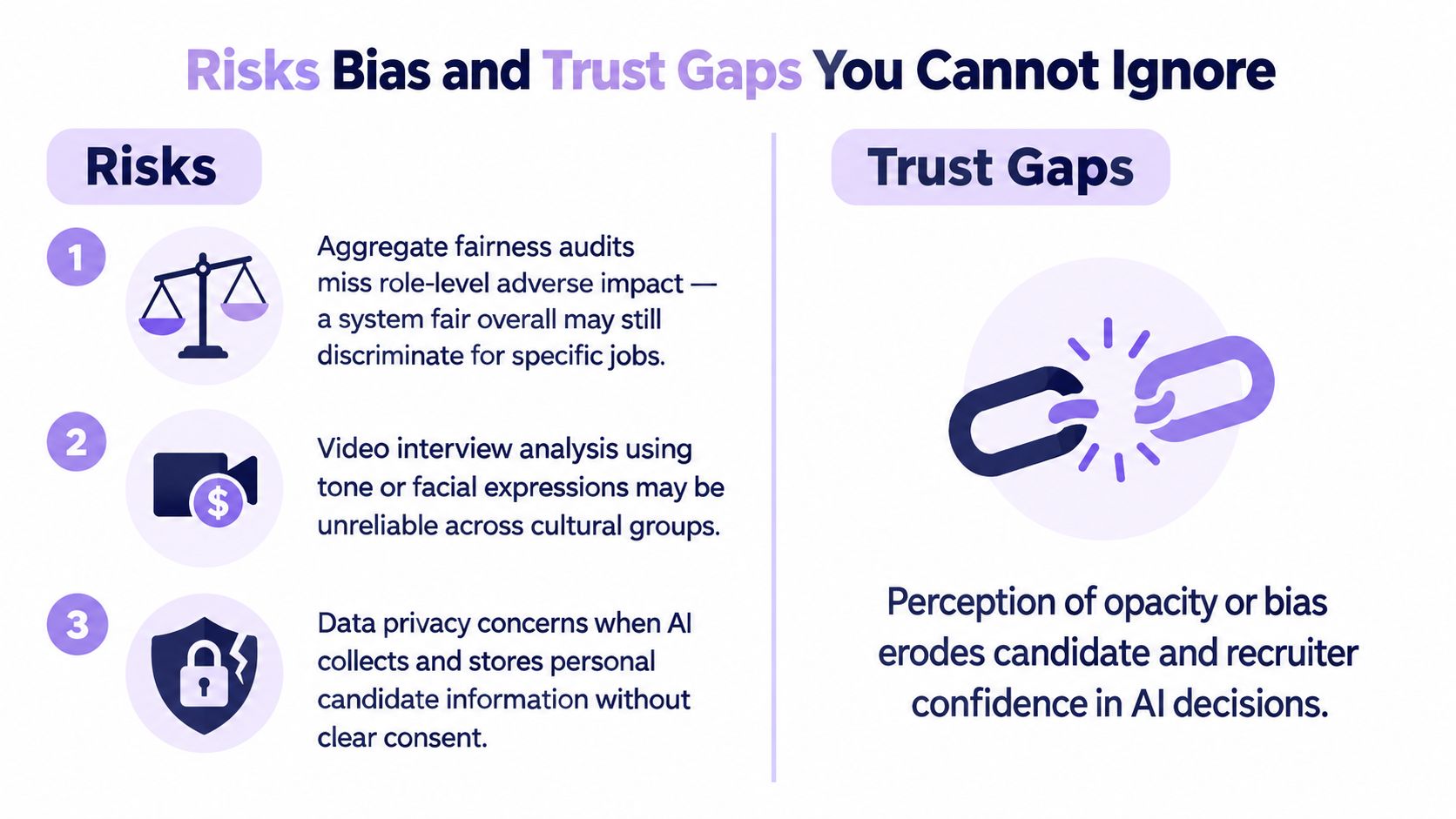
A large audit of AI hiring tools found that company-wide checks can miss role-specific discrimination. In a study covering 3.4 million applicants across 4 million applications and 1,700 positions, 26% of Black applicants and 15% of Asian applicants applied to roles where the system's selection rate for their group was low enough to trigger EEOC adverse-impact scrutiny, even though the vendor's overall audit looked clean when averaged across jobs, according to the research paper on role-level bias in hiring systems.
That matters because hiring doesn't happen at the “platform” level. It happens at the requisition level. A tool may behave one way for remote schedulers and another for billing support or intake coordinators.
Compliance point: If a vendor only shows aggregate fairness results, ask for reporting by role, requisition, and region.
There's also evidence that audited systems can outperform human-led screening on fairness metrics when they're tested properly. Across 150+ audits and more than 1 million test samples, audited AI systems showed an average impact ratio of 0.94 versus 0.67 for human-led decisions, with 85% meeting the EEOC four-fifths rule and 95% passing counterfactual consistency testing, as summarized in this review of audited AI hiring fairness findings.
That's useful, but it doesn't settle the issue. It tells you monitored systems can be calibrated well. It does not mean any off-the-shelf hiring tool is automatically safe in your workflow.
Even if a tool performs acceptably on technical metrics, candidates may still distrust it. Greenhouse's 2026 survey found that only 26% of applicants trust AI to evaluate them fairly, according to the 2026 AI in hiring report overview. That gap matters because recruiting is partly operational and partly relational.
If candidates think they're being scored by a black box, they may disengage, answer less candidly, or drop out early. In healthcare support hiring, where professionalism and communication matter, trust affects the applicant pool you end up seeing.
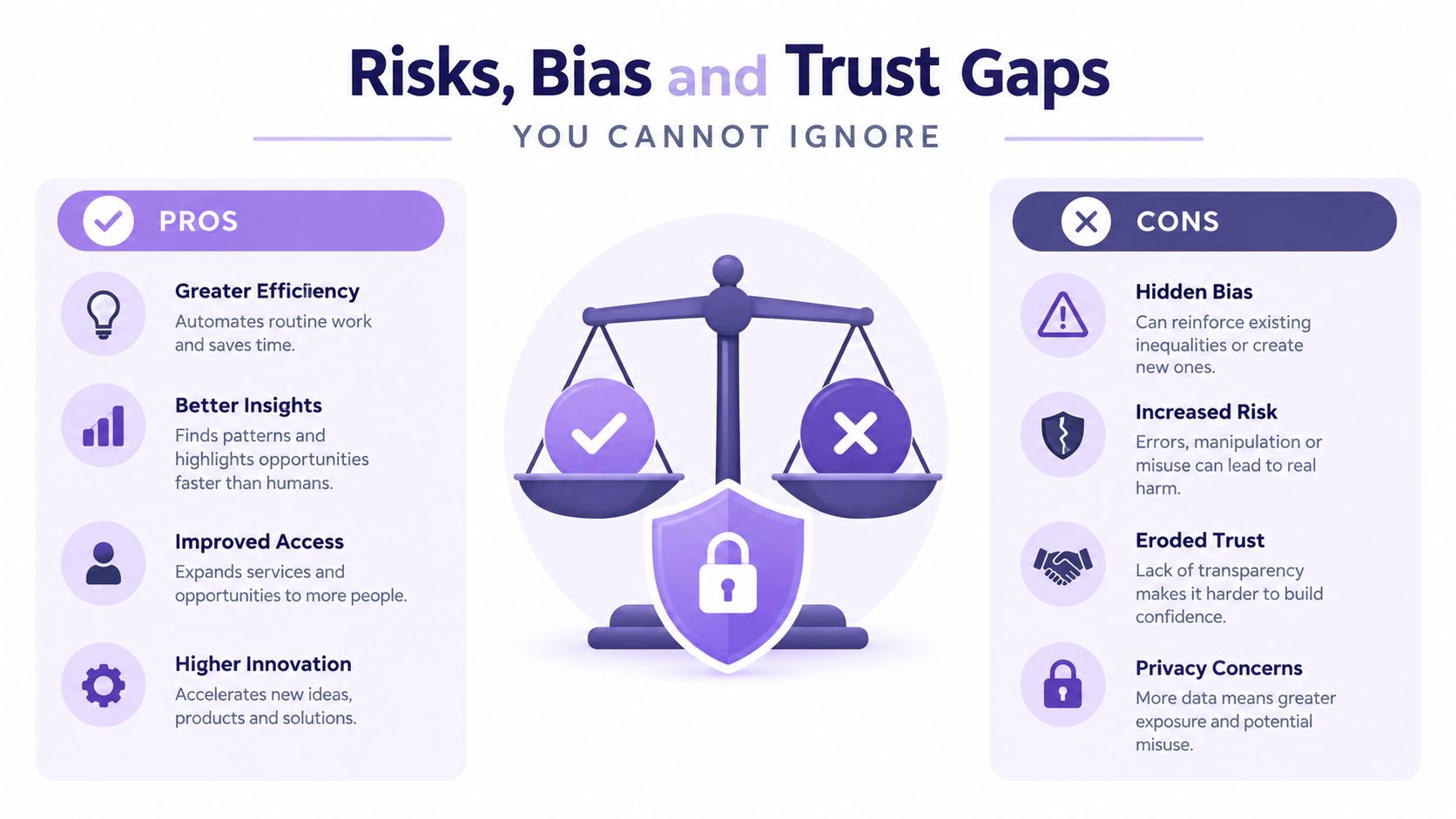
Another uncomfortable point is that bias doesn't stop once a recommendation reaches a person. Research summarized in this article on AI bias, feedback loops, and human mirroring in hiring notes that bias can be introduced through data and design, then reinforced through feedback loops, and that people can mirror AI hiring biases.
That means “a human made the final call” is not enough protection if the human is being steered by flawed rankings or scores.
Medical practices should remember that federal employment discrimination rules don't disappear because software is involved. The EEOC says those laws protect applicants from discrimination based on race, color, religion, sex, national origin, age 40 or older, disability, and genetic information. The EEOC also warns that video interviewing and monitoring tools can produce discriminatory outcomes, including lower scores tied to disability-related speech patterns or facial-recognition errors affecting darker skin tones, as described in this summary of EEOC AI hiring guidance.
If your practice uses video, speech, or behavior-analysis tools, that's a point for very close review.
A calm rollout beats a big rollout. Most medical practices don't need an “AI hiring transformation.” They need a controlled pilot tied to a specific bottleneck.
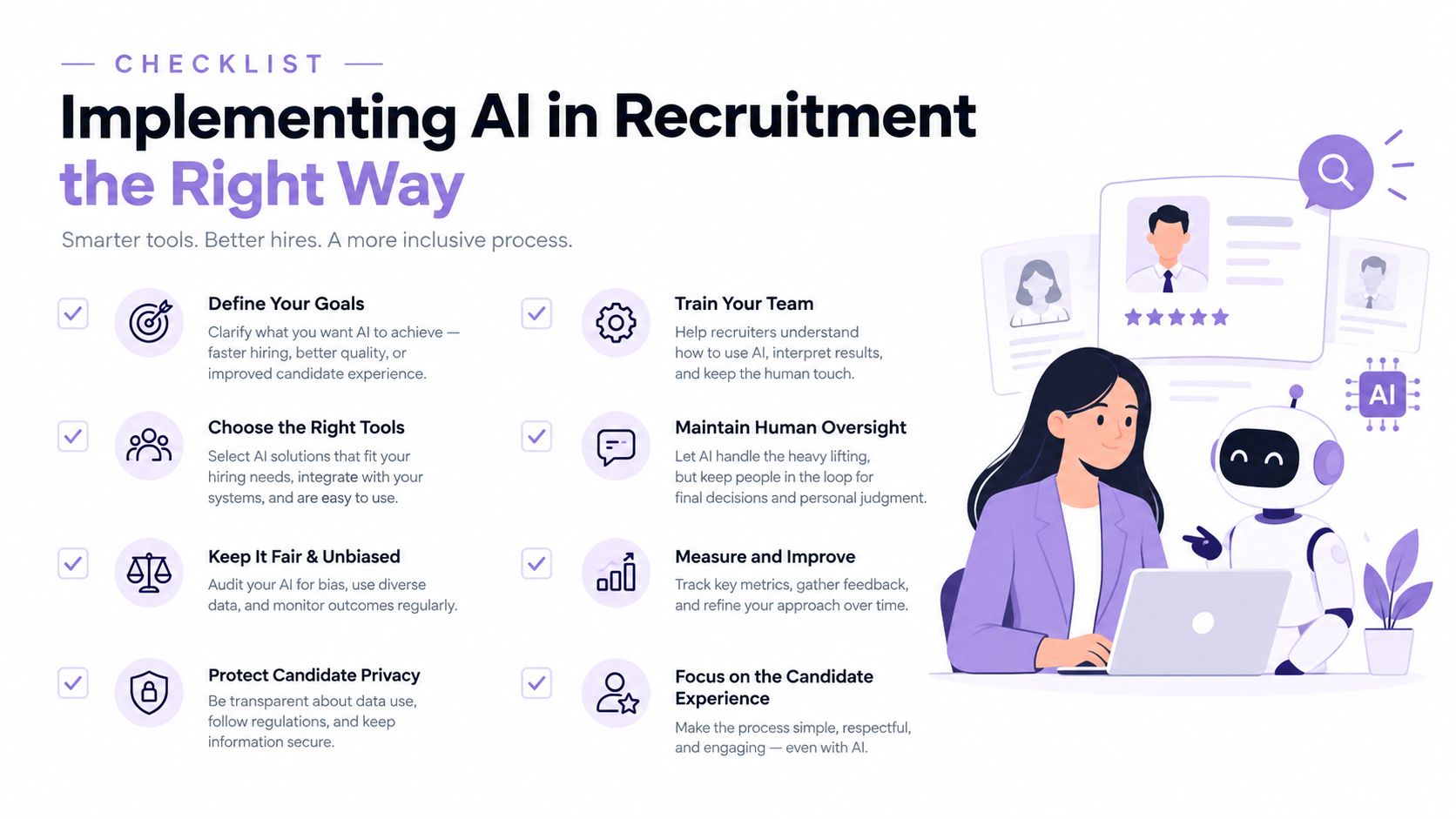
Pick one use case that is repetitive, measurable, and low-risk. Good starting points include first-pass screening for remote schedulers, interview scheduling, or candidate communication for non-clinical administrative roles.
Then define success in operational terms. Faster review, clearer shortlists, fewer scheduling delays, better documentation. Keep the pilot narrow enough that your team can see what changed.
AI performs better when your hiring process is already structured.
Use this checklist:
If you're comparing software categories, this list of recruitment automation software options can help frame what belongs in your stack and what doesn't.
Hiring remote healthcare staff adds extra obligations. If a worker will access protected health information, one source notes that HIPAA-related handling is typically conditioned on a signed Business Associate Agreement before access to patient data, along with documented HIPAA training, secure and access-controlled systems, and a breach-response process. The same guidance also notes the practical need for encrypted, audit-logged remote access and unique user logins for each worker, according to this discussion of HIPAA-compliant virtual medical assistant safeguards.
Screening should also fit the role. Guidance on remote healthcare worker screening emphasizes medical license verification, criminal background checks, healthcare-compliance checks, and early notice to candidates about background checks, especially for telehealth or remote staff who may touch patient data, as outlined in this guide to healthcare remote worker background checks.
In healthcare recruiting, a “good candidate match” isn't enough. You also need the right privacy controls, access rules, and verification steps.
Candidates notice technology long before HR teams do. If the process becomes too automated, trust falls.
That's why the implementation plan should include plain-language candidate communication, a way to request human review where appropriate, and basic training for your hiring managers. Broader thinking about employee experience with technology is useful here because the same design choices that frustrate employees often show up earlier in the applicant experience.
If you want one example of a tool-based workflow, LatHire is one option that combines AI-supported job description drafting and candidate matching with human-led hiring steps. That model fits teams that want automation in the early funnel without removing people from evaluation entirely.
The role of AI in recruitment is practical, not mystical. It helps hiring teams source wider, sort faster, communicate more consistently, and reduce manual workload across the recruiting lifecycle. For medical practices, that can be especially useful when hiring remote administrative staff such as schedulers, patient coordinators, insurance verification specialists, billing support, and virtual medical receptionists.
The boundaries matter just as much as the benefits. AI should assist with pattern finding and process flow. People should still own role design, fairness checks, exception review, compliance, and final selection. The safest approach is narrow, structured, and transparent. Start with one workflow problem, demand role-level validation, and keep human judgment active where context matters most.
If your practice is evaluating remote healthcare staff or medical virtual assistants, build your hiring process first and layer AI into the repetitive parts second. That's usually where the payoff is real and the risk is manageable.
If you want help building a shortlist for remote support roles with structured screening and human review, Medical Virtual Assistants can help U.S. medical practices evaluate pre-vetted LATAM talent for roles like patient coordination, scheduling, billing support, and front-desk administration.

