
The global HR payroll software market reached $38.82 billion in 2025 and is projected to grow to $62.64 billion by 2030, with 2026 projected at $42.78 billion. The practical takeaway is simple: the right global payroll software isn't one universal platform, but the one that matches how you hire across borders, whether you pay contractors, use an employer of record, or run payroll through your own entities.
A common situation looks like this. A U.S. or Canadian company hires a developer in Mexico, a marketer in Colombia, and a finance contractor in Brazil. What looked straightforward during recruiting becomes operationally messy once payroll starts. You now have different worker classifications, different pay frequencies, different statutory deductions, different approval timelines, and often different expectations around invoicing, reimbursements, and benefits.
That's why buyers get into trouble when they evaluate global payroll software as if every product solves the same problem. Some tools are built for fast cross-border hiring through EOR and contractor workflows. Others are stronger when you already own legal entities and need to centralize local payroll, tax handling, reporting, and finance controls. The software category itself keeps expanding, but user satisfaction still shows meaningful execution gaps. In the 2024 to 2025 Sapient Insights Group HR Systems Survey, payroll systems averaged 3.41 for user experience and 3.33 for vendor satisfaction on a 1 to 5 scale, continuing a downward trend over the prior two years in that survey's payroll category findings published by Sapient Insights Group.
For medical practices, MSOs, and healthcare organizations expanding administrative support across the U.S., Canada, and LATAM, that distinction matters even more. You need payroll infrastructure that fits your staffing model, your privacy expectations, your reporting needs, and your appetite for implementation work. The options below are best understood by operating model, not by marketing category.
A U.S. practice group hires a coordinator in Texas, a billing specialist in Ontario, and administrative support in Colombia and Mexico. The payroll problem is no longer just payroll. It becomes a question of who employs each worker, which tax rules apply, how funding moves across currencies, what data reaches finance, and how much manual review the team can absorb each month.
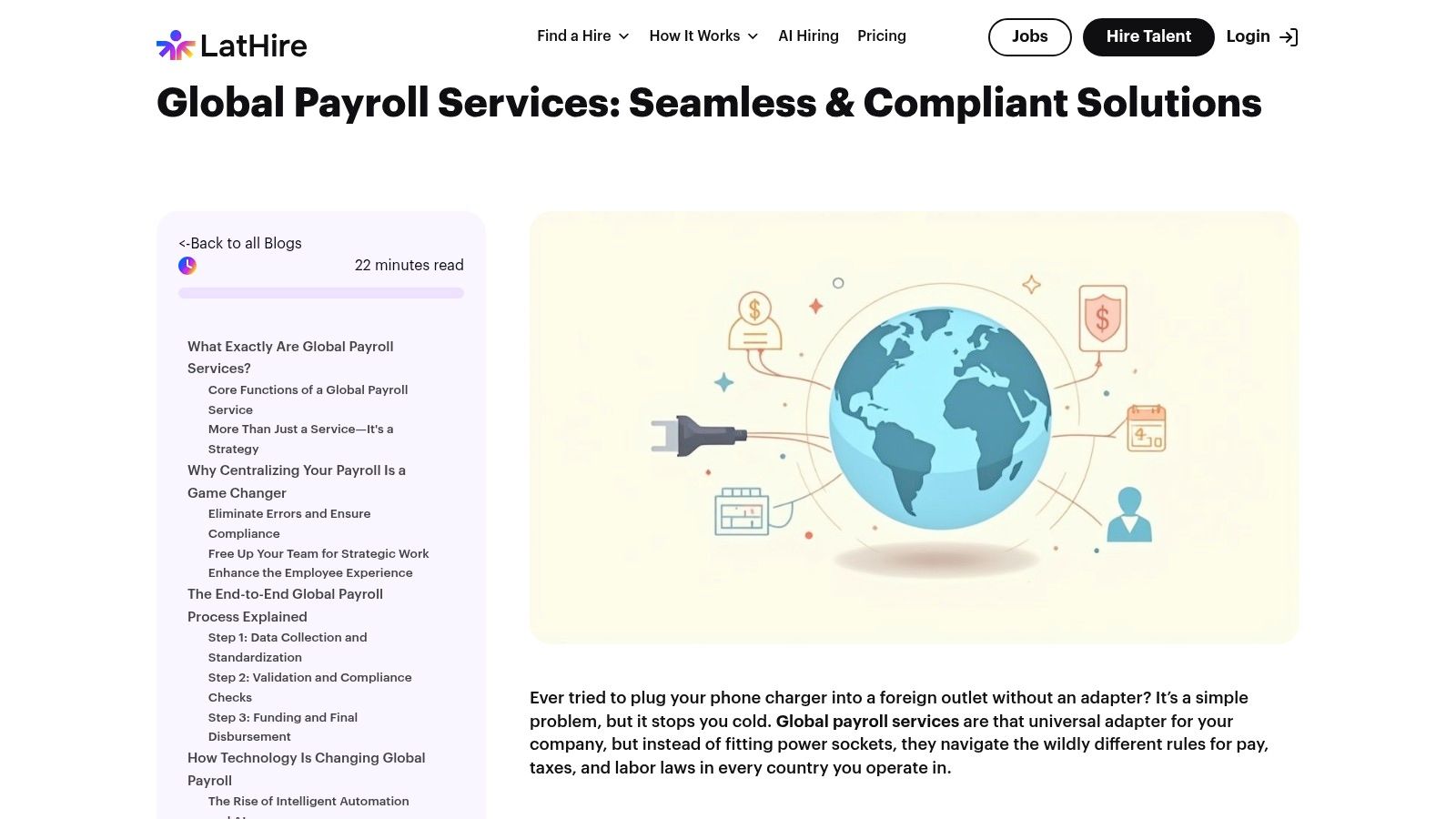
LatHire's Global Payroll Services is best understood through that operating lens. The offering is less about standalone software features and more about handling payroll as part of a cross-border hiring workflow, which can matter for companies building teams across the U.S., Canada, and LATAM without adding separate vendors for recruiting, onboarding, and pay administration.
ADP's explanation of global payroll is useful here because it frames the category correctly. The core requirement is centralized coordination across countries while local tax calculations, filings, and payment processes still need country-level accuracy. For buyers, that creates the main evaluation test. Does the platform fit your employment model, or does it force you into one?
For organizations that are still deciding between direct employment, EOR, and contractor arrangements, this model can reduce administrative fragmentation. That is particularly relevant in North America and LATAM, where teams often mix worker types by country based on entity ownership, budget, and speed to hire. A payroll service attached to the hiring workflow may simplify handoffs, but it also means buyers should look closely at scope boundaries, approval controls, and how exceptions are handled.
The trade-off is implementation burden versus internal control.
If your company already owns entities in multiple countries and wants deep in-country payroll standardization, a service-led model may feel less configurable than enterprise payroll software built for mature local operations. If you are earlier in the process and need support with documentation, funding, and recurring compliance tasks, the reduced coordination load may outweigh that limitation. The practical question is not whether one approach is better in general. It is whether your team wants to own country-by-country payroll operations directly or manage them through a provider layer.
Currency handling and reporting also matter more than many buyers expect. U.S. and Canadian leadership teams usually want consolidated visibility in one reporting structure, while LATAM payroll often introduces local payment timing, reimbursement practices, and exchange-rate reconciliation work. A platform that can connect funding, payroll outputs, and finance reporting is usually more useful than one that only produces local payslips.
Legal review still matters. Unusual worker classifications, local benefit obligations, and tax edge cases can exceed what any software or service workflow can automate. The same pattern shows up in country-specific compliance failures. Examples such as these common payroll errors in Ireland are outside the Americas, but the operating lesson carries over. Small setup mistakes in earnings codes, tax treatment, or filing responsibility tend to surface later as expensive cleanup work.
If you are building a shortlist, use this category to separate service-led payroll operating models from software-first platforms. This list of best international payroll providers is one useful reference point, but the more important filter is operational fit across entity ownership, worker type mix, integrations, funding flow, and reporting discipline.
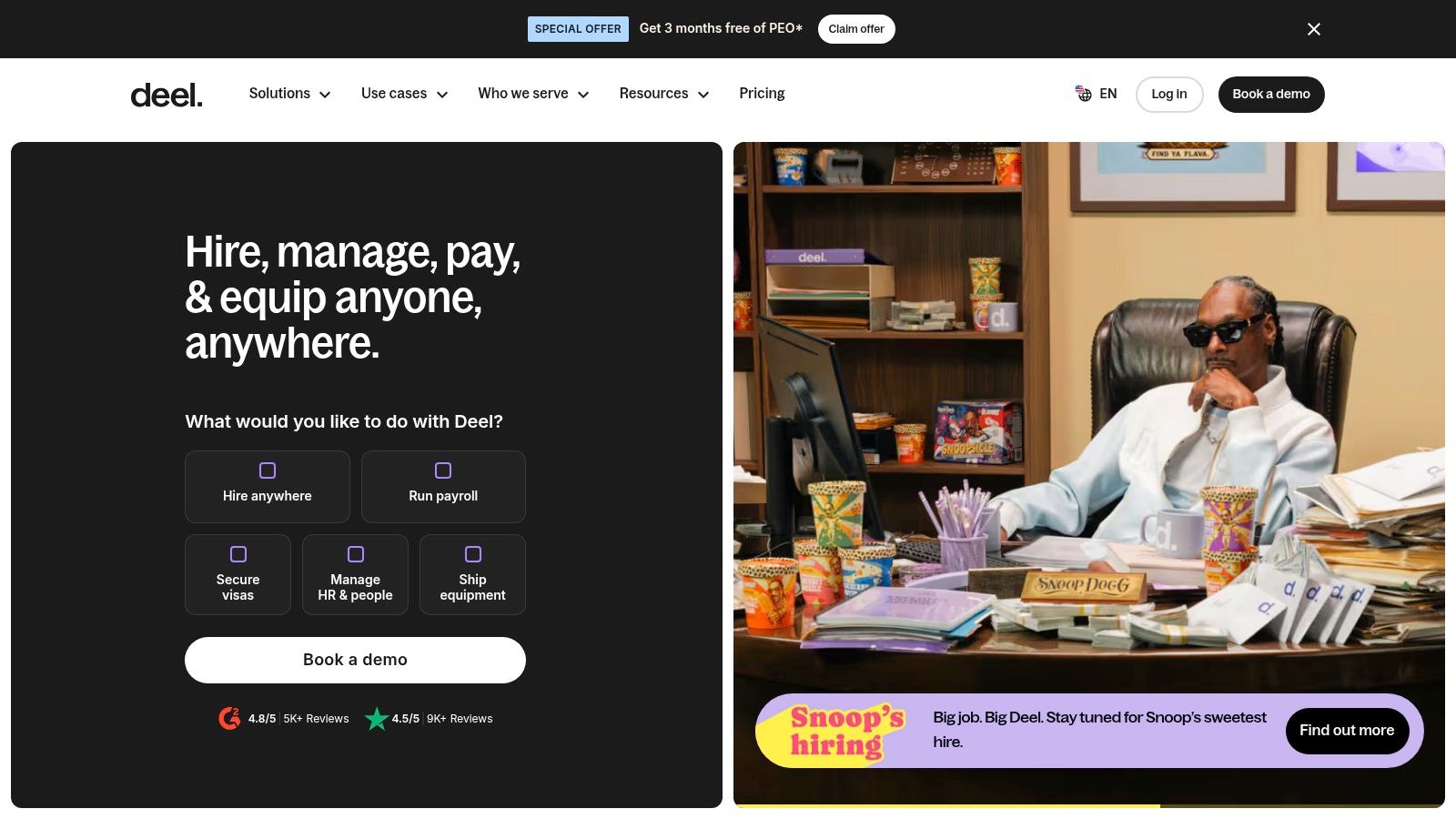
Deel is one of the clearest examples of a platform built around workforce variety. If your organization uses a mix of direct employees, EOR hires, and contractors across North America and LATAM, Deel is often on the shortlist because it tries to keep those worker types inside one operating environment rather than splitting them by vendor.
For healthcare-adjacent companies, that matters when you're hiring non-clinical staff across multiple countries and don't want separate systems for contracts, onboarding documents, payments, and localized workflows. Deel is particularly relevant for U.S.-based organizations that also need to manage domestic contractor paperwork alongside cross-border hiring.
Deel is usually a stronger fit for companies in transition than for companies with a fixed employment model. If you're not sure whether your Mexico or Colombia hires will remain contractors, convert to EOR, or eventually move under a local entity, that flexibility is useful.
Its appeal tends to come from:
The caution is cost structure. EOR pricing and country-specific fees can become expensive if you scale headcount and leave people in the EOR layer longer than planned. A company that starts in LATAM with EOR for speed may eventually want a different payroll architecture once it has enough concentration in one country to justify entity ownership.
Deel can work well for healthcare organizations hiring remote administrative staff, but the operational question isn't just whether the platform supports the country. It's whether your workflow needs more than payroll. If your team is handling insurance verification, scheduling, patient communication, or billing support, document control and role separation matter as much as payment execution.
Don't confuse a broad global hiring platform with a finished compliance program. You still need internal rules on worker scope, privacy access, approvals, and manager oversight.
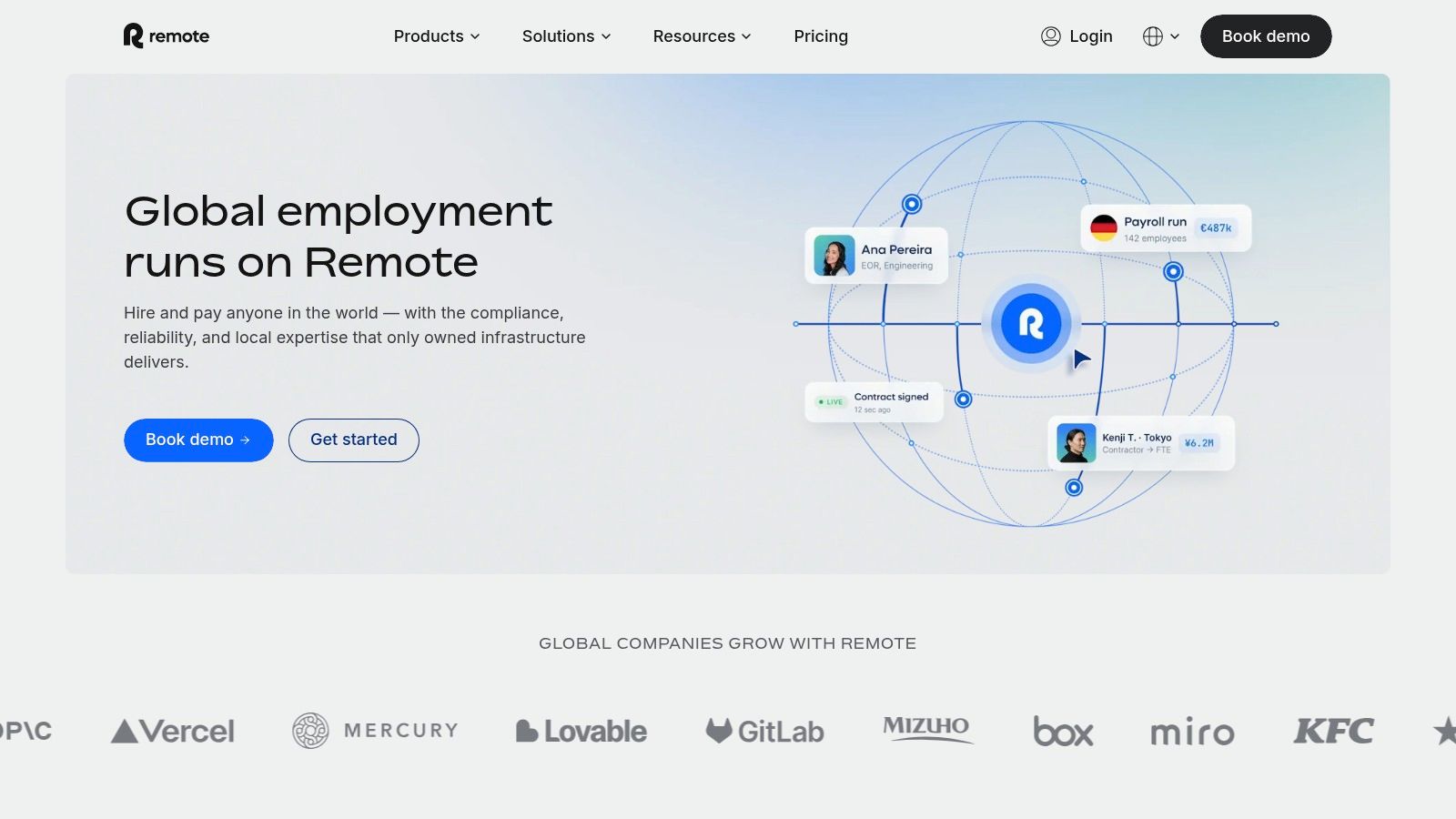
Remote is often the practical choice for organizations making their first real move beyond domestic payroll. Its appeal is less about having every advanced feature and more about reducing uncertainty for teams that need to hire internationally without building a full in-house payroll operation first.
That makes it useful for smaller healthcare groups, digital health companies, and support-heavy practices hiring administrative staff abroad for the first time. If you're starting with a few hires in LATAM and want a platform that can support contractors now and employees later, Remote has a straightforward operating logic.
Remote's structure is easiest to appreciate when you map it to growth stages. A company might begin with contractors, move some roles to EOR where long-term retention matters, and later add global payroll for countries where it owns entities. Remote supports that path without requiring a complete platform change at each stage.
Its stronger points include:
A limitation is that feature depth can vary by country. That isn't unusual in this category, but it matters more than buyers expect. If your hiring plan includes Brazil, Mexico, and Colombia, validate each country path separately instead of assuming a consistent experience.
Remote tends to fit organizations that need order more than customization. That's not a bad thing. Many payroll problems begin because teams add countries faster than they add process.
For managers who need a baseline operating framework before scaling, this guide to remote team payroll best practices is the kind of companion resource that helps. The software may run payroll, but your internal process still determines whether approvals, timesheets, reimbursements, and classification reviews happen consistently.
Papaya Global is better understood as a consolidation and control platform than as a simple hiring tool. If your organization already has multiple countries, different worker types, and fragmented payroll inputs, Papaya's value is in standardizing visibility across that complexity.
That's why it often appeals to finance-led teams. A practice-backed healthcare company, MSO, or scaling telehealth operation may care less about flashy onboarding and more about whether payroll data, payment flows, and compliance reviews can be monitored across countries without stitching together local reports.
Papaya is one of the stronger options when reporting and orchestration matter as much as pay execution. Its emphasis on standardized gross-to-net reporting, integrated payments, and analytics makes it suitable for organizations that need central oversight across a distributed workforce.
Relevant strengths include:
This is not the easiest path if your internal processes are still loose. Papaya works best when leadership is ready to standardize pay data, approval logic, and reporting conventions across regions. If each country team wants to preserve its own naming, timing, and approval habits, implementation becomes harder.
Papaya is often strongest for companies that already know they need centralized governance. It's less compelling for a very small employer with only a handful of international hires. In that case, a simpler EOR-first platform may produce less implementation burden.
A payroll platform with strong analytics can expose inconsistencies your team has been tolerating for years. That's valuable, but only if someone owns cleanup.
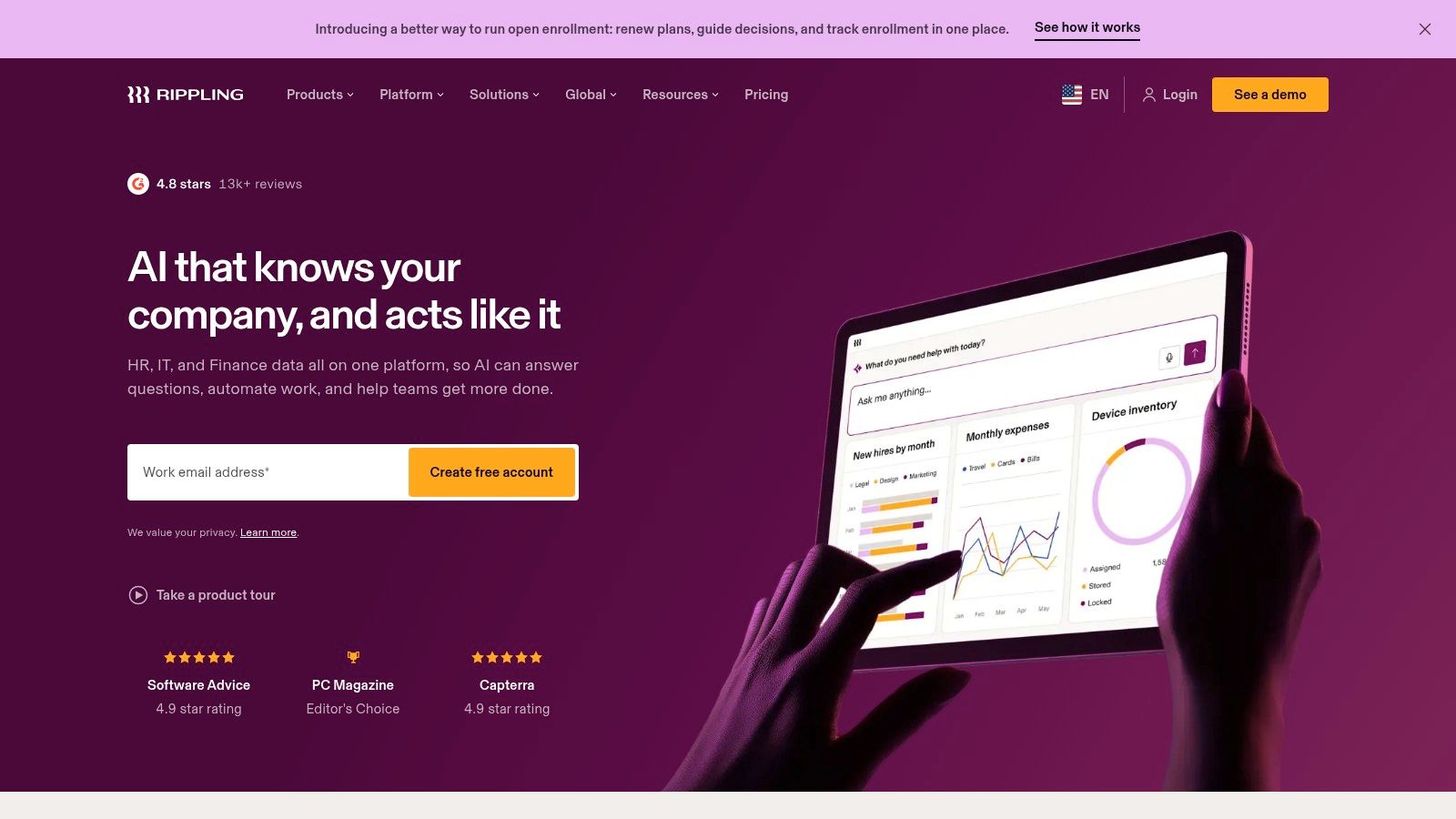
Rippling is different from most tools on this list because payroll isn't the center of the product. The center is the employee record. Payroll, HR, IT, and spend controls all sit around that shared system. For some buyers, especially those trying to connect onboarding, device access, approvals, reimbursements, and compensation, that architecture is the point.
This can be particularly relevant for healthcare organizations with distributed administrative staff who need controlled system access. If a bilingual patient coordinator in Colombia starts next week, the task isn't just paying that person. It's provisioning the right tools, limiting access appropriately, and making sure manager changes flow through the stack cleanly.
Rippling is strongest when you want payroll to be part of a broader operating system. It supports global payroll for owned entities, EOR where needed, and contractor management. It gives companies a path to move people between those models without rebuilding everything from scratch.
Key reasons teams consider it:
The trade-off is complexity. Rippling can solve broader operational problems, but buyers who only need straightforward international payroll may end up paying for architectural flexibility they won't use.
If your immediate need is to pay a small contractor team in LATAM with minimal setup, Rippling may be more system than you need. Its value increases as your workflows become more interdependent and your internal teams need one source of truth for people, permissions, and payroll data.
That's why Rippling tends to reward companies thinking one stage ahead. If you know your workforce model will evolve, it can be a smart foundation. If not, a narrower payroll-first product may be easier to implement.
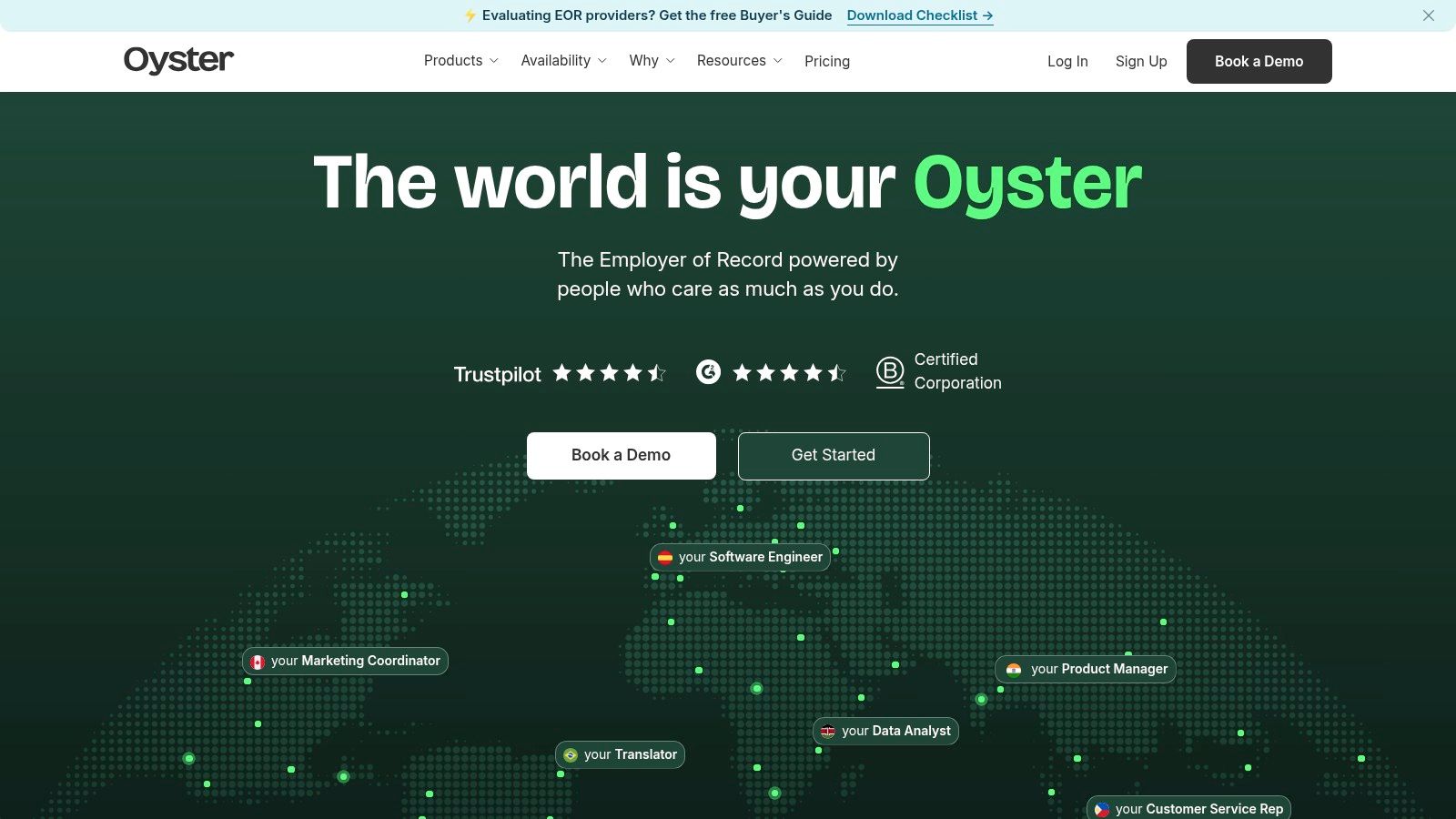
Oyster is one of the easier platforms to understand. It's built for companies that want to hire internationally with a relatively clean pricing story, a clear EOR and contractor workflow, and a visible compliance orientation. That simplicity is part of its appeal.
For a medical practice management group or healthcare support business, Oyster often makes sense when the goal is to bring on remote non-clinical staff without creating a heavyweight international infrastructure project. It's not trying to be a deep enterprise payroll operating system first. It's trying to make global hiring and payment manageable.
Oyster is usually more attractive to organizations that want transparent commercial terms and a narrower implementation path. Its in-app identity verification and worker classification support are meaningful for teams that worry about hiring speed outrunning compliance review.
What buyers usually like:
The main caution is that benefits depth and country-specific experience can vary. Oyster can still be a good fit, but you should confirm that the exact markets you care about have the support depth you need, especially if retention strategy depends on localized benefits.
If your plan is to hire a modest international team of schedulers, coordinators, or billing support staff, Oyster is often easier to operationalize than larger enterprise platforms. If your plan is to consolidate complex owned-entity payroll across many countries, its strengths become less distinctive.
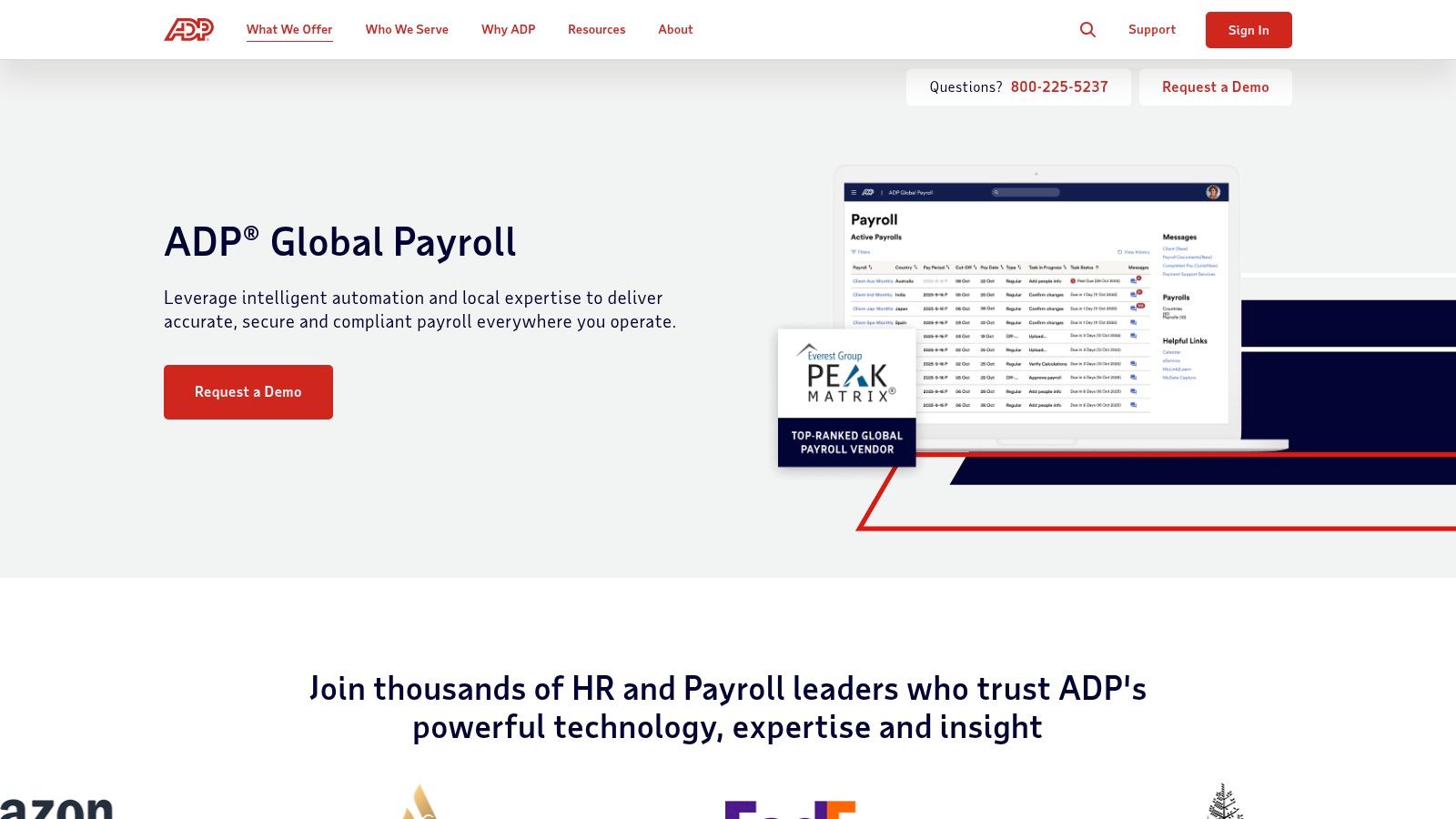
ADP Global Payroll is the familiar option for buyers who care about durability, governance, and enterprise procurement comfort. That doesn't make it the right fit for every company, but it does make it easier to justify internally when payroll is viewed as a risk-control function first.
ADP's own guidance is useful here. Its global payroll management overview explains that a core compliance function of global payroll software is keeping pace with labor laws, tax codes, reporting standards, statutory deductions, and social security contributions in each jurisdiction. That framing, set out in ADP's guide to global payroll management and best practices, is exactly why many larger organizations choose enterprise payroll platforms. They want local-rule support, not just international money movement.
ADP tends to fit companies that already operate entities or expect to. If your organization wants centralized orchestration, established finance and HCM integrations, and implementation support for a more formal rollout, ADP is credible.
Its strengths usually include:
The trade-off is speed. Smaller teams may find ADP heavier than they need, both in procurement and implementation. Startups and early-stage distributed employers often want faster onboarding and less formal setup than ADP's model typically implies.
Healthcare organizations often lean conservative with payroll because downstream errors affect not only staff trust but also internal compliance, budgeting, and administrative continuity. If your company already uses ADP domestically or prefers mature operating controls, global expansion through ADP can be logical.
For teams that want to pressure-test their internal readiness first, this stay compliant with LatHire checklist is a useful supplement. It helps surface whether your challenge is software selection or a deeper gap in approvals, data ownership, and compliance process.
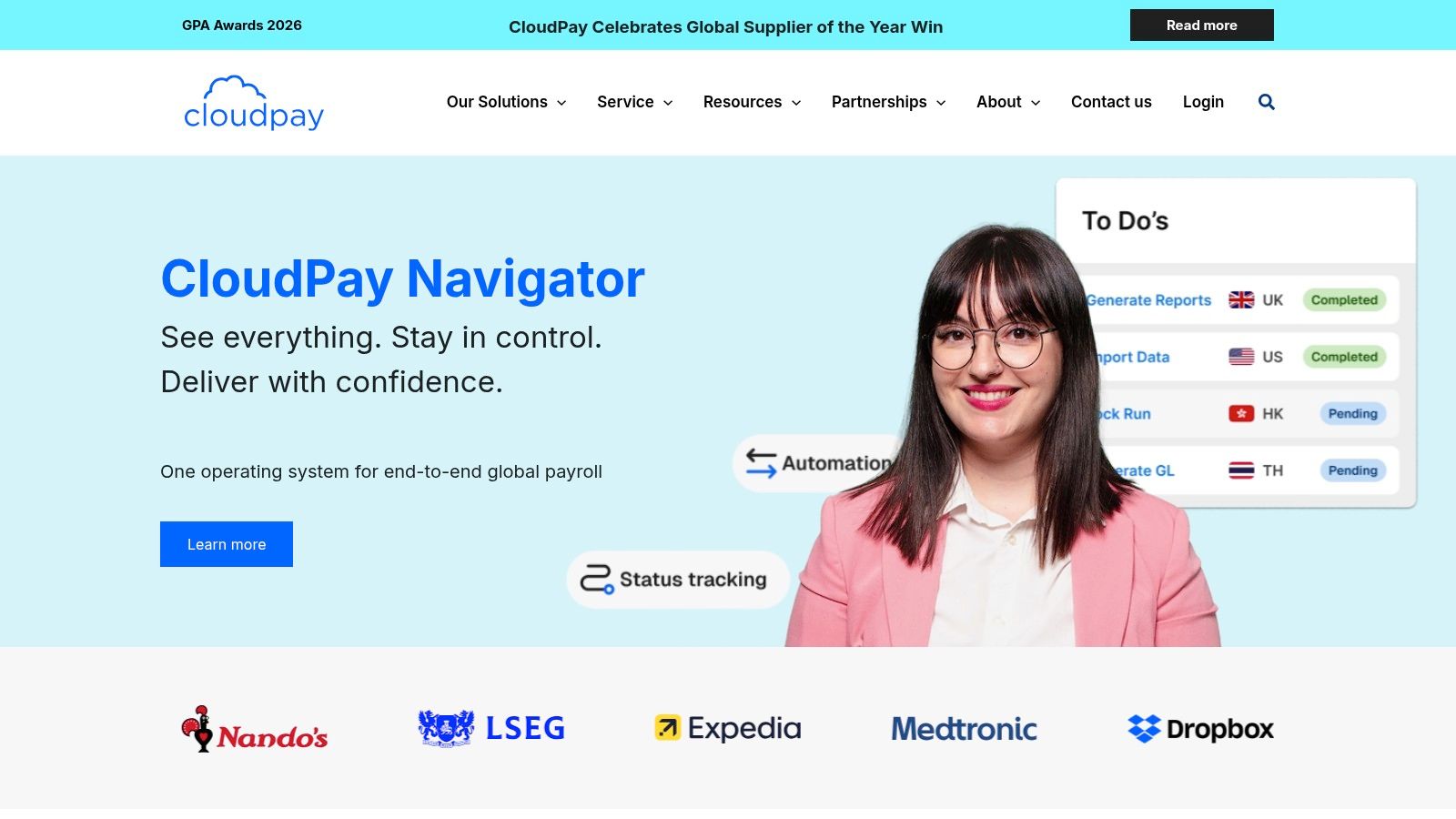
CloudPay is one of the more specialized choices in this category. It's most compelling when payroll and payments need to be standardized across many countries and you care about the full payroll-to-pay cycle, not just calculations and filings.
That focus makes it more attractive to mid-market and enterprise teams than to very small employers. If your organization already owns entities or expects to build them, CloudPay deserves attention. If your main need is EOR hiring for a handful of people, it's usually less aligned.
CloudPay's operating model centers on control, consistency, and analytics across countries. It's built for buyers who want a single global engine with local support rather than a loose collection of local providers.
Reasons it often makes sense:
That said, implementation isn't light. CloudPay usually asks the buyer to commit to process standardization, data mapping, and cross-country governance. That's often a good trade for larger footprints. It's usually an unnecessary burden for smaller international teams.
CloudPay is a good reminder that not all global payroll software is designed around hiring. Some platforms are designed around payroll operations after hiring is already solved. If your organization already knows where entities will sit and needs strong execution discipline after that point, CloudPay is more compelling.
Neeyamo is the long-tail coverage option on this list. Buyers often look at it when their country footprint extends beyond the usual high-demand markets and they need a vendor that can consolidate a broader set of local payroll arrangements.
That's relevant for companies whose expansion pattern isn't neat. Maybe you have a core team in Mexico, support staff in Colombia, a finance resource in Peru, and a specialized contractor in a less common market. Large platforms often market broad country availability, but practical support depth can be uneven. Neeyamo's positioning is stronger when your map includes harder-to-serve jurisdictions.
Neeyamo is generally an enterprise-style choice. It isn't the easiest product for a small company to buy, but it can be useful if your main problem is vendor fragmentation.
Strengths include:
The caution is implementation weight. This isn't the tool most buyers pick for speed. It's the tool they consider when fragmentation has already become expensive and difficult to supervise.
Healthcare organizations with international administrative teams often underestimate how quickly “a few exceptions” turn into a messy payroll estate. Neeyamo can be sensible when the main challenge is control across unusual geographies, but it's usually too heavy for a practice hiring its first small LATAM team.
Safeguard Global sits in the middle of several models. It supports payroll, EOR, and contractor management, which makes it useful for organizations that want optionality but don't want to commit immediately to a payroll-only or EOR-only path.
That flexibility is particularly relevant for U.S. and Canadian companies expanding into LATAM in phases. You might start with contractors in one country, use EOR in another, and move owned-entity payroll into the mix later. Safeguard Global is built for that sort of mixed architecture.
Safeguard Global is often strongest when workforce structure is still evolving. It provides a way to compare and manage different approaches without forcing all countries into one employment model too early.
What stands out:
The trade-off is that smaller teams may find it broader than necessary. If you only need one country and one worker type, some of its flexibility won't create immediate value. Like several enterprise-leaning platforms, the commercial picture also usually requires direct quoting.
Safeguard Global tends to appeal to operators who know payroll structure is strategic. That's a healthy instinct. In many growing companies, the wrong decision isn't picking a weak vendor. It's locking the business into an employment model that no longer fits by the time the team doubles.
| Provider | Core offering | Coverage & compliance | Integration & workflow | Best fit / target audience | Pricing & value |
|---|---|---|---|---|---|
| LatHire: Global Payroll Services | End-to-end cross‑border payroll with AI-driven automation | Strong jurisdictional compliance, multi‑currency gross‑to‑net, automated validation | Cloud single source of truth; integrates with LatHire hiring, HR, benefits & legal workflows | Companies hiring Latin American talent who want full‑service hiring + payroll | High value when paired with LatHire (cuts admin/hiring friction); setup/integration time required |
| Deel | EOR, global payroll, contractor management | Country‑specific compliance across many countries; supports 1099/US contractor flows | Built‑in HRIS, reporting, multiple payout methods and FX tools | Businesses needing unified pay for employees + contractors across countries | Per‑employee EOR fees and country deposits; some pricing by quote |
| Remote | EOR, contractor mgmt, global payroll | Transparent compliance guidance; broad country support | Onboarding/offboarding workflows, localized benefits guidance | US companies hiring first employees abroad seeking predictable pricing | Public pricing guidance with price guarantees; add‑ons for niche features |
| Papaya Global | Global payroll, EOR, payments, analytics | Coverage in 180+ countries with audit‑friendly reporting | Integrated payments (PaymentsOS), AI validation, BI dashboards | Organizations consolidating payroll ops and analytics at scale | Modular transparent model; country/volume quotes typically required |
| Rippling | Unified HR, IT, finance + payroll/EOR | Global payroll and EOR with country‑specific workflows | Single employee record across HR/payroll/IT; migrate EOR→entity paths | Companies wanting an all‑in‑one HRIS + IT + payroll stack | Modular pricing; quote‑based (add products as needed) |
| Oyster | EOR, global payroll, contractor management (B‑Corp) | EOR in 120+ countries; compliance‑focused tools and verifier | In‑app ID verification, misclassification analyzer, contractor trial | US teams hiring ethically with flat, predictable pricing | Transparent US‑friendly pricing; free 30‑day contractor trial; EOR monthly costs vary |
| ADP Global Payroll | Enterprise multi‑country payroll orchestration | Deep local compliance via ADP in‑country solutions | Integrates with leading HCM & ERP systems; strong implementation resources | Large enterprises needing scale, reliability and extensive integrations | Quote‑based enterprise pricing; longer procurement/implementation cycles |
| CloudPay | Multi‑country payroll + payments with analytics | Centralized engine with automated local tax/law updates | Payroll‑to‑payments automation, multi‑currency disbursements, benchmarking | Mid‑market and enterprise seeking standardization and control | Typically quote‑based per‑employee/per‑country pricing; implementation effort |
| Neeyamo | Global payroll & HR with long‑tail country coverage | Focus on niche/underserved locations and compliance workflows | Integrates with major HCMs (e.g., SAP); consolidates multi‑vendor payrolls | Multinationals expanding into hard‑to‑serve countries | Enterprise pricing and heavier implementation/design phase |
| Safeguard Global | Global Pay, EOR/GEO, contractor management | Multi‑country payroll with consolidated funding and filings | Consolidated payment runs, workforce intelligence and planning tools | Companies at scale needing consolidated payroll, EOR and contractor pay | Best value at scale; platform and EOR rates require a quote |
If you're evaluating global payroll software for hiring across the U.S., Canada, and LATAM, start with your workforce design before you start booking demos. Document which workers are contractors, which roles may need EOR, which countries justify entity ownership, and which functions are likely to remain administrative support versus long-term strategic headcount. That exercise usually makes the shortlist much clearer.
Market growth confirms that more companies are formalizing these systems. One global payroll software estimate values the market at $13.8 billion in 2025 and projects it will reach $29.6 billion by 2034, with cloud deployment holding 61.2% of revenue in 2025, software accounting for 63.4% of the market, and North America representing $5.2 billion, or 37.7% of the global total, according to DataIntelo's payroll software market analysis. That growth doesn't mean every platform is interchangeable. It means more buyers are trying to solve the same cross-border coordination problems at the same time.
For practical evaluation, request quotes only after you've documented countries, currencies, payroll volumes, integration requirements, approval controls, reporting needs, and likely expansion paths. Then validate the specifics that often get glossed over in sales conversations:
This is especially important for medical practices and healthcare organizations using remote administrative talent. Global payroll software often expands beyond salary processing alone. In multi-country operations, software commonly supports contractors, employer of record arrangements, onboarding, and benefits administration because different worker types and countries require different legal and payment workflows, as described by WorkMotion's overview of HR compliance software solutions. That broader scope is useful, but it also means your payroll choice affects staffing operations well beyond finance.
The right platform for an early contractor program usually won't be the right long-term engine for entity-based payroll in multiple countries. That's normal. The goal isn't to predict every future need perfectly. The goal is to choose software that fits your current structure, gives you a credible next step, and doesn't hide the operational burden behind polished demos.
Global payroll software is growing quickly, but the category still has real execution differences. The best option depends less on brand recognition and more on whether you're paying contractors, relying on EOR, or consolidating payroll through your own entities across the U.S., Canada, and LATAM.
For most buyers, the smartest next step is to map worker types, countries, currencies, compliance responsibilities, integrations, and approval flows before comparing vendors. If you need LATAM talent plus support with hiring, HR, benefits, payroll, and compliance, review LatHire's Global Payroll Services as one practical option alongside the other platforms above.

