

A practice manager may start by looking for help with phones, referrals, scheduling, and records, then discover that the physician-owner is losing hours to calendar conflicts, board preparation, and sensitive correspondence. That is where the administrative assistant vs executive assistant decision becomes more than a title comparison.
An administrative assistant is usually the better fit for repeatable, process-driven support across a team. An executive assistant is appropriate when a senior physician, owner, or administrator needs a trusted partner who can prioritize competing demands, manage confidential information, and coordinate work across departments. The roles overlap, but they don't carry the same judgment, authority, or exposure to leadership decisions.
For U.S. medical practices, the right choice depends on the workflow creating the bottleneck. This guide compares responsibilities, seniority, pay, confidentiality, remote staffing considerations, and practical hiring signals so you can select a role based on actual scope rather than an attractive title.
A practice rarely reaches the hiring decision with a clean question such as, “Should we hire an administrative assistant or an executive assistant?” The problem usually appears as missed calls, delayed referrals, physician calendars that require constant intervention, incomplete payer documentation, or a practice administrator who can't prepare for leadership meetings. Those symptoms can look similar, but they point to different staffing needs.
If the work is recurring and can be completed by following a documented process, an administrative assistant may provide the right operational relief. Scheduling appointments, updating demographic information, organizing records, preparing routine documents, and coordinating patient intake are examples of work that can often be assigned across a team. If the work requires someone to decide what deserves a physician-owner's attention, prepare a meeting before anyone asks, or protect a leader's time and confidential information, the role has moved toward executive assistance.

The labor market also reflects that distinction. The U.S. Bureau of Labor Statistics occupational data lists 3,515,600 jobs in the broader secretary and administrative assistant category in 2025. The executive subgroup is materially smaller, with 502,800 jobs projected for 2024 and 494,900 in 2034, a projected decline of 7,900 jobs, or 1.6%, over that decade. These figures don't mean either role lacks value. They show that executive assistant work is a more specialized slice of office support, while both occupations are mature categories facing weak growth or decline rather than expansion.
Practice managers should assess four questions before discussing compensation:
Practical rule: Hire for the decisions the person must make, not for the number of tasks listed in the job description.
Medical practices also need to separate patient-facing support from executive support. A remote medical receptionist or scheduling specialist may handle calls and appointments effectively without being equipped to manage physician-owner priorities. Conversely, an executive assistant may be overqualified for a queue of routine insurance-verification tasks and may become frustrated if the practice never uses the higher-level judgment it hired for. Managers comparing entry-level staffing options can also review HiredBySkill admin job openings to understand how broadly administrative roles are commonly scoped.
The simplest distinction is breadth versus influence. An administrative assistant generally supports a team, department, or several managers with recurring operational work. An executive assistant typically supports one senior leader directly, handling the leader's calendar, communications, meetings, and confidential priorities with greater independence.
The BLS occupational definition for executive secretaries and executive administrative assistants describes high-level administrative support that can include research, statistical reports, information requests, and training or supervising lower-level clerical staff. Routine functions, including correspondence, visitor reception, conference calls, and meeting scheduling, can still be part of the role. The difference is not whether the assistant schedules meetings. It is whether the assistant schedules them or actively decides how the executive's limited time should be used.
| Dimension | Administrative Assistant | Executive Assistant |
|---|---|---|
| Primary customer | Team, department, or several managers | One physician-owner, executive, or senior administrator |
| Typical work | Scheduling, data entry, documents, records, intake coordination | Calendar strategy, communication triage, briefings, leadership meetings |
| Operating model | Follows established processes | Interprets priorities and resolves conflicts |
| Authority | Limited, usually escalates exceptions | Uses delegated judgment within defined boundaries |
| Reporting line | Office manager, operations manager, or department lead | Directly to the supported executive or principal |
| Confidentiality exposure | Depends on workflow and system permissions | Often includes leadership, personnel, financial, and credentialing information |
| Handoff potential | Usually easier to distribute across staff | More dependent on trust and knowledge of one leader |
| Success measure | Accurate, timely throughput | Better executive focus, preparation, communication, and follow-through |
Both assistants may answer correspondence, coordinate meetings, maintain files, prepare documents, arrange travel, and use office software. In a medical practice, either role might work with an EHR, practice management platform, Microsoft 365, Google Workspace, payer portals, or a shared task system. Those tools don't determine seniority. The permissions and decisions attached to the work do.
An administrative assistant may coordinate patient intake for several providers using a standardized checklist. An executive assistant may prepare the physician-owner for a meeting about staffing, payer performance, or expansion, then identify which documents and participants are needed. The first role optimizes consistency. The second optimizes the leader's attention and readiness.
Some organizations use “executive assistant” for any assistant assigned to a senior person. That label can inflate expectations without clarifying authority. A practice should define whether the person can decline or move meetings, draft communications in the executive's voice, request information from department leads, prepare reports, and escalate sensitive issues.
For practices considering a remote placement, LatHire's executive assistant hiring page is one example of a sourcing route that presents executive-style support separately from general administrative hiring. The useful question remains the same regardless of channel: what will this person own, and what must still be approved by a provider or manager?
The salary gap between these roles is easier to understand when you examine the judgment behind the work. An administrative assistant needs reliable execution, clear communication, organization, comfort with practice software, and the ability to protect workflow accuracy. An executive assistant needs those foundations plus discretion, prioritization, drafting ability, stakeholder management, and the confidence to make bounded decisions without waiting for instructions on every exception.
For a medical practice, administrative competence often appears in practical behaviors. The candidate follows a patient-call script without sounding mechanical, documents the next step in the correct system, notices missing referral information, and escalates a clinical question instead of improvising an answer. These are valuable skills, but they are usually tied to a defined process.
Executive-level competence looks different. The assistant recognizes that a physician-owner's calendar has competing priorities, understands which meeting requires preparation, knows when a request should be routed through the practice administrator, and can assemble an accurate briefing packet from approved materials. The assistant doesn't diagnose, provide clinical care, or make licensed decisions. The value lies in judgment about coordination, access, timing, and escalation.
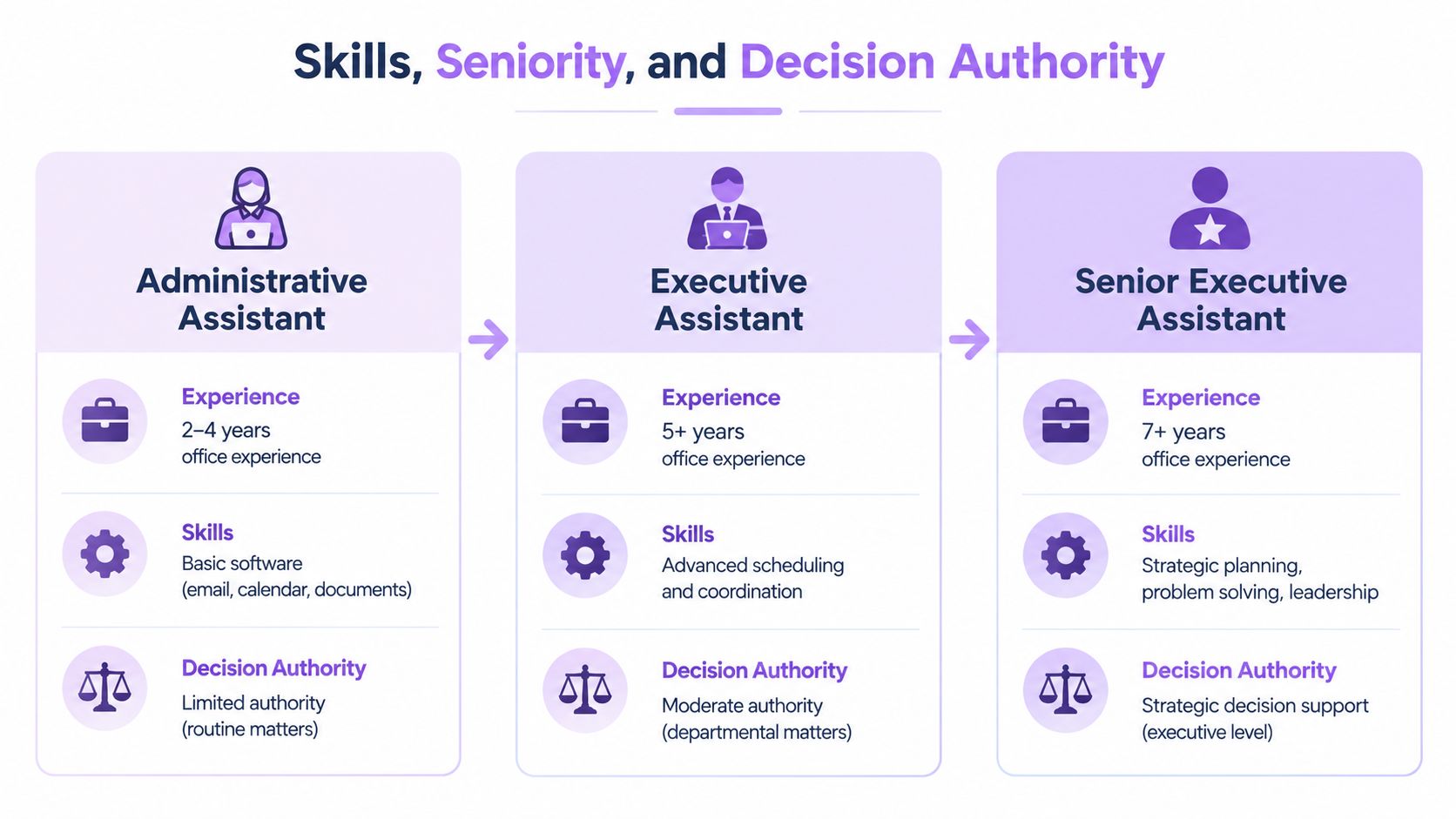
Job titles are inconsistent, so interviewers should look for evidence in the candidate's past scope:
The hard skills needed for EA roles can help managers build a broader assessment, particularly around calendar management, document preparation, communication, and business coordination. For healthcare hiring, add EHR familiarity, HIPAA awareness, patient telephone demeanor, and a firm understanding of role boundaries.
An administrative assistant commonly reports to an office or operations manager who sets priorities for the team. An executive assistant may report directly to the supported leader and act as a gatekeeper for time and information. That reporting line can create tension if the practice administrator, physician-owner, and department managers give conflicting instructions.
Resolve that before hiring. Write down who sets priorities, who can approve external communications, who can authorize calendar changes, and who receives escalations. A candidate can't compensate for an undefined chain of authority.
Compensation should follow scope, discretion, and leadership proximity, not the label printed on the offer letter. BLS reported a May 2025 median wage of $48,310 for all secretaries and administrative assistants, compared with $76,590 for executive secretaries and executive administrative assistants, a difference of $28,280, or about 58.5%. The figures come from the BLS wage data summarized for executive assistant roles, and they provide a useful structural benchmark rather than an automatic offer recommendation.
The same source identifies an earlier May 2023 mean annual pay of $73,680 for executive secretaries and executive administrative assistants. A practice shouldn't treat that figure as a universal salary floor. Geography, specialty, employment arrangement, schedule, benefits, experience, and actual decision authority can move an offer materially.
The role's confidentiality exposure also matters. An assistant who sees a physician's calendar and board materials may carry more trust responsibility than an assistant who handles routine appointment requests, even if both use Outlook and the same EHR. A remote position may also have a different compensation structure from an in-house employee, but the practice still needs to budget for supervision, training, security controls, and continuity.
| Role | Entry annual | Mid annual | Senior annual | Remote cost-of-living note |
|---|---|---|---|---|
| Administrative assistant | Varies by market and scope | Varies by market and scope | Varies by advanced workflow ownership | Compare duties and security requirements, not geography alone |
| Executive assistant | Varies by executive access and judgment | Varies by leadership support scope | Varies by strategic coordination and discretion | Remote savings shouldn't erase the premium for high-trust work |
A recent market dataset cited by Virtustant places Executive Assistants at $68,026 on average and Executive Administrative Assistants at $60,550, while Robert Half's 2026 guide lists Executive Assistants at $58,250 to $86,750 and Administrative Assistants at $42,000 to $52,750 in the U.S. The figures and ranges appear in Virtustant's executive assistant versus administrative assistant compensation discussion. The spread demonstrates why title alone stops predicting pay.
Use a compensation worksheet with four columns:
Then compare candidates against the worksheet. Don't offer executive-level pay for a routine role merely because it supports a physician. Don't advertise an administrative assistant position while expecting the person to run leadership coordination, prepare board packets, manage credentialing, and filter all executive communication.
The right answer becomes clearer when you attach the title to a real workflow. A solo practice, a multi-provider group, and a health center may all use the word “assistant,” but their operating pressures differ sharply.
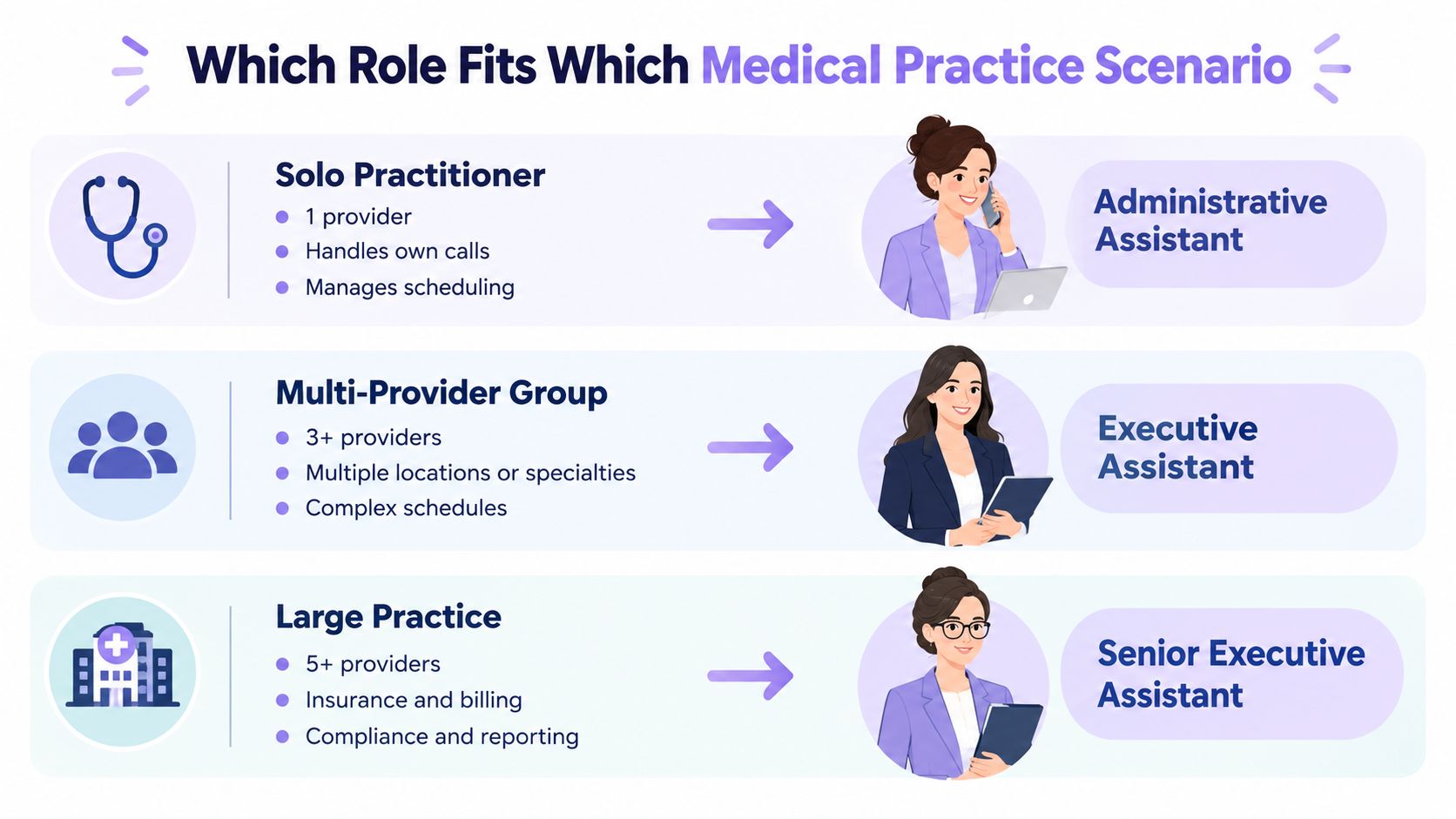
A solo physician who needs reliable call handling, appointment scheduling, referral follow-up, and basic records coordination usually needs an administrative assistant or a specialized remote medical receptionist. The work is valuable because it protects patient access and keeps the schedule moving, but it doesn't automatically require executive judgment.
A bilingual English and Spanish professional may be especially useful when patient communication depends on language access and consistent explanations of scheduling steps. The assistant should stay within the practice's approved scripts and escalation paths. They shouldn't interpret symptoms, offer medical advice, or make clinical decisions.
A group practice with several providers may begin with administrative support for appointment coordination, EHR updates, insurance verification, and cross-coverage. An executive assistant becomes more appropriate when one leader, such as a physician-owner or practice administrator, needs someone to coordinate provider meetings, prepare agendas, track decisions, and resolve priorities across the group.
Remote support can work well for scheduling, patient coordination, insurance verification, billing support, and prior-authorization support when the practice provides secure access and clear handoffs. It works less well when every exception depends on an informal hallway conversation or physical access to paper records.
A specialty practice preparing for payer audits, accreditation activity, or regulatory review may need an administrative assistant to maintain files and assemble requested documents. If the work expands into coordinating leaders, tracking open items across departments, preparing reports, and ensuring that meetings produce accountable follow-up, the practice may need executive-level coordination.
Healthcare postings illustrate how broad that scope can become. A medical executive assistant role description may include calendar management, travel, agendas, board packets, minutes, and confidential records under HIPAA and organizational policies. Another hospital executive assistant posting extends into regulatory records, reports, applicant screening, onboarding, reference checks, and credentialing.
Some health-center executive assistant roles include support for billing, coding, accounts payable, payroll preparation, EMR committees, and basic phone or IT troubleshooting, as shown in this health-center executive assistant job description. That combination is materially broader than generic clerical support, but it doesn't mean one person should own every function without controls.
A practice administrator who needs board reporting, physician credentialing coordination, confidential communications, and follow-through across operations has a stronger case for executive support. A department that needs accurate throughput across repeatable queues likely gets better value from a well-scoped administrative assistant.
For leadership-focused staffing, C-suite assistant hiring offers a relevant comparison point when defining the level of executive access and coordination expected.
Start with the workflow, not the job title. A five-step review helps practice managers avoid hiring a generalist for an executive problem or paying for senior judgment that the practice won't use.
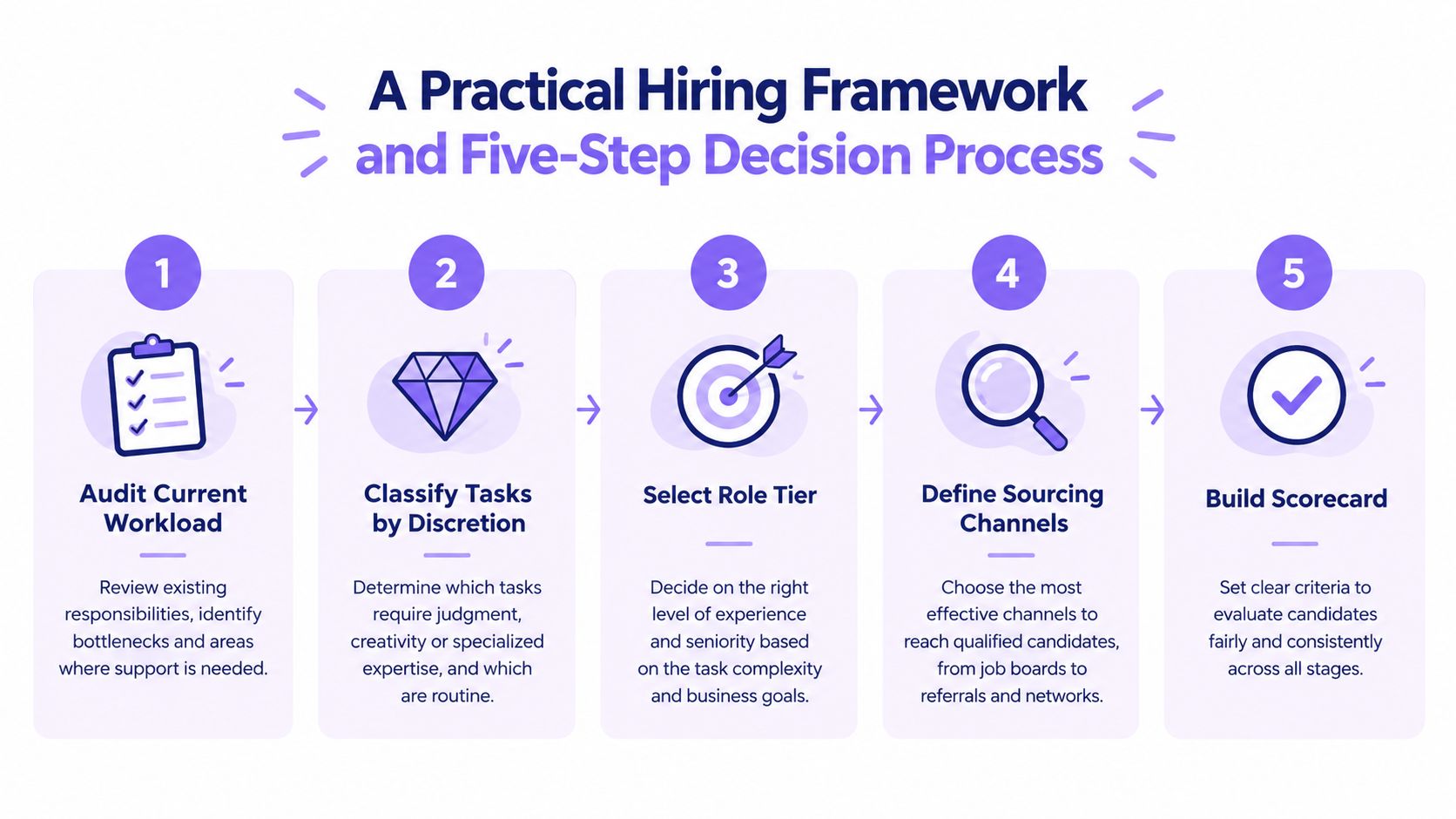
Job description: State the supported leader or department, daily workflows, required systems, schedule, escalation rules, access to patient information, and decisions the person may not make.
Interview exercise: Give the candidate a fictional calendar conflict, an incomplete referral request, and a patient call requiring escalation. Ask them to explain their order of operations. You're testing judgment and boundaries, not speed alone.
Writing sample: Request a short meeting confirmation or executive briefing based only on supplied facts. Look for clear wording, accurate details, appropriate tone, and visible uncertainty where information is missing.
Reference questions: Ask whether the candidate handled confidential information reliably, followed through without repeated reminders, communicated problems early, and respected authorization limits.
Remote-work readiness: Confirm quiet workspace expectations, approved devices and accounts, connectivity procedures, time-zone alignment, and the practice's process for removing access when the engagement ends.
HIPAA isn't a personality trait or a badge. If a remote assistant accesses protected health information, the practice must define permitted access, workforce training, account controls, minimum-necessary use, and incident escalation. If a staffing company accesses protected health information on the practice's behalf, independent guidance for medical practices says the company functions as a HIPAA business associate and a signed Business Associate Agreement before access begins is required.
Don't describe a vendor or worker as “HIPAA certified.” HHS doesn't recognize an official HIPAA certification. Have qualified compliance counsel review the arrangement, especially when a remote assistant will access schedules, charts, claims, patient messages, billing information, or credentialing files.
For administrative hiring, a clearly scoped admin assistant hiring process can help managers compare candidates against workflow requirements instead of relying on title familiarity. Whether you hire directly or through a staffing platform, onboarding should establish access by role, supervised practice in the EHR, call-handling standards, escalation rules, and review checkpoints.
Hire an administrative assistant when the work is task-bounded, repeatable, and process-driven, such as scheduling, intake coordination, records management, routine billing support, or insurance verification. Hire an executive assistant when a physician-owner, practice administrator, or senior leader needs a trusted partner who manages priorities, communications, confidential information, leadership meetings, and cross-functional follow-through.
The salary difference in an administrative assistant vs executive assistant comparison is justified only when the seniority, discretion, and scope are real. A senior title won't fix an unclear job, and a lower-cost title won't reliably cover executive-level responsibility.
Take three practical steps before posting the role:
If you're evaluating remote healthcare staff, Medical Virtual Assistants can help you compare administrative and executive-style support, including bilingual professionals aligned with U.S. working hours and prior healthcare experience. Define the workflow first, then request candidates against that scorecard rather than choosing based on title alone.
Need help deciding which role fits your practice? Contact LatHire with your current task list, systems, schedule, and access requirements, and use that information to scope the right remote healthcare support before you interview.