

Sales operations is the infrastructure and process function that supports revenue execution, not a synonym for sales management. In a Salesforce survey, 48% of sales professionals said sales operations played a critical role in their organization.
A seller can spend a morning updating records, chasing an approval, correcting an account assignment, and explaining why a forecast changed instead of speaking with a patient referral partner or prospective customer. The problem isn't always effort or talent. Often, the organization hasn't built a dependable system around the people doing the work.
That gap matters to medical practices evaluating remote healthcare staff. A remote medical receptionist, patient coordinator, or insurance verification specialist can complete assigned tasks, but their output depends on routing rules, documentation standards, escalation paths, permissions, and reporting. Without those controls, adding staff can multiply inconsistent work rather than create capacity.
Sales operations provides that operating system. This guide explains how the function developed, what its technical layer includes, how to measure capacity and forecast value, why AI requires preparation before automation, and how responsibilities should change as a team grows. It also translates the model for U.S. medical practices that use remote healthcare coordinators and medical virtual assistants.
What breaks first when a revenue team grows from 10 to 100 sellers? Coordination. Territories overlap, leads remain unassigned, opportunity stages mean different things to different managers, and finance cannot reconcile the forecast with the revenue plan. Sales operations addresses these operating failures so execution can repeat as the company scales.
The practical definition is straightforward: sales operations is the infrastructure and process function that supports revenue execution. Its work can include CRM administration, lead routing, territory and quota design, forecasting, deal-desk approvals, sales technology, and analysis of stalled opportunities. Sales managers coach sellers and own selling outcomes. Sales operations defines the systems and rules that make those decisions consistent.
The same operating layer matters in a medical practice, even without the title “sales operations.” A remote healthcare coordinator may conduct outreach, follow up on referrals, schedule appointments, or qualify inquiries. The workflow must specify where each interaction is recorded, who owns the next step, how unresolved inquiries escalate, and which fields managers review.
Practical rule: Remote staff can execute a workflow, while practice leadership retains control of permissions, definitions, escalation rules, and audit requirements.
At a smaller company, a founder may hold these decisions informally. As the team grows, that approach creates rework and weak forecast visibility. Clear ownership, reliable data, and defined processes also determine whether future AI automation can operate safely. Sales Ops connects commercial strategy with process definitions, data quality, forecast reviews, hiring plans, and cross-functional coverage. Leaders seeking a closer look at coordination and coverage can review PreSales Unleashed GmbH on presales orchestration.
Sales management and sales operations solve different problems. A sales manager decides how to coach a seller, progress a deal, or address weak execution. Sales operations defines the information, process, systems, and governance that make those decisions more consistent across the organization.
The discipline emerged as a recognizable function at Xerox in the 1970s, when J. Patrick Kelly established a group to handle analytical and administrative work that was distracting sales managers from coaching and selling. The function has since expanded from transactional support into strategic planning and cross-functional revenue management.
Salesforce's research illustrates that shift. In its survey of 5,951 full-time sales professionals, conducted from May 13 to June 30, 2020, 48% said sales operations played a critical role in their organization, according to the Salesforce State of Sales report. A separate Salesforce finding reported that 56% of sales-operations professionals had become more involved in sales-strategy planning since 2019, while 55% reported increased involvement in sales-performance analysis and another 55% in sales-strategy coordination.
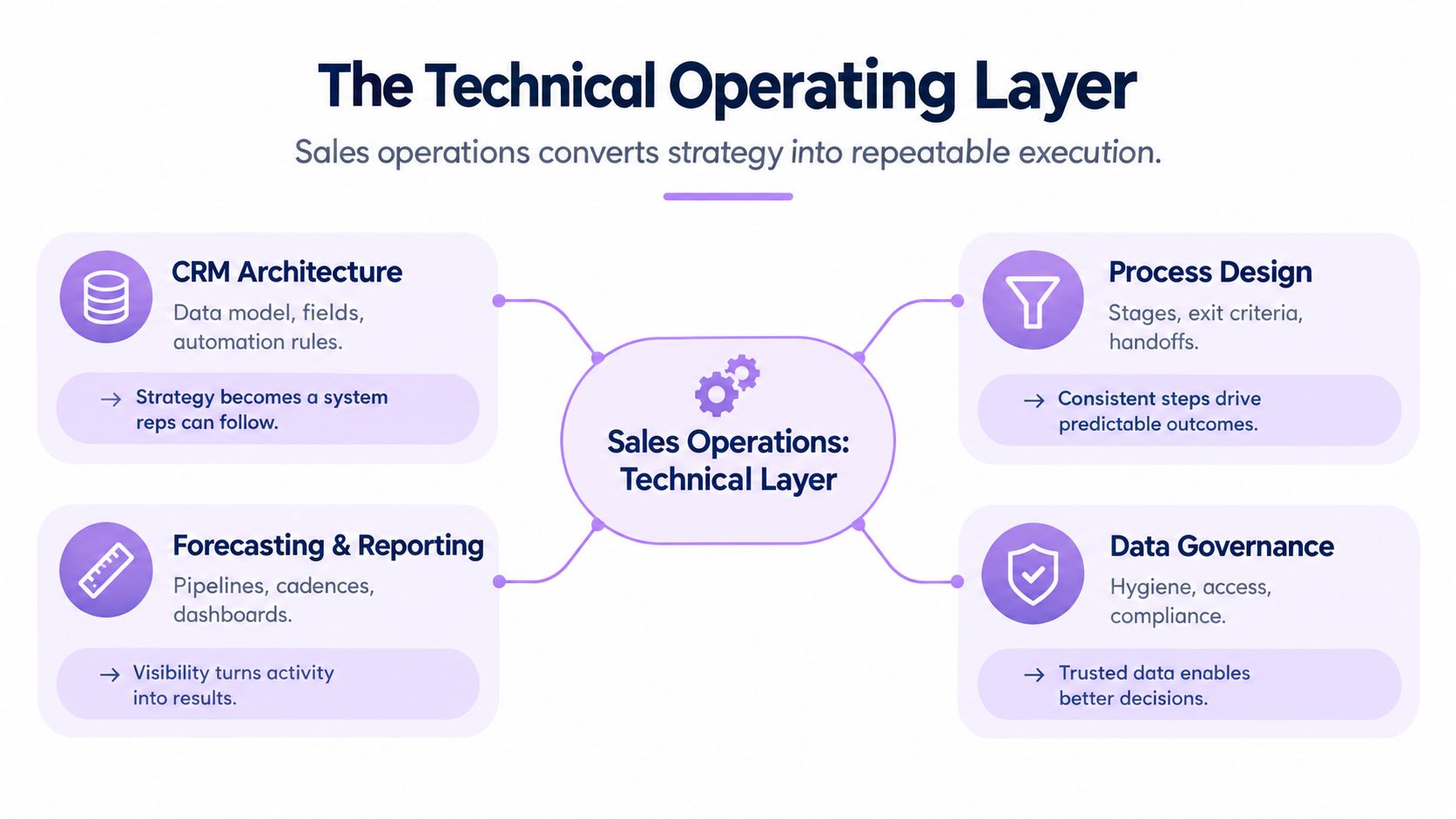
Calling sales operations “CRM administration” understates its decision-making role. CRM administration is one component. The larger responsibility is converting a commercial plan into rules people can follow and information leaders can trust.
For example, marketing may generate demand, but sales operations can define the conditions for a qualified opportunity and configure routing rules. Finance may establish a revenue plan, but sales operations can translate that plan into quotas and attainment reporting. Customer success may receive the account after a sale, but sales operations can define what information must be complete before the handoff.
This is why the function matters during expansion. Companies entering new markets or coordinating distributed teams need common definitions for territories, ownership, pipeline stages, forecast categories, and performance. Without those definitions, every manager builds a local workaround, and leadership receives several versions of reality.
Modern sales operations therefore turns strategy into repeatable processes, measurable targets, reliable forecasts, and scalable execution. It doesn't replace sales leadership. It gives sales leadership a controlled operating environment.
A useful sales operations team treats the CRM as a controlled data system, not as a contact database. Each record should help a manager understand what is happening, what must happen next, who owns the action, and whether the opportunity has enough evidence to remain in its current stage.
Typical ownership includes:
A practical opportunity record should include the opportunity stage, amount, expected close date, next action, buying-role coverage, and loss reason. The field list is only useful when each stage has observable exit criteria. “Proposal” might require a documented commercial proposal and confirmed decision process, while “evaluation” might require an agreed technical or operational review. The exact definitions vary, but ambiguity should not.
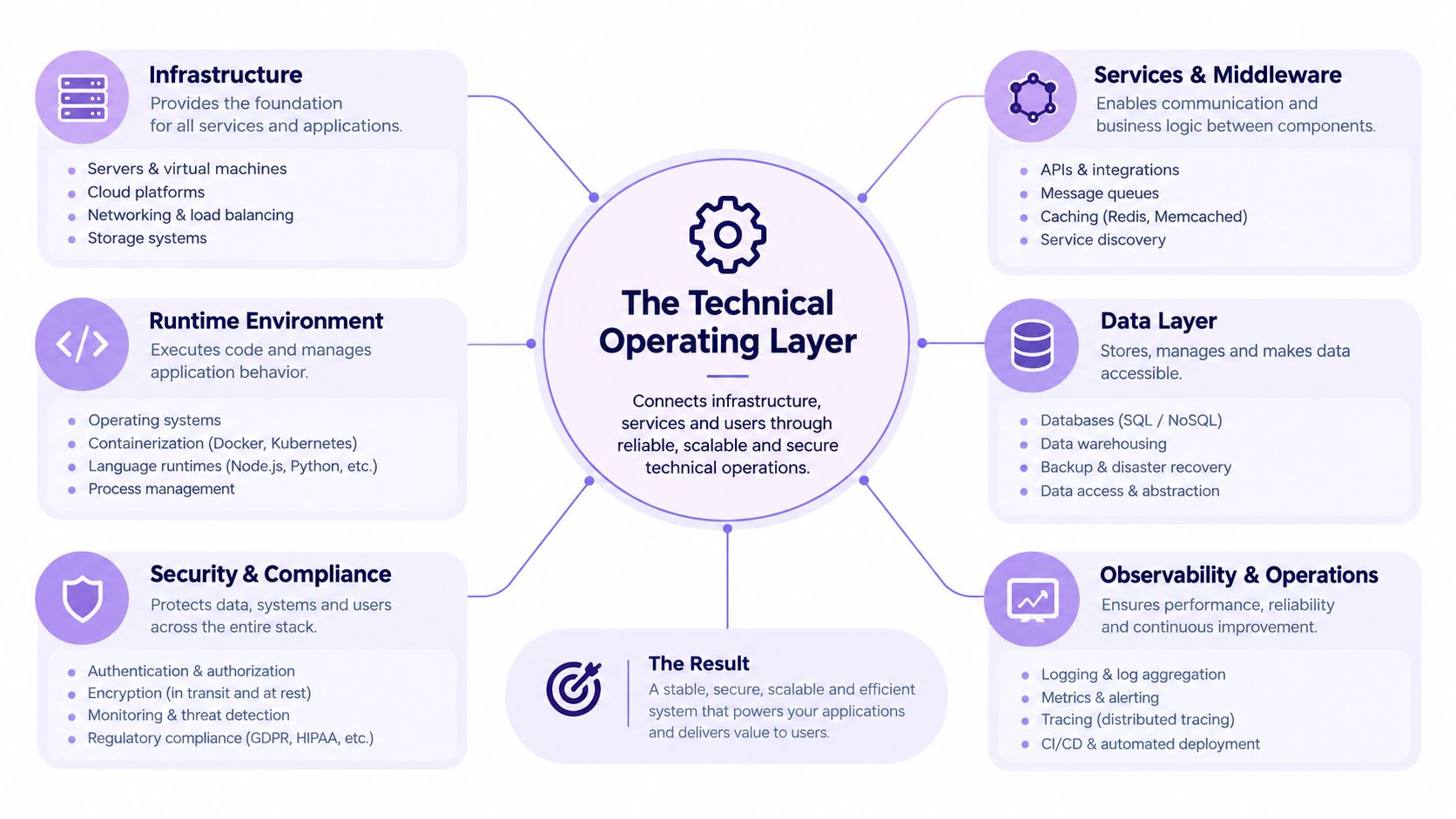
Forecasting models inherit the completeness and consistency of their source data. In Validity's 2020 CRM-data study, 95% of respondents used CRM data for forecasting and reporting. Among organizations reporting good or very good CRM data quality, almost three-quarters reported accurate or very accurate forecasts, compared with just over one-third where data quality was poor, as reported in the Validity CRM data management study.
For a startup, CRM hygiene should be an operating KPI rather than a vague expectation. Track the percentage of active opportunities with:
Forecast reviews should focus on exceptions. A manager should ask why a deal lacks evidence, why its close date moved, or why it has remained in one stage, rather than relying only on a subjective deal-by-deal opinion. A clear documentation standards framework can help remote staff record work consistently across locations and shifts.
Bookings alone don't tell you whether the sales system is healthy. Sales operations should connect leading indicators, such as qualified pipeline coverage, stage conversion, sales-cycle duration, activity-to-meeting rate, and opportunity aging, to outcomes such as revenue, gross margin, and quota attainment.
The basic logic is simple. If a segment converts 25% of qualified pipeline into wins, a $1 million target requires approximately $4 million of qualified pipeline before accounting for timing, deal-size variation, and slippage. Those figures illustrate the calculation described in the Xactly 2024 sales compensation survey, but they aren't a universal planning rule. Conversion rates differ by segment, motion, product, sales cycle, and deal quality.
Quota design creates another common failure point. The same 2024 B2B sales-compensation survey, covering 230 companies, found that only 9% of respondents planned for more than 90% of account executives to achieve quota. That doesn't prove a quota plan is wrong, but it shows how attainment expectations can diverge from the assignments given to sellers.
| Metric | Healthy range or target | Purpose |
|---|---|---|
| Pipeline coverage | 3 to 4 times the revenue target, as a typical operating range | Tests whether available qualified demand can support the target |
| Forecast accuracy | 90% or higher as a high-performing-team target | Shows whether leadership can plan with confidence |
| CRM adoption | 95% or higher as a published benchmark | Indicates whether the system reflects actual selling activity |
| CRM data completeness | At least 85% complete and accurate as a published benchmark | Tests whether reports and forecasts have usable inputs |
These operating benchmarks are described in a sales operations metrics guide. They should be adapted to specialty, payer mix, appointment capacity, sales-cycle length, and the quality of historical data. A medical practice could translate the same logic into referral-pipeline value, scheduled-to-completed-visit conversion, days from inquiry to appointment, aging of unworked referrals, and the percentage of records containing required insurance or contact information.
McKinsey's example shows why process capacity deserves financial attention. In one logistics company, representatives spent only 35% of their day actively selling because billing updates, internal communication, and problem-solving consumed the rest. After a sales-force productivity program was implemented across countries, representatives gained an average of 15% more selling time, proposal-to-sale conversion increased by 5%, and internal sales-process cycle time fell by 20%, with some benefits appearing within four months, according to McKinsey's analysis of freeing the sales force for selling.
The lesson isn't to promise the same result in every organization. It is to identify where people lose capacity. Run monthly quota-capacity reviews, publish attainment distributions by segment and tenure, and separate insufficient territory demand from weak conversion, poor pipeline creation, and execution gaps before changing headcount or incentives. A broader strategic workforce planning framework can support that analysis when hiring decisions depend on ramp time, territory potential, and workload.
AI adoption doesn't remove the need for sales operations. It raises the standard for data quality, workflow control, and human oversight.
Salesforce reported in 2026 that 87% of sales organizations use AI, while sellers expect agents to reduce prospect-research time by 34% and email-drafting time by 36%, according to its 2026 State of Sales announcement. Those expectations may be useful for prioritizing experiments, but they don't establish a guaranteed business result.
IBM's 2025 research describes a mixed maturity picture. 28% of executives were piloting intelligent workflows and 34% were scaling them, while 83% expected AI agents to execute actions from operational data by 2026. The gap matters because a company can buy an AI feature before it has standardized fields, resolved duplicates, defined permissions, or established an audit trail.

Before automating a workflow, document the decision it supports and the evidence it requires. Sales operations should standardize fields, repair duplicate records, define who can change critical data, record how recommendations were produced, and create a process for challenging incorrect outputs.
Human approval should remain in place for pricing, forecasting changes, territory prioritization, and customer-impacting actions. A lead-prioritization model can reproduce historical bias if its inputs reflect unequal follow-up, incomplete language data, or inconsistent territory coverage. Automation can make that problem faster and less visible.
For globally distributed teams, governance also includes time-zone ownership, multilingual data, privacy obligations, and consistent handoffs across countries. A remote staff member should know which queue belongs to their working hours, which language preference must be recorded, and when an issue moves to a U.S.-based manager or licensed professional.
A practical AI review asks:
Teams assessing whether an automated agent is ready for production can use an AI readiness assessment from Agentable. For hiring workflows, practices should also separate AI-assisted screening from human review, a distinction explored in this guide to AI in the recruitment process.
Sales operations becomes valuable when it resolves ownership questions that no single department can answer alone. Who defines a qualified opportunity? Who approves a discount? Who decides whether a referral is ready for a patient coordinator? Who measures the handoff from sales to customer success? Who turns a forecast assumption into a hiring or capacity decision?
Sales operations doesn't necessarily make every decision. It creates the definitions, data, approval paths, and meeting cadence that let the accountable leaders make decisions without rebuilding the facts each time. That's where sales operations differs from a task list and overlaps with revenue operations. The organizational label matters less than whether information moves cleanly across sales, marketing, finance, customer success, and leadership.
| Team size | Sales operations focus | Executive decisions that remain outside routine operations |
|---|---|---|
| 10 sellers | Own CRM basics, required fields, lead routing, pipeline definitions, weekly reporting, and forecast hygiene | Revenue targets, market selection, major pricing exceptions, and headcount commitments |
| 25 sellers | Add territory reviews, quota administration, stage conversion analysis, onboarding workflows, and formal forecast cadence | Compensation philosophy, expansion priorities, and material changes to the go-to-market model |
| 100 sellers | Coordinate specialized ownership across CRM, analytics, territories, compensation, deal desk, enablement, and cross-functional data governance | Strategic market entry, executive capacity trade-offs, risk tolerance, and organization design |
The exact structure will vary. A small company may use one operator, while a larger company may divide responsibilities among analysts, CRM specialists, planning leaders, and revenue operations partners. Work such as record review, report preparation, scheduling, documentation, and queue management can often be standardized remotely. Decisions involving pricing authority, permissions, compliance, compensation policy, and customer-impacting exceptions require clear executive or functional ownership.
A remote healthcare coordinator may perform referral follow-up, outreach, appointment scheduling, or lead qualification. That person should not diagnose patients, provide clinical care, independently make medical decisions, or perform licensed work unless the role and jurisdiction expressly permit it.
The sales-operations-style layer defines the system of record, required fields, routing logic, follow-up stages, escalation rules, and reporting standards. For example, every inquiry should have an owner, contact status, appointment outcome, next action, and documented reason for rescheduling or closure. Practice leadership should control permissions, approved scripts, privacy safeguards, and audit rules.
Medical practices can use remote healthcare staff for execution without outsourcing accountability. Pre-vetted LATAM healthcare talent from LatHire can include bilingual English and Spanish professionals aligned with U.S. working hours, with interview-before-hire and support for recruiting and international employment administration. The fit still depends on the practice's workflow design, supervision, privacy controls, and role boundaries.
Sales operations should measure its own quality, not only representative or provider production. Useful measures include forecast accuracy, CRM completeness, duplicate-record rates, stage conversion, seller ramp time, pipeline coverage, and the time required to answer a pipeline question. For a practice, that last measure can mean how quickly a manager can determine who owns an unworked referral, whether an appointment was confirmed, and why available capacity was not filled.
For readers building the commercial side of the function, a clear understanding of the skills of a sales strategist can help distinguish analytical operations work from frontline selling and strategic leadership.
Sales operations is the infrastructure that converts revenue strategy into repeatable execution. It combines CRM governance, process design, forecasting, territory and quota administration, data quality, capacity planning, and cross-functional decision rights.
For a scaling team or medical practice, start with ownership rules, required fields, stage definitions, escalation paths, and a small set of operational metrics. Add remote staff or AI only after the workflow is clear enough to supervise, measure, and audit.
If your medical practice is evaluating a remote healthcare coordinator, scheduler, insurance specialist, or medical administrative assistant, define the workflow before you hire. Contact Medical Virtual Assistants to discuss the role, required systems, patient communication standards, and oversight model that fit your practice.