
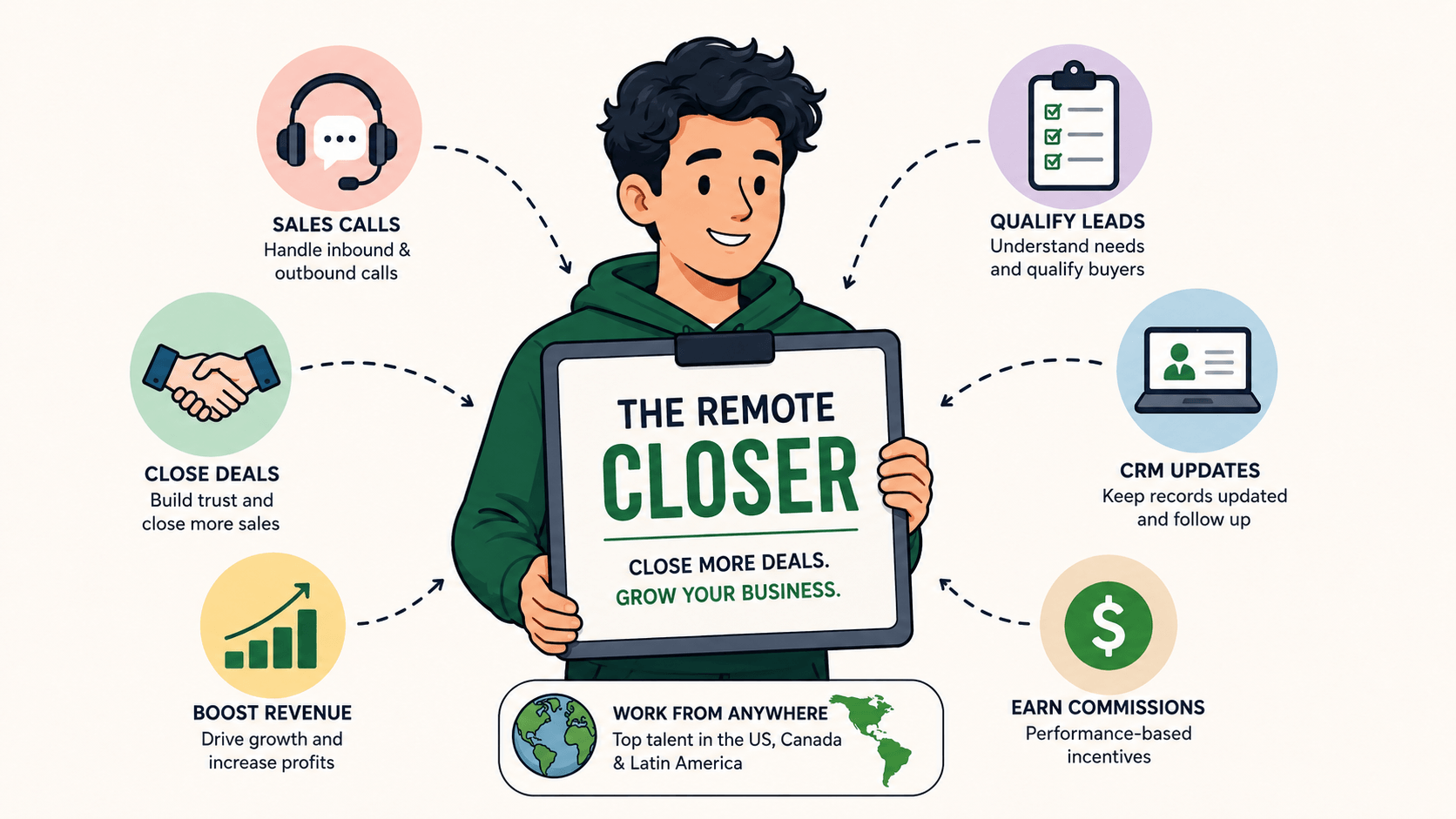
“Remote closer” is one of the most searched and least understood job titles in sales. Search it and you’ll find a wall of course sellers promising six figures from a laptop, and very little describing what the role actually involves, what it pays, or when a business genuinely needs one.
This guide covers both sides honestly: what a remote closer really does, how the pay works, when hiring one makes sense, and — for anyone considering it as a career — what the job is like once the marketing is stripped away.
A remote closer is a salesperson who runs the final conversion conversation — the call where a qualified prospect decides to buy — entirely over video or phone, without ever meeting the buyer in person. They don’t prospect, they don’t cold call, and they usually don’t book their own meetings. Someone else fills their calendar; the closer’s job is to convert what lands on it.
The title became popular in the coaching, consulting and online education world, where offers are sold on a single 45–60 minute Zoom call for $3,000–$50,000. It has since spread into SaaS, insurance, home services, medical aesthetics and B2B services — anywhere a considered purchase gets decided on one or two calls rather than a long procurement cycle.
Strip away the branding and a remote closer is an Account Executive who works one deal stage, remotely, usually on commission.
These four titles overlap constantly and get used interchangeably by people who should know better. Here’s the actual division of labour.
| Role | Owns | Measured on | Typical pay model |
| Cold Caller | Making contact | Dials, connects | Salary |
| Appointment Setter | Booking qualified meetings | Meetings booked, show rate | Salary, sometimes + bonus |
| SDR | Qualifying the opportunity | SQLs, pipeline created | Salary + commission |
| Remote Closer | Converting the deal | Close rate, revenue | Commission-heavy or commission-only |
The practical distinction: a setter fills the calendar, a closer empties it. Most businesses that think they need a closer actually need a setter first — a great closer with an empty calendar produces nothing, and it’s the most common mistake we see founders make.
Reviewing the setter’s notes, the application form, and whatever the prospect has already told you. Good closers spend five minutes before every call; poor ones open Zoom cold and improvise.
The first half of the call is diagnosis, not pitching — current situation, what they’ve tried, what it’s costing them, what changes if it’s solved. Most lost deals are lost here, because the closer started presenting before understanding.
Mapping the solution to what the prospect described, in their words, rather than delivering a fixed pitch. This should be the shortest part of the call.
Price, timing, spousal approval, “let me think about it”, prior bad experiences. This is the skill that separates a closer earning $3,000 a month from one earning $15,000, and it’s largely unteachable in a weekend course.
Taking the card or sending the payment link on the call. A “yes” that ends without payment collected converts at a fraction of one that doesn’t.
Most deals don’t close on call one. Structured follow-up across call, SMS and email is where a large share of revenue actually comes from — and where most closers are lazy.
Call outcomes, objections logged, next steps dated. Without it you can’t diagnose why close rates move, and you’re managing on anecdote.
This is where most of the confusion — and most of the disappointment — lives.
| Model | Typical terms | Who it suits |
| Commission-only | 10–20% of collected revenue | Proven closers, high-ticket offers |
| Base + commission | $1,500–$3,500/mo + 5–12% | Most B2B and SaaS roles |
| Salaried closer | $3,000–$6,000/mo + small bonus | Regulated or complex sales |
| Draw against commission | Advance recovered from future commission | Ramping new closers |
The honest version: commission-only sounds attractive to a business owner because it looks free. It isn’t. Commission-only attracts closers who can afford to gamble, which is a small pool, and they leave the moment lead flow dips — usually the exact moment you need them most. If your calendar isn’t consistently full, commission-only will not work, and you’ll churn through people blaming them for a lead problem.
A modest base plus real commission gets you a better candidate, keeps them through a slow month, and costs less overall than replacing three people a year.
Hire one when all of the following are true:
If your calendar isn’t full, the hire you need is an appointment setter or a cold caller, not a closer. That’s the more common problem by a wide margin.
On a good call the prospect talks roughly 60–70% of the time. A closer who dominates the call is presenting, not selling, and their close rate shows it.
Closers who need every deal apply pressure, and pressure produces refunds and chargebacks. A closer willing to disqualify someone protects your margins and your reputation.
Ask any candidate what they do with a “let me think about it”. The weak answer is “I follow up in a few days”. The strong answer involves booking the next call before the current one ends.
Your offer, pricing and objections will change. A closer who won’t review their own call recordings will plateau within two months.
Everyone claims a 40% close rate. Ask on what offer, at what price, from what lead source, over how many calls. Vague answers usually mean the number came from someone else’s dashboard.
A US-based closer typically wants $4,000–$8,000 a month in base plus 8–15% commission, or commission-only at 15–20% if the offer is strong enough to attract them.
Hiring from Latin America changes the economics substantially. An experienced bilingual closer with US-market experience typically costs $1,500–$3,000 a month in base plus commission, works your hours because the time zones overlap, and can sell into both English and Spanish-speaking markets — which for insurance, solar, home services and coaching offers is often worth more than the cost saving.
You can hire pre-vetted remote sales talent from Latin America here, including closers, setters and full sales teams.
Whichever route you take, run a live roleplay before hiring. Twenty minutes of a candidate selling your actual offer back to you tells you more than any CV, and it’s the step most people skip.
Yes — but not the version sold in most ads.
Remote closing is genuinely a real job with real earnings. Strong closers on good offers do make $8,000–$20,000 a month, and the work genuinely can be done from anywhere with a decent connection and a quiet room.
What the ads leave out is that it’s commission sales. Income is volatile and depends heavily on the offer, the lead quality and the market — none of which you control. Most people who complete a closing course never close consistently, not because the skills are unlearnable but because they join weak offers with thin lead flow and blame themselves for a structural problem.
If you’re considering it seriously, the things that actually matter are: pick a proven offer with real demand, accept that ramp takes three to six months, take a base if one is offered, and treat call recordings as the training rather than the course. Prior sales experience shortens all of it considerably.
If you’re an experienced closer looking for work with US companies, LatHire lists remote sales roles across Latin America.
A salesperson who handles the final conversion call — typically 45–60 minutes over Zoom or phone — for offers sold on a call rather than a checkout page. They don’t prospect or book their own meetings; someone else fills the calendar and the closer converts it.
Commission is usually 10–20% of collected revenue. On a $5,000 offer at 15%, each sale pays $750. A closer converting 15 deals a month earns around $11,000 — but that assumes a full calendar and a proven offer. Realistically, most earn far less in their first six months, and many never reach consistency.
A setter books qualified meetings and is measured on meetings booked and show rate. A closer converts those meetings and is measured on close rate and revenue. Setters are usually salaried; closers are usually commission-heavy. Most businesses need a setter before a closer.
Not formally, but prior sales experience makes an enormous difference. Companies hiring closers care about closed revenue on comparable offers, not certificates. Starting as an appointment setter is a far more reliable route in than paying for a closing course.
Some teach genuinely useful frameworks. The problem is that most sell an income expectation rather than a job, and the fundamentals they teach are available free. Before paying for one, ask whether it places graduates into actual roles and what proportion close consistently after six months. Most won’t answer.
Coaching and consulting, online education, agencies, SaaS, insurance, solar, home services, medical aesthetics, financial services and real estate investment — anywhere a considered purchase is decided on one or two calls.
Only if your calendar is genuinely full and your offer is proven. Commission-only shifts all the risk onto the closer, which narrows your candidate pool to people who can afford that risk — and they leave the moment lead flow drops. A modest base plus commission usually costs less than the churn it prevents.
A remote closer runs your conversion call and gets paid on what they close. They’re worth hiring when your offer sells on a call, your price supports commission, and your calendar is already full.
If your calendar isn’t full, that’s the problem to fix first — and it’s a setter’s job, not a closer’s.
LatHire places pre-vetted bilingual sales professionals from Latin America — closers, appointment setters, cold callers and SDRs — working your hours, interviewed before you hire, with no placement fee and a shortlist inside 24 hours.