
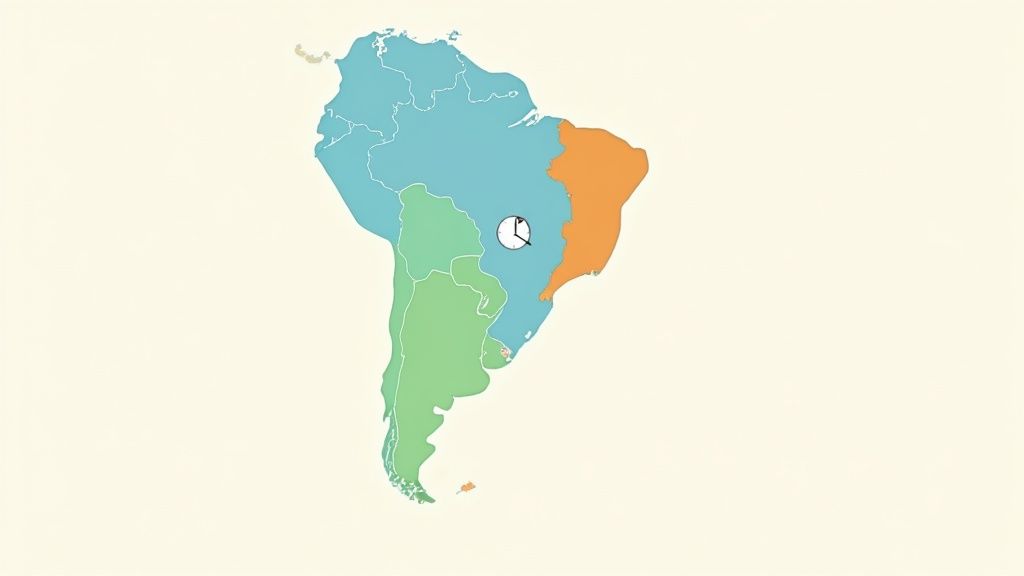
This guide is based on verified geographic and legal time data rather than crowd-sourced tables. For the core offsets listed below, I cross-referenced the timeanddate.com zone profiles against national government decrees where available—most notably Brazil’s Law 13,877/2019, which formally ended DST. When I drafted these sections, I kept an eye on the commercial implications of mismatched offsets; a two-hour difference between Bogotá and São Paulo looks small on paper but eats up two hours of overlapping workday every single day.
Brazil’s historical use of DST illustrates how policy shifts reshape collaboration windows. Between 1985 and 2019, daylight saving time advanced clocks by one hour during the summer and applied primarily to Brazil’s South, Southeast, and Central-West regions. Those regions represented approximately 65% of the country’s population, meaning that a majority of Brazilians could experience a seasonal change in the time difference with North America (Time in Brazil). Since 2019, that variability has disappeared for most of the population, leaving a more stable baseline for scheduling.
If you need the short answer immediately: South America spans multiple time zones, with most countries currently falling between UTC-5 and UTC-3, and Brazil extending from UTC-5 to UTC-2. There is no single continental clock, and any meeting request that doesn’t name a specific city will hit a scheduling wall.
The practical implication is that most of the continent’s business hubs fit within a tight three-hour band. Colombia, Peru, and mainland Ecuador sit at UTC-5. Bolivia, Venezuela, Guyana, and parts of Brazil sit at UTC-4. Argentina, Uruguay, Suriname, French Guiana, Paraguay, and most of Brazil sit at UTC-3. Only Brazil’s Fernando de Noronha archipelago pushes further east to UTC-2. That geographic concentration is commercially significant because much of South America operates within only two or three hours of each other (South America time zones).
When I coordinate calls across the region, the first thing I check is whether the other party is in a DST-observing country. Chile and Paraguay still shift seasonally, which means a timezone match in January can become a one-hour offset by July.
To determine the exact time right now for any South American city, start with the standard UTC offset and then adjust for local DST if applicable. The table below shows standard offsets alongside a major city and current DST status. DST rules in South America are irregular, so always verify the active dates for Chile and Paraguay before locking in a recurring meeting. If you are building a development team across these time zones, our guide on how to hire developers in Latin America compares overlap with US hours, rates and hiring models by country.
| Country | Standard UTC Offset | DST Currently in Effect? | Example Major City |
|---|---|---|---|
| Argentina | UTC-3 | No | Buenos Aires |
| Bolivia | UTC-4 | No | La Paz |
| Brazil (most) | UTC-3 | No | São Paulo |
| Brazil (Acre) | UTC-5 | No | Rio Branco |
| Chile (mainland) | UTC-4 | Seasonal | Santiago |
| Colombia | UTC-5 | No | Bogotá |
| Ecuador (mainland) | UTC-5 | No | Quito |
| Paraguay | UTC-4 | Seasonal | Asunción |
| Peru | UTC-5 | No | Lima |
| Uruguay | UTC-3 | No | Montevideo |
| Venezuela | UTC-4 | No | Caracas |
When you’re looking for the time zone for South America, the most reliable approach is a country-by-country directory. This section covers all twelve sovereign nations plus the notable exceptions that break the standard pattern. I arranged the list by UTC offset to make it easier to group collaborators geographically.
Editor’s note: “Latin America time” is broader than “South America time.” Mexico, Central America, and the Caribbean follow different offset patterns and often align with North American DST schedules. This article focuses strictly on the twelve sovereign South American countries, while flagging the exceptions above.
There is no single answer to “what time is it in South America” because the continent spans at least four distinct offsets at any given moment. If a colleague says “let’s meet at 3 PM,” the first question should always be “which 3 PM?”
South America’s time-zone structure creates a measurable scheduling advantage for companies using nearshore talent models. The mainland largely fits within three primary offsets—UTC−5, UTC−4, and UTC−3—while Brazil’s Atlantic islands add UTC−2. A three-hour continental spread is narrow compared with the six- to nine-hour differences commonly encountered when teams hire across Europe, Asia, or other distant regions. In practice, a U.S. company can often create a shared core schedule covering approximately six to eight hours of the workday with South American professionals, depending on the employer’s home zone and the specific country mix (Nearshore time zone news).
My rule of thumb when building a LATAM schedule is to anchor on Bogotá or Lima at UTC-5 during northern winter, because that offset aligns with US Eastern Standard Time. Once US clocks spring forward, that same anchor point becomes EDT minus one hour, which is still workable but shifts the overlap window.
Brazil's sheer size makes it one of the few South American countries with multiple time zones, a fact that can easily trip up even seasoned travelers and schedulers. The nation officially runs on four different clocks, which has a direct impact on everything from domestic flights to national TV broadcasts.
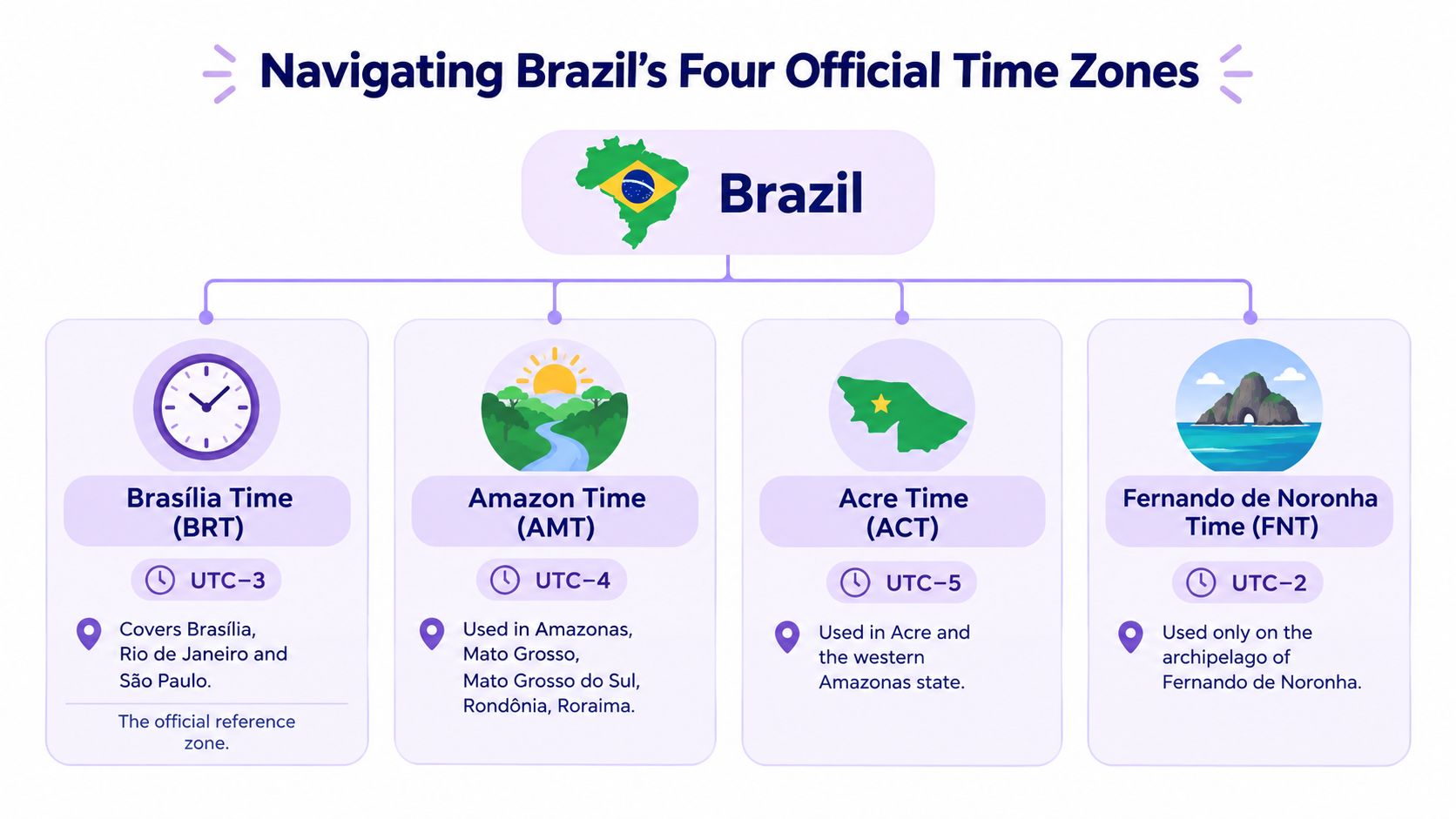
For instance, flying from Rio Branco in the state of Acre (UTC-5) to the capital, Brasília (UTC-3), means jumping forward two full hours. It's a small detail that can have big consequences if you're not prepared.
This complexity is a direct result of the country's massive geography. Brazil spans from UTC-5 on its western edge to UTC-2 on its remote Atlantic islands. The political and economic heart of the nation, however, beats on Brasília Time (UTC-3). This single zone is home to about 65% of Brazil's 213 million people and includes major cities like São Paulo and Rio de Janeiro. For a wider perspective on how this compares to other large countries, you can explore more about global time zone classifications.
The infographic below gives you a bird's-eye view of how some of the continent's major time zones are distributed.
As you can see, neighboring countries like Argentina and Bolivia fall into different, though adjacent, time bands, underscoring the importance of checking local times before scheduling any cross-border communication.
To make scheduling easier, it helps to know which regions use which offset. Here’s a quick breakdown:
One of the most significant changes for international scheduling came in 2019, when Brazil officially did away with Daylight Saving Time (DST). This decision means Brazil’s time zones are now stable year-round. While this simplifies planning in some ways, it also means the time difference with countries that do observe DST will change twice a year, so always double-check.
If there's one thing that trips up even seasoned managers scheduling across continents, it's Daylight Saving Time (DST). Regarding the time zone for South America, DST adds a layer of complexity that can feel like a moving target. The continent is a real patchwork: some countries observe it, others have ditched it entirely, and a few never bothered with it in the first place. This inconsistency is a classic source of missed meetings and scheduling headaches.
For instance, countries like Chile and Paraguay are still on the DST train, springing forward one hour in their spring and falling back in their autumn. But don't get too comfortable; their start and end dates rarely line up with schedules in North America or Europe.
The rules can and do change, so it's always a good practice to double-check the current local time. But here's a general breakdown of the current situation:
The takeaway here is simple: what was true last year might not be true this year. Before you lock in any plans, a quick search for the current local time is non-negotiable.
This constant state of flux is particularly critical for remote teams. Getting a handle on these regional quirks is a core part of making cross-continental collaboration work smoothly. You can dig deeper into the role of time zones in remote work to make sure your team stays perfectly in sync, no matter where they are.
So, you're ready to coordinate with partners or new hires in South America. The good news is that the time zone for South America often lines up beautifully with the US, making real-time collaboration a breeze. It’s one of the biggest practical advantages of nearshoring to the region.
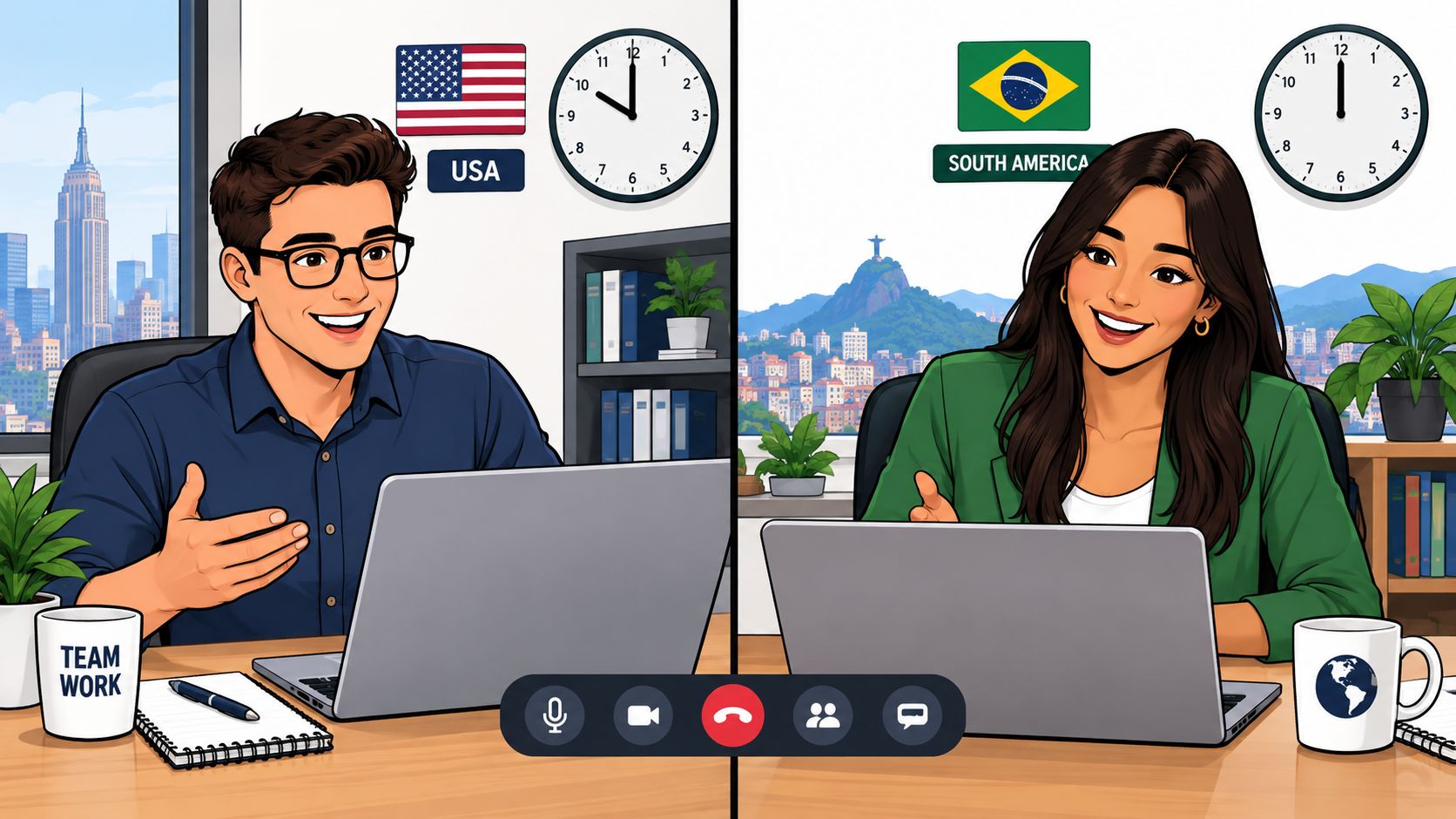
Take countries like Colombia and Peru, for example. They operate on UTC-5 all year. During the winter, that’s exactly the same as US Eastern Standard Time (EST), which means zero time difference to worry about. Even major business hubs like São Paulo, Brazil (UTC-3), are only two hours ahead of the US East Coast, leaving plenty of overlapping work hours for calls, demos, and stand-ups.
Yes, but only during northern winter. From early November to early March, Colombia and Peru stay at UTC-5, which matches US Eastern Standard Time exactly. From mid-March to early November, the US switches to EDT (UTC-4), and those same South American cities fall one hour behind New York. If your team relies on daily syncs during summer, plan around a one-hour gap rather than assuming perfect alignment.
London and South America sit roughly six to seven hours apart, depending on DST timing. During northern summer, London is on BST (UTC+1) while Bogotá and Lima remain at UTC-5, creating a six-hour gap. During northern winter, London reverts to GMT (UTC+0), widening the gap to seven hours. The practical overlap window is usually a narrow late-morning band in London and early afternoon in South America.
| City / Region | Northern Winter Offset vs New York | Northern Summer Offset vs New York | Typical Overlap Window with New York |
|---|---|---|---|
| Bogotá / Lima / Quito | Same as EST (UTC-5) | One hour behind EDT (UTC-5 vs UTC-4) | 10:00 AM–2:00 PM ET |
| São Paulo / Buenos Aires | Two hours ahead of EST (UTC-3) | One hour ahead of EDT (UTC-3 vs UTC-4) | 9:00 AM–1:00 PM ET |
| Santiago (mainland) | Varies with Chilean DST | Varies with Chilean DST | Often 10:00 AM–2:00 PM ET |
| London (reference) | Five hours ahead of EST | Five hours ahead of EDT | Rare meaningful overlap |
To get a clear picture of how your workdays align, we put together this quick reference table. It’s designed to help you find the sweet spot for scheduling calls between major business centers.
| US East Coast (EST/EDT) | US West Coast (PST/PDT) | Bogotá, Colombia (UTC-5) | São Paulo, Brazil (UTC-3) |
|---|---|---|---|
| 10:00 AM | 7:00 AM | 10:00 AM | 12:00 PM |
| 1:00 PM | 10:00 AM | 1:00 PM | 3:00 PM |
| 4:00 PM | 1:00 PM | 4:00 PM | 6:00 PM |
As you can see, there’s a solid window in the late morning and early afternoon (US East Coast time) where everyone is online and available.
Of course, knowing the time zones is only half the battle. To make those meetings count, you need solid practices. For great insights, check out these effective meeting management tips. And to get even deeper into building your cross-border team, have a look at our guide on challenges of time zone differences when hiring from LatAm.
Knowing the time zones is one thing; putting that knowledge into practice without causing a scheduling nightmare is another. To turn your understanding of the time zone for South America into error-free planning, you just need the right tools and a few smart habits.
A reliable online time zone converter or world clock app should be your first stop for any quick check. These tools take the guesswork out of the equation, giving you real-time accuracy, which is especially critical when you're dealing with countries that may or may not be observing Daylight Saving Time.
Beyond apps, a few simple communication tweaks can prevent the vast majority of scheduling mishaps. Getting these habits down ensures everyone is on the same page, no matter where they are.
For keeping your own day straight, platforms like Google Calendar for scheduling tasks are built with time zone awareness in mind, making them indispensable for managing a cross-continental schedule.
As you start working with teams across this massive continent, a few key questions almost always come up. Here are some straightforward, practical answers to help you sidestep common scheduling headaches, whether you're a traveler, remote manager, or global professional.
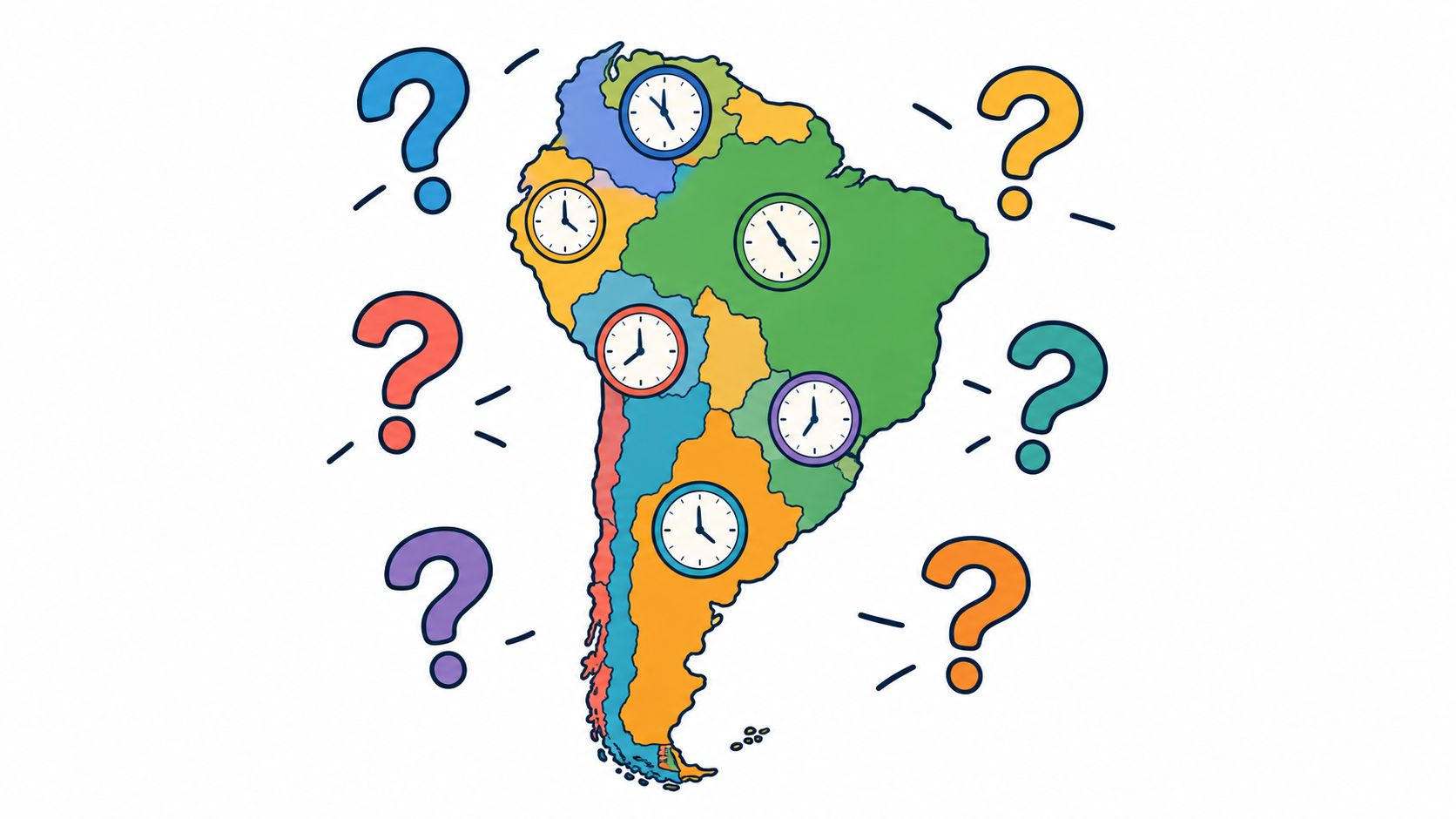
There is no single South American time zone. The continent uses offsets from UTC-5 to UTC-2. Most major business centers fall into three bands: UTC-5 (Colombia, Peru, Ecuador mainland), UTC-4 (Bolivia, Venezuela, Paraguay, Chile mainland, parts of Brazil), and UTC-3 (Argentina, Uruguay, most of Brazil, Suriname, French Guiana).
No. The continent spans multiple time zones, and even individual countries contain exceptions. Brazil alone uses four official zones. Chile’s mainland, Easter Island, and Magallanes each follow different rules. Ecuador’s mainland and Galápagos are one hour apart. Assuming a single continental clock is the fastest way to miss a meeting.
The UK sits roughly six to seven hours ahead of South American business hubs. During northern summer, London (BST, UTC+1) is six hours ahead of Bogotá and Lima (UTC-5). During northern winter, London (GMT, UTC+0) is seven hours ahead. Overlap windows are narrow and usually centered on late morning in London and early afternoon in South America.
Peru is in the same time zone as the US East Coast during northern winter, when both run on UTC-5. During northern summer, the US switches to EDT (UTC-4) while Peru remains at UTC-5, creating a one-hour gap. Peru never observes DST, so its offset is fixed year-round.
That would be Brazil, hands down. Because of its sheer size, it officially covers four time zones, stretching from UTC-5 on its western edge with Peru all the way to UTC-2 for its remote Atlantic islands.
But here’s the key takeaway: the overwhelming majority of Brazil’s population and its economic powerhouses like São Paulo and Rio de Janeiro run on Brasília Time (BRT), which is UTC-3.
Not anymore. Daylight Saving Time (DST) has become increasingly rare across South America. While a couple of countries like Chile and Paraguay still spring forward and fall back, most nations have ditched the practice for the sake of consistency.
Major players like Brazil, Argentina, Peru, Colombia, and Uruguay no longer change their clocks. This makes year-round scheduling a lot simpler.
Important Note: You absolutely must verify the current DST rules for Chile and Paraguay before scheduling anything important. Their start and end dates can shift and rarely align with North American or European schedules. A quick check upfront can prevent a world of miscommunication.
The best strategy is to be crystal clear and lean on reliable tools. When you send a calendar invite, always specify the time using a UTC offset (for example, "10:00 AM UTC-5") instead of relying on a city name alone. This simple step eliminates any and all guesswork.
For teams, mastering these differences isn't just a convenience, it is a fundamental part of running a smooth operation. To get a better handle on this, it's worth exploring the challenges of time zone differences when hiring from LatAm and learning how to build an integrated team.
| Country | Primary Standard Time Zone (UTC Offset) |
|---|---|
| Argentina | UTC-3 |
| Bolivia | UTC-4 |
| Brazil | UTC-3 (Brasília Time) |
| Chile | UTC-4 (Mainland) |
| Colombia | UTC-5 |
| Ecuador | UTC-5 |
| Paraguay | UTC-4 |
| Peru | UTC-5 |
| Uruguay | UTC-3 |
| Venezuela | UTC-4 |