
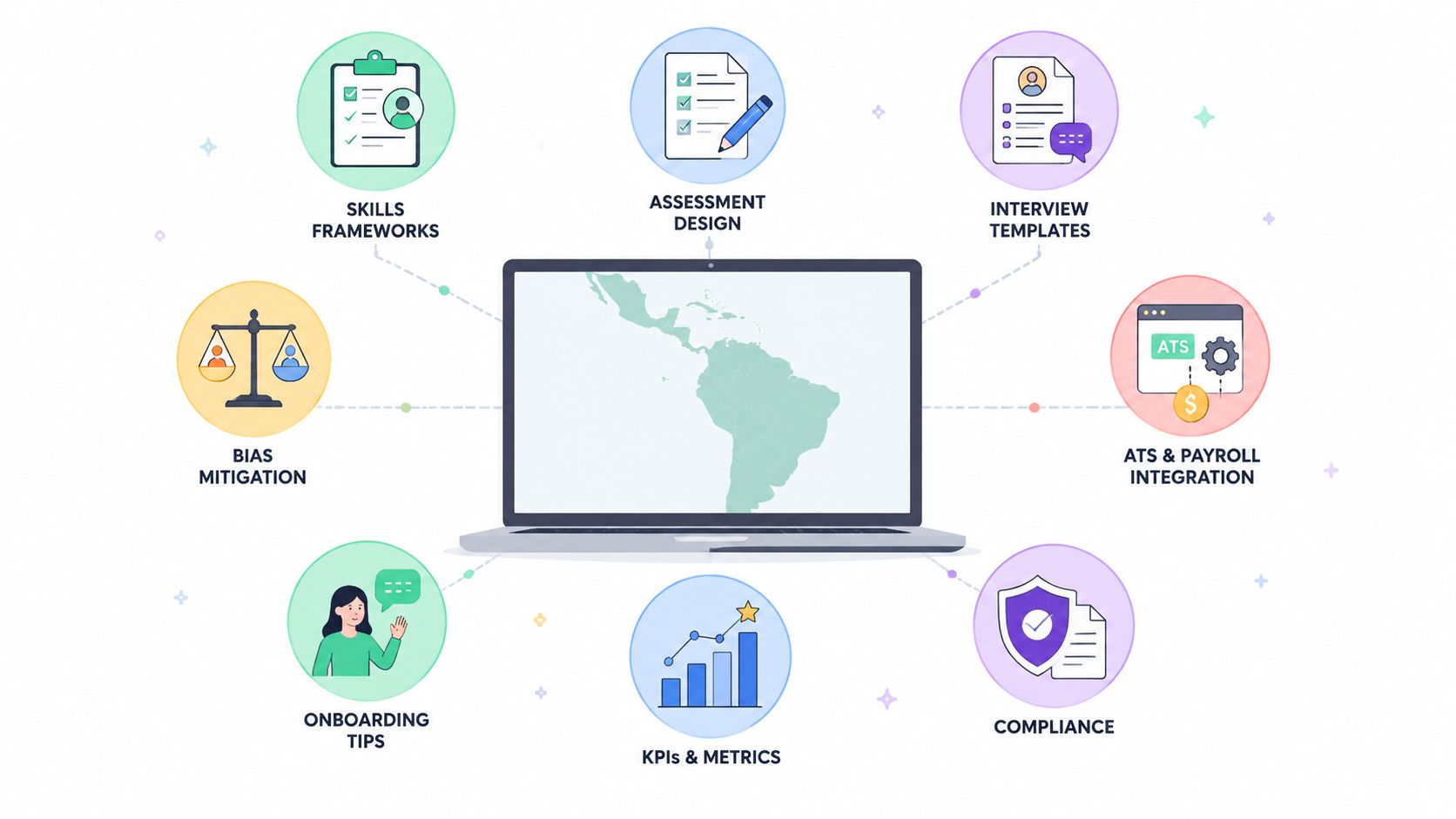
Stop hiring resumes and start hiring talent. That's the whole game, and anyone still treating a diploma as the main event is basically doing recruiting with a blindfold on. If you're building remote teams in Latin America, you need a process that finds what people can do, not what they printed on fancy paper ten years ago.
The old model is already wobbling. NACE reported that 73% of employers screened candidates by GPA in 2019, but only 42% still did in the latest survey, while 70% said they use skills-based hiring and 71% said they use it at least half the time. NACE also found employers use skills-based methods most often in interviewing (87%), screening (65%), and job descriptions (81%) (NACE's skills-based hiring report). Translation, this is no longer a cute experiment. It's the operating system.
For LATAM hiring, this matters even more. You're working across time zones, cultures, education systems, and wildly different access to brand-name schools. So let's stop pretending a resume tells you who can ship, sell, design, or run operations. Here's the practical playbook.
Resume parsing is the corporate equivalent of judging a restaurant by the font on the menu. Cute? Sure. Useful? Not really. If you are hiring remote talent in Latin America without turning it into credential bingo, start with a job-relevant assessment before anyone gets on a call.
Skip the brainteasers. Skip the trick questions. Use a coding challenge, a customer support simulation, a sales writing exercise, or a marketing brief that mirrors the actual work. The point is plain, measure what the person can do, not whether they have mastered LinkedIn theater.
TestGorilla's 2025 report says 85% of employers use skills-based hiring, 76% use skills tests, but only 36% use those tests before reviewing resumes, and employers who test first report higher quality hires (96% vs. 87%) (TestGorilla 2025 report). That gap tells you exactly where to improve.
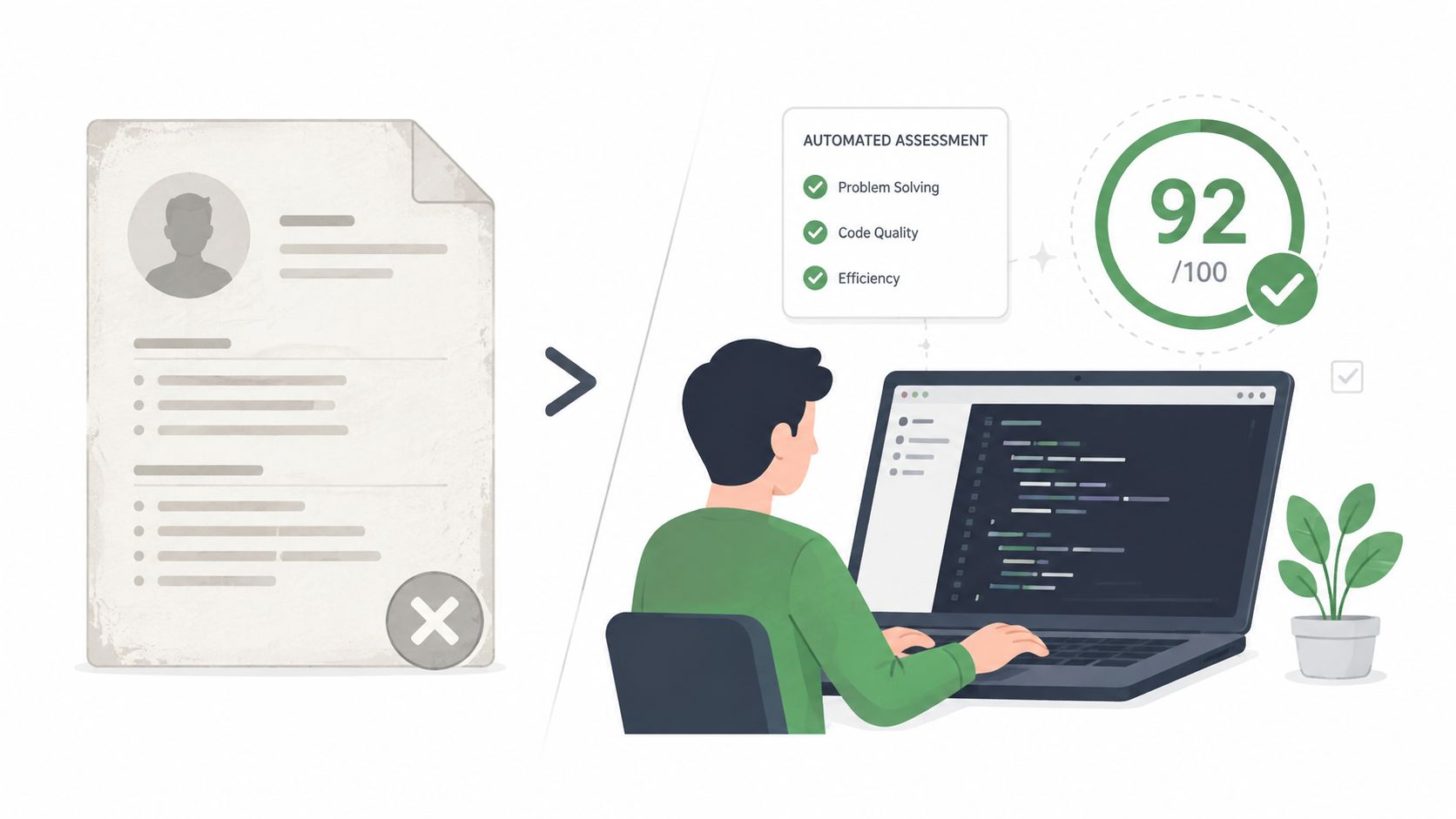
A good test stays close to the work and short enough that sane people will complete it. A bad test is a five-hour unpaid science project that tells you more about someone's free time than their skill. If you want a practical setup, LatHire's pre-employment skills testing approach is built around that idea.
Practical rule: if the task does not resemble the day-to-day job, throw it out. You are screening for capability, not patience.
For Latin American candidates, especially those balancing full-time jobs or unstable schedules, keep the time burden tight and the instructions painfully clear. Then use the assessment as a conversation starter in the interview, not a courtroom verdict. If someone scores well but explains their thinking poorly, that tells you something too.
Most job descriptions read like a grocery list written by six managers after a chaotic meeting. “Must have everything, ideally by Tuesday.” That kind of spec attracts the wrong crowd and repels the people who can do the work.
Build the role from the work itself. Start with what the person must deliver in month one, what they should own by month three, and what can be taught after onboarding. That approach works especially well for remote LATAM hiring because it gives strong candidates room to win on skill, not on polished pedigree. NACE found that employers are already paying attention to demonstrated proficiency in key competencies, even as they vary in how they screen academic signals (NACE).
Basecamp has long been known for writing job descriptions around problem-solving needs instead of a pile of tools, and Buffer has published detailed skill requirements alongside salary ranges. That instinct is correct. If you are hiring a remote operations manager in Colombia or a designer in Mexico, spell out the core work, not the fantasy version.
That level of clarity helps candidates self-select fast. It also saves your team from interviewing people who sound impressive on paper but cannot handle the actual job. For remote hiring across Latin America, it matters even more because strong candidates are often balancing current jobs, family obligations, or uneven schedules. LatHire's AI job-description tooling can help extract actual requirements from role data, which beats copying yesterday's mess into today's JD.
A portfolio is the grown-up version of “show me.” Use it. Especially for remote hiring, where you can't rely on office presence, hallway charisma, or whether someone laughs at the right moment in a Zoom call.
For developers, that means GitHub contributions, shipped products, or a small integration they've built. For designers, it means case studies with the thinking laid out, not just pretty screens. For marketers, it means campaign samples, funnel analysis, or copy that did a real job. The trick is to evaluate the work, not just admire the polish.
A portfolio only tells half the story. Ask the candidate to walk you through a decision they made, a constraint they hit, and what they'd change now. That's where you separate real operators from people who just know how to make a deck look expensive.
Practical rule: when someone shows you a project, ask what broke, what they fixed, and what they'd do differently. Good people answer quickly. Great people light up.
A simple rubric keeps you honest. Score things like problem framing, technical quality, communication, and scope fit before the interview starts. If the work is confidential, ask for an anonymized walkthrough with enough detail to judge the approach. And for senior hires, weight the portfolio heavily. At that level, independent shipping matters more than shiny credentials.
LatHire's model of validated skills profiles backed by real project experience fits this nicely, because it gives you a way to compare candidates on output rather than mythology. If the person can ship, show it.
If your interviews are still “so, tell me about yourself,” you're not interviewing, you're improvising. That's how bias sneaks in wearing a blazer. Structured interviews are boring in the best possible way, because they make candidates comparable.
The mechanics are dead simple. Define the competencies that matter, write the same core questions for every candidate, and score answers against a rubric before anyone starts freelancing with their memory. AIHR recommends job-relevant assessments, structured interviews, realistic work samples, and clear evidence rules for what counts as valid proof of skill (AIHR). That's not bureaucratic fluff, that's how you stop hiring by vibe.
Three or four good questions per core competency beat twenty surface-level ones every time. If you want a cleaner interview flow, use STAR, Situation, Task, Action, Result, and push for specifics. When a candidate says “I improved the process,” ask what the process was, what they changed, and how they knew it worked.
Use one shared scorecard. If two interviewers score the same answer very differently, the problem isn't the candidate. It's your framework.
For Latin American remote hiring, structured interviews matter even more because accents, cultural directness, and interview style can distort gut reactions. A strong framework keeps the conversation focused on competence. LatHire's guide on competency-based interviewing is worth using as a reference point if you're building this from scratch.
Google, Amazon, McKinsey, and HubSpot all use variations of structured competency systems for a reason. They reduce randomness. And randomness is expensive.
Hiring doesn't stop at the offer. That's when the work starts, and if you skip skills gap analysis early, onboarding turns into guesswork with a nice payroll run attached. Hope is not a management system.
Start before day one. Identify the person's baseline, map the ramp, and decide what solid performance looks like at 30, 60, and 90 days. Decide what they need to learn, who will coach them, and how you'll measure progress without hand-waving. LatHire's skill gap analysis fits that model because it treats onboarding as a competency journey. For frameworks on mapping employability skills, see the MasteryMind employability skills page.
Good teams do not improvise learning and call it culture. They put the path on paper, assign a mentor or buddy, and hold regular check-ins so people know whether they are improving or just staying busy. Remote talent in Latin America needs that structure even more, because timezone overlap can be tight and vague expectations get expensive fast.
Keep the ramp practical. Use real work that tests the missing skill, not filler tasks that look productive in a spreadsheet. A new hire who needs sharper reporting should build real reports. A developer who needs stronger testing habits should ship against your actual QA process. If the goal is skill growth, the work has to prove the skill.
Continuous assessment is where weak hiring systems get exposed. SHRM recommends updating HR KPIs beyond cost-per-hire to include things like employee net promoter scores, turnover or attrition after 18 months, and internal mobility numbers (SHRM). That is the right lens. If someone gets hired and never grows, the process did not produce a team member. It produced a warm body and a training bill.
Reference checks are usually lazy. People ask, “Would you hire them again?” and then nod politely at whatever answer comes back. That's not diligence, that's social theater.
Ask better questions. Talk to people who directly observed the candidate's work, managers, peers, clients, anyone who saw the person ship, collaborate, or stumble. You want evidence of technical depth, delivery outcomes, and behavior under pressure. Stripe is known for asking references about shipping outcomes and technical depth, which is the right instinct if you care about performance rather than personality trivia.
If the candidate is comfortable, call past peers too. They often tell the truth faster than managers do. Ask about how the person handles disagreement, feedback, and deadlines that go sideways. Then listen for consistency between what the candidate said and what the reference confirms.
“Tell me about a time they struggled, and what happened next.”
That single question usually reveals more than ten generic ones.
LatHire's profile verification process includes skill validation from past clients and managers, which is a smarter version of the same idea. If you need a separate verification workflow, Burnt's employment verification guide is relevant to how these checks get documented in practice.
The goal isn't to catch people in a lie. It's to verify performance patterns. One good reference can save you from months of regret.
Years of experience are a blunt shortcut. They also mean different things in different companies and countries. Someone with five years in a small team may have handled more scope, more mess, and more accountability than a person with ten years inside a bloated org where nobody owned anything.
Level roles by competency, autonomy, and impact. Junior, mid, senior, and principal should describe real capability, not just time served. Stripe's engineering levels are tied to shipping autonomy and system ownership, Amazon uses scope and impact in its level definitions, and GitLab's public career framework maps competency to level. That is the useful kind of boring.
A remote hire from Latin America can easily get boxed out when a team overvalues tenure and undervalues proof. Good leveling fixes that fast. It gives candidates a clear target and forces hiring managers to stop hiding behind vague titles.
When candidates can see the level criteria, they self-select better. That saves time and cuts down on awkward mismatches later. It also gives remote LATAM candidates a fair shot because the conversation shifts from pedigree to proof.
Write the bar in plain language. If a senior role requires independent delivery, call that out. If a principal role needs cross-team influence, say so. Don't hide the actual job behind mushy HR phrasing.
LatHire's skill proficiency scoring maps to role-level requirements, which is exactly the kind of operational detail hiring teams need when they are working across markets. If you want people to grow inside the company, they need a map. Otherwise, they will assume promotion is random and start looking elsewhere.
If you hire only from the usual pedigree stack, you'll get a very familiar team and a very limited perspective. That's fine if your goal is comfort. It's terrible if your goal is building something resilient.
Prioritize skill and potential over brand names. Remove degree requirements unless they are necessary. Use blind resume screening in the first pass. Ask assessment questions that allow different approaches, not one approved answer. This matters in Latin America because you are tapping a broad, global talent base where formal credentials do not always line up neatly with capability.
Google has said the predictive validity of GPA is near zero, which is exactly why GPA shouldn't be your golden ticket in hiring. GitHub has also shown that self-taught developers can outperform on measured metrics, and that should make any serious team rethink its assumptions. LatHire's Latin America model also widens access to diverse backgrounds while keeping the economics sane.
Do this without posturing: remove the credential filter first, then look at what your assessments actually surface. If the pool suddenly looks different, good. That means the filter was doing too much.
Keep an eye on performance after hire. Diversity for its own sake is not the point. Diverse background plus strong execution is the point. If your process only finds people who look good on paper, you're leaving a lot of talent on the table.
Pay people for what they can do and the level they operate at. Tenure-based pay creates instant resentment, and remote teams feel it faster because contribution is visible and comparison never sleeps. If someone is carrying harder problems, coaching others, or taking real ownership, their compensation should reflect that.
Publish salary ranges. Publish leveling criteria. Make promotion standards explicit. Basecamp, Stripe, and Buffer use transparent or level-based compensation models for a reason, opacity turns pay into a guessing game, and nobody enjoys guessing when rent is due.
Growth should map to evidence people can point to, not vibes or office folklore. A move from mid to senior needs a visible jump in judgment, autonomy, and problem size. If the person is still asking for hand-holding on work that should be routine at the next level, they are not there yet. That standard matters even more in remote Latin America hiring, where teams span countries, currencies, and expectations, and vague pay logic turns into a mess quickly.
A clean leveling system gives you something better than a feel-good policy. It gives managers a way to explain why a remote hire in Argentina may sit at a different pay band than a peer in Austin, and the answer should always point to role scope, level, and performance. Geography can inform the structure, but it should not become a lazy excuse.
LatHire's geography-aware models fit this reality because they support fair compensation without pretending location costs are identical everywhere. Use that structure, then stick to it. “Because that's how we've always done it” is a weak policy and an even weaker retention strategy.
Single-skill hiring leaves lean teams with sharp specialists and no one who can hold the whole machine together. That looks efficient on paper. In practice, it slows everything down. Skill stack hiring fixes that by looking for complementary abilities that let one person handle more than one kind of problem without turning them into the team's permanent errand runner.
Remote teams across Latin America benefit from that approach fast. A developer who can ship frontend, handle backend work, and manage enough DevOps to keep releases moving is far more useful than a narrow specialist who freezes the moment the task crosses a boundary. The same goes for a marketer who can write copy, read analytics, and speak product without turning every meeting into a translation exercise. Stripe hires engineers who can code, operate systems, and unblock customers, which is exactly the kind of practical thinking worth copying.
The trick is to hire for a primary skill first, then a useful second layer. If you skip that order, you get a broad generalist who is mediocre at everything or, worse, a burnt-out person carrying half the company on their back.
Treat the stack as a map, not a wish list.
That balance matters in distributed teams because the best LatHire candidates often arrive with cross-functional combinations across tech, operations, or sales. Use that range to cover more ground without adding headcount you do not need. A strong skill stack makes one seat more productive. It does not give you a free pass to overload one person until they quit.
| Approach | Implementation complexity | Resource requirements | Expected outcomes | Ideal use cases | Key advantages |
|---|---|---|---|---|---|
| Assessment-Based Screening Over Resume Parsing | Medium–High: design and validate role-relevant tests | Assessment platform, SME time, scoring automation | Objective skill data; fewer unqualified interviews | Technical and remote/international hiring | Reduces resume inflation; measurable comparisons |
| Role-Based Job Descriptions Built on Actual Skill Requirements | Medium: analyze top-performers and rewrite JDs | Stakeholder interviews, time to build skills matrix, optional AI tools | Better candidate fit; clearer onboarding expectations | New roles; improving hiring accuracy | Attracts honest matches; opens non-traditional talent |
| Portfolio and Work Sample Evaluation | Medium: collect samples and create evaluation rubrics | Reviewer time, access to repos/portfolios, scoring rubric | Demonstrable evidence of work quality and approach | Design, engineering, senior individual contributors | Objective proof of capability; shows growth and communication |
| Structured Interview Frameworks Tied to Skill Competencies | Medium–High: develop rubrics and train interviewers | Competency templates, interviewer training, calibration sessions | Fairer comparisons; reduced bias; consistent hiring decisions | High-volume or cross-team hiring; remote panels | Consistency across interviews; data-driven decisions |
| Skills Gap Analysis, Training Path Mapping, and Continuous Assessment | High: build training pathways and ongoing checkpoints | Training budget, mentors, LMS/tools, manager time | Faster onboarding, improved retention, targeted development | Junior hires, upskilling programs, growth-oriented orgs | Expands hiring pool; reduces time-to-productivity surprises |
| Reference Checks Focused on Work Performance and Skill Validation | Low–Medium: structured reference process | Time to contact references, structured questionnaires | Validation of on-the-job performance and behavior | Senior, high-risk, or client-facing roles | Higher predictive value than generic references |
| Competency-Based Leveling Over Years of Experience | Medium: define competencies and map levels | Leadership input, documented frameworks, calibration | Clear promotion paths; fair leveling across regions | Scaling organizations, global teams | Fairness across geographies; clearer career trajectories |
| Diversity of Skills and Background Weighting | Medium: change sourcing and assessment policies | Sourcing channels, bias-detection tools, panel training | Larger, more diverse talent pool and perspectives | DEI initiatives, global hiring, non-traditional pipelines | Reduces credential bias; improves team creativity |
| Skills-Based Compensation and Career Progression | High: align pay to demonstrated competency | Compensation analysis, pay bands, HR systems, calibration | Transparent pay, motivated skill development, retention | Companies aiming for pay equity and transparency | Ties compensation to skill and impact; motivates growth |
| Skill Stack Matching Over Single-Skill Focus | Medium: define and assess complementary skill sets | Multi-skill assessments, role design, interview probes | Hires who cover multiple needs; reduced headcount | Startups, lean remote teams, cross-functional roles | Versatility and cross-functional resilience |
Skills-based hiring isn't a trend you admire from a safe distance. It's the practical response to how work gets done now, especially when you're hiring across borders and time zones. The old degree-first model was always a blunt instrument. In Latin America, it's even worse because it ignores the huge spread of access, training paths, and real-world experience.
The best teams do the same thing every time. They define the role in terms of competencies, test those competencies early, interview with structure, check references on actual performance, and keep development going after the hire. That's what makes hiring predictable instead of theatrical. It also lines up with the market shift NACE documented, where 70% of employers reported using skills-based hiring and 71% said they use it at least half the time, with skills-based methods embedded in interviewing, screening, and job descriptions (NACE).
For remote hiring in Latin America, the rule is even cleaner. Don't guess. Prove it. Prove the skill with assessments, prove the fit with structured interviews, prove the output with portfolios and references, and prove the growth path with a real onboarding plan. That's how you build teams that ship, stay, and don't require you to mortgage the ping-pong table every time you need another good hire.
If you're ready to stop sorting resumes and start validating talent, LatHire is a practical place to begin. Its platform connects US and Canadian companies with pre-vetted Latin American professionals, and it uses skills evaluations, human-led checks, and matching support to speed up the process.