
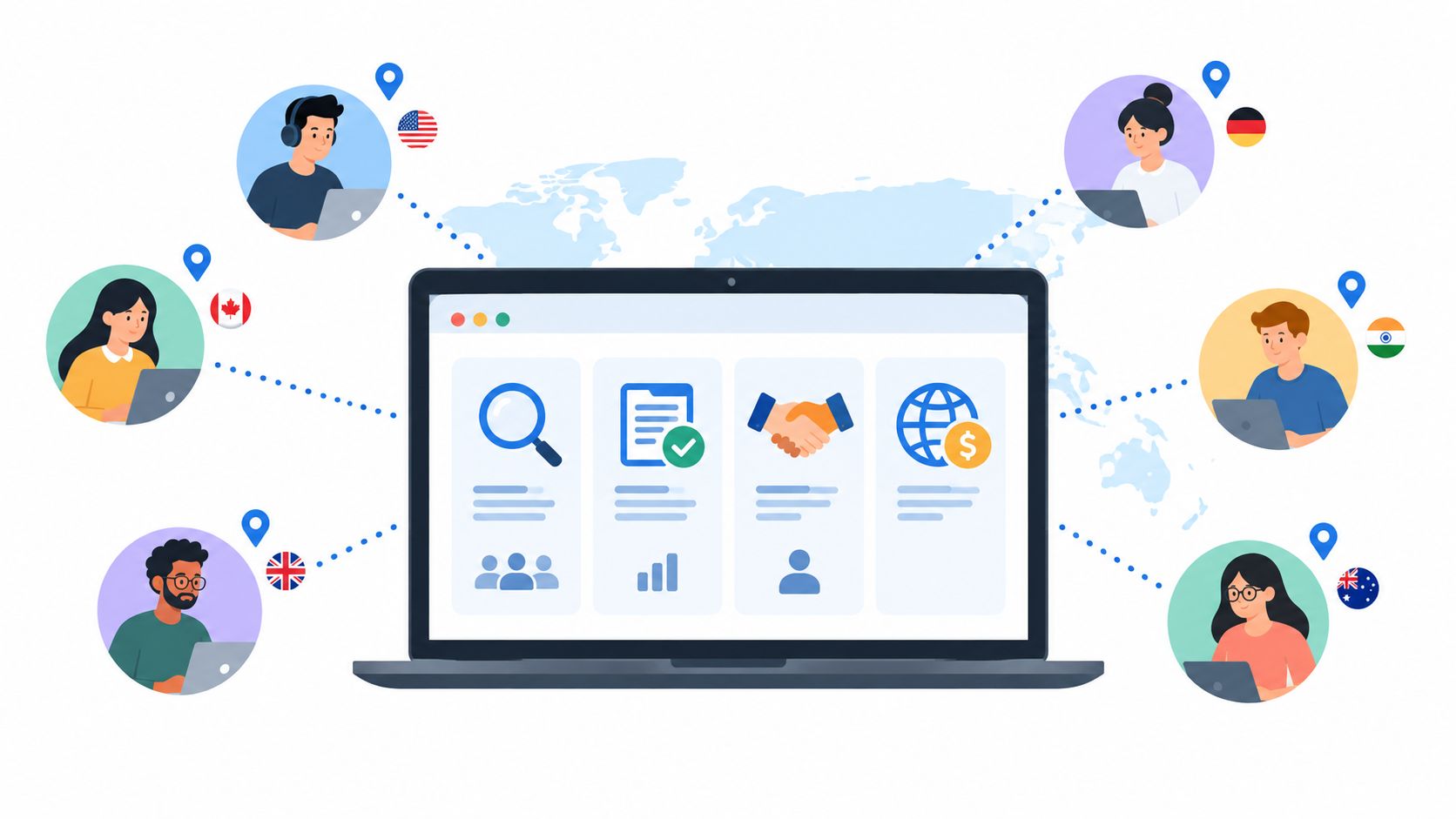
You've got a full inbox, a calendar filled with interviews, and very little confidence that any candidate can handle patient communication, scheduling, or protected health information. The problem usually isn't a lack of applicants. It's that sourcing, screening, classification, payroll, access control, and onboarding sit in separate systems, with nobody owning the handoffs.
A remote hiring platform can solve that problem, but only if it does more than display profiles and automate interviews. For a U.S. medical practice, the useful platform connects talent discovery to structured evaluation, worker classification, international payments, time-zone coordination, and privacy controls. It also makes clear what a remote medical assistant may do and where licensed clinical judgment must remain with providers.
This guide explains how to evaluate the category, where platforms commonly fail, how to build a safe hiring workflow, and which questions to ask before signing. The central recommendation is simple: judge the operational layer underneath the dashboard, not the polish of the demo.
A practice manager can spend days reviewing applications for a virtual receptionist, patient coordinator, or billing assistant, only to discover that the strongest candidates aren't available during U.S. clinic hours. Others may communicate well but lack experience with your EHR, insurance workflows, or patient privacy procedures. A job board gives you more names. It doesn't necessarily give you a dependable hiring process.
A remote hiring platform is an end-to-end system for distributed hiring. Depending on the vendor, it may source candidates, match profiles to a role, administer assessments, schedule interviews, support references, prepare contracts, classify workers, arrange payroll, and provide post-hire administration. The practical value comes from connecting those stages instead of forcing your office manager to copy information between recruiting, payroll, and compliance tools.
The category is often confused with four different vendor types:
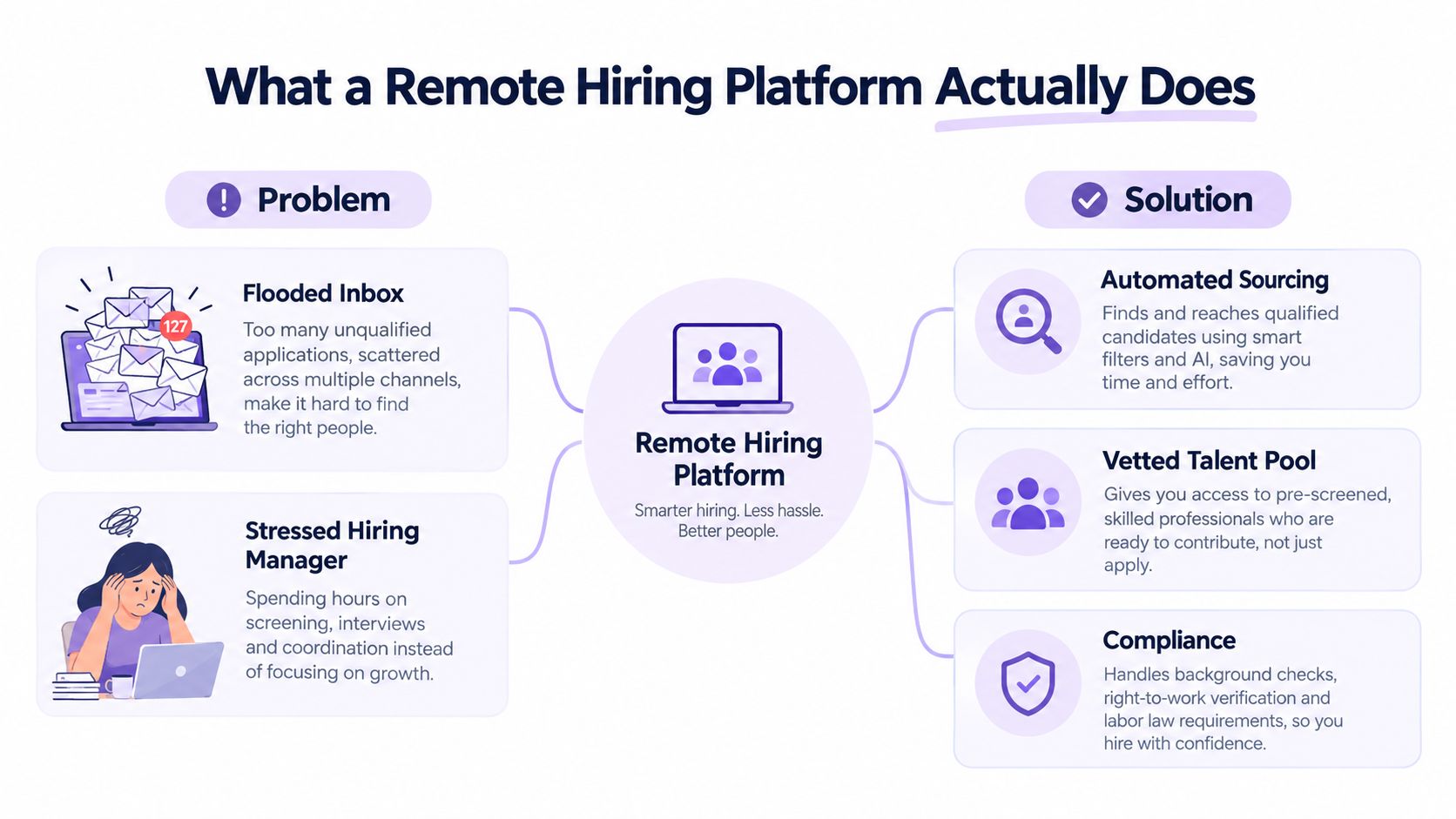
Most platforms are effective at the visible parts of recruiting. They can help you build a job description, filter candidates, coordinate calendars, and organize basic skills tests. Those features matter, especially when a practice doesn't have a dedicated recruiter.
The weaker areas are less visible. A platform may not tell you whether a contractor relationship resembles employment under the worker's local rules. It may not explain who handles withholding, benefits, social-security obligations, relocation approvals, or changes in work country. It may also leave your team to decide whether a medical virtual assistant needs access to PHI and whether a business associate agreement is required.
A useful platform should let you answer five questions before a hire starts:
For a more detailed look at the category, compare the international hiring platform workflow with a basic applicant-tracking process. The difference isn't the number of screens in the dashboard. It's whether the system carries responsibility through the stages that create risk.
Practical rule: If a vendor can't explain what happens after you select “hire,” you're looking at a sourcing tool, not a complete operating solution.
A strong demo should follow the order in which your practice makes decisions. Start with the role, then test candidates, then examine the employment and privacy consequences. Don't let a vendor spend the entire meeting showing search filters.
The right capability depends partly on the job. The OECD report on remotely performable employment estimates that remotely performable jobs account for 33.6% of employment in high-income economies, compared with 17.8% in upper-middle-income economies, 10.0% in lower-middle-income economies, and 4.0% in low-income economies. The difference reflects occupational structure, infrastructure, devices, connectivity, and digital skills. A platform built for software and administrative work won't automatically suit roles requiring physical presence.
Sourcing and matching should show more than a large database. Ask the vendor to find a bilingual patient coordinator with experience in a specific specialty, U.S. working-hour overlap, and familiarity with your scheduling workflow. The system should reveal why it recommended each person, not just produce an unexplained match score.
Assessment should measure the work. A medical receptionist might complete a scheduling scenario, draft a patient-facing message, or explain how they would route an insurance question. A test that only measures general aptitude tells you less than a role-specific work sample with a defined rubric.
Interview coordination needs structured questions, scorecards, recording consent where applicable, and interviewer instructions. A separate tool can help teams streamline applications with AI, but automation shouldn't replace your review of the candidate experience or the job-related criteria.
References and background checks need clear ownership. Ask which checks are available, who reviews results, how disputes are handled, and whether the vendor supports workers across the countries you target. Never assume that “vetted” means the same thing across providers.
Classification, payroll, and benefits are the dividing line between a recruiting product and an operating platform. The vendor should explain whether it supports employees, contractors, or both, how it handles country changes, what payment rails are available, and which party is responsible for filings and records.
Post-hire support should include changes to compensation, leave, location, access, and contract status. A platform that goes silent after the offer is signed has transferred the hardest work to your practice.
| Capability | Job Board | Agency | EOR | Full Platform |
|---|---|---|---|---|
| Candidate discovery | Inbound applications | Agency network | Usually limited | Sourcing and matching |
| Structured assessment | Rarely included | Sometimes | Usually not core | Typically integrated |
| Interview coordination | Employer-managed | Often supported | Usually employer-managed | Integrated workflow |
| Worker classification | Employer-managed | Contract-dependent | Core service | Should be explicit |
| International payroll | Employer-managed | May be included | Core service | Integrated or coordinated |
| Healthcare-role screening | Employer-managed | Depends on specialization | Usually not core | Should be role-specific |
| Post-hire administration | Employer-managed | Varies | Core service | Integrated or coordinated |
Before committing, request a written workflow and ask the vendor to identify the exact party responsible at every handoff. The remote recruitment software comparison can help you organize that review, but your own contract and compliance assessment still control the decision.
Treat the hire as an operational project, not a single recruiting event. A practice needs a defined path from job design to the first review after onboarding. The cross-border decision points should appear in that path before a candidate accepts an offer.
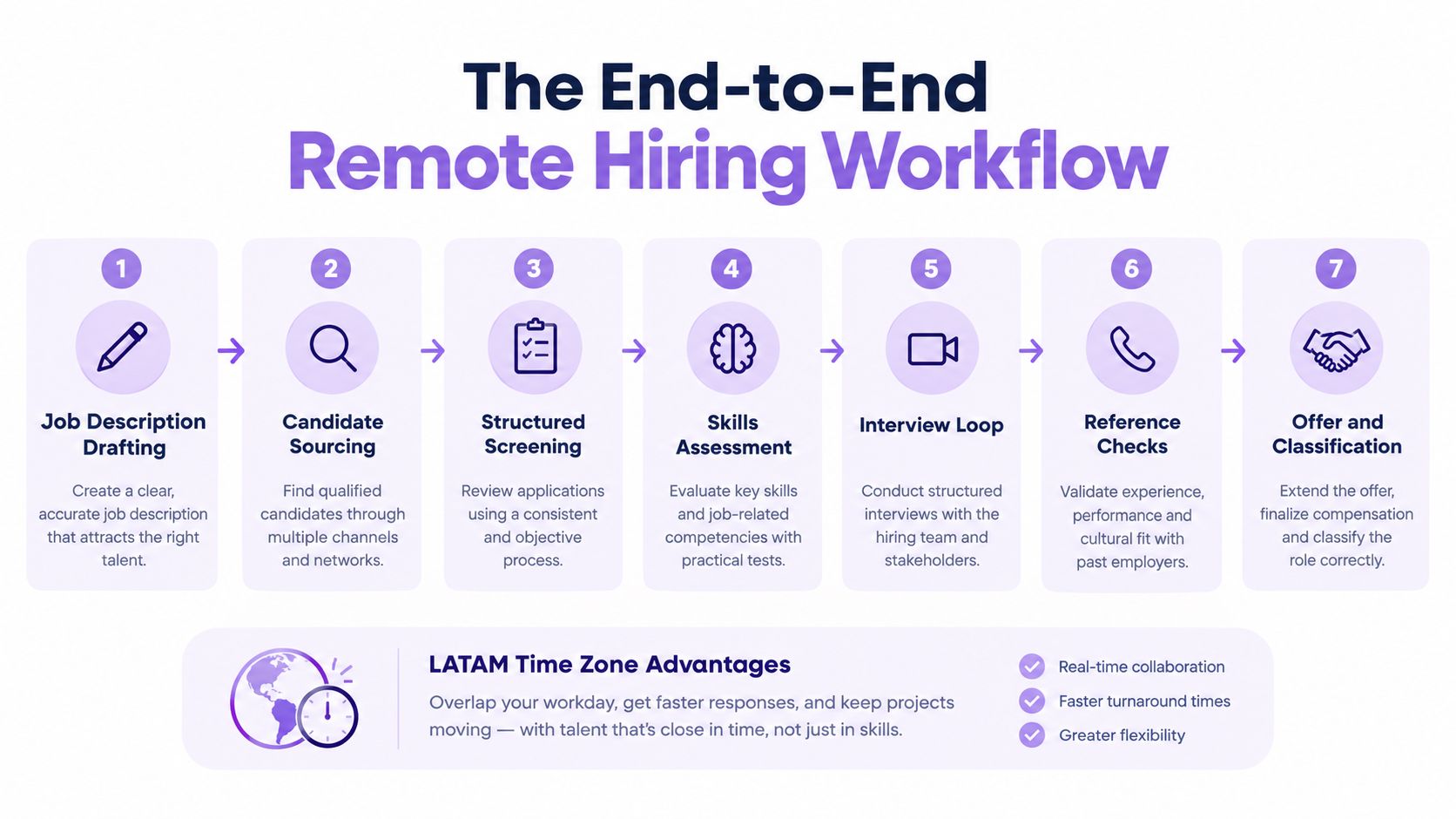
Start with duties, not a generic title. A remote medical administrative assistant might confirm appointments, prepare charts, collect structured intake information, route messages, and maintain referral records. A virtual medical receptionist may handle calls and scheduling. An insurance verification specialist may confirm coverage and document the result for the appropriate team member.
The American Medical Association recommends mapping telehealth support around defined workflow steps such as virtual rooming, pre-visit planning, documentation support, medication review, EHR order entry, scheduling, and care-gap review. Use a workflow diagram for team-based telehealth support to assign each task clearly. Providers should retain diagnosis, clinical judgment, treatment decisions, and patient-specific advice unless a properly licensed role and applicable jurisdiction permit otherwise.
The location field deserves special attention. The cross-jurisdiction employment tax guidance from RSM explains why obligations can arise in both the employer's jurisdiction and the worker's physical work country. Maintain an auditable location history, require approval before relocation, and connect each location to the relevant classification and payroll rules.
After signing, provision only the systems the role requires. Create individual accounts, use approved communication channels, confirm device expectations, document escalation routes, and schedule training around the actual patient workflow. For a worker outside the United States, confirm the payment route and local administration before the first pay cycle, rather than treating banking setup as an afterthought.
A practice should also review the engagement after onboarding. Check whether the assistant follows scripts, documents accurately, responds within agreed windows, and escalates clinical or privacy concerns correctly. A resource on how to find remote work offers useful context on how remote professionals evaluate roles, which can improve your job description and candidate communication.
A polished dashboard can make an assessment score look objective while hiding what the score actually measures. It may reflect access to outside AI tools, familiarity with the test format, language fluency, or assumptions built into the evaluation. Your practice needs evidence that a candidate can perform the assigned work safely, not just complete a platform test.
Recent data in the Remote Workforce Report shows that 76% of employers use skills tests, 65% use AI in hiring, and 74% of job seekers completed a skills-based test in the previous 12 months. Among candidates who admitted cheating, 70% used AI to do so. These figures do not establish that every candidate cheats. They do show why test completion cannot serve as proof of independent capability.
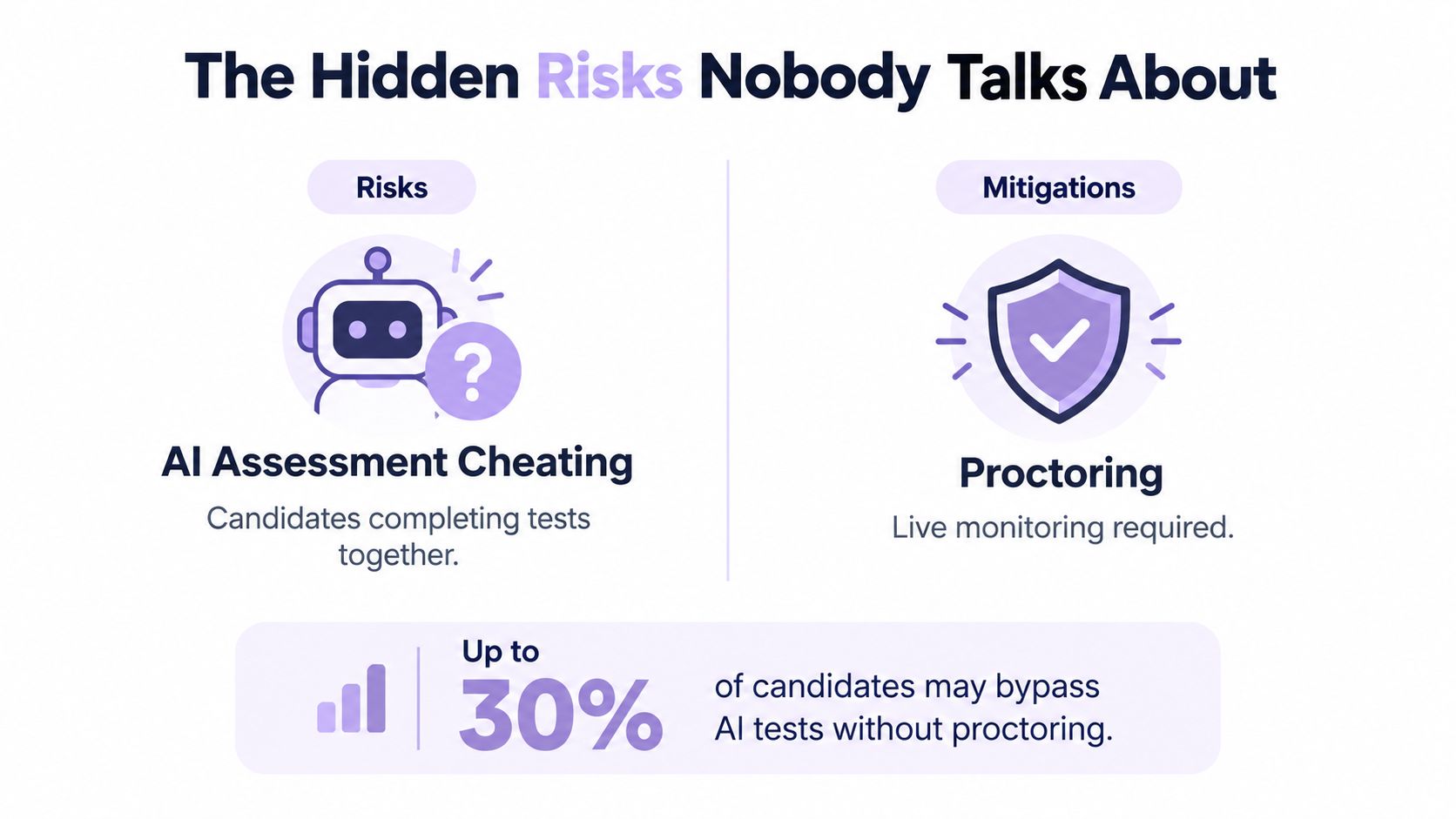
Start with a work sample tied to the job, then use a live or timed discussion. Ask the candidate to explain a decision, revise an answer, or respond to an unfamiliar scenario. State identity and environment policies before testing. Do not penalize ordinary productivity-tool use unless the role requires unaided completion.
Your practice also needs controls around the information used during evaluation. Review a guide to data security best practices before sharing patient, customer, or internal data in a work sample. Use fictional or restricted examples, define who can access submissions, and delete material that no longer serves the hiring decision.
A systematic review that screened 112 studies and included 26 found that most studies reported positive effects of remote work on productivity and performance, while others found no difference or negative effects. The reviewed evidence on remote product development supports a practical hiring rule: assess observable output, documentation, asynchronous communication, time-zone fit, and milestone delivery. Online presence is not performance evidence.
Algorithmic matching introduces another risk. Research involving 39 HR professionals and AI developers identified “similar-to-me” and stereotype bias as recurring problems in recruitment systems. The Gallup workplace research offers context for examining how AI-supported hiring can affect people and organizations.
Ask vendors for clear answers on:
A contract label does not settle worker status. A contractor working fixed hours, following detailed instructions, using your systems, and performing an ongoing core function may create obligations that differ from those of an independent business. The platform should explain its classification method and escalation process. Your practice should also obtain qualified legal advice for the relevant jurisdictions.
Healthcare organizations face a separate access-control question. The U.S. Department of Health and Human Services explains that a remote IT contractor or vendor maintaining or supporting systems containing electronic PHI can be a business associate. Whether a remote assistant or staffing vendor qualifies depends on the work performed and whether it creates, receives, maintains, or transmits PHI on the practice's behalf. Compare the assistant's actual duties with the HHS guidance on business associates, then limit access to the systems and records the role requires.
A U.S. practice hiring a bilingual operations specialist still needs to define the work before searching. The role might include referral coordination, appointment follow-up, insurance documentation, and routing patient messages, while excluding diagnosis, treatment advice, and independent clinical decisions. The hiring platform should then evaluate the candidate against those duties, not against a generic “healthcare support” label.
LatHire connects U.S. and Canadian companies with pre-vetted Latin American professionals across technology, marketing, sales, and operations. Its stated workflow includes importing or generating a job description, matching candidates, interviews, direct hiring, contracts, international payroll, and legal-compliance support. The company describes a talent pool of more than 800,000 candidates, AI-driven job-description and matching tools, human-led background checks, and a shortlist in as fast as 24 hours. Those figures and capabilities come from the publisher's product information and should be confirmed directly during a vendor evaluation.
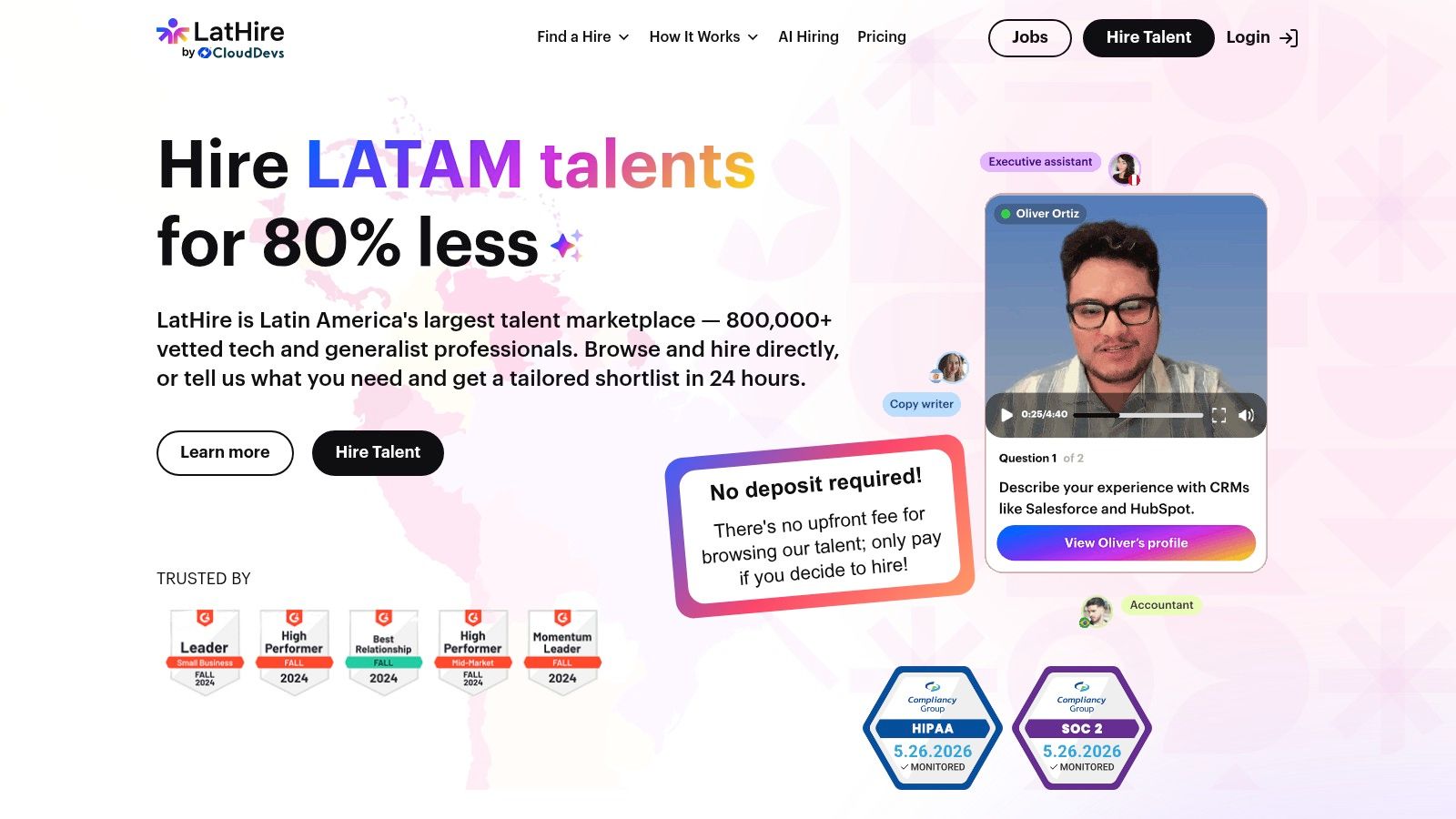
The practice supplies the role requirements, including English or Spanish communication needs, U.S. working-hour overlap, healthcare experience, and the boundaries around patient information. LatHire's matching process produces candidates for review, while the practice still conducts interviews and validates whether the person can follow its specific scripts, EHR procedures, and escalation rules.
The operational advantage is consolidation. HR support, international payroll, benefits, and legal-compliance administration sit alongside the recruiting workflow rather than being assembled from unrelated vendors. LatHire also states that its process can reduce hiring costs by up to 80% and time-to-hire by over 80%. Treat those as stated platform outcomes, not guaranteed results. Ask how the vendor calculates them, what fees are included, and which responsibilities remain with your practice.
The fit is narrower than a sales page may suggest. A platform focused on LATAM talent can suit U.S. and Canadian organizations hiring remote technology, marketing, sales, operations, and administrative professionals. It isn't a substitute for a locally licensed clinician, a role requiring physical presence, or a practice that only wants in-market hiring. You should also confirm exactly who signs the contract, who controls PHI access, and what happens if the worker changes country.
HHS requires written satisfactory assurances when a business associate handles PHI. A business associate agreement must define permitted uses, safeguards, breach reporting, and other duties. A BAA doesn't make an unsafe workflow compliant, so the practice must still limit access to the minimum necessary information and approve the tools the worker uses.
Take this checklist into the vendor meeting. Require a yes-or-no answer first, then ask for a demonstration or contract clause that supports it.
Use this framework to compare vendors on evidence rather than feature count. For practices considering LATAM talent, LatHire's remote hiring platform is one option to evaluate against these questions, especially if you want sourcing, hiring administration, and international support in one workflow.
A remote hiring platform is valuable when it connects recruiting decisions to the operational work that follows. For a medical practice, that means role boundaries, structured assessments, location-aware classification, payroll administration, controlled access to PHI, and a documented offboarding process.
Don't choose a vendor because it has the largest talent pool or the smoothest demo. Ask what happens on day 90, when a worker changes location, a patient message is mishandled, payroll needs correction, or an assessment produces an implausibly strong result. Those answers tell you whether the platform can support a real practice.
If you're hiring remote Latin American healthcare support, start with one clearly defined role and run the checklist against the vendor's live workflow, contract, classification process, and privacy controls. Contact LatHire to review candidate availability and determine whether its hiring, payroll, and compliance workflow fits your practice.