
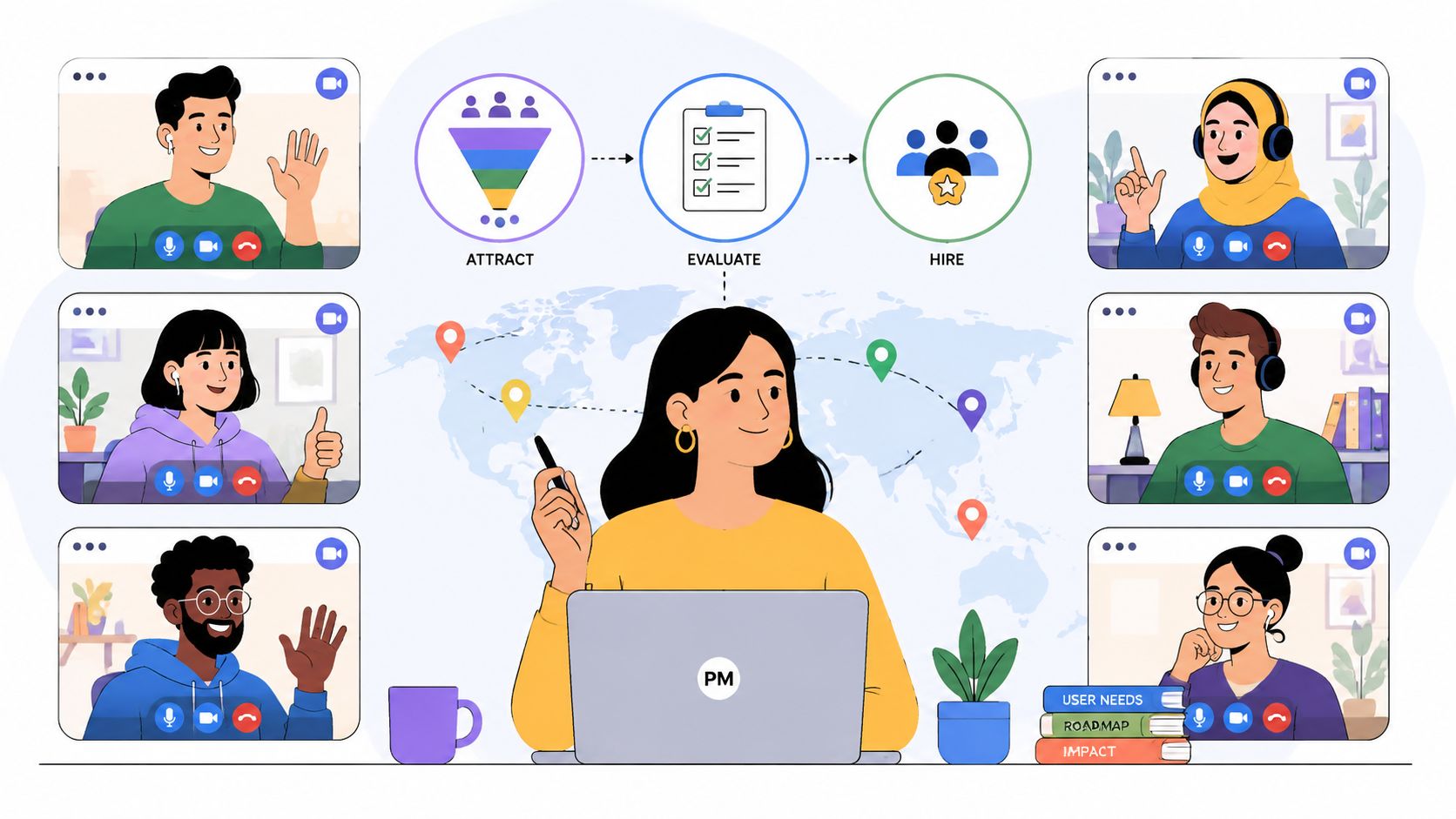
“Hire the best PM you can find” is popular advice. It's also incomplete enough to wreck a hiring plan.
Product manager recruitment isn't a numbers game. A large applicant pool doesn't compensate for a vague role, a theatrical interview loop, or a hiring team that can't agree on what the PM must accomplish. The market makes that problem sharper. One independent review counted more than 2.6 million people listing Product Manager as their title on LinkedIn, while global open roles generally moved between about 20,000 and 26,000, landing near 23,000 in April 2025. The market review makes the mismatch plain: plenty of people identify as PMs, but relatively few have the exact operating experience your business needs.
Remote hiring adds another trap. A senior PM in New York, a product operator in Mexico City, and an AI-fluent PM in São Paulo may all use similar language on their résumés. Their ability to work across time zones, translate technical uncertainty, and make decisions without constant supervision can be radically different.
The answer isn't another résumé filter. It's a precision funnel built around the work, not the title.
Most PM hiring processes fail before the first candidate applies. The job description says “own the roadmap,” “work cross-functionally,” and “thrive in a fast-paced environment.” That wording attracts nearly anyone who has attended a sprint planning meeting, then forces your team to excavate the actual requirements during interviews.
That's backwards. Define the operating context first, then invite candidates into it.
A product manager recruitment process should answer practical questions before sourcing begins:
The talent pool is broad, but the vacancy is narrow. The same market review reported roughly 4,200 openings across the European Economic Area and about 1,200 in the UK, figures that show why generic inbound sourcing creates noise rather than value. The European PM market analysis also illustrates the practical issue for startups: a recognizable title doesn't tell you whether someone can operate at your company's level of ambiguity.
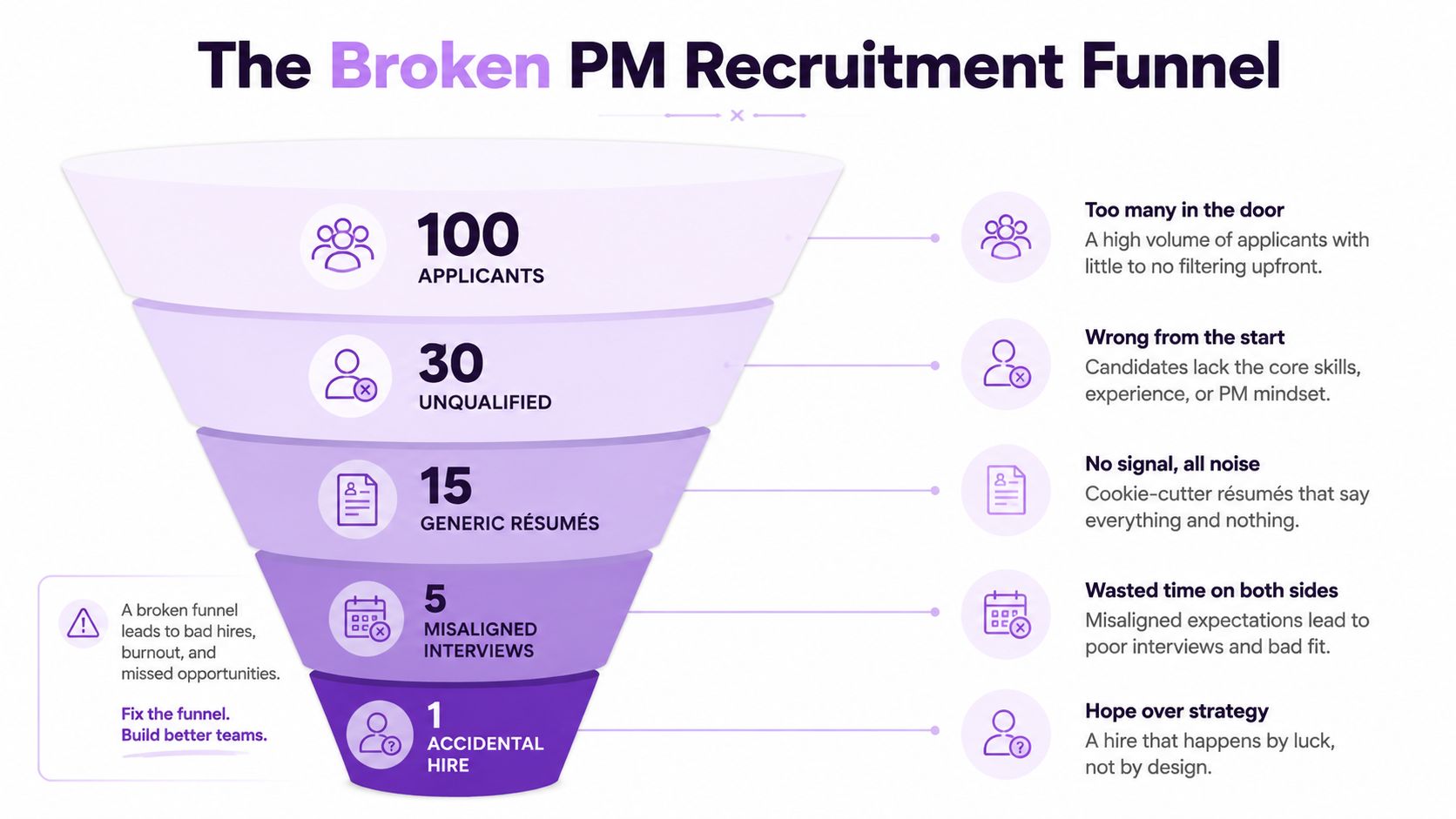
Teams regularly mistake interview fluency for operating ability. A candidate gives crisp answers, names the right frameworks, and turns every question into a tidy prioritization matrix. Then they join, encounter conflicting stakeholder demands, and wait for someone else to define the problem.
The halo effect makes this worse. Charisma, brand-name employers, and confident language can overpower evidence of actual product judgment. Expert guidance on hiring PMs warns specifically against confusing people who are good at interviewing with people who are good at doing the job. This product hiring analysis advocates testing problem definition, assumptions, users, and outcomes instead of rewarding presentation polish.
Practical rule: Never score a candidate on confidence until you've scored the quality of their decisions.
Before interviews, prepare for the human side of the process as well. Candidates will ask about reporting lines, decision-making, expectations, and team friction, so hiring managers should prepare for HR conversations rather than improvise answers halfway through the loop.
The best PM funnel narrows around relevant judgment, not résumé volume. That means the next filter must be the job description itself.
A strong PM job description should make some qualified people opt out. That sounds counterintuitive until you remember the alternative: hundreds of applicants who recognize the title but not the work.
Start with the problem. Don't write “seeking a rockstar product manager to drive innovation.” Write what's broken, who experiences it, and what this hire controls. A senior PM should understand the operating terrain before applying.
Weak version:
We're looking for a proactive Product Manager to own the roadmap, collaborate with engineering and design, and deliver delightful customer experiences.
Stronger version:
You'll own the workflow that helps distributed customer-support teams resolve complex cases. You'll partner with engineering, design, data, and operations to prioritize improvements, define outcome metrics, and decide where automation should stop and human review should begin. The role is AI-heavy, so you'll need to evaluate uncertain outputs, explain trade-offs to non-technical stakeholders, and monitor quality after launch.
The second version does more than sound specific. It tells candidates whether they've done this work before.
Your posting should name the product context, the users, the decisions, and the relationships. If the role is platform-focused, say so. If it's growth-focused, identify the funnel or adoption problem. If it involves AI, describe the applied fluency required, including model limitations, data readiness, evaluation, and responsible use.
Use this structure and edit it until every sentence earns its place:
A candidate shouldn't need to reverse-engineer whether the role is strategic or clerical. That's how you accidentally hire a roadmap coordinator and blame them for lacking product leadership.
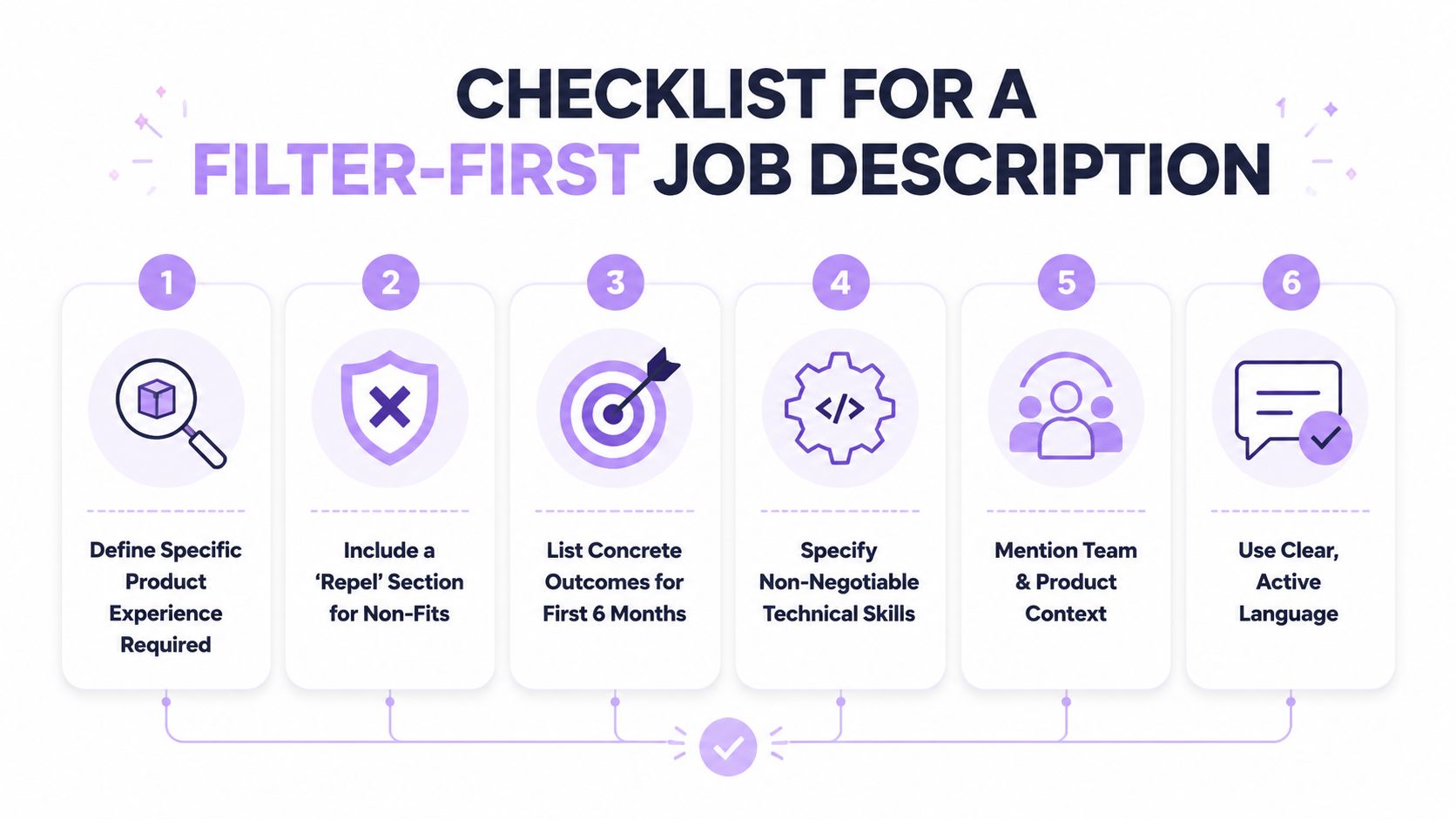
Use this job description creation guide as a practical audit before publishing. Then ask three internal reviewers to highlight the sentence that explains the role's hardest decision. If each person highlights a different sentence, your brief isn't ready.
Senior PMs rarely need another generic job alert. They need a credible reason to consider a move, a role with real authority, and enough context to decide whether your company is worth their attention.
That makes sourcing a channel strategy, not a posting strategy.
LinkedIn and Indeed still have a place. They're useful when you need visibility, a broad market test, or candidates actively searching. They're poor substitutes for targeted outreach when the role requires senior judgment, AI fluency, or experience working across borders.
| Channel | What it does well | Where it breaks | Best use |
|---|---|---|---|
| LinkedIn job post | Creates broad visibility and supports direct outreach | Produces substantial title-based noise | Market awareness and targeted searches |
| Indeed | Reaches active applicants across a wide market | Offers limited signal for senior product judgment | General pipeline building |
| Employee referrals | Transfers trust and context | Depends on the diversity and reach of your network | Hard-to-find operators with relevant backgrounds |
| Niche PM communities | Reaches people discussing real product problems | Requires thoughtful participation and a credible role story | Senior, specialized, remote talent |
The market is recovering, but it's selective. One 2026 hiring report counted 66,026 unique Product Manager postings in the prior 90 days, with an average of 4,738 new listings per week. The United States led with 25,621 openings, followed by India with 5,529 and the United Kingdom with 5,203. The reported hiring distribution shows why a single geography or job board can distort your view of available talent.
For US and Canadian companies, Latin American hiring can provide practical overlap with North American working hours and access to professionals who already operate in English-speaking product environments. The advantage isn't “cheap labor.” That framing attracts the wrong relationship and usually produces the wrong expectations.
The better argument is nearshore operating fit. A senior PM who can join the same planning window, respond during overlapping hours, and work directly with engineering and design may create more value than a supposedly perfect candidate separated by a difficult schedule.
Build a sourcing mix around the role:
Don't ask which channel delivers the most applicants. Ask which channel delivers candidates who can make the decision your business needs.
A PM interview should resemble the job closely enough to expose judgment. If the candidate will narrow messy problems, negotiate trade-offs, and align technical and commercial stakeholders, your loop must test those behaviors directly.
A practical structure has four stages: recruiter screen, hiring manager deep dive, a full-day interview with a project and three to six one-to-one interviews, then a panel discussion where interviewers cast blind votes before references and an offer. Lenny's interview process describes this kind of staged approach, which is far more useful than stacking unconnected conversations.
The recruiter screen confirms motivation, communication, location, availability, and basic scope alignment. It shouldn't become a surprise product case. The hiring manager then examines the candidate's operating history:
Listen for ownership and reasoning. Senior candidates don't need every launch to be a triumph. They need to show how they made calls with incomplete information and corrected course when reality disagreed.
For AI-heavy roles, add questions about data readiness, model behavior, evaluation, monitoring, and human oversight. Generic PM advice misses this distinction. Recent coverage reports that AI PM searches grew 41% year over year and that AI PM roles can command a 15% to 30% salary premium, while also noting that AI-native startups and developer-tools companies are driving much of the demand. The 2026 AI PM hiring report supports a sharper screen for applied AI fluency rather than a résumé keyword hunt.
Give candidates a real product case, but don't reward the fastest solution. Ask them to:
A useful rubric scores problem framing, prioritization, evidence quality, metrics discipline, technical judgment, and stakeholder communication. Score each area independently. A dazzling presentation shouldn't erase weak assumptions.
For cross-functional assessment, run a role-play. Give the candidate a stakeholder who wants an AI feature launched immediately, while engineering flags unreliable outputs. Strong PMs don't hide behind process. They clarify the risk, propose a decision path, and explain what evidence would change the recommendation.
Companies such as Amazon and Atlassian offer helpful structural examples. Amazon describes an application, possible technical phone screening, a possible second screening, a writing assessment two days before the loop, and outcomes returned within five business days. Amazon's PM interview preparation page documents that flow. Atlassian describes a panel after the hiring-manager conversation, with exactly three product-management interviews and one values interview. Atlassian's product manager handbook shows how explicit structure can reduce interviewer improvisation.
Use competency-based interviewing to keep the rubric tied to job behavior, then collect blind votes such as Strong No, No, Yes, and Strong Yes before discussion. Independent guides commonly place major-tech PM processes at roughly three to six weeks from recruiter screen to final decision, with one recruiter screen, one product-sense or hiring-manager screen, and four to seven onsite interviews. This interview guide provides that benchmark.
Compensation negotiations go badly when companies price the title instead of the scope. “Product Manager” can mean backlog ownership, platform strategy, AI product leadership, or company-level product direction. Those are different jobs, and the offer needs to reflect the one you're hiring for.
AI changes the equation further. A candidate who can translate model constraints into product decisions is competing in a narrower market than a generalist PM. The relevant benchmark from recent coverage is a 15% to 30% premium for AI PM roles, not a universal rule for every AI-adjacent title. The AI hiring report connects that premium to the specialized demand.
| Role Level | Base Salary (US) | AI Premium | LatAm Equivalent |
|---|---|---|---|
| Mid-level PM | Benchmark by role scope and market | 15% to 30% where the role requires applied AI fluency | Benchmark locally, based on scope, seniority, and scarcity |
| Senior PM | Benchmark by ownership, complexity, and leadership expectations | 15% to 30% where AI expertise is central to the role | Benchmark locally, with time-zone overlap and operating scope included |
| Head of Product, VP, or CPO | Benchmark as an executive search, not a generic PM hire | Apply only when AI leadership is a core requirement | Benchmark against leadership scope and cross-border employment structure |
I won't invent a salary table just to make the spreadsheet look authoritative. The provided evidence supports premiums and scope-based benchmarking, not a universal US base or LatAm equivalent.
Share the compensation philosophy early. Explain what determines base pay, how equity or bonuses fit, and which benefits are available. If a candidate says they have another offer, don't panic and start mortgaging the office ping-pong table. Ask what they value, what decision criteria they're using, and whether your role still solves the problem that motivated them to interview.
A useful response is:
“Thanks for being transparent. We won't manufacture urgency or bid blindly. Tell us which parts of the offer matter most, and we'll explain what we can change and what we can't.”
For cross-border candidates, discuss payment, benefits, working hours, holidays, and legal employment structure before the final signature. A lower nominal cost doesn't make a weak offer competitive, and a higher offer won't rescue a role with vague authority.
The signed offer is not the finish line. It's the moment your company inherits a new execution risk: the PM can either become useful quickly or spend weeks decoding org charts, permissions, and contradictory priorities.
Make the first week operational.
Confirm the employment or contractor structure, payroll path, benefits, equipment, access permissions, and working-hour expectations. Cross-border hiring creates administrative work around local compliance and payment, so assign one owner instead of making the new PM chase finance, HR, and IT separately.
Send a concise onboarding packet:
Week one should produce relationships and context. Introduce the PM to engineering, design, data, sales, support, and the executive sponsor. Give them access to customer evidence and invite them into existing planning conversations without forcing premature opinions.
By the second phase, ask for a written problem brief. It should identify the user, evidence, assumptions, constraints, possible outcomes, and unresolved questions. Don't ask for a roadmap masterpiece. Ask for a sharper view of reality.
By day thirty, the PM should own a decision or discovery track with visible stakeholders. That could mean narrowing an AI use case, clarifying a platform dependency, or resolving a customer workflow problem. The win is not shipping something recklessly. The win is creating shared understanding and moving a consequential decision forward.
For companies hiring across Latin America, a provider such as LatHire can combine pre-vetted candidate matching with support for HR, international payroll, benefits, and legal compliance. Use that kind of platform to remove administrative drag, not to outsource your judgment about the role.
A good hire should feel like an insider by the end of the first month. If they're still asking where the bathrooms are, your onboarding is the problem.
Build your next product manager recruitment process around one clearly defined role, a work-sample interview, a blind scoring panel, and a compensation plan that reflects real scope. If you're hiring remotely across the Americas, write the operating context into the job description, source beyond generic job boards, and prepare compliance and onboarding before the offer is signed. That's how you find a PM who can make decisions, not just survive interviews.