

You've hired a “contractor” to help with one project. Six months later, they work full-time hours, attend every team meeting, follow one manager's roadmap, and can't realistically take another client. Congratulations, you may have built an employee relationship with contractor paperwork taped over it.
That's where smart outsourcing starts. Not with a cheap rate or a polished profile, but with clear scope, the right engagement model, measurable deliverables, and disciplined management. An outsourced employee can give your company specialist capability, broader coverage, and faster access to talent. They can also create tax, benefits, intellectual property, and co-employment headaches if you treat legal structure as an afterthought.
The playbook below is practical by design. It shows how to define the role, choose the model, vet the person, onboard them properly, manage the work across distance, and recognize when outsourcing has stopped making sense.
Many teams get outsourcing wrong at the same moment: the job description is vague, the classification is casual, and everyone assumes the contract will sort out reality later. It won't. If a worker performs a narrowly defined project with meaningful independence, that looks different from someone embedded in your daily operation, working your hours, using your systems, and taking direction from your managers.
An outsourced employee is a worker engaged through a third-party provider, an Employer of Record, a staffing agency, or an independent contractor agreement while your company directs some or all of the work. They're not necessarily a freelancer taking isolated assignments, and they aren't automatically a member of your directly employed staff. The label matters less than the facts of the relationship.
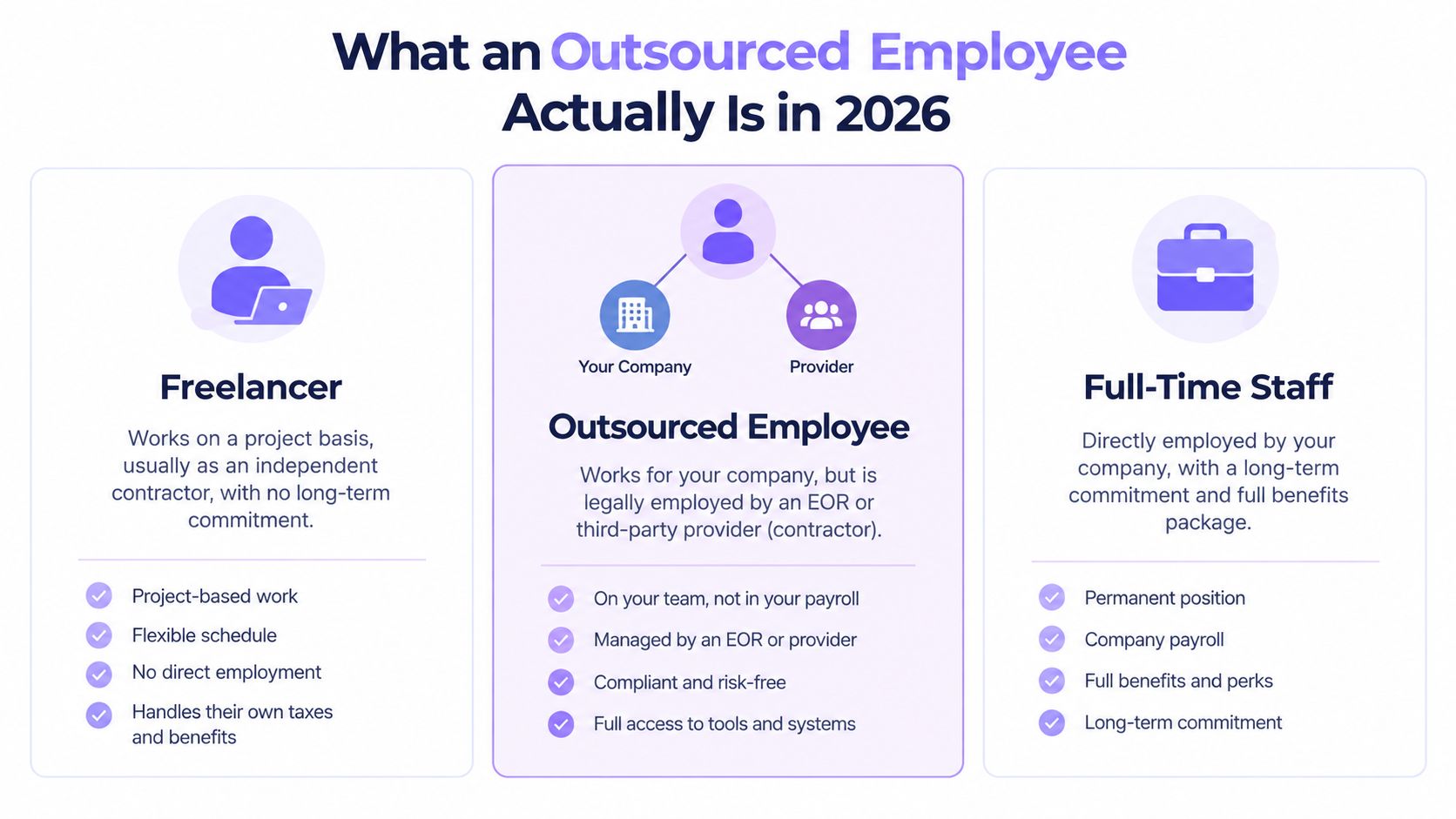
The labor market has used intermediaries for years. The International Labour Organization's discussion paper describes more than 4 million people employed by temporary work agencies every day in EU member states, about 2% of total employment, and records an increase from around 4.5 million temporary agency workers in 1997 to 9.5 million in 2007 across major economies. Remote platforms, global agencies, and EOR arrangements have made the boundaries easier to blur, not easier to ignore.
Use these signals before you approve an agreement:
A worker can be remote and still look like an employee under local rules. The U.S. Department of Labor says employers are responsible for determining whether a worker is an employee under the Fair Labor Standards Act, and misclassification can deprive workers of minimum wage and overtime protections. The Department of Labor's classification guidance is a useful reminder that calling someone a contractor doesn't transfer responsibility.
For a broader view of how distributed work is evolving, read Tandem Space workforce report from Tandem Space, Inc.. Then compare your operating needs with why companies choose to outsource. The useful question isn't “Can I call this person a contractor?” It's “Does the structure match the work we're asking them to do?”
There are three practical routes most companies use when they engage an outsourced employee: independent contractor, staffing agency, and Employer of Record. Each gives you a different mix of speed, control, paperwork, and exposure. Picking one because it's familiar is how founders end up paying for a model that never fit.
| Model | Legal Risk to You | Time to Start | Control Over Work | IP Clarity | Best Fit |
|---|---|---|---|---|---|
| Independent contractor | High classification responsibility | Often fast | High day-to-day influence, which can increase risk | Must be written carefully | Defined deliverables and genuinely independent work |
| Staffing agency placement | Shared or co-employment exposure | Fast to moderate | High operational control | Usually handled through agency terms and client agreement | Temporary capacity and agency-managed employment |
| Employer of Record | Provider carries much of the employment administration, but the client still controls the work | Moderate | High practical control, within agreed boundaries | Requires explicit assignment language | Longer international engagements and local employment compliance |
This model works when the worker controls how they deliver the result and the engagement has a credible business scope. It becomes fragile when you dictate hours, methods, exclusivity, reporting lines, and internal routines while keeping contractor paperwork for convenience.
The U.S. Government Accountability Office notes that misclassified workers may lose protections and benefits while employers may fail to pay taxes they owe. A state-level audit-based study cited in the compliance tracker estimated average misclassification prevalence at 1.3% of worker hours from 2013 through 2017. That figure isn't a permission slip. It's a warning that the issue is material even when it isn't universal. Review the outsourcing and remote talent compliance tracker before using this model across borders.
A staffing agency can move quickly, handle payroll, and supply workers for temporary or specialized capacity. You'll still direct daily work, though, which creates a practical risk of shared responsibility. Your agreement should define supervision, safety, performance management, replacement rights, confidentiality, and who handles disputes.
An EOR becomes the legal employer in the worker's country and generally manages employment contracts, payroll, benefits, and local compliance. You still manage the work, but you give up some flexibility around employment terms, termination, and local processes. That trade is usually worthwhile when the engagement is long, cross-border, or too important to leave to improvised paperwork.
The rule is simple: the longer and deeper the relationship, the more the model should insulate you, not merely simplify hiring. For a closer look at how this differs from other capacity models, review staff augmentation versus consulting.
A polished résumé is a weak hiring signal. I'd rather see how someone handles an ambiguous deliverable, writes an update when a deadline slips, and reacts to feedback on imperfect work. Your vetting process should test those behaviors before the person becomes embedded in the team.
Write the role around outputs, not titles. “Senior developer” tells you almost nothing. “Own the API integration, document the handoff, and deliver a tested release candidate” gives the candidate and your team something concrete to evaluate.
Include:
Then use a paid skills test lasting 3 to 5 hours. Keep it tied to one real backlog problem, remove confidential information, and score it with a rubric. Test the thinking, not the candidate's willingness to perform free labor. A developer might review a flawed pull request. A marketer might outline a launch brief. A designer might improve one existing screen and explain the trade-offs.
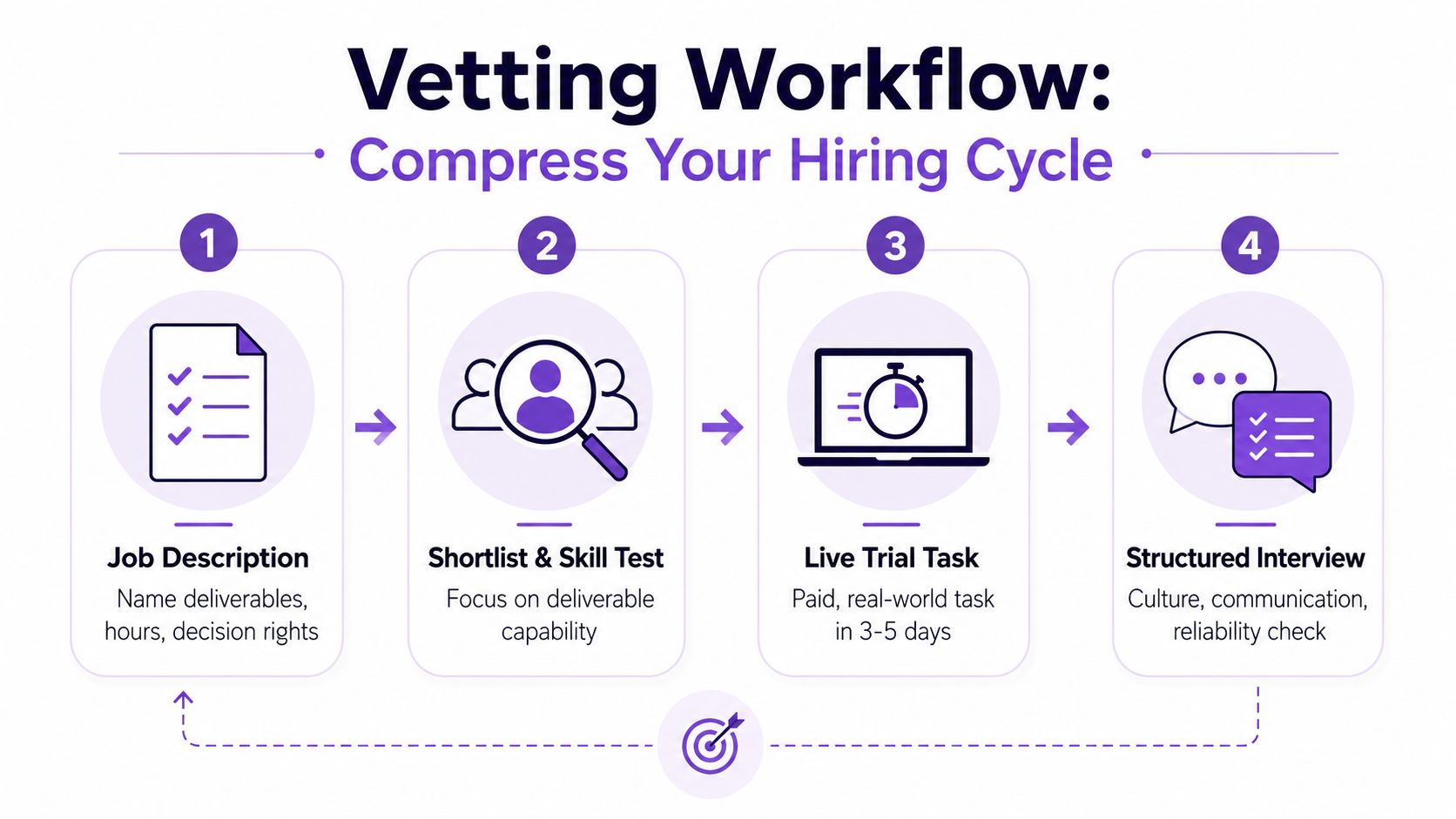
Run a structured async interview. Ask the same core questions, request a short written response, and probe scenarios such as:
Use pre-employment skills testing as one part of the process, not as a substitute for judgment. A test can show capability. It can't tell you whether the person will surface risk early or disappear behind a green status icon.
Reference checks should ask former managers about reliability, ownership, and response to missed commitments. “Were they technically strong?” produces polite noise. “What happened when the work went off plan?” produces signal.
Finally, run a paid 2-to-4-week trial engagement with written success criteria and a mutual exit clause. The trial should end with a decision, not drift into permanent ambiguity. If the person performs, you have evidence. If they don't, you can exit before your roadmap starts depending on them.
Most outsourced engagements don't fail because the worker lacks talent. They fail because the company gives them access to Slack, a calendar full of meetings, and a cheerful “shout if you need anything.” That isn't onboarding. That's abandonment with emojis.
The first month should answer four questions: What am I responsible for? Who can unblock me? What does good work look like here? How will we decide whether this engagement continues?
Day 1 needs a written brief. Include the role scope, first deliverable, tools, access permissions, security expectations, working overlap, escalation path, and one named point of contact. Don't make the new hire hunt through old documents for basic context.
Week 1 should produce a shadow task. The outsourced employee reviews an existing process, fixes a small issue, or documents a workflow. The team reviews the output together, which exposes gaps in both the person's understanding and your documentation.
Week 2 moves into a paired project. The outsourced employee owns a defined slice, while a senior reviewer stays close enough to catch expensive misunderstandings early. Ownership matters. If the person only observes, you won't learn how they operate under real responsibility.
Day 30 ends with a written retro. Score ramp speed, communication, output quality, and scope judgment against the original brief. Keep the review factual. “Good culture fit” isn't a useful operating measure.
Use a daily 15-minute check-in during the first week, then taper it to weekly once the worker can use the system independently. The check-in should cover progress, blockers, decisions needed, and the next committed output. It shouldn't become a surveillance ritual.
Require documentation in a shared workspace. That includes decisions, process notes, links to deliverables, open questions, and handoff instructions. Before the engagement begins, verify classification paperwork, IP assignment, equipment provisioning, security access, and offboarding permissions.
Practical rule: If the worker can't explain the role, the first deliverable, and the escalation path after onboarding, your onboarding failed before their work did.
I've seen distributed teams make the same hire produce two completely different outcomes. The difference wasn't the résumé. It was the operating rhythm.
In one four-person engineering pod spread across three time zones, the team used async standups, a shared Loom channel for design reviews, and a weekly written retro. The outsourced engineer shipped a feature in three weeks and stayed for eighteen months. Nobody needed to be online at the same time for every decision because the work stayed visible.
Another pod used ad hoc Slack pings and overlapping Zoom calls at 6 a.m. The outsourced engineer felt invisible, missed two deadlines, and quit in week six. The company called it a motivation problem. It was a management design problem wearing a motivation costume.
Use a written-first operating model:
Tool choice matters less than consistency. Linear, Jira, Asana, Notion, Slack, and Loom can all work if the team agrees where work belongs. The person managing the outsourced employee should model the behavior. If the manager sends critical instructions through scattered messages, the worker will spend their day reconstructing context instead of delivering output.
A strong HR advisory for executive teams can help leadership teams design responsibility boundaries, but no advisor can rescue a team that refuses to document decisions.
Respect shows up operationally. Give people reasonable overlap, notice before changing priorities, feedback tied to observable work, and enough context to make decisions without begging for permission. Productivity improves when accountability is clear, not when everyone is forced into the same meeting at an absurd hour.
Outsourcing isn't automatically cheaper. Sometimes it's just a faster way to buy the wrong capability, create a classification problem, or postpone a hiring decision you already know you need to make.
The comparison is the cost of the operating model. A misclassified contractor can create exposure for back taxes, penalties, benefits, and legal fees. The IRS makes the point plainly: outsourcing payroll doesn't outsource the employer's liability for withholding and paying employment taxes, except in qualifying arrangements involving a Certified Professional Employer Organization. Read the IRS guidance on payroll outsourcing and third-party payers before assuming a vendor has absorbed the headache.
A bad full-time hire can also drain momentum, consume management attention, and burn months of runway before anyone admits the fit is wrong. “Local” doesn't mean “safe.” It means you've chosen a different risk profile.
| Scenario | Better Choice | Why | Warning Sign You Picked Wrong |
|---|---|---|---|
| A project has a clear end date | Outsourced employee | You can match capacity to a defined outcome | The roadmap keeps extending the work indefinitely |
| You need a specialist for a limited initiative | Outsourced employee | You access expertise without pretending the role is permanent | The specialist becomes the only person who understands a core system |
| Customers need coverage across time zones | Outsourced employee | Distributed coverage can extend operational availability | Handoffs create unresolved ownership gaps |
| Work can be measured through deliverables | Outsourced employee | Output gives both sides a clear accountability line | Managers begin tracking every minute and method |
| Someone owns an ongoing product roadmap | Local hire | Institutional context and durable ownership compound over time | The outsourced worker is already treated as a department leader |
| The role handles sensitive, continuous compliance work | Local hire or properly structured EOR | The company needs durable accountability and clear employment treatment | The team relies on contractor paperwork for employee-like control |
Country-specific rules can change the answer quickly. In Mexico, outsourced work must be specialized, cannot cover all workplace activities, and cannot duplicate tasks already performed by the company's own workforce. If those conditions aren't met, the customer can be treated as a co-employer and face liabilities involving salaries, social security, benefits, and the requirement to distribute 10% of annual taxable income to employees, as described in this Mexico outsourcing legal checklist.
China draws another hard boundary. Temporary staffing is limited to temporary, auxiliary, or substitute positions, and temporary workers cannot exceed 10% of the employer's total workforce, according to this China staffing and outsourcing explanation. A contract called outsourcing can still be treated as staffing if the facts say otherwise.
Outsource when the role is bounded, the output is visible, and the engagement structure matches local law. Hire locally when the work owns your future.
Use this decision rule before anyone says, “Just hire a freelancer.”
Outsource a defined role only when the scope is clear, classification risk is controlled, and the work doesn't require deep institutional context that the worker can't reasonably build.
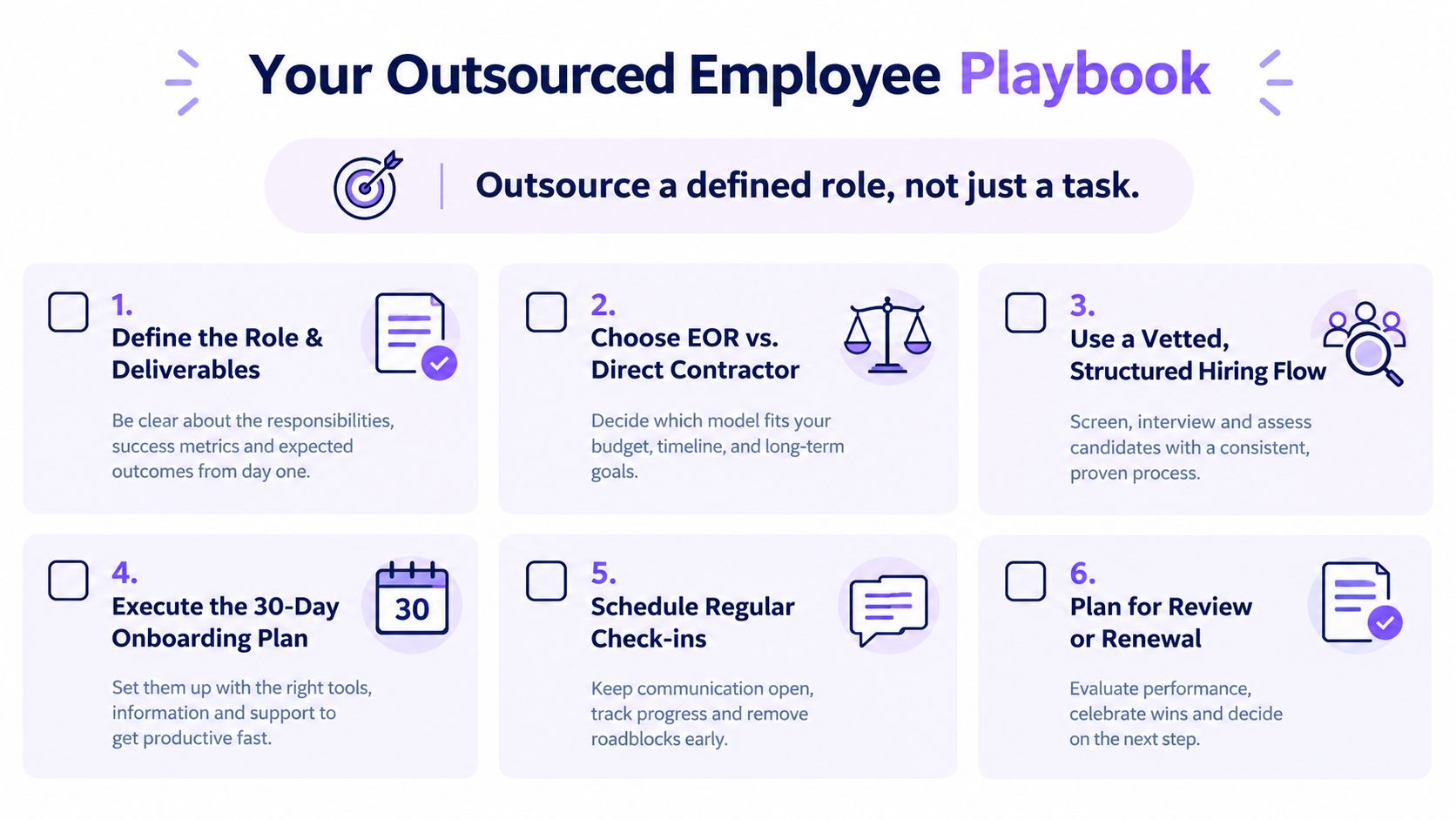
There are three escape hatches. Convert to full-time employment when the person owns an enduring roadmap, holds essential institutional knowledge, or the role has become employee-like in control and dependency. Fire fast when the worker hides missed deadlines, ignores agreed communication, or repeatedly produces work below the written standard. Walk away from outsourcing entirely when local law, data sensitivity, or operational dependency makes the model more complicated than a direct hire.
For teams hiring across Latin America, LatHire is one option that combines candidate matching with pre-vetting, international payroll, benefits, and legal compliance support. Treat it as infrastructure, not magic. You still need to define the role and manage the work well.
Run this checklist before your next outsourced employee starts. If any box stays unchecked, pause the hire, fix the operating model, and only then put the person on your roadmap.
If you're hiring a remote developer, marketer, designer, sales specialist, or operations teammate, start with the role definition rather than the résumé. Write the deliverables, choose the engagement model, and use a paid trial to test the work. Then bring in legal or payroll support before the relationship becomes too integrated to unwind cleanly.