

The release is “finished.” The team is exhausted. Then someone finds a broken payment path, a permission leak, or a mobile layout that collapses like a cheap camping chair. The product may have passed a collection of tests, but nobody can confidently say it's ready for real users.
That's the problem with treating outsourced quality assurance services as a rented pile of test cases. You don't need more green checkmarks. You need a quality operating model with clear ownership, useful evidence, and enough independence to challenge a release before customers do.
The market reflects that shift. One 2026 forecast estimates outsourced software testing will reach USD 58.44 billion in 2026 and USD 176.99 billion by 2035, representing a 13.1% CAGR (Business Research Insights). Another estimate projects growth from USD 61.12 billion in 2025 to USD 122.36 billion by 2030, with North America identified as the largest region in 2025 (Global Growth Insights). This isn't a niche trick for teams trying to avoid hiring. It's a serious delivery model.
A vendor joins the kickoff call, opens the backlog, and asks what should be tested. The answer cannot be “the app.” That phrase hides every decision that will later become a delay, dispute, or missed defect.
Before outsourcing quality assurance services, define the operating model. Specify the product area, target users, environments, integrations, failure conditions, and release blockers. If the provider receives only a staging URL, a backlog, and a polite request to “keep communication open,” you have not prepared a QA brief. You have handed over an escape room with production risk attached.
Start with risk, not test volume. A consumer SaaS product may prioritize permissions, billing, browser compatibility, and regression across high-use workflows. A fintech product needs tighter control over transaction integrity, audit evidence, data handling, and security review. A data-intensive platform needs confidence across pipelines, APIs, microservices, schemas, and data integrity. Identical test-case counts can represent very different levels of protection.
Your one-page brief should settle five practical questions:
The operating model has changed as testing has grown more complex and release cycles have shortened. Industry estimates associate outsourced QA demand with functional testing and automation, with automation expected to represent nearly 42% of outsourced testing projects and functional testing close to 38% of service demand by 2035 (Global Growth Insights).
Practical rule: Do not optimize for tester headcount. Optimize for risk removed per release.
| Decision Area | Questions to Settle | Evidence to Provide |
|---|---|---|
| Product risk | Which workflows could cause financial, legal, security, or reputational harm? | Risk register, user journeys, incident history |
| Release expectations | What must be tested before each release? | Release calendar, acceptance criteria, quality gates |
| Ownership | Who prioritizes defects and makes the release call? | Named owners and escalation paths |
| Environments | Which environments are available, and how closely do they match production? | Environment map, access rules, deployment notes |
| Test data | What data may the vendor use, and how is sensitive data protected? | Masking rules, synthetic-data policy, retention terms |
| Outcomes | How will the team prove quality improved? | Baselines, dashboards, defect reports, leakage tracking |
Settle the purchase category internally before comparing providers: are you buying execution capacity, specialist expertise, or a more capable quality function? These require different scopes, governance, and contracts. Confuse them, and the company can pay for a managed service while still directing every tester, defect, and deadline itself. That is an expensive way to retain the original problem.
Some QA work benefits from distance. Some work becomes dangerous when distance removes context.
Keep quality strategy, risk acceptance, release accountability, and sensitive security decisions close to the product owners. Those decisions depend on business priorities, customer impact, regulatory exposure, and institutional knowledge. A vendor can recommend that a payment flow is not ready. Someone inside the company still needs authority to accept or reject that risk.
Outsource work that's repeatable, specialist-heavy, or expensive to maintain intermittently. Functional regression, browser and device compatibility, load testing, test documentation, and automation maintenance often fit well. Share work where the vendor provides execution or expertise, while the internal team retains product context and final judgment.
A fintech team might outsource scalable regression and performance execution while keeping data-governance review, fraud-risk interpretation, and release approval internal. A healthcare company may bring in external accessibility or security specialists but retain ownership of patient-data handling and compliance evidence. A small SaaS company with no quality owner may need staff augmentation first, not a grand managed-service contract that promises to “transform quality” while nobody can answer basic product questions.
The work is not ready to outsource when requirements change daily, staging is unreliable, product ownership is unclear, or the vendor is expected to certify code it wasn't allowed to understand. Those aren't vendor problems. They're operating-model defects wearing a procurement badge.
| Keep Internal | Share With Vendor | Outsource |
|---|---|---|
| Product risk appetite | Test strategy and planning | Repeatable regression execution |
| Release accountability | Defect severity and triage | Browser and device compatibility |
| Sensitive security decisions | Automation architecture | Load and performance execution |
| Regulatory interpretation | Quality dashboards | Test documentation |
| Customer-impact trade-offs | Exploratory testing around risky features | Test-case maintenance |
| Business-domain knowledge | Release-readiness recommendation | Specialist testing with defined outputs |
The right model often leaves a small internal quality nucleus in place. That group owns product knowledge, standards, and decisions. The external team supplies execution capacity, independent challenge, and specialist capability.
If you're building a quality career around emerging products, it's also useful to find Web3 QA careers and study how companies describe testing responsibilities in blockchain environments. The domain is a good reminder that “functional testing” can hide very different risks when assets, transactions, and irreversible state changes are involved.
Keep the authority to accept risk internal. You can outsource testing activity, but outsourcing accountability without a named internal owner is just premium-priced confusion.
Engagement models determine who makes decisions, who performs the work, and who absorbs the consequences when a release slips. Treat the choice as an operating-model decision, not a procurement label.
A nearshore team provides closer working hours and easier real-time collaboration, with the provider often coordinating delivery. A remote project team shares responsibility for a defined workstream. Staff augmentation places individual specialists inside your team, while you retain prioritization, coaching, workflow, and outcome ownership. A managed QA service assigns the provider responsibility for an agreed testing function or result.
No model wins by default. The wrong choice leaves an expensive gap between the service described in the contract and the management work still sitting on your desk.
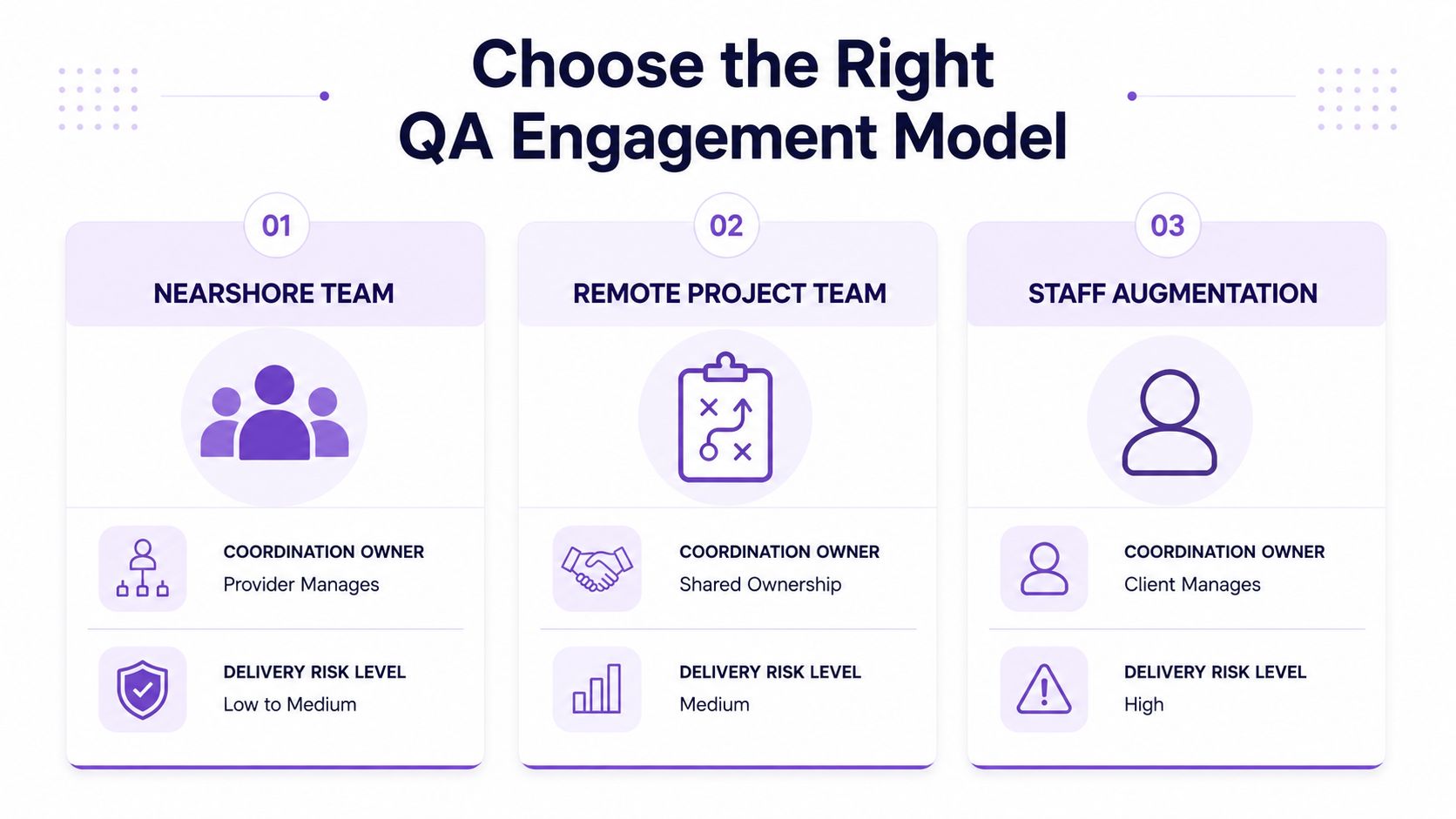
Choose staff augmentation when an internal QA or engineering lead can direct the work, the bottleneck is temporary, and the incoming specialists have clearly bounded tasks. The model is quick and flexible. Your team still carries coordination, requirement clarification, and severity decisions. Without internal capacity for those duties, augmentation adds people to an unmanaged queue.
Choose a managed service when testing needs repeat across products or releases and governance must stay consistent. The provider should own staffing, process execution, reporting, and agreed outcomes. Require that ownership in the contract. A managed-service fee should not buy a team that waits for your manager to assign every task.
Nearshore suits work where collaboration and time-zone overlap affect delivery. A remote project team fits a bounded launch, migration, or specialist testing effort. Ask who owns missed deadlines, controls the backlog, approves test completion, and handles changed requirements. Those answers expose the true model faster than a polished service description.
| Engagement Model | Buyer's Control | Best Fit | Main Trade-Off |
|---|---|---|---|
| Nearshore team | High operational access, with provider coordination | Agile delivery needing close collaboration | May cost more than distant delivery |
| Remote project team | Shared control around a defined scope | Launches, migrations, and bounded workstreams | Scope disputes can grow quickly |
| Staff augmentation | Client manages daily work | Temporary capacity or specialist gaps | High internal management burden |
| Managed QA service | Buyer governs outcomes, provider runs operations | Repeatable testing across products | Requires strong contracts and trust |
Before comparing prices, complete a decision worksheet covering product maturity, urgency, release cadence, domain risk, internal QA capability, time-zone needs, expected duration, and the person managing the relationship. Leave that final field blank and augmentation becomes another management job. That's quality engineering as an operating model, not a staffing arrangement.
Vendor selection should produce evidence, not applause for polished slides. Require anonymized examples of test strategies, defect reports, automation architecture, release-readiness summaries, and escalation records. Confidential client details can stay out. The useful question is whether the vendor communicates risk clearly after the screenshots disappear and the adjectives lose their job.
The sales lead may be charming. That person is not the deliverable.
Meet the proposed test lead and at least one engineer who will execute the work. Give them an incomplete product brief and ask them to identify missing risks. Request a smoke-test plan, a sample defect triage, and a clear explanation of where automation would help. A mature team asks questions before presenting a suspiciously polished answer.
Use a short, falsifiable assessment:
Treat claims of full automation coverage as a warning sign. Automation can pay off, but its value depends on the product, test design, maintenance burden, and release process. One survey reported median ROI of 52% for GUI automation, with observed results ranging from 0% to 300%, which makes a sales estimate a poor substitute for evidence (SAGE Journals).
| Evaluation Area | Evidence to Request | Scoring Question |
|---|---|---|
| Test strategy | Anonymized strategy or plan | Does it connect tests to product risk? |
| Defect management | Sample defect reports and triage notes | Can engineers reproduce and prioritize issues? |
| Automation | Framework overview and maintenance approach | Does the team understand stability and value? |
| Data handling | Access, masking, retention, and deletion procedures | Can they protect sensitive information? |
| Security | Control descriptions, audit arrangements, incident process | Are safeguards specific or decorative? |
| Continuity | Staffing plan and knowledge-transfer process | What happens when a key tester leaves? |
| Reporting | Dashboard or release-readiness example | Can leadership make a decision from it? |
| Proposed team | Interviews with actual delivery staff | Are these the people in the contract? |
Reference checks should focus on failure conditions. Ask what happened when scope changed, a defect escaped, or a proposed tester became unavailable. Review these vendor management best practices before signing, then record the answers in the evaluation. Choose a provider whose weaknesses are visible, priced into the operating model, and manageable through clear ownership.
A low hourly rate is meaningless if the vendor underestimates regression, lacks test-data access, or reports defects after the sprint has already ended.
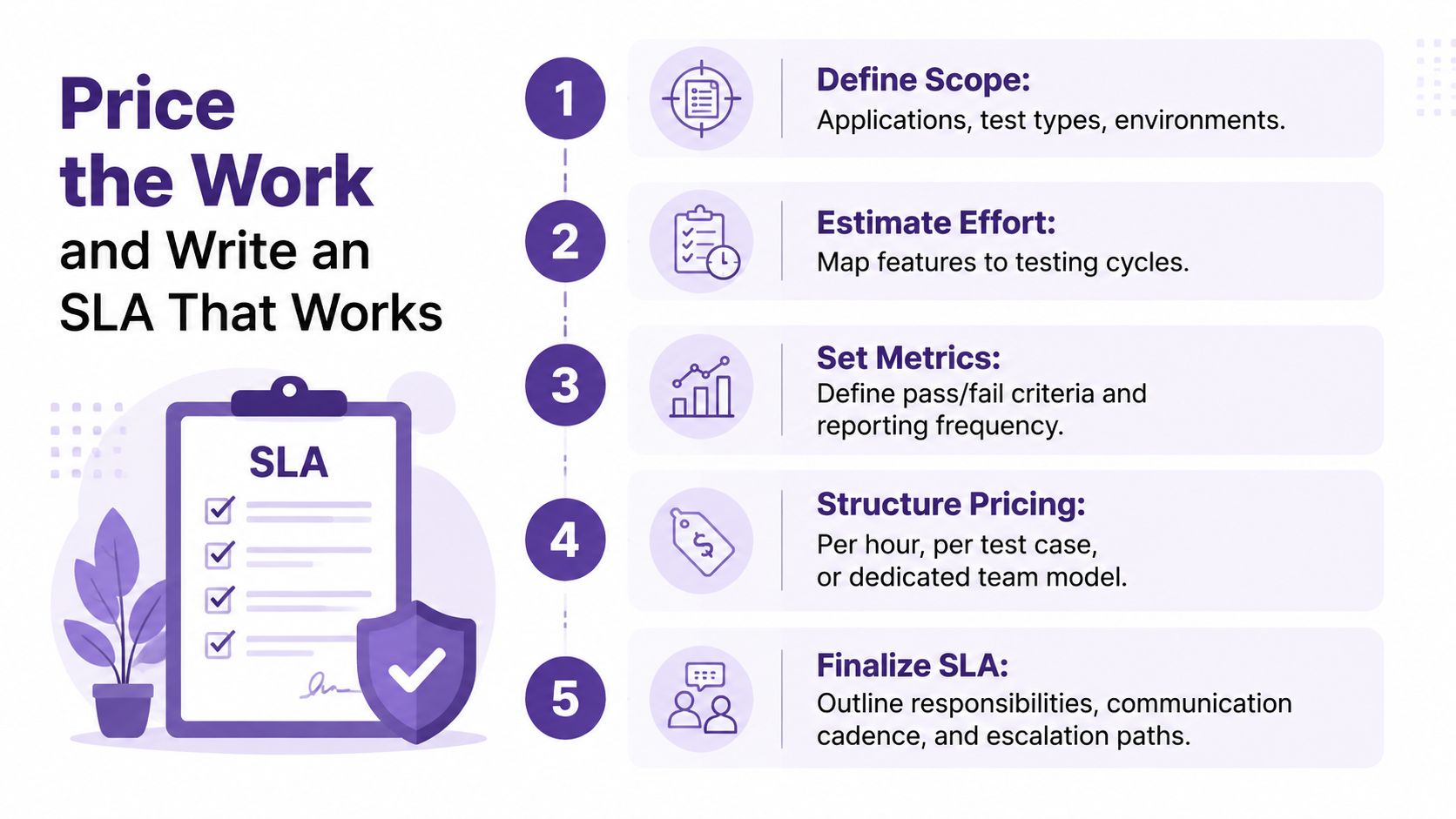
Price the actual system of work. Scope should account for applications, platforms, test types, environments, integrations, release frequency, automation expectations, documentation, and the access needed to investigate failures. A vendor testing one stable web flow is not doing the same job as a team covering mobile clients, APIs, microservices, cloud infrastructure, and regulated data.
| Commercial Structure | Best Use | Risk to Manage |
|---|---|---|
| Time and materials | Evolving scope and specialist work | Paying for activity without outcome evidence |
| Fixed price | Stable, bounded deliverables | Change requests and under-tested edge cases |
| Milestone-based | Projects with clear review points | Arguments over what “done” means |
| Managed service | Recurring QA operations | Weak metrics or vague accountability |
| Dedicated team | Ongoing capacity with close alignment | Client still carrying too much management |
Your SLA should define critical and major defects, response expectations, test execution, coverage, leakage, reporting, escalation, acceptance, and change control. It should also state that the buyer retains release authority. The vendor can recommend “go” or “no-go.” It shouldn't become the legal owner of your product decision.
A published 2026 QA outsourcing benchmark lists critical-defect response targets of 4 hours for standard service and 2 hours for premium service, major-defect targets of 8 hours and 4 hours, execution rates of 90%+ and 95%+ per sprint, defect leakage below 5% and 2%, and coverage targets of 70% to 80% and 85% to 95% (LinkedIn). Treat these as negotiation reference points, not universal truth. Your product risk should set the targets.
A useful SLA measures whether the team found and explained meaningful risk, not whether it produced a heroic number of test cases.
Add clauses for staffing changes, intellectual property, data protection, audit access, security incidents, service credits, subcontracting, knowledge transfer, and termination assistance. Service-level agreement guidance can help structure the commercial conversation, but don't let a template make decisions your product team hasn't made.
Onboarding starts before the first defect appears. If the vendor spends the opening week asking where requirements live, which environment is valid, and who may change severity, the operating model is already losing value.
Give the team enough context to make sound decisions, while limiting access to what the work requires. Product demos, architecture notes, user roles, release calendars, known risks, historical defects, and customer-impact priorities matter more than a giant folder of stale documents. The vendor should understand how the product fails, who feels the impact, and which decisions remain with your internal team.
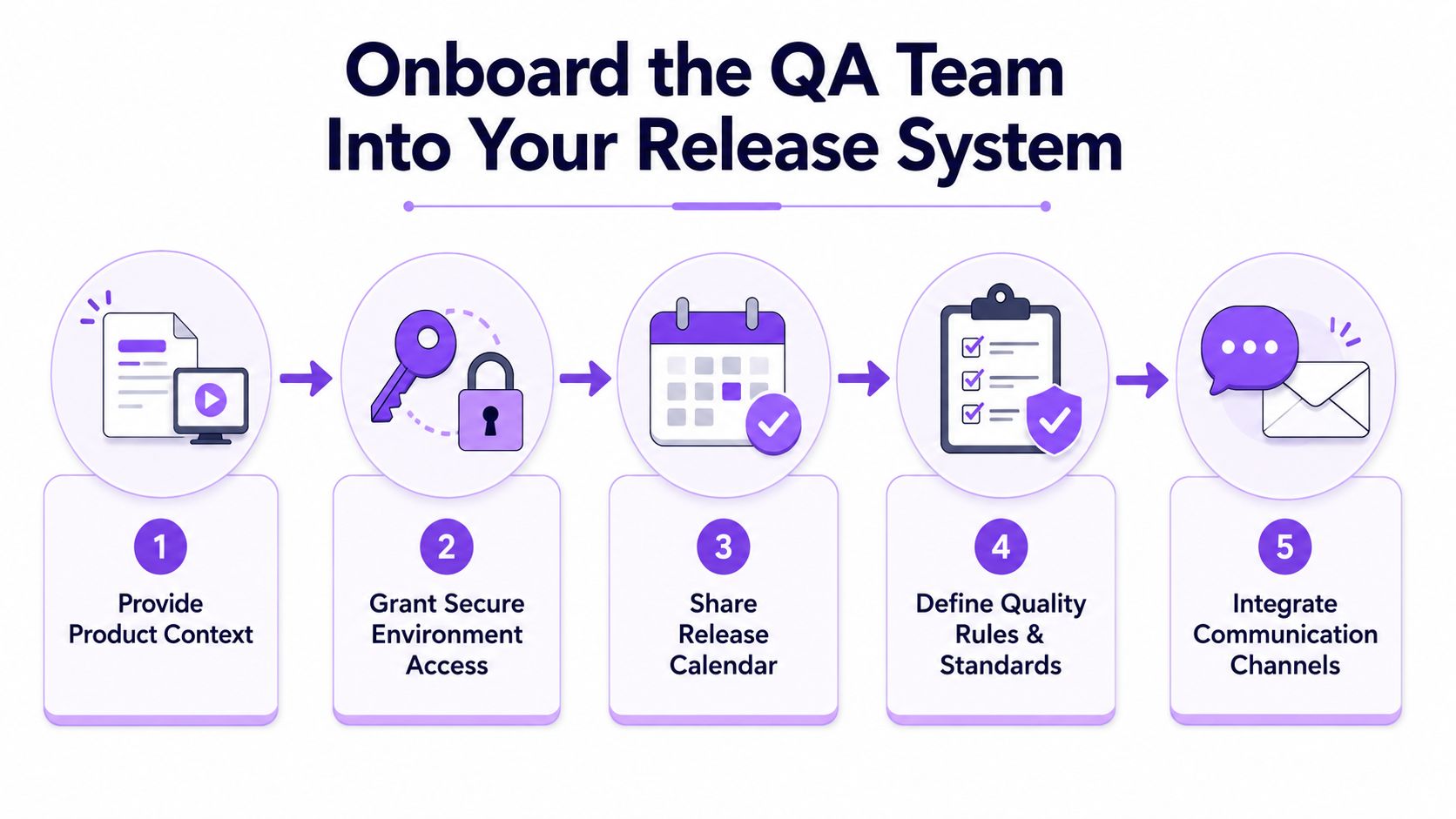
Put the outsourced team in the same issue tracker, CI pipeline, test-management system, and release rhythm as the internal team. Define the defect template, severity rules, evidence requirements, regression-entry criteria, and sign-off process before execution begins. Separate tools and parallel reporting create delays, disputed facts, and two versions of release readiness.
Use this onboarding sequence:
AI-assisted testing needs explicit controls. Industry coverage reported that in 2025, 37% of organizations had GenAI-augmented testing in production, 52% were still in pilot, and 15% had enterprise-wide implementation (Vervali). The figures show uneven adoption, not permission to remove human review.
Use generated tests and risk prioritization as recommendations. Require a person to check relevance, duplication, privacy exposure, and false confidence. Ban sensitive production data from unapproved tools, even during a vendor demonstration. Explaining that incident to security later will not improve the release process.
| Onboarding Area | Required Output | Owner |
|---|---|---|
| Product context | Recorded demo, workflow map, risk notes | Product owner |
| Secure access | Approved accounts, role map, access log | Security and engineering |
| Environment | Environment guide and reset process | DevOps |
| Release calendar | Sprint, freeze, deployment, and rollback dates | Engineering lead |
| Quality rules | Severity matrix, test standards, acceptance criteria | Internal quality owner |
| Defect workflow | Templates, triage schedule, escalation path | QA lead |
| AI governance | Approved tools, review rules, data restrictions | Security and QA |
| Reporting | Dashboard, cadence, and audience | Vendor test lead |
Stale environments require correction or clear evidence labels. Testing against the wrong build produces results that look authoritative but mean nothing. Make the build identifier, environment state, and test timestamp visible in every release report.
A vendor can meet every activity target and still hand you a fragile release. Governance must expose that gap before customers do.
Review planned versus executed tests, defect response, severity distribution, automation stability, coverage, escaped defects, exploratory findings, and release-cycle impact. Segment results by application risk. A blended dashboard can let a low-risk marketing page offset warning signs in a high-risk payment service. That dashboard is hiding the decision you need to make.
Defect leakage measures bugs that escape one test phase and surface later, often during UAT or production. Use this formula:
(defects found in later phase) / (total defects found earlier plus later) × 100
The definition and formula appear in this defect leakage guide. The metric matters because a low defect count can signal weak testing rather than strong quality. If customers or UAT uncover serious failures while the QA team reports almost none, investigate under-testing, under-reporting, and poor test selection.
ISO/IEC 27002 Control 8.30 requires supervision and monitoring of outsourced software development. Its guidance covers contractual security requirements, secure coding standards, acceptance testing, evidence of testing for malicious content and vulnerabilities, audit rights, and applicable-law review (ISMS.online). The vendor may perform the QA work, but the buyer sets and enforces these guardrails.
Begin with a bounded pilot. At the first review, confirm that the vendor can access the required systems, understand product risk, report defects clearly, and follow the agreed workflow. A pleasant team is not evidence of fit. Useful evidence is.
At the next review, compare outcomes with the baseline. Check for fewer late surprises, stronger exploratory findings, stable automation, and clearer release decisions. SLA response times alone do not demonstrate risk control. If critical business risks remain uncovered, change the operating model instead of applauding a tidy spreadsheet.
At the later review, choose whether to expand, restructure, or stop. Scope creep, repeated late-cycle defects, flaky automation, declining defect discovery, and duplicate reporting deserve investigation. They can reflect vendor performance, unstable requirements, or environments that prevent meaningful testing.
| Metric | Question It Answers | Action Trigger |
|---|---|---|
| Planned versus executed tests | Did the team complete the agreed work? | Investigate repeated misses or unapproved scope changes |
| Critical-defect response | Does urgent risk receive timely attention? | Escalate missed responses |
| Severity distribution | Are findings concentrated in meaningful risk areas? | Review triage quality when everything is trivial |
| Automation stability | Can automated evidence be trusted? | Quarantine and repair flaky suites |
| Test coverage | Are important paths represented? | Reprioritize uncovered high-risk workflows |
| Defect leakage | What escaped earlier testing? | Rework test design and release gates |
| Release impact | Did QA improve decision speed and confidence? | Revisit scope, staffing, or workflow |
| Security evidence | Can the engagement withstand scrutiny? | Block expansion until gaps are closed |
Use this overview of quality assurance testing methods to align testing terminology and compare approaches. Track whether outsourced QA improves release decisions, not merely whether it produces more test cases.
A strong outsourced QA arrangement keeps internal accountability visible. Internal owners define risk, approve release gates, and accept the consequences. External specialists execute agreed work, challenge assumptions, and add capacity where the risk justifies it. That is an operating model, not a staffing invoice wearing a blazer.
Start with the one-page brief, map each QA responsibility to keep, share, or outsource, and run a small vendor pilot before signing a broad contract. If you need additional QA capacity across overlapping time zones, compare qualified specialists, verify their technical evidence, and choose the engagement model that leaves ownership clear when release day arrives.