

Most advice on organizational restructuring is backward. It starts with the org chart, the headcount model, the shiny new reporting lines. That's like repainting a car because the engine keeps coughing smoke.
I've been through three reorgs. Two were expensive chaos with nicer slide decks. One worked. The difference wasn't courage or consultant polish. It was diagnosis, discipline, and the willingness to admit that sometimes the structure isn't the problem. Leadership is.
If you're considering organizational restructuring, stop treating it like a ceremonial box-shuffling exercise. Most companies do that, then act surprised when morale drops, productivity wobbles, and six quarters later everyone is whispering about another “strategic reset.” Toot, toot.
Let's kill the favorite executive fantasy first. A reorg is not proof of decisive leadership. Sometimes it's proof you got impatient.
The ugly reality is that organizational restructuring succeeds only 12–23% of the time when measured against original ambitious targets sustained for three years. The most common reasons it fails are cultural resistance, insufficient top-management support, and poor communication, according to this restructuring failure analysis. Those aren't minor implementation bugs. Those are leadership failures wearing strategy's clothes.
Most reorgs begin with a symptom:
So leadership reaches for the corporate wrench and starts moving boxes around.
Bad move.
If your decisions are slow because nobody owns them, redrawing reporting lines won't save you. If your managers don't trust each other, a new department name won't fix it. If your people are confused, adding another layer won't create clarity. It just creates fresh confusion with updated titles.
Practical rule: If the main artifact of your reorg is a PowerPoint org chart, you're probably solving the wrong problem.
Because people have seen the movie before.
First comes the vague all-hands. Then the “streamlining” memo. Then the calendar fills with alignment meetings run by people who can't explain what's changing, only that “change is hard.” Then the best operators update their LinkedIn profiles while everyone else waits for the next surprise.
The reorg gets framed as transformation. Employees experience it as whiplash.
Here's the piece leaders hate hearing. A lot of restructures aren't strategy. They're avoidance. It's easier to announce a redesign than to confront weak managers, broken decision-making, bloated workflows, or a product strategy that should've been killed six months ago.
Organizational restructuring can absolutely be the right move. It makes sense when your strategy changed and the current machine can't execute it. New markets, automation, major capability gaps, post-merger duplication, serious cost pressure. Fine. That's real.
But if you haven't proven that the structure itself is blocking execution, you're just renovating the lobby while the pipes burst in the basement.
Use this test:
| Question | If the answer is yes | What it usually means |
|---|---|---|
| Are priorities clear but execution still stalls? | Maybe | Structure may be part of the issue |
| Are teams unclear on who decides what? | Yes | Decision rights issue first |
| Are managers avoiding hard calls? | Yes | Leadership issue first |
| Are workflows tangled across functions? | Yes | Process problem first |
That's the wake-up call. Don't start a reorg because you're frustrated. Start one because you've diagnosed the underlying blockage and you're ready to fix it properly.
Before you touch a single reporting line, run a health check. Not a vibe check. Not a leadership offsite with sticky notes and catered wraps. A real diagnosis.
Here's the checklist I wish more executive teams used before they detonated half the company.
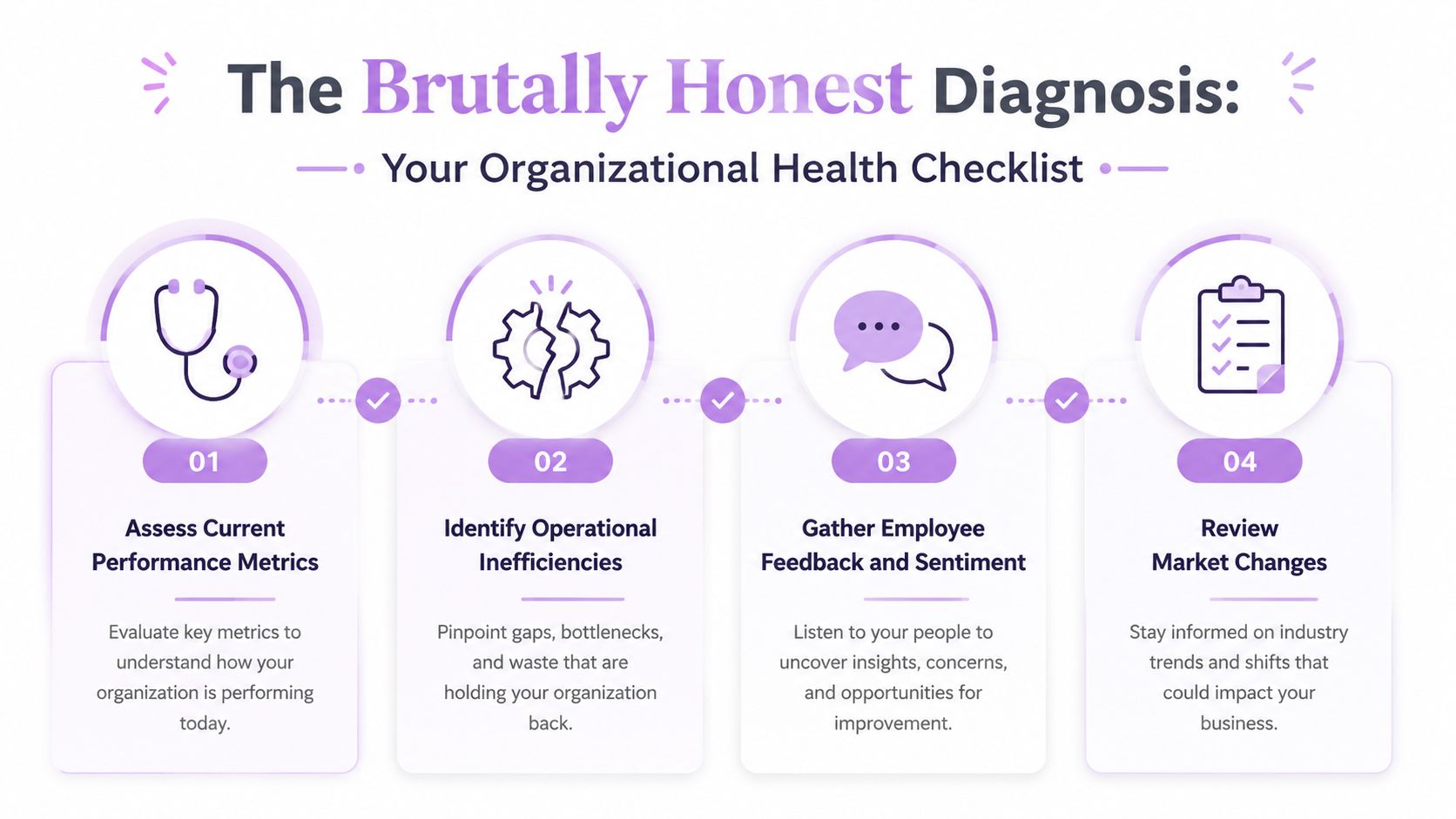
The trap is simple. Leaders see friction and assume structure is to blame. Often it isn't.
The reorg cycle of instability usually starts with a bad diagnosis. Research summarized in this analysis of structural instability says 40% of accountability issues can be solved by clarifying decision rights or redesigning processes without any structural change at all. That should make every CEO put the marker down before sketching a new hierarchy.
If your teams keep saying “we don't know who owns this,” don't immediately split a department in two. First ask:
That last question is the one people dodge.
I use a simple screen before approving organizational restructuring.
If the issue is capability, don't pretend structure alone will solve it. You need to know what skills are missing, and a proper skill gap analysis is a lot more useful than another reorg announcement.
If people can't name the owner, the SLA, and the escalation path, your problem is probably operational discipline, not structure.
A few signs should stop you cold:
That last one is poison. The minute the conversation becomes “where do we put Sam?” before “what role does the company need?”, you're building a political settlement, not an operating model.
A solid diagnosis feels annoying because it forces honesty. Good. That's cheaper than a failed reorg.
If the diagnosis says a restructure is necessary, now you earn your paycheck. At this stage, most leaders turn into demolition crews. They move too fast, over-index on org charts, and under-design the operating model.
Don't do that. Build the machine first. Then decide who sits where.
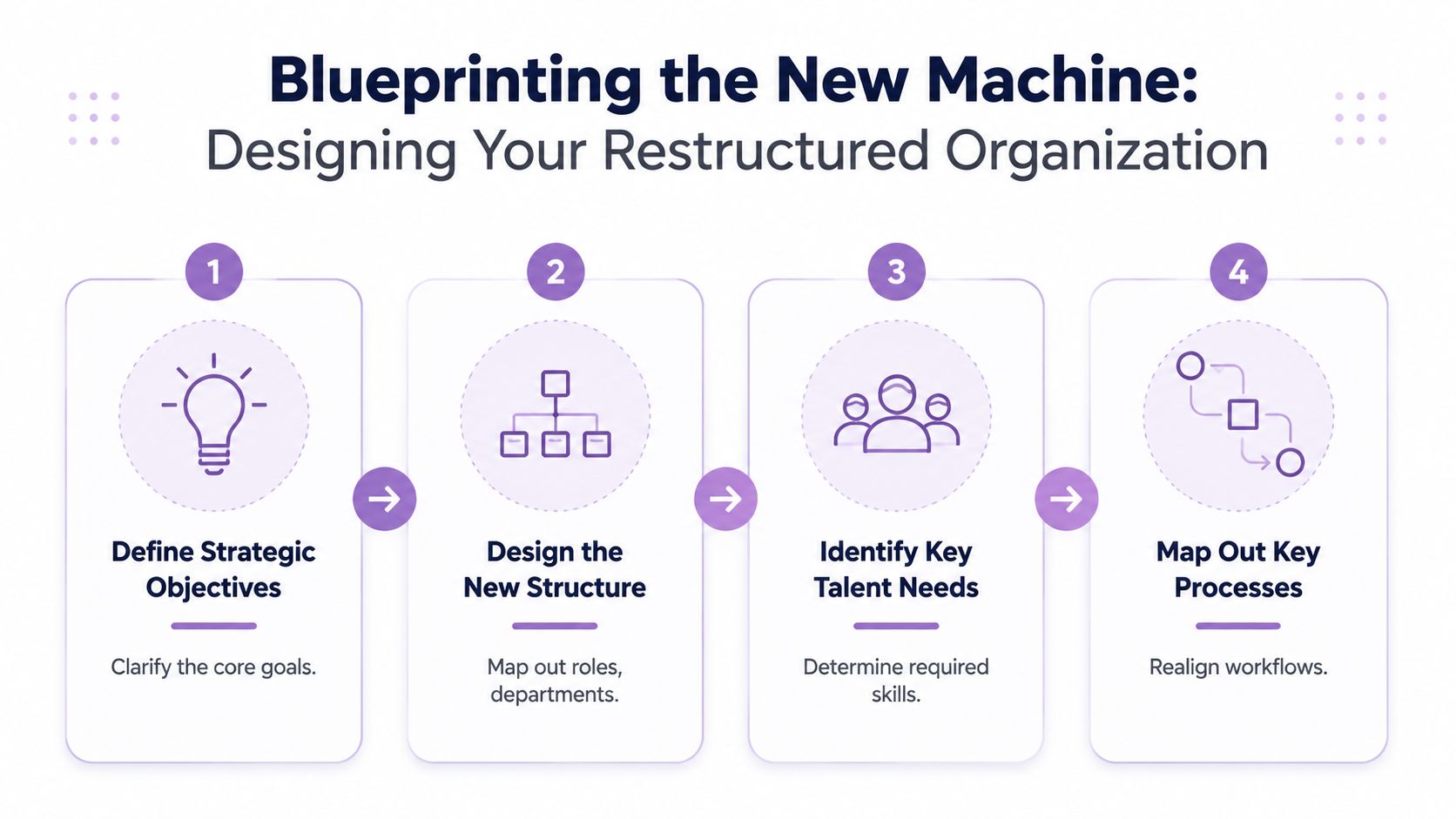
There's one piece of guidance I'd staple to every board packet on this topic. Expert methodology identifies nine rules that can increase redesign success by 7x, including anchoring on strategic aspirations, testing multiple blueprint options, defining roles before people, and establishing KPIs from the start, as outlined in McKinsey's reorganization guidance.
The key phrase is roles before people.
Leaders love to say this. Then they immediately violate it because they don't want hard conversations. They design around incumbents, personal loyalties, and who will throw a fit in the meeting. Congratulations. You've just built an org for politics, not performance.
Your blueprint should answer a few hard questions in plain English:
| Design question | What a good answer sounds like |
|---|---|
| What are we trying to win at? | Specific markets, products, customers, or capabilities |
| What work creates that outcome? | Clear value-creating activities, not vague functions |
| What roles are mission-critical? | Named responsibilities with decision rights |
| Where do teams need tight coordination? | Defined interfaces, not “they'll figure it out” |
That's why I like using operating-model references from adjacent functions. If you're redesigning revenue operations, a practical resource like this B2B sales ops structure guide can sharpen how you think about ownership, planning, and support layers without disappearing into jargon.
Most executives approve a design because it looks tidy. Tidy is not the same as resilient.
Run scenarios. What happens if your largest customer segment shifts? What happens if hiring freezes? What happens if a key leader exits? What happens if product and sales priorities collide in quarter two? If the structure crumples under normal business stress, it's decorative.
Here's the blueprinting sequence I trust:
Good restructuring doesn't start with “who reports to whom.” It starts with “what must this company be able to do better on Monday morning?”
Another expensive mistake. Leaders finalize the structure and only then ask whether they have the talent to run it.
Backward again.
Workforce design belongs inside the blueprint stage. If your strategy requires different capability mixes, identify them now through disciplined strategic workforce planning. Otherwise you'll launch a new structure that depends on skills you don't have, can't hire quickly, or haven't budgeted to retain.
Pretty org charts are cheap. Functional operating models are not. Build the latter.
This is the part everyone pretends is “mostly an HR workstream.” Nonsense. Rebuilding the team is the reorg.
You can design a sharp structure on paper and still wreck the company if you mishandle talent. I've seen leaders spend weeks debating reporting lines, then treat role mapping, exits, retention, and onboarding like admin. Hope you enjoy spending your afternoons untangling missed handoffs and interviewing replacements, because that's now your full-time job.
Independent research found that 96% of organizations globally are undergoing transformations, driven by technological disruption and skills gaps, according to this 2025 transformation overview. That tracks with what operators already know. The issue isn't whether change is happening. It's whether you're upgrading capability on purpose or just burning through people and calling it modernization.
Start with critical roles. Not seniority. Not tenure. Not who's loudest in the meeting.
Look at the new design and identify the positions that keep the machine running or accelerate the strategy. That usually includes builders, technical anchors, customer owners, and managers who can effectively lead through ambiguity instead of narrating it on Slack.
A practical triage looks like this:
That last category is where things get political. Stay calm and use evidence. If a role doesn't support the target operating model, sentimentality won't make it useful.
A lot of companies restructure for speed, then rebuild talent with a local, slow, manually coordinated hiring process that takes forever. Brilliant. You've redesigned the race car and left square wheels on it.
If the new organization needs specialized engineers, operators, analysts, or creatives, widen the talent aperture immediately. Global hiring isn't a novelty anymore. It's just competent execution. And if you're bringing in distributed talent, use proven remote onboarding strategies for LATAM instead of winging it with a Notion page and a welcome emoji.
During organizational restructuring, even people who stay need onboarding. Different manager, different peers, different KPIs, different tools, different expectations. That is onboarding, whether HR calls it that or not.
Here's what I want every retained employee to get in writing:
| Item | What they need |
|---|---|
| Role scope | What they own now, and what they no longer own |
| Success metrics | How performance will be judged |
| Interfaces | Which teams they depend on and serve |
| Escalation path | What to do when priorities collide |
If your leaders need a template, use something grounded like these employee onboarding best practices and adapt them for internal transfers, not just new hires.
The people who stay are watching every decision. They decide whether the new structure gets energy or quiet sabotage.
Layoffs and role eliminations are sometimes part of restructuring. If that's happening, drop the euphemisms. Don't say “rightsizing” like you're naming a scented candle.
Be direct, respectful, and fast. Tell people what changed, why the role is affected, what support exists, and who they can contact. Then tell the remaining team what happens next. The vacuum after a layoff announcement is where rumors breed and trust dies.
A clean team rebuild isn't painless. It is possible, though. But only if you treat talent as strategy, not paperwork.
Most reorg communication is written by committee, approved by legal, softened by HR, and delivered by a leader who looks like they'd rather fake their own kidnapping.
People can smell that instantly.
If you want organizational restructuring to work, communicate like a human being with a spine. Say what's changing. Say why. Say what people should expect this week, this month, and this quarter. Then stop hiding behind fog-machine phrases like “optimizing collaborative potential” and “evolving our organizational design.” Nobody trusts language that sounds like it came from a malfunctioning investor deck.
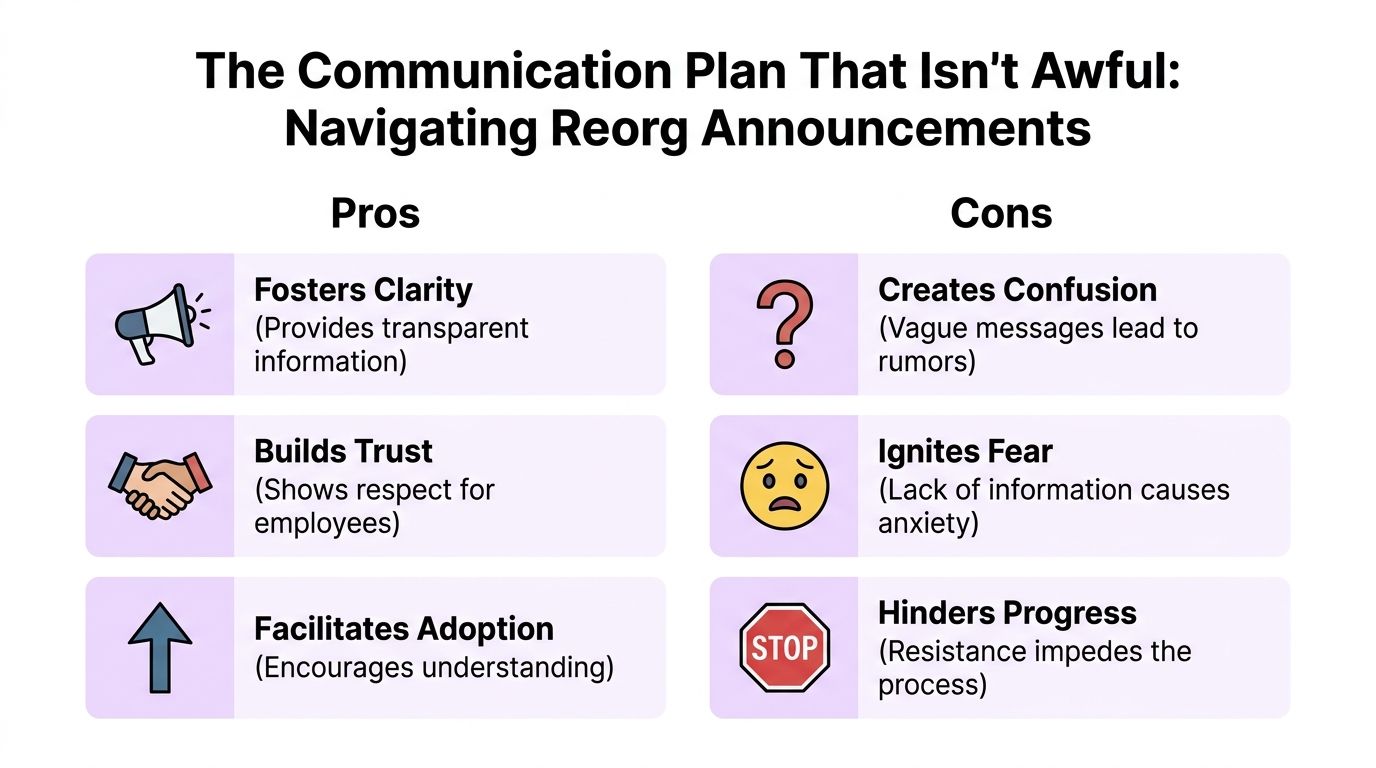
One of the nastiest effects of a reorg is invisible on the org chart. The hidden productivity tax. Research summarized in this restructuring guide notes a 15-20% efficiency loss from communication friction when companies break informal collaboration networks without understanding them through Organizational Network Analysis.
That rings painfully true.
The official org chart tells you who reports to whom. It does not tell you who everyone relies on to get things done. The quiet project manager who connects product and support. The veteran engineer who translates nonsense into action. The operations lead who knows where approvals get stuck. Cut those bridges carelessly and work slows down even if the chart looks cleaner.
Don't send one generic message and call it transparent. Different groups need different answers.
Plain beats polished.
Say what you know, what you don't know, and when you'll know more. That single habit saves more trust than any all-hands presentation.
| Do | Don't |
|---|---|
| Explain the business reason in plain language | Hide behind buzzwords |
| Acknowledge disruption honestly | Pretend everyone should feel inspired |
| Repeat key decisions consistently | Let every manager improvise |
| Share timelines for unresolved questions | Leave silence and hope for the best |
One more thing. Communicate twice as much as you think you need to. Then once more after that. Not because people are slow. Because uncertainty makes even smart teams hear only half of what you say.
The launch is not the finish line. It's the start of the proof phase.
Many leaders often grow complacent at this stage. They announce the new structure, survive the first month, and move on to the next fire. Then a year later they can't explain whether the reorg improved anything, so they start talking about another redesign. That's how companies end up trapped in permanent organizational restructuring, like a dog chasing a car it already caught.
A successful restructuring needs formal reviews at 30, 90, and 180 days, tracking financial metrics, operational KPIs, voluntary turnover, and employee engagement, according to this restructuring success guide.
That cadence is simple for a reason. It forces leaders to look at evidence before the story hardens into self-congratulation.
Here's how I'd use those checkpoints.
Look for early breakage.
Don't overreact to noise, but don't ignore smoke.
Check whether the machine is settling or stalling.
This is the point where people should understand roles, interfaces, and decision rights. If teams still can't explain ownership cleanly, the design or communication was sloppy. Fix it now while credibility is still recoverable.
Judge whether the restructure changed performance, not just diagrams.
Review three buckets together:
| Category | Questions to answer |
|---|---|
| Financial | Did costs move in the direction intended? |
| Operational | Are teams moving faster, cleaner, and with fewer collisions? |
| Human | Did you keep key talent, and are people engaged enough to execute? |
They track costs and ignore capability loss. Or they run engagement surveys and ignore delivery drag. Or they focus on attrition without asking whether the people leaving are exactly the ones they needed to keep.
That's amateur hour.
Use a single scorecard. Review it with the same seriousness you'd use for product performance or pipeline health. If the restructuring isn't improving execution, then the answer isn't another inspirational town hall. It's intervention.
A reorg only counts as successful when the business performs better and the new way of working sticks.
Organizational restructuring should be a strategic tool, not a panic button. If you diagnose the root cause, design around work instead of personalities, rebuild the team deliberately, communicate like an adult, and measure the outcome hard, you can break the cycle of endless reorgs.
Most companies won't. That's why they keep doing this every couple of years.
If you need to rebuild capability fast after a reorg, especially across engineering, operations, marketing, or support, LatHire is worth a look. It connects companies with pre-vetted Latin American talent and handles the messy parts like payroll, compliance, and HR support, so you can spend less time buried in hiring admin and more time making the new structure work.