

A multi-location specialty practice can have full schedules and still lose capacity every day. Referrals sit in an inbox, prior authorizations wait for missing documentation, a provider's schedule changes without every department seeing it, and billing discovers a problem only after the claim has already stalled. An operations coordinator is the person who keeps those failures from becoming the practice's normal operating rhythm.
Operations coordinator jobs in 2026 are less about clerical task completion and more about process control, throughput, data quality, and exception management. The role connects front-desk, clinical, billing, vendor, and leadership workflows so work moves to the right person with enough context to continue. That makes it relevant to three groups: candidates assessing the career, hiring managers defining the position, and practice owners comparing in-house, remote, and nearshore staffing models.
This guide breaks down what the role includes, the skills that separate strong candidates from task-followers, how compensation and hiring models differ, and how to write and evaluate the position inside a U.S. medical practice. It also addresses where remote LATAM coordinators can help, and where a practice still needs local presence, clinical judgment, or direct compliance oversight.
A specialty practice adds a new location. Intake volume rises, providers need cleaner schedules, billing wants fewer preventable errors, and the front desk is already answering patient calls. The operations coordinator does not merely “help with administration.” They take ownership of the workflow that connects those activities, identify where work is stuck, and make sure the next person can act.
Current job descriptions frame the position around operational data, service-level agreements, performance monitoring, and risk escalation, rather than basic scheduling alone. The Data Operations Coordinator II description from Nielsen illustrates that process-control orientation. In healthcare, the same logic appears across referral queues, payer portals, EHR worklists, provider schedules, and revenue-cycle reports.
A receptionist completes assigned front-desk interactions. An executive assistant protects an executive's time and priorities. An operations coordinator watches the outcome across a system. If a referral cannot be scheduled because an authorization is missing, the coordinator identifies the blockage, contacts the responsible team, records the status, and escalates when the delay threatens access or revenue.
That distinction matters when you write the job description. A practice that advertises “general administrative support” may attract someone who is organized but uncomfortable owning unresolved exceptions. A practice that specifies queue management, reporting, SOP maintenance, and escalation standards gives candidates a clearer picture of the work. The comparison between support roles is useful when separating process ownership from task support, as shown in this guide to administrative assistant versus executive assistant responsibilities.
Practical rule: Hire for the workflow you need controlled, not the title you happen to use.
In 2026, strong coordinators need more than a calendar and a dependable inbox. They need fluency with spreadsheets and business systems, concise written communication, reliable remote collaboration, and the judgment to distinguish a routine delay from a risk that needs immediate attention. They don't diagnose patients, make clinical decisions, or replace licensed staff. Their value comes from keeping authorized operational work moving and making exceptions visible before they disrupt the day.
The most useful way to understand the job is to follow the work through four operating categories: throughput, data, coordination, and escalation. These categories apply to healthcare, logistics, SaaS, and other industries, although the systems and consequences differ.
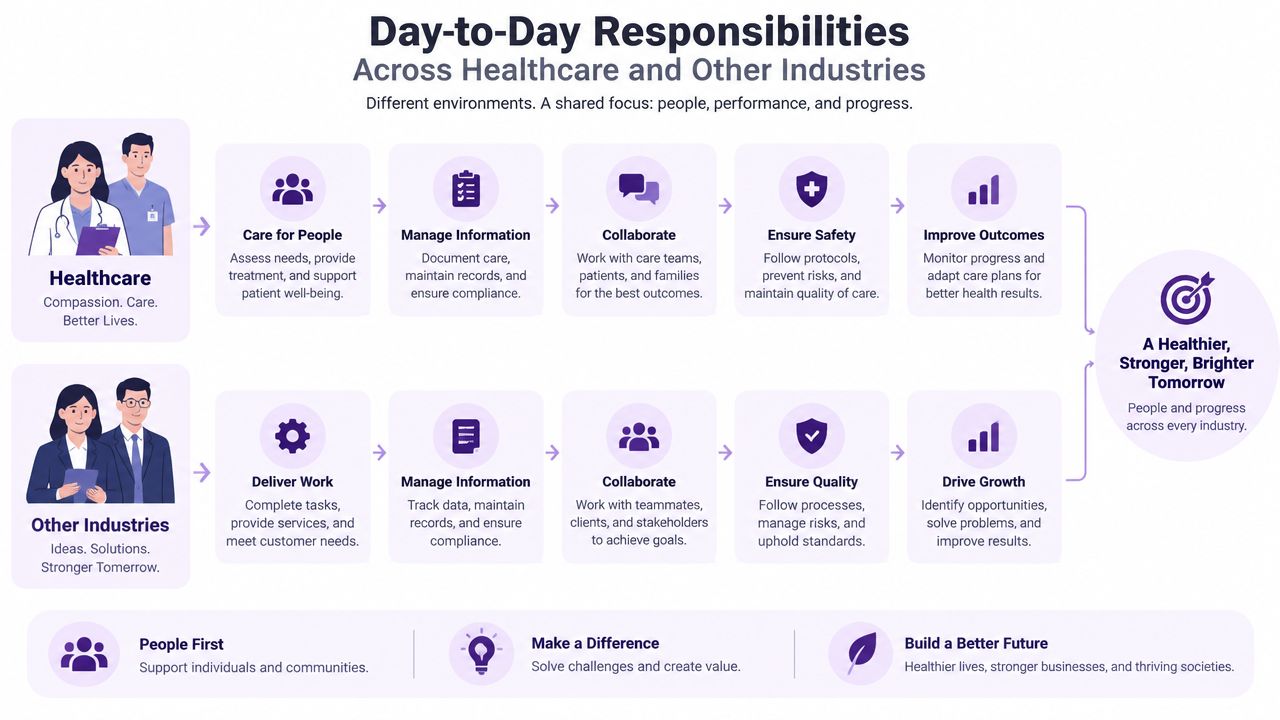
In a medical practice, throughput means more than keeping providers busy. The coordinator may monitor whether referrals are contacted, whether appointments convert into completed encounters, whether provider templates reflect actual capacity, and whether a schedule disruption has been communicated across teams. In a dental setting, that might include chair utilization and procedure readiness. In a specialty clinic, it may center on referral intake and authorization progress.
A good coordinator doesn't optimize one department at the expense of another. Filling every appointment slot with cases that lack documentation can create downstream cancellations, billing rework, or patient frustration. The practical measure is whether the entire workflow advances cleanly from intake to care to payment.
Coordinators often reconcile EHR or practice-management exports with billing data, clean duplicate or incomplete records, and produce a weekly snapshot that a practice lead can use. The report might flag unusual denial patterns, unresolved work queues, missing referral fields, or scheduling disruptions. The coordinator isn't expected to infer a diagnosis or independently change a payer policy. They are expected to make the operational condition clear.
This is why spreadsheet ability matters even in practices with modern software. Data still moves between systems, and managers still need someone to check whether a report reflects reality before acting on it. The healthcare business process outsourcing overview provides useful context for deciding which administrative workflows can be separated from on-site clinical operations.
Prior authorizations may require clinical documentation, payer follow-up, provider review, and patient communication. The operations coordinator routes each piece, records the current owner, and prevents the request from disappearing between departments. They may also synchronize inventory across locations, organize equipment access, maintain launch checklists, or coordinate staff onboarding.
Healthcare postings show how broad this responsibility can become. Practice operations roles may include SOP rollout, new-location checklists, EHR or practice-management migration support, and regular leadership reporting, according to the medical staffing operations coordinator role description. That scope is operational and systems-heavy, not clerical.
The daily exception list could include a stalled authorization, late courier, unavailable provider, patient complaint, or software outage. The coordinator's job isn't to forward every problem. It's to investigate enough to state what happened, what has already been tried, what is blocked, who owns the next action, and when escalation is required.
In logistics, the records may live in a transportation-management system and shipping portal. In SaaS, they may live in a CRM, ticketing platform, or billing system. The domain changes, but the discipline doesn't. Strong coordinators spend more time unblocking other people than checking items off their own task list.
The technical floor comes first. A coordinator who writes polished emails but can't reconcile a spreadsheet, interpret a queue, or trace a record across systems will create extra work for the team.
Look for practical Excel or Google Sheets ability, including filters, clean formulas, pivot tables, and lookup logic such as XLOOKUP or INDEX-MATCH. The point isn't to test obscure functions. It's to see whether the candidate can combine exports, identify inconsistencies, and produce a report without damaging the underlying data. Current job guidance specifically highlights intermediate to advanced Microsoft 365 skills, including Excel pivot tables and Power Query, for operations coordinator work. (Operations coordinator technical guidance)
System experience matters just as much. A candidate may have used an EHR, ERP, CRM, ticketing platform such as Jira or Zendesk, and collaboration tools such as Slack or Microsoft Teams. You don't need every applicant to know your exact stack. You do need evidence that they can learn a workflow, follow permissions, document changes, and avoid treating a system as a personal spreadsheet.
An effective escalation note is brief but complete. It identifies the patient or work item through the approved secure process, states the issue, records the current status, explains the operational impact, and names the next owner. A vague message such as “Can someone look into this?” shifts the investigation to the recipient.
The same standard applies to SOPs and meeting notes. A usable SOP includes the trigger, the responsible role, the system used, the decision points, and the handoff. If you want to understand how notification design supports operational response in another service environment, this resource on restaurant operations notifications setup offers a helpful comparison without replacing healthcare-specific privacy controls.
Strong coordinators close loops. They don't merely route a denial, authorization, or scheduling problem and assume the next person will solve it. They follow the status, record the outcome, and update the process when the same exception repeats.
Assess whether a candidate can say no with a reason. For example, they might explain that a request can't move forward until a required document arrives, then identify the fastest compliant path to obtain it. A bachelor's degree may appear in postings, but demonstrated process ownership, system fluency, and measurable workflow responsibility are more useful hiring signals than education alone.
Remote staff also need disciplined collaboration habits. Define which issues belong in the EHR, which belong in a ticketing tool, which require a secure call, and which need same-day escalation. A guide to remote collaboration tools for distributed teams can help managers build that operating layer before hiring.
The available U.S. labor data shows that operations coordinator jobs are established and actively hired, but it doesn't justify inventing a universal healthcare salary band. Salary varies with geography, specialty complexity, system responsibility, seniority, and whether the role includes revenue-cycle work. One cited dataset reports an average salary of $41,934, more than 185,785 people employed in the occupation, and 102,598 active openings. (Salary data for operations coordinators)
The same source projects 12% growth from 2018 to 2028, with about 52,400 new jobs over that decade. Those figures describe the broader U.S. occupation, not a guarantee for a particular practice or specialty, but they support a clear conclusion: this isn't a disappearing clerical category. Employers continue to need people who can coordinate systems, monitor performance, and manage exceptions.
Healthcare expands the scope through referral queues, payer requirements, patient access, denials, staff scheduling, and reporting. A pediatric or specialty practice may ask one coordinator to monitor no-shows and slot utilization while also supporting insurance verification, authorizations, coding, charge entry, denial reduction, payroll, and financial reporting. (Healthcare operations coordinator responsibilities) That combination should affect the level you hire for and the outcomes you assign.
Don't compare an employee's wage with a contractor's invoice as if they represent the same cost. Include recruiting, management time, equipment, training, payroll administration, benefits, coverage gaps, and compliance support. The table below is intentionally qualitative because the verified data doesn't establish universal compensation ranges or monthly LATAM costs.
| Model | Base Pay Range | Total Loaded Cost | Typical Use Case |
|---|---|---|---|
| In-house employee | Varies by market and scope | Includes employment overhead and benefits | High-touch workflows, local presence, or complex internal coordination |
| General remote hire | Varies by geography and engagement structure | Includes management, equipment, and cross-border or contractor administration where applicable | Distributed administrative work with a documented process |
| LATAM partner | Set by role scope and partner arrangement | Includes the service structure and agreed support model | Recurring coordination requiring time-zone overlap and remote systems work |
Salary should follow responsibility. If the coordinator owns a multi-site authorization workflow, maintains reporting used by leadership, and supports system changes, pricing the role as basic reception creates predictable retention and quality problems. Conversely, a practice shouldn't pay for advanced operations scope when it only needs appointment confirmation and inbox routing.
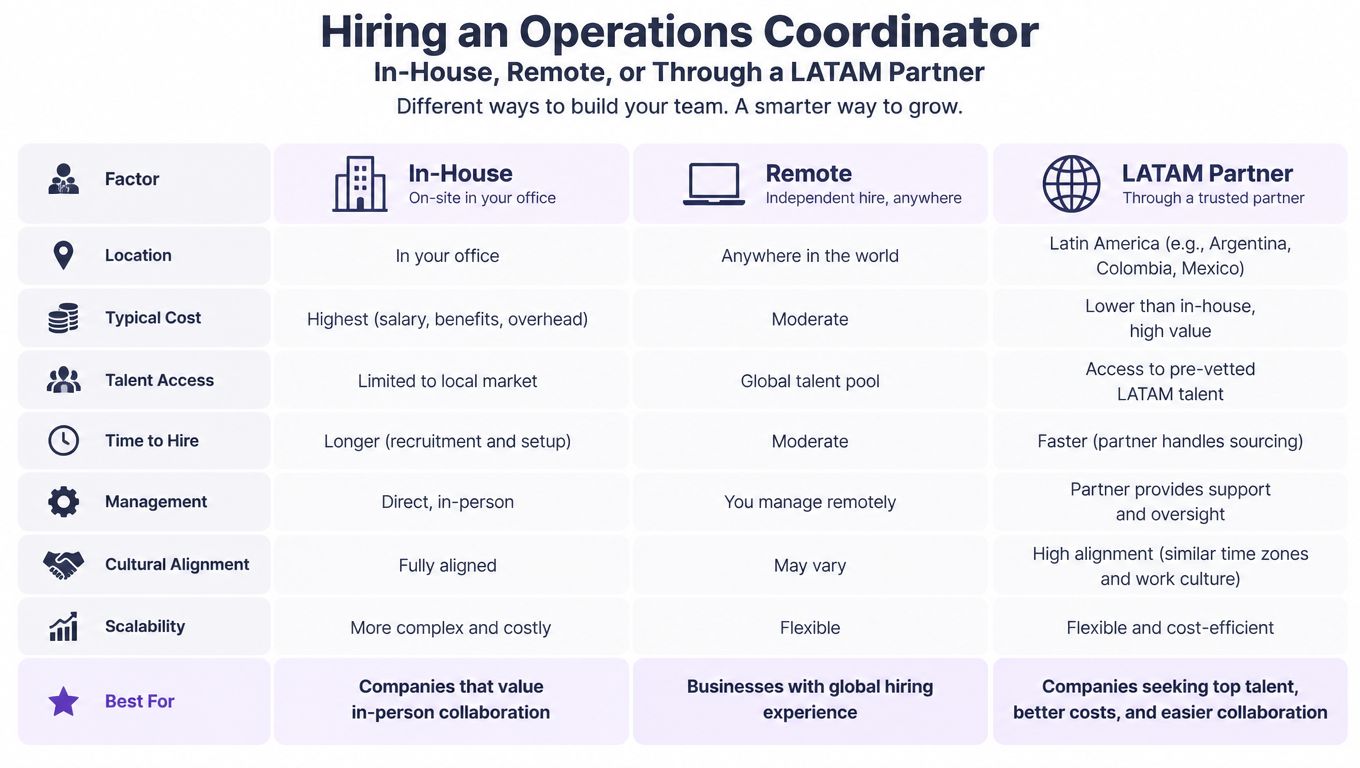
The right model depends on the work, not on a general preference for office or remote staffing. Start by identifying whether the role needs physical presence, patient-facing phone coverage, access to local relationships, or continuous system coordination that can be performed securely from another location.
An in-house coordinator can walk to the front desk, observe patient-flow problems directly, coordinate supplies, and build relationships with providers who prefer in-person communication. That model fits practices where the role includes room readiness, local vendor management, physical records handling, or frequent same-day changes that are difficult to communicate remotely.
The trade-off is cost and recruiting friction. The practice carries the full employment structure and may spend more management time recruiting and covering the vacancy. Physical presence also doesn't automatically produce process ownership. A local employee can still forward exceptions without resolving them.
A remote coordinator can manage queues, reports, referral follow-up, scheduling administration, and documented handoffs without occupying clinic space. The model works when the practice has stable systems, defined permissions, reliable scripts, and a supervisor who reviews work rather than relying on informal hallway updates.
Remote work creates exposure if the practice treats access casually. HIPAA obligations depend on the functions performed and the relationships between the practice and its vendors or workforce. Review HHS guidance on business associates, use appropriate agreements where required, and confirm state-specific obligations with qualified compliance counsel. HIPAA certification isn't an official designation recognized by HHS, so evaluate controls, training, access, and accountability instead of accepting a certification label.
LATAM teams can be practical for work that requires English or bilingual communication, U.S.-compatible working hours, and consistent remote collaboration. A partner such as LatHire can present pre-vetted LATAM professionals for operations and administrative roles, while the practice still needs to define the job, verify healthcare experience, approve access, and manage performance.
Time-zone alignment is especially relevant to patient access. A Mayo Clinic hospital operations posting lists a standard weekday schedule from 8:00 a.m. to 5:00 p.m., which illustrates why many healthcare operations roles are tied to business-hour coordination rather than overnight coverage. (Mayo Clinic hospital operations coordinator posting)
| Decision factor | In-house | General remote | LATAM nearshore |
|---|---|---|---|
| Physical presence | Strong | None | None |
| Time-zone alignment | Local | Depends on location | Often compatible, verify schedule |
| Management need | Direct, daily | Structured remote oversight | Structured oversight plus partner support |
| Privacy exposure | Still requires controls | Requires remote-access controls | Requires remote-access controls and vendor review |
| Best fit | On-site coordination | Documented administrative queues | Recurring, systems-heavy remote operations |
A useful job description tells candidates what they will control, what they may not decide, and how the practice will judge performance. Avoid combining front-desk reception, billing ownership, clinical triage, project management, and executive support into one undefined position.
Role: Healthcare Operations Coordinator
Purpose: Maintain the flow of administrative and operational work across scheduling, referrals, authorizations, documentation, billing support, and leadership reporting.
Responsibilities:
Required experience:
Measures to define: authorization turnaround, unresolved queue age, referral conversion, denial trends, documentation completeness, schedule disruption response, and reporting accuracy. Use the measures that fit your practice. Don't promise a target the baseline hasn't established.
Candidates should replace responsibility statements with evidence. A strong bullet explains the workflow, the intervention, and the verified result. Don't use invented figures. If your records support a number, state it. If they don't, describe the improvement accurately without manufacturing precision.
For hiring managers, ask questions that expose judgment:
A short work sample usually tells you more than broad questions. Give candidates a fictional queue, a simple spreadsheet, and an incomplete handoff. Assess whether they identify the bottleneck, protect sensitive information, prioritize correctly, and document the next action. For broader guidance on writing a target job description for more interviews, focus on specificity rather than inflated requirements.
Candidates usually find operations coordinator jobs through LinkedIn, Indeed, healthcare job boards, staffing firms, and specialized remote hiring platforms. Employers should choose the channel based on the workflow's complexity and the screening burden they can handle.
| Channel | Best For | Time-to-Fill | Geographic Reach |
|---|---|---|---|
| Professional networks and targeted outreach | Depends on internal screening | Broad | |
| Indeed | High-volume applicant sourcing | Depends on posting quality and review capacity | Broad |
| Healthcare boards | Candidates with practice or hospital context | Depends on specialty and location | Industry-focused |
| Staffing agencies | Managed screening and urgent coverage | Agency-dependent | Local or broad |
| Nearshore platforms | Remote operations and administrative talent | Managed pipeline varies by provider | LATAM and other supported markets |
A practice should screen for more than a polished profile. Look for evidence of EHR or practice-management exposure, spreadsheet work, payer or referral workflows, written escalation, and overlap with the hours when patients and internal teams need support. Candidates improve their visibility by naming the systems they used, the queues they managed, the departments they coordinated, and the operational outcomes they can substantiate.
For U.S. practices, a managed LATAM pipeline can reduce fragmented posting, screening, and onboarding work by combining candidate sourcing with checks for English proficiency, schedule alignment, and relevant experience. The practice still owns access decisions, workflow design, supervision, and compliance review. A remote coordinator is an operational extension of the team, not a substitute for accountable clinical or compliance leadership.
Operations coordinator jobs are best understood as ongoing process-control roles. The strongest coordinators protect throughput, reconcile operational data, coordinate handoffs, and resolve exceptions with enough context for the next person to act. Medical practices should scope those outcomes clearly instead of posting a vague administrative role.
Before hiring, map the queues, systems, decisions, hours, and escalation points the coordinator will own. If the work is recurring and systems-heavy, evaluate in-house, remote, and LATAM options against privacy controls, supervision capacity, time-zone fit, and the actual scope of responsibility.
If your practice needs help defining a remote healthcare operations role, Medical Virtual Assistants can help you evaluate pre-vetted LATAM talent, including bilingual administrative and patient-coordination professionals, against your systems, schedule, and workflow requirements. Start with a precise role description and request a shortlist through LatHire, then interview candidates before making a commitment.