
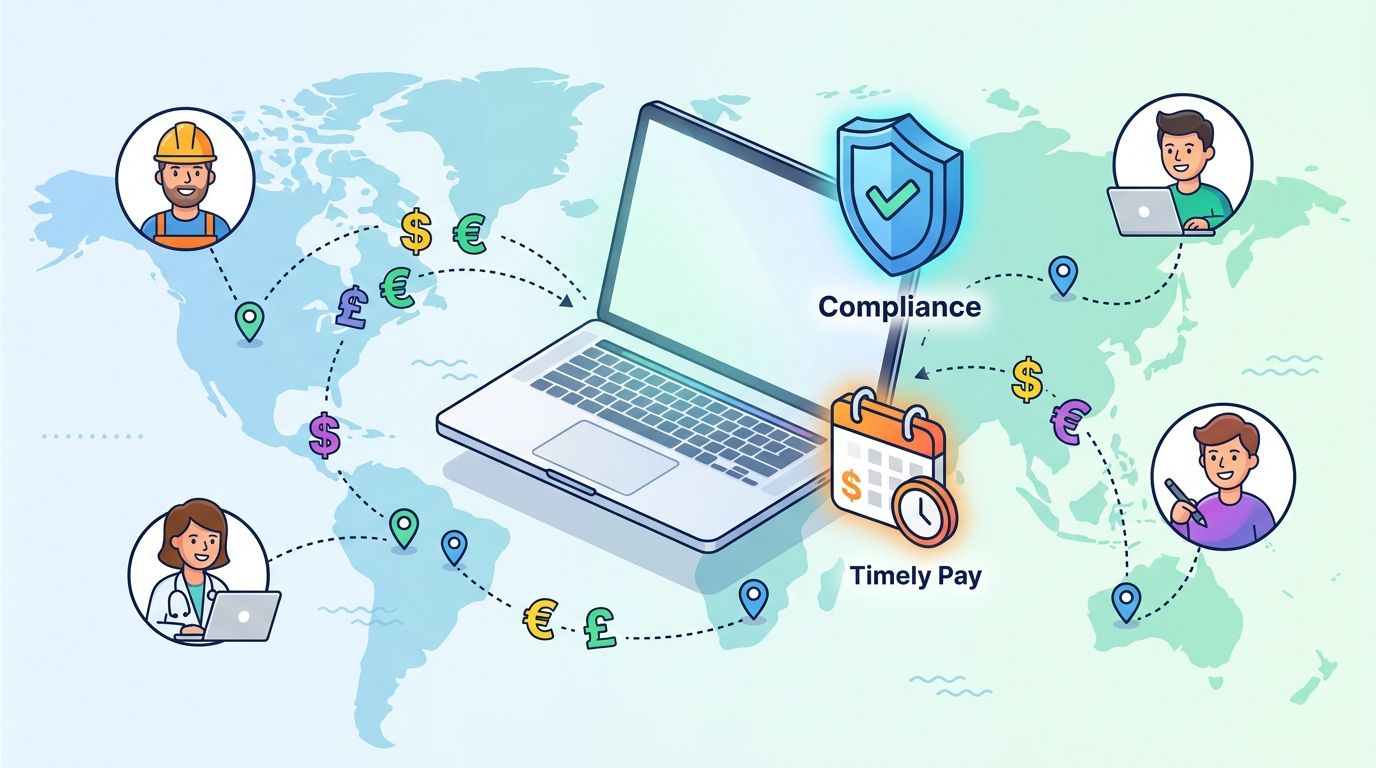
You've hired someone in Berlin, Toronto, or São Paulo. The offer is signed, the start date is on the calendar, and someone in finance says, “We'll just wire the salary from the US.” That sentence has launched more payroll fires than most founders care to admit.
International employee payroll isn't a bigger version of domestic payroll. It's an operational system with four moving parts: worker classification, country rules, gross-to-net calculation, and payment execution. Get the order wrong and even a compliant calculation can arrive late, short, or impossible to reconcile.
The global payroll services market is estimated at $27.81 billion in 2025 and projected to reach $34.76 billion by 2030, a 4.56% CAGR, according to market analysis of global payroll infrastructure. That's not niche back-office software anymore. It's infrastructure.
A founder in Austin approves April payroll for a new hire in Berlin. The salary file looks right. The bank sees an international commercial transfer, not a salary payment. An intermediary bank takes a cut, the German bank applies another deduction, and the employee receives less money than expected, 36 hours late.
The founder starts calling the bank. The employee starts calling the founder. Finance opens a spreadsheet. Nobody knows whether the problem sits with payroll, treasury, the payment rail, or the receiving bank. Everyone agrees it's “being investigated,” which is corporate language for “we've lost control of the situation.”
That first wire teaches an expensive lesson: cross-border payroll fails operationally before it fails legally. The calculation may be correct, but the wrong rail, currency, funding account, approval workflow, or cut-off time can still damage trust.
Cross-border payroll is part of a much larger financial system. One market analysis estimates that employer-originated wages crossing borders exceed $200 billion annually, while the broader cross-border payments market is projected to grow from $238.14 billion in 2026 to $336.49 billion by 2031 (cross-border payroll and payments analysis). Salary delivery is a major global payment flow, not a few transfers sent from a laptop.
The practical lesson: the difference between a small FX loss and a painful one often comes down to which payment rails you use, not how hard your team worked on the spreadsheet.
I use a simple sequence:
That order matters. Teams that begin with “Which payroll vendor should we buy?” often end up automating an unclear employment arrangement. Automation doesn't rescue bad inputs. It just processes them faster, with better-looking reports.
Start with where the person physically performs the work. Nationality, home-country headquarters, and the currency in the employment contract don't override that basic operating principle. The work location usually drives registration, withholding, reporting, and social-security obligations, and employers may need to register with local tax authorities before paying workers, as outlined in this cross-border employment FAQ.
Before creating a pay record, document four things:
A contractor who works to a fixed schedule, uses mandated equipment, follows internal operating procedures, receives benefits parity, and performs a core business function may look much more like an employee than the contract says. Labels don't decide classification. The working relationship does.
Use the relevant local tests rather than importing your home-country assumptions. UK IR35 principles and US common-law standards both focus heavily on the actual relationship, including control and independence. The safest workflow is to have local counsel or a qualified payroll specialist review borderline arrangements before the first payment, not after a worker asks why they have no statutory benefits.
Create a country rule sheet that answers:
Canada illustrates why broad “international payroll” checklists fall short. For Canadian-source compensation, the payer generally withholds Canadian income tax at source even when a treaty may ultimately exempt the worker, unless a waiver applies. The amounts also need reporting on annual information returns such as the T4 slip and T4 summary, according to this cross-border payroll tax guide for Canada.
US payers face their own reporting mechanics. Payments to foreign persons can involve Form 1042 and Form 1042-S, while wages paid to nonresident aliens may still require Form W-2 reporting for state and local wage and tax amounts, even where a treaty provides federal tax relief, as explained in this US payer guide to cross-border withholding and reporting.
Treat every new country as a new configuration. Don't clone the US payroll calendar, swap the currency, and hope the deductions behave.
The right model depends on whether you're testing a market, building a durable local team, or already have an entity that needs help. There's no prize for owning a subsidiary that exists mainly to generate paperwork.
An employer of record, or EOR, legally employs workers on behalf of the client company and typically manages payroll, taxes, benefits, and compliance while the client retains day-to-day control of the work, as described in this EOR payroll and compliance guide.
| Factor | EOR | Own Entity | Local Payroll Provider |
|---|---|---|---|
| Best fit | Early hiring, market testing, small local teams | Long-term hiring concentrated in one country | Existing entity with limited payroll capacity |
| Legal employer | EOR | Your local entity | Your local entity |
| Setup speed | Fastest | Slowest | Depends on entity readiness |
| Control | Moderate, with provider involvement | Highest | High over employment, outsourced payroll operations |
| Compliance ownership | Shared operationally, EOR handles local employment administration | Internal team and local advisers | Provider supports payroll, entity retains core obligations |
| Main drawback | Provider dependency, pricing, visa and equity limits | Administrative overhead and local governance | Integration and local-expertise quality vary |
For a small team testing demand, I'd start with an EOR. It keeps entity creep from swallowing your finance calendar and lets you validate whether the market deserves a permanent structure. An EOR also avoids the classic situation where HR, finance, and legal argue over who owns the paperwork.
The trade-off is real. EORs may not sponsor visas, can restrict equity administration, and can create IP-assignment friction for product-led teams. Read the contract provisions on inventions, confidentiality, termination, and worker transfer before signing. “We'll sort that out later” is how intellectual property ends up in a negotiation nobody budgeted for.
An own entity makes more sense when hiring is concentrated, recurring, and strategically important. You gain control over employment terms, benefits, banking, and equity, but you also inherit registrations, accounting, filings, local banking, and ongoing governance.
A local payroll provider sits between the two. It's useful when your entity already exists but your team doesn't want to calculate local deductions manually. Compare service scope carefully. Some providers process payroll but leave registrations, benefits, payments, and filings sitting with your team.
For a broader operational overview, distributed workforce payroll is a useful resource. If you're still unclear on the legal-employer model, this explanation of what an employer of record is is a good primer.
Payroll cost doesn't stop at gross salary. It leaks through conversion spreads, payment routing, provider markups, duplicate records, and late approvals. The annoying part is that these losses often hide outside the payroll report.
A 2025 global payroll payments report found that 66% of payroll professionals either don't know or lack the data to compare FX rates and fees across providers, 15% rely on more than eleven providers, and one in four experience frequent or occasional FX miscalculations (global payroll payments report analysis). That's not a treasury problem in isolation. It's a payroll-control problem.
Finance executives see the impact directly. 97% reported payroll-cost changes from FX movements over the prior 12 months, with 53% seeing monthly variance of 1% to 2% and 45% seeing variance of 2% to 5% (cross-border payroll operations research). The same research identified regulatory differences, currency-conversion costs, reconciliation and reporting issues, and limited real-time FX visibility as recurring failure points.
Suppose five employees across three countries produce a monthly payroll run totaling $200,000. A 1.5% FX spread on that run costs $3,000 per month, or $36,000 annually. That's money a founder may never see because it sits inside the conversion rate rather than on a line called “payroll waste.”
A 4% monthly FX swing can also distort a quarterly forecast before anyone changes headcount. The answer isn't guessing the market correctly. It's deciding when rates are captured, who approves the conversion, which wallet or account funds the run, and what variance triggers escalation.
| Cost Source | Typical Rate | Annual Cost, 5 Employees, 3 Countries |
|---|---|---|
| FX spread | 1.5% | $36,000 on a $2.4M run |
| Bank wire fees | $25 to $50 per leg | Depends on payment count and routing |
| Intermediary deductions | $15 to $30 per deduction | Depends on corridor and bank path |
| Provider fragmentation | Varies by provider | Requires provider-level reconciliation |
| FX miscalculation | Varies by incident | Requires exception review |
Audit your setup before the next pay run:
For contractor payments, the operational details differ, but the same payment discipline applies. This guide to paying international contractors is useful when your workforce includes both employees and independent workers.
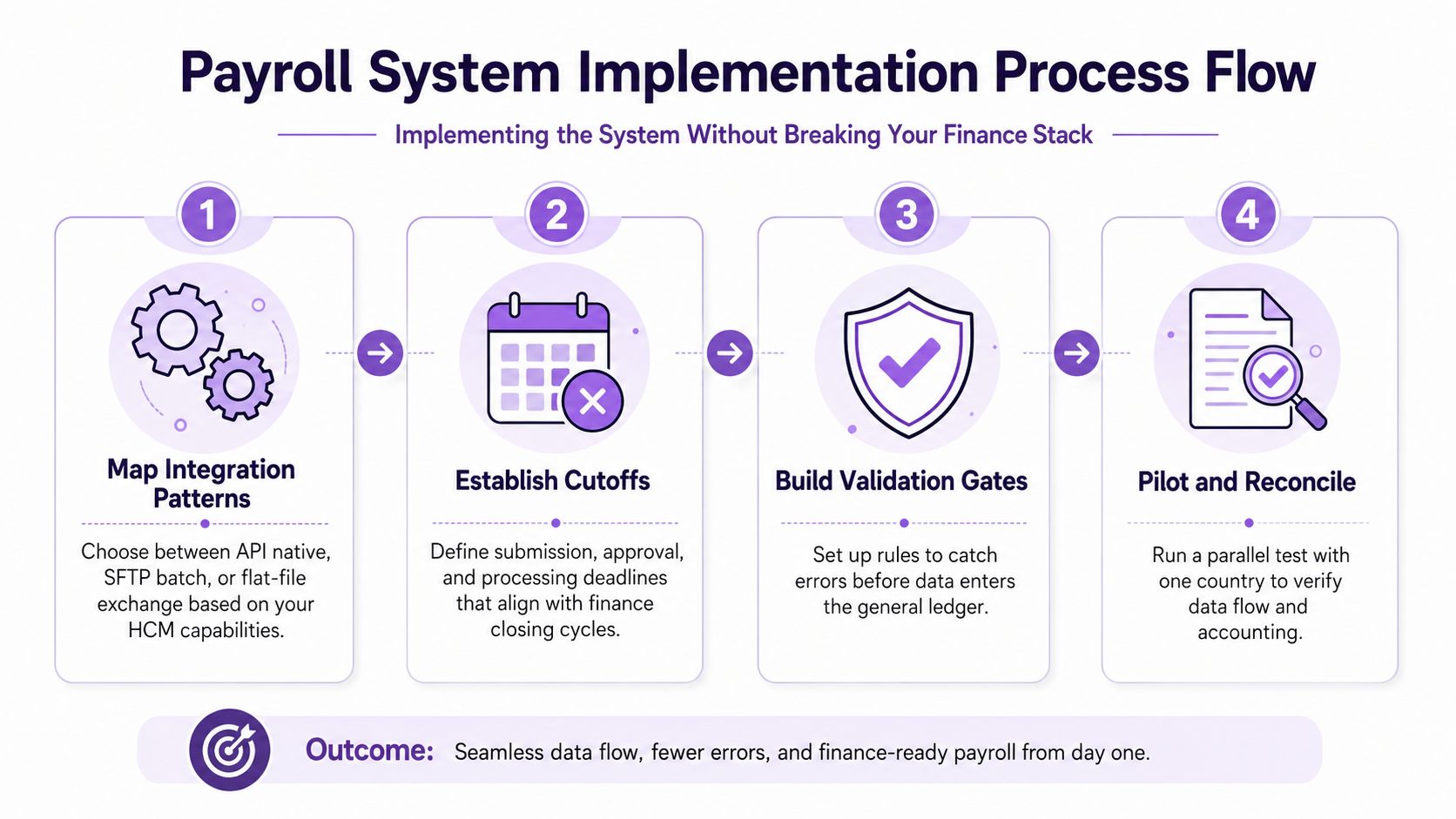
Payroll implementation should fit the finance stack you already defend in monthly close. Don't buy a platform that creates a second source of truth because its demo looked polished.
The first decision is how data moves from the HCM system into payroll and back into finance. An API-native integration can support frequent synchronization, but it still needs authentication controls, rate-limit handling, and clear ownership. SFTP batch exchange works well for scheduled files and controlled review. Flat-file exchange is less elegant, but it can be dependable when the schema is documented and validation happens before upload.
Set cutoffs backward from the local pay date, then add approval time for HR, finance, and the payment operator. Your calendar should distinguish:
Late time-tracking and post-cutoff inputs are recurring payroll issues. PayrollOrg's 2025 survey ranked local compliance as the biggest challenge for 57% of respondents, while also highlighting the difficulty of automating inbound HCM data and outbound finance or data-lake data in this global payroll survey review.
Create gates that reject bad data before it reaches accounting:
Run one parallel payroll cycle for a single country. Compare gross-to-net results, employee-level payments, employer liabilities, GL mapping, and bank settlement. Assign named sign-offs for HR, payroll, finance, and treasury. If a variable arrives after cutoff, route it into an exception queue with an explicit treatment, such as next cycle, off-cycle payment, or documented hold.
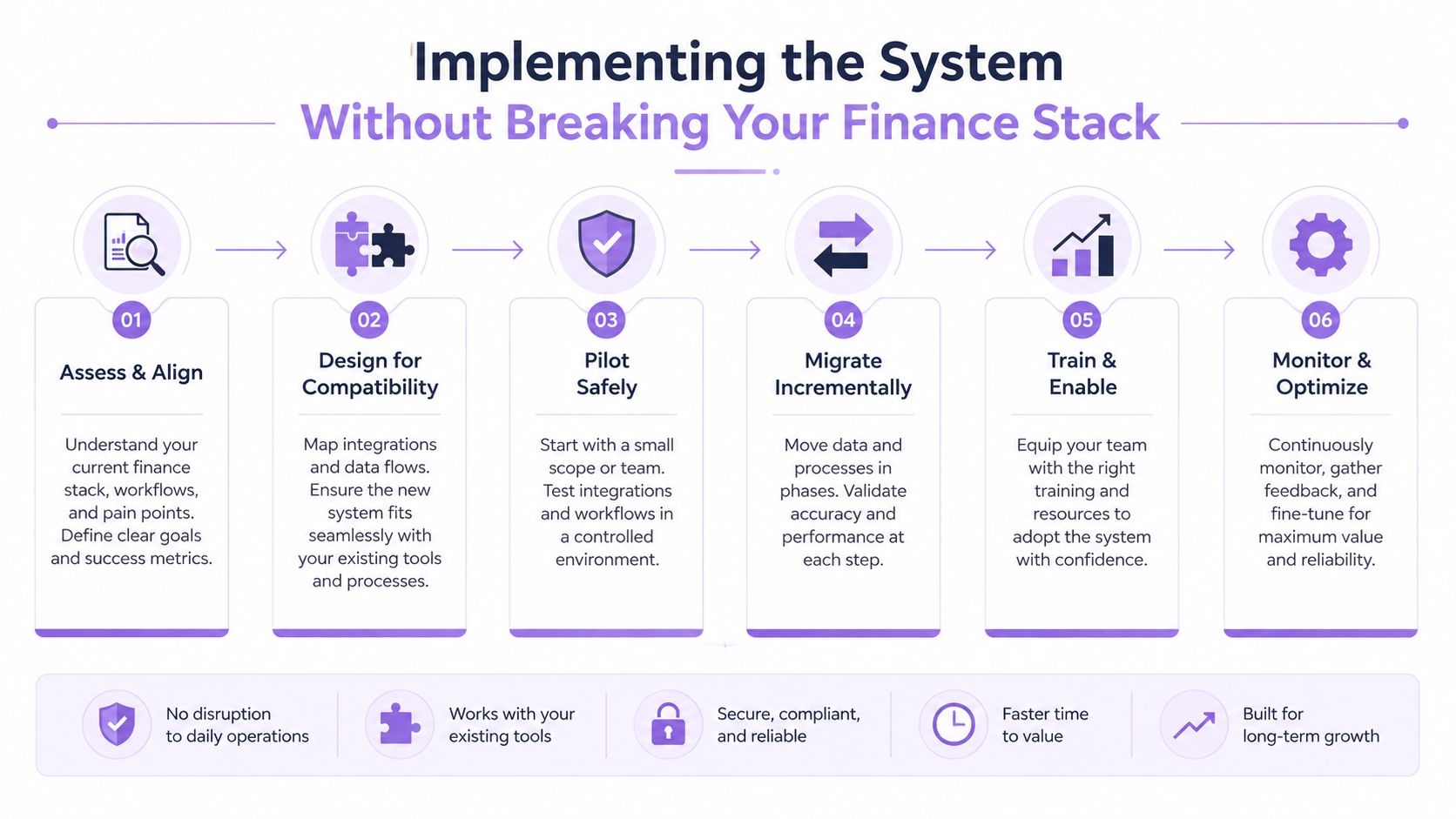
Watch for rate limits, schema drift, stale employee records, duplicate hires, and terminated workers still present in a payment file. These failures can derail month-end close even when every individual salary calculation is correct.
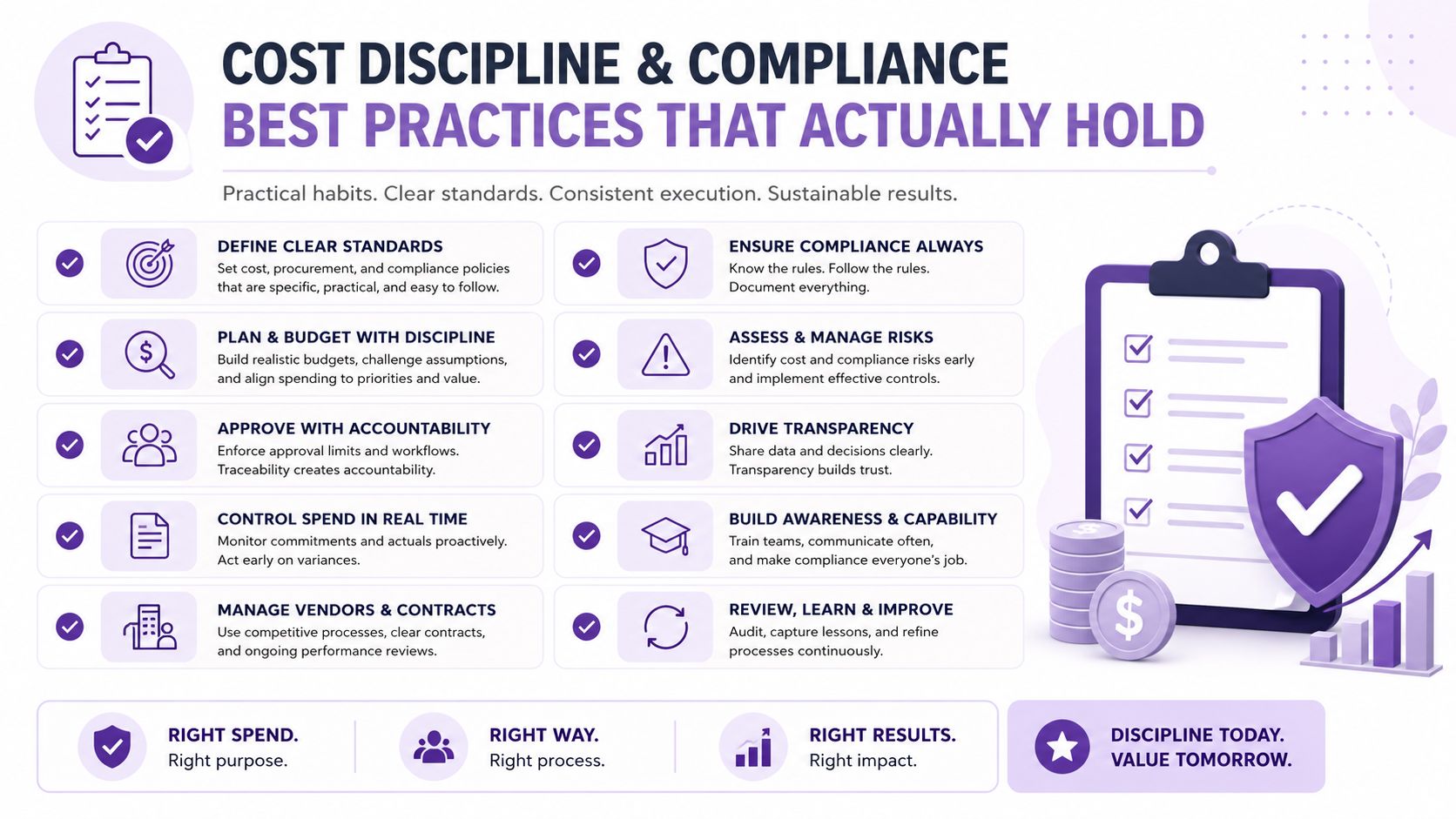
Cost control and compliance aren't competing priorities. The same controls that stop a late filing often stop a bad payment, an unexplained FX loss, or a duplicate journal entry.
Start with the money-moving decisions. Use multi-currency wallets where they fit your corridors, consolidate predictable payment windows, and centralize FX decisions for recurring payroll rather than letting every country manager improvise. Don't hedge blindly. Forecast the currencies, define the approval authority, and document the rate used for each run.
Your minimum control set should include:
Scale changes the risk profile. 35.8% of internationally operating organizations reported payroll-related compliance issues or audit findings in the past 12 months, and 53% of companies had incurred payroll penalties in the past five years. Among organizations operating in two to five countries, the penalty rate reached 67%, according to payroll statistics and compliance research.
Automation reduces error exposure but doesn't remove accountability. The cited research reports manual global payroll error rates of 1.2% to 2.0% per pay run, compared with 0.3% to 0.5% for automated platforms, and puts the average staff-time cost of each correction at $291 (same payroll research source). Because source URLs should stay focused, treat that linked research as the evidence for both points.
A durable rule: every country expansion is a new compliance configuration, not another row in a global spreadsheet.
A two-person finance team can run a sensible cadence:
Use this payroll compliance checklist to turn those controls into an operating routine rather than a heroic end-of-quarter scramble.
Don't leave the old country's payroll running while you “figure it out.” Record the move date, physical work location, tax residency position, social-security treatment, and treaty documentation, then have the relevant payroll owners determine where withholding changes.
Treaty relief should be applied only after the employee provides the relevant residency certificate and the employer confirms the treaty conditions. Until the documentation is complete, keep the applicable withholding process running and record the reason for any later adjustment.
Stop improvising when every new hire creates a new bank account, provider login, filing calendar, and manual spreadsheet. If your team can't name the legal employer, payroll owner, funding account, and local filing process before the offer goes out, use an EOR or another managed model.
For a small, distributed team, an EOR often absorbs the entity and compliance burden. For a concentrated, long-term hiring plan, revisit the own-entity economics once the local team is large enough to justify dedicated operations. The decision should follow hiring intent, not founder pride.
Model the full cost, not just salary. Include entity setup, accounting, banking, payroll administration, benefits, local advisers, filings, FX, and management time. If setup and ongoing operating costs exceed 18 months of projected payroll, I'd pull back unless the country is strategically necessary.
That trigger doesn't mean the market is bad. It means your current hiring model is wrong for the opportunity. Use an EOR, hire through a different approved structure, or pause the expansion instead of mortgaging the office ping-pong table.
Don't ask payroll to settle a residency dispute. Collect the employee's physical-work history, tax-residency certificates, travel pattern, and treaty position. Then obtain a country-specific determination and document which country handles withholding, reporting, and social contributions.
The mistake is assuming one payroll system can resolve conflicting residency rules by itself. It can't. Payroll executes a documented decision.
Treat an undisclosed relocation as a payroll and employment-control incident. Pause any assumption that the existing country setup still applies, confirm the new work location and move date, and assess registration, withholding, benefits, worker classification, and permanent-establishment implications.
Then fix the process. Require employees to report work-location changes before they move, and make managers responsible for escalating location changes. “I thought they were still in Madrid” isn't a control.
Read the employment contract and local law first. Force majeure clauses may address operational impossibility, but they don't automatically erase wage, withholding, benefits, or reporting obligations. Confirm whether the crisis affects payment rails, banking access, work authorization, or the employer's ability to operate.
If the host country becomes operationally inaccessible, document the event, activate your continuity plan, and decide whether a backup payment route or temporary relocation is lawful. Don't use force majeure as a shortcut for avoiding payroll.
International employee payroll works when you build it like infrastructure: clear ownership, country-specific logic, controlled funding, tested integrations, and documented exceptions. The companies that scale cleanly aren't the ones with the fanciest dashboard. They're the ones that know exactly what happens between an approved salary and money in an employee's account.
If you're hiring across Latin America and need help coordinating talent, HR, international payroll, benefits, and compliance, LatHire offers managed support for cross-border hiring and payment operations. Map your next country, classify the role, and pressure-test the payment route before you send the offer. That's cheaper than learning from your first wire panic.