

You're staring at a role that's already bleeding money. The roadmap is slipping, the backlog is a mess, and somebody on your team has decided that “we need a web developer” counts as a hiring plan. It doesn't. It's how founders end up interviewing the first ten people who can spell React, then acting shocked when the product still feels held together with duct tape and optimism.
How to hire web developers without setting your calendar on fire comes down to discipline. Define the mission, write a job post that sells the work, source where real developers spend time, and test for shipping ability instead of résumé theater. The primary challenge is operational. A vague spec turns into wasted interviews, slow offers, messy handoffs, and payroll headaches if you hire across borders. If you want a job post that attracts the right people, start with how to create job descriptions that do the heavy lifting.
Hiring also has a hidden cost people love to ignore. Every bad brief, every sloppy screening call, every “we'll figure out the contract later” decision adds friction you pay for later in missed deadlines and internal cleanup. You are not just filling a seat. You are buying fewer fires, cleaner handoffs, and a developer who can ship without turning your team into part-time babysitters.
Don't write a job description yet. That's how people end up hiring a “senior full-stack developer” for a maintenance cleanup job, then acting surprised when the candidate either runs away or shows up and starts judging everyone's architecture choices.
Start with the actual business problem. Is this person fixing a brittle site, building a new product, cleaning up front-end debt, or owning a stack end to end? Those are different jobs, and pretending they're one role is how you get the wrong hire with the wrong expectations and a very expensive calendar full of misunderstandings.
A proper mission brief should answer a few blunt questions. What does success look like in 90 days? What systems will they touch? What tools are essential, and what can be learned on the job? If you cannot answer that, you are not ready to hire, you are ready to think harder.
Practical rule: if the role scope is fuzzy, the interview process will be fuzzy, and the hire will be fuzzy too. Fuzzy hires become expensive hobbies.
The seniority level matters just as much. A junior developer can be great at defined tasks and support work. A senior person should handle ambiguity, trade-offs, and ownership. Don't pay for a seasoned architect when you need someone to maintain landing pages and ship small features. That is how you waste money on the wrong layer of experience and still end up fixing the same problems later.
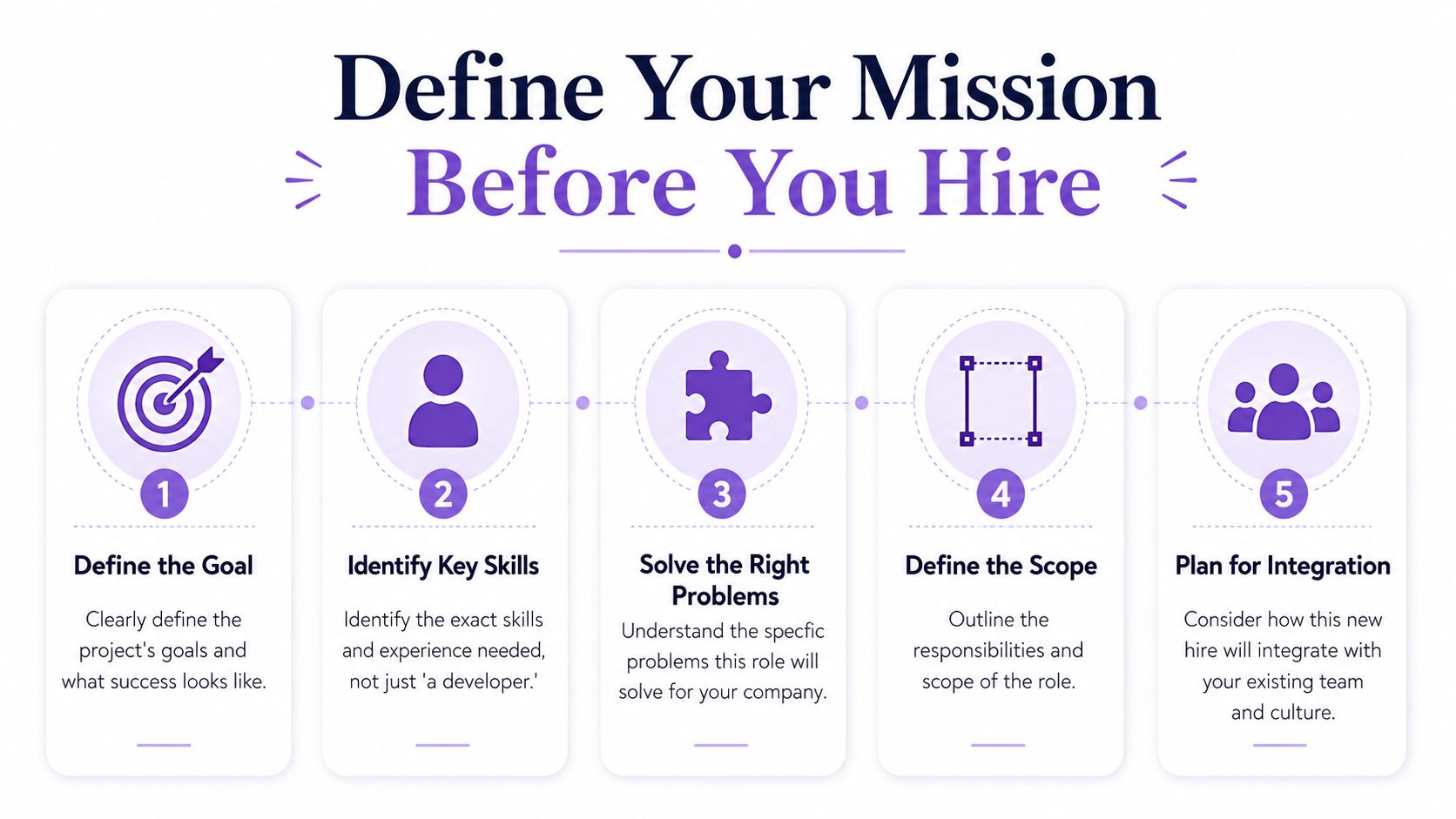
Stakeholders need to agree on scope, budget, and the engagement model before candidates show up. If product wants speed, engineering wants maintainability, and finance wants a miracle, you are not hiring one developer, you are setting up a mess that nobody wants to own.
A platform like LatHire pushes that clarity early by matching on mission and skills instead of vague keywords, which helps because the market does not reward sloppy hiring. The BLS web developer outlook points in the same direction. Demand stays active, so the employer who dithers loses to the employer who knows exactly what they need.
Your job description is a sales page. Not a legal monument. Not a beige acronym dump. Not a museum of everything your team once touched during a sprint in 2021.
If a strong developer reads your post and sees only buzzwords, they'll assume the company is disorganized, the scope is bloated, and the interview loop will be an endurance sport. They're probably right. A good job post does two things well. It attracts the right people and scares off the wrong ones before you waste an afternoon on screening calls.
Start by defining the problems the developer will solve. Say the site needs faster feature delivery, better performance, cleaner front-end architecture, or a stable deployment pipeline. Then name the stack. Then state the seniority, work style, and expected ownership.
A simple structure works because it respects the reader's time:
Transparency matters here too. If you've got a compensation range, put it in the post. If there are three interview rounds and a take-home task, say so. That honesty doesn't shrink the funnel, it improves it.
A decent developer can smell fake culture from a mile away. Don't write “we move fast and break things” unless you also enjoy paying for outages. Don't say “rockstar ninja wizard” unless you want a pile of unserious applicants and one person who should never be trusted with production.
The goal is to sound like the kind of company that understands what shipping software takes. If you want a helpful template for that kind of clarity, this job description guide is a decent starting point. Toot, toot, done properly.
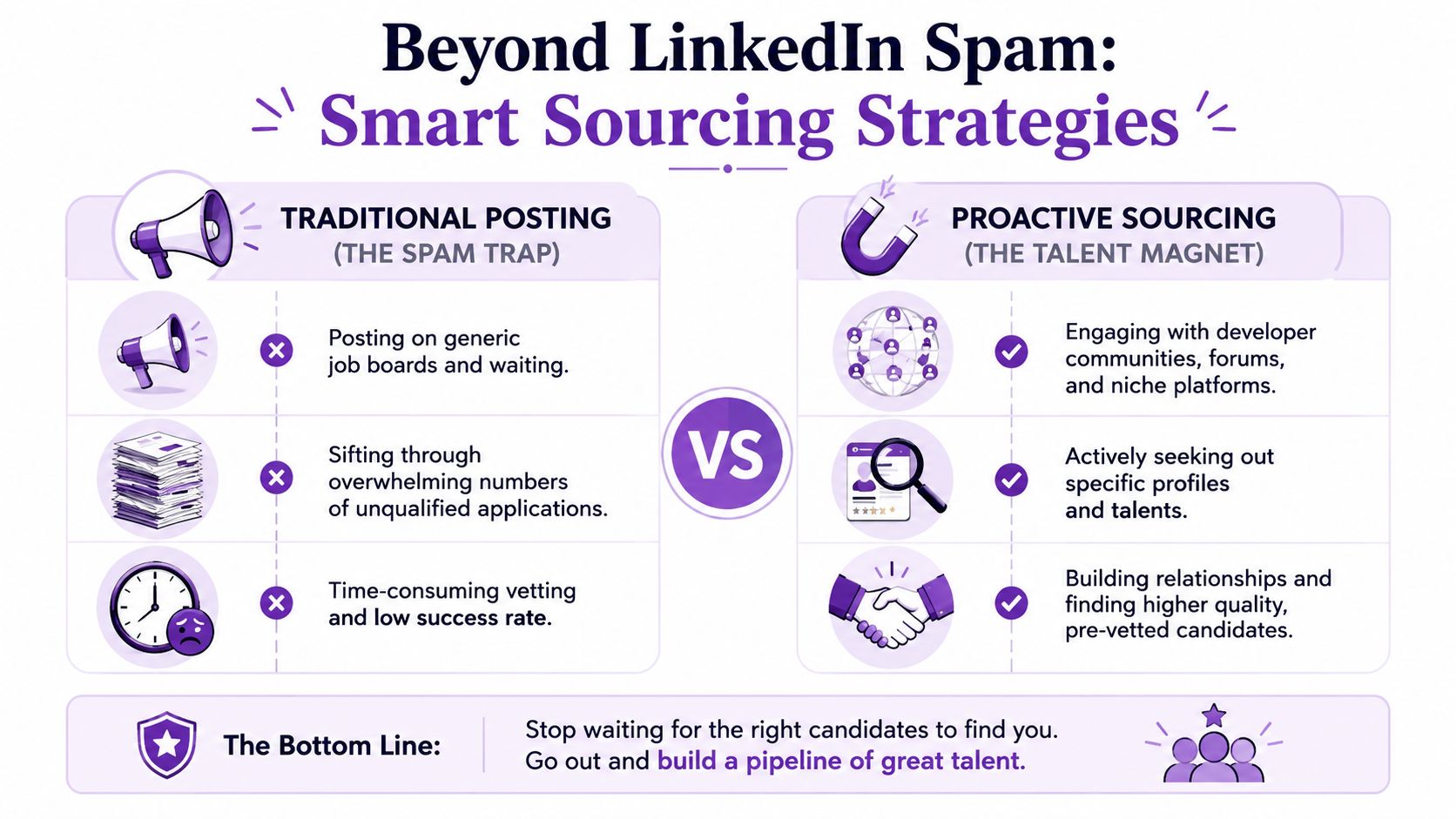
If your plan is to post on a giant job board and wait, you're basically opening a fishing line in a storm and hoping the exact fish you want jumps in. Meanwhile, the good developers are busy building, contributing, freelancing, or ignoring your generic outreach because they've seen that message before.
The problem isn't just volume. It's noise. Big platforms create a flood of applications, and most of them are wrong. That creates more screening work, more slowdowns, and more chances for a good candidate to disappear before you've even scheduled round one. Engineering hiring already runs long. A recruiting summary citing Workable and SHRM data says engineering roles take about 62 days to fill globally, compared with 42 days across roles, and hiring teams are dealing with 2.7 times more applications than three years ago (recruiting statistics summary).
The better move is targeted sourcing. Go where code lives. Look at open-source contributions. Search niche communities. Read GitHub activity. Use referrals from people who've already worked with the type of engineer you need. A blunt search message sent to the right person beats a polished job post buried under 300 junk applications.
“If they're already visible in a community where the work is real, you've got a better signal than any generic posting can give you.”
That's especially true when you're hiring across borders. The best people often aren't sitting on the same job boards your competitors are browsing. They're in smaller networks, local tech groups, and communities that don't show up in your standard sourcing playbook. That's not a problem. That's the opportunity.
For U.S. and Canadian teams, Latin American talent pools are a practical answer to slow local searches. The value isn't only lower cost. It's timezone overlap, English fluency, and faster access to qualified developers who can work closely with your team. In markets where hiring drags on, that matters a lot more than the branding of the platform you found them on.
A curated platform like LatHire can be useful, because it's built to surface pre-vetted Latin American professionals and shorten the drag that comes from sorting through the wrong crowd. The point isn't to “go international” for the sake of it. The point is to stop pretending your best candidates all live in the same place your last five applicants did.
Most hiring processes are built to reward people who interview well, not people who build well. That's why you end up with candidates who can talk for 40 minutes about architecture but somehow can't ship a feature without breaking the footer.
The fix is simple. Stop making résumé screens do the job of actual proof. If you want someone who can deliver, you need evidence from their work, not from their self-description.
Portfolios are only useful if they're real. Click the links. Open them on mobile. Check whether the site works, loads cleanly, and does the thing it claims to do. Screenshots are decorative. Live products are evidence.
A hiring guide on web developer screening says exactly that, ask for live links and verify that the site is fast and mobile-friendly instead of judging from polished images alone (portfolio review guidance). Another hiring resource says to request concrete examples of past projects and case studies rather than relying on vague claims. Good. That should be the bare minimum.
This is the part that saves you from expensive regret. Give candidates a modest, paid assignment tied to actual work they'd do on the job. Not a free full build. Not a pretend puzzle from a textbook. A real task with real constraints.
One independent hiring guide recommends a paid test project precisely because it reveals whether a candidate can deliver under realistic conditions, and another advises employers to use paid sample tasks to gauge skill and fit (paid test project guidance). If a candidate flinches at a reasonable paid trial, that's useful information. Cheap red flags are still red flags.
Generic interview questions are lazy. Ask how they handle scope creep. Ask what they do when a production bug lands late on a Friday. Ask how they'd review maintainability or approach system design for a scalable app. That tells you more than a hundred “what's your greatest weakness” answers.
Practical rule: if the interview doesn't resemble the job, the interview is theater.
Expert guidance recommends replacing generic questions with task-based evaluations, like a 2 to 4 hour live coding challenge that mirrors a real project, especially for modern front-end and back-end roles (task-based evaluation guidance). That's the right instinct. If you want another example of a practical interview workflow, the PerfectInterview.Ai report from AI Website Detector is worth a look because it frames evaluation around actual output, not polished chatter.
For structured technical filtering, LatHire's technical skill assessment follows the same logic, combine skill checks with human review, then talk only to people who can build.
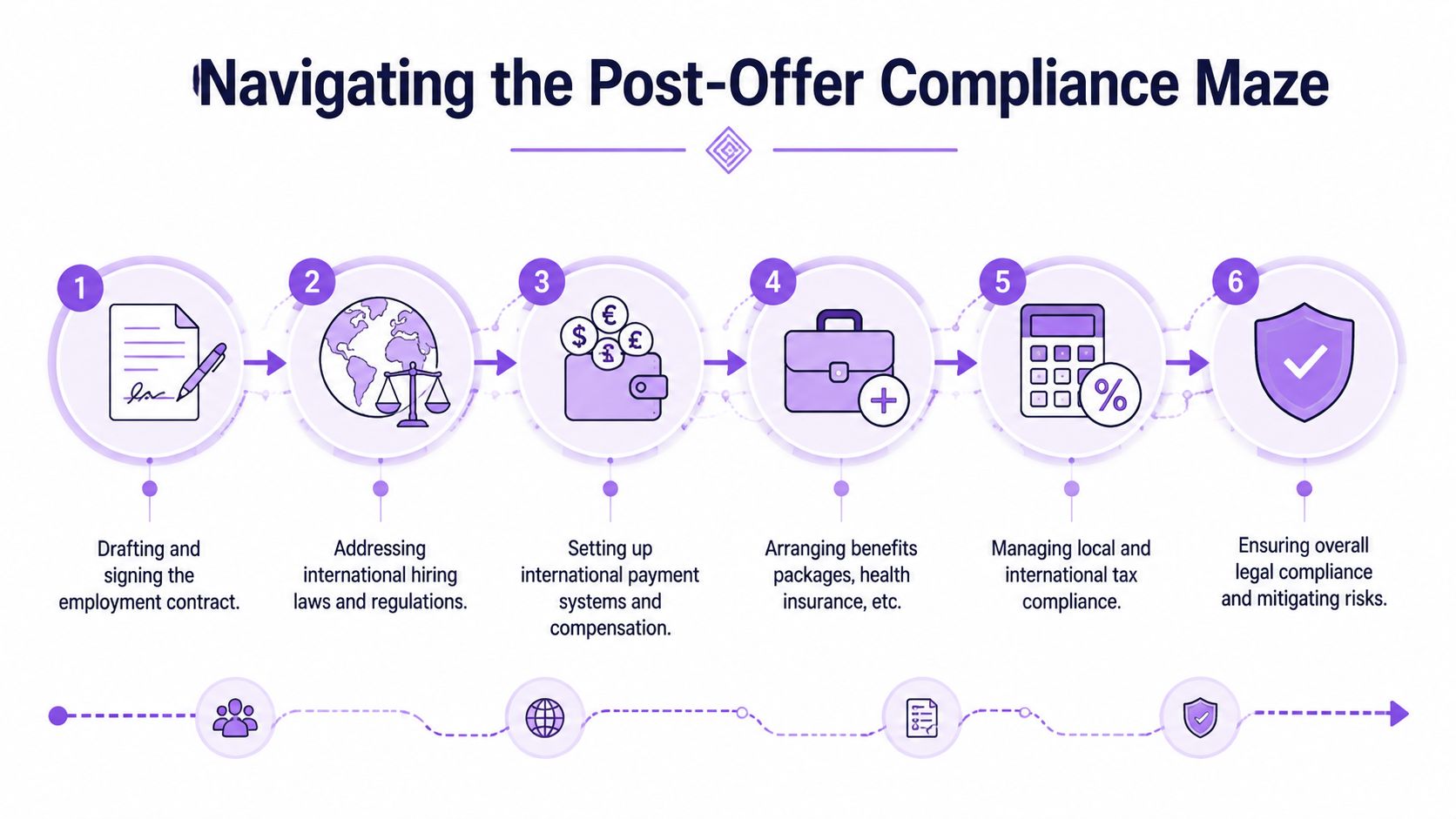
You found the developer. Great. Now comes the part where founders suddenly discover that hiring doesn't end at “you're hired.” It ends when the contract is signed, the payments are flowing correctly, the benefits are set up, and nobody has accidentally created a legal mess in another country.
DIY international hiring often gets weird. You're juggling compensation, classification, labor law, taxes, and payroll across jurisdictions. One wrong assumption and your exciting growth move turns into a compliance headache with a side of panic.
If you're hiring abroad, the first question is whether the person is a contractor or an employee. That distinction matters a lot. Different countries treat the relationship differently, and pretending the distinction is cosmetic is a fast way to create risk.
Set compensation with local reality in mind too. Don't just convert your U.S. salary into another currency and call it generous. The market, the role scope, and the engagement model all shape what fair looks like. This isn't the place for improvisation.
Once the offer is accepted, the admin stack starts. Contracts need to be issued. Payments need a real system. Benefits may need local handling. Tax rules need to be respected. And every piece has to fit the country where the developer lives.
If that sounds like a lot, it is. That's why many teams use an Employer of Record model, which lets a third party handle employment administration, payroll, and compliance while you keep the person on the team. A clear explanation of that model is available in LatHire's Employer of Record guide. It's the difference between hiring globally and accidentally becoming your own compliance department.
The smartest teams don't try to hand-roll everything. They use systems that keep the offer-to-payroll transition boring. That's a compliment. Boring compliance is good compliance.
If you're scaling internationally, this is one area where a platform can save you from becoming the person who knows too much about labor law by accident. You want your team building products, not reading tax forms at midnight.
A signed contract doesn't make a developer productive. Onboarding does. Or, more accurately, bad onboarding destroys productivity and then everyone pretends the hire “wasn't a fit.”
Remote onboarding is especially unforgiving. A welcome email and a repo link isn't a plan. It's a shrug. If the first week is chaotic, the new hire spends energy trying to decode your process instead of shipping anything useful.
The first month should be simple and deliberate. Set up their environment. Introduce them to the tools, repos, and deployment flow. Schedule 1-on-1s with the people they'll work with most. Give them one small, winnable project so they can get a real victory early.
That early win matters more than founders like to admit. It gives the developer context, confidence, and a sense that they're contributing to something coherent rather than wandering around a Slack maze. For broader guidance, the article on new hire onboarding best practices is a useful reference point if you want to compare your process against something more disciplined.
Remote and cross-cultural teams need more clarity, not less. Write things down. Repeat the important bits. Make expectations explicit. Silence feels efficient until it turns into confusion, then rework, then a “quick sync” that should've been a document in the first place.
The real test: if a new developer can't explain your process after two weeks, your onboarding isn't working.
The first 90 days decide a lot. Good onboarding turns a hire into a contributor. Lazy onboarding turns a good hire into a frustrated one, and frustrated people eventually leave. If you've done the earlier steps right, don't blow it now by pretending onboarding is just HR's problem.
Hiring web developers is a process, not a gamble. If you want fewer bad hires, stop winging it. Define the mission, write a job post that makes sense, source beyond the usual noise, test for real work, and handle the post-offer mess like a grown-up. If your team is ready to hire without wasting months on guesswork, start by tightening your role brief and then build the process around it.