

You wake up to a Slack ping from payroll, and suddenly the contractor who's been “basically full-time” for six months has an invoice that looks suspiciously like a salary. Then a recruiter forwards a candidate note about a messy prior termination, and you realize you've got three countries, two time zones, and one half-baked policy stack holding the whole thing together.
That's when employment law compliance stops being a webinar phrase and becomes the thing standing between you and a very bad Friday. The lawsuits get the headlines, sure, but the damage usually starts quieter, with misclassification, missing notices, sloppy records, and data handling that would make a labor lawyer reach for a headache tablet.
For founders, the hard truth is simple. Compliance isn't a legal side quest. It's how you hire, pay, monitor, document, and terminate people without building a future problem out of today's shortcut. If you want a practical reference for a country-specific setup, 2026 HR compliance checklist Ireland is a useful example of how local rules get operationalized instead of hand-waved.
The worst compliance problems rarely arrive with sirens. They arrive as a small inconsistency that everyone ignores because the team is busy, cash is tight, and the product is on fire in a more glamorous way.
A contractor has set hours, uses company tools, and reports to the same manager as the employees. Nobody pauses because the person is good, the work is real, and the agreement says “independent contractor.” Then one day the invoice lands on finance's desk, and it's obvious the paper trail and the working relationship don't match.
That's how founders get dragged into the long, boring machinery of enforcement. In the U.S., the Department of Labor's Wage and Hour Division reported 16,924 concluded compliance actions in FY 2025, down from 33,146 in FY 2013, which still leaves a serious amount of federal scrutiny on the table, with recent peaks of 29,483 in FY 2014 and 28,397 in FY 2018 showing this has stayed high for years rather than spiking once and fading away (U.S. Department of Labor chart).
Practical rule: if your people ops process can't survive a regulator reading it aloud in a conference room, it's not a process yet.
The other trap is the quiet one. A candidate mentions a prior shady layoff, a manager wants to “move fast” on a background check, or payroll starts storing more personal data than anyone can justify. That's when a founder learns that compliance is not only about avoiding lawsuits, it's about surviving repeated administrative review in one of the world's biggest labor markets.
The useful mindset is blunt. If a decision touches pay, classification, leave, privacy, or termination, write it down. If you can't explain the decision later, assume someone else will explain it for you.
Employment law compliance is the operating system behind every hire and every exit. It decides who you can bring in, how you pay them, what you owe them when things go sideways, and how you prove you did the right thing after the fact.
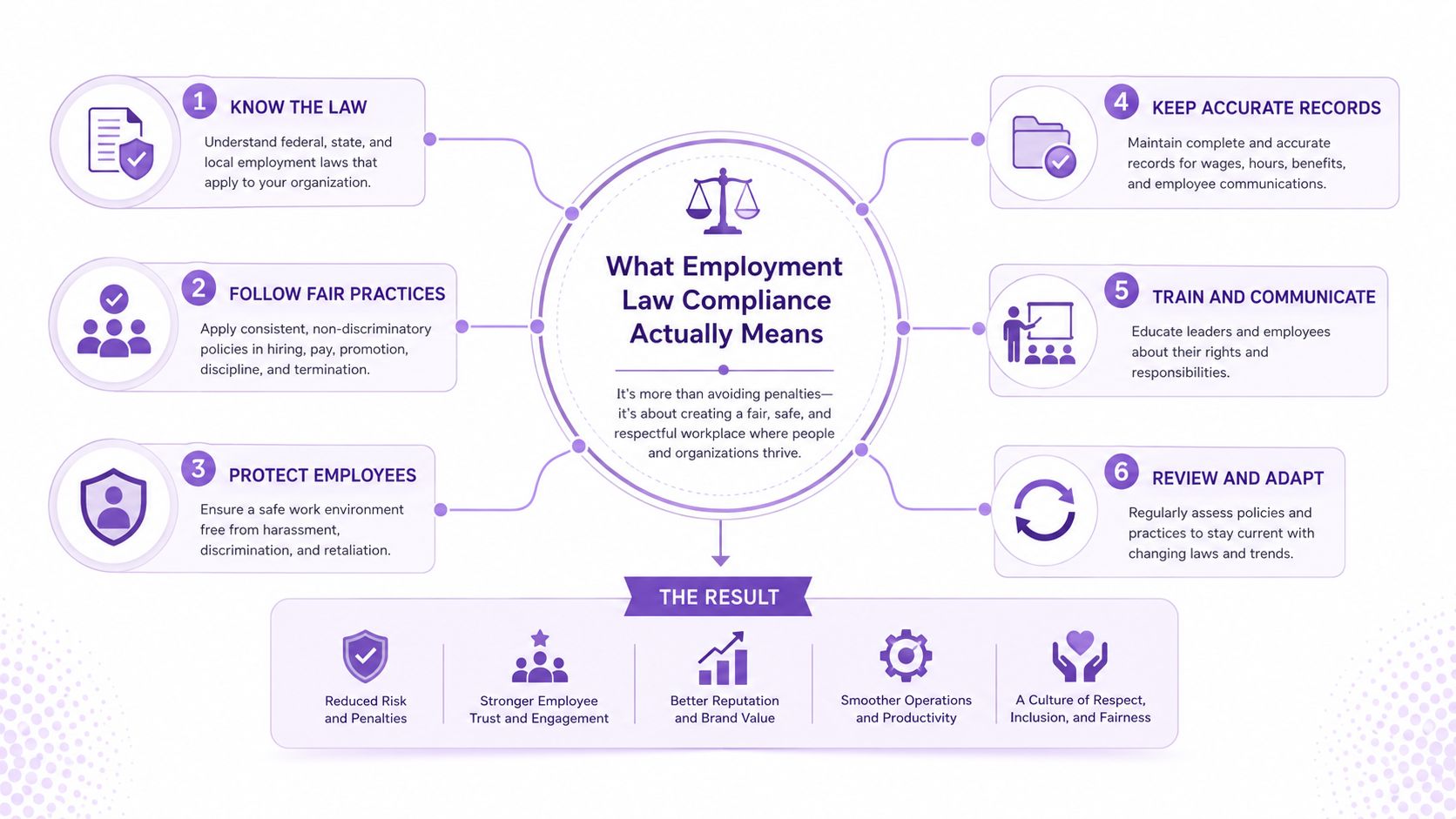
Start with classification. Employee or contractor, exempt or non-exempt, local hire or cross-border worker. Get this wrong and every downstream decision gets shakier.
Then there's compensation and hours, which sounds straightforward until you're juggling overtime rules, salary thresholds, and local pay disclosures. Add leave and accommodations, because sick leave, family leave, and disability-related adjustments don't care how small your team is. The next pillar is workplace safety, which includes the obvious physical stuff and the less obvious obligations tied to how work is organized.
The last two pillars are where a lot of founders get sloppy. Data and privacy rules control how you handle employee and applicant information, and termination rules dictate how you end a relationship without turning a normal business decision into a legal mess.
A 25-person startup and a 500-person scaleup fail differently. The small company usually breaks because the founder improvises too much and documents too little. The larger company usually breaks because policies exist, but nobody knows which version applies to which worker in which place on which day.
Useful habit: if a policy exists but no manager can find the current version in under two minutes, it might as well not exist.
For a UK-flavored overview that keeps the focus on day-to-day HR decisions, DynamicsHub on UK HR rules is a good example of how broad compliance gets translated into practical workplace administration.
The clean mental model is this. Inputs go in, decisions come out, and every decision needs a record. Compliance isn't a binder on a shelf. It's the controls around hiring, payroll, leave, privacy, and exits.
Same role, same recruiter, three different legal answers. That's the fun part of cross-border hiring, the kind of fun that makes lawyers expensive and founders slightly puffy-eyed.
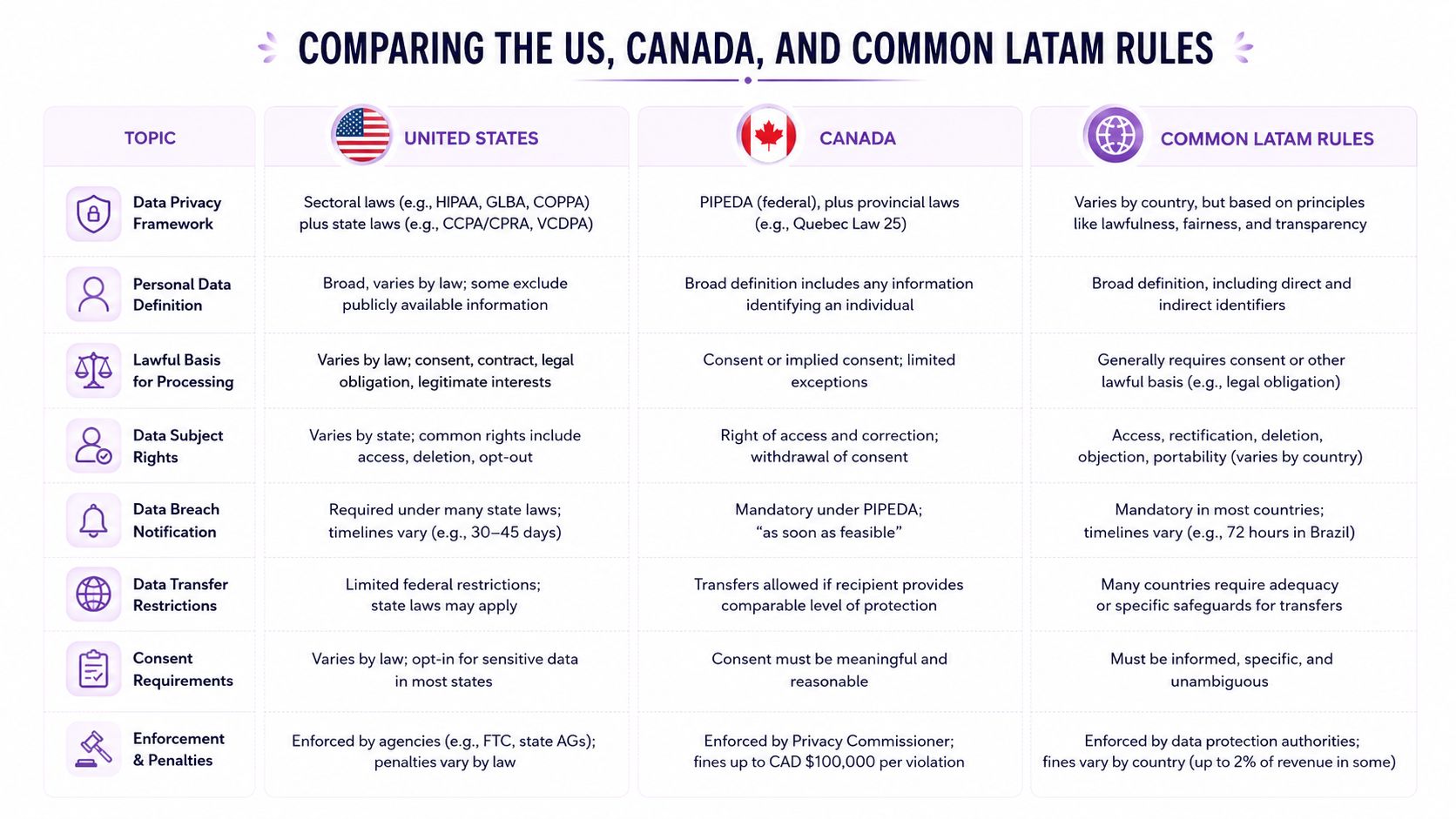
In the United States, employment law is a layered mess of federal, state, and local rules. Thresholds matter, because statutes such as Title VII apply at 15 or more employees, the ADEA at 20 or more, and the FMLA at 50 or more employees within 75 miles of a worksite (HR compliance threshold overview). Cross one of those lines and your legal obligations change under your feet.
In Canada, the default mental model is different. You don't get to rely on a single national answer and call it a day, because provincial rules matter a lot, and termination often turns on notice obligations rather than a pure at-will style assumption. That means the same employment decision can need a different paper trail depending on where the worker sits.
Across LATAM, the common trap is assuming local hiring works like a U.S. contractor arrangement with a different accent. It doesn't. Many markets bring statutory benefits, stricter employment protections, and more formal termination handling into the mix. Brazil's CLT-style framework is not a casual suggestion, and Mexico is not Texas with better weather.
| Area | United States | Canada | Common LATAM Rules |
|---|---|---|---|
| Hiring model | Heavily shaped by federal, state, and local rules | Strong provincial overlay | Often more formal employee protections |
| Worker status | Contractor tests can vary by jurisdiction | Classification matters, but local practice differs | Contractor labeling alone is not enough |
| Termination | Statutory triggers depend on headcount and location | Notice and common-law style obligations are often central | Notice, severance, and process can be more rigid |
| Benefits | Varies widely by statute and employer policy | More structured by province and plan design | Statutory benefits are often a bigger baseline issue |
| Compliance posture | Fragmented, threshold-driven | Provincial and federal layering | Local labor code often drives the process |
The operational point is ugly but useful. “Remote” is not a jurisdiction. It's usually three jurisdictions stacked on top of each other, with payroll, privacy, and termination rules all trying to bite at once.
The contractor shortcut is popular because it feels clean. Less payroll overhead, less benefits admin, less paperwork. Right up until someone asks whether the relationship was ever defensible in the first place.
A signed independent contractor agreement is not magic. If the person works like an employee, gets managed like an employee, and depends on you like an employee, the label starts looking decorative. That's the problem, not the form.
The hidden cost is bigger than misclassification alone. If the contractor role later has to be treated like employment, the business can also run into IP assignment gaps, benefits exposure, and backpay headaches that turn a cheap hire into a very expensive cleanup project. That's especially painful for agencies and startups that build around fast delivery and assume every contributor relationship can be standardized.
The question isn't “Can we call them a contractor?” It's “Can we defend the relationship if someone reads the facts instead of the label?”
Founders also underestimate how often good intentions fail in practice. The manager wants urgency, the recruiter wants flexibility, and nobody wants to slow down a strong candidate by opening the classification debate. That's how bad defaults happen.
If you're using contractors, treat classification like a legal decision, not a vibe. Document the scope, the independence factors, the IP terms, and the business reason for the structure. If you can't explain why the role is separate from your employee core, you're probably pretending.
For a more tactical look at the mechanics, this contractor classification guide is worth using as a sanity check before you hand someone access to everything and hope for the best.
Remote hiring doesn't fail because someone lives far away. It fails because the company assumes distance only changes Slack response times. The legal mess usually starts somewhere else entirely.
Payroll across borders is rarely just a finance issue. Different currencies, different pay cycles, different statutory deductions, and different local expectations can all collide in one monthly run. If your systems can't tell which worker is governed by which rules, finance becomes the accidental compliance team.
Data privacy is the other sleeper problem. Under GDPR, HR teams handling employee or applicant data need appropriate technical and organizational measures, including encryption, access controls, and staff training, plus a record of processing activities. For higher-risk work like employee monitoring or background checks, a DPIA is recommended, and certain personal data breaches must be reported within 72 hours when required (GDPR compliance brief for HR). That's not abstract. That's what happens the moment a candidate in Lisbon fills out your form and your U.S. team casually exports the data into five places.
The Berkeley Tech and Work Policy Guide takes a stricter line than many founders expect. Employers must give detailed prior notice before electronic monitoring, cannot rely primarily or exclusively on monitoring data for hiring, firing, discipline, or promotion, and must conduct bias audits on digital technologies before use and annually thereafter (Berkeley Tech and Work Policy Guide). That means surveillance software is not a plug-and-play fix, it's a governance project.
I've seen teams call themselves remote-first, then accidentally create different benefits tiers by country, manager, or employment type. Nobody intended it. The policy drift just happened because nobody owned the map.
If your workforce spans time zones, your biggest risk isn't the meeting schedule. It's the false assumption that every worker is governed the same way.
The warning sign usually shows up weeks before the explosion. A manager says, “I thought that person was covered.” Finance says, “We never got the local paperwork.” HR says, “Which version of the policy did they sign?” That's the sound of a system that never decided which rules applied to which worker on which day.
Theory is cheap. Payroll still hits on Monday.
Run a monthly review with six ugly but useful checks. Start with a classification audit, then reconcile payroll against contracts and time records. After that, check policy version control, review leave and accommodation logs, clean up retention schedules, and schedule a quarterly legal update sweep so you're not learning about new rules from an angry email.
You don't need a 40-person HR department to do this. You need discipline and a folder structure that doesn't look like a crime scene.
Some files are theater. Some files save you. The difference is whether a stranger can reconstruct the decision later without guessing.
For templates, employment contract templates are only useful if they reflect the actual relationship and jurisdiction. A pretty template that ignores the facts is just expensive wallpaper.
There's a reason EOR-style models exist. They take the messiest parts of cross-border employment and move them into a system that already knows how to handle local payroll, benefits administration, legal support, and the difference between a contractor structure and full-time employment. That doesn't erase risk, but it does stop every hire from becoming a bespoke legal project.
LatHire is one of the platforms that packages that model for US and Canadian companies hiring in Latin America. It supports cross-border recruiting with HR, international payroll, benefits, and legal compliance tooling, which is useful when the alternative is stitching together five vendors and a prayer. If you want the mechanics, this EOR explainer is the relevant reference.
The trade-off is obvious, and founders should say it out loud. You give up some direct control over the employment relationship, and EOR is not free. But if you're hiring under 50 cross-border people, building a custom compliance stack usually means paying lawyers to reinvent a wheel that already exists.
The right move is to decide deliberately. If the role needs local employment, local payroll, and real legal coverage, use a model built for that. If it doesn't, don't force the problem into an employee-shaped hole just because it feels tidy.
The habit that matters most is a documented decision trail. Every hire, classification, termination, and policy change gets a short memo with a date, a reason, and a name attached.
That one habit would've saved the Friday from hell. Payroll would've had a record, the manager would've had a rationale, and the lawyer would've had something better than folklore to work with. You're not trying to be unassailable. You're trying to be legible.
If you're hiring across borders, stop improvising and build the decision trail now. Pick one person to own the monthly compliance review, clean up the classification records, and lock your current policy versions into one place before the next Slack ping turns into a legal scramble.