
You're probably living this right now.
A role has been open for weeks. You've paid for job boards, pinged recruiters, posted a polished update on LinkedIn, and told yourself your company has a “great culture.” Then the applications roll in and half of them are wildly off target. The strong candidates ghost. The one person you like gets to final round and takes another offer.
That's not a sourcing problem. It's usually a branding problem.
I learned this the expensive way. Founders love to talk about hiring like it's a pipeline math issue. More ads in, more candidates out. Cute idea. In reality, candidates are screening you just as hard as you're screening them. If your company feels vague, generic, or inconsistent, they move on. Efficiently. Without sending you a little note explaining why your careers page reads like every other SaaS company on earth.
Employer branding for recruitment isn't about looking impressive. It's about making the right people want to talk to you before compensation becomes the whole conversation.
A ping-pong table is not a talent magnet. Neither is “we move fast,” “we're like a family,” or “free snacks.” That stuff doesn't separate you. It makes you sound like you copied your careers page from a startup template in 2018.
I've seen founders throw money at hiring while ignoring the obvious. The company says it values ownership, but every interview requires five approvals. The company says it cares about growth, but no one can explain how promotions work. The company says remote-first, but the final interview reveals a secret preference for people who live near HQ. Candidates notice. Then they bail.
That disconnect is your employer brand.
Your employer brand isn't what you say in a slide deck. It's what people believe after checking your website, your reviews, your job posts, your hiring process, and the humans they meet along the way.
And yes, candidates do the homework. 75% of candidates investigate a company's reputation and online presence before applying, while 86% actively evaluate reviews and ratings when considering job applications, according to Zippia's employer branding statistics roundup. If your public footprint is thin, messy, or contradictory, your funnel leaks before it even starts.
Your careers page is not the first impression. It's the confirmation step.
That's the painful bit. By the time someone reads your job description, they may have already formed an opinion from your leadership posts, employee comments, review sites, and whether your company looks coherent online.
Here's the blunt version. Candidates don't join because you offer kombucha. They join because they can answer a few basic questions fast:
If your brand doesn't answer those questions, your recruiters end up doing manual damage control in every intro call.
Most hiring problems people call “talent shortages” are really messaging failures mixed with process sloppiness. You're not invisible because no one wants the role. You're invisible because your company hasn't made a clear case for why a smart person should care.
A strong employer brand gives candidates a simple story they can repeat. Not corporate wallpaper. A story.
Short version? If your hiring depends on job boards doing all the heavy lifting, you don't have a recruiting engine. You have a slot machine.
Let's talk money, because it's the point at which the fluffy employer-branding nonsense falls apart and the useful version starts.
A strong employer brand is not an HR side quest. It's a financial lever. When your reputation pulls candidates in, you spend less chasing them, less convincing them, and less replacing the people who never should've been hired in the first place.
Here's the visual most leadership teams need:
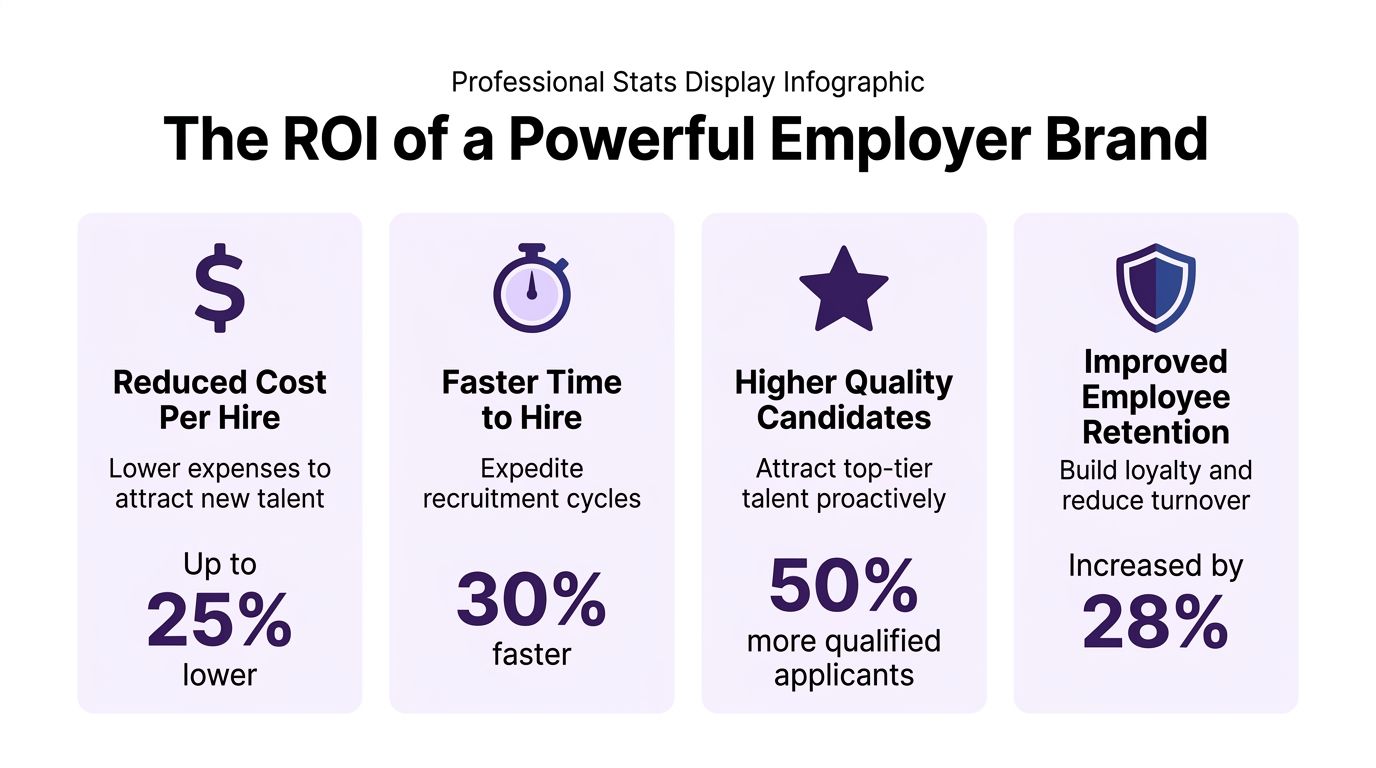
The strongest number in the room is usually cost-per-hire. If that number is ugly, everything else gets tense fast. Companies that invest consistently in their employer brand save an average of 50% on recruitment costs, which translates to a 43–50% reduction in cost per hire across multiple studies, according to Searchlab's 2026 employer branding statistics.
That should reset the conversation immediately.
You can keep overspending on recruiters and job boards, or you can build a company people already want to talk to. Turns out there's more than one way to hire elite people without mortgaging your office ping-pong table.
Employer branding pays twice.
First, it lowers acquisition cost. Better-fit candidates arrive warmer, faster, and with fewer objections. Your team spends less time dragging people through the funnel.
Second, it improves retention and satisfaction when the story matches reality. That matters because replacing a bad-fit hire is where the hidden bill shows up. The recruiting invoice is only the appetizer.
Here's the operating logic in plain English:
| Brand signal | What it changes | Why finance should care |
|---|---|---|
| Clear EVP | Better-fit applicants | Less wasted screening time |
| Consistent candidate experience | Higher trust during interviews | Fewer drop-offs and reneged offers |
| Honest storytelling | Better expectation setting | Lower regret hires and less churn |
Practical rule: If your hiring team has to “explain what the company is really like” on every call, your employer brand is underperforming.
Often, people get weirdly superficial or weirdly lazy. Visual presentation matters, especially on leadership pages, team bios, and recruiting materials. Sloppy photos signal sloppy operations. Over-produced photos signal a brand team covering for reality. The sweet spot is credible and professional. If your team needs a better baseline, this essential guide for crafting business portraits is useful because it focuses on how people truly appear in company-facing material, not just vanity shots for a brochure.
That's not decoration. It's signal design.
Candidates are asking themselves one quiet question through the whole process: “Do these people have their act together?” Your employer brand answers before anyone says a word.
Organizations often make employer branding for recruitment harder than it needs to be. They start with slogans. Wrong move. Start with reality, then package it cleanly.
I use a three-part framework. Not because frameworks are sexy. They aren't. I use it because it stops teams from publishing nonsense no employee would recognize.
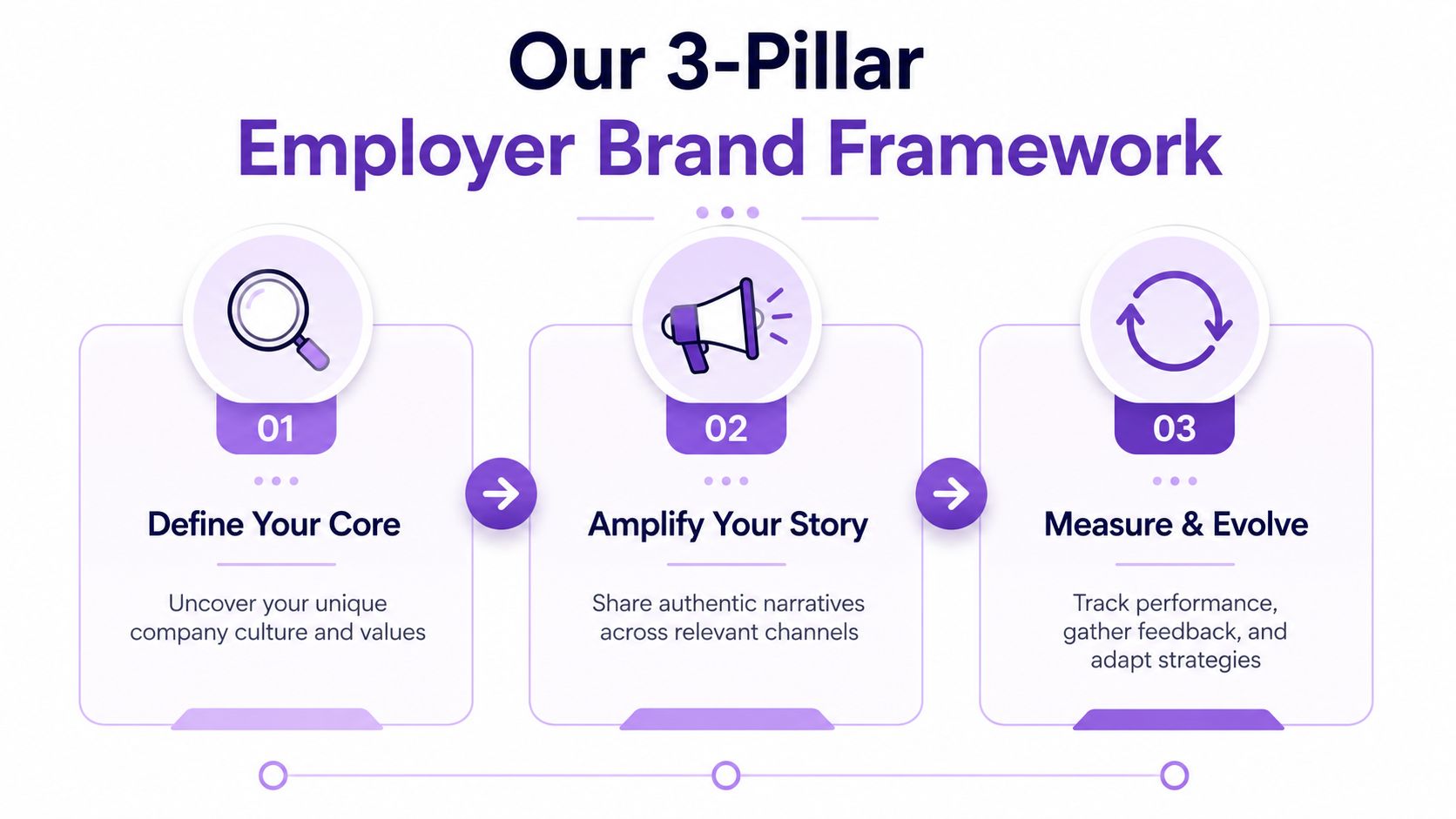
This is your Employee Value Proposition, or EVP if you enjoy acronyms. Strip away the jargon and the question is simple. Why would a high-quality person choose to work here and stay?
Not “what benefits do we offer.” Bigger than that.
For tech and SaaS companies, getting this right is worth real operational gains. Effective employer branding yields a 28–50% reduction in cost-per-hire, a 50% increase in qualified applicants, and up to 50% faster time-to-fill positions, with specialized technical roles typically filling 45–60 days faster when brand metrics are strong, according to Nobel Recruitment's analysis of SaaS employer branding ROI.
Start by answering these without fluff:
If your leadership team gives five different answers, your brand isn't unclear. It's fragmented.
Your brand lives or dies in the process. Candidates don't remember your values page if your scheduling is chaotic, your interview panel is unprepared, or your rejection emails sound like they were written by a sleep-deprived robot.
Audit the basics:
Hope you enjoy spending your afternoons fact-checking resumes and running technical interviews, because that's your full-time job if your front-end brand attracts the wrong people.
Candidates want evidence, not adjectives. “Collaborative.” “Progressive.” “Dynamic.” Fine. Show me.
Use employee stories, day-in-the-life posts, hiring-manager notes, product milestones, and examples of how remote teams work together. Specific beats polished every time.
If you need a model for turning loose brand thinking into something usable, these real-world brand guideline samples are handy. Not because you need a fifty-page brand bible, but because recruiting content falls apart when nobody agrees on voice, visuals, and basic message discipline.
If an employee reads your careers page and says, “That doesn't sound like us,” stop publishing and fix the foundation.
Frameworks are nice. Monday morning is nicer. Here's the version you can run.
Start by reading everything a candidate would read. Careers page. LinkedIn company page. Leadership bios. Job descriptions. Review-site comments. Recruiter templates. Interview email copy.
Then talk to people inside the company. Not just your loyalists. Talk to recent hires, top performers, people in the middle, and one or two employees who are constructive but not easily impressed. Ask where the company story feels true, where it feels vague, and where the hiring process overpromises.
Use a simple scorecard:
| Area | What to check | Red flag |
|---|---|---|
| Careers page | Clear story and role context | Reads like generic HR copy |
| Job posts | Specific scope and expectations | Laundry list of demands |
| Interview process | Consistency across interviewers | Everyone tells a different story |
| Candidate communication | Speed and tone | Delays, ghosting, robotic replies |
Don't keep your employer brand in someone's head. Document it.
That means a short EVP statement, a few proof points, standard messaging for recruiters and hiring managers, and clear rules for how the company talks about itself in hiring. Not sterile scripts. Guardrails.
A useful document usually includes:
If your recruiting team and hiring managers freelance the company narrative, candidate trust drops fast.
Often, teams get distracted by employer-brand videos no one asked for. Skip the vanity project. Fix the touchpoints candidates already use.
Rewrite the careers page. Improve the top job descriptions. Tighten the recruiter outreach. Train interviewers to explain the company in the same language. Add employee proof where it helps. Cut the chest-thumping.
Candidates forgive a smaller brand. They don't forgive confusion.
For remote and cross-border hiring, this phase matters even more. Candidates are already taking a trust leap. They need to understand communication norms, time-zone expectations, growth potential, and whether your company treats remote hires like core team members or outsourced extras.
Employer branding isn't a launch. It's upkeep.
Set a recurring review. Look at candidate questions, offer declines, referral quality, comments from new hires, and where the process still creates friction. When a pattern repeats, don't explain it away. Update the message or fix the underlying issue.
If you're waiting for some magical rebrand moment, you're stalling. Employer branding improves when teams tighten one touchpoint at a time and keep the promise consistent.
Vanity metrics are where good intentions go to die. I don't care how many impressions your “Meet the Team” post got if your offers keep getting declined.
Measure the hiring outcomes that reveal whether your employer branding for recruitment is pulling its weight.
Here's the visual shortcut:
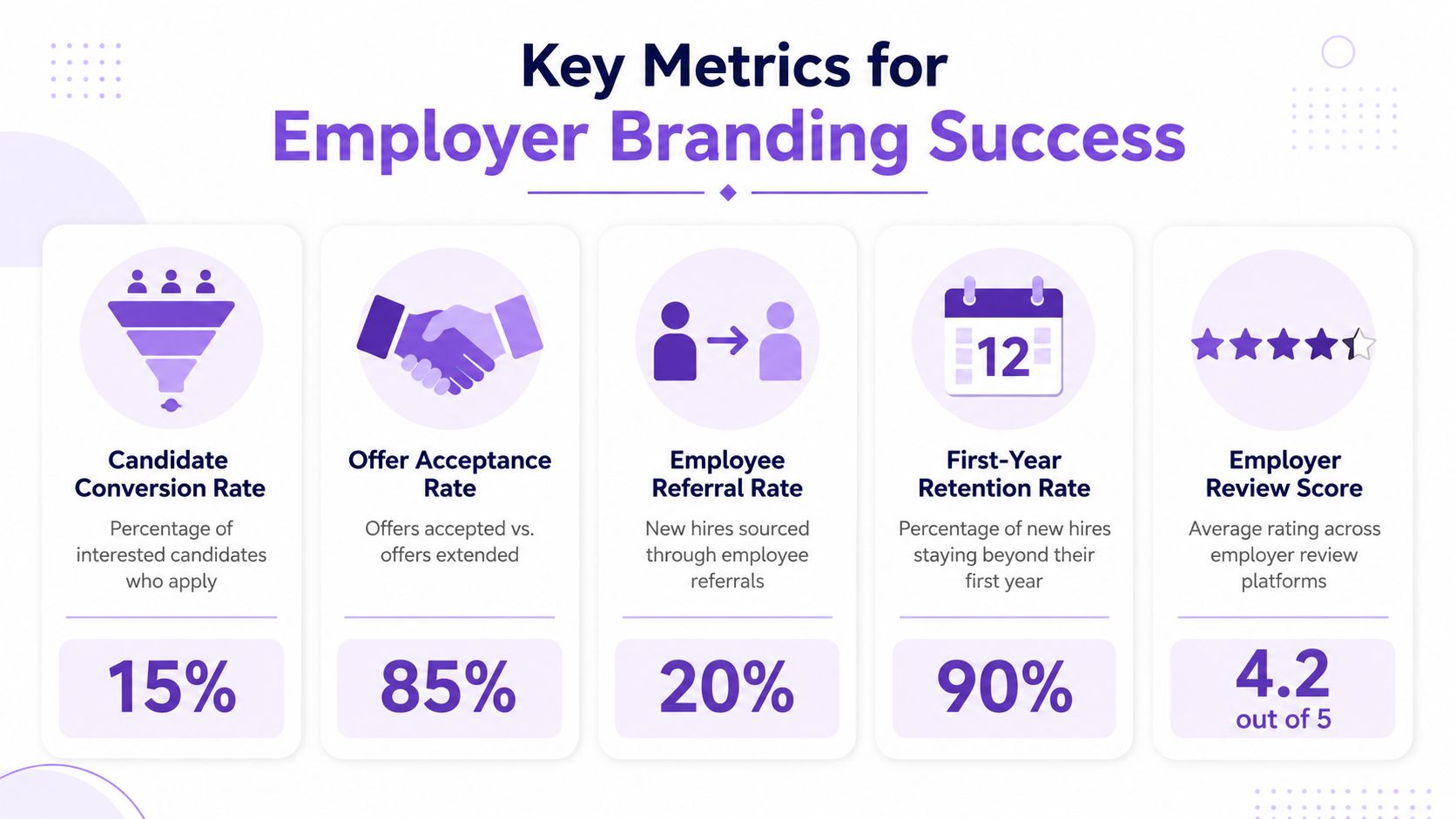
Track a small set of indicators and make them boringly consistent.
That's the dashboard. Not follower count. Not applause from other founders on LinkedIn.
Many teams grow complacent. They apply domestic benchmarks to global hiring and then wonder why the numbers feel fuzzy.
The gap is real. While 80% of companies now hire remotely, only 12% publish employer brand metrics tied to international talent acquisition success, according to CPS HR Consulting's discussion of employer branding in recruitment. That means most companies hiring across borders are operating with half a dashboard and a lot of vibes.
If you're hiring in Latin America, track metrics by geography and role family. Separate local hires from cross-border hires. Compare acceptance patterns, interview drop-offs, and retention by market. A blended average hides useful truth.
For a cleaner way to think about reporting, use a recruitment analytics view that ties brand activity to hiring outcomes, not just top-of-funnel noise. This guide on recruitment analytics is a solid starting point for structuring that dashboard.
The metric only matters if it changes a decision.
A falling cost per hire can mean your brand is attracting inbound interest. Good.
A falling time to fill can mean your EVP is clearer and candidates trust the process faster. Also good.
But if offer acceptance rises while first-year retention drops, don't celebrate too hard. You may have improved persuasion while damaging accuracy. That's not branding success. That's a shinier mismatch.
Theory is cheap. Let's make it real.
A U.S. SaaS startup needs senior engineers. The founders assume the answer is compensation. Then they run into the obvious problem. Bigger companies can usually pay more, promise more logos on a résumé, and throw a shinier package on the table.
So the startup has to win differently.
It sharpens the mission, clarifies product ownership, and tells candidates exactly how much autonomy senior engineers get. The interviews reinforce the same message. Small team, direct influence, fast decisions, real product impact. Not “we're disrupting the future.” Actual specifics.
That approach matters because a 2026 Mercer survey found that 67% of professionals sent an unsolicited application based on a strong employer brand, and mission-driven branding outranked salary increases of up to 15% in 11 of 27 markets, as summarized in Amra & Elma's employer branding statistics roundup.
The lesson is simple. If you can't outbid the market, out-clarify it.
Now the more interesting one.
A growth-stage company needs to build a team of remote professionals in Latin America. Not random freelancers. Real long-term hires who can plug into the business, work in overlapping time zones, and grow with the company.
Generic employer branding often falls flat. A company needs a micro-brand for the region. Not a fake personality. A focused version of the truth.
That means speaking clearly about:
The companies that get this right don't just translate a U.S. careers page into Spanish or Portuguese and call it strategy. They adapt the message to the candidate's real questions.
If you're hiring in the region, this breakdown of employer branding when hiring in LATAM is worth reading because it focuses on trust, expectations, and market-specific positioning instead of generic “remote culture” fluff.
Different markets. Same rule.
Candidates join clear stories, not vague promises. They want to know what they're walking into, who they'll work with, and whether your company respects their ambition. Toot, toot. That sounds obvious. Yet a shocking number of hiring teams still lead with perks and slogans.
At some point, manual hiring turns into a self-inflicted wound.
You can absolutely run employer branding for recruitment with spreadsheets, disconnected tools, generic job boards, and heroic effort from your internal team. You can also eat soup with a fork. Doesn't mean it's a good plan.
Specialized hiring platforms can strengthen your employer brand if they reinforce the message you want candidates to receive. Generic job boards often flatten your identity. You become one more listing in a sea of listings. A focused platform can do the opposite. It can signal quality, seriousness, and process maturity before a candidate even applies.
Here's the kind of environment that sends that signal:
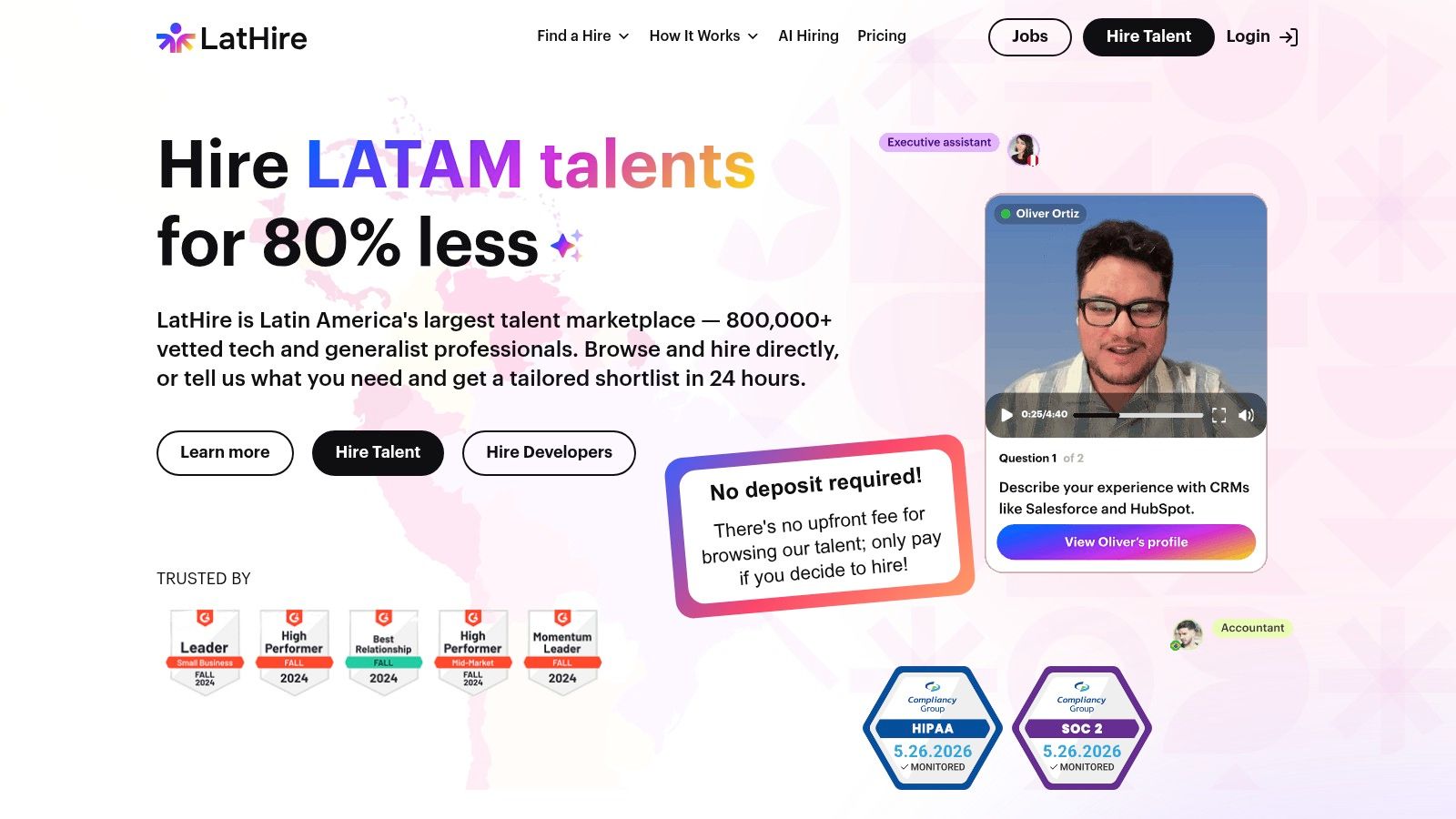
The biggest trap with automation is pretending candidates won't notice it. They notice. They always notice.
And the data cuts both ways. Recent studies show 67% of candidates perceive AI-rescreening as reducing human connection, yet companies that disclose their AI validation methods see 30% higher candidate acceptance rates, as noted in this LinkedIn summary on AI and employer branding. So the move isn't to hide automation. The move is to explain it well.
Tell candidates what the system evaluates. Tell them how human review fits in. Tell them why the process exists. Framed properly, automation becomes a signal that you care about consistency and fairness, not just speed.
When a company uses a platform with pre-vetted talent, structured skills validation, and cross-border compliance support, it sends a message.
It says:
That's branding. Operational branding, but branding all the same.
If you're tightening the top of funnel and the candidate journey together, think about recruitment marketing as part of the same system, not a side project. This guide to recruitment marketing is useful if you want the messaging layer and the hiring engine to stop fighting each other.
The best platforms don't replace your employer brand. They amplify it, or expose that you never had one.
If your hiring feels harder than it should, fix the story before you buy more distribution.
A credible employer brand lowers friction, attracts better-fit candidates, and gives remote hiring a backbone, especially across borders. If you want help turning that into an actual hiring system, LatHire helps U.S. and Canadian companies hire pre-vetted Latin American talent with AI-powered matching, skills validation, and cross-border support built in.