

You know the moment. The job post is live, your inbox is full, and somehow the candidates look like they came from three different planets. One's a BI engineer who wants to rebuild your entire warehouse. One's a marketing analyst who can talk attribution until lunch. One's a junior data scientist who keeps saying “modeling” like it's a personality trait. None of them is the analyst you need.
That's the core problem with data analyst hiring. Many teams start with sourcing, when they should start with triage. If you don't know whether you're hiring for reporting, product analytics, marketing insights, or a data-leaning ops role, you're basically shopping for a wrench while asking for plumbing, carpentry, and electrical work in the same sentence. Dumb process. Expensive mistake.
The first sign of trouble is usually the job description. It says “data analyst,” but what the team means is “someone who can make the dashboard, explain the dashboard, fix the spreadsheet, and occasionally tell the CEO why the numbers moved.” That's not one role. That's four.
The clean way to think about analyst hiring is by archetype.
Each one needs a different stack, a different seniority level, and a different interview rubric. A BI hire who thrives on monthly reporting may hate the ambiguity of growth work. A growth analyst who loves experimentation may be bored stiff in a pure reporting seat. If you treat them as interchangeable, you'll end up with a candidate who looked great in the process and feels wrong on day six.
Practical rule: if you can't explain the analyst's recurring decision in one sentence, you're not ready to hire them.
Here's the test I'd use before writing a single line of the JD. What decision will this person improve, who will use the output, and how often will it matter? If you can't answer that cleanly, you don't have a hiring problem. You have a definition problem.
That's why role clarity beats “strong resume” every time. A vague seat attracts vague candidates, then everyone wastes time pretending the mismatch can be fixed in interviews. It can't. First define the archetype. Then write the job. Then source. No archetype, no hire.
Most analyst JDs read like a keyword landfill. SQL. Python. Tableau. Excel. Maybe some “rockstar” nonsense if the founder had too much coffee. That kind of posting doesn't attract quality, it attracts people who are good at spraying résumés everywhere.
Start with the problem, not the tool stack. Candidates self-select much better when they know whether they're joining to improve product funnels, stabilize weekly reporting, or untangle customer acquisition data. A strong JD says what decision this hire will influence and what the business is trying to stop doing badly.
Then rank the technical stack by weight. Don't list everything as if each skill matters equally. Put the must-haves first, then the nice-to-haves, then the “if you have this, cool” extras. If SQL is mandatory and Python is helpful, say so. If dashboarding matters more than modeling, say that too.
Years of experience is a lazy proxy. Better signals are concrete outputs. Did the candidate own a dashboard used in leadership meetings? Did they build a recurring report that changed an operating decision? Have they worked with messy source systems and still shipped something trusted by non-technical stakeholders?
That's what seniority looks like in the wild. Not calendar time. Judgment. Ownership. Communication. People who can't explain the work to the business are usually not ready for a real analyst seat, no matter how pretty their GitHub looks.
Coursera's analyst interview guidance puts real weight on the ability to summarize EDA clearly, explain dashboard choices, and present recommendations to cross-functional audiences, which is exactly where a lot of teams get sloppy in hiring. They test SQL hard, then act surprised when the candidate can't make a recommendation sound like it belongs in a meeting. That's not a candidate problem. That's a hiring process problem. Coursera's data analyst interview guide gets this part right.
Here's a simple example of a better JD paragraph for a product analyst role:
“You'll partner with product and lifecycle teams to define weekly growth metrics, diagnose funnel drop-off, and turn analysis into decisions the team can act on. SQL is required, Python is useful, and dashboard fluency matters more than fancy modeling. We care less about years on a résumé and more about whether you can explain tradeoffs clearly to non-technical stakeholders.”
That reads like a real seat. Not a keyword soup. Also, retire words like “rockstar” and “SQL guru”. They don't make you sound modern. They make you sound unserious.
Generic sourcing advice is a trap. If you post everywhere and hope for signal, you'll spend your afternoons fact-checking resumes and running technical interviews like that's your full-time job. Hope you enjoy that lifestyle.
Traditional job boards like LinkedIn and Indeed still work for mid-level generalists, especially when the role is common and your bar is reasonable. The downside is obvious. They're flooded. You get volume, not necessarily fit.
Niche communities are the opposite. Places like Locally Optimistic, r/dataengineering, Kaggle forums, and dbt Slack can produce stronger specialist candidates, but only if you show up like a human and not a drive-by recruiter with a copy-paste pitch. If you want senior people, don't shout into the void. Participate. Comment. Build credibility.
AI-matched platforms with pre-vetted pools are a different animal. They help when speed matters and you do not want to manually sort through a giant applicant pile. LatHire is one such option, and it matters when you are open to Latin American talent and want candidates with validated skills, real-time availability, and overlapping North American time zones. If you are hiring a first analyst and do not have a recruiting machine, that shortcut is worth using.
A startup hiring its first analyst usually needs breadth. Someone who can clean data, build a dashboard, and help shape the reporting muscle of the company. That candidate may come from a broad job board or a curated pool.
A Series B team with five analysts already has the opposite problem. It needs specialization, not just another generalist with a tidy résumé. Niche communities and direct search tend to work better there.
If you want examples of how analyst resumes are commonly structured, the Resumey.Pro analyst resume examples are a useful reference point before you decide what kind of profile you're targeting. For a clearer breakdown of where candidates come from and how the pipeline works, the internal guide on candidate sourcing is worth reading.
Domestic hiring is not always the smartest move. Nearshoring Latin American talent is a real cost-quality lever when the seat is remote-friendly. If the work is analytical, asynchronous, and tied to clean communication, geography should be a business decision, not a habit.
Whiteboard SQL is a comfort blanket for hiring teams. It feels rigorous, but it often tests whether someone memorized syntax under pressure, not whether they can do the job. That's how you end up hiring people who ace interviews and then freeze when the data is messy and the stakeholder wants an answer by Thursday.
A strong analyst funnel starts cheap and gets expensive only when it should. The practical sequence is a role-specific skills test, then a cognitive ability test, then a realistic work sample, then a structured interview. That order matters because it filters fast before you burn interview time on people who can't clear the basics.
The skills test should hit the actual work. SQL, Python, visualization judgment, statistical reasoning, communication. Not trivia. Not trick questions. The goal is simple. Can the person operate in the role you posted?
Then comes cognitive ability, which helps you assess how someone thinks under complexity. After that, use a work sample that feels like the job. Not an absurd eight-hour monster. A realistic business problem with enough ambiguity to show judgment, but not so much that you're asking for free labor in disguise.
Good rubrics beat good vibes. If every interviewer scores candidates differently, you're not running a process, you're hosting a group opinion.
Teams love take-home tests until they realize they've built a system that rewards people with extra time and punishes people with better jobs, kids, or boundaries. A decent take-home should be short, relevant, and easy to evaluate. If it drifts into full project territory, you've gone off the rails.
Brainteasers are even worse. They rarely predict analyst performance, and they make the company look like it still thinks hiring is a clown show from 2014. Structured interviews are the last piece, not the first. Everyone asks the same questions, scores against the same rubric, and evaluates the same competencies. That's how you compare candidates without fooling yourself.
Testlify's recommended hiring workflow for analysts lines up with that exact logic, including the idea of standardizing scoring so every candidate is rated on the same rubric. Their guidance on pre-employment skills testing is a useful reminder that the point is prediction, not theater.
If you're still doing unstructured panels and hoping “chemistry” will save you, you're not screening for analyst performance. You're selecting for whoever was most polished on Zoom.
Cash matters. It just doesn't close the deal by itself. The second you post a vague analyst role with a soft process and a mediocre offer, you're competing against every other company that also thought it could wing this. With 54% of companies keeping headcount flat and hiring mainly to backfill roles, candidates know a good seat is worth waiting for Burtch Works hiring trends for 2025.
For a junior analyst, the pitch is learning speed, mentorship, and real exposure to decision-making. For a mid-level hire, it's autonomy plus scope. For a senior analyst, it's ownership, influence, and fewer bureaucratic headwinds. If you lead with salary alone, you sound like every other shop trying to buy attention.
Equity matters most when the company is early and the candidate is taking real risk. Flexibility matters almost everywhere, especially for analyst work that doesn't need constant in-person supervision. Remote-first usually beats hybrid because analysts do better when they can concentrate without being dragged into office choreography for no reason.
Mission is the last lever, but it still matters. Analysts like solving problems that connect to visible business outcomes. If your company can't explain why the work matters, the offer needs to do more heavy lifting than it should.
| Seniority | US Domestic | LatAm Nearshore | Global Remote |
|---|---|---|---|
| Junior | Higher base, usually paired with more structured mentorship | Lower base, often attractive for first full-time analyst roles | Varies by market and scope |
| Mid | Strong base plus scope-based growth story | Meaningful value when paired with ownership and clear expectations | Varies by market and scope |
| Senior | Highest base, often with equity or leadership runway | Competitive when the role has real autonomy and cross-border flexibility | Varies by market and scope |
I won't pretend to be exact here. The precise number depends on the archetype, the company stage, and the market you're hiring in. The mistake is low-balling “to leave room.” Candidates can smell that move from a mile away, and they walk fast when the process already feels tentative.
Many teams think retention starts with perks. It doesn't. It starts the minute the offer is accepted, and the first thing that usually breaks is access. Not culture. Access.
Week one should be about environment, permissions, data access, and the basics of how the company works. If the analyst can't get to the data, you're already telling them their time doesn't matter. That's how good hires sour.
Weeks two through four should be paired work with a senior partner. Not because they need hand-holding forever, but because context matters more than cleverness in the early days. Give them one or two concrete projects and let them learn the decision rhythms of the business.
By day 30, they should be able to explain the core metrics. By day 60, they should own a recurring deliverable. By day 90, they should have shipped something the team uses. If those checkpoints aren't real, your onboarding process is cosplay.
Retention levers for analysts are boring in the best way. Own a recurring decision. Own a metric the business cares about. Get exposed to leadership. Have a visible path to senior or staff. Let the analyst say, without fear, that an analysis isn't worth doing.
That last one matters more than people admit. Analysts burn out when they become dashboard janitors for every random request that wanders by. If everything is urgent, nothing is strategic. Snacks won't fix that. Swag won't fix it. Ping-pong definitely won't fix it, unless your retention strategy is mortgaging your office ping-pong table for vibes.
You want an analyst who stays? Give them work that compounds. Give them trust. Give them a reason to believe the role has a future beyond the next reporting cycle.
Founders start sweating into their keyboards. Fair enough. Cross-border hiring sounds bureaucratic because it is bureaucratic. But the trick is to treat it like a design choice, not a legal side quest you'll “deal with later.” Later is how people end up with expensive mistakes and sad calendar invites from lawyers.
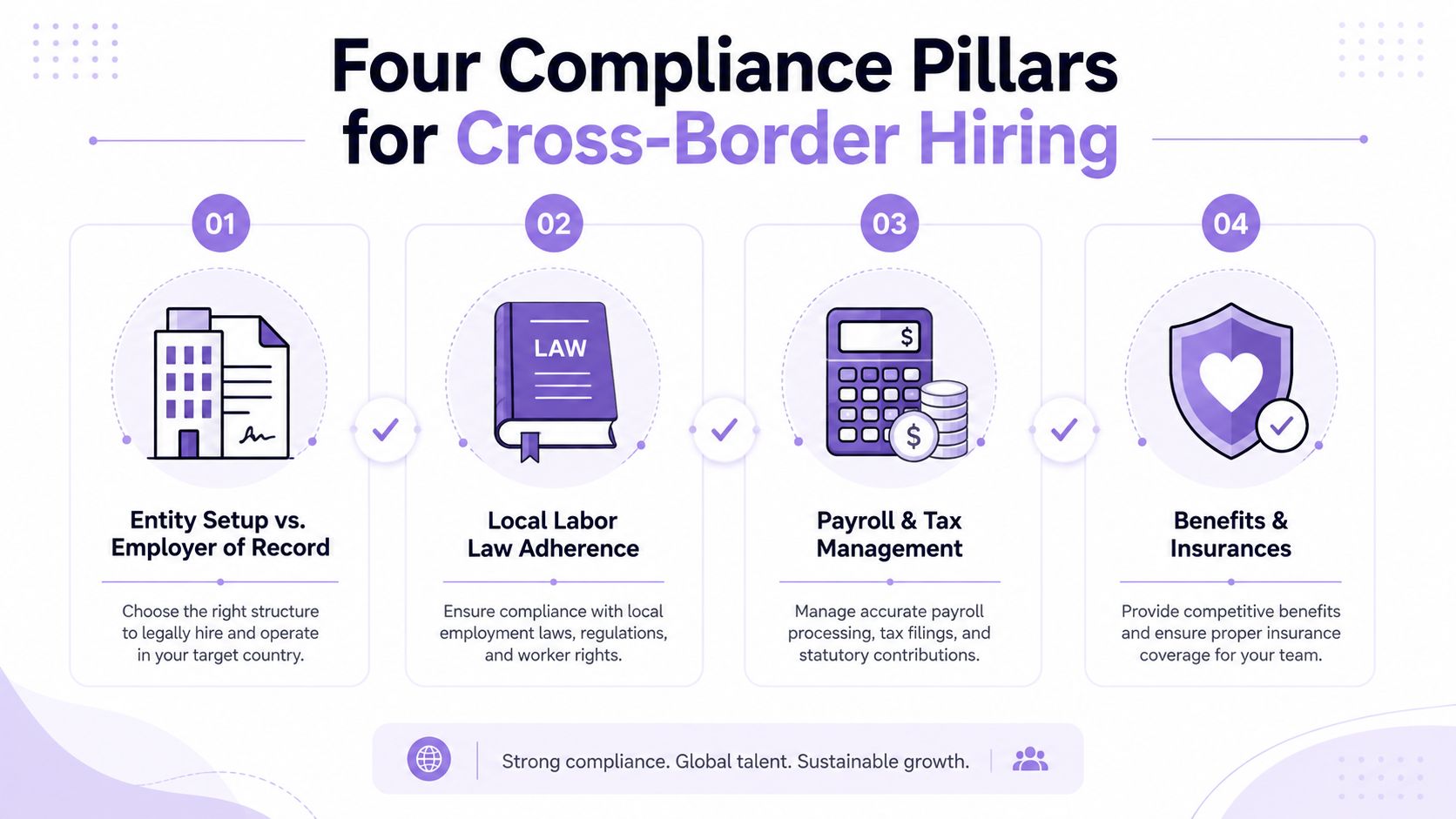
If you're hiring analysts in Latin America, you've got three common paths. Build your own entity. Use an Employer of Record. Or classify the person as a contractor if the relationship supports that. Each choice has consequences for payroll, taxes, benefits, and how much admin your team wants to absorb.
The honest view is simple. Building your own entity is usually a long, expensive project, and it only starts to make sense once you're doing a meaningful volume of cross-border hires. Before that, an EoR or a platform that bundles talent, payroll, and compliance is the rational move. If you want a working reference for this layer, LatHire also publishes a guide on international hiring compliance.
Labor law changes country to country, and so do termination rules, benefits, tax handling, and IP assignment. A generic contract copied from your US playbook is not a magic shield. It's a shortcut to confusion.
Put the boring clauses in writing. Work schedule, overlap hours, equipment, confidentiality, tax treatment. Make expectations explicit. If the analyst is working across borders, you need clarity on who owns what, when they're available, and how they get paid. Otherwise, every small issue turns into a meeting nobody wanted.
If you're hiring your next analyst now, stop treating this like a résumé contest. Decide what the role is, choose the right sourcing lane, and run a process that measures real work instead of interview polish. Then make the offer cleanly, onboard like you mean it, and pick the compliance setup before legal starts chasing you.