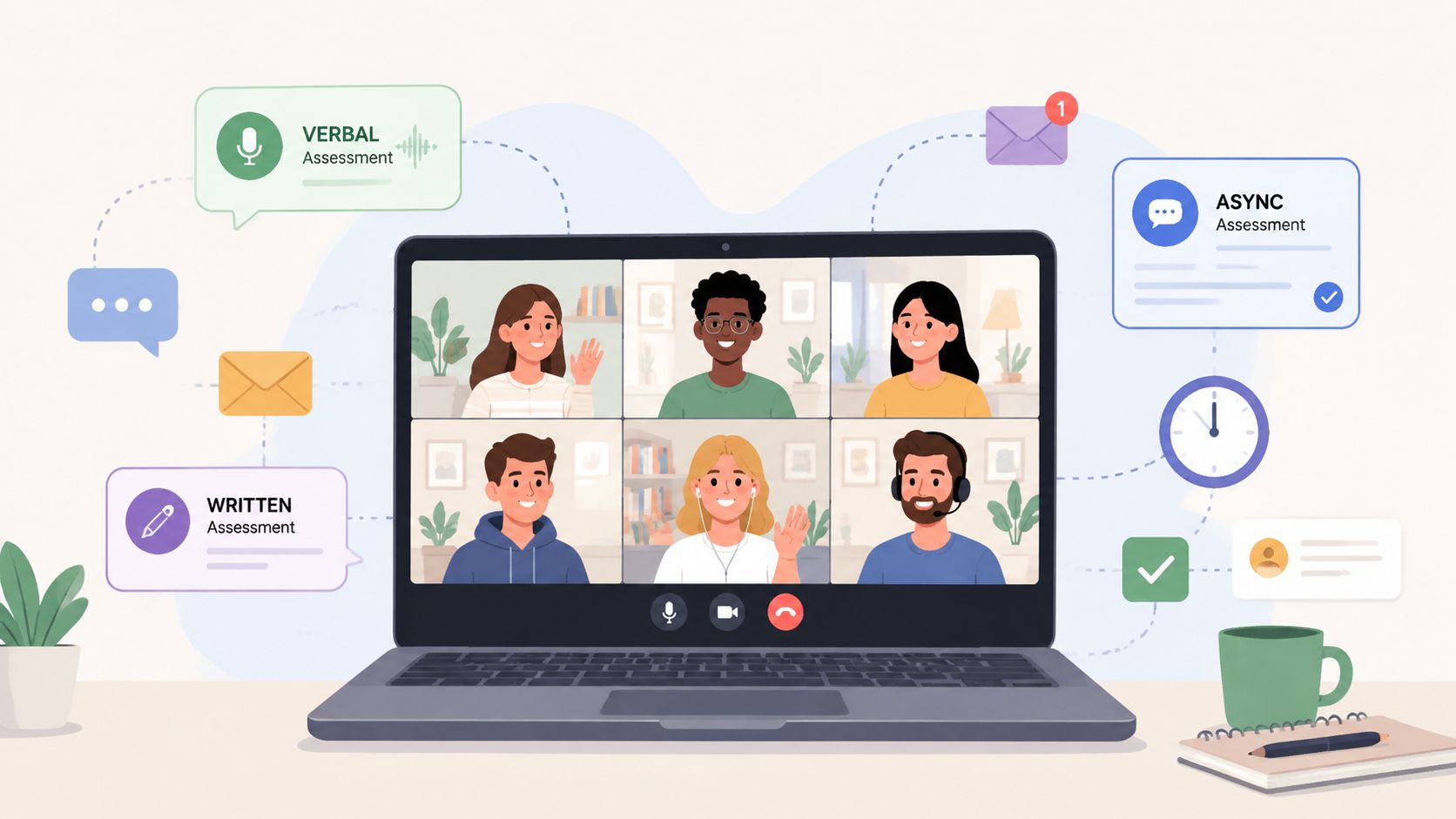
You've probably seen this movie. The candidate aces the Zoom interview, makes everyone feel smart, speaks in polished paragraphs, then vanishes into Slack like a magician with no return date. Two weeks later, your team is decoding one-line replies, missed handoffs, and email drafts that read like they were written during a power outage.
That's why communication skills assessment goes sideways so often. Most hiring loops treat communication like a vibe check in a nice shirt. Remote work punishes that approach fast, because the job isn't “sound good in a room,” it's “move work cleanly across channels, time zones, and people who weren't in the meeting.”
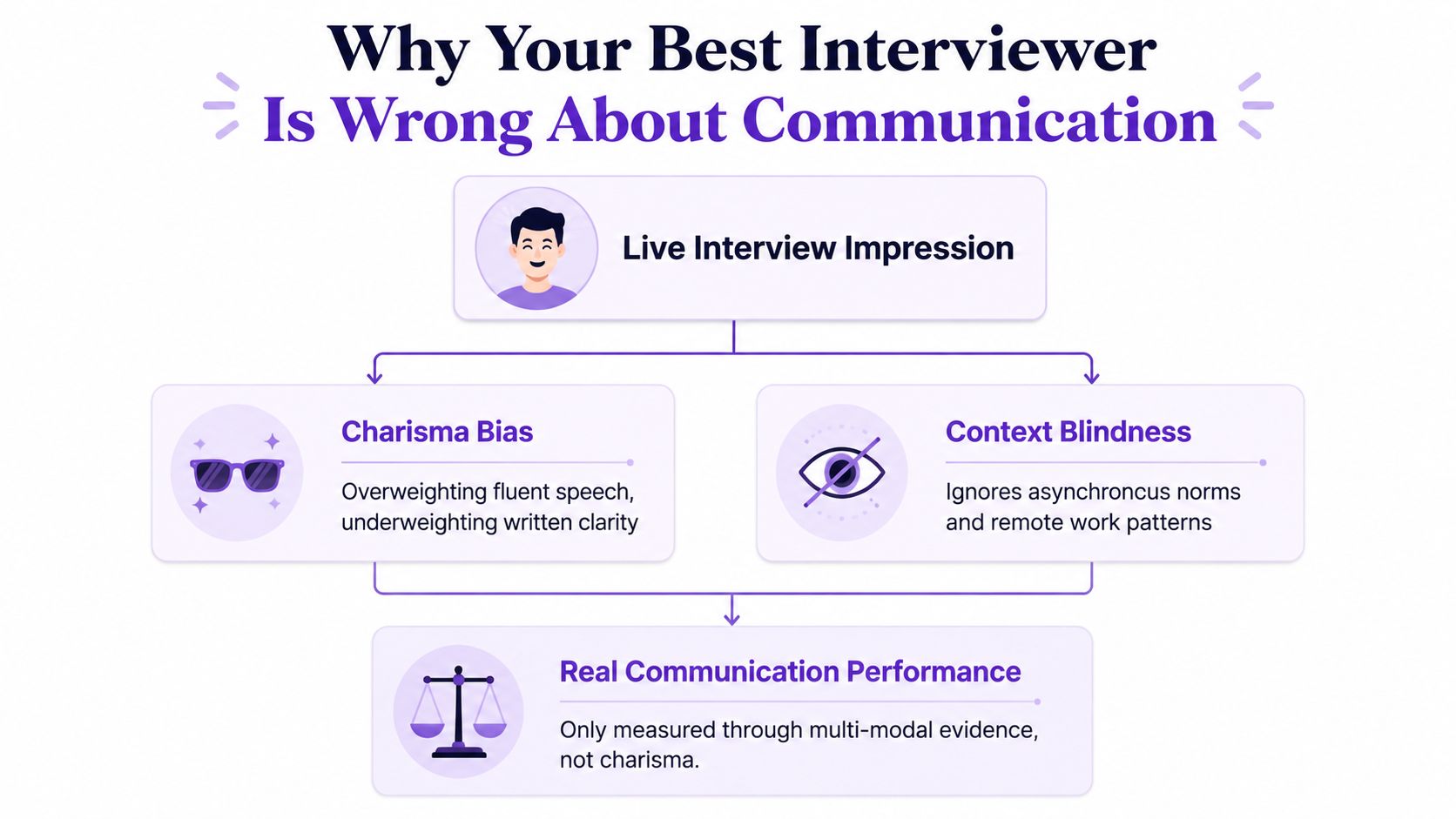
The person who charms your panel is often the person who looks best in a panel. That sounds obvious until you are three weeks into onboarding and realize that “great communicator” really meant “good at talking while being watched.” In remote hiring, that mistake gets expensive fast, because the work lives in written handoffs, async updates, and messages that either reduce friction or create it.
Communication is not one skill. A classic review identified listening, empathy, non-verbal communication, and expressive abilities as core skill areas that keep appearing in communication research (Wiley review). If your rubric only scores “speaks confidently,” you are grading the icing and pretending the cake does not matter.
Listening is the silent killer on async teams. You see it when someone replies before reading the whole thread, misses the actual ask, or rewrites a decision everyone already made. In remote work, listening shows up as synthesis.
Empathy in a distributed team is not a warm smile. It is summarizing the other person's point accurately, acknowledging constraints, and writing in a way that helps the next person move. A candidate who cannot do that will create tiny paper cuts all day long.
Non-verbal communication still matters, but not in the old-school “eye contact” sense people love to overrate. In remote settings, it shows up in pace, formatting, turn-taking, and whether a Loom or call feels organized instead of chaotic.
Expressive ability is the flashy one, and yes, it is useful. But expressive ability without structure is just polished fog. You have met the person who can explain a plan for ten minutes and still leave everyone unsure who owns what.
Practical rule: if your gut says “great communicator,” force yourself to ask, “Great at what channel, and under what conditions?”
The history of communication assessment is basically a story of moving from tiny samples to real-world use. By June 2011, the Communication Matrix had already completed more than 41,000 profiles on over 23,000 individuals, with assessments entering at about 300 per week, users in 124 countries, and 65% of users from the U.S. The same source shows that 44% of users were speech-language pathologists and 43% were teachers, other educators, or therapists, which is a nice reminder that assessment became a working tool, not an ivory-tower exercise (Communication Matrix data).
That shift matters for hiring. Employers in the University of Illinois-cited 2020 Job Outlook report said they were looking for strong written skills, verbal skills, interpersonal skills, and computer skills, with written skills at 77.5%, verbal skills at 69.6%, interpersonal skills at 62.7%, and computer skills at 54.9% (Illinois report). The same report's workplace English research found oral comprehension mattered for more than 70% of jobs across job zones, while writing mattered for more than 70% of jobs only in Job Zone 5, the roles needing more than a bachelor's degree. Translation, communication is not one skill, and it is not equally important in every role.
For remote hiring, that means you need separate scores for live speaking, written clarity, and async follow-through. If a candidate shines in conversation but sends muddled handoffs, they are not a strong communicator for the job you need filled. Tools like pre-employment skills testing help you test that difference before you make a hire you will regret.
Try this on your last three hires. Score them separately on listening, empathy, non-verbal communication, and expressive ability. If your “overall communicator” score hides wildly different sub-scores, that is not a scoring problem. That is your rubric telling on your bias.
A manager can also fool themselves by mistaking confidence for competence. The fix is boring and effective. Use structured prompts, ask for written responses, and compare the candidate's live answers against their async work. If you want a gut check before you put someone in front of a real team, use interview practice for professionals to see whether the polish holds up under pressure.
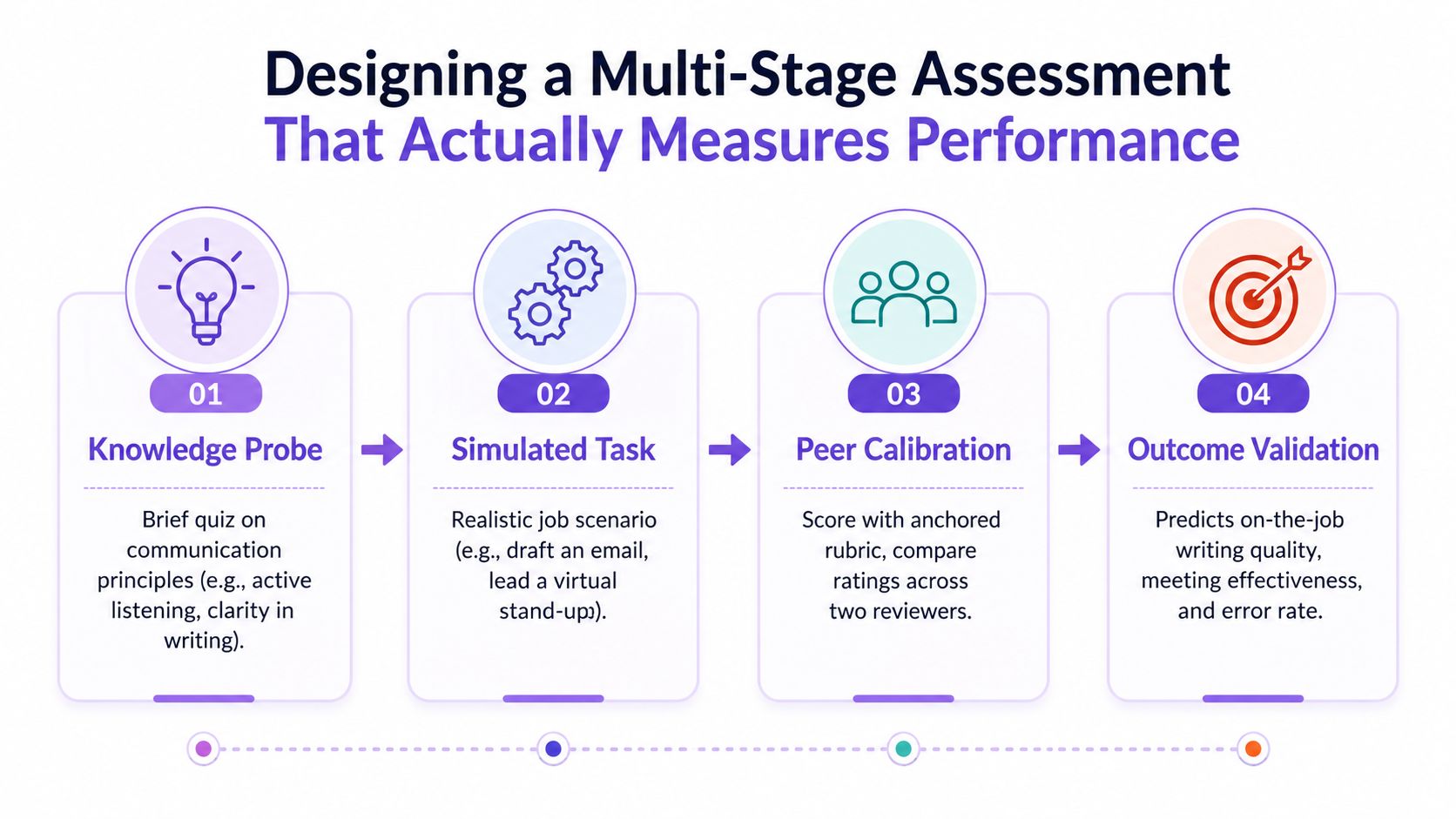
A serious communication skills assessment should feel like a job simulation with receipts, because that is what remote hiring needs. The literature points to a simple sequence, start with a knowledge check, move into a role-play, then review real work artifacts. That order separates what someone knows from what they can do when the clock is running and the stakes are real (PubMed review).
Define the target competencies first. If you are hiring support, you need clarity, tone, responsiveness, and task accuracy. If you are hiring sales, you need live discovery, objection handling, and crisp follow-through. Write prompts before you define the job, and you end up measuring whichever skill the interviewer likes most, which is how weird hires happen.
A good first stage is a knowledge probe. Keep it short and concrete. Ask the candidate to identify what makes a message clear, what makes a handoff risky, or what a weak reply looks like. That shows whether they understand communication principles before you ask them to perform under pressure.
Then move to a role-play. Use realistic prompts tied to the actual role. The goal is to see whether the candidate can apply the principle in a live exchange without freezing, rambling, or turning every answer into a podcast monologue.
Practical rule: if the prompt could fit any job at any company, it is too generic to be useful.
If you want a lightweight practice ground before you build the formal loop, interview practice for professionals can be useful as a prep resource, especially when you want candidates to rehearse structured answers without turning the actual hiring process into improv night.
Finish with an async work artifact. That is the part most hiring teams skip, which is exactly why polished talkers keep slipping through. A written handoff, a customer reply draft, a bug summary, or a meeting recap usually tells you more about actual remote performance than a forty-minute call ever will.
The strongest assessment setups also leave room for feedback, since one-and-done verdicts miss how people improve once they get input. If you want to plug this into a broader screening workflow, LatHire's guide on pre-employment skills testing fits naturally alongside a staged communication review.
A knowledge probe tests whether the candidate knows good communication principles. The role-play tests whether they can use them in real time. The async artifact tests whether they can keep the thread moving when nobody is watching them live.
That is the whole game. Each stage should surface a different failure mode. If all you do is interview, you are paying for confidence and hoping it converts into performance. That is not a system, that is a gamble with a calendar invite.
Different jobs need different proof. A sales rep still needs a live discovery call simulation. An engineer needs a written bug report and a clean handoff doc. A senior support hire lives or dies on written empathy and response quality in async channels. One-size-fits-all is how you end up hiring a person who's brilliant in meetings and unusable everywhere else.
For engineers, written exercises beat polished live answers. Give them a bug report, a design critique, or a structured handoff scenario. You're looking for whether they can explain tradeoffs, name assumptions, and write so another person can continue the work without decoding a riddle.
For marketers, a live exercise and a written artifact both matter. They often need to pitch ideas out loud, then follow up with clear written context for stakeholders. If the live answer is brilliant but the written recap is mushy, the campaign meeting is going to become a recurring support ticket.
For sales reps, keep the live verbal exercise. You want to hear how they ask questions, adapt in the moment, and keep a conversation moving without bulldozing the buyer. But don't stop there. Add a short follow-up email or recap. Sales doesn't end when the call does, despite what some overcaffeinated reps seem to believe.
For operations hires, async is usually king. Written handoffs, status updates, and coordination notes are the job. If someone can't produce a clean thread or summary, the team will end up doing archaeological work just to understand what happened.
A live exercise shows presence under pressure. A written exercise shows structure and precision. An async exercise shows whether the candidate can work without immediate feedback. You don't need every format for every role, but you do need at least the format that mirrors the job.
The British Council's guidance on assessing communication skills makes the same general point, use triangulated evidence because no single method captures the full picture (British Council). That's especially true for remote and cross-border work, where clarity often matters more than charisma and responsiveness is measured in threads, not handshakes.
For teams using the LatHire platform, one practical option is to pair a role-specific writing sample with a short live scenario, then evaluate both against the same rubric. That keeps the process grounded in what the person will do on day thirty, not what they can improvise on a Tuesday afternoon.
If you want defensible communication skills assessment, stop scoring “good communicator” as if it means anything useful. That phrase is a junk drawer. Build a rubric with separate dimensions, anchored examples, and trained raters who know what each score means. Anything else invites halo effect, style bias, and the usual “I just had a good feeling” nonsense.
The literature points to exactly this kind of structure. One practical guide recommends 1-4 or 1-5 behavior-based scales, separate dimensions, and comparison against known performance indicators like manager feedback, QA notes, or stakeholder records (Indeed guide). That is the right instinct. Score behavior, not charisma.
| Dimension | Score 1, Below bar | Score 3, Solid | Score 5, Excellent |
|---|---|---|---|
| Clarity | Hard to follow, missing key facts, buried ask | Mostly clear, minor gaps, the main point lands | Crisp, structured, easy to act on |
| Listening | Misses the ask, repeats what was already said | Catches most points, occasional omission | Summarizes accurately, responds to the core issue |
| Responsiveness | Slow, vague, or incomplete replies | Replies in a usable way, needs some follow-up | Fast, complete, and anticipates the next question |
| Tone | Abrupt, inconsistent, or inappropriate for context | Professional, generally appropriate | Calm, empathetic, and well-matched to audience |
| Task accuracy | Wrong details or missed steps | Mostly correct with small fixes needed | Precise, complete, and dependable |
Do not collapse all of that into one glorious mushy number. A candidate can be excellent at tone and still fail on task accuracy. Another can be sharp and accurate but deliver replies like a parking ticket. Those are different problems, and they need different hiring decisions.
Here's the cleanest way to run it. Give the candidate a written sample, then score each dimension independently. If one reviewer rates clarity a 5 and another rates it a 2, do not average your way into false peace. Ask what evidence each person saw, then calibrate against the rubric.
Practical rule: if two reviewers cannot explain why a score changed, the rubric is not anchored enough.
Use actual work indicators, too. Compare the assessment with manager feedback, QA notes, or stakeholder communication records once the person is in seat. The goal is not perfection. The goal is fewer hires who are smooth in interviews and sloppy in the work.
For teams that want a cleaner benchmark for structured scoring, Reach120's official scoring guide shows how behavior can be translated into a repeatable scale without turning judgment into guesswork. If you also want a live format in the mix, a one-way video interview setup can help capture a short response under time pressure, but it should still be scored against the same anchored rubric, not vibe and camera confidence.
A candidate can sound polished on Zoom and still ship vague handoffs, muddled updates, and half-finished docs. That happens all the time. Remote hiring punishes style-first judgment fast, because the work lives in messages, notes, summaries, and follow-through, not in a clean-looking interview.
For cross-border and hybrid teams, async artifacts are often the most defensible proof of communication ability. Email threads, written handoffs, meeting summaries, Slack simulations, and doc comments show how a person thinks when the conversation is not happening live. That is the point. Remote work rewards people who can make meaning clear without leaning on presence or instant charm.
Score the artifact on clarity, structure, responsiveness, and completeness. A strong sample answers the ask directly, groups information logically, covers edge cases, and leaves the next person with something usable. If you need to squint, reread, or infer the missing piece, the score should drop.
Standard interviews can underrate capable candidates. That happens when the format rewards accent, speed, or live fluency more than actual workplace communication. The Northeastern paper on traditionally underserved candidates makes the warning plain, conventional assessments can blur language access, sensory access, and communication skill, which means someone can look weak in an interview and still perform well on the job (Northeastern paper).
Use the mode that matches the work. If the role is mostly written, prioritize written evidence. If the role depends on live coordination, include live evidence too. One modality alone is lazy, and lazy hiring creates expensive cleanup.
A candidate who struggles in a standard interview is not automatically weak. Sometimes the assessment is measuring the wrong thing.
A lot of teams want one simple communication score. That is convenient, and it is also wrong. Score the channel the job uses, then compare the result with other evidence, not with your memory of how likable the person felt in a short conversation.
For teams that want a cleaner async benchmark, a one-way video interviewing setup can sit beside written samples and async response tasks, especially when consistency across applicants matters. If you also want candidates to rehearse before the final screen, the practice mock interview AI link belongs in the prep bucket, not in the final judgment bucket.
AI can help with communication skills assessment, but only if you don't let it cosplay as judgment. Used well, it speeds up first-pass screening and keeps scoring more consistent across large candidate pools. Used badly, it rewards style over substance and bakes in bias against non-native English speakers and neurodivergent candidates.

Writing analysis tools can be helpful when they flag structure, clarity, and missing pieces in a draft. Async simulation platforms can also add value when they score responses across multiple channels. That's the good part. The bad part starts when teams use AI to overread tone, eye contact, or “confidence” as if those were the same thing as work quality.
The British Council points to triangulating self, trainer, 360-degree, and digital signals because no single method captures the full spectrum of communication skill (British Council). That's exactly how AI should fit in, as one input, not the referee.
Avoid tools that treat eye contact and tone as sacred data. Those systems tend to overweight style, and style is where bias loves to hide. If the person writes excellent handoffs but doesn't present like a broadcast host, that's not a communication failure. That's a hiring team confusing theater with output.
For teams using practice mock interview AI, the useful version is practice, not verdict. Let candidates rehearse. Let AI help standardize the first look. Then put human reviewers back in charge of the decision, because the company has to defend that call later, not the model.
A reasonable workflow is simple, use AI to sort and summarize, then have humans score the actual artifact against a rubric, then sanity-check with background evidence and performance data once available. If the AI and the human reviewer disagree, trust the rubric and the evidence, not the vibes machine.
The LatHire AI in hiring process guide fits well here if you want the broader logic of where automation helps and where it absolutely should stay in the background.
Use this before you ship any loop. If even one item is missing, your “communication” screen is probably doing decorative work.
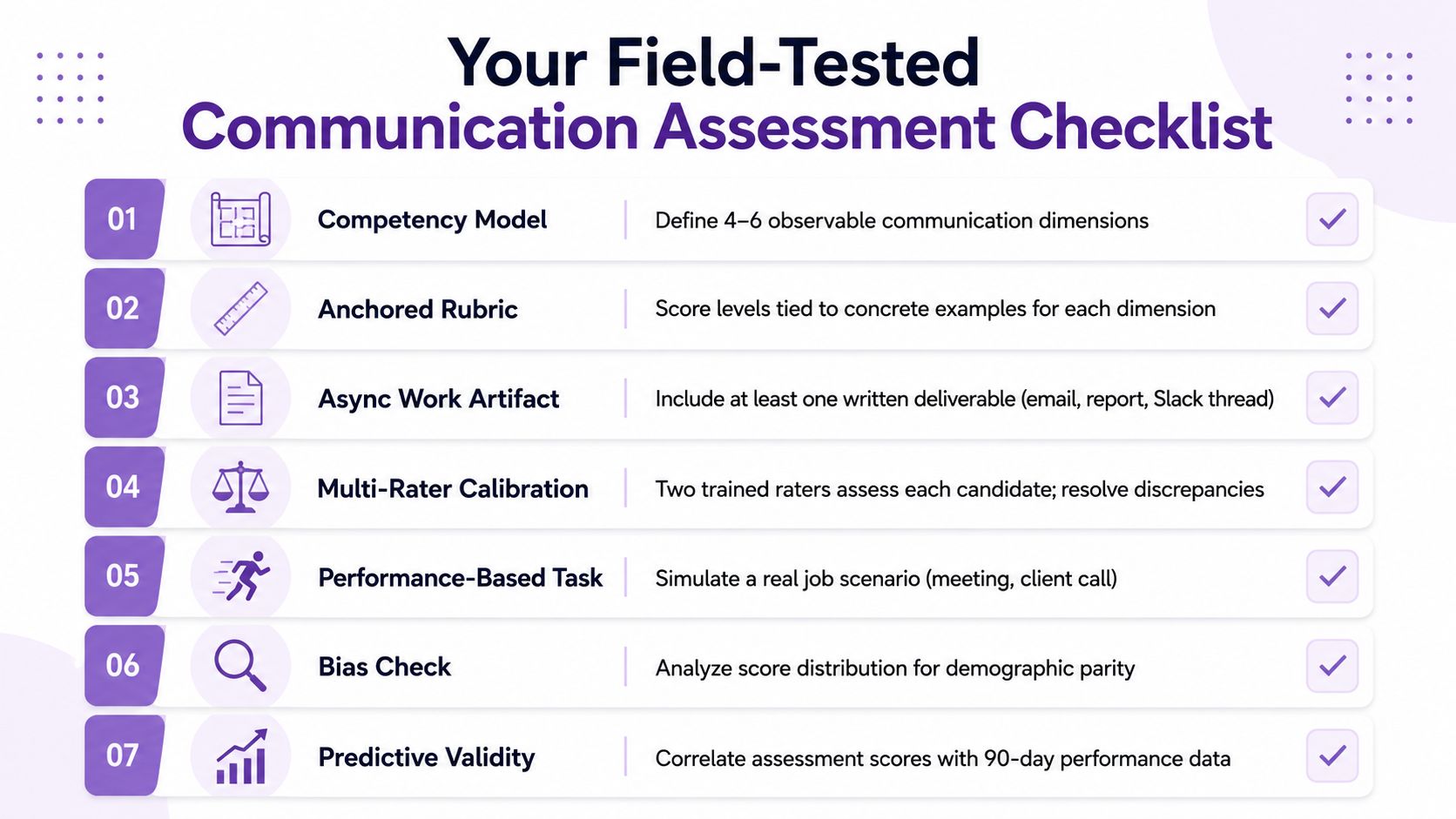
The biggest mistake founders make is scoring one global impression and calling it rigor. The second biggest is skipping async samples because the interview "felt strong." The third is trusting an AI score without checking whether the artifact solves the problem.
That's how polished talkers keep getting through. Not because the team is stupid. Because the process is lazy. A solid communication assessment is boring in the best way. It's repeatable, grounded, and annoying to fake.
If you're refining your hiring loop this week, start with one role and rebuild the communication screen around the work that role does. Then test it on your shortlist, compare the scores, and kill any step that only measures charisma.